Playbook
Insurance Agency SEO in 2026: What Actually Moves You Up
Most of what gets called SEO for an agency site is one layer out of three. Here is all three, and the order to fix them in.


21 min read
Insurance agency SEO is not one thing, it is three. Google's own documentation names a fast, mobile-usable site as something its ranking systems are built to reward.1 A separate system, the local algorithm behind the map pack, ranks you on relevance, distance, and prominence, and says plainly that none of that can be bought.3 A third layer, your content, now has to satisfy both classic search and the AI answer engines reading the same pages. Most agencies work on whichever one layer they heard about last. The ones that move up work on all three, in the right order.
What insurance agency SEO actually means
Insurance agency SEO is the work of getting your site found in Google, in the map pack, and increasingly in the AI answers your prospects ask instead. It is not a single checklist. It is three separate systems, each with its own rules, each capable of holding the other two back if you leave it broken.
The first is technical: can Google crawl your site, and does it load fast enough on a phone to pass the thresholds Google's own ranking systems are built around. The second is local: does your Business Profile and the content around it satisfy the three factors Google states it uses to rank the map pack. The third is content: once a page is fast and found, does it actually answer the question a prospect typed, with enough named, sourced substance that both a search algorithm and an AI model reading it can trust it enough to show it. An agency can be excellent at one of these and invisible anyway, because Google and the AI engines reading your site treat all three as separate gates, not interchangeable ones.
That is the part most guides on this topic skip. A vendor blog post about insurance SEO will tell you to write more content, or to optimize your Google Business Profile, or to fix your site speed, usually whichever one their product happens to sell. Few of them explain that these are three independent systems a real agency site has to pass at the same time, which is the actual reason an agency can follow good advice and still not move.
The scale question matters here too. A single-location agent checking these three layers is a two-hour afternoon. An FMO or IMO running a downline of dozens of producer sites, each on its own domain, each set up by whoever onboarded that agent years ago, is really running dozens of independent instances of this same three-layer problem at once. One producer's site might pass the technical layer and fail local. Another might have a strong Business Profile sitting on top of a site that takes nine seconds to load on a phone. Multiply the audit above across a network and the work stops being a weekend project and starts being something that needs a system behind it, which is a different conversation than fixing one site.
Where AEO fits into this
AEO, answer engine optimization, is the newer layer on top of all three: making your pages the passage an AI assistant lifts and names when a prospect asks it a question instead of typing one into Google. It leans on the same technical and content foundation covered here, with its own extra requirements. We cover that side in full in what changed in AEO for agencies this year.
Why fixing one thing doesn't work
Picture three agencies, each doing real work, each stuck.
The first spent four months publishing two blog posts a week, has forty new pages live, and ranks exactly where it did in June. Its site takes seven seconds to load on a phone, a page builder theme nobody has touched since it was installed. The content was never the problem. Google's crawler is hitting a wall before it gets far enough into the site to care how good the writing is, and the handful of visitors who do click through are leaving before the page finishes painting.
The second agency has a fast, clean site, one of the better-built sites in its county, and still does not show up in the map pack for "medicare agent near me." Its Business Profile description was written once, five years ago, by whoever set it up, and has never been touched since. The category is wrong, the service area is unset, and the agency has nine reviews to a competitor's hundred and forty. Speed was never the problem here either. The local algorithm is working exactly as designed, rewarding the agency that looks more established, because it is more established, at least on paper.
The third agency has a fast site and an actively managed Business Profile, and still never gets named when a prospect asks ChatGPT or Google's AI Overview who to call. Its blog reads like it was written to satisfy a word count: no named source for a single figure, no dated facts, a generic byline instead of a real author. A fast, well-ranked, well-reviewed site with nothing citable on it is still invisible to the growing share of searches that end in an AI-written answer instead of a list of links.
None of these three agencies is doing bad work. Each one fixed a real layer and assumed the other two would follow. They do not follow each other. They are graded separately, by separate systems, and a site has to clear all three gates before any of the effort on any one of them pays off.
Layer one: the technical foundation
Start here, because nothing downstream works if this layer is broken. Google's Search Central documentation states plainly that Core Web Vitals, the three metrics measuring load speed, interactivity, and visual stability, align with what its core ranking systems seek to reward, and that it highly recommends site owners achieve good Core Web Vitals scores for success with Search.1 That is about as direct as Google gets about a ranking-adjacent signal.
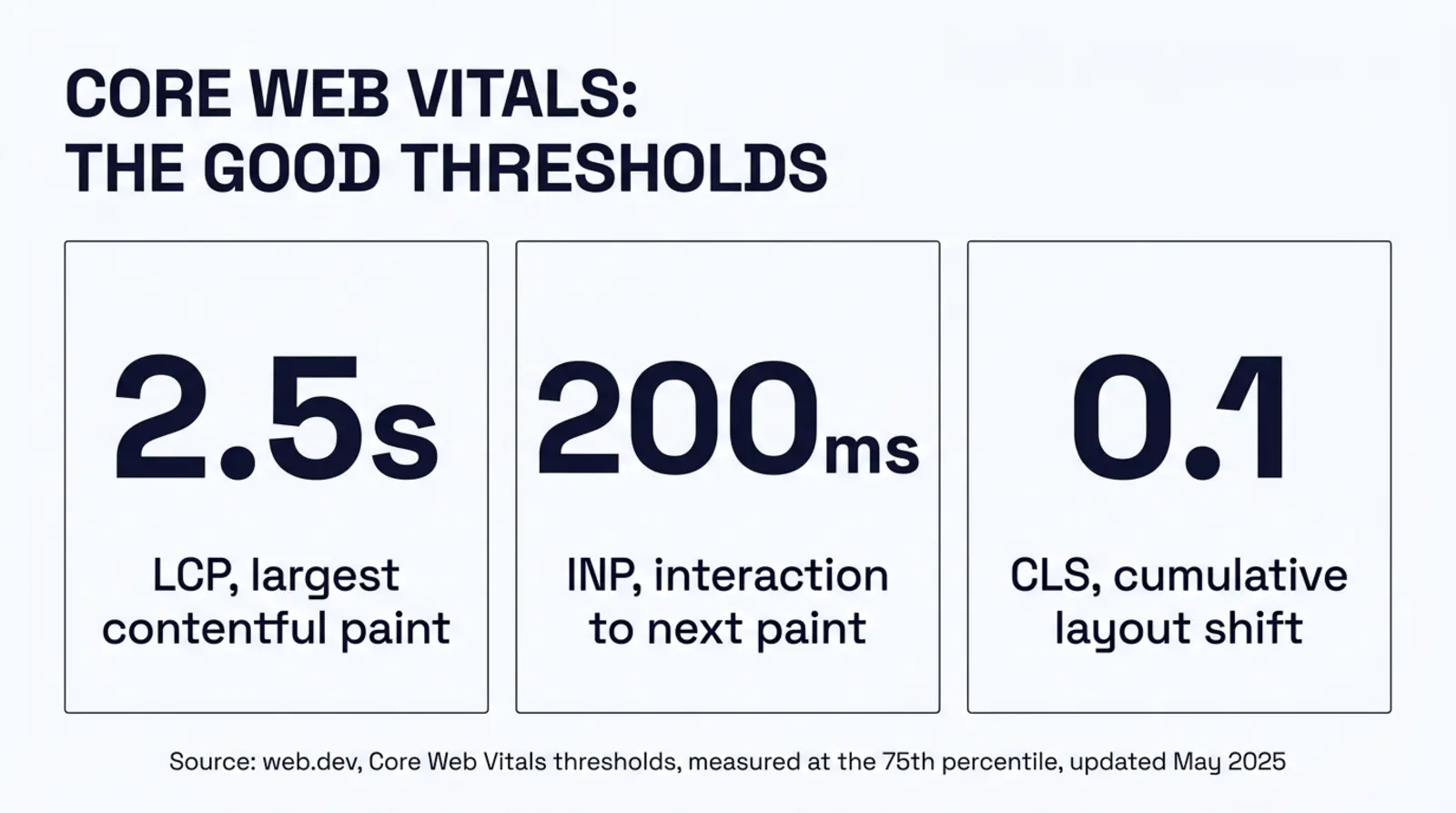
The three metrics, and the thresholds that count as good, come from web.dev, Google's own developer documentation, last updated May 7, 2025.2 Each is measured at the 75th percentile of real visits to a page, meaning three out of every four visits need to clear the bar, not just your best test run.
| Metric | Good | Needs improvement | Poor |
|---|---|---|---|
| LCP, Largest Contentful Paint | 2.5 seconds or less | 2.5 to 4 seconds | Over 4 seconds |
| INP, Interaction to Next Paint | 200 milliseconds or less | 200 to 500 milliseconds | Over 500 milliseconds |
| CLS, Cumulative Layout Shift | 0.1 or less | 0.1 to 0.25 | Over 0.25 |
The part agencies miss is that this is a mobile problem first, not a general one. Google indexes and ranks using the mobile version of your content, crawled with its smartphone agent, for virtually every site on the web, a policy it calls mobile-first indexing.4 Your site is being judged on how it performs on a phone, whether or not you personally ever look at it on one. Google's own PageSpeed Insights tool reports on the user experience of a page on both mobile and desktop devices separately, using different simulated conditions for each, which is why the same page routinely scores worse on mobile than desktop.5 If you've only ever checked your site speed on a laptop, you have not actually seen the score Google is using to evaluate you.
Here is the mechanism behind why so many agency sites fail this layer before anyone writes a word of content. A page-builder platform, a GoHighLevel funnel page, a WordPress theme with a visual builder, a Wix or Squarespace site, loads a runtime, a theme engine, and a stack of plugins before a visitor sees anything. That JavaScript has to download, parse, and execute on a mid-range phone over a real mobile connection before the page becomes usable, and every one of those steps eats into the Core Web Vitals budget above. A site built on Astro, by contrast, ships zero JavaScript to the browser by default and renders pages to static HTML at build time, so the browser downloads a finished page instead of downloading a framework and booting it first. That architectural difference, not a clever trick or a paid plugin, is the entire reason one kind of site tends to clear these thresholds and the other tends not to. We go deeper on exactly what that looks like, measured across real agency sites, in our audit of 1,080 insurance agency websites and in WordPress versus a static site for an agency.
None of this requires guessing at your own numbers. Google's PageSpeed Insights tool is free, and running your homepage and your highest-traffic landing page through it takes about two minutes. Read the mobile score first. If it is comfortably in the 90s, this layer is in good shape and you can move to the next one. If it is sitting in the 40s or 50s, which is common for a page-builder site that has not been touched since launch, nothing you do on the local or content layers will move the needle as much as fixing this one will.
There is a second, quieter cost to a slow, JavaScript-heavy site that has nothing to do with the visitor at all: crawl efficiency. Googlebot has to spend real compute executing a page's JavaScript before it can see the finished content, which is slower and more expensive than reading finished HTML directly. A small agency site with a few dozen pages will usually still get crawled in full eventually, so this rarely explains a totally missing page. What it does explain is a site where new pages take noticeably longer to get indexed after you publish them, and where a large content program, the kind an FMO running location pages across a whole state needs, starts to see some pages crawled promptly and others sitting unindexed for weeks. A static HTML build removes that rendering step entirely, so there's nothing for Googlebot to execute before it can read the page.
Layer two: local signals
Once your site is fast and crawlable, the next system that decides whether a nearby prospect finds you is entirely separate from classic organic ranking. It is the algorithm behind Google's local results and the map pack, and Google names exactly three factors it runs on: relevance, distance, and prominence.3
Google's own support documentation defines relevance as how well a Business Profile matches what someone is searching for, and recommends complete, detailed business information to help it match your listing to the right searches.3 Distance is measured from the location in the search, or Google's best estimate of the searcher's location if none is given.3 Prominence is how well known a business is, drawn from information across the web, including links, articles, and directories, and Google states directly that review count and review score factor into local ranking.3 The same page is explicit about one more thing: "There's no way to request or pay for a better local ranking on Google."3 No ad spend moves this. Only the underlying signals do.
Of the three, distance is the one factor you cannot influence at all, short of opening a second office. Relevance and prominence are both things an agency controls directly, and both are commonly left half-finished. A Business Profile with an unset service area, a generic category instead of a specific one, and a description nobody has touched since it was created is actively hurting your relevance score, not just failing to help it. A profile with nine reviews sitting next to three competitors with over a hundred each is losing on prominence before a search is even run.
A mistake we see constantly
An agency owner assumes map pack ranking works like organic ranking, meaning content and backlinks move it. It doesn't. It is a separate algorithm with its own inputs, and an agency can have the fastest, best-written site in the county and still lose the map pack to a competitor with a more complete profile and twelve times the reviews. We walk through exactly what that looks like, with real before-and-after listings, in why your agency doesn't show up in the map pack.
There is a content side to local too, and it is the one most agencies never build at all. A single homepage cannot realistically rank for "medicare agent in Minnehaha County" and "aca agent in Lincoln County" at the same time, because a generic page has no reason to be considered more relevant to either specific search than a competitor's page that names the county by name. A dedicated page per service area, built around the actual county or city you serve rather than one page trying to cover a whole region, is what gives the relevance factor something concrete to match against. We cover why this matters, and the mechanics of building it without creating duplicate thin pages, in why your insurance website only ranks in one county.
Layer three: content and AEO
The third layer is the one that used to be the whole game: content. It still matters, but the bar for what counts as content worth ranking, and worth citing, has moved. A page built around a keyword phrase, padded to a word count, with no named author and no sourced data, is thin by today's standard even if it technically answers the question.
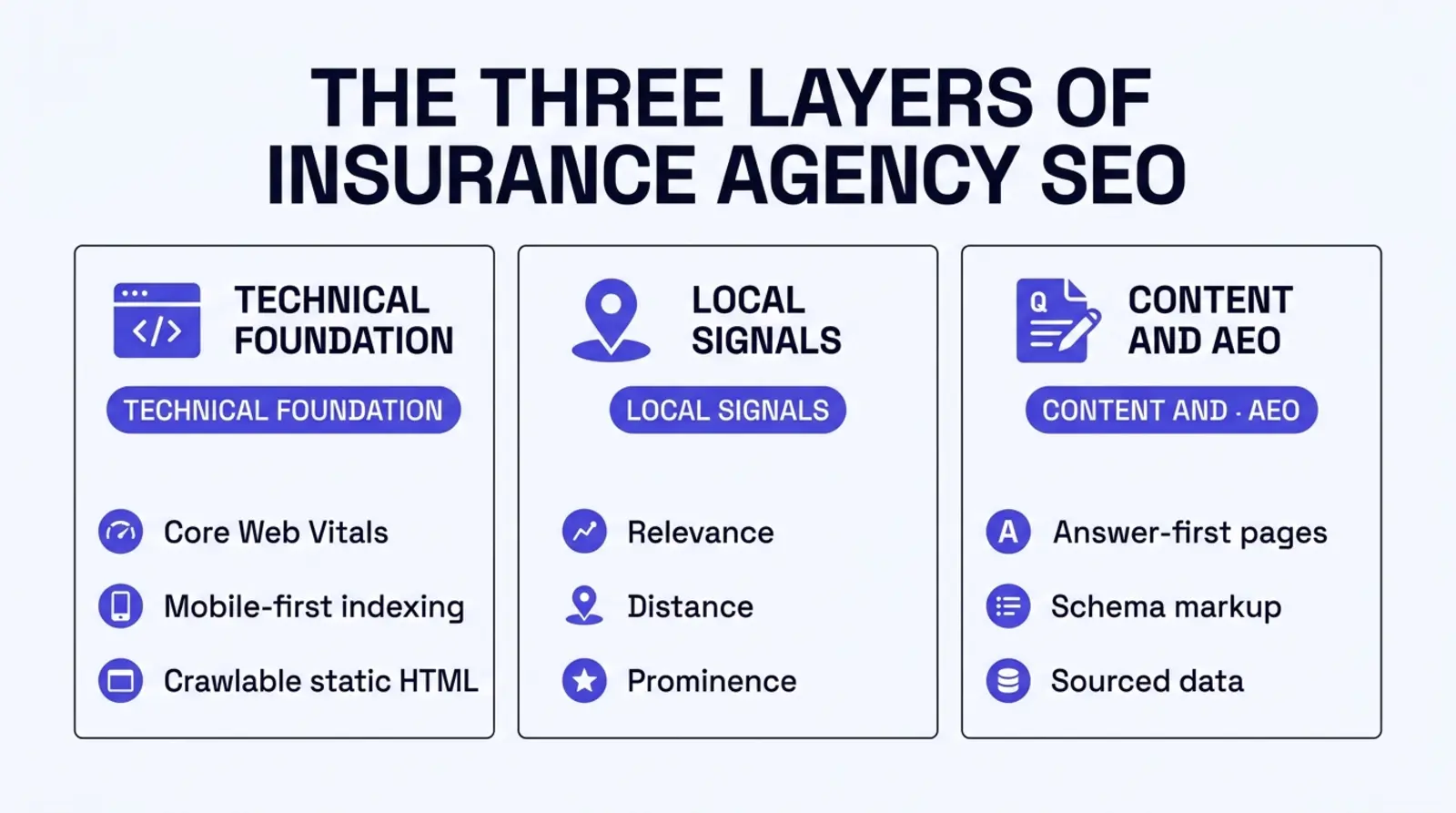
Three things separate a page that ranks and gets cited from one that just technically exists. The first is structure: does the page answer the actual question in its first paragraph, with clean, question-shaped headings underneath rather than a slow build-up to the point. The second is sourcing: does every figure on the page name where it came from and when it was true, rather than a vague "studies show" with nothing behind it. The third is markup: does the page carry schema that actually matches what is on it, so a machine reading the page does not have to guess at what kind of content it found.
Google itself is honest that schema markup is not required to rank in classic search results. That is also not the question that matters most anymore. The newer question is whether an AI assistant reading your page has enough structure to trust it enough to repeat it and name you as the source. Schema is one of the clearest signals a machine can parse without guessing, which is why it is worth building even in a market segment where Google's own guidance downplays its ranking value. We go through the full argument for that, with a specific market example, in why Texas insurance agents still need schema markup.
The other half of this layer is cadence, and it is where a lot of agencies that start strong lose the thread. A burst of ten pages published in one busy month, followed by silence for a year, reads to both Google and an AI model as a site that stopped being maintained. A slower but genuine weekly or daily rhythm, where every new page carries a real date and real sourced content, is what keeps a site looking current enough to keep citing. We cover the mechanics of what breaks that rhythm, and how to get it back, in why your agency's blog stopped getting cited by AI.
What getting this wrong costs you
The clearest way to see what this is worth is to look at what the same traffic costs if you pay for it instead of earning it. We pulled live Google Ads keyword data for the US market the same day we wrote this guide. "Insurance agency seo" gets roughly 590 searches a month nationally and costs an estimated $43 per click if you ran ads against it. "Hipaa compliant website" runs about 260 searches a month at roughly $48 a click. "Insurance broker website" runs about 50 searches a month at roughly $51 a click.6 These are not high-volume phrases. They are expensive ones, which is itself a signal: a $40 to $50 cost per click means the people typing these specific phrases are not browsing, they are agency owners and decision makers actively evaluating a purchase.
Run the math on one agency. Say a Starter-level SEO effort earns an agency ten extra organic visits a month for a phrase in that price range, visits that would have cost roughly $45 each on paid search. That is a little over $450 a month in avoided ad spend for ten visits, before any of them convert to a call. Scale that across the dozens of phrases a real content program targets, not just the one or two everyone fights over, and the organic traffic a properly built site earns is not a vague SEO benefit. It is a specific, calculable offset against what the same attention costs on paid search, which we also cover in more depth in why your cost per lead keeps climbing.
The other cost is less visible and harder to put a number on: the cost of invisibility during the weeks that matter most. A Medicare or ACA agency that is slow, missing from the map pack, or uncited by AI answers during open enrollment is not failing evenly across the year. It is failing hardest during the exact six to eight week window when the most prospects are actively searching, which is also the window competitors with a working site are capturing disproportionately.
Multiply that by a downline and the same math changes shape rather than scale. A single agent losing visibility during AEP is one book of business growing more slowly than it should. An FMO with fifty producer sites, each quietly failing one of these three layers in its own way, is fifty separate versions of that same loss happening at once, usually invisible from the top until someone pulls the aggregate numbers and asks why total digital-sourced production is flat year over year despite the network growing. The fix at that scale isn't convincing fifty agents to each read a guide like this one. It's building the three layers into the site template every producer starts from, so the floor is already correct before anyone has to think about it.
The order to fix it in
Sequence is not a minor detail here. Fixing these layers out of order is the single most common reason an agency spends real money on SEO and sees nothing move.
| Stage | What you fix | Why it comes here |
|---|---|---|
| 1. Technical | Mobile Core Web Vitals, crawlability, a static or near-static build | Nothing downstream ranks on a site Google can't crawl and load fast enough to fully index |
| 2. Local | Business Profile completeness, category, service area, review habit | The map pack runs on a separate algorithm that content alone never moves |
| 3. Content | Answer-first pages, named sourced data, real author, matching schema | This is the material that actually earns a ranking and a citation once it can be found and trusted |
| 4. Cadence | A consistent publishing rhythm instead of one burst | A site that stops publishing reads as a site that stopped being maintained |
A checklist you can run this week
None of the following requires hiring anyone. It requires about two hours spread across a week, and it will tell you exactly which of the three layers is actually holding your agency back.
First, run your homepage and your best landing page through PageSpeed Insights. Read the mobile score, not the desktop one. Under 50 means the technical layer is the priority, full stop, before anything else on this list.
Second, open your Google Business Profile and read it the way a stranger would. Is the category specific to what you do, is the service area set, is the description current, and does it list a phone number and hours that are actually right. Fix anything that is stale.
Third, count your reviews against your three closest competitors. If you are meaningfully behind, that gap is costing you prominence, the one local factor review activity feeds directly. A simple post-close text asking for a review, sent consistently, closes this gap faster than almost anything else on this list.
Fourth, pick your five most recent blog posts and check each one for a named source on every number. If a post states a statistic with nothing behind it, that page is not helping you get cited, whatever else it might be doing for you.
Fifth, check whether you have a dedicated page for each county or city you actually write business in. One page trying to cover a whole region is competing against zero specific pages, which is a fight you can't win against an agency that built one page per area.
Sixth, check whether your site has a sitemap and an `llms.txt` file at all, and whether either one lists your newest page. Visit yourdomain.com/sitemap.xml and yourdomain.com/llms.txt directly. A missing sitemap means Google is discovering your pages less efficiently than it could. A missing or stale llms.txt means AI crawlers have no structured map of your site's content at all, which matters more every month as more of that traffic starts arriving from assistants instead of search results pages.
Want this scored instead of self-checked
The free Audit runs a live AEO and speed check against your actual site, plus a HIPAA tracking scan, in about a minute. It is the fastest way to see which of these three layers needs attention first without doing the five-point check above by hand.
How we build this into every site
We re-fetched our own Digital Foundation pricing page live while writing this section, the same standard this guide has held every other claim to.7 A standalone website, with no ongoing management, runs $84 a month and ships with 30 pages live on day one, including ten blog posts, ten location pages, and ten answer pages, built to pass a full 60-point SEO and AEO checklist before anything goes live.7 Starter, at $247 a month, adds seven new pages a month and weekly Google Business Profile management.7 Pro, at $497 a month, adds up to 18 new pages a month, review harvesting built into the CRM workflow, and a 24/7 AI voice receptionist.7 Scale, at $997 a month, scales content to up to 71 new pages a month, one blog post, one location page, and one answer page published every business day.7
| Tier | Price | What it covers from this guide |
|---|---|---|
| Website | $84/mo | Technical layer: static build, 60-point SEO/AEO checklist, 30 pages live7 |
| Starter | $247/mo | Technical plus local: weekly Google Business Profile management, 7 new pages/mo7 |
| Pro | $497/mo | All three layers: GBP plus review harvesting, up to 18 new pages/mo, AI voice receptionist7 |
| Scale | $997/mo | All three at full cadence: up to 71 new pages/mo, daily publishing7 |
We build on Astro, which ships zero JavaScript by default, so your pages arrive as finished HTML instead of a runtime a visitor's phone has to download and boot before anything loads. Our builds score 90+ on Lighthouse performance on both mobile and desktop, and some score 100, which is the technical layer handled before anything else gets built on top of it. Every site we ship also includes the identity and structure layer most agencies skip entirely: a full schema stack per page type, and an `llms.txt`, sitemap, and `robots.txt` that regenerate themselves the moment a new page publishes, with the complete absolute URL, so nothing goes stale because someone forgot to update it by hand.
The local layer is handled the same way, not as a one-time setup but as ongoing management: weekly Business Profile posts starting at Starter, and review harvesting built into the CRM workflow from Pro up, so prominence keeps compounding instead of sitting wherever it was the day the listing was first claimed.
Most agency sites fail one of these three layers quietly, for years, without anyone noticing which one. The fix is never a mystery once you know which gate is actually closed.
What changes for your agency
None of this promises a ranking position or a specific lead count, because neither can be honestly promised by anyone. What building all three layers correctly changes is more concrete than that.
A site that clears the technical gate
Fast enough on a phone that nothing downstream is being held back before a visitor even sees the page.
A Business Profile built for the algorithm it's actually graded on
Relevance and prominence worked deliberately, not left at whatever they were the day the listing was created.
Content that can be cited, not just read
Sourced figures, real authorship, and schema that matches the page, built for both search and AI answers.
A cadence that compounds instead of decaying
Regular publishing that keeps every layer current, instead of one busy month followed by silence.
The underlying point is not really about any one tactic in this guide. It is that insurance agency SEO fails for most agencies not because the advice they followed was wrong, but because they followed one piece of correct advice while two other gates stayed shut. Check all three. Fix them in order. The order is what the rest of this industry's content rarely tells you.
Questions agents ask
What is insurance agency SEO, in one sentence?
It is the combined work of making your site fast and crawlable, making your Google Business Profile match what Google's local algorithm rewards, and publishing content sourced and structured well enough that both classic search and AI answer engines can rank and cite it. All three have to work together. Fixing only one is the most common reason agencies spend money on SEO and see nothing change.
Is SEO still worth it now that so many searches end in an AI answer instead of a click?
Yes, and the two are more connected than they look. AI answer engines still draw heavily on the same crawled, indexed web that classic search ranks. A page that is slow, thin, or unsourced is unlikely to rank in classic results and just as unlikely to get cited in an AI answer. Building the technical and content foundation covered in this guide is also what makes a page citable, not just rankable. We cover the citation side in more depth in our guide on what changed in AEO this year.
How long does insurance agency SEO take to show results?
It depends on how far behind the site starts and how competitive the local market is, and nobody can honestly promise you a date. What we can say is that the technical layer, fixing site speed and mobile usability, tends to show up in Search Console data within weeks because it removes a real barrier rather than adding a ranking boost. Local and content signals compound more slowly, typically over months, because they depend partly on factors outside your control, like review velocity and how established competing listings already are.
Does Google really treat mobile page speed as a ranking factor for a small agency site?
Google's own Search Central documentation says Core Web Vitals align with what its core ranking systems seek to reward, and that it highly recommends achieving good Core Web Vitals scores for success in Search. Google also indexes and ranks using the mobile, smartphone-crawled version of your content for virtually every site, a policy it calls mobile-first indexing. Put together, a site that is slow or broken on a phone is being evaluated on that broken mobile experience, not a cleaner desktop version you might be looking at yourself.
What are the three local ranking factors, and which can my agency actually influence?
Google names them directly: relevance, distance, and prominence. Distance is mostly outside your control since it is measured from the searcher's location. Relevance and prominence are not. Relevance comes from how complete and accurate your Business Profile and website content are. Prominence comes from how well known your business is across the web, including your review count and rating. An agency can move both of those with ordinary, unglamorous work: a complete profile, consistent information across the web, and a real review habit.
Do I need schema markup if Google says my page can rank without it?
Google is correct that schema markup is not required to rank in classic search results. It is also not the same question as whether schema helps an AI answer engine understand and trust your page enough to cite it, which is a separate and newer problem schema is well suited to solving. We go through the mechanics of this, including why it matters even in markets where Google's own guidance downplays it, in our guide on schema markup for insurance agents.
How much does insurance agency SEO cost?
It depends heavily on what you are buying: a one-time technical fix, an ongoing content and local management program, or a full website rebuild. We can speak to our own current pricing, since we checked it live while writing this: Digital Foundation starts at $247 a month for a compliant, AEO-optimized site with weekly Google Business Profile management, and runs to $997 a month for a plan that includes daily content publishing and GBP management with review harvesting. A standalone website, with no ongoing SEO management, runs $84 a month. What a different agency, consultant, or freelancer charges is their own pricing to quote, not something we can state on their behalf.
Can I do my own agency SEO, or do I need to hire it out?
A lot of this guide is genuinely doable yourself: checking your Core Web Vitals scores, auditing your Business Profile for completeness, and building a review habit all take time rather than money. Where it gets harder to DIY is the technical rebuild, migrating off a slow page builder, wiring up schema that actually matches your content, and keeping a content cadence going every week without it becoming the thing that slips first when you get busy selling. Reading this guide and deciding you would rather handle the technical and content side yourself, and just want it checked, is a completely reasonable outcome too.
Sources
- Google. "Understand and measure Core Web Vitals," Search Central Documentation. "This, along with other page experience aspects, aligns with what our core ranking systems seek to reward," and "We highly recommend site owners achieve good Core Web Vitals for success with Search." Fetched live October 22, 2026. developers.google.com/search/docs/appearance/core-web-vitals.
- web.dev (Google). "How the Core Web Vitals metrics thresholds were defined," thresholds measured at the 75th percentile of page visits: LCP good is 2500ms or less, poor is over 4000ms; INP good is 200ms or less, poor is over 500ms; CLS good is 0.1 or less, poor is over 0.25. Page last updated 2025-05-07. Fetched live October 22, 2026. web.dev/articles/defining-core-web-vitals-thresholds.
- Google. "How to improve your local ranking on Google," Google Business Profile Help: "Relevance is how well a Business Profile matches what someone is searching for"; "Distance refers to how far each business is from the customer who's searching"; "Prominence means how well-known a business is... More reviews and positive ratings can help your business's local ranking"; "There's no way to request or pay for a better local ranking on Google." Fetched live October 22, 2026. support.google.com/business/answer/7091.
- Google. "Mobile site and mobile-first indexing best practices," Search Central Documentation: "Google uses the mobile version of a site's content, crawled with the smartphone agent, for indexing and ranking." Fetched live October 22, 2026. developers.google.com/search/mobile-sites/faq.
- Google. "About PageSpeed Insights," PageSpeed Insights v5 documentation: PSI "reports on the user experience of a page on both mobile and desktop devices," using distinct simulated lab conditions for each. Fetched live October 22, 2026. developers.google.com/speed/docs/insights/v5/about.
- Strategic AI Architects. Internal keyword research, DataForSEO, Google US monthly search volume and estimated cost per click: "insurance agency seo" 590/mo at $43 CPC; "hipaa compliant website" 260/mo at $48 CPC; "insurance broker website" 50/mo at $51 CPC. Pulled October 22, 2026.
- Strategic AI Architects. Digital Foundation service page: Website $84/mo (30 pages live, 60-point SEO/AEO checklist, no ongoing management); Starter $247/mo (7 new pages/mo, weekly Google Business Profile posts); Pro $497/mo (up to 18 new pages/mo, GBP management plus review harvesting, 24/7 AI voice receptionist); Scale $997/mo (up to 71 new pages/mo, daily publishing). Fetched live October 22, 2026. strategicaiarchitects.com/digital-foundation.
Talk it through
Want a second pair of eyes on it?
Free 30 minutes. Bring what you found, or bring nothing and we will look together at how AI engines read your site and which fixes move first.
See which of the three layers is actually holding your site back
Run a free Audit and see how your site scores on speed, AI citation readiness, and HIPAA safe tracking, in about a minute.
Related reading: We ran PageSpeed on 1,080 insurance agency websites · Why your agency doesn't show up in the map pack · Why schema markup still matters even when Google says you don't need it