Playbook
Why Your Insurance Agency's Blog Stopped Getting Cited by AI
AI answer engines and Google both reward content that gets touched on a schedule. A blog that goes quiet for a year does not get deleted. It just stops getting picked.


20 min read
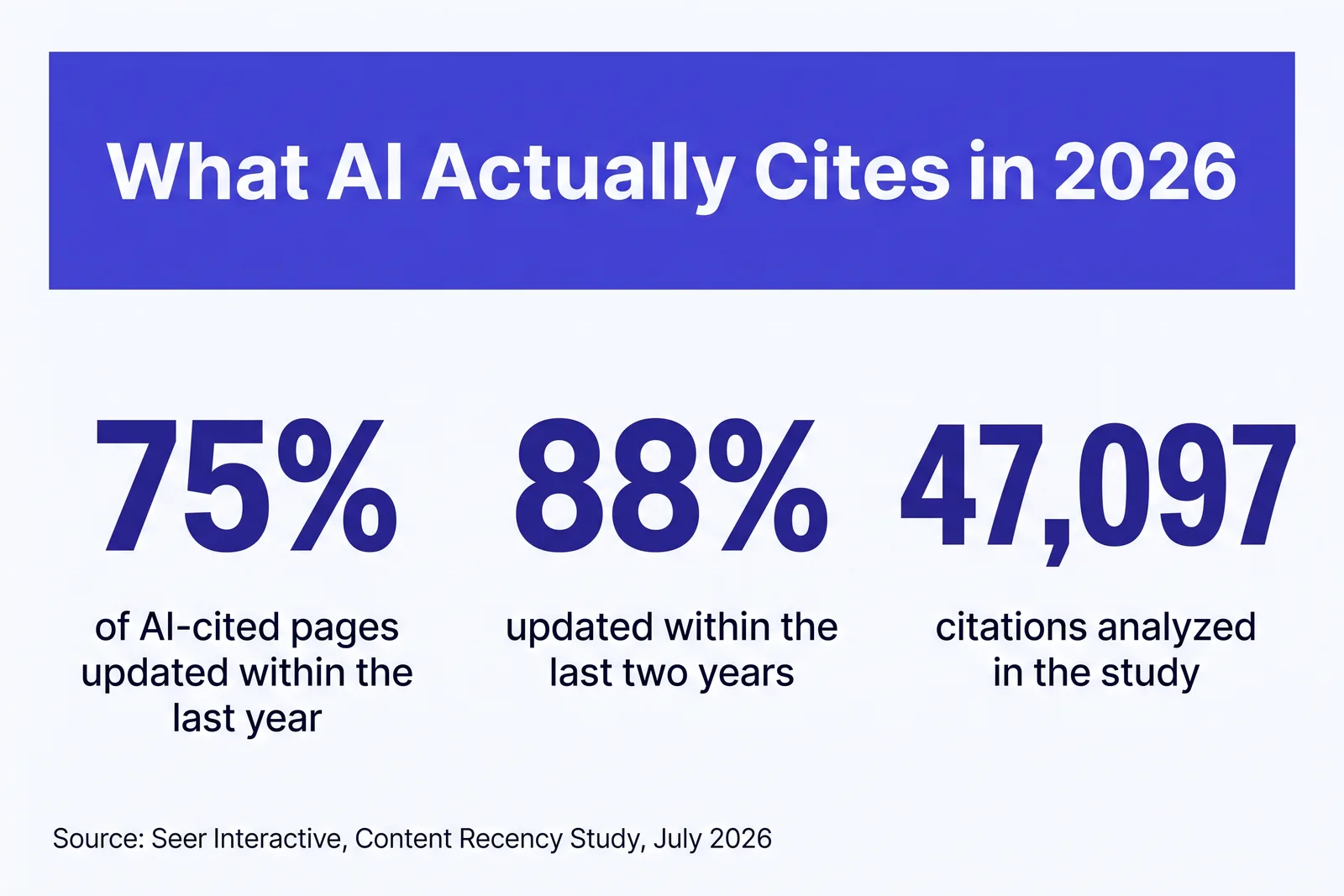
A 2026 study of 47,097 AI citations across ChatGPT, Perplexity, and Gemini found that 75% of the pages those systems cited had been updated within the past year, and 88% within two years1. Most agency blogs are built the opposite way: a burst of posts written in a couple of months, then silence. The posts are still live. They are just no longer the kind of thing an AI system treats as trustworthy enough to quote. Here is what the data actually shows, what a quiet blog costs, and the cadence that keeps an agency in the pool.
The blog that stopped working
Somewhere in your website sits a folder of blog posts. Eight of them, maybe fourteen, written in a two month push back when someone decided the agency finally needed a blog. Titles like "What Is Medicare Advantage" and "ACA Open Enrollment Dates." Then the push ended, the person writing them moved on to other work, and the blog went quiet. The posts are still live. Google still knows they exist. And they are doing almost nothing for you anymore.
That is not a guess about your specific site. It is the default outcome of how most small agencies approach content, because writing in a burst is the natural way anyone tackles a task they have been putting off. You clear a weekend, or you hire someone for a month, and you produce a stack of posts all at once. It feels like progress. It is progress, for exactly as long as the burst lasts.
You might reasonably think none of this matters much, since the posts are still on your site and nothing removed them. But "still online" and "still counted" turned out to be two different states once AI answer engines entered the picture, and the gap between them is wider than it was for traditional search.
Here is the version of this most agencies actually recognize. Someone, an owner, a spouse who handles marketing, a contractor hired for a project, sits down and writes with real energy for a few weeks. The posts are decent. Some of them even rank. Then renewal season hits, or a big group comes on, or the contractor's invoice comes due and does not get renewed, and the blog simply stops. Nobody makes a decision to abandon it. It just falls off the list of things anyone is actively doing, the way most maintenance tasks do once the initial push is over. Eighteen months later, an owner runs a search or asks ChatGPT a question their own blog should answer, and it is not there. The posts exist. They are just not the thing being named anymore.
Curious where your own blog stands
The free Audit checks whether your existing posts are still structured and current enough to be citable, alongside your crawl access and your HIPAA tracking exposure, in about a minute. Run the free Audit.
Why "still online" is not "still counted"
Google has run what it calls "query deserves freshness" systems for years, built to show newer content for the queries where recency is genuinely what a searcher wants. Google's own ranking systems documentation describes them plainly: "we have various 'query deserves freshness' systems designed to show fresher content for queries where it would be expected"2, and it gives the example of a search for an earthquake surfacing recent news over general preparation guides once one has actually happened. Not every query works this way. But a meaningful share of what your prospects ask, plan year rules, current pricing, what changed this enrollment period, absolutely does.
AI answer engines raise the bar further, because they are not deciding whether to rank a page among ten blue links. They are deciding whether to name a page as the source behind a synthesized answer, which is a much higher bar and one that leans harder on whether the page looks actively maintained. Seer Interactive's July 2026 study sampled 7,683 dated pages carrying 47,097 total citations across ChatGPT, Perplexity, and Gemini, gathered between March and June 2026, and found 75% of cited pages had been updated within the last year and 88% within the last two years1. Broken out by engine, the pattern holds across all three, though not identically.
It helps to be precise about the mechanism, because "AI likes fresh content" is too vague to act on. When an assistant answers a question, it is not simply retrieving the single best matching page the way a search index does. Several candidate pages get pulled, weighed against each other on multiple signals at once, structure, sourcing, apparent trustworthiness, and recency, and one or a handful get named. Freshness is not a tiebreaker applied at the end. It is one of the inputs the whole ranking runs on, which is why a page that is well written but visibly untouched for two years can lose to a page that is merely adequate but demonstrably current. The system is not rewarding newness for its own sake. It is using recency as a proxy for whether the information is still true, and for a page listing a subsidy figure or a plan year rule, that proxy is a reasonable one.
This is also where insurance content has a structural disadvantage most industries do not. A recipe blog or a general home improvement guide can be accurate for a decade without a single edit. An ACA subsidy explainer, a Medicare Part D cost breakdown, or an enrollment period calendar is correct for exactly one plan year and then quietly wrong, even though nothing about the page's visible quality changed. Your content does not age like wine. It ages like a carton of milk with the date rubbed off, and an AI system evaluating whether to trust it has no way to know the difference between a page that is current and one that is a year past the point where its numbers stopped being true, unless the page itself signals which one it is.
What the freshness data actually shows
The engine by engine numbers matter because they tell you freshness is not a single universal cutoff. Gemini leaned freshest, ChatGPT and Perplexity a step behind it, and all three showed a meaningful share of citations going to pages that were originally published years earlier and had simply been kept current rather than replaced.
| Engine | Cited pages updated within 1 year | Updated within 2 years | Citations to pages refreshed from 2+ years old |
|---|---|---|---|
| Gemini | 78% | 90% | 27% |
| ChatGPT | 73% | 87% | 28% |
| Perplexity | 65% | 83% | 28% |
Notice the spread between Gemini's 78% and Perplexity's 65%. That thirteen point gap is not noise, and the practical takeaway is not to optimize for one engine over another, since you cannot choose which assistant a given prospect happens to open. The takeaway is that Perplexity, the engine with the widest gap between how fresh its typical citation is and how fresh Gemini's typical citation is, is also the one where a stale post is likely to fall out of consideration soonest. An agency running a real cadence shows up across all three. An agency that lets its content lapse will likely feel that loss first on Perplexity, and eventually, though somewhat more slowly, on the other two as well.
The most useful number in the whole study is not the headline 75%. It is the split between pages cited once and pages cited repeatedly. Content cited consistently across all four months of the study carried a freshness rate of 68% at a median age of 5.6 months, while content cited only one time skewed to 86% freshness at a median age of just 1.9 months1. Read that carefully, because it runs against the obvious assumption. Being brand new gets a page noticed once. Being maintained, not necessarily brand new, but demonstrably kept current, is what gets a page cited again and again across months. A single fresh post can catch an engine's attention. A track record of upkeep is what keeps it coming back.
Fresh is not the same as new
27% to 28% of the pages counted as "fresh" in this study, across all three engines, were originally published more than two years ago1. They earned their freshness by being maintained, not by being replaced. A well-kept post from 2024 can outperform a neglected post from last month.
What a quiet blog costs you
Google's March 2024 core update is the clearest evidence of where the wider search ecosystem is heading, and it is worth naming because the direction has not reversed. Google's own announcement, updated after the rollout completed, states the company delivered "45% less low-quality, unoriginal content in search results versus the 40% improvement we expected across this work"4. That update specifically targeted scaled, thin, and stale content, the exact profile of a blog built as one burst and never touched again. It is not a penalty aimed at insurance agencies. It is a description of what happens to content, across the entire web, that looks abandoned.
75%
Of AI-cited pages updated within the last year1
68%
Freshness rate for pages cited consistently across months1
45%
Less low-quality, unoriginal content since Google's 2024 core update4
47,097
AI citations sampled in the 2026 freshness study1
Put those two data points next to each other and the cost of a quiet blog stops being abstract. You are not just failing to gain new citations. You are sitting in the exact content profile, published once and never revisited, that both the classic search ranking systems and the newer AI citation systems have independently converged on treating as low value.
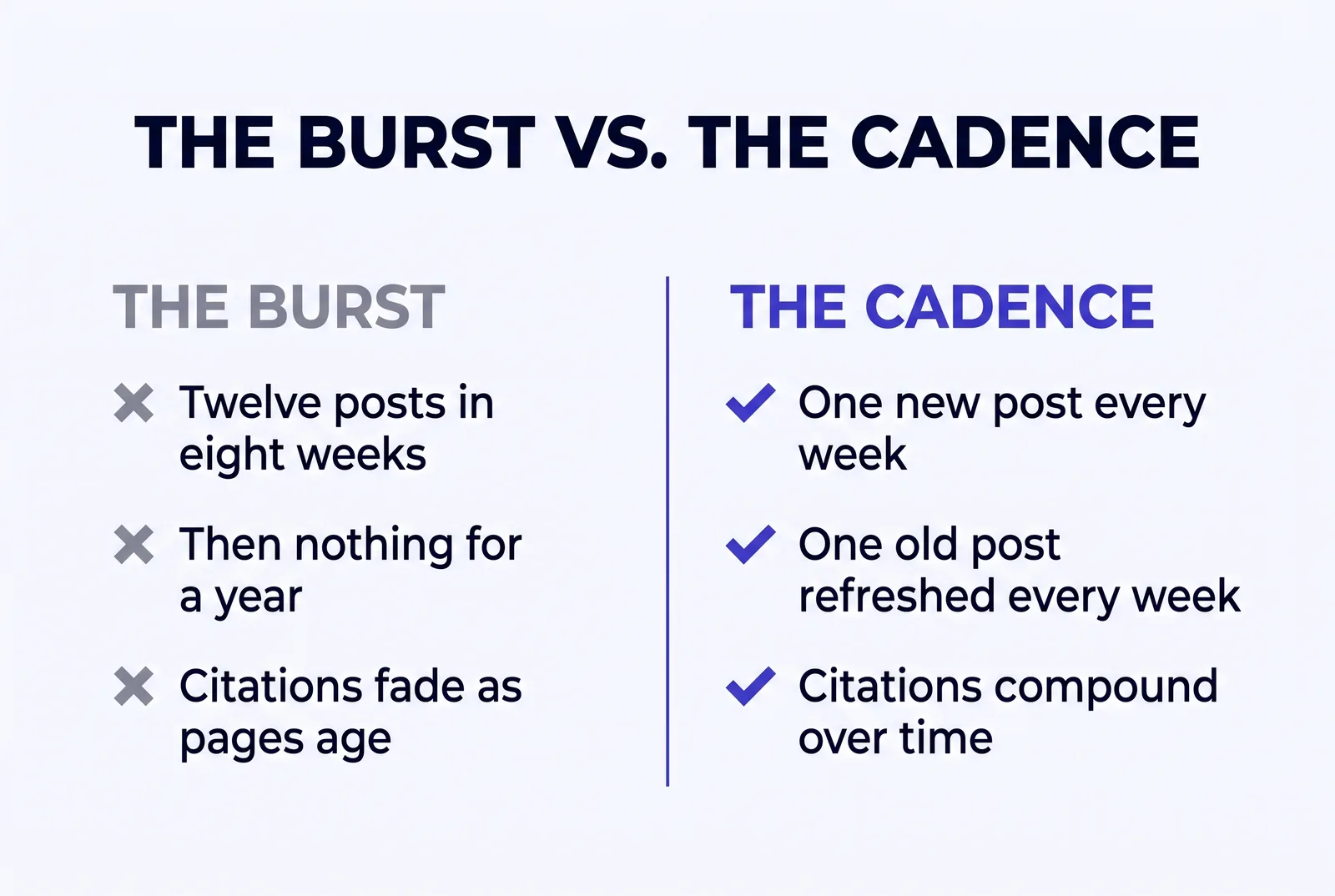
There is a compounding side to this too, and it cuts the direction most owners do not expect. A single fresh post competes for attention once, gets whatever citations it earns in the weeks after it publishes, and then starts fading on the same clock every other page rides. A cadence does something different: each new post adds a fresh data point while the posts from three, six, and nine months ago are still inside the window the Seer Interactive data calls current, and the ones from a year or two back keep getting quietly touched up rather than left to expire. The result is a library where a meaningful share of your pages sit inside the freshness window at any given moment, not just the one you happened to publish last week. A burst produces a single spike that decays. A cadence produces a rolling plateau that does not.
The math if you write it yourself
Writing a single properly sourced post yourself is not expensive in dollars. It is expensive in the hours it takes away from selling, and those hours have a real, measurable price. The U.S. Bureau of Labor Statistics puts the median wage for insurance sales agents at $29.02 an hour, based on May 2024 data5. Say a post that actually meets the bar this data sets, sourced figures with named citations, a real FAQ, a table, formatted and checked for accuracy, takes you five hours from research to publish. That is roughly $145 of your own selling time for one post, before you have touched a second post or gone back to refresh the ones you already have.
Now multiply that by an actual cadence instead of a one time burst. One new post a week, five hours each, is about $755 a month in your own time, every month, indefinitely, and that number does not yet include the separate hour or two it takes to review an older post, check whether a stat or a plan year reference is stale, and update it honestly rather than just bumping the date. Add that maintenance pass, roughly ninety minutes a week at the same wage, and the fully loaded monthly cost of running a real weekly cadence yourself lands closer to $945, in time you would otherwise spend selling.
| Cadence | Hours per month | Modeled monthly cost at $29.02/hr |
|---|---|---|
| Weekly new post + weekly review | ~32.5 hrs | ~$945 |
| Monthly new post + monthly review | ~7 hrs | ~$203 |
| Quarterly burst, no ongoing review | ~5 hrs (averaged) | ~$145 (averaged) |
Read that table carefully, because the cheapest row is the trap. The quarterly burst looks like the bargain until you remember it is the exact pattern the freshness data shows losing citations, since nothing gets touched in the months between bursts. It is not that the quarterly approach costs too little. It is that the hours it does spend are not going toward the thing that actually earns a citation, which is a page that looks maintained right now, not a page that was well written eight months ago. Most agency owners do the math once, see a number like $945 a month in their own time, and quietly downgrade to a burst instead. That is not a character flaw. It is a rational response to the real cost of doing it alone, which is exactly why this specific task, not the whole website, not the whole marketing plan, just the writing and the maintaining, is the one agencies most often hand off first.
So how often should you actually publish?
There is no single magic number, and be skeptical of anyone who hands you one without qualification. What the freshness data supports is a floor, not a ceiling: touch the blog every week, even when the touch is a review rather than a brand new post, and treat a once a year burst as better than nothing but nowhere near a cadence.
A workable weekly minimum looks like one new post plus one older post reviewed for accuracy. The review does not need to be a rewrite. It needs to confirm the numbers are still correct, the plan year references still say 2026 and not an old year, and the page still answers the question a prospect is actually asking today. If your capacity genuinely does not stretch to weekly, monthly is a real second tier, but quarterly or annual bursts are the pattern the data shows losing ground, not holding it.
Not every post ages at the same rate, and treating them all identically wastes review time on pages that did not need it. Split your library into two rough buckets before you decide what to touch each week. The first bucket is time-sensitive: anything naming a plan year, a subsidy figure, a premium, an enrollment date, or a specific dollar amount tied to a program that changes annually. Those pages carry a built-in expiration date whether you write one down or not, and they belong at the front of your review queue every single year, on a schedule tied to when the underlying figures actually change, not to when you happen to remember. The second bucket is closer to evergreen: general explainers of how a product type works, how to choose between two kinds of coverage, or what a term in the industry means. Those pages age slower, but "slower" is not "never," and the Seer Interactive data does not carve out an exception for content that merely feels timeless. Even an evergreen post benefits from an annual pass to confirm the examples, the screenshots, and the surrounding context still look current.
| Tier | Price | Cadence |
|---|---|---|
| Starter | $247/mo | Complete AEO-optimized site and educational pages, no ongoing blog cadence included |
| Pro | $497/mo | 1 new blog post and 1 new location page every week, plus a 24/7 AI receptionist |
| Scale | $997/mo | 1 new blog post every business day, 20 to 22 a month, plus 2 new location pages a week |
Do not fake the freshness
Google is explicit that this backfires. Its own guidance asks site owners to check whether they are "changing the date of pages to make them seem fresh when the content has not substantially changed," and states directly that doing so "won't help your search rankings"3. Update the date when you have actually updated the content. Otherwise leave it alone.
Audit your own blog in fifteen minutes
You do not need a tool to start this. Open your blog's index page and do the following, in order.
The 15 minute cadence audit
- List every post with its publish date, and sort oldest to newest.
- Flag anything published more than twelve months ago. That is your review queue.
- For each flagged post, check every number on the page: plan year references, prices, dates, and any figure that could have changed since publication.
- If a number changed, fix it and update the visible date. If nothing changed, leave the date alone.
- Pick the two or three flagged posts closest to answering a question your prospects actually ask today, and refresh those first, not the ones that are simply oldest.
- Set one recurring calendar block, weekly if you can sustain it, monthly if you cannot, and protect it the way you protect an appointment.
A worked example makes the priority order concrete. Say your fifteen minute pass turns up nine posts older than a year: three explain ACA subsidy eligibility, two cover a specific Medicare plan comparison, and four are general "how to choose an agent" style pieces with no plan-year figures in them at all. The subsidy and Medicare posts move to the top of the queue regardless of how old they are, because their numbers are the ones most likely to be flatly wrong right now. The general pieces can wait a month, since a stale example is a smaller problem than a stale dollar figure. Working through content in that order, most-time-sensitive first, gets you a citable, accurate library faster than working through it oldest-first, which is the instinct most people default to and the slower path to the same result.
How we handle cadence for agencies
This is the specific problem our content service is built to remove. We write and publish on a real schedule, for a single agency site or for every site an FMO or IMO runs, and every figure in every post comes from a source we fetch that same session, cited by name, rather than copied from a previous post or recalled from memory. That is what keeps a fast-moving cadence from turning into the exact thin, stale content the freshness data punishes.
Publishing to one of our sites also updates the sitemap and llms.txt automatically the moment a post goes live, with the full absolute URL, so the crawl path for both Google and the named AI crawlers is current the same day, not whenever someone remembers to check it.The multi-site case is where the cadence problem gets genuinely hard to solve by hand. An FMO or IMO running content for a dozen agency sites cannot simply hire one person and hope, because a single writer working from memory tends to reuse the same handful of statistics across every property, which is precisely the thin, duplicated content pattern both Google's ranking systems and the AI citation data treat as low value. Each site needs its own real cadence, on its own topics, with its own sourced figures pulled the same session that specific post gets written, which is a production problem, not a writing problem, and it is the reason we built this as a service rather than a one-time deliverable. If you want the fuller picture of what makes a page worth citing once it is found, we wrote about that separately in what changed in how agencies get cited this year, and if a crawler reaching your site at all is still an open question, start with whether AI crawlers can even see your site. For the ongoing side of this, tracking whether you are still being named after a cadence is running, see the citation monitoring guide.
We run the cadence so you do not have to
Digital Foundation's Pro tier ships a new blog post and a new location page every week, and the Scale tier moves that to a new post every business day. See Digital Foundation.
What a real cadence gets you
None of this guarantees a specific ranking or a specific number of leads, and be wary of anyone who promises either. What a real cadence does is keep your site inside the pool of pages an AI system will even consider citing, and inside the pool Google's own freshness systems will consider surfacing for a time-sensitive query. A burst of posts written once gets you into that pool for a while. A maintained cadence, new posts plus honest updates to the old ones, is what keeps you there.
The alternative is not neutral. It is not "the posts just sit there doing nothing." The data shows content that goes untouched steadily loses the exact signal that gets it named in an answer, while nothing about the page itself tells you it is happening. No error, no broken link, no drop you would notice from inside your own browser. Just a slow fade out of consideration, until you check where you actually stand.
Concretely, an agency that keeps a real cadence running for a year ends up with a library where a majority of its pages sit inside the twelve month freshness window at any given moment, not just the handful published most recently. That is the difference between a blog that is a historical record of things you once wrote and a blog that functions as a live, checkable reference an assistant is willing to draw from today. The second kind is the one that shows up when it matters, during an enrollment window, during a rate change, during the exact week a prospect is actually deciding, because it looked current on the day they asked.
Questions agencies ask
How often should an insurance agency actually publish new blog content?
Enough to touch the site every week, even if not every touch is a brand new post. A realistic minimum that shows up in the freshness data is one new post plus one older post reviewed and updated every week. An agency that cannot sustain that should aim no lower than monthly, and should stop treating a single annual burst of posts as a content strategy, since the data shows consistently cited pages carry a real, ongoing maintenance signal, not just a publish date.
Does updating an old post count the same as publishing a new one?
For citation purposes, it counts for more than most agencies assume. Seer Interactive's 2026 study found 27% to 28% of the pages AI systems currently treat as fresh were originally published more than two years ago and had simply been kept current, meaning a maintained old post can out-perform a neglected new one for the exact same query.
Will Google or an AI engine notice if I just change the date on an old post?
Google's own guidance is direct about this: it asks site owners whether they are “changing the date of pages to make them seem fresh when the content has not substantially changed,” and states plainly that doing so will not help rankings. Bump the date only when you have actually changed the numbers, the plan year, or the guidance on the page.
Is a big burst of posts once a year better than nothing?
It is better than a truly empty blog, but it is not a cadence, and the data does not treat it as one. Pages cited only once by an AI system skew very new, a median age of about 1.9 months in the Seer Interactive study, while pages cited consistently across months carry an ongoing freshness signal a once a year burst cannot produce on its own.
Does this work the same way for Google search and for AI answer engines?
The mechanism is related but not identical. Google has long run what it calls “query deserves freshness” systems that favor recent content for queries where recency matters. AI answer engines go further, since a citation is a much higher bar than a ranking, and the 2026 data shows freshness weighing more heavily on which sources actually get named in an answer.
What if I run more than one site, like an FMO or IMO managing several agencies?
The math gets harder, not easier, because each site needs its own independent cadence rather than one calendar stretched across all of them. This is the exact case we build for: a shared content engine that keeps every site on its own real schedule, with figures sourced per session rather than copy-pasted across brands.
Can I hit a real cadence without hiring a full time writer?
Most agencies cannot sustain one on their own, which is the honest answer. At a median insurance sales agent wage of $29.02 an hour, a properly sourced, formatted, and fact-checked post is a half day to a full day of production time, every week, indefinitely, on top of selling. That math is exactly why agencies hand this specific task to a service built to do it on a schedule.
Should I publish more heavily around AEP and Open Enrollment than the rest of the year?
It is reasonable to weight new posts toward the questions your prospects are actually asking during those windows, but the review side of your cadence should not go quiet the rest of the year. A subsidy or premium figure published in October is exactly as stale the following August as it would be in any other month, and the freshness data does not grant a seasonal exception.
Sources
- Seer Interactive. "Study: Content Recency's Impact on AI Visibility in 2026," 7,683 dated pages and 47,097 citations sampled March to June 2026, published July 24, 2026. seerinteractive.com.
- Google Search Central. "A Guide to Google Search Ranking Systems," freshness systems section, last updated 2025-12-10. developers.google.com.
- Google Search Central. "Creating Helpful, Reliable, People-First Content," last updated 2025-12-10. developers.google.com.
- Google. "Google Search: New updates to address spam and low-quality results," published March 5, 2024, updated April 26, 2024. blog.google.
- U.S. Bureau of Labor Statistics, Occupational Outlook Handbook. "Insurance Sales Agents," median wage data for May 2024. bls.gov.
- Strategic AI Architects. "Digital Foundation," pricing verified live on 2026-08-02. strategicaiarchitects.com.
Talk it through
Want a second pair of eyes on it?
Free 30 minutes. Bring what you found, or bring nothing and we will look together at how AI engines read your site and which fixes move first.
Find out if your own posts are still citable
Run the free Audit, a live AEO Audit plus a HIPAA tracking scan of your site, in under a minute.