Playbook
Why Texas Insurance Agents Still Need Schema Markup, Even Though Google Says They Don't
Google says its own AI answers need no special schema markup. It never said that about anyone else's.

19 min read

Google's AI Overviews genuinely don't need schema markup. Its own documentation says plainly that no special schema.org markup, and no machine-readable file like llms.txt, is required to appear in its generative AI features13. That statement is scoped to Google. ChatGPT, Perplexity, and Claude don't share Google's crawl or index, ordinary Google rich results still run on the schema Google's own guidelines require2, and Texas alone had more than 4 million people shopping the ACA marketplace this year6. Skipping schema because of one true sentence about one engine is how an agency goes quiet on the other three.
Google said the quiet part out loud
Somewhere in the last few months, a version of this made it into a Facebook group for insurance agents, or a text from whoever built your website, or a headline you skimmed and half-remembered: "Google says you don't need schema markup for AI search." It's not wrong. Google's own documentation says it in plain English. What usually doesn't survive the retelling is the one word that matters most in that sentence: Google's.
Insurance is a market where a real share of shopping now starts with a question typed into an assistant instead of a search box, and Texas carries an unusually large piece of that shopping. The state ran up 4.17 million ACA marketplace plan selections during the 2026 open enrollment period, a 5 percent increase over 2025 and the largest number-of-enrollees swing of any state CMS tracked6. Every one of those people, plus everyone still shopping Medicare Advantage during this fall's enrollment window, is a candidate to type a question into ChatGPT, Perplexity, or Google's AI Mode before they ever call an agent.
So when an agency owner reads that Google doesn't require schema for its AI features and concludes the whole subject is settled, the math that follows is understandable and wrong at the same time. Understandable, because the sentence is a real, accurately reported statement from Google. Wrong, because it answers a narrower question than the one most agents think they're asking. The question an agent actually cares about is "will AI name my agency," and that question has at least three other engines in it besides Google.
The sentence everyone quotes, and the sentence nobody adds
What gets repeated: "Google says you don't need schema markup for AI search." What almost never gets added, because Google's own documentation buries it in the same paragraph rather than stating it as a warning: this guidance describes Google's AI Overviews and AI Mode specifically, not the other AI systems your prospects are already using to shop insurance.
What Google's 2026 guidance actually says
Start with the actual text, because it's worth reading precisely rather than as a paraphrase. Google's AI features documentation states: "You don't need to create new machine readable files, AI text files, or markup to appear in these features. There's also no special schema.org structured data that you need to add."1 The same page adds that there are "no additional requirements to appear in AI Overviews or AI Mode, nor other special optimizations necessary" beyond what classic Search already requires1: a page has to be indexed and eligible to show a snippet, the same bar every organic result already clears.
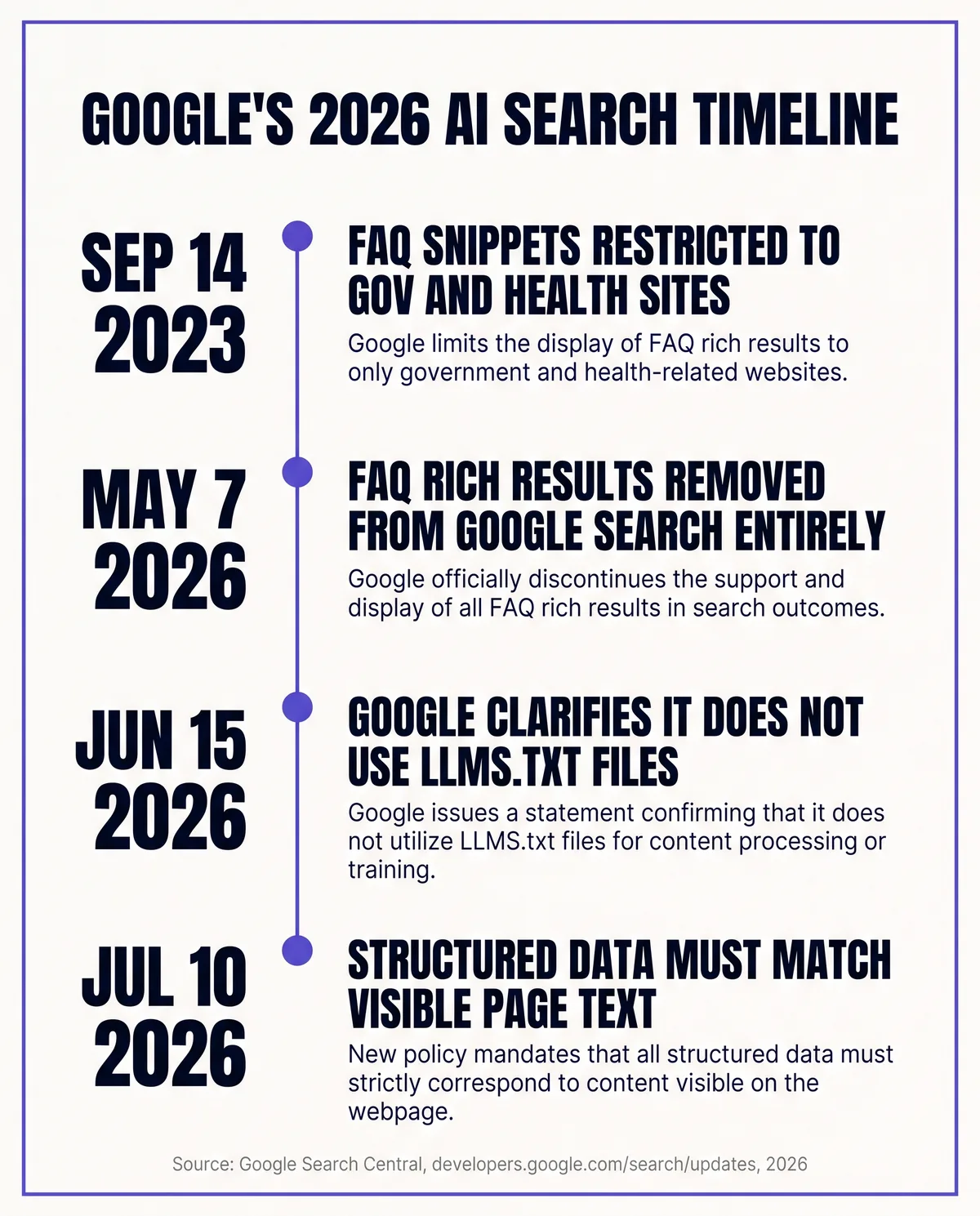
On June 15, 2026, Google's Search Central changelog logged a second, related clarification, this one aimed specifically at llms.txt and similar files: a note confirming that Google Search doesn't use them at all, so maintaining one neither helps nor hurts a site's presence in Google Search or its generative features3. Between those two statements, Google has now directly addressed the two things most AEO advice tells agencies to build first: schema markup and llms.txt. Google's answer to both, for Google specifically, is that neither is required.
Read alongside Google's description of how AI Overviews and AI Mode actually pull an answer together, that statement stops sounding like an oversight and starts sounding like an engineering choice. Both features "may use a 'query fan-out' technique, issuing multiple related searches across subtopics and data sources, to develop a response,"1 which is Google's own language for generating several related sub-questions behind the scenes and pulling supporting material for each one from whatever's already indexed. The mechanism runs on the index, not on a parallel structured-data layer built just for it.
| Requirement | Google's position | Source |
|---|---|---|
| Indexed and snippet eligible | Required, same bar as classic Search | AI features documentation1 |
| Special schema.org markup for AI features | Not required, none exists specifically for this | AI features documentation1 |
| llms.txt or a similar machine-readable file | Not required; Google Search doesn't use it | Search Central changelog, June 15, 20263 |
| Structured data matching visible page text | Required wherever schema is used at all | General structured data guidelines2 |
| Required properties for a given rich result type | Missing required properties disqualify that rich result | General structured data guidelines2 |
Notice the last two rows. Google didn't say schema markup stopped mattering everywhere. Its general structured data guidelines, last updated July 10, 2026, still require that "structured data must be a true representation of the page content" and that a page missing required properties "is not eligible for rich results"2. That's a live rule governing ordinary Google rich results, the review stars and expandable listings that still appear in classic search, sitting right alongside the statement that none of it is required for AI Overviews specifically. Both things are true. Agencies keep hearing only the second one.
Why Google gets to say that about its own answers
Here's the part worth sitting with for a second, because it explains why this isn't a contradiction on Google's part. Google operates a crawler and an index built over more than two decades, dense enough that its own systems can extract meaning, entity relationships, and factual claims directly from rendered HTML most of the time, without a separate machine-readable summary standing in for the page. Its AI features inherit that index rather than building a new one, which is exactly what the eligibility language says: indexed and snippet eligible, full stop, nothing extra1. Google doesn't need a translation layer for a language it already reads fluently.
That's a genuinely different starting position from a third-party AI product. ChatGPT's browsing tool, Perplexity's search layer, and Claude's web access don't inherit twenty years of Google's crawl history. Each one runs its own retrieval against a page at request time, or against a narrower index it built itself, and a clean, complete piece of structured data removes ambiguity those systems would otherwise have to infer from prose. Google can afford to say "we don't need this." The other three systems your prospects are already using were never part of that sentence, because Google was only ever describing its own product.
What ChatGPT, Perplexity, and Claude still need
None of the three engines an agent's prospects are most likely to ask a question in are Google, and none of them operate under Google's specific "we already understand your page" claim. What that means in practice, on an insurance agency site specifically, comes down to a handful of concrete gaps a missing schema leaves open.
Without InsuranceAgency or LocalBusiness schema, nothing on the page
formally states, in a format a machine can parse without guessing, what kind of business this is,
what area it serves, or what its verified name, address, and phone number are. A retrieval system
reading a paragraph of prose has to infer all of that from context. A retrieval system reading a
JSON-LD block just reads it.
Without Service schema on each line of business, an assistant answering "does this
agency write Medicare Advantage" or "does this agency handle final expense" has to parse marketing
copy to guess at an answer instead of reading a declared list. Without Article schema
carrying a named organization as author, a blog post reads to a machine as anonymous text with no
stated source, which is precisely the kind of content GEO research finds AI systems are least likely
to quote and attribute by name.
None of this is a claim that ChatGPT, Perplexity, or Claude have published a rule requiring schema the way Google publishes its documentation. They mostly haven't said so explicitly, in either direction, which is itself the point: in the absence of a stated rule, giving a smaller, less mature retrieval system a structured, unambiguous answer instead of prose it has to interpret is the safer bet, not the wasted one.
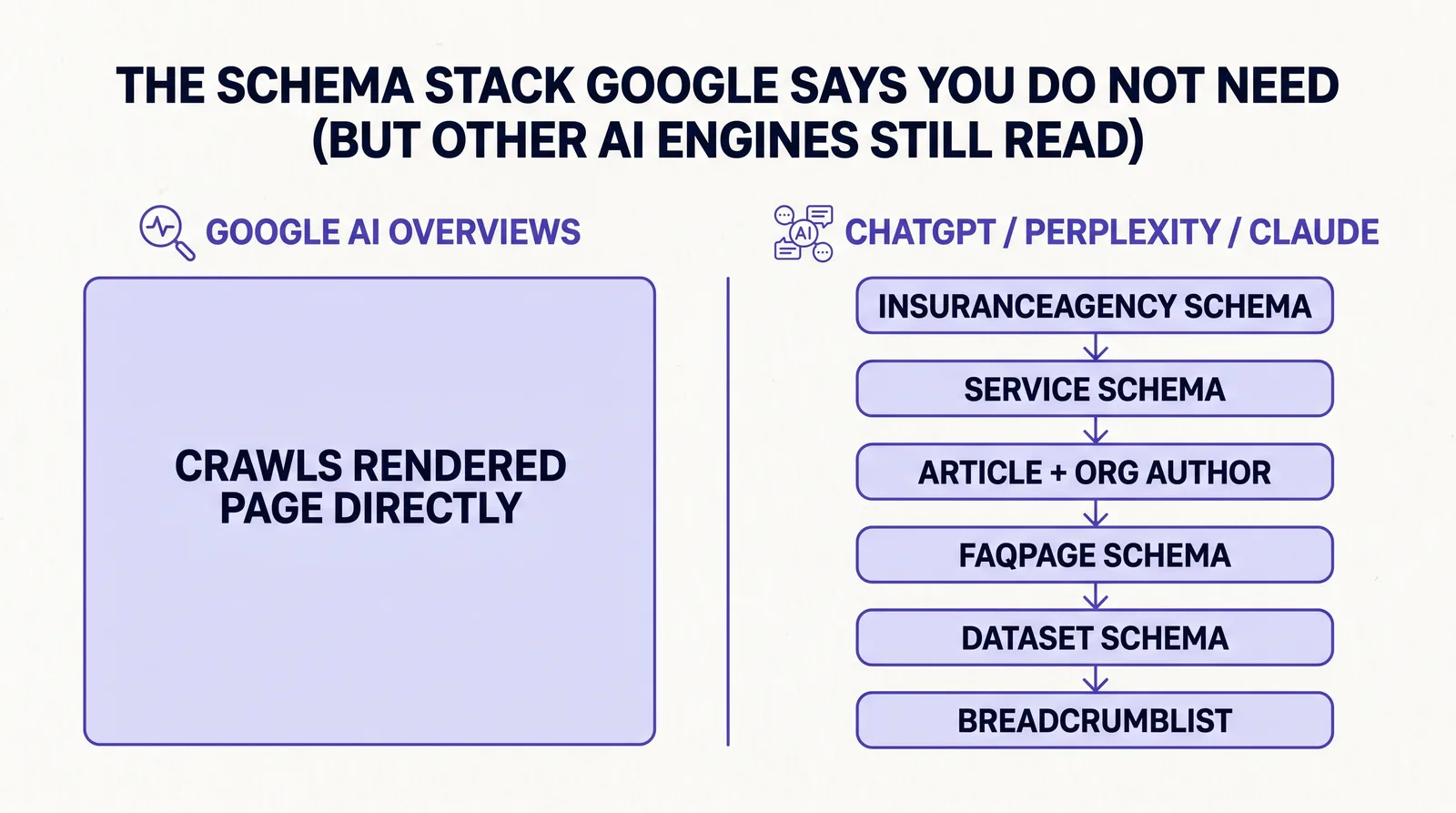
One question, three different engines, three different answers
Abstract talk about crawlers and indexes is easier to follow with an actual query run through it. Picture a prospect in Harris County typing something close to "which Medicare Advantage plans in Houston have no monthly premium" into three different tools on the same afternoon.
In Google's AI Mode, the query fan-out Google describes kicks in: the system generates related sub-questions behind the scenes, covering plan availability, premium structure, and star ratings, and pulls supporting passages from whatever's already indexed and snippet eligible for each piece1. An agency page that ranks well and answers the question thoroughly in plain text has a real shot here, schema or no schema, because Google's own crawl already understands the page.
Hand that same question to Perplexity or to ChatGPT with browsing turned on, and the retrieval step
looks different. Neither system carries Google's twenty-year crawl history behind it. Each pulls a
smaller set of pages at or near request time and has to decide, quickly, what a given page is about
and whether to trust it enough to quote. A page with Service schema explicitly declaring
"Medicare Advantage" as a line of business, and an InsuranceAgency block declaring
Harris County as part of the service area, hands that decision to the retrieval system in a form it
doesn't have to infer. A page with neither leaves the system guessing from marketing copy, under
more time pressure than Google's index ever puts it under.
The practical result: the same agency, with the same underlying expertise, can be a strong candidate in one engine's answer and functionally invisible in another's, not because the content changed, but because one engine can read an unmarked page as confidently as a marked one and the others can't. That gap is exactly what the schema stack in this guide closes, and it's why "Google doesn't need it" was never the same claim as "nobody needs it."
Google removed FAQ rich results. Drop FAQ schema too?
This is the specific change that's driving most of the current confusion, so it's worth walking through exactly what happened and when. On May 8, 2026, Google's Search Central changelog announced that the FAQ rich result feature "will no longer appear in Google Search starting May 7, 2026"3. The visible documentation for the feature was removed from Search Central a little over a month later, on June 15, 2026, with the changelog entry noting simply that the feature was "no longer shown in Google Search results"3. As of this writing, the expandable FAQ snippet that used to appear under a search result is gone, for every site, everywhere.
What often gets skipped is that this feature was already narrow before it disappeared. Since September 14, 2023, Google had restricted the FAQ rich result to "well-known, authoritative government and health websites" only3, which means a typical independent insurance agency site had already been ineligible for the visual snippet for nearly three years before the removal made it official for every remaining site too. If your agency's FAQ section never actually produced that expandable snippet in a Google result, and for almost every agency reading this it never did, then May 2026 changed nothing you were relying on.
The mistake this news is causing
We've seen agencies read "Google removed FAQ rich results" and strip FAQPage schema from their site entirely, reasoning that a feature with nothing left to earn isn't worth the markup. That throws out the part that was never about the visual snippet in the first place: a clean FAQPage block is a structured question-and-answer format a machine can lift directly, whether or not Google ever renders it visually. Removing it doesn't clean anything up. It just makes your content harder for everyone but Google to parse.
Put plainly, FAQPage schema was doing two jobs the whole time. One job was competing for a rich snippet slot in Google's results, and that job is over, and honestly was mostly already over for agency sites specifically. The other job was declaring, in a format ChatGPT, Perplexity, Claude, and Google's own query fan-out can all parse without guessing, exactly which sentence answers exactly which question. That second job never depended on the visual snippet existing, and it's still worth doing on every page that carries real questions and real answers.
What it costs a Texas agent specifically
Zoom out from the schema mechanics for a second to the actual size of who's asking these questions in Texas this year, because the stakes are not abstract. Texas posted 4.17 million ACA marketplace plan selections during the 2026 open enrollment period, a 5 percent increase, roughly 206,000 more people than 2025, and the largest single-state swing by raw enrollee count that KFF's analysis of CMS enrollment data identified6. An earlier semifinal CMS snapshot, published January 13, 2026, put the state's total at 4,113,465 selections, itself already about 150,000 more than the prior year, before the final count came in higher still7.
Selecting a plan and keeping it active turned out to be two different things for a meaningful share of those Texans. By February 2026, effectuated enrollment, meaning coverage people had actually kept active, sat around 3.28 million, about 146,000 fewer than the same point in 2025, a 4 percent decline even as raw plan selections rose6. That works out to roughly 79 percent of people who selected a plan actually carrying active coverage a few months later, one of the largest gaps between selection and activation among the states KFF was able to compare6.
| Segment | Figure | Source & date |
|---|---|---|
| ACA plan selections, 2026 OEP (final) | 4.17 million, up 5% from 2025 | KFF, Jul. 28, 20266 |
| ACA plan selections, 2026 OEP (semifinal) | 4,113,465 | Texas 2036 / CMS, Jan. 13, 20267 |
| ACA effectuated enrollment, Feb. 2026 | ~3.28 million, 79% of selections | KFF, Jul. 28, 20266 |
| National Medicare Advantage share of Medicare, 2026 | 48% of all Medicare enrollees | CMS, Sep. 26, 20254 |
| National average MA plan premium, 2026 | $14.00/mo, down from $16.40 | CMS, Sep. 26, 20254 |
| National MA enrollment share, 2026 | 55% of eligible beneficiaries, up from 19% in 2007 | KFF, Jul. 1, 20265 |
The gap between those two KFF-sourced figures, 4.17 million selections against roughly 3.28 million effectuated, works out to about 890,000 Texans who selected a plan and, for one reason or another, didn't keep it active by February, plus everyone in the state currently weighing a Medicare Advantage plan ahead of this fall's enrollment window. Both groups are, by definition, people already in the market, already comparing options, and increasingly likely to open that comparison with a question to an assistant rather than a phone call to an agency. Every one of those questions gets answered by whichever engine the person happens to be using, and whichever source that engine trusts enough to name. An agency invisible to three of the four major engines isn't losing a small edge on that population. It's opting out of being considered by most of it.
The schema stack that still earns its keep
None of this requires exotic markup nobody's heard of. It's a fixed, known list of schema.org types, each doing one specific job, none of them invented for this guide. Here's what an insurance agency site should be carrying, and what each type is actually declaring to whatever's reading it.
| Schema type | What it declares | Where it belongs |
|---|---|---|
| InsuranceAgency / LocalBusiness | Verified business identity: name, address, phone, service area | Homepage and every location page |
| Service | Each specific line of business the agency actually writes | One block per service page |
| Article + Organization author | A stated source for a blog or education page, not anonymous text | Every blog post and guide |
| FAQPage | A clean, parseable question-and-answer structure | Any page with a real FAQ section |
| Dataset | The exact government or industry source behind a cited figure | Any page quoting CMS, HealthCare.gov, Census, or similar data |
| BreadcrumbList | Where a page sits in the site's structure | Every indexed page |
| Review / AggregateRating | Real testimonial data, matched to what's visibly on the page | Pages that actually display reviews |
| ContactPoint + Person | A real, named point of contact, not a placeholder | Contact page and author bios |
One rule cuts across every row in that table, and it's the same one Google's own general structured data guidelines state for classic Search: "don't mark up content that is not visible to readers of the page," and the markup "must be a true representation of the page content"2. A FAQPage block listing questions that don't appear anywhere in the visible text, or a Review schema citing a rating count higher than what's actually shown on the page, isn't a shortcut. It's the exact kind of mismatch that gets a listing removed from rich results and gives any retrieval system, human or machine, a real reason not to trust the rest of the page either.
8
Schema types a complete agency site should carry
0
Of them Google requires for AI Overviews eligibility
3
Other major AI engines an agency's prospects already use
2026
The year Google removed the FAQ rich result and clarified llms.txt
How to check what your own site is shipping
This doesn't require a paid tool, and it takes a few minutes per page. Run through this on your homepage, your top service pages, and one or two blog posts.
- View the page source and search for it directly. Right-click the page, choose View
Page Source, and search for
application/ld+json. Every block between those script tags is a piece of schema currently live on that page. If the search comes back empty, that page is carrying none. - Run the URL through Google's Rich Results Test. At
search.google.com/test/rich-results, paste in a page URL. It still validates the underlying JSON-LD and flags missing required properties, even for schema types, like FAQPage, that no longer produce a visual result in Google itself. - Read what each block actually says against what's on the page. Open the FAQPage block specifically and compare its questions to what's visibly written on the page. A mismatch here is the exact violation Google's structured data guidelines call out2, and it's common on sites where a template shipped generic placeholder questions nobody swapped out.
- Check whether your author is a real named person or organization, or just "admin."
Look for an
authorproperty inside any Article or BlogPosting block. A generic system username there reads as anonymous to anything trying to judge whether your content has a real, trustworthy source behind it. - Confirm the schema survives your platform's own rendering. Some page builders and GoHighLevel funnel templates inject JSON-LD through a settings panel that only fires on certain page types, or that a later template swap silently strips. View source on the actual live URL, not a preview or staging link, since a builder can render differently between the two.
- If you're on a platform where you can't edit schema directly, know that before you build anything else on top of it. Some funnel and page-builder platforms don't expose JSON-LD editing at all, which means the schema question isn't a to-do item, it's a platform limitation worth weighing against a build that does give you that control.
If you'd rather see the full picture at once
The free Audit checks your schema stack against this exact list, along with the rest of your site's AEO readiness and a HIPAA tracking scan, in under a minute. Run a free Audit.
How we build this in from day one
This is the layer Digital Foundation ships automatically rather than leaving to a plugin or a template nobody's audited. Every site we build carries the full stack from the table above on the page types it actually applies to: InsuranceAgency and LocalBusiness on the homepage and location pages, Service on each service page, Article with an Organization author on every blog post, FAQPage on any page with real questions, Dataset on any page citing a government source, BreadcrumbList sitewide, and a real Person bio behind whoever's named as author or reviewer.
Because it's built at the architecture level instead of bolted on page by page, it doesn't drift the way a hand-maintained WordPress or page-builder site does, where a template update or a new plugin can silently overwrite a JSON-LD block or introduce the exact visible-text mismatch Google's own guidelines warn against2. We verified every claim in this guide by re-checking the live Digital Foundation pricing page the same day it published, the same standard we hold every number in this article to.
It also means the llms.txt question and the schema question get handled as two separate, correctly scoped decisions instead of one collapsed one. llms.txt ships because ChatGPT, Perplexity, and other agent tools were the actual audience for it, not because Google reads it, and every build's llms.txt and sitemap update themselves automatically the same day a new page publishes. This pairs with what we cover in our guide to the separate technical gate that controls Google AI Overviews eligibility specifically, and with what changed in AI citation more broadly this year: this guide is the schema layer underneath both of those, scoped correctly to the engine that actually reads it.
Digital Foundation, verified live
Starter runs $247 a month: a complete, compliant site with AI citation optimization built in, Google Business Profile management with review harvesting, and an AI chat widget, with a 14-day free trial and setup free on a limited basis. Pro and Scale add a weekly or daily blog and location-page cadence on top of the same schema-complete foundation. Pricing verified on the live page the day this guide published8.
What actually changes
Not a guaranteed spot in any specific AI answer. No one, including Google, can promise that, and this guide isn't going to pretend otherwise. What changes is more basic than a promise: your site stops being unreadable to three of the four systems your prospects are already asking, for the sole reason that one true, narrow sentence about the fourth system got generalized into advice it was never meant to be.
Google's statement about its own AI Overviews was accurate the day it was published and it's accurate today. It was also never a statement about ChatGPT, Perplexity, Claude, or the roughly 890,000 Texans who selected an ACA plan this year and didn't keep it active by February. Building the schema stack doesn't contradict what Google said. It just answers the three-quarters of the question Google's sentence was never trying to.
Questions Texas agents ask
Does my insurance agency still need schema markup if Google says it isn't required for AI Overviews?
Yes. Google's statement is specific to its own AI Overviews and AI Mode, which run on the same crawl and index as classic Search and don't need a separate machine-readable shortcut to understand a page. ChatGPT, Perplexity, and Claude don't share Google's index or crawl depth, and ordinary classic Search rich results, like review stars and breadcrumbs, still run on the schema Google's own structured data guidelines require. Dropping schema helps nothing and quietly costs you all three.
What did Google actually say about llms.txt files in June 2026?
On June 15, 2026, Google Search Central added language stating site owners don't need machine readable files, AI text files, or Markdown to appear in Google Search, including its generative AI features, because Google Search itself doesn't use them. That statement is scoped to Google. Other AI systems and agent tools were never part of it, and llms.txt was built for them, not for Google.
Google removed FAQ rich results in May 2026. Should I remove FAQPage schema from my site?
No. The May 7, 2026 removal ended the visual FAQ snippet in Google Search results, a feature that had already been restricted to government and health sites since September 2023, meaning most agency sites lost nothing they had. FAQPage schema still forces your content into a clean, machine-parseable question-and-answer structure that non-Google engines can lift directly, which is the actual value it was providing agencies all along.
What schema markup does an insurance agency website actually need in 2026?
At minimum: InsuranceAgency or LocalBusiness for the agency itself, Service for each line you sell, Article with an Organization author for blog and education content, FAQPage for question-and-answer sections, BreadcrumbList for navigation, Dataset for any page citing government or industry data, and ContactPoint plus a real Person bio for whoever's named as the author or reviewer. Review or AggregateRating schema applies if testimonials appear on the page.
Do ChatGPT, Perplexity, and Claude read schema markup the same way Google does?
Not identically, but all three rely more heavily on structured signals than Google's AI features do, precisely because none of them operates a crawler and index at Google's scale. Perplexity's retrieval layer and OpenAI's and Anthropic's own crawlers pull from a page's rendered content and any structured data present, and a clean JSON-LD block removes ambiguity a plain paragraph leaves for them to guess at.
Will adding schema markup to my WordPress or GoHighLevel site guarantee I get cited by AI?
No, and no one honest will tell you it does. Schema removes a technical barrier and makes your page easier to parse correctly. It doesn't make thin, generic content citable. The agencies getting named in AI answers pair complete schema with sourced, dated, specific content, not schema as a standalone fix.
How do I check what schema markup is already on my website?
View your page source and search for script type application/ld+json, or run the URL through Google's Rich Results Test at search.google.com/test/rich-results, which still validates the underlying markup even though FAQ rich results no longer render visually. Either method shows you exactly which @type values are present and whether required properties are filled in.
Does ranking well in Google mean I'm also visible in ChatGPT or Perplexity answers?
Not automatically. Google's index and ranking signals are Google's own. ChatGPT's browsing and retrieval, Perplexity's search layer, and Claude's web tools each run their own crawl and their own judgment about what to cite. A page can rank on page one of Google and never surface in a single one of those answers, because the underlying question each system is answering is different.
Sources
- Google Search Central. "AI Features and Your Website," query fan-out description, machine-readable file and structured data requirements. developers.google.com. Accessed August 31, 2026.
- Google Search Central. "General Structured Data Guidelines," required properties and visible-content matching rules, last updated July 10, 2026. developers.google.com.
- Google Search Central. Documentation changelog, entries for September 14, 2023 (FAQ rich result restricted to government and health sites), May 8, 2026 (FAQ rich result deprecation announced), and June 15, 2026 (FAQ documentation removed; llms.txt usage clarified). developers.google.com.
- Centers for Medicare & Medicaid Services. "Medicare Advantage & Medicare Prescription Drug Programs Expected to Remain Stable in 2026," national average premium and enrollment projections, published September 26, 2025. cms.gov.
- KFF. "Medicare Advantage in 2026: Enrollment Update and Key Trends," published June 5, 2026, updated July 1, 2026 with March 2026 data. kff.org.
- KFF. "How Has ACA Marketplace Enrollment Changed Across States in 2026?," Texas plan selection and effectuated enrollment figures, based on CMS Open Enrollment and Effectuated Enrollment public use files, published July 28, 2026. kff.org.
- Texas 2036. "Texas ACA Enrollment Hits Record High in 2026, Surpassing Last Year," citing CMS "Marketplace 2026 Open Enrollment Period Report, National Snapshot," published January 13, 2026. texas2036.org.
- Strategic AI Architects. "Digital Foundation," service pricing page. strategicaiarchitects.com.
Talk it through
Want a second pair of eyes on it?
Free 30 minutes. Bring what you found, or bring nothing and we will look together at how AI engines read your site and which fixes move first.
See what schema your own site is missing
Run the free Audit, a live AEO Audit plus a HIPAA tracking scan of your site, in under a minute.