Playbook
Your Website Gets Traffic. The Phone Doesn't Ring.
The traffic is real. The calls aren't. Here is where that gap usually lives, and what to check on your own site first.


20 min read
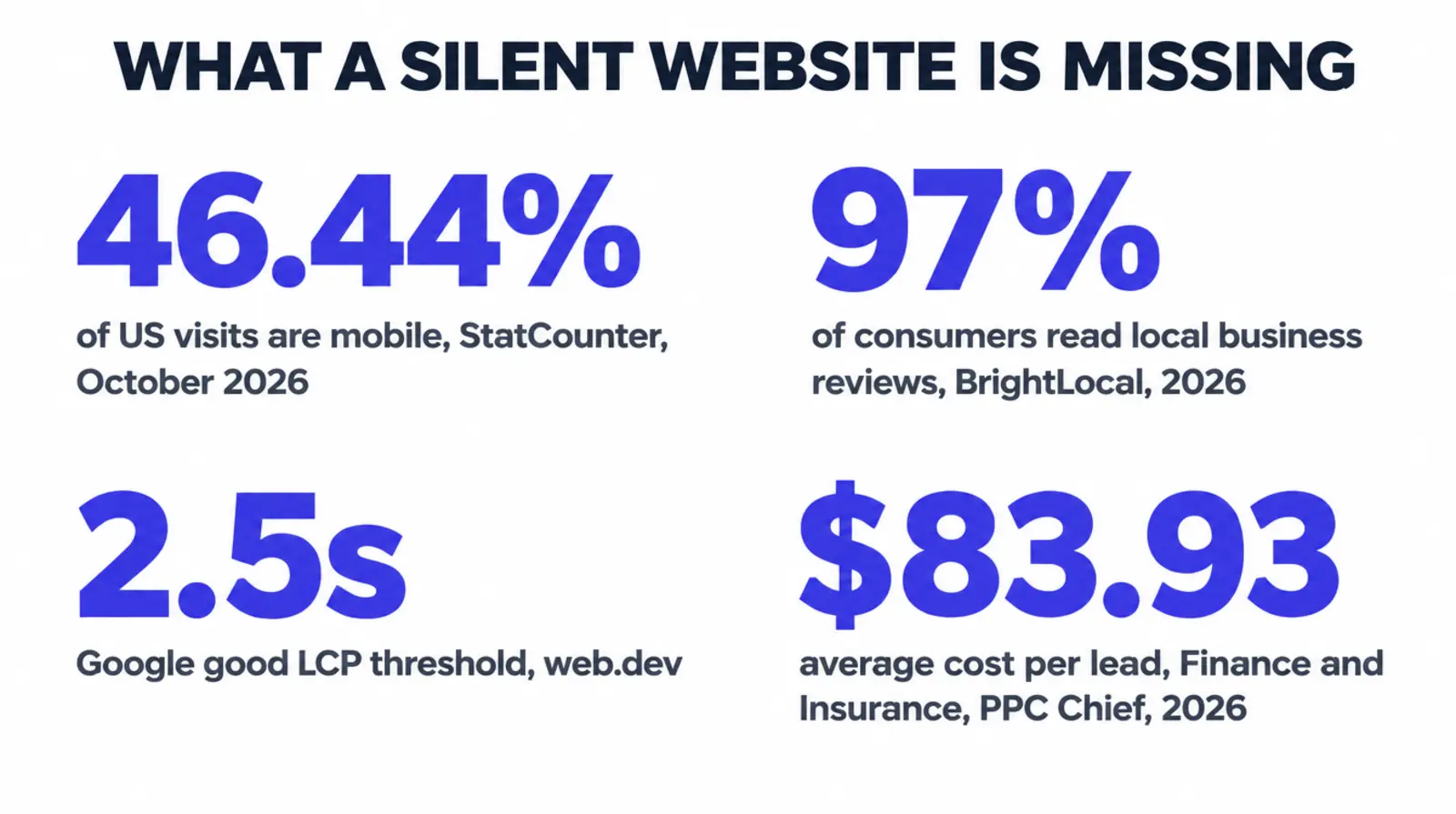
If your site is getting traffic and the phone still isn't ringing, the cause is almost always one of six things, and you can check most of them yourself in about twenty minutes. Nearly half of US internet visits are now mobile, StatCounter puts October 2026 US mobile share at 46.44%3, and Google treats Core Web Vitals as a page experience signal that aligns with what its ranking systems reward5. A page that fails that test on a phone loses the visitor before your reviews, your phone number, or your quote form ever get seen. Everything downstream of that first few seconds, trust signals, a tappable number, a form that actually works, is fixable without touching your ad spend or your keywords at all.
The traffic shows up. The phone doesn't.
You check Search Console or your Google Business Profile insights, and the numbers look fine. Clicks are up from last month. Your blog post about Medicare enrollment dates is pulling real impressions. Someone found your agency searching for exactly the thing you sell. By every metric you can see before a visitor actually lands on your site, the morning looks like a good one.
Then you look at the pipeline. No new inquiries overnight. No missed calls. The quote form submissions folder has the same three entries it had three days ago, and one of them bounced. The gap between "people are finding us" and "people are calling us" is one of the more frustrating places to sit as an agency owner, because it does not feel like a marketing failure. Marketing worked. Someone searched, someone clicked, someone arrived. What happened in the seconds after that is the part almost no agency actually watches.
It is also not usually a single catastrophic problem. Nobody's site is broken in an obvious way that jumps out the moment you look at it. It is more often two or three small, ordinary weaknesses stacking on the same page at once, each one shaving off a share of visitors who would have otherwise picked up the phone, until the total loss is large enough that a real amount of traffic produces almost nothing.
A two minute check before you read further
Open your own site on your own phone, on cellular data, not office WiFi. Time how long it takes before the page is actually usable, and count how many taps it takes to call your number from the homepage. If you are not sure, or the answer is more than one tap, you already found the first candidate.
Why ranking and ringing are two different jobs
Getting found and getting called are two separate pieces of engineering, even though most agencies treat them as the same project. Getting found is a content and indexing problem: the right keywords, a Google Business Profile that is filled in correctly, a blog that answers real questions, enough technical plumbing that Google can crawl and understand the site. None of that work has anything to do with what happens once a human actually arrives.
Getting called is a different job entirely, closer to product design than marketing. It asks whether the page, in the handful of seconds a real visitor gives it, proves it loaded fast enough to trust, proves the agency behind it is legitimate, and makes the one action you want, a call or a quote request, obvious and easy. A site can be excellent at the first job and nearly silent at the second, and from the outside both look identical in your search traffic reports. The only place the difference shows up is in a pipeline that is not moving.
This is also why "just get more traffic" is the wrong first move for an agency in this position, even though it is almost always the instinct. If the page that is already getting visited is not built to convert, a second ad campaign or a new blog post sends more visitors to the same leak. The traffic was never the scarce resource. The conversion was.
What a non converting visit actually costs you
It helps to put a real number next to the problem instead of treating it as an abstract annoyance. PPC Chief's 2026 Google Ads benchmark for the Finance and Insurance category puts average cost per lead at $83.93, with an expected range of $63 to $113, against a category conversion rate of 2.5% compared with a 7.5% all industry average4. Those figures describe paid traffic specifically, but the underlying math applies just as directly to organic and Google Business Profile traffic, because every visit, however it arrived, cost something in time, content, or ad spend to earn.
A visit that leaves without converting is not a neutral event. It is money and effort already spent walking back out the door. If your agency is producing, say, 400 qualified visits a month across search, Google Business Profile, and direct traffic, and the site is quietly losing half of those visitors to a slow mobile page, a missing trust signal, or an untappable phone number before they ever see your offer, that is not a small, fixable-later problem. It is the single highest leverage thing on your list, because the traffic acquisition cost is already sunk whether the visitor converts or not.
Read that chart as a floor, not a forecast. Mobile share varies by month and by how StatCounter counts tablets, and your own agency's visitor mix may run higher or lower depending on whether your traffic comes mostly from Google Business Profile searches, which skew heavily mobile, or from referrals and direct visits, which skew more toward desktop. The point is not the exact percentage. It is that close to half of your visits, on a conservative national figure, are arriving on a device where speed and layout mistakes are the least forgiving.
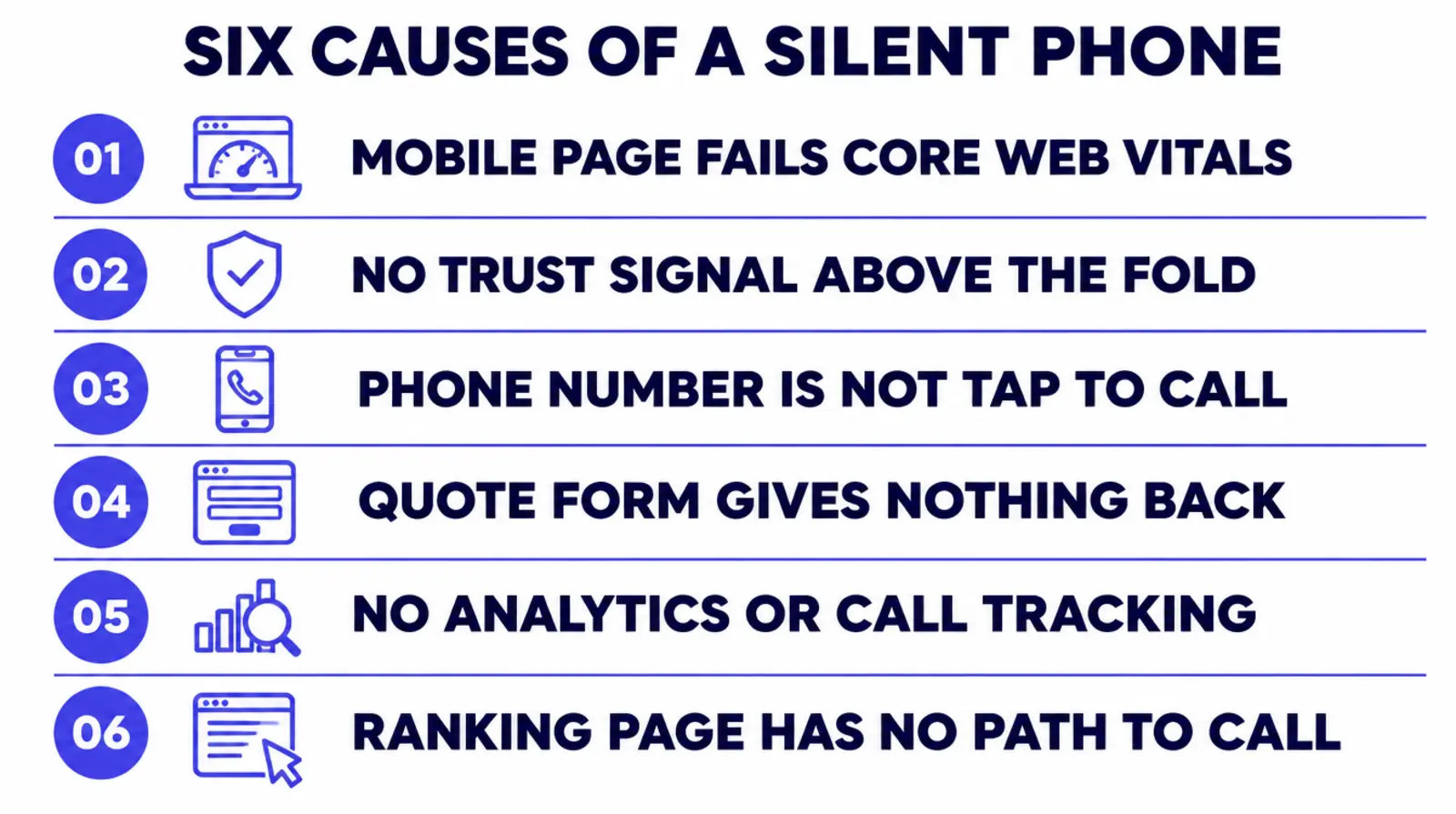
The six usual causes, in order of how often we find them
None of what follows is exotic or expensive to diagnose. By our own count across the agency sites we have built and audited, what is unusual is finding a site where none of these six are present at once.
Cause one: the mobile page fails before it finishes loading
Google defines three Core Web Vitals, each with a published threshold for what counts as a good experience versus a poor one, measured at the 75th percentile of real visits1.
| Metric | Good | Needs improvement | Poor |
|---|---|---|---|
| LCP, loading | 2.5s or less | 2.5s to 4.0s | over 4.0s |
| INP, responsiveness | 200ms or less | 200ms to 500ms | over 500ms |
| CLS, visual stability | 0.1 or less | 0.1 to 0.25 | over 0.25 |
Largest Contentful Paint is the one that matters most for a first visit, because it measures how long it takes the biggest, most meaningful piece of content, usually your headline or hero image, to actually paint on screen. A visitor whose phone has not shown them anything recognizable after two and a half seconds is well inside the window where people start to assume the page is broken and leave, and a site that takes four, five, or six seconds on a phone has lost a real share of visitors before the rest of this guide's checklist even becomes relevant.
The usual cause on an agency site is heavy page builder output: a theme loading several render blocking scripts, a carousel plugin, a chat widget, and a stack of tracking pixels, all fighting for the same few seconds a phone has before a visitor's patience runs out. Google states plainly that this performance "aligns with what our core ranking systems seek to reward"5, so a slow page is not only a conversion problem, it is also working against you in search at the same time.
We have written in depth about what actually causes mobile speed failures and ran PageSpeed against a large sample of agency sites to see how common this really is. If speed is the piece you want to dig into first, the mechanics of why a site passes desktop and fails mobile are covered here, and the research across 1,080 agency sites is here.
Cause two: nothing earns trust in the first few seconds
A visitor who makes it past the load time still has to decide, almost instantly, whether this particular agency is worth a phone call instead of the next search result. Reviews are doing more of that work than they used to. BrightLocal's 2026 Local Consumer Review Survey, based on a representative panel of 1,002 US adults, found that 97% of consumers read reviews for local businesses, and the share who say they always do rose to 41%, up from 29% a year earlier2.
| What consumers require | 2025 | 2026 |
|---|---|---|
| Will only use a business rated 4 stars or higher | 55% | 68% |
| Will only use a business rated 4.5 stars or higher | 17% | 31% |
The same survey found 47% of consumers will not use a business with fewer than 20 reviews at all2. That is one source, a single annual survey rather than two independently confirmed studies, so treat the exact percentages as directional rather than a universal law, but the direction itself, consumers checking reviews more often and expecting more of them, lines up with what we see on the agency sites we audit: a review count that has not moved in a year, or no reviews surfaced on the site at all even when the agency actually has them on Google.
A real photo of a licensed agent, states you are licensed in, and a visible review count or rating do not need to dominate the page. They need to be present, above the fold, in the first screen a mobile visitor sees, not buried under three paragraphs of marketing copy about your mission.
If you want to know where your own site stands on this
The free Audit scores a live site against signals like this in about a minute, no signup required. Run a free Audit.
Cause three: calling you is harder than it should be
With close to half of visits arriving on a phone3, the actual mechanics of how a visitor calls you matter more than most agencies assume. A phone number baked into a header image looks identical to a real one on a desktop monitor and is completely untappable on the device most of your visitors are actually holding. A number buried in a footer below a long page means a visitor has to go looking for it, and a visitor who was ready to call is also a visitor with low patience for looking.
The fix is mechanical and genuinely does not take long: the phone number needs to exist on the page as
an actual tel: link, visible without scrolling, ideally present in more than one place on
longer pages. If your agency also depends on after hours inquiries going somewhere useful instead of
straight to voicemail, what an unanswered
after hours call actually costs an agency is covered in detail here.
Cause four: the quote form gives nothing back
Some agency sites skip the phone number problem by leaning entirely on a quote form instead, and then run into a version of the same trust problem from a different angle. A form that asks for a name, phone number, and ZIP code, and then simply says "someone will be in touch," is asking a visitor to hand over contact information on faith, with nothing shown back in return. A real quoting tool that shows an actual premium range, pulled from live data for that visitor's own county and plan year, gives something immediate in exchange for the information, which is a fundamentally different offer to a skeptical visitor comparing three agencies in three browser tabs.
This is a large enough topic on its own that it has its own guide. What separates a form that actually quotes from one that only collects contact information, and what the difference costs an agency, is covered in full here.
Cause five: you can't see where the visit actually dies
This is the cause that makes the other five hard to find in the first place. Most agency sites we audit have no event tracking tied to the phone number, no call tracking connecting an inbound call back to the page the visitor was on, and Google Analytics either never installed or installed once, years ago, and never checked again. Without that, every fix an agency makes to its own site is a guess made from the outside, not a decision made from evidence.
The practical minimum is not complicated or expensive. A free Google Analytics 4 property with a
tracked event on the tel: link and the quote form's submit button tells you, in plain
numbers, how many visitors reached the page, how many scrolled far enough to see the call to action,
and how many actually tapped it. Call tracking, a tracked number that logs which page a caller was on
before they dialed, closes the last gap, connecting an actual phone call back to the specific page
that earned it. Neither requires rebuilding the site. Both require someone to actually set them up and
then look at them on a schedule, which is the step almost every agency we have audited has skipped.
Here is the honest tradeoff on this one specifically: a single producer running a small, steady volume of traffic may genuinely be fine running the twenty minute manual audit below on a recurring basis instead of building out full analytics. The case for wiring up real tracking gets much stronger once an agency is spending meaningfully on ads, running more than one campaign or line of business through the same site, or simply has not been able to explain, in the last three months, why a given week's calls were up or down.
Cause six: the page that ranks isn't built to convert
The last cause is less about anything being broken and more about a mismatch. Agencies that publish blog content and build location pages, which we recommend, sometimes discover that their best ranking, best trafficked page is an educational post about open enrollment dates or a county page that answers a search question well but was never built with a phone number, a trust signal, or a call to action anywhere on it. The page did exactly what it was built to do. It just was not built to do the second job too.
This is worth checking specifically, because it hides easily behind otherwise good numbers. Open your Search Console or Google Analytics and find your single most visited page from the last 90 days. If it is not your homepage, your quote page, or a page with an obvious path to call, that page is where a real share of your traffic is currently landing with nowhere useful to go.
A twenty minute audit of your own site
Before changing anything, find out where your own site actually stands today. This does not require new software, a developer, or a subscription.
The checklist, in order
- Run your homepage and your single most visited page through Google's free PageSpeed Insights, and read the mobile score, not the desktop one, since Google measures each under different simulated conditions.
- Open the site on your own phone, on cellular data. Time how long it takes to feel usable.
- Find your phone number. Tap it. Confirm it opens your phone's dialer rather than doing nothing.
- Look for a review count or rating on the page, above the fold, without scrolling.
- Fill out your own quote form as if you were a stranger. Note whether it gives you anything back, or only a thank you message.
- Check whether Google Analytics is installed at all, and whether it shows any event tied to a phone click or a form submission.
- Find your single most visited page in Search Console or Analytics, and confirm it actually has a phone number and a call to action on it.
Most agencies running this checklist for the first time find at least two or three of the six causes above present on their live site. That is a normal result of building a site once, years ago, and reasonably assuming it still works the way it did then. Page builder themes update, plugins get added for one campaign and never removed, and a site that was fine in 2022 quietly stops being fine as thresholds for speed and trust keep moving without anyone announcing it.
What we actually change
This section describes what we actually do, so it stays narrow and sticks to what is live on our own pricing page. Digital Foundation replaces a slow, hand maintained site with one built on Astro, which ships zero JavaScript to the browser by default and renders pages as finished HTML instead of a framework the browser has to load and boot first6. Our builds score 90 or higher on Lighthouse performance for both mobile and desktop, and a number of pages score 100.
Trust and conversion elements are built into the page from the start rather than added later: a real
tel: link, Google Business Profile management, and review collection built into the
site's own workflow instead of left for an agency to chase manually. Where a site needs a quote, the
widget behind it pulls real premiums and subsidy figures from live federal data for that visitor's own
county and plan year, not a static form with the same example numbers shown to everyone, the same fake
quote problem covered in the companion guide linked above.
| Tier | Price | What it adds |
|---|---|---|
| Starter | $247/mo | 7 new pages a month, 2 change requests a month, Google Business Profile and AI chat7 |
| Pro | $497/mo | 14 to 17 new pages a month, up to 2 languages, reviews, and an AI voice receptionist7 |
| Scale | $997/mo | Up to 71 new pages a month, up to 4 languages, and a monthly newsletter7 |
Every tier includes a 14-day free look period, verified live on the Digital Foundation page this session7. If what your site actually needs is a specific analytics and call tracking setup wired into an existing site you want to keep, or a custom build around a particular carrier or workflow, that work is scoped on a call under AI Expert rather than sold as a fixed monthly line.
What changes once the site can do both jobs
Strip away the platform names and the outcome is narrow and concrete. Same traffic, same keywords, same Google Business Profile, a larger share of the visits you are already earning turn into an actual phone call or a real quote request, because the page those visits land on no longer loses people to a slow load, a missing trust signal, or a phone number nobody can tap. Nothing about your content strategy or your ad spend has to change for that shift to start showing up.
There is a compounding piece worth naming too. A fast, trustworthy site is not a separate project from being discoverable in the first place. Google states plainly that Core Web Vitals performance aligns with what its core ranking systems reward5, so the conversion fix and the discoverability project are the same foundation doing two jobs at once, not two separate line items competing for budget and attention.
What changes if you run more than one office
Everything above holds for a single producer running one site. It compounds for an FMO or IMO running several offices or several downline agents, each one often inheriting the same shared template, because a structural weakness in a template is not a problem that is smaller when it is spread across five sites. It is five times larger, quietly taxing five separate traffic sources on the exact same gap, every month the sites stay live.
Worth a real conversation at this scale
Auditing and standardizing a conversion baseline across multiple agency sites, each keeping its own brand and its own licensing details, is exactly the kind of work we handle for FMOs and IMOs running more than one office. Book a call.
Questions agents ask
Why does my insurance agency website get traffic but no calls or leads?
Most of the time it is one or more of six fixable problems: the mobile page fails Google's Core Web Vitals before a visitor sees anything, nothing on the page earns trust in the first few seconds, the phone number is not a real tap to call link, the quote form collects information but gives nothing back, there is no analytics or call tracking so the agency cannot see where visits actually drop off, or the specific page getting the traffic, often a blog post or a location page, was never built with a path to convert at all. It is rarely a traffic quality problem once you actually look.
Is a slow mobile site really costing me calls, or is that overstated?
Google treats Core Web Vitals, Largest Contentful Paint, Interaction to Next Paint, and Cumulative Layout Shift, as a page experience signal that aligns with what its core ranking systems reward, and nearly half of US internet visits are now on mobile, StatCounter puts October 2026 US mobile share at 46.44%. A visitor who leaves before a slow page finishes loading never sees your phone number, your reviews, or your quote form at all, so speed is not a nice to have sitting next to the content. It is the gate the content has to get through first.
How many reviews does an insurance agency actually need before it affects conversions?
BrightLocal's 2026 Local Consumer Review Survey found 47% of US consumers will not use a business with fewer than 20 reviews, and the share who will only use a business rated 4 stars or higher rose from 55% in 2025 to 68% in 2026. There is no hard cutoff where trust suddenly appears, but a site with zero visible reviews or an outdated review count is working against a bar that moved up a full 13 points in a single year.
Should I be watching Google Analytics, or is it fine to just watch the phone?
Watching the phone tells you a lead came in. It tells you nothing about the ten visits that did not become a lead, which page they were on, or where they left. Without analytics and call tracking tied to the actual pages on your site, every fix you make to the page is a guess, and most agencies running this guide's twenty minute audit for the first time find out their site has never had either one properly connected.
Is this different from a landing page conversion problem on my paid ads?
Related, but not the same problem. A paid landing page is judged against the exact ad that sent the click, and Google Ads scores that relationship directly through Quality Score. This guide is about the whole site, including organic visits, Google Business Profile clicks, and direct traffic that never touched an ad at all, where the same underlying weaknesses, speed, trust, a tappable number, a real form, show up without an ad account to flag them. If paid traffic specifically is the problem, the anatomy of a page built to convert an ad click is covered in a companion guide linked below.
How do I check my own site's Core Web Vitals score without hiring anyone?
Google's free PageSpeed Insights tool scores a live URL on both mobile and desktop using Google's own Core Web Vitals thresholds, and the mobile score is the one that matters most since it is measured under harder simulated conditions than desktop. Run your actual homepage and your actual most visited blog or location page, not just a page you think looks fast, since the two can score very differently.
What does Digital Foundation actually fix from this list?
It replaces a slow, hand maintained site with one built on Astro, which ships pages as finished HTML instead of a runtime that has to load before content appears, built to score 90 or higher on Lighthouse performance for both mobile and desktop. Every build ships with Google Business Profile management, review collection, and a quoting tool wired to live federal data instead of a decorative form, verified live on the Digital Foundation pricing page this session. It does not fix a missing call tracking setup on its own, that is a conversation worth having separately if your current stack has never had one.
Sources
- web.dev. "How the Core Web Vitals metrics thresholds were defined," LCP, INP, and CLS good, needs improvement, and poor bands, last updated 2025-05-07, verified live 2026-11-05. web.dev.
- BrightLocal. "Local Consumer Review Survey," 2026 edition, representative panel of 1,002 US adults, published 2026-02-11, verified live 2026-11-05. brightlocal.com.
- StatCounter Global Stats. "Desktop vs Mobile Market Share, United States of America," October 2026 monthly data, verified live 2026-11-05. gs.statcounter.com.
- PPC Chief. "Google Ads Cost, Finance and Insurance," cost per click, cost per lead, and conversion rate benchmark, last reviewed 2026-05-22, page updated 2026-06-16, verified live 2026-11-05. ppcchief.com.
- Google Search Central. "Understanding Core Web Vitals and Google search results," ranking systems statement, verified live 2026-11-05. developers.google.com.
- Astro. "Why Astro," zero JavaScript by default and server-first rendering, verified live 2026-11-05. docs.astro.build.
- Strategic AI Architects. "Digital Foundation," pricing and guarantee, verified live 2026-11-05. strategicaiarchitects.com.
Talk it through
Want a second pair of eyes on it?
Free 30 minutes. Bring what you found, or bring nothing and we will look together at how AI engines read your site and which fixes move first.
See what your own site is actually doing with the traffic it gets
Run the free Audit, a live AEO Audit plus a HIPAA tracking scan of your site, in under a minute.
Related reading: landing pages built for paid ad clicks specifically · what makes a quote form real instead of decorative · why cost per lead keeps climbing