Playbook
What an After-Hours Call Costs an Insurance Agency
The prospect calling at 8pm is already dialing two other agencies. Whoever picks up first usually gets the appointment.
19 min read
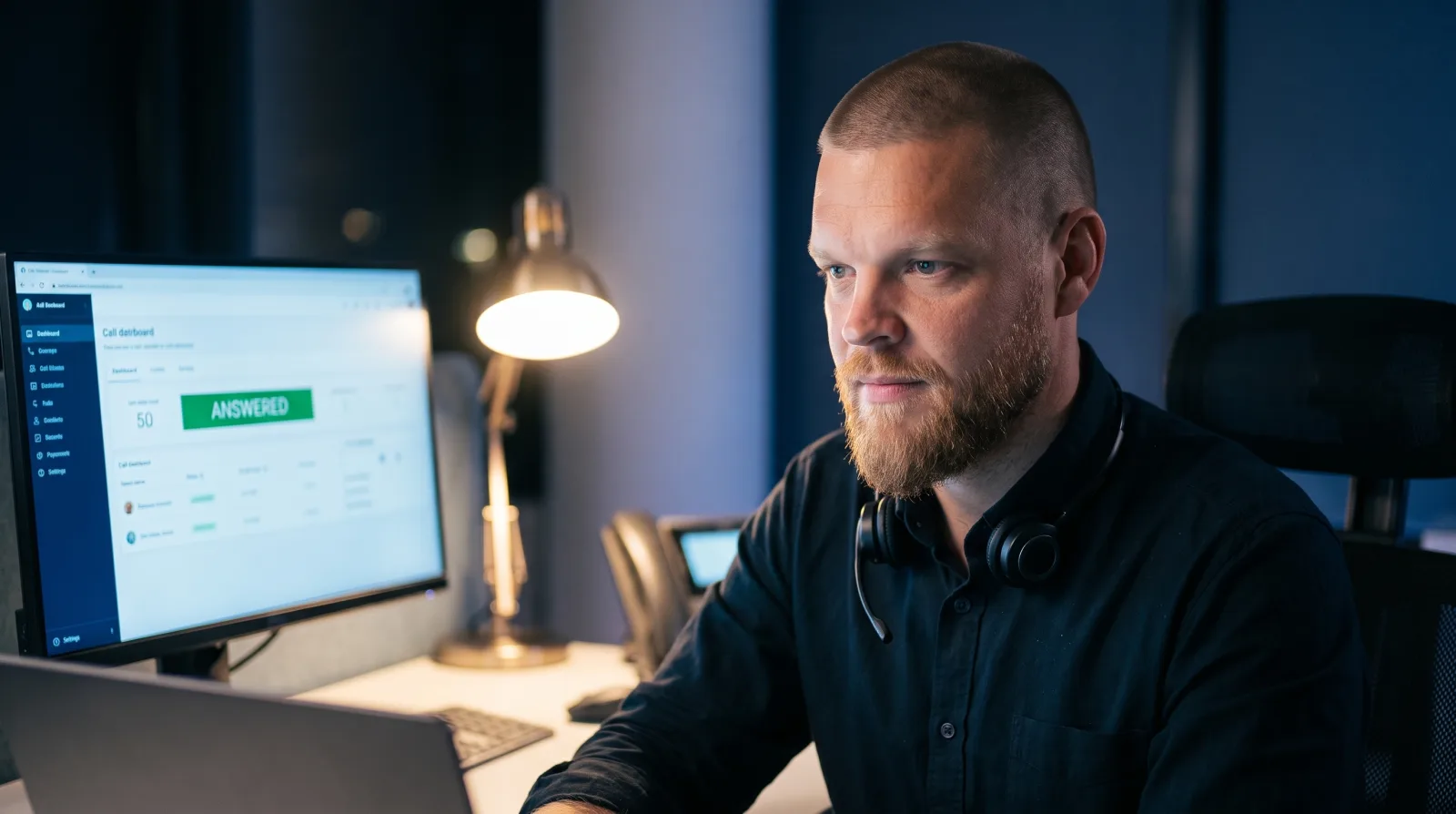
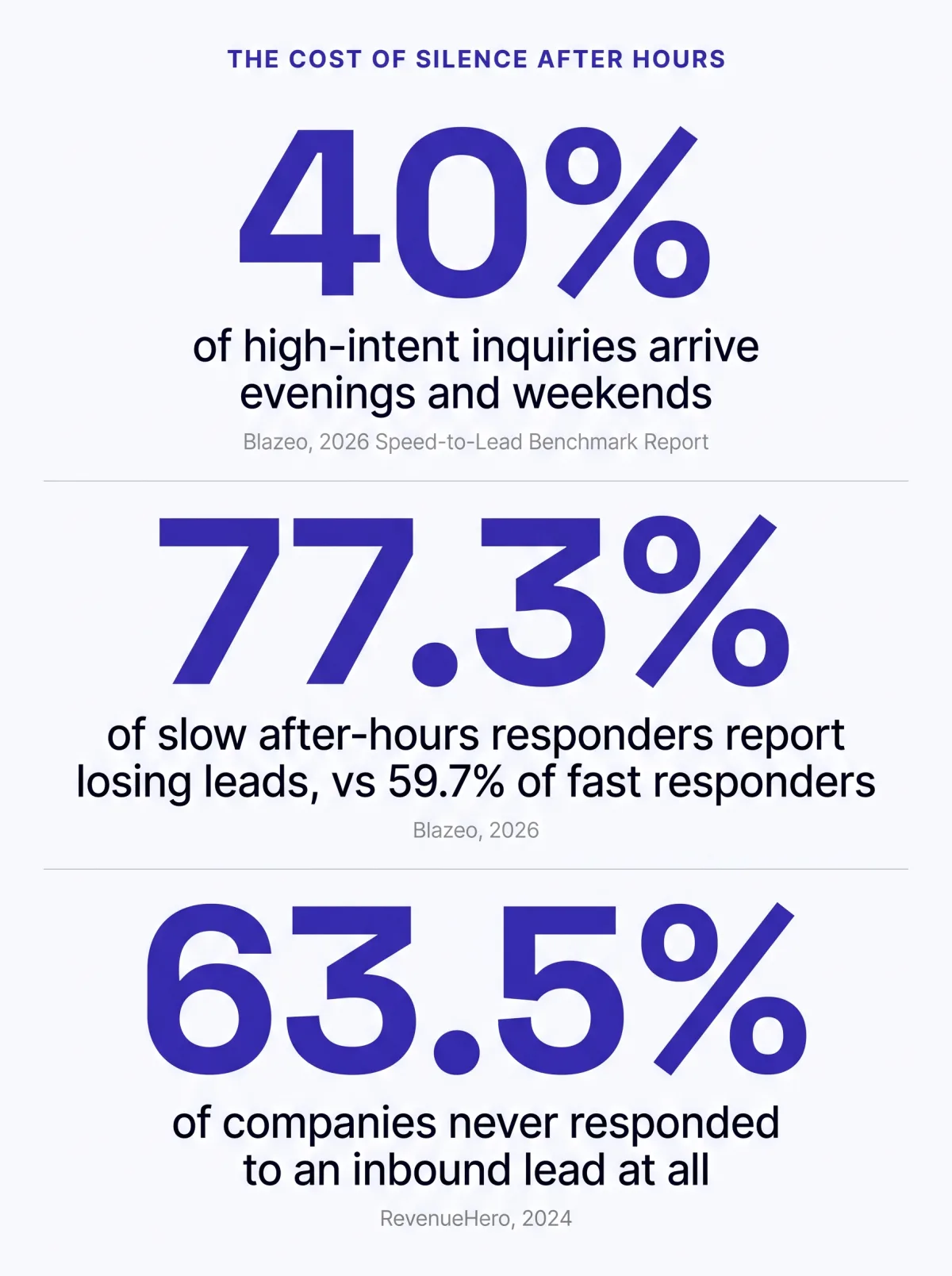
Nights and weekends are not quiet hours for insurance shoppers. Blazeo's 2026 Speed-to-Lead Benchmark Report found 40% of high-intent inquiries arrive evenings or weekends, and 24.6% of companies respond to those inquiries slowly or not at all. Slow after-hours responders report losing leads 77.3% of the time, against 59.7% for fast responders. The fix is not working nights yourself. It is making sure something with real context picks up when you cannot.
The call that goes to voicemail
It's 8:12pm on a Tuesday. Someone just finished dinner, opened their phone, and typed "Medicare agent near me" or "ACA plans open enrollment." They call the first number that comes up. Your agency's Google Business Profile lists your office line. It rings four times and goes to a voicemail box that says you're out of office until 9am.
They don't leave a message. Most people don't. They hang up, and thirty seconds later they're calling the second agency in the search results, or the third. One of those agencies picks up, or texts back inside a minute, and that's the one who gets the appointment. Not because they had a better rate or a better pitch. Because they answered.
This isn't a story about a lazy agent. It's a story about an office that closes at 5 and a buyer who researches at 8. Nobody built that gap on purpose, and almost every independent agency has it, because staffing a phone line past business hours has never made sense for a one or two person shop. What's changed is how much that gap now costs, and this guide puts real numbers on it.
Before you read further
If you want to know how your own site and phone setup score today, the free Audit checks AEO readiness and HIPAA tracking exposure in about a minute. Run a free Audit.
Why the phone goes quiet after five
The mismatch is simple once you say it out loud. Your agency operates on a schedule built around licensed hours, carrier portals, and the fact that you are one person or a small team. Your buyer operates on whatever schedule is left after their own job, their kids, and their dinner. Those two schedules overlap for maybe six hours a day, and shrink further around a holiday week or a school pickup.
Blazeo's 2026 Speed-to-Lead Benchmark Report, a study of 573 companies across six service industries released February 24, 2026, found that 40% of high-intent inquiries arrive evenings or weekends1. That's not a niche pattern. It's close to half of the buyers who are ready to talk, showing up exactly when most small offices have nobody at the desk.
The same report found that 24.6% of companies respond to those after-hours inquiries slowly or not at all1. Put those two figures together and the shape of the problem is obvious: a real chunk of your best prospects call outside business hours, and a real chunk of businesses, plausibly including yours, have nothing built to answer them.
None of this data comes from an insurance-specific study. Nobody has published one this session that we could find and verify, and we won't invent a number that doesn't exist. What we can say is that the underlying behavior, people researching and calling on their own schedule instead of yours, doesn't change by industry. If anything it's sharper in insurance, where the purchase is confusing enough that people want to talk to someone the moment they feel ready, not schedule a callback for tomorrow.
There's also a staffing reality most owners never say out loud: hiring a person to sit by the phone from 6 to 9pm on the chance a call comes in doesn't pencil out for a one or two person agency, and it barely pencils out for a bigger one. You'd be paying a real wage for hours where most of the time nothing happens, against the handful of hours where something does. That's exactly why most agencies default to voicemail instead, not because anyone decided silence was acceptable, but because the alternative looked like overstaffing for a problem nobody had priced out yet.
What the response time data shows
Speed to lead isn't a new idea, but the 2026 data on it is more specific than the old "five-minute rule" advice you've probably heard. Optifai's benchmark of 939 B2B companies across SaaS, manufacturing, professional services, and consulting, covering Q2 2025 through Q1 2026, tracked close rate against how fast a lead got a first response2.
| First response time | Close rate |
|---|---|
| Under 5 minutes | 32% |
| Under 1 hour | 18% |
| Under 24 hours | 15% |
| Over 24 hours | 12% |
That's a 2.6x spread between the fastest bucket and the slowest, on the exact same lead quality, the exact same offer, and presumably a mix of the exact same sales skill2. The only variable that moved was how long the phone, or the inbox, sat quiet before someone picked it up.
Separately, RevenueHero tested 1,000 B2B companies in 2024 by submitting a real demo request to each one, then waiting. 63.5% of them never responded at all. Among the ones that did, the average response time was 29 hours3. That study published February 10, 2025, and it's the same story from a different angle: the phone or inbox that never answers isn't a hypothetical, it's the median outcome when nobody built a process to prevent it.
Two independent studies, different sample sets, different industries, the same direction: speed of response is doing more to determine who wins a lead than almost anything else measured in either report. Neither study is insurance-specific, and we're saying that plainly rather than dressing a B2B SaaS number up as an insurance statistic. The pattern is still worth taking seriously, because nothing about "the first person to answer usually gets the sale" is unique to software.
The math on your own after-hours calls
Run your own numbers through Blazeo's two percentages and the size of the gap gets concrete fast. Say your agency's line takes 60 inbound calls in a typical month. At the report's 40% after-hours share, that's about 24 calls landing evenings or weekends1. At the 24.6% rate of slow or absent response, roughly 6 of those 24 calls a month get silence, voicemail, or a callback that comes too late to matter1.
Six calls a month is 72 a year, if your volume holds steady, which during an enrollment push it usually doesn't (more on that below). Not every one of those calls was a sure sale. Some were tire-kickers, some would have gone nowhere even with an instant answer. But Blazeo's own data on lead leakage says the ones that do go somewhere skew heavily toward whichever business answered first1.
Here's the other half of the math, the half that's easy to miss because it never shows up as a bill. The median insurance sales agent earns $29.94 an hour, per the Bureau of Labor Statistics' Occupational Employment and Wage Statistics survey for May 2025, with a mean annual wage of $81,480 across 479,100 agents nationally4. The Occupational Outlook Handbook's separate figure, which folds in a broader estimate that includes self-employed producers, puts the median annual wage at $60,370 across roughly 568,800 jobs, with 4% projected growth from 2024 to 2034 and about 47,000 openings a year5. The two BLS releases measure the occupation slightly differently, which is why the totals don't match exactly, but both land in the same range.
That's what your own hour is worth if you tried to cover the gap personally. Sitting by the phone from 6 to 9pm every weeknight, on the chance a high-intent call comes in, isn't a realistic use of a producer's time even at that hourly rate, and most agents know it without needing the math spelled out. The real choice isn't "answer it yourself or lose it." It's "build something that answers it, or accept the leakage rate Blazeo already measured for you1."
How to measure your own gap
Everything above is a benchmark, not your agency's actual number, and the benchmark only matters as a comparison point. Before you decide anything, spend two weeks finding out what your own phone is actually doing. This costs nothing and takes about ten minutes a day.
Most phone systems already have the data. Google Business Profile shows call history under "Calls" if you've claimed the listing. GoHighLevel and most modern CRMs log every inbound call with a timestamp. Even a basic cell carrier's call log works if your office line forwards to a mobile number. The method doesn't require new software, just fifteen minutes to pull what you already have.
- Pull every inbound call to your main number for the last two full weeks, including nights and weekends.
- Mark each one by the hour it came in: business hours (whatever yours actually are) or after hours.
- For the after-hours calls, mark whether it was answered live, went to voicemail with a message left, or went to voicemail with no message and no callback number captured.
- Total each column. Divide after-hours calls by total calls, and divide unanswered after-hours calls by total after-hours calls.
- Compare your two percentages against Blazeo's 40% after-hours share and 24.6% slow-or-no-response rate1. Close to those numbers, above them, or well below them tells you how urgent this actually is for your book, rather than how urgent it is for the average agency in a benchmark study.
Agents who actually run this log, instead of guessing from memory, are usually surprised in one of two directions. Some find their after-hours share is lower than the benchmark, because their book skews toward referrals who call during the day. Others find it's higher, especially agents doing any paid search or social advertising, where the traffic runs on the buyer's schedule around the clock rather than a referral's habits. Either result is useful. Guessing isn't.
Why whoever answers first tends to win
There's a reason speed matters more in insurance than it might in, say, buying a mattress. RevenueHero's own industry breakdown notes that a prospect comparing auto insurance quotes "will typically request information from three to five providers simultaneously"6. Nobody researching Medicare Advantage or ACA plans calls one agency and waits patiently for a callback. They call two or three, sometimes on the same drive home, and take whichever one actually picks up and can talk them through it.
That's the part that makes an unanswered after-hours call different from a missed sale in a slower-moving business. The buyer isn't waiting on you. They're already on the phone with somebody else, and the agency that answers isn't necessarily the one with the better book of carriers, it's the one that happened to be reachable at 8:12pm on a Tuesday.
This is also why a callback the next morning, even a fast one by most business standards, often lands on a closed door. If a prospect has already talked to two agents by 9am, "we called you back within an hour of opening" doesn't beat "we picked up when you called." The five-minute window insurance shoppers actually experience is the one at 8:12pm, not the one measured from your office's open sign.
The enrollment period makes it worse
For agents who work Medicare, this gap doesn't distribute evenly across the year. CMS sets the Medicare Annual Enrollment Period at October 15 through December 7 every year, the annual window when beneficiaries can switch between Original Medicare and Medicare Advantage, or change Part D coverage7.
Call volume concentrates hard into that seven-week window, and so does the evening research habit that drives it. A beneficiary comparing plans during AEP is often doing it after a family dinner, the same pattern the general Blazeo data shows, except now it's compressed into seven weeks instead of spread across twelve months1. A missed call in March is one missed opportunity. The same coverage gap during AEP means a much larger share of a year's Medicare business is riding on whether your phone gets answered between 6 and 9pm on a normal weeknight in late October and November.
ACA agents see a version of the same spike around open enrollment. The mechanism doesn't change, only the calendar. Whatever after-hours coverage gap exists in your agency gets worse exactly when the stakes on it are highest, which is the argument for fixing it before the season starts rather than during it.
The timing matters for another reason too. Standing up a new after-hours system, whatever form it takes, has a shadow period where you're checking its work before trusting it unsupervised, covered in more detail later in this guide. Doing that shadow period in September, ahead of AEP, means the system is already proven by the time October 15 hits. Doing it during the enrollment window itself means you're debugging a new process at the exact moment call volume is highest and the margin for a mistake is smallest.
This compounds with a messy pipeline
An after-hours call that does get answered still needs to land somewhere useful. If your CRM doesn't hold real context on that caller, from prior touches to what they actually asked about, an instant answer only gets you halfway there. We cover why that memory gap matters in our guide to AI context in the CRM.
Four ways to cover the phone after hours
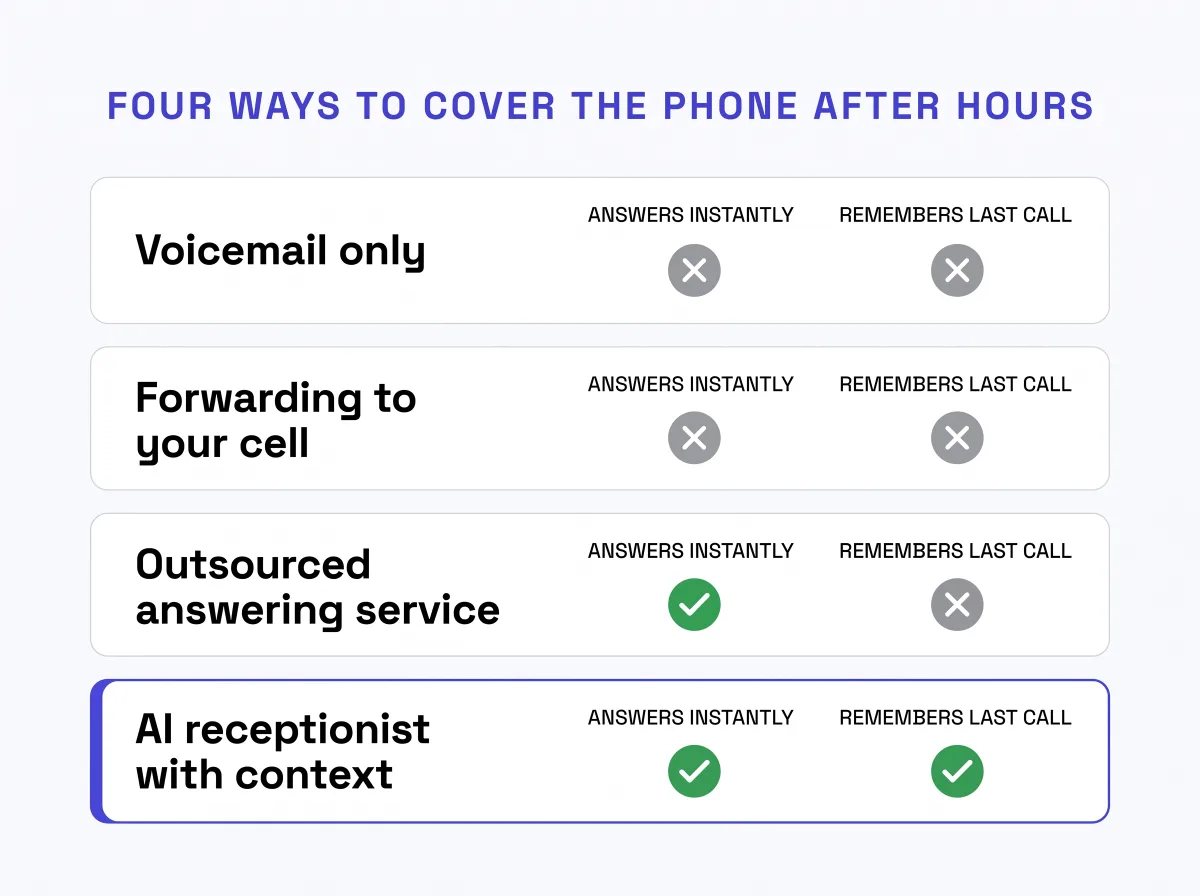
Once you accept the gap is real, the decision is which fix actually closes it. There are four common answers, and they aren't equally good, so it's worth being honest about what each one actually does.
| Option | Answers instantly, 24/7? | Remembers the last contact? | Typical cost |
|---|---|---|---|
| Voicemail only | No | No | Free |
| Forwarding to your cell | Only if you personally pick up | Only what you remember | Free |
| Outsourced human answering service | Yes | No, no access to your CRM | Billed per minute or per call by the vendor |
| AI receptionist with context | Yes | Yes, reads prior calls, texts, and notes | $497/mo, included in Digital Foundation Pro8 |
Voicemail only
Costs nothing and catches almost nobody. Most callers who reach a machine hang up without leaving a message, so this is functionally the same as not answering.
Forwarding to your cell
Fine for a very small book, honest about the tradeoff: you are the after-hours system, and it breaks down the moment nights and weekends outnumber the hours you can realistically answer.
Outsourced answering service
Solves the instant-answer half of the problem. A live person can take a message or book a callback, but they have never seen your CRM and cannot tell a returning client from a stranger.
AI receptionist with context
Answers instantly and reads what came before: the plan they asked about last month, the objection from a prior call, whether they're already a client. This is the option built to close both halves of the gap.
Say the honest part here too. If your book is small enough that forwarding calls to your cell actually works, meaning you answer most of them, most of the time, without it costing you sleep or selling hours, you don't need to build anything more complicated than that yet. This math is for the agent whose after-hours volume has already outgrown what one person can personally cover.
If the fourth row is the answer
We build the fourth option into every Digital Foundation Pro site as a 24/7 AI receptionist with real CRM context, not a bolt-on script. See Digital Foundation.
What a generic answering service still misses
The instinct after reading the table above is often "so I'll hire an answering service." That fixes the instant-answer half of the gap and leaves the context half untouched, and the context half is where insurance calls actually go sideways.
A generic answering service operator has a script and a blank slate. They don't know this caller asked about Plan G pricing three weeks ago, or that they're already a client calling about a claim, or that the last note in your CRM says "call back after the 15th, waiting on spouse's decision." Every after-hours call starts from zero, which means every after-hours call either turns into a generic "someone will call you back" message, or the caller has to re-explain their whole situation to a stranger who can't actually help them.
That's not a knock on answering services doing what they're built to do. It's the reason "picked up the phone" and "handled the call well" are two different bars, and most fixes for this problem only clear the first one. The differentiator worth building toward is a system that keeps the same context across every channel, so an after-hours pickup isn't starting a new conversation, it's continuing one. We go deeper on why that memory layer matters more than raw response speed alone in our guide to AI context in the CRM, and the same principle applies to dead leads sitting in your pipeline, covered in our guide to database reactivation.
There's a cost side to this too, worth naming plainly. An outsourced human answering service usually bills by the minute or the call, which scales with volume in a way that's easy to underestimate during a busy month like an enrollment period. A flat monthly rate for a receptionist that both answers instantly and carries context removes that variable cost entirely, which matters more the closer you get to AEP, when call volume is exactly what you can't predict a month ahead.
How we build the after-hours fix
Digital Foundation Pro includes a 24/7 AI receptionist and AI chat widget on top of the full Starter website, plus one new blog post and one new location page every week, at $497 a month, verified live on the pricing page8. It's not a bolt-on script answering with a canned greeting. It runs on the same context layer as the rest of the site, so when it answers a call at 9pm it can see what that person already asked about, whether they've called before, and what the last note in the pipeline says.
For agencies that want something scoped further, past a productized tier, custom builds through Ambrose and Claude Code cover the same ground with more control: an AI receptionist "that actually knows your book," voice AI that texts and calls back with real context, and HIPAA compliant handling of anything that touches protected health information, priced to the actual work on a call rather than a flat retainer9.
Either path runs on your own accounts and your own CRM, and the PHI gating that makes this HIPAA compliant, never HIPAA certified, works the same way whether you're on the productized tier or a custom build: it passes coded, safe data between connected systems so the receptionist gets what it needs without ever holding raw protected health information.
None of this replaces a licensed conversation. What it replaces is the silence between when someone calls and when a person who can actually help them gets on the line.
What the first week actually looks like
Standing up an AI receptionist fails when it starts with "just turn it on and see what happens." It works when the scope gets set before anything answers a real call, the same discipline that matters for any automation touching a client-facing line.
The first step is the two-week call log from earlier in this guide, or a shorter version of it, so the setup is built around your actual after-hours volume instead of a generic template. That log also surfaces the handful of questions callers ask most often, which is what the receptionist gets scripted to handle versus flag for a callback.
Next comes connecting the CRM. This is the step a bare answering service can never do, because it requires read access to prior contacts, not just a phone line. Through Ambrose's PHI gating, that connection passes coded, safe data rather than raw protected health information, so the receptionist can say "I see you called about a Plan G quote last month" without ever holding a client's health details directly.
Then a short shadow period, usually the first week or two of live calls, where every after-hours interaction gets reviewed the next morning before it's trusted unsupervised. This is the same principle as checking a new hire's work early, and it's where most of the adjustments happen: tightening which questions get answered directly versus routed to a callback, and confirming the appointment booking actually lands correctly on your calendar.
By the end of that shadow period, review shrinks to spot checks, and the calls that used to go to voicemail at 8:12pm start showing up on your calendar the next morning already booked, with the caller's context attached instead of a blank slate. The order matters more than the speed. Skipping the log or the shadow period is the most common reason an after-hours system feels unreliable in month one, and it's rarely the technology's fault when that happens.
Running more than one office
An FMO or IMO covering several offices is weighing this same gap multiplied by every agent on the roster. That's usually a conversation, not a form. Book an appointment.
What still needs a license
Worth being direct about the boundary here, because "AI receptionist" invites the wrong assumption if you let it. Nothing in this fix recommends a specific policy, gives coverage advice, or binds anything. That work stays exactly where it already is: with a licensed producer having a real conversation.
What a context-aware receptionist actually does after hours is narrower and more useful than "replace the agent." It answers instantly instead of ringing to voicemail. It asks the same basic intake questions a front desk would ask: name, what they're calling about, whether they're an existing client. It checks the CRM for context, so a returning caller isn't starting from zero. And it gets a real appointment on your calendar for the conversation that actually requires you, at a time you set, instead of losing the caller to whichever agency answered first.
That's a meaningfully different job than "sell the policy," and it's worth being skeptical of anything that claims otherwise. The value isn't in replacing the licensed conversation. It's in making sure that conversation still happens, with the right person, instead of never happening because nobody was there to pick up.
What changes on your calendar
The honest outcome here isn't a promised lead count or a ranking, because nobody can guarantee either one. What changes is measurable in your own call log.
40%
Of high-intent inquiries arrive evenings or weekends, Blazeo 2026
2.6x
Close rate spread between under-5-minute and over-24-hour response, Optifai
24/7
Coverage window with context, Digital Foundation Pro
1
PHI gate between your CRM and any connected receptionist
The same Tuesday from the top of this guide, six months later, looks different in one specific way. The 8:12pm call still comes in. This time something with real context answers it, already knows why they're calling if they've reached out before, and gets a licensed conversation on the calendar instead of a hang-up. Nothing about your license changed. What changed is who, or what, was listening when the phone actually rang.
Questions agents ask
What percentage of insurance inquiries come in after business hours?
There is no insurance-specific figure fetched this session, but the closest cross-industry benchmark is Blazeo's 2026 Speed-to-Lead report, which found 40% of high-intent inquiries across six service industries arrive evenings or weekends. Insurance shopping happens on the same evening and weekend schedule as everything else people research after work.
Does a missed call actually cost an insurance agency money?
It costs you the appointment more often than not, though no vendor can hand you an exact dollar figure without your own numbers. Blazeo's 2026 report found 77.3% of slow after-hours responders report losing leads, against 59.7% of fast responders, a gap that holds across the six service industries the report covers.
Is an outsourced human answering service good enough for an insurance agency?
It solves the instant-answer problem but not the context problem. A generic answering service can pick up the phone at 9pm, but the person on the line has never seen your CRM and cannot tell a returning client from a first-time caller, which is the gap a context-aware AI receptionist is built to close.
What is the Medicare Annual Enrollment Period, and why does it matter for phone coverage?
CMS sets the Medicare Annual Enrollment Period at October 15 through December 7 every year, the window when beneficiaries can change Part C and Part D coverage. Call volume concentrates into that seven-week span, which means the same after-hours coverage gap that costs you a little in March can cost you a lot more in November.
Can I just forward my calls to my personal cell after hours?
You can, and for a very small book it is a reasonable answer, as long as you are honest that you are the after-hours system. It only breaks down at volume, when nights and weekends outnumber the hours you can realistically pick up, which is exactly when the missed-call math in this guide starts to matter.
Is an AI receptionist HIPAA compliant for a Medicare or ACA agency?
It can be, when it is built to keep protected health information out of the parts of the system that do not need it. Strategic AI Architects builds this through Ambrose's PHI gating, which passes coded, safe data between connected systems. Say this plainly: HIPAA compliant, never HIPAA certified, because no vendor can certify a whole practice.
How much does an AI receptionist cost through Strategic AI Architects?
Digital Foundation Pro includes a 24/7 AI receptionist plus an AI chat widget, alongside the full Starter website and one new blog post and location page every week, at $497 a month, verified live on the pricing page. A fully custom receptionist build is scoped and priced on a call instead of a flat monthly rate.
Sources
- Blazeo. "2026 Speed-to-Lead Benchmark Report," 573 companies across six service industries, released February 24, 2026. prnewswire.com.
- Optifai. "Lead Response Time Benchmarks," 939 companies, Q2 2025 to Q1 2026. optif.ai.
- RevenueHero. "Speed to Lead," 1,000 B2B companies tested in 2024, published February 10, 2025. revenuehero.io.
- U.S. Bureau of Labor Statistics. "Occupational Employment and Wage Statistics, National Employment and Wage Data," Table 1, May 2025. bls.gov.
- U.S. Bureau of Labor Statistics. "Occupational Outlook Handbook: Insurance Sales Agents," May 2024 wage data. bls.gov.
- RevenueHero. "Speed to Lead Benchmarks by Industry." revenuehero.io.
- Centers for Medicare & Medicaid Services. "Medicare Open Enrollment," partner resources page. cms.gov.
- Strategic AI Architects. "Digital Foundation," pricing and features verified live on 2026-07-31. strategicaiarchitects.com.
- Strategic AI Architects. "Your Ambrose and AI Expert," service page verified live on 2026-07-31. strategicaiarchitects.com.
Talk it through
Want a second pair of eyes on it?
Free 30 minutes. Bring what you found, or bring nothing and we will look together at how AI engines read your site and which fixes move first.
See what your own after-hours gap looks like
Run the free Audit, then look at what a 24/7 receptionist with real context would change.