Playbook
Insurance Agency Landing Pages That Turn Clicks Into Calls
The ad did its job. Someone clicked. What happens on the page in the next few seconds decides whether that click ever becomes a phone ringing on your desk.


21 min read
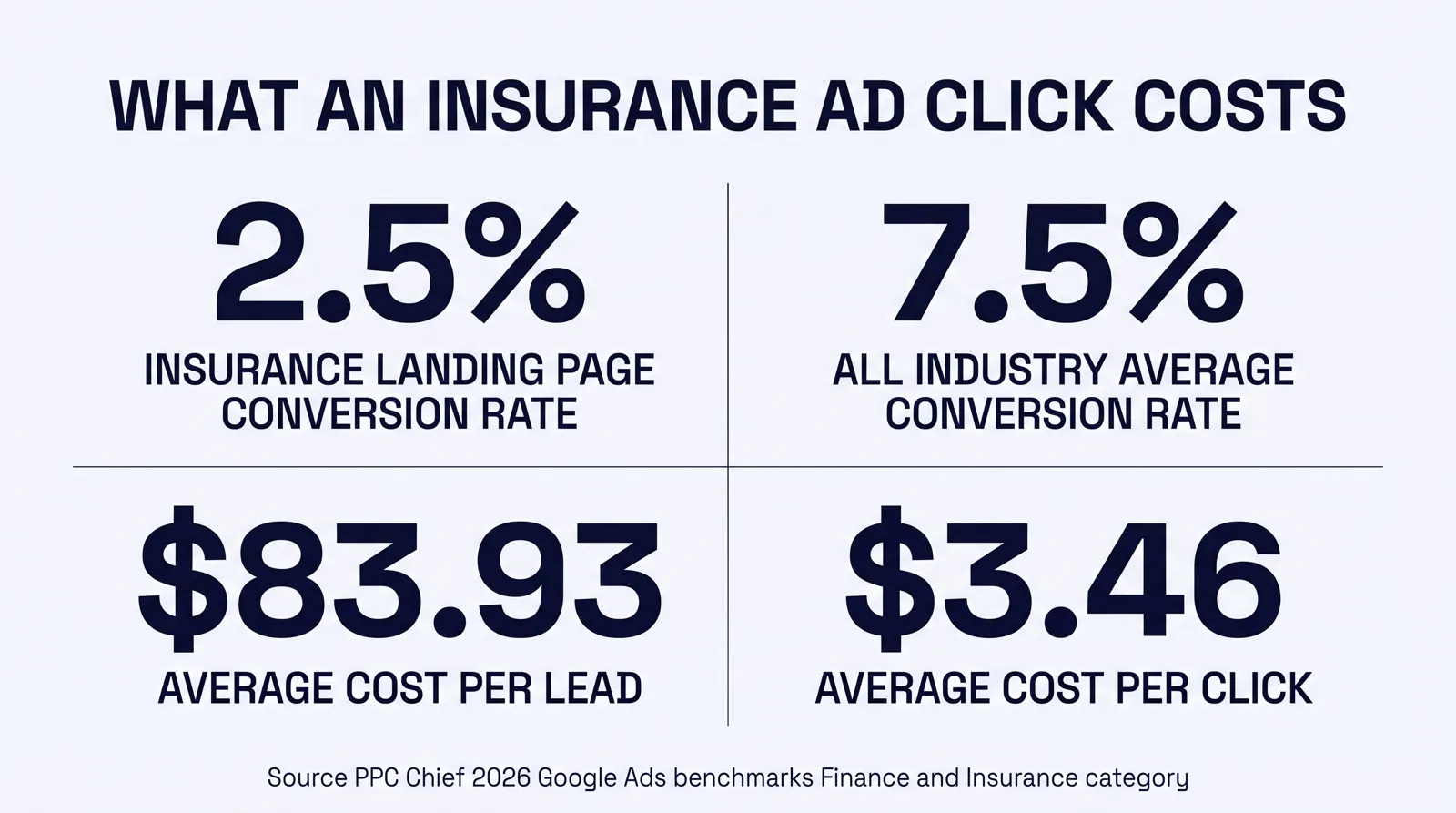
Insurance landing pages convert at 2.5%, against a 7.5% all industry average, PPC Chief's 2026 Google Ads benchmark for the Finance and Insurance category reports1. That gap is not mostly a targeting problem. It is usually a page problem: the wrong headline, too many offers, a phone number nobody can tap, or a disclaimer that either buries the offer or never shows up at all. Google itself names landing page relevance as one of three published Quality Score components4, which means a weak page does not just lose visitors, on Google specifically it can also raise what you pay for the next click.
The click landed. The phone didn't ring.
You turned the ad on. The campaign is spending. Google or Meta shows clicks coming in every day, and somewhere in your dashboard a number is going up that cost you real money. The phone, meanwhile, is doing what it was doing before you spent anything at all. Quiet.
This is one of the more disorienting moments in running paid ads for an agency, because every number you can see looks like it is working. Impressions are up. Clicks are up. The campaign is not disapproved, not under review, not flagged for anything. And still, no calls. The instinct is to assume the targeting is wrong, the keywords are off, or the offer itself does not land with the audience. Sometimes that is true. More often, the ad did exactly what you paid it to do, which was get someone to click, and the page that click landed on did not do its job once they got there.
It helps to be specific about where that click actually lands, because for a lot of agencies the honest answer is embarrassing once you say it out loud. It lands on the homepage. Or on a generic funnel page built once, months ago, and reused for every campaign since, Medicare, ACA, final expense, life, all pointed at the same page with a swapped headline. Or on a page that technically has a quote form, but the form sits below a wall of stock photography and three paragraphs of marketing copy a mobile visitor will never scroll to.
None of that shows up in your ad platform's dashboard, because the ad platform only knows what happened up to the click. What happens after the click is yours to see, and most agencies never actually look.
A two minute check before you read further
Open the exact URL your current campaign sends traffic to, on your own phone, on cellular data, not office WiFi. Time how long it takes you to find the phone number and how many taps it takes to call it. If the answer is "I'm not sure" or "more than one tap," you have already found the first problem this guide is about.
Why a paid click and a phone call are two different outcomes
A click is cheap to earn, relatively speaking. A compelling headline, a decent image, and a bid that wins the auction will get you clicks on their own. A phone call requires something more specific: a visitor who arrives, immediately understands this page is about the exact thing they clicked on, sees one clear next step, and can take that step with a thumb in under a few seconds. Those are different jobs, and most agency landing pages were never built to do the second one.
The most common root cause is a page built to do too many jobs at once. An agency's homepage, almost by definition, has to introduce the agency, list every line of business it sells, link to an about page, a contact page, maybe a blog, and work for a visitor who arrived with no context at all. That is a reasonable job for a homepage. It is a bad job for a page a paid visitor lands on seconds after clicking an ad for one specific offer, because that visitor already has context, and a page built for someone with no context reads as unfocused to someone who already knows exactly what they want.
The second cause sits underneath the first: a mismatch between what the ad promised and what the page delivers. An ad that says "Medicare Advantage plans in your county" sending a visitor to a homepage headlined "Your trusted insurance partner for life" is not technically false, but it forces the visitor to do work, scanning the page to confirm this is actually the right place, that the ad itself already should have done. Every second of that confirmation work is a second closer to the visitor deciding it is easier to hit the back button and try a competitor's ad instead.
Neither of these is a targeting mistake. Both are page construction mistakes, and both are fixable without touching your keywords, your audience, or your bid strategy at all.
What Google itself says decides a good landing page
It is worth seeing this in Google's own words rather than taking it on faith, because the mechanism is published, not speculative. Google Ads Help names three components that make up Quality Score: expected click through rate, ad relevance, and landing page experience, each rated Below Average, Average, or Above Average4. Google defines landing page experience plainly as "how relevant and useful your landing page is to people who click your ad"4. That is the entire published definition. Relevant, and useful, to the person who clicked this specific ad.
| Component | What Google says it measures |
|---|---|
| Expected CTR | The likelihood your ad will be clicked when shown4 |
| Ad relevance | How closely your ad matches the intent behind a search4 |
| Landing page experience | How relevant and useful your landing page is to people who click your ad4 |
Google is explicit that Quality Score itself is a diagnostic tool, not a direct input into the ad auction4. But landing page experience, the component this guide is about, shows up directly inside your own Google Ads account, rated against your actual keywords, and a Below Average rating there is one of the more common reasons an agency's overall account health looks worse than its ad copy alone would predict. You can see your own rating today, free, inside the Quality Score columns of your Google Ads interface.
There is a separate, related signal worth naming here too. Google Search Central states that Core Web Vitals performance, how fast a page loads and how stable it is while loading, "aligns with what our core ranking systems seek to reward"2. A slow page is one of the more common reasons landing page experience rates Below Average in the first place, which means the speed problem and the relevance problem are not two separate issues. They show up on the same line item in your own ad account.
What a non converting landing page costs, in real numbers
PPC Chief's 2026 Google Ads benchmark data puts the Finance and Insurance category at $3.46 average cost per click and $83.93 average cost per lead, with an expected cost per lead range of $63 to $113, against a 2.5% conversion rate for the category compared with a 7.5% all industry average, the page last reviewed May 22, 2026 and updated June 16, 20261. A category converting at roughly a third of the average across all industries is not a small gap. It is the difference between a lead pipeline that fills a calendar and one that leaves an agent checking the phone every afternoon wondering where the campaign went.
| Metric | Finance & Insurance | All industry average |
|---|---|---|
| Avg. cost per click | $3.461 | — |
| Avg. cost per lead | $83.93 (range $63–$113)1 | — |
| Conversion rate | 2.5%1 | 7.5%1 |
A note on sourcing, in the interest of being straight with you: PPC Chief's page draws on a mix of third party studies and its own managed account data, and it is the one benchmark source we could reach and verify live this session. WordStream publishes a comparable annual Google Ads benchmark report that has shown similar Finance and Insurance figures in the past, but it blocked automated access when we tried to verify it today, so we are not citing a number from it here. Treat the PPC Chief figures above as the current best available benchmark, not as two independently confirmed sources, and pull your own account's real numbers before treating any external figure as your baseline.
Here is what that gap looks like in real spend. Say an agency runs $2,000 a month in Google Ads for the Finance and Insurance category, at the $3.46 category cost per click1. That buys roughly 578 clicks a month. At the category's 2.5% conversion rate, those clicks produce about 14 to 15 leads1. If the same page, same spend, same clicks, converted at even half the gap closed toward the 7.5% all industry average, say 4%, a conservative, unsourced midpoint offered here only as illustration and not a promise, that same spend would produce roughly 23 leads, close to 60% more calls from money you are already committing every month.
| Conversion rate | Clicks at $2,000/mo | Leads produced |
|---|---|---|
| Category average, 2.5%1 | ~578 | ~14 to 15 |
| Illustrative midpoint, 4% | ~578 | ~23 |
| All industry average, 7.5%1 | ~578 | ~43 |
Read that table for the shape of the gap, not as a forecast for your account. No guide can promise your page will reach the 7.5% all industry figure, and category averages blend agencies with excellent pages and agencies with none at all. What the math shows honestly is that the category's conversion rate sits far enough below the broader average that even a partial, conservative improvement compounds into real calls every single month, at the exact ad spend you are already paying.
The six things a landing page needs to earn a call
None of what follows is exotic. It is also, by our own count across the agency sites we have built and audited, rarely all present on the same page at once.
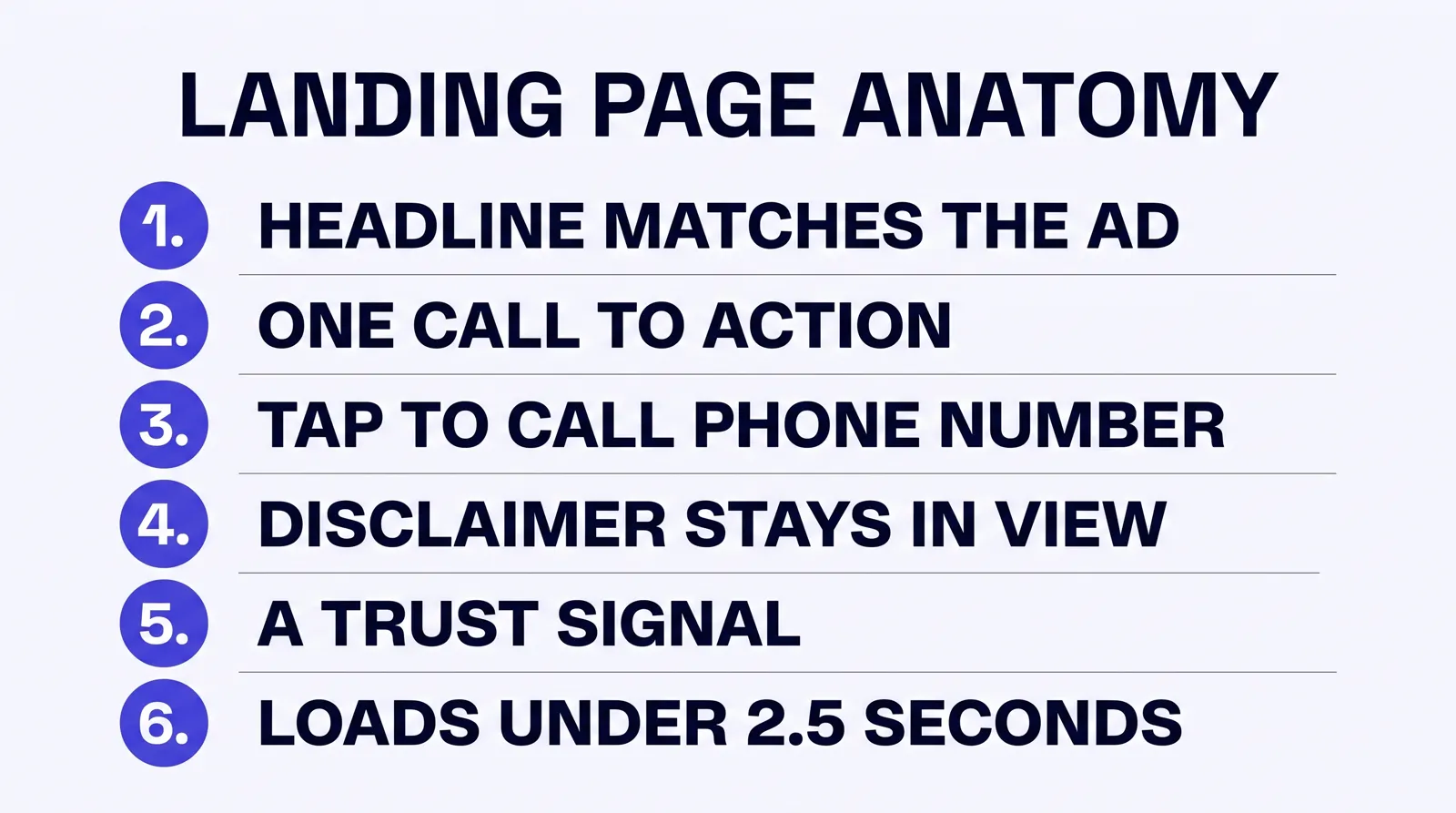
Headline matches the ad
The visitor should read the page headline and immediately recognize the ad they just clicked. This is the fastest way to raise Google's own ad relevance and landing page experience ratings at once.
One offer, one call to action
Every additional link, every secondary offer, every "or browse our other plans" option is a decision the visitor has to make instead of calling. A page built for one campaign should ask for one thing.
A real tap to call phone number
Built as an actual tel: link, not a phone number baked into a hero image, and not buried in a footer. Google itself is phasing out standalone call ads in favor of call assets attached directly to responsive search ads, new call ads stop being creatable in February 20266, which makes a real tappable number on the landing page the more durable piece to get right.
The disclaimer stays visible
A TPMO line, a non government endorsement notice, or a consent statement should be readable without a scroll past a wall of copy. Covered in full in the next section, because it is the one most agencies get backwards.
A trust signal above the fold
A licensed states list, a review count, or a named, photographed agent does real work here. A paid visitor comparing three agencies in three tabs is looking for a reason to trust the one they land on first.
Finishes loading before patience runs out
Google's published good Largest Contentful Paint threshold is 2.5 seconds or less3. A paid visitor has invested nothing but a tap, so a slow page gives them permission to leave with zero sunk cost.
If you want a second opinion on where your own page stands
The free Audit scores a live site against signals like this in about a minute, no signup required. Run a free Audit.
Where the disclaimer goes without burying the offer
This is the item agencies get backwards most often, usually in one of two opposite directions. Some pages skip the required disclaimer language entirely, which is a compliance problem well outside the scope of a marketing guide. Others overcorrect, stacking every compliance line, every carrier logo, and every legal notice above the fold, so the actual offer, the reason the visitor clicked, is pushed below a wall of text a mobile visitor never scrolls past.
Neither version serves the visitor or the agency. The practical middle is a page where the disclaimer sits in a clearly readable band, typically directly under the primary call to action or in a persistent footer, in text large enough to read without zooming, present on every page view, but not competing with the headline and the phone number for the first thing a visitor's eyes land on. The goal is simple: a compliance reviewer can find it in one glance, and a real visitor is not forced to read it before they can find the thing they clicked the ad to see.
This matters more on insurance landing pages specifically than on most other industries' pages, because the required language is longer and more frequent than almost any other advertiser deals with. A TPMO disclaimer, a government non endorsement line, sometimes a bilingual requirement, and an e-signature or consent capture on top of the base offer are all legitimate, separate requirements stacking on the same page. Treating each one as a design element with its own defined place, rather than text appended wherever there happened to be room, is the difference between a page that passes a compliance review and converts, and a page that passes review and quietly loses the visitor before they ever reach the call to action.
If your quote form itself, not just the disclaimer around it, is the thing not actually capturing valid consent or routing correctly, that is a deeper problem than page layout and worth reading separately. We cover what makes a quote form real instead of decorative here, and the TCPA consent language specifically belongs with the current consent capture rules covered in this guide.
Mistakes that quietly kill the call
When a campaign underperforms, the instinct in most agencies is to touch the ad account first. Tighten the keywords, raise the bid, try a new audience. Sometimes that is the right move. Often it is adjusting the part of the funnel you can see instead of fixing the part sitting quietly on your own site.
Sending every campaign to the same page
A Medicare campaign, a final expense campaign, and an ACA campaign all pointed at one shared funnel page means none of them get a headline that actually matches the ad that sent the click.
Putting the phone number in an image
A phone number baked into a hero graphic looks fine on a desktop monitor and is completely untappable on the phone most paid visitors are actually holding.
Adding a chat widget to "help" conversion
A chat widget is a script the browser has to load before the page settles. Bolting one onto an already slow page usually makes the Largest Contentful Paint problem worse, not better.
Testing the page on a desktop browser
Most paid insurance traffic lands on a phone first. A page that looks clean on a wide monitor can still bury the call to action below three screens of scroll on mobile.
Offering three ways to convert at once
A call button, a chat widget, and a long form on the same page do not triple your odds. They split the visitor's attention and usually lower every single conversion path's completion rate.
Never re-checking after a redesign
A new theme update, a marketing team adding a tracking pixel, or a plugin update six months later can quietly undo a working page. Landing page experience is not a one time project.
Check your own landing page in ten minutes
Before changing anything, find out where your actual campaign's actual landing page stands today. This does not require new software or a developer.
A simple ten minute audit
- Open the exact URL your live campaign points to, on your own phone, on cellular data.
- Read the headline. Does it match the ad you just clicked, word for word or close to it?
- Find the phone number. Tap it. Does it open your phone's dialer, or does nothing happen?
- Scroll from the top. How far do you go before you see the offer and a way to act on it?
- Find the disclaimer. Is it readable, or do you have to hunt for it or zoom in?
- Run the URL through Google's free PageSpeed Insights tool and read the mobile score, not the desktop one, since Google measures each under different simulated hardware and network conditions5.
Most agencies running this check for the first time find at least two of the six items in the anatomy section above missing or broken on their live campaign's actual landing page. That is a normal result, not a sign the agency has been doing something unusually wrong. Page builder templates and reused funnel pages were not designed with a specific campaign's ad copy in mind, because they were built once and pointed at whatever campaign came next.
What a real fix looks like
This is the section built to describe what we actually do, so it stays narrow and sticks to what is live on our own pricing page. Digital Foundation replaces a shared funnel template or a homepage doing double duty with a page built for the specific offer a campaign is running, on Astro, so the architecture starts fast instead of fighting a page builder's runtime for every visitor8. Our builds score 90 or higher on Lighthouse performance for both mobile and desktop, and a number of pages score 100, the tier and pricing verified live on the Digital Foundation page this session9.
The phone number is built as a real tappable link from the start, not added as an afterthought. The disclaimer has a defined place in the layout rather than being squeezed in wherever there was room. And where a campaign needs a quote, the widget behind it pulls real premiums and subsidy figures from live federal data sources, not a static form showing the same example numbers to every visitor regardless of their actual county or plan year, which is the same fake quote problem covered in detail in the companion guide linked above.
| Tier | Price | What it adds |
|---|---|---|
| Starter | $247/mo | Campaign-ready pages, GBP management, AI chat widget9 |
| Pro | $497/mo | Plus weekly new pages, review harvesting, 24/7 AI receptionist9 |
| Scale | $997/mo | Plus daily new pages, up to 4 languages, monthly newsletter9 |
Every tier is month to month with a 14-day free look period, verified live on the Digital Foundation page this session9. If your agency's needs go past a standard campaign page, a custom quoting tool wired to a specific carrier, or a conversational AI follow-up flow that keeps context on every caller, that work is scoped on a call under AI Expert instead of sold as a fixed monthly line.
It is fair to ask whether a dedicated page is worth building if your current campaign is small. For a single producer running a light, occasional budget, the ten minute audit above and a few of the cheaper fixes, a real tel: link, a trimmed form, a headline that matches the ad, will get you most of the way there without a rebuild. The case for a full dedicated build gets stronger the more consistent and the larger your monthly spend already is, because every point of conversion improvement compounds against dollars you are committing anyway, month after month.
What changes once the page does one job
Strip away the platform names and the outcome here is narrow and concrete. Same ad spend, same keywords, same offer, a larger share of the clicks you already paid for turn into an actual phone call, because the page those clicks land on is built around the one thing the ad promised rather than serving five audiences at once. Nothing about your targeting or your bids has to change for that shift to show up in your call volume.
There is a second lever that moves at the same time. A landing page experience rating that improves from Below Average toward Above Average also improves Quality Score, which can lower what you pay per click at the same ad position, on top of the conversion gain itself. Two separate numbers, cost per click and conversion rate, both moving in your favor from the same underlying fix, which is why the effective cost per call tends to move faster than either number would suggest on its own.
There is also a compounding piece worth naming. A fast, focused landing page built on the same architecture as the rest of an agency's site is not a separate project from building an organically discoverable, AI-citable site. Google states plainly that its core ranking systems reward the same Core Web Vitals performance a converting landing page already needs2, so the paid traffic fix and the organic growth project are the same foundation doing two jobs, not two separate line items competing for budget. Google's own published case studies document what that foundation is worth: Nuvemshop improved LCP health from 57% to 96% across its stores between January 2025 and January 2026 and measured an 8.9% increase in mobile, organic-search conversion rate as a direct result7, the same mechanism behind item six in the landing page anatomy checklist above.
What changes if you run ads for more than one office
Everything above holds for a single agent running one campaign. It compounds for an FMO or IMO running paid traffic across several offices or several downline agents, each one often reusing the same shared funnel template regardless of which office or which line of business the campaign is actually for.
If five offices are each spending $2,000 a month at the category's 2.5% conversion rate, a shared, unfocused template is not a problem that is five times smaller than one agency's. It is five times larger, because the same structural weakness, no headline match, no tappable phone number, a buried disclaimer, is quietly taxing five separate ad budgets on the exact same gap at once, every month the campaigns keep running.
Worth a real conversation at this scale
Standardizing a campaign-ready landing page template across multiple offices, each keeping its own brand and its own disclaimer requirements, is exactly the kind of work we handle for agencies running more than one site. Book a call.
Questions agents ask
What makes an insurance agency landing page actually convert ad clicks into calls?
A headline that matches the ad word for word, one offer and one call to action, a phone number built as a tappable tel: link instead of an image, a compliance disclaimer that stays visible without burying the offer, a trust signal above the fold, and a page that finishes loading before the visitor's thumb moves to the back button. Each one is a documented factor in either Google's own Quality Score definition or basic mobile usability, not a guess.
Should I send paid ad traffic to my homepage or build a dedicated landing page?
A dedicated landing page almost always wins for paid traffic, because a homepage has to serve every visitor's intent at once, nav menu, multiple products, an about page link, while a paid visitor already clicked on one specific offer and expects the page to be about that offer alone. Google Ads Help names landing page experience, defined as how relevant and useful the page is to the person who clicked, as one of three published Quality Score components, and a homepage built to serve everyone is structurally less relevant to any one ad than a page built for that one campaign.
What is Google Ads Quality Score's landing page experience component, exactly?
Google Ads Help lists three components that make up Quality Score: expected click through rate, ad relevance, and landing page experience, each rated Below Average, Average, or Above Average. Google defines landing page experience plainly as how relevant and useful your landing page is to people who click your ad. It is a diagnostic rating, not a direct auction input by Google's own description, but a low rating on it is one of the most common reasons an agency's overall Quality Score sits lower than its ad copy alone would predict.
How many form fields should an insurance quote landing page have?
As few as the page can get away with and still route the lead correctly, typically name, phone, ZIP code or county, and the one or two details that change the quote. Every additional field is one more reason a mobile visitor who already decided to call instead abandons a form they were never going to finish on a phone keyboard in the first place.
Where should the TPMO disclaimer or non government disclaimer go on a landing page?
Visible without a scroll or a tap to reveal it, typically in the footer band or directly under the primary call to action, in text large enough to read on a phone screen. The mistake is not including it, it is treating it as an afterthought appended below a thousand pixels of marketing copy where a compliance reviewer has to hunt for it and a real visitor never sees it at all.
Does a slow landing page affect what I pay per click, or only how many visitors convert?
Both. Google states plainly that Core Web Vitals performance aligns with what its core ranking systems seek to reward, and landing page experience is a named Quality Score component. A page that loads slowly or buries its offer can show as Below Average on that component, which is one input into a lower Quality Score, and Quality Score is part of what sets your actual cost per click at a given ad position. The conversion loss and the cost increase are two separate problems stacking on the same page.
Is a dedicated landing page worth building for Facebook and Meta ads too, or just Google?
Yes. Meta does not publish a Quality Score by that name, but its delivery system estimates how likely a click is to lead to a valued action and prices delivery partly on that estimate, the same mechanism in different packaging. A page built around one offer, with the phone number tappable and the form short, performs the same way on Meta traffic as it does on Google traffic, because the visitor's phone and patience are the same regardless of which platform sent the click.
What does Digital Foundation actually change about an agency's landing pages?
It replaces a shared funnel template or a homepage doing double duty with a page built on Astro for the specific offer a campaign is running, with the phone number built as a real tel: link, the disclaimer placed where a visitor and a compliance reviewer can both find it, and a quoting widget wired to live federal data instead of a static form with example numbers. Our builds score 90 or higher on Lighthouse performance for both mobile and desktop, and a number of pages score 100, verified live on the Digital Foundation pricing page.
Sources
- PPC Chief. "Google Ads Cost, Finance and Insurance," cost per click, cost per lead, and conversion rate benchmark, last reviewed 2026-05-22, page updated 2026-06-16, verified live 2026-11-01. ppcchief.com.
- Google Search Central. "Understanding Core Web Vitals and Google search results," ranking systems statement, last updated 2025-12-10, verified live 2026-11-01. developers.google.com.
- web.dev. "Largest Contentful Paint (LCP)," published good, needs improvement, and poor thresholds, last updated 2025-09-04, verified live 2026-11-01. web.dev.
- Google Ads Help. "Quality Score: definitions," expected CTR, ad relevance, and landing page experience components, verified live 2026-11-01. support.google.com.
- Google Developers. "About PageSpeed Insights," mobile and desktop measured on different simulated hardware, last updated 2024-10-21, verified live 2026-11-01. developers.google.com.
- Google Ads Help. "About call ads," call assets replacing call ads, verified live 2026-11-01. support.google.com.
- web.dev. "How Nuvemshop's image prioritization strategy led to a 68% improvement in LCP and 8.9% more conversions," published 2026-06-24, measured January 2025 to January 2026, verified live 2026-11-01. web.dev.
- Astro. "Why Astro," zero JavaScript by default, verified live 2026-11-01. docs.astro.build.
- Strategic AI Architects. "Digital Foundation," pricing and guarantee, verified live 2026-11-01. strategicaiarchitects.com.
Talk it through
Want a second pair of eyes on it?
Free 30 minutes. Bring what you found, or bring nothing and we will look together at how AI engines read your site and which fixes move first.
See what your own landing page is actually costing you
Run the free Audit, a live AEO Audit plus a HIPAA tracking scan of your site, in under a minute.
Related reading: why your agency's cost per lead keeps climbing · what makes a quote form real instead of decorative