Playbook
Your Translate Button Is Not a Spanish Website
Most agencies that "offer" a Spanish site have added a browser widget that rewrites the page after it loads. Google's crawler never sees it, so there is no second page to rank, and Latino consumers made 29.4% of HealthCare.gov plan selections in 2024.


20 min read
A browser translate widget is not a second webpage, and Google cannot rank what it never receives. Googlebot indexes the HTML your server sends, and a client-side translate widget changes what a visitor's browser displays after the page loads, not what the server actually sends6. Latino consumers made up 29.4 percent of HealthCare.gov plan selections in 2024, up from 20.4 percent in 20201, and 28 percent of Hispanic adults now have a smartphone but no home broadband, the highest rate of any group Pew Research measures4. A real Spanish version, built as its own server-rendered page with correct hreflang tags, is what actually gets indexed, ranked, and found.
The little globe icon in your footer, and what it actually does
Scroll to the bottom of a lot of agency websites and you will find a small globe icon or a dropdown that says something like "Select Language." Click it, pick Spanish, and the page redraws in Spanish right there in the browser. It feels like you just built a Spanish website. You did not. You turned on a feature that exists entirely inside that one visitor's browser tab, for that one visit, and it leaves behind nothing a search engine can find later.
This matters because the actual question an agency owner is usually trying to answer is not "can a visitor who is already on my site read it in Spanish." It is "will a Spanish-speaking prospect searching for an agent find me at all." Those are two different problems, and a translate widget only ever answers the first one. This guide is about that second problem, getting a real Spanish page indexed and ranked in classic search at all; a separate guide covers why a Spanish page that does get indexed still might not get lifted and attributed by an AI answer5.
The most common versions of this feature are a free embeddable Google Translate widget, a plugin bundled with a page builder, or a one-line script added by whoever built the site originally and never revisited. All three work the same way under the hood: JavaScript running in the visitor's browser scans the page text that already loaded and swaps it for a translation, in place, after the fact.
It is also worth naming what agencies usually have instead of a real Spanish build: a third-party plugin bundled into a WordPress theme or a GoHighLevel funnel template and marketed as a selling point, "multilingual ready," on the page builder's own feature list. That claim is technically true in the narrowest sense, the words on screen do change, but nothing about it promises a second indexable page, and the plugin's own setup documentation rarely claims otherwise if you read past the marketing line at the top.
Worth checking before you read further
The free Audit checks whether your site has a real, separately indexable Spanish version or just a browser widget, along with your broader AEO and compliance posture, in about a minute. strategicaiarchitects.com/audit.
Why a browser widget can't become a second webpage
Here is the mechanism, in plain terms. When Googlebot requests a page, your web server sends back a block of HTML, the actual document the server generated for that URL. That response is what gets parsed, indexed, and eventually matched to a search query. A translate widget does not touch that server response at all. It runs afterward, in the browser, rewriting the text that already arrived.
That ordering is the entire problem. There is only ever one URL, and the HTML that URL returns is still English, every single time anything requests it, including Google's crawler. Nothing about clicking the widget changes the address bar to a new URL, and nothing about it changes what the server hands back on the next request. A second, Spanish version of the page simply does not exist anywhere Google can find it, because it is never written down anywhere except temporarily, in one visitor's browser memory, for one session.
A real localized page works the opposite way: it lives at its own URL, your server returns actual Spanish HTML when that URL is requested, by anyone, including a crawler, and that HTML can be indexed, ranked, and returned for a Spanish-language search, completely independent of whether a human ever clicks anything.
What Google's crawler sees when a visitor clicks it
It helps to walk through both paths side by side, because the difference is not a matter of quality or effort, it is a difference in what exists at all.
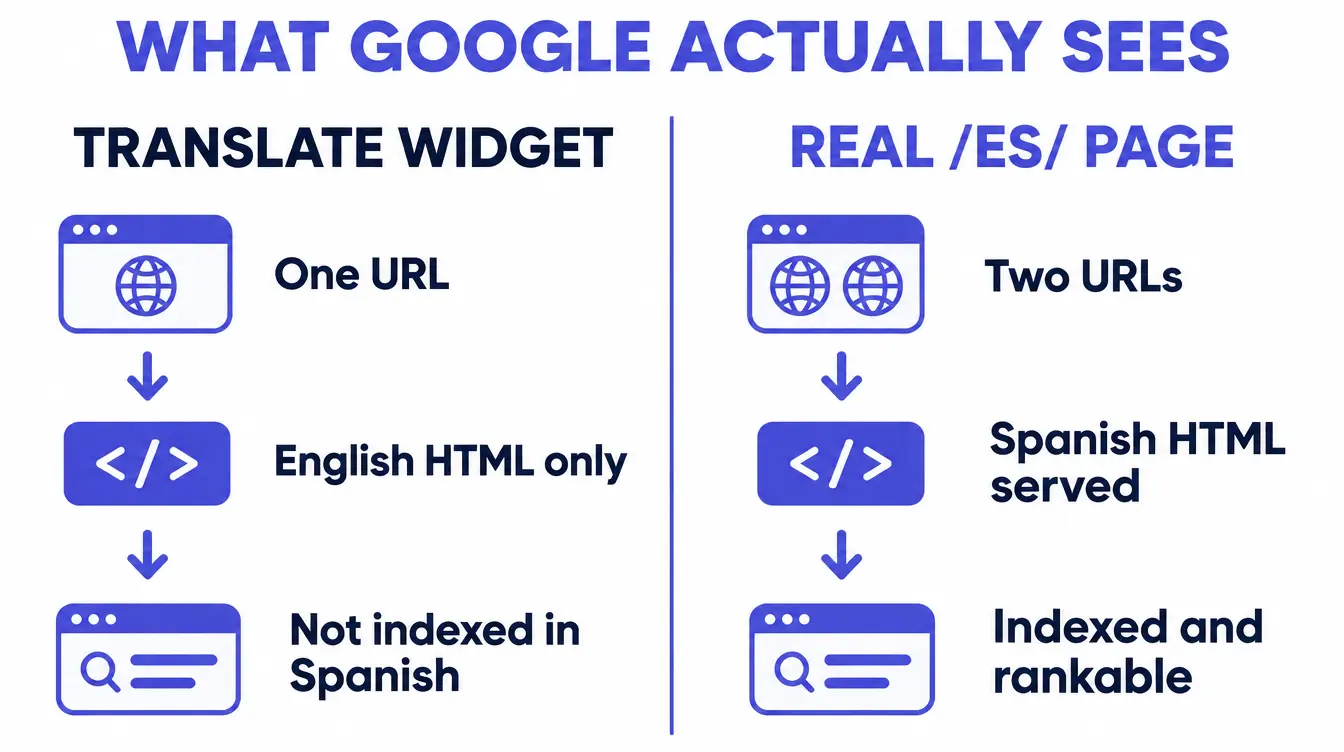
With a translate widget: there is one URL. The server always returns English HTML, regardless of who or what requests it. The result is that nothing in Spanish is ever indexed, because nothing in Spanish was ever actually served.
With a real localized build: there are two URLs, your English homepage and something like yoursite.com/es/, each requested independently. The server returns genuine Spanish HTML for the second one, whether the requester is a human or Googlebot. Both can be indexed. Both can show up in search results for their own language's queries. A Spanish-language search for an agent in your city can return your Spanish URL directly, something a translate widget can never cause to happen, because it never creates a second thing to return.
None of this is a judgment about effort or intent. An agency that added a translate widget usually did it because someone, reasonably, wanted to be helpful to Spanish-speaking visitors and this was the option that showed up first in a plugin search. The technical reality underneath it is just not what the feature's name implies.
The Spanish speaking market your current setup can't reach
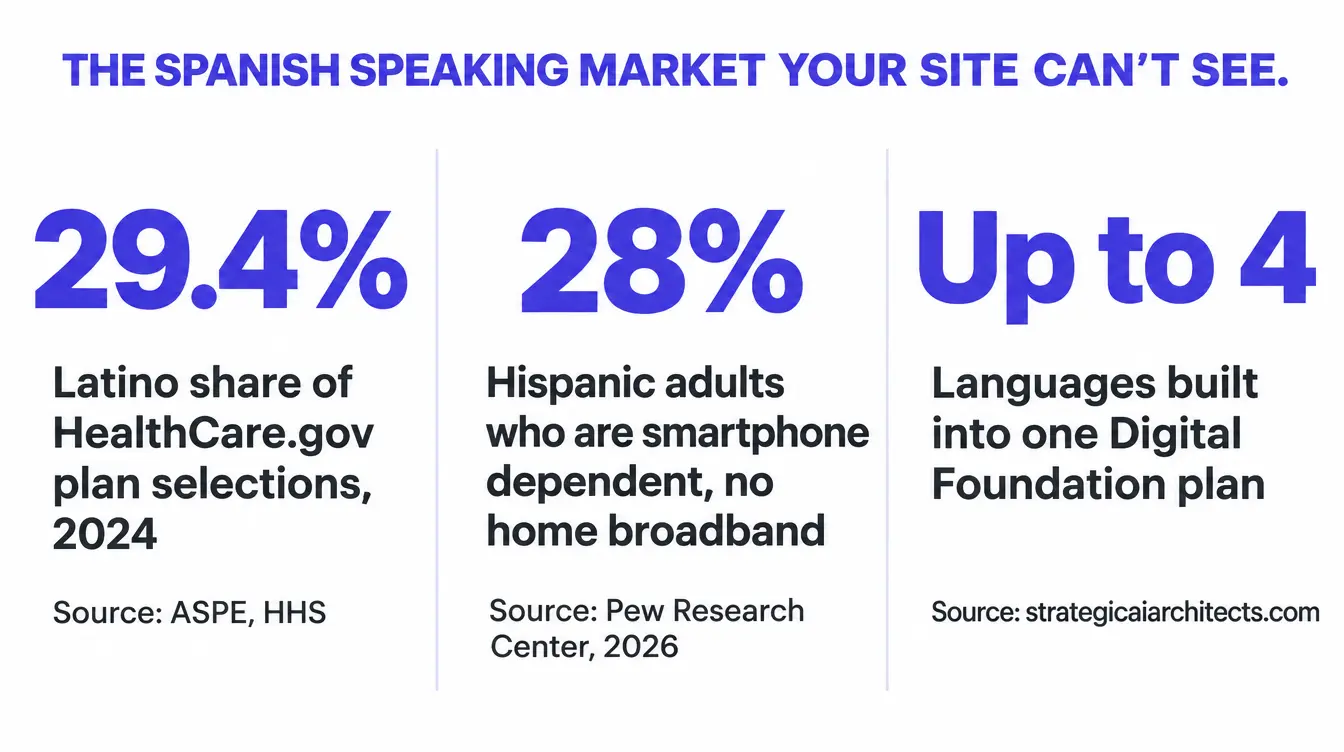
The size of what a translate widget misses is not a rounding error. During the 2024 Open Enrollment Period, Latino consumers represented 29.4 percent of all consumers selecting plans on HealthCare.gov, up from 20.4 percent in 2020, a 185 percent increase in the number of Latino consumers selecting plans over that four year span, according to an October 2024 HHS issue brief that uses a validated statistical method to account for the roughly half of applicants who do not voluntarily report race or ethnicity1. Put another way, essentially three in ten HealthCare.gov enrollees in 2024 were Latino, a group whose plan selections grew faster over that period than any other racial or ethnic group except Black consumers, who grew from a smaller base1.
It is worth being honest about a complication in that number rather than picking the figure that tells the cleanest story. KFF's own public tracker of marketplace plan selections by race and ethnicity, built from the same federal public use files but using raw self-reported data rather than ASPE's imputation method, shows Hispanic and Latino consumers at 10.9 percent of the national total of 24,319,713 marketplace plan selections for the 2025 Open Enrollment Period2. The gap between 29.4 percent and 10.9 percent is not two sources disagreeing about the same fact, it is the difference between a figure corrected for the roughly half of applicants who skip the race and ethnicity question and a figure counting only what people actually volunteered. ASPE's brief states plainly that providing this information is voluntary and that data on race and ethnicity was missing for more than half of all individuals who made selections on HealthCare.gov in 2024, which is exactly why it built a statistical correction rather than reporting the raw, undercounted share1. We use the corrected 29.4 percent figure as the more reliable estimate specifically because the uncorrected version is known to understate Latino representation, and we are flagging the discrepancy here rather than quietly picking the bigger number.
Scale matters too. HealthCare.gov alone logged 4,601,634 total plan selections for the 2026 Open Enrollment Period through November 29, 20253, and that is one federal platform in one enrollment window, not the full year-round book of ACA, Medicare, life, and annuity business an independent agency actually works. Whatever share of that pool is Spanish-dominant or Spanish-preferring, a site that cannot be found in a Spanish search is invisible to all of it, not some of it.
A reasonable question to ask yourself first
If your book has genuinely never included a Spanish-speaking client and your county's population does not suggest meaningful demand either, this is not the first thing to spend on. If you have ever had someone ask whether anyone at your agency speaks Spanish, that is the signal this section is about.
Why this is the audience you can least afford to load slow for
There is a second, separate reason this matters beyond raw market size: how this audience actually accesses the internet. Pew Research Center's most recent survey, fielded February 5 to June 18, 2025 and published January 8, 2026, finds that 28 percent of Hispanic adults are "smartphone dependent," meaning they own a smartphone but do not have a home broadband subscription, the highest share of any racial or ethnic group the survey measured, compared to 19 percent of Black adults, 13 percent of White adults, and 11 percent of Asian adults4. That Hispanic share rose sharply, from 20 percent in 2023 to 28 percent in 2025, while the share of Hispanic adults with home broadband fell over the same period, from 75 percent to 68 percent4.
Translate that into what actually happens on your site: a Spanish-dominant prospect is disproportionately likely to be reaching your agency on a phone, over a cellular connection, not a laptop on home wifi. A page-builder site that loads a heavy JavaScript runtime and a theme before any content appears is a bad experience for every visitor, and it is a measurably worse one for the segment of your audience most likely to be mobile-only. This is also exactly the audience for whom the claim we make about our own builds actually matters in practice: we build on Astro, which ships zero JavaScript by default, so pages arrive as finished HTML instead of a framework that has to boot before anything renders, and our builds score 90 or higher on Lighthouse performance on both mobile and desktop, with a number of pages scoring 100.
Google's own Core Web Vitals program measures this directly through Largest Contentful Paint (how long the main content takes to appear) and Interaction to Next Paint (how quickly the page responds once someone actually taps something), and both are scored for mobile separately from desktop. A visitor on a slower cellular connection, which is more common on a smartphone-dependent connection than on home broadband, feels every extra second of a bloated page-builder theme more acutely than a visitor on fast home wifi does. The agencies with the most to lose from a slow mobile build are, by this data, disproportionately the ones trying hardest to reach Spanish-speaking prospects in the first place.
What actually counts as a Spanish version of your site
Google is explicit that alternate-language versions do not need to live on the same domain, or even the same type of address. Its own documentation on localized versions of a page gives examples using a subdomain and a completely separate country-code domain, alongside the more common subdirectory pattern6. What it does require is that each language version be its own real, separately requestable URL, returning its own real HTML, annotated so Google understands the relationship between them.
For a small or mid-sized agency site, a subdirectory such as yoursite.com/es/ is almost always the practical choice. It shares your existing domain's established authority instead of asking Google to build trust in a brand-new property from zero, and it is simpler to maintain inside one codebase than a separate subdomain or country domain would be.
There is a second reason the subdirectory approach fits an agency site specifically, beyond ease of setup. Your English site's existing backlinks, reviews, and trust signals, built up over years of being the agency's one website, extend to a page living under the same domain in a way they do not automatically extend to a brand-new subdomain or a separate .mx or .es-style country domain. A fresh subdomain is treated with enough independence that it can take longer to earn its own ranking footing, which matters more for an agency launching its first Spanish pages than for a large multinational that can afford to run a fully separate regional property for years before it matures.
Hreflang, in plain English
Hreflang is the annotation that tells Google "this page and that other page are the same content, in different languages, so show whichever one matches the searcher." Google's own documentation on this spells out several rules that are easy to get wrong6:
Self-reference every version
Each language version must list itself as well as every other language version, so the English page links to the Spanish page and also links to itself.
Return links are required
If the English page links to the Spanish page, the Spanish page must link back. A one-way annotation can be ignored or misread entirely.
Use valid language codes
Codes come from a real standard; a region code alone, such as just "MX," is not valid on its own, and reserved codes like "EU" or "UK" have no effect on Search.
Use fully qualified URLs
Alternate URLs need the full address, including the protocol, not a bare path or a protocol-relative shortcut.
Add x-default sparingly
The x-default tag is a fallback for visitors whose language does not match any version you offer, and it is most useful on a language-selector or auto-redirecting homepage, not every page.
Pick one method and keep it consistent
Hreflang can be declared in page HTML, in your sitemap, or in HTTP headers. Mixing methods inconsistently across the site is a common source of the annotation being ignored.
Where agency bilingual builds usually go wrong
In order of how often we see each one: a translate widget presented as "we have a Spanish site," with no second URL behind it at all. A Spanish homepage that was built once, with no Spanish version of the actual quote form, so the visitor who gets that far still hits an English form at the finish line. Hreflang tags added on the English page but never returned on the Spanish page, which Google's own rules say can cause the whole annotation to be disregarded6. And literal, word-for-word machine translation of legal or compliance language, like a TCPA consent disclosure, published without a bilingual person ever checking whether the translated sentence still says what the English one legally says.
That last one deserves its own warning, separate from the SEO question entirely: a disclosure that is legally sufficient in English is not automatically legally sufficient in Spanish just because a translation tool produced grammatically correct sentences. Compliance language is a case where "close enough" from software is not the same bar as "close enough" for marketing copy.
A fifth, quieter mistake: building the Spanish version once, as a launch project, and then letting it fall behind every time the English site gets a new page, a new disclosure update, or a pricing change. A Spanish homepage that still shows last year's plan-year language while the English site has already been updated is worse than no Spanish page at all for a visitor who notices, because it signals the Spanish version is an afterthought rather than a maintained part of the business.
What machine translation alone does not fix
Google's spam policies do not ban machine translation outright, but they do flag content generated at scale through automated transformations, including translation, when it adds little value for users. A literal, unreviewed translation of a quote form or legal disclosure is exactly the pattern that description covers, and it carries legal risk on top of any SEO risk.
One page, two real versions: a worked example
Here is the same homepage, built the wrong way and the right way.
| Element | Translate widget | Real localized build |
|---|---|---|
| URL | One URL for everyone | yoursite.com/ and yoursite.com/es/, each its own address |
| What the server returns | English HTML, always, to any requester | English or Spanish HTML, depending on which URL is requested |
| hreflang annotation | None, because there is only one page to annotate | Each page self-references and links to the other, per Google's rules |
| Indexable in Spanish search | No | Yes |
| Quote form at the end | Usually still English, mid-translation | Spanish form, matching the rest of the path |
The gap between the two columns is not expensive to close technically. It is mostly a matter of building the Spanish version as a real route from the start, with its own template rendering real Spanish HTML, rather than trying to retrofit a translation layer on top of a site that was never designed to serve a second language. An agency rebuilding its site anyway loses almost nothing by doing it right the first time; an agency bolting a Spanish version onto an existing WordPress or page-builder site later usually finds the retrofit is the harder and more expensive path, which is the same pattern as most of the compliance and performance problems a page-builder site accumulates over time.
Translation quality is also a ranking and trust signal
Once the technical structure is right, the words on the page still matter. A page that reads like a literal, word-for-word machine translation, with the slightly off phrasing that produces, is a weaker trust signal to a Spanish-dominant reader than a page written the way a bilingual person in your market would actually say it. This is not primarily an algorithmic concern, it is a conversion one: a prospect who notices the translation is awkward reasonably wonders what else about the agency was done the cheap way.
A practical middle ground: use machine translation as a first draft, then have a bilingual speaker, ideally someone who actually talks to your Spanish-speaking clients, edit it for how your specific market actually phrases things, particularly for product names and plan terminology where a literal translation can be confusing or simply wrong.
Insurance terminology is a particularly easy place for a literal translation to misfire. "Premium" is usually rendered as "prima," which is correct in an insurance context but is also the word for a female cousin, so the surrounding sentence has to make the meaning unambiguous rather than relying on the word alone. "Deductible" is "deducible," a near-cognate that reads naturally to a fluent speaker but can look like a typo of "deducir" (to deduct, the verb) to someone skimming quickly, which is exactly why a bilingual review catches phrasing a translation tool has no way to judge. "Open Enrollment" does not have one universal Spanish rendering across Latin American Spanish dialects, agencies serving a majority-Mexican client base and agencies serving a majority-Puerto Rican or Cuban client base sometimes expect different phrasing for the same federal program, which is a market-specific judgment call no automated tool can make for you.
Tagging each version so search and AI both understand it
Each language version of a page should carry its own schema markup, not a single schema block shared across
both. The inLanguage property on your WebPage or BlogPosting schema
should say "en" on the English page and "es" on the Spanish page, matching the actual content, and each
version's Breadcrumb and Article schema should point at its own URL rather than reusing the English one.
This is a small detail, but it is the same kind of structured signal that AEO and GEO depend on broadly:
search and AI systems both do better with content that states, explicitly, what it is and in what language,
rather than leaving it to be inferred.
The same logic extends to your sitemap and your llms.txt file. A sitemap entry for a Spanish
URL should sit alongside its English counterpart, not be omitted because "it's really the same page," and
a crawler file that welcomes AI crawlers should welcome them to both language paths equally. An agency that
gets this right ends up with two complete, separately citable surfaces instead of one surface and one
decoration, which is the entire point of doing this as a real build rather than a visual feature.
How to tell whether the Spanish build is actually working
Once a real Spanish version exists, you can actually measure it, which is itself a meaningful improvement over a translate widget that leaves no trail at all. Google Search Console reports performance per URL, so a Spanish subdirectory shows its own impressions, clicks, and average position separate from the English site, rather than everything blending into one undifferentiated number. If your Spanish pages are indexed but earning almost no impressions after a few weeks, that is a sign to check the hreflang annotations and sitemap entries rather than assume the content itself is the problem.
The more direct signal, and the one that actually matters to the business, is simpler than any search console metric: whether the phone starts ringing with calls in Spanish, or whether the Spanish quote form starts producing submissions where it never had before. Tag the Spanish version's quote form distinctly in your CRM, even something as basic as a hidden form field noting which language the visitor submitted from, so you can see the lead volume directly instead of inferring it from traffic numbers alone.
How we build bilingual sites: up to 4 languages, one plan
This is built into Digital Foundation rather than sold as a separate project. Digital Foundation Pro publishes a site in up to 2 languages, and Digital Foundation Scale goes up to 4, both at no extra cost beyond the plan's own price, and a page published in several languages counts as one page against the plan's monthly content allowance rather than multiplying the bill7. Each language version is its own server-rendered page with its own URL, correct hreflang annotations in both directions, and its own schema, which is the actual engineering difference between "we have a Spanish site" and "we clicked a translate button once."
The free Audit checks whether your current site has a real, indexable Spanish version or just a browser widget, along with the rest of your AEO and compliance posture, in about a minute8.
What changes once your Spanish pages are real pages
Nothing about the visible experience for an English-speaking visitor changes. What changes is that a Spanish-language search can now return your site at all, your Spanish quote form becomes something a search engine, and eventually an AI answer, can actually find and recommend, and a prospect who prefers to read in Spanish reaches a page that was built for them instead of patched for them after the fact.
This is not a one-time project that gets finished and forgotten any more than your English content is. New pages need their Spanish counterpart built alongside them, not bolted on later, which is the reason this works better as part of an ongoing content cadence than as a single translation sprint.
It also compounds the same way your English content does. Every new Spanish location page, answer page, or blog post adds another indexable surface in a part of the search landscape most competing agencies have not touched at all, since a widget cannot compound, it can only sit on the homepage forever doing the same nothing it did on day one. An agency that starts now, even with a handful of core pages, is building a library in a language most of its local competitors have never published a single real page in.
Questions agents ask
Isn't a translate widget better than nothing?
It is better than nothing for a visitor who is already on your English page and wants a rough read of it. It does nothing for a visitor who searches in Spanish and never finds your site in the first place, because Google's index has no Spanish URL to return. A widget serves the handful of people who land on your site by accident; it does not reach the much larger group searching in Spanish from the start.
Will adding a Spanish version hurt my English site with duplicate content?
Not if it is built correctly. Duplicate content penalties apply to identical content competing for the same query, not to the same information published in two different languages for two different audiences. Hreflang annotations tell Google these are deliberate alternate-language versions of the same page, which is the opposite of the signal that triggers a duplicate content problem.
Can I just machine-translate my whole site and publish it?
You can technically publish it, and Google's spam policies do not ban machine translation outright. They flag content generated at scale, including through automated translation, when it adds little value for users. A literal, unreviewed machine translation of an insurance quote form or a compliance disclaimer is exactly the kind of low-value page that policy describes, and it is also a real risk if the translated legal language is wrong. Machine translation as a first draft that a bilingual person then reviews is a different, much safer thing.
Do I need a Spanish version of every page, or just the homepage?
Start with the pages that drive the most quotes: the homepage, the main quote or contact form, and your core product pages (Medicare, ACA, life, whichever you sell most). A single translated homepage with no path to a Spanish quote form answers less than half the question a Spanish-speaking visitor actually has.
What URL structure should I use, a subdirectory or a subdomain?
Google's own documentation says alternate-language URLs do not have to share a domain at all, and its examples show both a subdomain and a separate country domain working. In practice, a subdirectory such as yoursite.com/es/ is the simplest to set up and maintain on a small agency site, since it shares your existing domain's authority instead of starting a second property from zero.
Does a Spanish page need its own Google Business Profile?
No, a single Google Business Profile serves a single physical location regardless of how many languages your website runs in. What does help is making sure your profile's services and posts reflect that you serve Spanish-speaking clients, so the two channels tell a consistent story.
How is this different from getting cited by ChatGPT in Spanish?
This guide is about classic search indexing and ranking: whether Google has a real, separate Spanish URL to return at all. We cover the separate question of why a Spanish page that does exist still might not get lifted and attributed by an AI answer in a dedicated guide on AI citations for Spanish content, which assumes the indexing problem this guide fixes is already solved.
Is this worth doing if I only have a handful of Spanish-speaking clients today?
That is a fair question to ask honestly rather than assume the answer. If your book genuinely has no Spanish-speaking demand and your local market does not either, a full bilingual build is not the first thing to spend on. If you have ever had a client ask whether you have someone who speaks Spanish, or your county's population data suggests a meaningful Hispanic share, the math usually favors building it once, correctly, over turning down calls indefinitely.
What about agents who sell Medicare or life insurance specifically, not just ACA plans?
The HealthCare.gov enrollment figures in this guide are the clearest sourced data point for Spanish-language demand, but the underlying audience is not limited to ACA shoppers. A Spanish-dominant household buying a Medicare Advantage plan, a final expense policy, or an annuity has the same practical need to find and read your site in Spanish, and the same technical fix applies regardless of which product line brought them to your site.
Sources
- Warrier, A., Lee, A., Peters, C., De Lew, N., and Buchmueller, T. "HealthCare.gov Plan Selections by Race and Ethnicity, 2015-2024." ASPE Issue Brief HP-2024-19, HHS Office of the Assistant Secretary for Planning and Evaluation, October 1, 2024. Latino share 29.4 percent of 2024 plan selections, up from 20.4 percent in 2020; 185 percent increase in Latino plan selections 2020 to 2024. Verified live 2026-11-11. aspe.hhs.gov.
- KFF. "Marketplace Plan Selections by Race/Ethnicity," state indicator tool, 2025 Open Enrollment Period national total of 24,319,713 plan selections, Hispanic/Latino share 10.9 percent. Cited for methodological contrast with source 1's imputed figure. Verified live 2026-11-11. kff.org.
- Centers for Medicare & Medicaid Services. "Marketplace 2026 Open Enrollment Period Report: National Snapshot." 4,601,634 total HealthCare.gov plan selections, data through November 29, 2025. Verified live 2026-11-11. cms.gov.
- Pew Research Center. "Internet use, smartphone ownership and digital divides in the U.S." Published January 8, 2026, based on a National Public Opinion Reference Survey of 5,022 U.S. adults fielded February 5 to June 18, 2025. 28 percent of Hispanic adults smartphone dependent (up from 20 percent in 2023), versus 19 percent Black, 13 percent White, 11 percent Asian adults; home broadband among Hispanic adults fell from 75 percent to 68 percent. Verified live 2026-11-11. pewresearch.org.
- Strategic AI Architects. "Why Your Agency's Spanish Page Never Gets Cited by AI," companion guide on AEO and AI-answer citation for Spanish content. strategicaiarchitects.com.
- Google Search Central. "Tell Google about localized versions of your page" (hreflang documentation): self-referencing tags, required return links, the x-default fallback tag, valid language/region codes, fully qualified URLs, and one-method-per-site consistency. Verified live 2026-11-11. developers.google.com. Scaled/automated translation content guidance from Google Search Central, "Spam policies for Google Search," scaled content abuse section. Verified live 2026-11-11. developers.google.com.
- Strategic AI Architects. "Digital Foundation," plans, pricing, and language tiers (Pro up to 2 languages, Scale up to 4, a page in multiple languages counts as one page against the plan's content allowance). Verified live 2026-11-11. strategicaiarchitects.com.
- Strategic AI Architects. "Free Audit," what the scan checks. Verified live 2026-11-11. strategicaiarchitects.com.
Talk it through
Want a second pair of eyes on it?
Free 30 minutes. Bring what you found, or bring nothing and we will look together at how AI engines read your site and which fixes move first.
Find out if your "Spanish site" is actually a second page
Run the free Audit, a live AEO Audit plus a compliance scan of your site, in under a minute.
Related reading: why your Spanish page never gets cited by AI · insurance agency website design · insurance agency SEO in 2026