Playbook
Why Your Agency's Spanish Page Never Gets Cited by AI
Latino consumers now make up 29.4% of everyone selecting a plan on HealthCare.gov, and Texas and Florida alone are home to more than 18 million Hispanic residents. Almost none of that traffic finds a real Spanish-language answer when it asks an AI assistant instead of a person, and a straight translation doesn't fix it.


20 min read
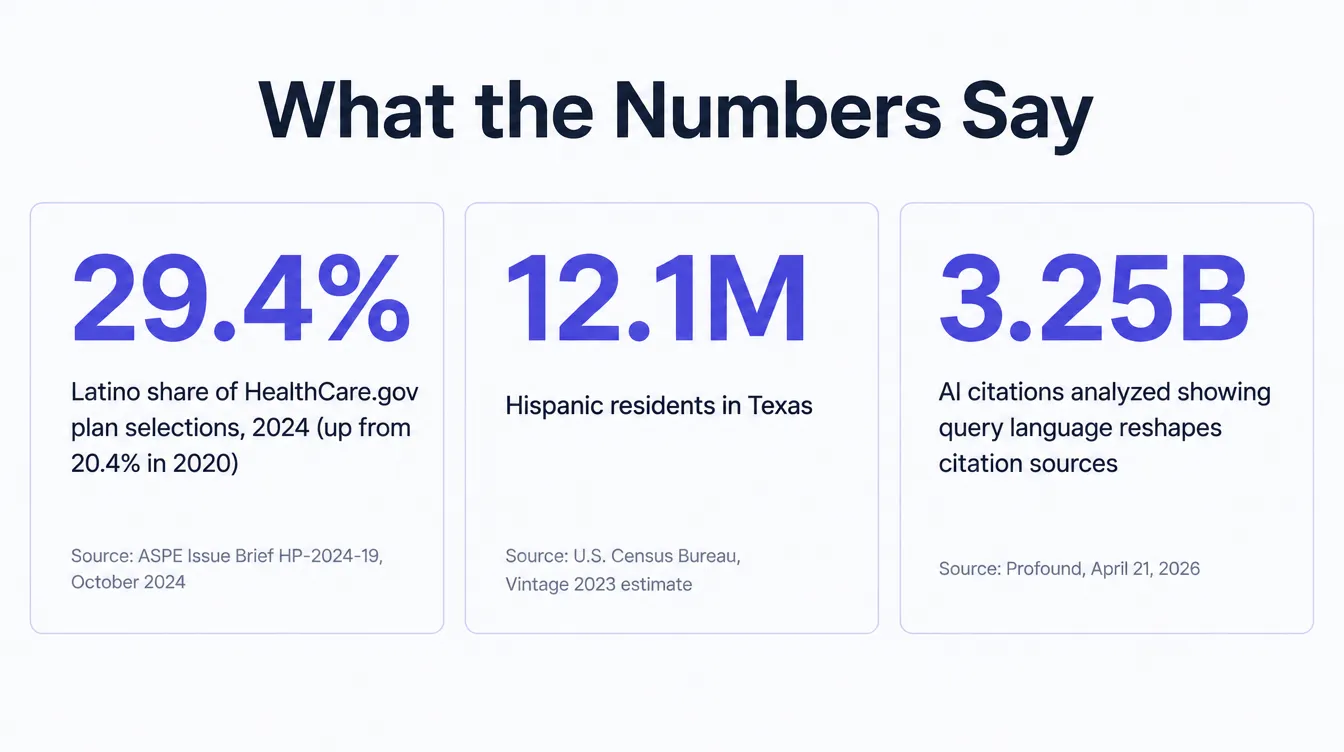
Latino consumers made 29.4% of HealthCare.gov plan selections in 2024, up from 20.4% in 2020, a nine point jump in four years1. Texas and Florida alone hold 12.1 million and 6.2 million Hispanic residents2. A study of 3.25 billion AI citations published April 21, 2026 found that the language of a query rewires which sources an AI assistant cites entirely, not just which language it answers in3. And hands-on testing published in December 2025 found ChatGPT, Perplexity, and Claude frequently answer a Spanish question by translating the English source on the fly, never touching the real Spanish page at all4. Put a Google Translate widget on your site and none of that changes.
The gap: how big the Spanish-speaking market already is
Start with the plainest number available: who is actually enrolling in ACA coverage right now. The Office of the Assistant Secretary for Planning and Evaluation, the research arm of HHS, publishes an annual breakdown of HealthCare.gov plan selections by race and ethnicity. The October 2024 edition, covering Open Enrollment Periods from 2015 through 2024, states plainly that Latino consumers' share of plan selections increased by nine percentage points, from 20.4 percent in 2020 to 29.4 percent in 20241. In raw numbers, Latino consumers selecting a HealthCare.gov plan grew from 3.4 million in 2023 to 4.8 million in 2024, a 40.1 percent jump in one year, and a 185 percent increase since 20201. Total HealthCare.gov plan selections hit a record 16.4 million in 20241. Read those together and the takeaway is simple: almost three out of every ten people choosing a Marketplace plan on the federal platform right now are Latino, and that share is still growing.
Layer in where those people live. The Census Bureau's own 2024 population release, using Vintage 2023 estimates as of July 1, 2023, put the U.S. Hispanic population at 65,219,145, a gain of nearly 1.2 million people in a single year2. Among states, Texas held the second-largest Hispanic population in the country at 12,135,690, and Florida held the third-largest at 6,197,465, trailing only California's 15,760,4372. Texas and Florida also posted the largest raw numeric increases of any state that year, adding 242,306 and 191,373 Hispanic residents respectively2. If your book of business touches either state, or any state with a sizable Hispanic population, this is not a niche audience. It is a fast-growing share of the exact market you're already licensed to serve.
None of this reads like a one-year blip that reverses on its own. The Latino share of HealthCare.gov plan selections climbed every single year from 2020 through 2024, and the state population figures behind it moved the same direction over the same stretch1,2. A trend that consistent, running that long, is the kind of thing worth building for rather than waiting out. An agency that treats this as next year's project is choosing to sit out several more years of a market that keeps getting bigger while it waits.
Before you keep reading
If you want to know whether your own site currently has anything an AI assistant could find and cite in Spanish, the free Audit reads it for AI-citation readiness in about thirty seconds. strategicaiarchitects.com/audit
What most agency sites actually publish
Even the federal government treats this seriously enough to run a fully separate site. HealthCare.gov's Spanish-language counterpart lives at its own domain, CuidadoDeSalud.gov, which we confirmed live this session resolves to its own Spanish-language homepage, not a translated overlay on the English site5. CMS also publishes its Marketplace eligibility notices, redetermination letters, and special enrollment period notices in dedicated Spanish-language document sets, not machine-translated on demand6. That's the standard the agency serving this market set for itself.
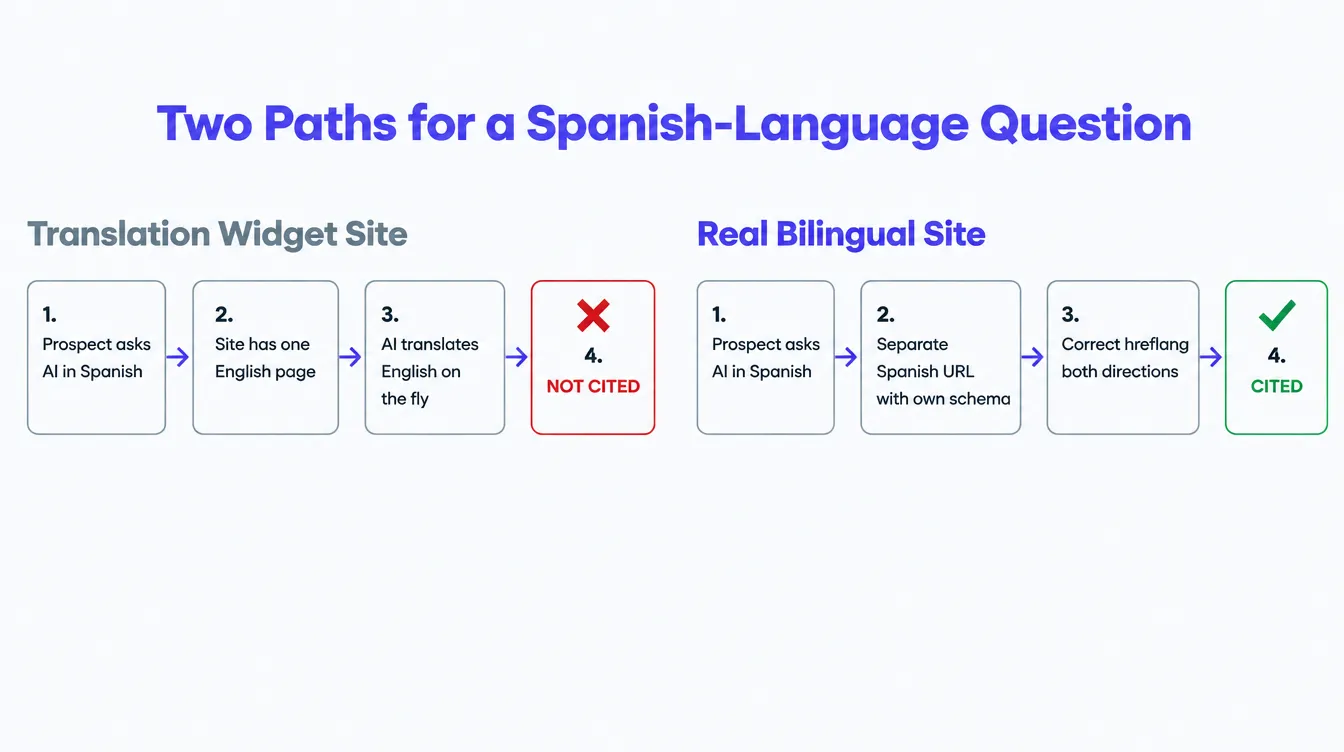
Most agency sites don't come close. The common pattern is a language toggle in the header that runs the whole page through an automatic translation script, or a single "Hablamos Espanol" page that states the agent speaks Spanish without a single Spanish sentence of actual content behind it. Neither one gives a search engine or an AI assistant a real, separate, indexable Spanish-language page to find. A translation widget renders different text to the browser after the page loads, but the underlying HTML a crawler reads is still the English page at the same URL with the same language tag. There is nothing new to index, and nothing new to cite.
The rarer but still common failure is a real, separate Spanish URL that exists purely as a literal, word for word rendering of the English page, produced by a translation tool and never reviewed by a bilingual person. It clears the bar of "technically a different page," but it often reads stiffly enough that a native Spanish speaker notices immediately, and it carries almost no information that isn't already sitting on the English version at a different address. That distinction, a separate URL versus a genuinely distinct page, turns out to matter more than most agencies assume once you look at how the assistants actually decide what to cite.
How AI assistants actually handle a Spanish-language question
The assumption behind most "add a Spanish version" projects is that the language is a wrapper around the same underlying answer, so getting the translation right is most of the job. The research on how AI systems actually behave says something more specific and more useful: the language of the query changes which sources get pulled into the answer at all, not just which language the final sentence is written in.
Profound, an AI search analytics firm, published a study on April 21, 2026 analyzing 3.25 billion AI citations across ChatGPT, Claude, Google AI Mode, Google AI Overviews, Gemini, Microsoft Copilot, and Perplexity, filtered across 14 countries to native-language prompts only3. Its finding, in the researchers' own words, is that "the language of the query can rewire the entire citation graph: which domains appear, how often they're cited, and even whether the social web shows up at all"3. One concrete example from the study: Spanish-language prompts surface social media content at roughly 1.4 times the English rate inside Google AI Overviews, but at roughly half the English rate inside ChatGPT3. Same question, same underlying topic, two different assistants pulling from meaningfully different pools of sources purely because of the language it was asked in.
Separately, SEO consultant Glenn Gabe published hands-on testing in December 2025 checking how several AI Search platforms handle a query typed in a non-English language with the user's language preference set accordingly4. His finding: ChatGPT, Perplexity, and Claude frequently returned the U.S. English version of a page or answer anyway, effectively translating the English source on the fly rather than surfacing the real, native-language page. Microsoft Copilot, which leans on Bing's own language detection, was noticeably more consistent at returning the correct language version. Gemini's behavior was inconsistent across his tests. This is one named practitioner's own testing, not a peer-reviewed study, and we're citing it as exactly that: a documented, dated, first-hand account, not a statistic.
Google's own documentation adds the last piece. Hreflang, the tag most technical SEO advice treats as the whole solution to multilingual sites, is described by Google as a way to "point users to the most appropriate version of your page by language or region," meaning it tells Google which URL to surface for a given searcher, not a ranking signal, and Google's documentation makes no mention of hreflang affecting AI Overviews or AI Mode specifically7. Any effect it has on those AI features would be indirect, flowing through which page Google's classic index and ranking system chooses to surface in the first place, which AI Overviews then draws from.
Read the Profound finding again and the practical implication gets sharper. If Google AI Overviews leans more heavily on social content for a Spanish prompt while ChatGPT leans away from it for that same prompt, then optimizing your Spanish content for one assistant's citation habits doesn't automatically carry over to the next one. A page built purely to rank in classic Google search, then pointed at with an hreflang tag and left alone, is optimizing for exactly one of several systems that don't share a playbook. That's not a reason to give up on any of them. It's a reason to check more than one, and to stop treating "we did hreflang" as a finished project.
| Platform | What the evidence shows | Practical read |
|---|---|---|
| Google AI Overviews / AI Mode | Draws on Google's own index and ranking; hreflang can indirectly steer which URL is eligible, per Google's documentation7. Surfaces social content at a higher rate on Spanish prompts than on English ones3. | Getting hreflang and classic SEO right on the Spanish page still matters most here. |
| ChatGPT | Frequently returned the English source translated on the fly in hands-on testing4; surfaces social content at roughly half the rate Spanish prompts get in AI Overviews3. | Don't assume a Spanish page will be found just because it exists. Test directly. |
| Perplexity | Same pattern as ChatGPT in the same hands-on testing4. | Treat as unreliable for language matching without direct verification. |
| Claude | Same pattern as ChatGPT and Perplexity in the same testing4. | Same caution applies. |
| Microsoft Copilot | Most consistent at returning the correct language version, attributed to Bing's language detection4. | The one assistant where a well-built Spanish page is more likely to actually surface as written. |
Why a machine-translated page rarely clears the bar
Set the AI-specific mechanics aside for a moment and look at the more basic problem: a literal, unreviewed machine translation often doesn't even earn a place in the index it needs to be eligible for citation in the first place. Search engines have spent years building quality systems aimed at exactly this pattern, a page that exists mainly as a mechanical variant of another page rather than a genuinely useful piece of content in its own right. A translated page that adds no new examples, no locally relevant detail, and no independent value reads to those systems the same way a spun or duplicated page does, regardless of the language it's written in.
There's a compliance angle here too, and it cuts the other way from what most agencies assume. The risk isn't that Spanish content triggers extra scrutiny. It's that a literal, unreviewed translation of a regulated disclaimer or a plan-mechanics explanation can quietly shift its meaning without anyone noticing, because nobody who reads Spanish fluently ever checked it. The fix isn't avoiding Spanish content. It's having a bilingual human review anything regulated before it publishes, the same review discipline you'd expect for the English version.
Put the two problems together and the practical rule is straightforward: a Spanish page needs to be different enough to be worth indexing on its own terms, and accurate enough that a bilingual reader wouldn't wince at it. A translation tool alone gets you neither.
Spanish isn't one dialect, and your hreflang tag should say so
Most agencies that get as far as building a real Spanish page stop at a single generic tag,
lang="es", and call it finished. Hreflang was built to be more specific than that on
purpose. The tag pairs a language code with an optional region code, so es-US,
es-MX, and the broader Latin American code es-419 are all valid, distinct
values Google's documentation supports for exactly this reason, distinguishing Spanish written for
a U.S. audience from Spanish written for readers elsewhere in Latin America7.
A Cuban-American client in Miami, a Mexican-American client in Houston, and a Puerto Rican client
in Orlando don't all reach for identical vocabulary when they talk about insurance, and a page that
guesses wrong reads as slightly foreign to all three instead of natural to any of them.
You don't need three separate pages to handle this well. Picking es-US as your
default region code is the right call for most agencies serving Spanish-speaking clients inside
the United States, because it signals general U.S. Spanish rather than one specific country's
dialect. What matters is making that choice on purpose and tagging it correctly, rather than
leaving the region code off entirely and letting every search engine and assistant guess.
A quick way to check your own site
Ask a native Spanish speaker, or a Spanish AI assistant session, your own agency's most common Spanish-language question exactly the way a real prospect would type it. If the answer comes back translated from English on the spot rather than quoting anything that looks like your site, you've just watched the gap described in this guide happen live.
What the gap actually costs
The clearest way to see the cost is the trend line itself. Latino consumers' share of HealthCare.gov plan selections has risen every single year on record: 20.4 percent in 2020, 22.6 percent in 2021, 25.3 percent in 2022, 28.2 percent in 2023, and 29.4 percent in 20241. That's not a one-time spike. It's a five-year climb, and nothing in the underlying demographics suggests it reverses.
Layer the geography on top and the cost concentrates further. The four states with the largest Hispanic populations account for a large share of the country's total Hispanic residents, and Texas and Florida are both states with heavy ACA Marketplace enrollment and heavy independent agent activity.
| State | Hispanic population | Numeric change from prior year |
|---|---|---|
| California | 15,760,437 | +83,036 |
| Texas | 12,135,690 | +242,306 (largest of any state) |
| Florida | 6,197,465 | +191,373 (second largest) |
| New York | 3,873,130 | Not among the top three increases |
Texas added more Hispanic residents in one year than the total Hispanic population of most individual counties an agency serves2. An agency writing ACA or Medicare business anywhere near that growth and publishing nothing a Spanish-speaking prospect's AI assistant can actually find is leaving a fast-growing, already-large share of its addressable market to whichever source, a large publisher, a competitor, or nothing specific at all, the assistant decides to trust instead.
There's a paid-traffic version of the same cost, not just an organic one. An agency running Spanish-language ads and sending that traffic to a page with no real Spanish content behind it, or to an English page a visitor has to work to read, is paying to acquire a click that then has nowhere good to land. The same logic that makes a slow English landing page raise cost per lead applies here: a mismatch between the language a prospect was reached in and the language of the page they arrive on is friction, and friction on a paid click is money spent for a worse chance of a conversion.
29.4%
Latino share of HealthCare.gov plan selections, 2024, up from 20.4% in 20201
12.1M
Hispanic residents in Texas, the second-largest state total2
3.25B
AI citations analyzed in the study on query language and citation graphs3
1.4x
Rate Spanish prompts surface social content in Google AI Overviews versus English prompts3
How to fix it yourself
None of this requires a rebuild of your entire site to start. It requires treating the Spanish version of your highest-value pages as real pages, not as a setting.
Start with your highest-traffic English answer page. Pick the one page that already answers a question your Spanish-speaking prospects are most likely to ask, a subsidy eligibility explainer, an enrollment period page, a plan comparison, and give that one a genuine Spanish counterpart before touching anything else.
Write it, don't just translate it. Have a bilingual person write or substantially rework the Spanish version so it reads naturally, with its own examples where useful, rather than running the English draft through a translation tool and publishing the output untouched.
Give it its own URL and its own schema. A real subfolder or subdomain, not a query
parameter or a client-side toggle, with its own BlogPosting or Article schema, its own FAQPage
schema if the page has one, and its own inLanguage value. Link the two versions
together with hreflang tags in both directions, English pointing to Spanish and Spanish pointing
to English, which is the mechanism Google's documentation actually describes7.
List both URLs in your sitemap and your llms.txt. Neither file is useful if it only contains the English side of a bilingual site.
Test the assistants directly, in Spanish, every month. Don't rely on hreflang alone to do the work with ChatGPT, Perplexity, or Claude. Open each one, ask your top five Spanish-language questions the way a real prospect would phrase them, and note whether it names your agency, translates a competitor's English page, or names nothing specific. That's the only way to know whether the fix is actually working, because the documentation and the testing cited in this guide both say the assistants don't behave consistently with each other.
You can do this yourself
Everything in this section is buildable without hiring anyone, if you have a bilingual person on staff and some patience with schema markup. Most agents read this and decide they'd rather have it built for them. Either outcome is fine.
What a citable bilingual page looks like
Take a subsidy eligibility page as the example, because it's one of the most-asked questions in both languages. A non-citable Spanish version reads like a translated brochure: "Puede calificar para asistencia financiera para su seguro de salud," with no number, no threshold, and a contact form as the only next step. There's no fact in that sentence for an assistant to lift, in either language.
A citable version states the mechanic directly, in Spanish, with its own worked number rather than a copy of the English example: it names the income thresholds tied to the federal poverty level that determine subsidy eligibility, states them in the reader's own currency and terms, and gives one concrete example household. It carries its own dateline, its own named source citation the way the English page does, and its own FAQPage schema answering the Spanish-language phrasing of the same question, not a copy of the English FAQ schema with translated question text pasted over the same answers. That last detail matters more than it sounds like it should: several of the AI platforms reviewed in this guide are, per the evidence cited above, inconsistent about following a language pointer, but none of them can cite a page that was never built as a real, independently structured document in the first place.
Who this fits, and who it doesn't
This is worth building for any agency writing ACA, Medicare, or life business in a market with a meaningful Hispanic population, and especially in Texas, Florida, or any state posting the kind of year over year growth described above. It's a real commitment, not a checkbox: a genuinely separate Spanish page, reviewed by a bilingual person, is more work than flipping a translation widget on.
It fits less well for an agency with no bilingual staff, no plan to serve Spanish-speaking clients directly, and no realistic path to answering the phone in Spanish once a Spanish-language page generates a call. Building the page without the service behind it creates the same problem as any other citable content that dead-ends at a contact form nobody can actually help. If that's your situation today, the honest first step is deciding whether to build that capacity, not whether to build the page.
How we build this
Every site we build treats a second language as a first-class version of the site, not an add-on: its own URL structure, its own schema stack, correct bidirectional hreflang, and its own entries in the sitemap and llms.txt the moment it publishes. Digital Foundation runs $247 a month for a complete, AEO-optimized site with Google Business Profile management and an AI chat widget, $497 a month for that plus a new blog post and location page every week and a 24/7 AI receptionist, and $997 a month for a blog post nearly every business day, and all three tiers include a 14-day free trial and month-to-month billing8. For an agency that wants original Spanish-language content written and published on a real cadence rather than translated after the fact, that's exactly the blog cadence service handles, in both languages, on the same schedule.
For a larger book with its own bilingual quoting needs, a custom build scoped on a call can wire a real subsidy or premium calculator to serve both languages directly from the same live federal data, rather than maintaining two separate, drifting versions of the same tool9.
Questions agents ask about Spanish-language AEO
Is a Google Translate widget on my site enough to reach Spanish-speaking prospects?
It's better than nothing for a human reader who can still make sense of a rough translation, but it does almost nothing for AI citation. A widget that translates on the fly still serves one underlying URL and one language tag to a crawler, so there's no separate, indexable Spanish page for an assistant to find and quote. It also tends to produce stiff, literal phrasing that reads as low effort to both readers and the quality signals search engines use.
Do I need hreflang tags, or do AI assistants ignore them?
You still need them, but treat them as necessary and not sufficient. Google's own documentation describes hreflang as a way to tell Google which URL variant to surface for a given language or region in classic Search, and it's silent on AI Overviews and AI Mode specifically. Hands-on testing published in December 2025 by SEO consultant Glenn Gabe found ChatGPT, Perplexity, and Claude frequently returned the English-language version even when a Spanish query and language preference were used, while Copilot, which leans on Bing's language detection, was noticeably more consistent. Build the hreflang correctly for Google and classic Search, then verify the assistants separately, because they don't all read the signal the same way.
Does this only matter in states like Texas and Florida?
Those two states carry the largest Hispanic populations after California, so they're the clearest examples, but the underlying shift is national. HealthCare.gov's own enrollment data shows Latino consumers' share of plan selections climbing every year from 2020 to 2024 across every state using the federal platform, not just the biggest ones. If you write ACA business anywhere, this is worth checking.
Is writing separate Spanish content a compliance risk?
The compliance rules that already govern your English content, accurate plan mechanics, no misleading claims, the required disclaimers, apply the same way to a Spanish page. What changes is the work: a compliant English disclaimer translated word for word is still compliant in meaning, but it needs a competent human review, not just a translation tool, because a literal translation can shift the meaning of a regulated phrase without anyone noticing.
How long should a Spanish-language page be to get cited?
Length isn't the variable. A citable page answers one question directly in the first two sentences, in that language, with a named source. A short page that does that is more citable than a long page that circles the question. Match the structure of your best English answer pages: one question per URL, not a single long page trying to cover every topic in Spanish.
Should the Spanish page be a translation of the English page, or original content?
Original is stronger, but a faithful, professionally reviewed translation of a genuinely good English answer page is a legitimate starting point. What doesn't work is a literal, unreviewed machine translation with no independent value, because that reads as duplicate content to the same quality systems that would otherwise reward it. If you can only do one well, pick your highest-traffic English answer page and give it a real Spanish version first, rather than machine-translating your entire site at once.
Do the numbers in this guide apply to Medicare too, or just ACA?
The enrollment data cited here is specific to HealthCare.gov's ACA Marketplace, which is where ASPE publishes this breakdown. Medicare Advantage and Medicare Supplement marketing to Spanish-speaking beneficiaries follows the same citation mechanics described in this guide, but we're not citing a Medicare-specific version of this enrollment statistic, because we don't have one verified this session.
Sources
- Warrier A, Lee A, Peters C, De Lew N, Buchmueller T. "HealthCare.gov Plan Selections by Race and Ethnicity, 2015-2024," Issue Brief No. HP-2024-19, Office of the Assistant Secretary for Planning and Evaluation, U.S. Department of Health and Human Services, published October 2024: Latino share of HealthCare.gov plan selections rose from 20.4% in 2020 to 29.4% in 2024 (22.6% in 2021, 25.3% in 2022, 28.2% in 2023); Latino plan selections grew from 3.4 million (2023) to 4.8 million (2024), a 40.1% one-year increase and a 185% increase since 2020; total HealthCare.gov plan selections reached a record 16.4 million in 2024. Verified live 2026-09-26. aspe.hhs.gov.
- U.S. Census Bureau. "New Estimates Highlight Differences in Growth Between the U.S. Hispanic and Non-Hispanic Populations," press release, Vintage 2023 population estimates as of July 1, 2023, published June 27, 2024: U.S. Hispanic population reached 65,219,145, up nearly 1.2 million (1.8%) from 2022; California (15,760,437), Texas (12,135,690), Florida (6,197,465), and New York (3,873,130) had the largest state Hispanic populations; Texas (+242,306) and Florida (+191,373) had the largest numeric increases. Verified live 2026-09-26. census.gov.
- Profound. "How query language reshapes AI citations," published April 21, 2026: analysis of 3.25 billion AI citations across ChatGPT, Claude, Google AI Mode, Google AI Overviews, Gemini, Microsoft Copilot, and Perplexity, across 14 countries filtered to native-language prompts; Spanish-language prompts surface social media content at roughly 1.4 times the English rate in Google AI Overviews and roughly half the English rate in ChatGPT; language "can rewire the entire citation graph." Verified live 2026-09-26. tryprofound.com.
- Gabe G. GSQi. "AI Search, hreflang, and translated content: How do ChatGPT, Perplexity, Gemini, Copilot, and Claude handle multilingual queries?" hands-on testing published December 2025: ChatGPT, Perplexity, and Claude frequently returned the U.S. English version of content even with a non-English query and language preference set; Microsoft Copilot, using Bing's language detection, was the most consistent; Gemini's results were inconsistent. First-hand practitioner testing, not a peer-reviewed study; cited as such. Verified live 2026-09-26. gsqi.com.
- CuidadoDeSalud.gov, HealthCare.gov's Spanish-language Marketplace site. Verified live 2026-09-26: resolves to its own Spanish-language homepage at a dedicated domain, not a translated overlay of the English site. cuidadodesalud.gov.
- Centers for Medicare & Medicaid Services. "Notices," Marketplace In-Person Assister resources page: publishes Marketplace Open Enrollment, eligibility determination, data-matching, and Special Enrollment Period notices in dedicated Spanish-language document sets alongside the English versions. Verified live 2026-09-26. cms.gov.
- Google Search Central. "Tell Google about localized versions of your page": hreflang tells Google Search which URL variant to surface to a user by language or region; described as a mechanism for URL selection, not documented as a ranking signal, with no mention of AI Overviews or AI Mode. Verified live 2026-09-26. developers.google.com.
- Strategic AI Architects. Digital Foundation service page: Starter $247/month (complete AEO-optimized website, Google Business Profile management, AI chat widget); Pro $497/month (adds one blog post and one location page weekly, 24/7 AI receptionist); Scale $997/month (adds a blog post nearly every business day and two location pages weekly); all tiers include a 14-day free trial and month-to-month billing. Verified live 2026-09-26. strategicaiarchitects.com/digital-foundation.
- Strategic AI Architects. AI Expert / custom build service page: custom AI agents and calculators wired to live data, scoped and priced on a call, built on the agency's own accounts and domain. Verified live 2026-09-26. strategicaiarchitects.com/ai-expert.
Talk it through
Want a second pair of eyes on it?
Free 30 minutes. Bring what you found, or bring nothing and we will look together at how AI engines read your site and which fixes move first.
See what AI finds when it searches your site in Spanish
Run the free Audit, a live AEO Audit plus a HIPAA tracking scan of your site, in under a minute.
Related reading: AEO for Medicare and health agencies · Why Texas insurance agents still need schema markup · Texas ACA premiums for 2027