Playbook
Pennsylvania's Pennie Premiums Jump Again for 2027
The state regulator cut the ask. The bill still goes up. Open Enrollment opens in seventeen days, and whatever number is on your site right now is either this one or it is wrong.

18 min read
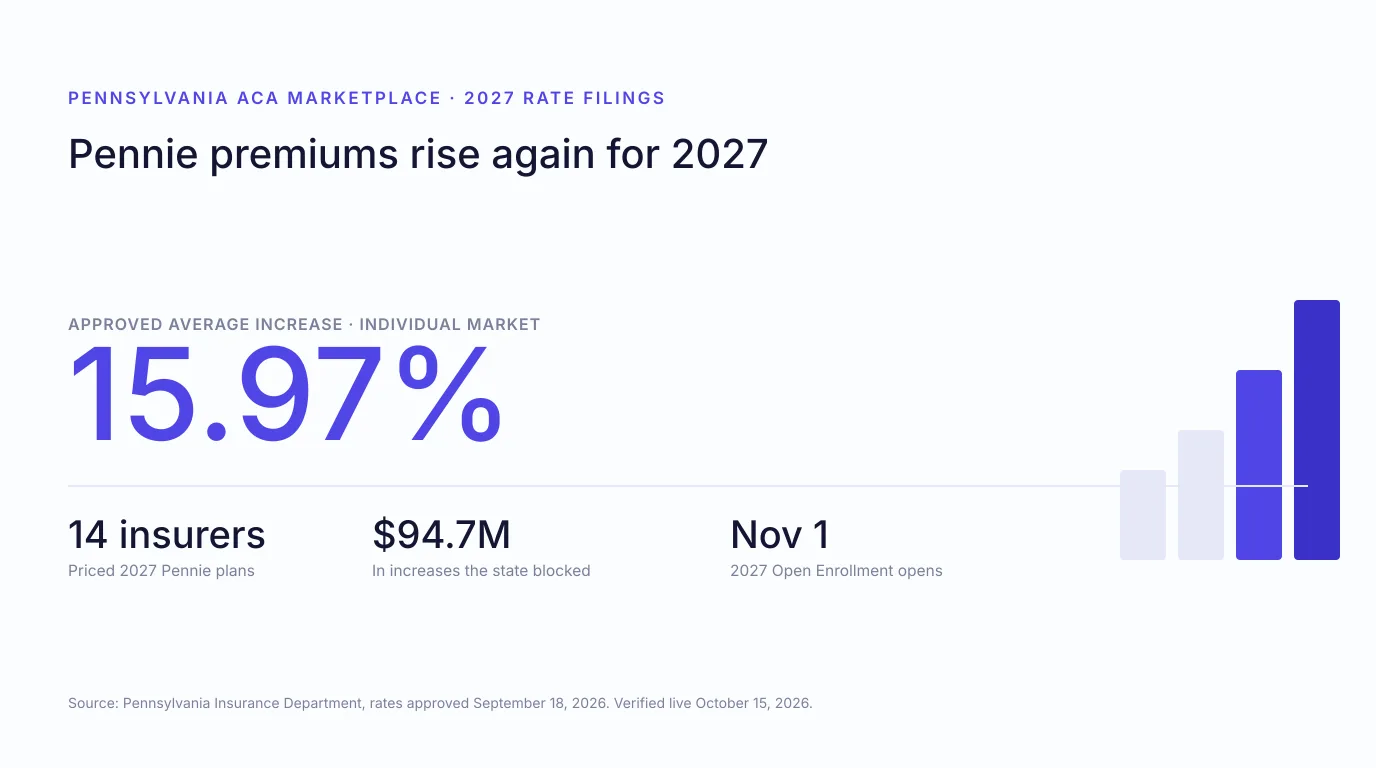
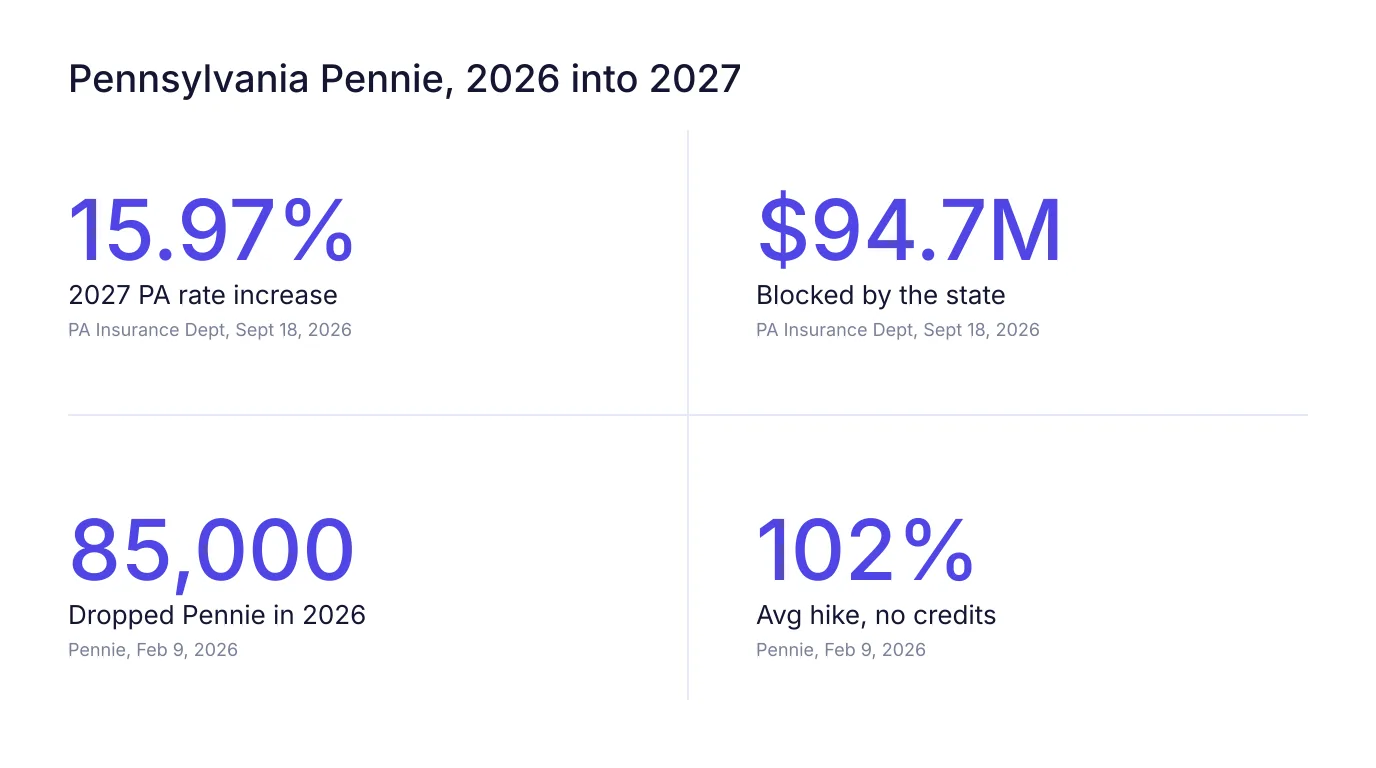
The Pennsylvania Insurance Department approved a weighted average 15.97% increase for 2027 Pennie individual market plans, down from the 17.14% insurers requested, and blocked $94.7 million in increases it found unjustified1. Small group plans rose 10.28%1. This lands on a market that already lost about 85,000 enrollees, nearly one in five, early in 2026 when enhanced federal tax credits expired and premiums jumped an average of 102% for anyone keeping the same plan without them2, and kept shrinking through the year, down 10% from its 2025 peak by June3. Open Enrollment for 2027 coverage runs November 1, 2026 through January 15, 2027, after a court fight nearly shortened it4. None of this is a forecast. It is what Pennsylvania's own regulator and Pennie's own data already say, seventeen days before the window most of your prospects will search in opens.
The renewal letter about to land in Pennsylvania mailboxes
Sometime in the next few weeks, a Pennie enrollee you helped get covered last year is going to open an Annual Notice of Change and see a number that is bigger than what they paid in 2026. They are not going to read a Pennsylvania Insurance Department fact sheet first. They are going to see the new premium, feel it against a budget that has not gotten any looser, and either call you or search for an answer themselves, on Google or in whatever AI assistant they already have open.
If they search, and your site is one of the results, the number on your page needs to be the right one. Not last year's. Not a rounded guess. The one the state actually approved on September 18, 2026, which is 15.97%, not the 17.14% insurers originally asked for1. That gap, between what was requested and what was approved, is itself part of the story, and it is the kind of specific, sourced detail that separates a page worth trusting from one that is just filler written before the real numbers existed.
This piece is the sourced picture of what Pennsylvania just approved for 2027 Pennie coverage, what already happened to enrollment once 2026's bills arrived, and the two things worth doing to your own site before November 1 so the renewal conversation starts with you knowing more than the client, not less.
Before you read further
If you want a read on whether your own site's numbers, speed, and AI citation readiness hold up, the free Audit scores it in about thirty seconds8. strategicaiarchitects.com/audit
What the Pennsylvania Insurance Department actually approved
The Pennsylvania Insurance Department, PID, announced its final 2027 ACA rate decisions on September 18, 2026. For the individual market, the weighted average approved increase is 15.97%, down from the 17.14% insurers originally filed for1. For small group plans, the average approved increase is 10.28%, down from an 11.49% request1. Commissioner Michael Humphreys framed the gap between what was requested and what was approved in dollar terms: PID's review denied $94.7 million in increases it determined were not justified by the underlying data, close to $95 million kept out of Pennsylvanians' bills this cycle1.
That review is not a rubber stamp, and the department's own release backs that claim with a real number on the other side of the ledger. Insurers paid $845 million more in 2025 medical and prescription drug claims than they did in 2024, a 13% increase in claims costs in a single year1. A regulator cutting a requested increase while claims costs climb that fast is not denying that costs went up. It is checking whether the specific number an insurer asked for matches what its own claims experience actually supports, and in most of the 14 individual market filings this cycle, PID's answer was no, not by that much.
What PID says is driving the increase
The department's release names three causes: rising medical and prescription drug costs generally, Congress not reauthorizing enhanced premium tax credits for 2026 and beyond, and the Medicaid work requirements and new enrollment paperwork created by the July 2025 federal budget law, commonly referred to as H.R. 11. None of the three is specific to Pennsylvania. All three are shaping ACA filings nationwide.
Insurer by insurer: who moved the most
The 15.97% weighted average sits on top of a much wider spread. Fourteen insurers filed individual market rates for 2027 Pennsylvania coverage, and PID's review treated each one differently based on what its own filing supported.
| Insurer | Requested | Approved |
|---|---|---|
| Ambetter Health of Pennsylvania | 40.9% | 35.1% |
| Keystone Health Plan Central | 33.8% | 33.4% |
| Highmark Benefits Group | 21.4% | 19.7% |
| QCC Insurance Company | 19.9% | 21.3% |
| Partners Insurance Company | 20.5% | 18.8% |
| Capital Advantage Assurance | 18.3% | 14.8% |
| Highmark Inc | 16.2% | 14.5% |
| Keystone Health Plan East | 14.7% | 16.0% |
| UPMC Health Plan Inc | 15.8% | 13.5% |
| Health Partners Plans | 15.9% | 18.3% |
| Oscar Health Plan of PA | 15.4% | 1.4% |
| Geisinger Quality Options | 13.0% | 10.7% |
| UPMC Health Network Inc | 12.0% | 9.7% |
| Geisinger Health Plan | 10.5% | 8.6% |
| Pennsylvania weighted average | 17.14% | 15.97% |
Two insurers are worth calling out specifically, because they cut against the overall pattern. Health Partners Plans and Keystone Health Plan East were both approved for more than they requested, 18.3% against a 15.9% ask for Health Partners and 16.0% against a 14.7% ask for Keystone East. PID's release attributes the Health Partners increase to a less healthy membership mix confirmed through federal risk adjustment data, and the Keystone East increase to worsening medical and drug cost trends the department's own review found1. If a client on either plan asks why their increase looks larger than a neighbor's on a different carrier, that is the honest, sourced answer, not a guess.
Why the number is still climbing
None of the three drivers PID names are unique to Pennsylvania. KFF's own tracking of preliminary 2027 filings, updated August 3, 2026, covers 276 insurers across all 50 states and DC and lands on a national median proposed increase of 15%5. Pennsylvania's approved 15.97% sits almost exactly on that national line, which tells you something: the state's insurers were not filing aggressively or out of local politics. They were pricing the same national cost trend everyone else filed against.
KFF names the same underlying forces as PID, with more detail on two of them. First, rising healthcare prices remain the primary driver nationally, with insurers citing higher costs for medical services, general inflation, and labor shortages5. Second, insurers point directly to the expiration of enhanced premium tax credits at the end of 2025 as a factor, alongside what KFF describes as a related increase in the risk pool's morbidity, meaning the people who stayed enrolled after the credits expired skew sicker and more expensive to cover than the pool that existed before the subsidy cliff5. That second point is not abstract for Pennsylvania. It is close to a direct description of what Pennie's own enrollment data shows happened here, covered next.
The subsidy fight nobody has resolved
Every number in this article assumes the enhanced premium tax credits stay expired, because that is what Pennsylvania's insurers assumed when they filed. The credits lapsed on schedule at the end of 2025. KFF's own July and August 2026 rate analyses are explicit that insurers priced 2027 nationwide against that expiration as a settled input, not an open question5. Nothing in PID's September 18 announcement, and nothing in Pennie's enrollment data, assumes Congress acts before 2027 coverage begins.
That matters for what you tell a client. The honest version of this conversation is not "your rate went up a little." It is closer to "the extra help that lowered your premium the last few years is gone, it has been gone since January 1, 2026, and the people who set these 2027 rates did not build in any assumption that it comes back." Clients tend to trust an agent who says that plainly over one who implies a fix might land before their next payment is due. If Congress does eventually restore the credits, which remains possible and has not happened despite months of attempts, every figure in this article would need revisiting. Until that changes, the responsible content for your site is what the filings actually say, not what might happen if a stalled effort suddenly moves.
What already happened once the 2026 bills arrived
The 2027 rate filing is not the first sign of stress in Pennsylvania's ACA market. It is the second chapter. Pennie's own press office has been tracking, and publishing, the fallout from the 2026 subsidy cliff in close to real time, and the numbers are specific enough to put directly in front of a client who thinks a 15.97% increase sounds abstract.
Pennie closed its 2026 Open Enrollment Period with 486,000 enrollees, as of February 1, 202623. Inside that topline number sits a sharper story. About 85,000 Pennsylvanians, nearly one in five of the people who had coverage, dropped it early in the year once they saw what their premium would be without the enhanced credits: an average increase of 102% to keep the same plan2. New enrollment was down too, about 79,500 new sign-ups, 12% fewer than the prior year2. One visible behavior shift: roughly 33,000 more Pennsylvanians chose a Bronze plan than the year before, a 30% jump, trading a lower monthly premium for higher deductibles and out-of-pocket costs, exactly the kind of tradeoff a stressed household makes when the sticker price is what is driving the decision2.
It did not stop there. Pennie's June 9, 2026 release reports that enrollment kept eroding through the spring: total enrollment down 10% from the 2025 peak of 497,000, and more than 40,000 additional Pennsylvanians gone in the four months after the February snapshot, on top of the 85,000 who had already dropped coverage3. By June, roughly one in three people who had Pennie coverage in 2025 no longer had it3. The release's own stated reason, from surveyed enrollees, was not confusion about enrollment or a change in health status. It was simply higher plan costs3.
The two releases check against each other, which is worth noticing. Pennie's June figure puts enrollment down 10% from the 497,000 peak, which lands at roughly 447,000. Subtract the "more than 40,000" additional drop its own release reports from the 486,000 counted at the February close, and you land at roughly 446,000. Two different ways of stating the same erosion, from the same source, inside a few hundred people of each other. That kind of internal consistency is exactly what makes a number safe to repeat to a client without hedging it.
| Point in time | What Pennie reported |
|---|---|
| 2025 peak | 497,000 enrollees3 |
| Feb 1, 2026, close of 2026 OEP | 486,000 enrollees; about 85,000 (nearly 1 in 5) had already dropped coverage; average 102% premium jump without enhanced credits2 |
| June 9, 2026 | Enrollment down 10% from the 2025 peak; roughly 1 in 3 of 2025's enrollees no longer covered3 |
| Sept 18, 2026 | PID approves 2027 rates: 15.97% individual average, $94.7M in increases blocked1 |
| Nov 1, 2026 | 2027 Open Enrollment opens4 |
16%
Approved 2027 individual market average, 15.97% exactly1
$95M
In increases Pennsylvania blocked, $94.7M exactly1
85K
Pennsylvanians who dropped coverage, early 20262
17
Days until 2027 Open Enrollment opens
A calendar that almost got shorter
Open Enrollment for 2027 Pennie coverage runs November 1, 2026 through January 15, 20274. That window almost did not survive intact. A federal rule would have cut open enrollment periods on marketplaces nationwide to a shorter window, but a federal court in Maryland stayed several provisions of that rule, including the shortened calendar, while litigation continues4. In response, Pennie's own board voted to reinstate its originally planned dates rather than build a shorter 2027 calendar around a rule that might not survive the case4. The window held, but it held because of a court fight your Pennsylvania clients almost certainly never heard about, which is itself a reason your site, not a federal rule tracker, is where they should be able to find the actual dates.
Seventy six days is not a long runway for a market that just posted a round of double digit rate changes on top of a year that already saw a fifth of its enrollees walk away once. Every one of the roughly 486,000 people enrolled when 2026 closed is a renewal this cycle, whether their carrier raised them 1.4% or 35.1%.
What a stale number costs an agency
Put a labor number on the reactive version of this season. BLS puts the median hourly wage for an insurance sales agent at $29.94, as of May 20256. Every call that opens with "why did my Pennie bill go up" instead of "I already know, here is what changed and what your options are" is a producer or a CSR spending that hourly value reacting to a surprise the state made public a month earlier, instead of running a conversation on their own terms.
There is a second, quieter cost that has nothing to do with phone minutes. A prospect who finds your site, sees a premium estimate or a plan count that is visibly wrong against what Pennie itself now shows, does not usually tell you the page is stale. They just trust it less, close the tab, and keep searching. The same applies to whatever answers an AI assistant gives when someone asks it about Pennie rates for 2027: the page it can quote from confidently is the one with a specific, current, sourced number on it, not a page that still says 2026 or says nothing at all.
Google's own guidance on what it calls helpful content asks site owners to check their own pages against a specific question: "Does the content have any easily-verified factual errors?"9 A 2026 premium figure sitting on a page after the state already published the 2027 number is exactly that, an easily verified error, and for a health insurance topic Google's guidance is blunter still, stating that content on topics like this one "must be highly accurate and consistent with established expert consensus"9. That is not a ranking trick to chase. It is a bar your page either clears or does not, and checking it costs nothing but the time to read your own site the way a regulator just made it possible to fact check.
The default outcome if you say nothing
A client who hears nothing from you does not wait for an explanation. They open the notice, see the number, and either call whoever answers fastest or quietly let Pennie auto-renew them into whatever they had, which may not be the best fit once the 2027 rates are actually priced in. Silence is a choice. It just is not yours to control once you make it.
How to fix your own site before November 1
None of this requires new software. A disciplined agency, even a one person shop, can get through this list in a weekend.
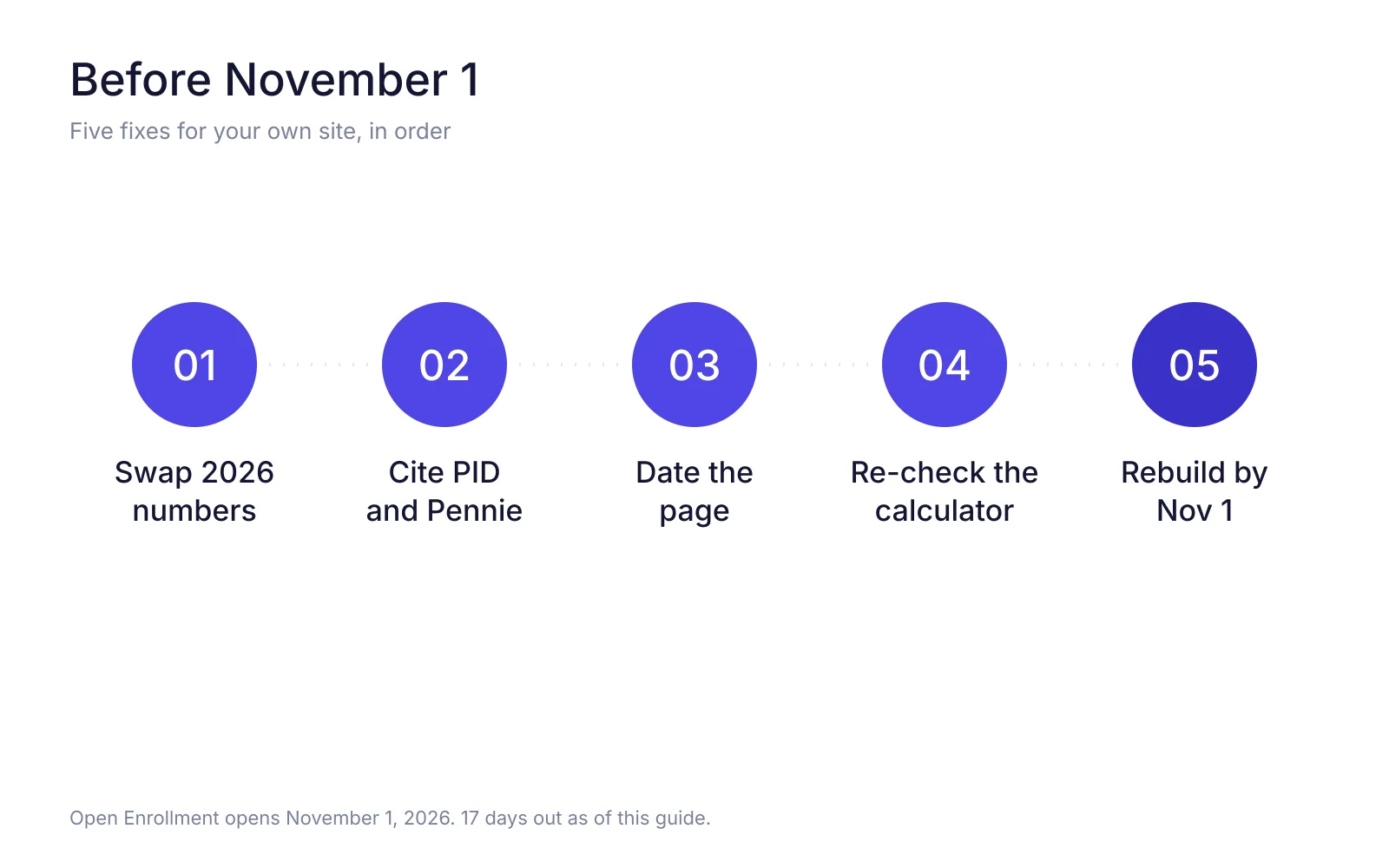
Find every page that states a 2026 number. Search your own site for "Pennie," "ACA," or any dollar figure tied to a premium or subsidy example. If the page was written before September 18, 2026, assume the number on it is wrong until you check.
Replace the number, not just the year. A page that changes "2026" to "2027" next to an unchanged dollar figure is worse than one that says nothing, because it reads as current and is not. Use the actual approved figures: 15.97% for individual plans, 10.28% for small group, sourced to PID's September 18 announcement.
Check your quote or subsidy calculator specifically. If it is hardcoded to 2026 premiums or last year's subsidy cliff math, it is quietly contradicting every other claim on the page the moment a visitor plugs in their own numbers.
Put a real, visible updated date on the page. Not a hidden metadata timestamp. A line a human and a crawler can both see, the way this guide states September 18, 2026 as the date PID's rates were finalized, and October 15, 2026 as the date this page was verified live.
Write the renewal talk track before the calls start. "Your plan renewed" is the wrong opener for a season with an average double digit increase behind it. "I already saw the 2027 rate the state approved, here is what changed for your specific plan" is a different first impression, and it costs nothing except knowing the number before the client does.
If you publish schema markup, update the figures inside it too. A Service or FAQPage schema block that still states a 2026 premium range is invisible to a human visitor but not to a crawler, and a stale number inside structured data is still a stale number. Whatever static copy you fix on the page, fix the matching value in the markup underneath it in the same pass.
How we keep every page like this current
The actual gap most agency sites have is not effort. It is cadence. Someone wrote the ACA page in good faith eighteen months ago, the number was correct the day it was published, and nobody has had a reason to open that file again since. Pennsylvania's rate filing is exactly the kind of event that creates a reason, and it is also exactly the kind of event most agencies do not have a process for catching.
This is the specific gap Digital Foundation is built to close. It is our done-for-you website product, and the content engine behind it, which we call THE BRAIN, is wired to 43 government data spokes so the figures it writes with come from a live source, not a cached guess from whenever the page was first built. On the Pro and Scale plans, that engine publishes new blog posts, location pages, and answer pages on a real weekly or daily cadence, not a burst once a year, so a filing like Pennsylvania's September 18 announcement has somewhere to land on your site the same month it happens, not whenever someone remembers to write about it.
We are not going to pretend that is magic. It is a publishing cadence plus a sourcing discipline, applied consistently, on a schedule a single producer juggling a renewal season cannot realistically keep up with alone. Every plan, including the entry Website tier, launches with ten blog posts, ten location pages, and ten answer pages already built, so a new Digital Foundation site is not starting from the same blank page your current one may still be sitting on7.
What you get
Concretely, an agency that closes this gap gets a site where a Pennsylvania client who searches for their own renewal finds a page with the actual September 18 numbers on it, not a placeholder from last year. It gets a quote calculator that reflects the plan year a visitor is actually shopping for. It gets fewer calls that start with a client correcting you about a number your own site got wrong. None of that is a promise about rankings, traffic, or income, and we are not going to imply it is. It is a decision about whether your site reflects what the state actually approved, or what happened to be true when someone last had time to update it. It also gets a site positioned for whatever comes next, since the same cadence that caught September's PID announcement is the one that catches the next carrier notice or the next plan year change, whenever it lands, instead of waiting for someone to remember.
When this doesn't change much for you
If your book is mostly Medicare Advantage, Part D, or life insurance, this specific filing does not touch your calendar. Pennie, the rates covered here, and the subsidy cliff are Pennsylvania's ACA individual and small group marketplace specifically, governed separately from Medicare or life business, even though your Medicare clients are working through their own Annual Enrollment Period on an overlapping calendar this same month. And if you already maintain your site on a real schedule, pulling PID's filings and Pennie's own releases the week they publish, you are already doing the harder part of what this guide recommends. The gap this piece is about is specific: a real rate change plus a short renewal window, landing on a site with no process for catching either one.
Questions Pennsylvania agents ask
How much are Pennie premiums increasing in Pennsylvania for 2027?
The Pennsylvania Insurance Department approved a weighted average increase of 15.97% for individual market plans sold through Pennie for 2027, down from the 17.14% insurers originally requested. Small group plans rose an average of 10.28%, down from an 11.49% request. The rates were finalized and announced on September 18, 2026.
Why did Pennsylvania approve a lower increase than insurers asked for?
The Pennsylvania Insurance Department reviewed each insurer's filing and denied the portion it found unjustified, a total of $94.7 million in requested increases across the market. Two insurers, Health Partners Plans and Keystone Health Plan East, were actually approved for more than they requested, because the department's own review found their risk pool and cost trend data supported a higher number.
Which Pennie insurers have the biggest 2027 rate increases?
Ambetter Health of Pennsylvania has the largest approved individual market increase at 35.1%, down from a 40.9% request. Keystone Health Plan Central follows at 33.4%. Oscar Health Plan of PA has the smallest approved increase of any individual market insurer, 1.4%, cut sharply from its 15.4% request.
When is Open Enrollment for 2027 Pennie coverage, and why did the dates almost change?
Open Enrollment for 2027 Pennie coverage runs November 1, 2026 through January 15, 2027. A federal rule would have shortened that window on marketplaces nationwide, but a federal court in Maryland stayed the provision during ongoing litigation, and Pennie's board voted to reinstate its original dates rather than build a shorter calendar around a rule that might not survive the case.
How many Pennsylvanians already dropped Pennie coverage in 2026, and why?
About 85,000 Pennsylvanians, nearly one in five of the people enrolled, dropped Pennie coverage early in 2026 after enhanced federal premium tax credits expired at the end of 2025, facing an average 102% premium increase to keep the same plan without that help. Enrollment kept eroding through the year: by June, total enrollment was down 10% from its 2025 peak, with roughly one in three 2025 enrollees no longer covered.
Will the enhanced federal premium tax credits come back before 2027?
Not as of this writing. Congress let the enhanced credits lapse at the end of 2025, and insurers filing 2027 Pennie rates priced their plans assuming that stays true, citing the expired credits as a direct driver of cost. Nothing in Pennsylvania's rate filing or Pennie's own enrollment data assumes a reversal, and an agency's content should not assume one either until it actually happens.
Does this affect Medicare or life insurance business too?
No. Pennie is Pennsylvania's ACA individual and small group marketplace, a completely separate program from Medicare Advantage, Part D, or life insurance. An agency writing mostly Medicare business is working its own Annual Enrollment Period calendar, which opened the same week this piece was written, but the rate filings, carrier detail, and enrollment figures here are ACA specific and do not change anything about a Medicare or life book.
How can an agency make sure its own website reflects the 2027 numbers before November 1?
Pull every page that states a Pennie premium, a subsidy example, or a 2026 plan count, and replace each figure with the 2027 number and a cited source, the way this guide does. Check any quote or subsidy calculator for a hardcoded 2026 assumption. Put a visible, genuine updated date on the page. None of that requires new software, just a weekend of edits before the window most of your Pennsylvania prospects are searching in actually opens.
Sources
- Pennsylvania Insurance Department. "Pennsylvania Releases Affordable Care Act 2027 Health Insurance Rates," published September 18, 2026: 15.97% weighted average individual market increase (down from 17.14% requested), 10.28% small group average increase (down from 11.49% requested), $94.7 million in increases denied as unjustified, $845 million increase in 2025 medical and prescription drug claims (13% year over year), carrier level requested versus approved rates for 14 individual market insurers. Verified live 2026-10-15. pa.gov.
- Pennie (Pennsylvania Health Insurance Exchange), agency press office. "One in Five Pennie Enrollees Drop Health Coverage Due to Expired Federal Tax Credits," published February 9, 2026: 486,000 enrollees at the close of the 2026 Open Enrollment Period, about 85,000 (nearly 1 in 5) dropped coverage, average 102% premium increase without enhanced tax credits, 79,500 new enrollees (12% below the prior year), about 33,000 additional enrollees chose Bronze plans (a 30% increase), four of five enrollees qualify for premium tax credits. Verified live 2026-10-15. agency.pennie.com.
- Pennie, agency press office. "Pennsylvanians Dropping Health Coverage Through Pennie Citing Higher Plan Costs as the Number One Reason," published June 9, 2026: 486,000 enrollees as of February 1, 2026; enrollment down 10% from the 2025 peak of 497,000; more than 40,000 additional enrollees lost in the four months after the February snapshot; roughly one in three 2025 enrollees no longer covered by June; higher plan costs cited as the top reason for dropping coverage. Verified live 2026-10-15. agency.pennie.com.
- Pennsylvania State University, Project Office of Rural Health (PORH). "PA Health Insurance Exchange 2027 Open Enrollment Period Returns to November 1, 2026-January 15, 2027," published July 25, 2026: 2027 Open Enrollment runs November 1, 2026 through January 15, 2027; a U.S. District Court for the District of Maryland stay of provisions in the federal 2027 Notice of Benefit and Payment Parameters, including a shortened enrollment window, led the Pennie Board to vote to reinstate the original dates. Verified live 2026-10-15. porh.psu.edu.
- KFF. "How Much and Why ACA Marketplace Premiums Are Going Up in 2027," originally published July 8, 2026, updated August 3, 2026: 15% national median proposed increase across 276 insurers in all 50 states and DC; rising medical costs named as the primary driver; insurers cite the expiration of enhanced premium tax credits at the end of 2025 and a related increase in the risk pool's morbidity. Verified live 2026-10-15. kff.org.
- U.S. Bureau of Labor Statistics. Occupational Outlook Handbook, "Insurance Sales Agents": median annual wage $62,280, median hourly wage $29.94, May 2025. Verified live 2026-10-15. bls.gov.
- Strategic AI Architects. Digital Foundation service page: Website, Starter, Pro, and Scale pricing tiers; content engine ("THE BRAIN") described as wired to 43 government data spokes; every plan launches with 10 blog posts, 10 location pages, and 10 answer pages; Pro and Scale publishing cadence of 15 to 76 new pages a month. Verified live 2026-10-15. strategicaiarchitects.com/digital-foundation.
- Strategic AI Architects. Free Audit page: scores content depth, question and answer structure, E-E-A-T and trust signals, schema and structured data, and technical and agentic readiness; checks trackers against consent on health and Medicare pages; initial score in about thirty seconds, full report in 6 to 15 minutes. Verified live 2026-10-15. strategicaiarchitects.com/audit.
- Google. "Creating helpful, reliable, people-first content," Search Central documentation: self-assessment question "Does the content have any easily-verified factual errors?"; guidance that YMYL content "must be highly accurate and consistent with established expert consensus." Verified live 2026-10-15. developers.google.com.
Talk it through
Want a second pair of eyes on it?
Free 30 minutes. Bring what you found, or bring nothing and we will look together at how AI engines read your site and which fixes move first.
See if your site still shows last year's Pennie numbers
Run the free Audit, scoring content accuracy signals, schema, and AI citation readiness in about thirty seconds. Then let's talk about a cadence that catches the next filing automatically.
Related reading: does your Georgia insurance site still say HealthCare.gov · your insurance website is behind on 2027 plan data · why your insurance website's subsidy calculator is wrong