Playbook
Does Your Georgia Insurance Site Still Say HealthCare.gov?
Georgia stopped using HealthCare.gov for individual coverage two plan years ago. Enrollment has since fallen 37%, and the eight insurers still in the market are asking for a 20.7% average rate increase for 2027. A client who gets a renewal notice this month is about to search for answers, and a site with the wrong exchange name on it isn't the one they'll trust.


22 min read
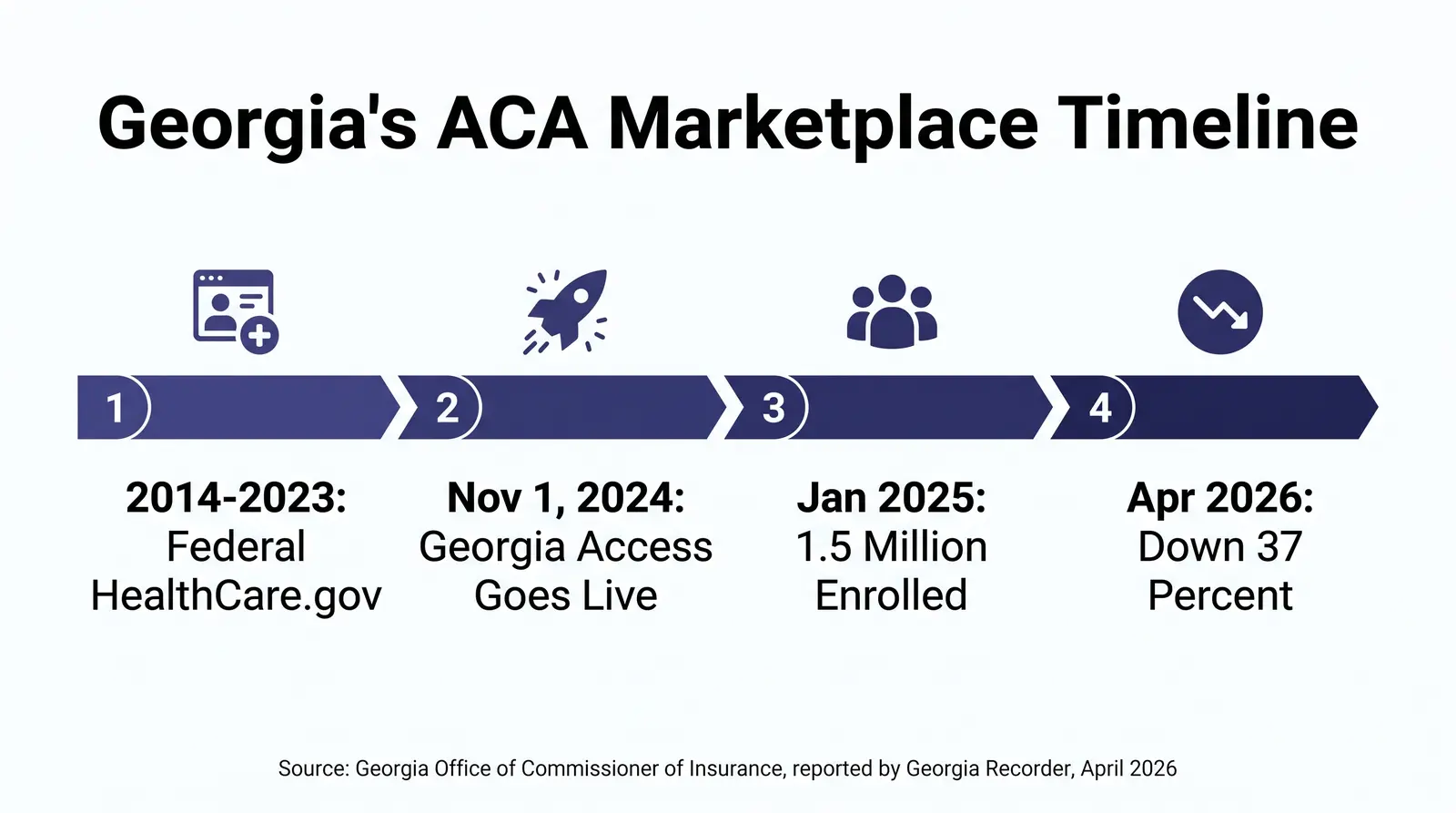
Georgia Access, not HealthCare.gov, has run Georgia's individual health insurance marketplace since November 1, 2024.1 Enrollment fell from 1.5 million in January 2025 to 950,000 by April 17, 2026, a 37% decline that Georgia's own insurance regulator attributes largely to the expiration of enhanced federal premium subsidies, and it kept falling toward roughly 900,000 by early September 2026.23 The eight carriers still offering Georgia Access plans for 2027 have filed for a weighted average 20.7% rate increase before subsidies, with Cigna and UnitedHealthcare exiting the market entirely.4 Open enrollment for 2027 coverage runs November 1, 2026 through January 15, 2027.3 If your agency's website still tells a Georgia client to enroll at HealthCare.gov, or still shows last year's rates, you're not just out of date. You're giving an answer that's factually wrong, right as the search volume for it spikes.
The call that's coming before Thanksgiving
Somewhere in your book right now is a Georgia client who opened a renewal notice, saw a number that didn't match last year's, and set the letter down without reading the rest of it. Open enrollment for 2027 coverage starts November 1 and runs through January 15,3 and the eight insurers still selling through Georgia Access have filed for a weighted average premium increase of 20.7% before any subsidy is applied.4 For plenty of Georgians, the number on that letter is worse than average, because the federal subsidy that used to soften it expired at the end of 2025.
That client is going to do one of two things before they call you. They're going to type the question into a search bar, or they're going to ask an AI assistant. Either way, they're looking for the same thing: a plain explanation of why this happened and what to do next, with today's date on it. The agencies that show up for that search aren't necessarily the ones with the best rates. They're the ones whose website already has a correct, current, sourced answer sitting on it.
Before you keep reading
Open your own site in a new tab and search it for "HealthCare.gov." If it shows up anywhere near your Georgia enrollment instructions, that's the first thing to fix, and it takes less time than reading the rest of this guide. If you want a broader read on where your site stands, the free Audit scores speed, AI citations, and HIPAA safe tracking in about a minute.
Why Georgia doesn't run on HealthCare.gov anymore
Georgia ran its individual ACA market entirely through HealthCare.gov from the law's 2014 launch through 2023, the same as most states that never built their own exchange. That changed in two steps. For 2024 coverage, Georgia operated under a hybrid model, certifying its own plans and running a state Navigator program while residents still enrolled through the federal HealthCare.gov platform. For 2025 coverage, Georgia took over every piece of the marketplace, including the enrollment platform itself, under the name Georgia Access.5
The Georgia Office of Commissioner of Insurance and Safety Fire, which built and runs Georgia Access, states it plainly on its own site: Georgia Access "will go live as the official health insurance marketplace on November 1, 2024, as Open Enrollment 2025 commences," becoming, in the office's words, the first state-based exchange to partner with private sector companies to get consumers enrolled.1 Existing HealthCare.gov accounts for Georgia residents were transferred over, and Georgia Access now runs its own marketplace call center, so Georgia residents no longer use HealthCare.gov's call center for enrollment help.5
That's two full plan years a Georgia resident has not used HealthCare.gov to enroll in individual coverage. It's also two plan years some agency websites, blog posts, and downloadable guides have had to get wrong, because the instructions were written once, before the switch, and never revisited.
Georgia Access describes itself as "Health Insurance for Georgia, by Georgia." A site that still sends a Georgia client to HealthCare.gov is describing a marketplace that no longer exists for them.
What Georgia Access actually is
Georgia Access is the state's own health insurance marketplace, operated by the Office of Commissioner of Insurance and Safety Fire under Insurance Commissioner John F. King, built for Georgians to shop for and enroll in individual market coverage the same way HealthCare.gov used to handle it, just under state control.6 It carries its own open enrollment window, its own consumer support line, and now its own enrollment and rate history, separate from the 32 or so states still using the federal platform. None of that is a minor branding difference. It's the actual platform a Georgia client needs to be pointed toward, and the actual source a current rate figure needs to come from.
Why enrollment fell 37% in fifteen months
Georgia's Office of Commissioner of Insurance released enrollment figures to Georgia Recorder and The Current GA following a public records request, and the number is not a rounding error: ACA marketplace enrollment in Georgia fell from 1.5 million in January 2025 to 950,000 by April 17, 2026, a 37% drop of more than 550,000 people, described in that reporting as the steepest decline in the state since ACA plans launched in 2014.2 The Atlanta Journal-Constitution, reporting separately in October 2026, put enrollment at roughly 1.3 million in fall 2025 easing to roughly 900,000 by early September 2026, a different snapshot window on the same downward trend.3
The mechanism behind the drop is a subsidy cliff, not a change in how many people need coverage. Enhanced federal premium tax credits, the pandemic era boost that let far more people qualify for a subsidized premium, expired at the end of 2025. Reporting on the Georgia OCI data describes Georgians earning above roughly $64,000 as an individual losing federal assistance entirely, with premiums for some filers more than tripling.2 People didn't get healthier or stop needing insurance. A large share of them did the math on a plan that suddenly cost three times as much and walked away from it.
CMS's own December 5, 2025 fact sheet on the 2026 open enrollment period gives a useful, independently sourced baseline for where this started. As of the reporting period through November 22, 2025, Georgia's State-based Exchange had logged 213,873 new plan selections plus 1,046,228 consumers auto-re-enrolled into 2026 coverage, a combined 1,260,101 plan selections reported to the federal government.7 That's a different measurement than the "enrolled" figures OCI later released (a plan selection isn't the same as a paid, effectuated policy), but it confirms the same order of magnitude Georgia started 2026 with, before the subsidy cliff and non-payment losses pulled hundreds of thousands of those selections out of force over the following months.
| Date | What was measured | Figure | Source |
|---|---|---|---|
| January 2025 | Enrolled in ACA coverage through Georgia Access | 1.5 million | Georgia OCI, via Georgia Recorder2 |
| Through Nov. 22, 2025 | Cumulative 2026 plan selections reported to CMS (new plus auto-re-enrolled) | 1,260,101 | CMS official fact sheet7 |
| April 17, 2026 | Enrolled in ACA coverage through Georgia Access | 950,000 | Georgia OCI, via Georgia Recorder2 |
| Early September 2026 | Enrolled in ACA coverage through Georgia Access | ~900,000 | The Atlanta Journal-Constitution3 |
Note: the November 2025 CMS figure counts plan selections reported to the federal government, which can include people who never pay a first premium. The January 2025, April 2026, and September 2026 figures come from Georgia's own insurance regulator and reflect enrollment actually in force. The two measurements aren't directly interchangeable, but together they show the same story: Georgia started 2026 with well over a million people in the marketplace and lost somewhere around a third of them within a year.
What 2027 premiums actually do, carrier by carrier
Eight insurers will offer Georgia Access plans for 2027, two fewer than you'd get by simple addition, because Cigna and UnitedHealthcare are both exiting the market at the end of 2026 coverage while one new insurer, Antidote Health Plan of Georgia, joins.4 Across the carriers that are staying, healthinsurance.org's review of the filed rates puts the weighted average requested increase at 20.7% before any subsidy is applied,4 and The Atlanta Journal-Constitution's own reporting on the same filings describes "most insurers raising their prices upward of 20% compared with 2026 prices," while noting the numbers weren't final as of that reporting and are confirmed before open enrollment opens November 1.3
| Carrier | 2027 status | Proposed rate change |
|---|---|---|
| CareSource | Continuing | +27.4% |
| Oscar | Continuing | +26.9% |
| Alliant | Continuing | +21.5% |
| Kaiser Permanente | Continuing | +20.2% |
| Ambetter (Centene) | Continuing | +18.0% |
| Anthem BCBS of Georgia | Continuing | +16.9% |
| AMGP Georgia Managed Care (Anthem HMO) | Continuing | +12.2% |
| Antidote Health Plan of Georgia | New for 2027 | No prior year rate |
| Cigna | Exiting | N/A |
| UnitedHealthcare | Exiting | N/A |
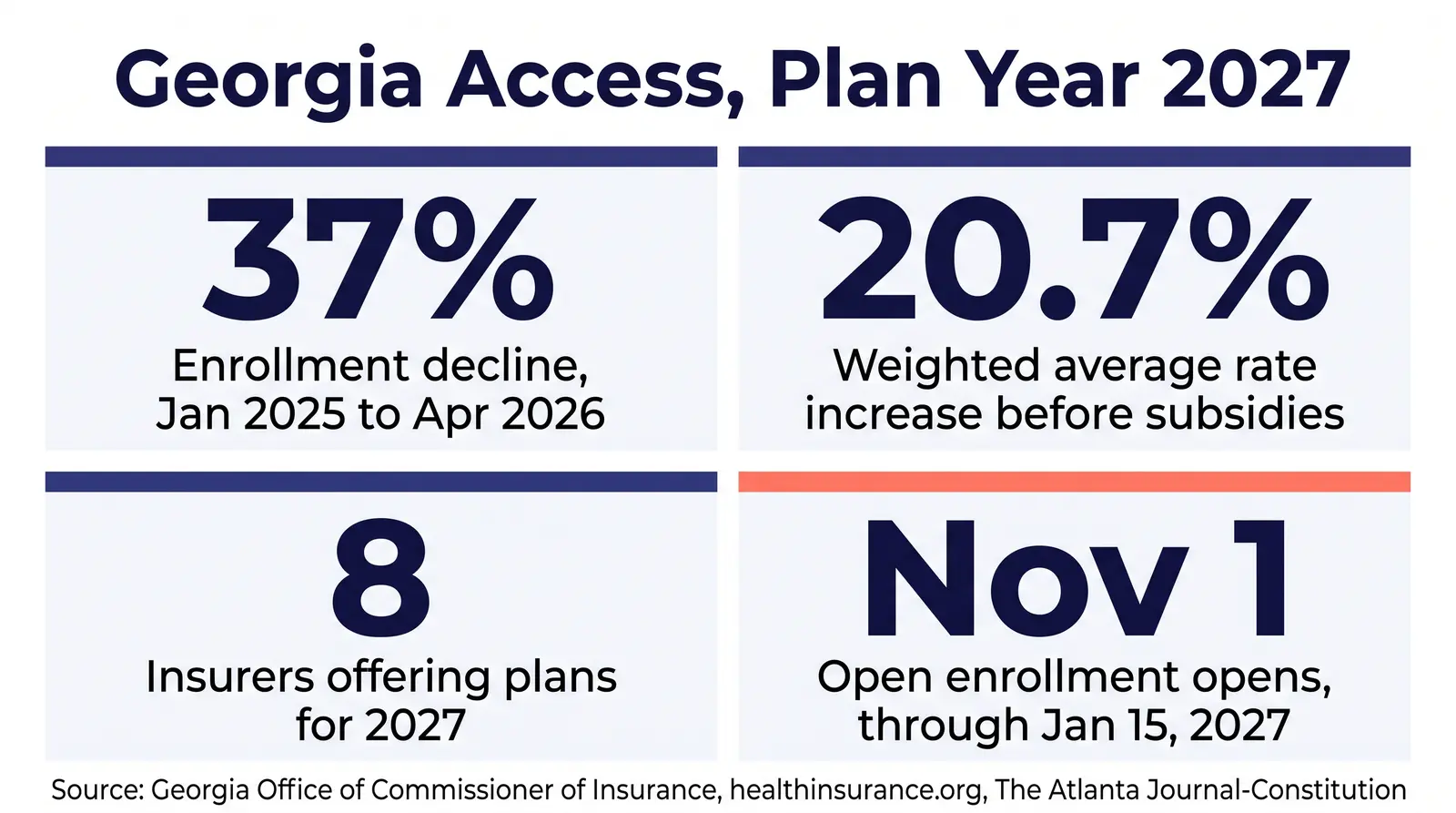
37%
Georgia ACA enrollment decline, Jan 2025 to Apr 20262
20.7%
Weighted average 2027 rate increase before subsidies4
8
Insurers offering Georgia Access plans for 20274
Nov 1
2027 open enrollment opens, through Jan 15, 20273
None of this is evenly spread across the state. Reporting on the OCI figures notes some rural counties losing more than half their enrollment, which tracks with what rural hospital finance researchers have been warning about separately: a shrinking insured pool concentrated among older, sicker enrollees who stayed, while healthier, price sensitive enrollees left. That's worse for the risk pool, which is part of why insurers are filing for another year of double digit increases instead of a one time correction.
This isn't a one state story, but Georgia shows it clearly
KFF's national analysis of 2027 filings across all 50 states and Washington, D.C. found a median proposed increase of 15%, the second highest requested rate cycle since 2018, driven by the same subsidy cliff affecting Georgia. Georgia's 20.7% average sits above that national median, and its 37% enrollment drop is specifically called out in state level reporting as the steepest since 2014. If you serve clients in other states, the mechanism is the same even where the exchange name doesn't change.
What a wrong exchange name costs you, twice
A Georgia agency site that still says HealthCare.gov pays for that mistake in two separate ways, and most agents only think about the first one.
The first cost is the obvious one. A client who clicks through to HealthCare.gov to "enroll" hits a wall, a confusing redirect, or an application that doesn't actually process for a Georgia resident anymore. That's a real, immediate conversion loss, and it happens at the worst possible moment, right when a price shocked client is deciding whether to shop around or just let coverage lapse.
The second cost is quieter and compounds. Every major AI answer engine, and Google's own AI Overviews and AI Mode, works by pulling supporting passages from pages it trusts to be accurate, then generating an answer from them. Google's own documentation on AI features describes the process using a "query fan-out" technique, issuing multiple related searches across subtopics to build the answer, and states that a page has to be indexed and eligible to appear in regular Search before it can ever show up as a supporting link in an AI feature.8 A page that names the wrong exchange isn't a crawling or indexing problem. It's a content accuracy problem, and accuracy is the one thing a fan-out process across multiple sources is specifically built to cross check. An answer engine that pulls from five Georgia insurance pages and finds four naming Georgia Access correctly and one still naming HealthCare.gov has an easy call to make about which one to trust and quote.
A quick way to check your own site
Search your own domain for "HealthCare.gov," "healthcare.gov," and "federal marketplace." Check every page that mentions how a Georgia client enrolls: your homepage, your ACA service page, any downloadable guide or PDF, your FAQ, and any blog post written before November 2024. If any of them send a Georgia reader to the federal platform by name or by link, that page is actively wrong, not just stale.
How an AI answer engine decides which page to trust
Google's guidance is specific about what actually gates inclusion in AI Overviews and AI Mode, and none of it is exotic. A page has to be indexed and snippet eligible in ordinary Search first.8 Beyond that gate, Google is explicit that the same SEO fundamentals that have always mattered are what decide whether a page gets pulled into an AI generated answer: helpful, accurate, well structured content that actually answers the question being asked.
For a page about Georgia's 2027 marketplace, that means naming Georgia Access specifically, stating a current rate figure with its date, and citing where the figure came from. It also means the page needs to load. Google's own Core Web Vitals guidance sets pass thresholds of 2.5 seconds for Largest Contentful Paint, 200 milliseconds for Interaction to Next Paint, and 0.1 for Cumulative Layout Shift, each measured at the 75th percentile of page loads and segmented separately for mobile and desktop.9 A panicked client checking a renewal letter on a phone in a parking lot is exactly the visitor a slow page loses before the content ever gets read, correct exchange name or not.
Put plainly: there's no shortcut that substitutes for getting Georgia Access right, dating the page, sourcing the rate figures, and making sure the page actually loads fast on a phone. There's also no extra AI specific step beyond that. The agencies that show up in these answers are the ones that already do ordinary things well, applied to a topic that changed this year.
What to fix on your site this week
None of this requires new software. It requires an afternoon and a willingness to actually read your own site the way a confused client would.
1. Find and fix every HealthCare.gov reference
Search your site, your PDFs, and your email templates for any reference to the federal marketplace in the context of Georgia individual coverage. Replace it with Georgia Access, by name, with a link to georgiaaccess.gov.
2. Put the 2027 numbers on the page, dated
State the 20.7% weighted average increase, name it as a weighted average before subsidies, and date it. A number without a date reads as permanent, and this one will be revised again by the time final rates post ahead of open enrollment.
3. Name which carriers are leaving
If you write for clients on a Cigna or UnitedHealthcare Georgia Access plan, say so directly rather than making them discover it when their renewal doesn't arrive. That's the single most useful, most searched fact an exiting carrier's client needs this fall.
4. Publish a short, sourced explainer before the letters land
A plain page answering "why did my Georgia health insurance premium go up for 2027" with the actual figures and sources, dated, is the page that gets read out loud as the answer instead of a competitor's or a national news aggregator's.
Don't round the number to sound more dramatic
20.7% is already a striking figure. Don't inflate it into "rates are doubling" or borrow a single carrier's 27.4% as if it were the average. CMS TPMO marketing rules apply to how you describe pricing even in educational content, and an inflated figure is also just less useful to a client trying to budget accurately.
You can do all four of these yourself
Most agents read a list like that and decide the writing and sourcing part is where they'd rather not spend an afternoon. Either outcome is fine. If you'd rather talk through what this page should say for your own book, book a short call and we'll look at it with you.
How we build a site that already has this right
We build insurance agency websites on Astro, which ships zero JavaScript to the browser by default and renders pages to finished HTML at build time, served from the edge on Cloudflare. Page-builder platforms like a GoHighLevel funnel page or a heavily plugged WordPress theme load a runtime, a theme, and a stack of plugins before the content appears. Our builds score 90+ on Lighthouse performance on mobile and desktop, and a number of pages score 100, which is the difference between a page that's still loading and one that's already answered the question by the time a client's thumb stops scrolling.
Every page we ship carries a schema stack built to match what's actually on the page:
Article and FAQ markup, breadcrumbs, and organization data, not boilerplate copied across
every post. The crawler files, llms.txt, sitemap.xml, and
robots.txt, regenerate themselves the moment a new page publishes, with the
full absolute URL, and robots.txt is written to welcome every major crawler,
including the named AI crawlers, so a page like this one is actually reachable by the
systems summarizing it for your clients.
That matters specifically here because a fact like "Georgia switched exchanges" doesn't stay news forever, but it stays wrong on an unmaintained site forever. Per the live pricing page, verified today, Digital Foundation's Pro tier adds a new blog post, location page and answer page every week, and Scale adds one of each every business day.10 When a state changes its exchange, or a carrier exits, or a subsidy expires, that cadence is what gets a correct, sourced answer live while the search volume for it is still climbing, instead of next quarter.
We also build real quote and comparison tools wired to live federal data, not a static form showing last year's example numbers. For a market moving this fast, that's the difference between reassuring a client in the abstract and showing them an option that's actually current today.
What changes for your agency
The practical result of fixing this isn't a ranking promise. It's that your site stops being the thing that embarrasses you in front of a client who already knows more about Georgia Access than your own homepage does.
The exchange name is right, everywhere
No page, PDF, or email template still points a Georgia client to HealthCare.gov.
A page live while it's still news
Weekly or daily publishing cadence means a rate change or carrier exit gets answered while people are searching it.
Schema that matches the page
Article, FAQ, and dataset markup built to reflect what's actually written, not copied boilerplate.
A fast page on a phone
90+ Lighthouse on mobile and desktop, built to pass Core Web Vitals, not assumed.
Crawl files that maintain themselves
llms.txt, sitemap.xml, and robots.txt regenerate with full URLs on every publish.
When this doesn't change much for you
If you write mostly life, final expense, or annuities business and only occasionally touch ACA coverage for a Georgia client, this specific fix is quick and worth doing, but you don't need a daily publishing cadence built around it. A single correct, sourced page covering it is enough. Save the urgency for the agencies with a concentrated Georgia ACA book, since that's where 550,000 displaced enrollees and another year of double digit increases actually collide with how many people are about to search for help.
Questions Georgia agents are asking
Is Georgia Access the same thing as HealthCare.gov?
No. Georgia Access is the state's own health insurance marketplace, operated by the Georgia Office of Commissioner of Insurance and Safety Fire, and it fully replaced HealthCare.gov as the enrollment platform for Georgia residents starting with plan year 2025, going live November 1, 2024. A site that still tells a Georgia client to enroll at HealthCare.gov is sending them to a platform that no longer processes Georgia individual market applications.
Why did Georgia's ACA enrollment drop 37%?
The main driver is the expiration of enhanced federal premium tax credits at the end of 2025, which raised the out of pocket cost of coverage sharply for anyone earning above roughly $64,000 as an individual. Georgia's Office of Commissioner of Insurance reported enrollment falling from 1.5 million in January 2025 to 950,000 by April 17, 2026, a drop Georgia Recorder reporting called the steepest since ACA plans launched in the state in 2014.
How much are Georgia Access premiums rising for 2027?
A weighted average of 20.7% before subsidies, based on rate filings for the eight insurers offering plans through Georgia Access in 2027, according to healthinsurance.org's review of the filings. Individual carrier increases range from 12.2% to 27.4%. The Atlanta Journal-Constitution separately reported most insurers requesting increases upward of 20%, with final rates confirmed before open enrollment begins.
Which insurers are leaving the Georgia Access marketplace for 2027?
Cigna and UnitedHealthcare are both exiting Georgia Access at the end of 2026 coverage, per healthinsurance.org's review of Georgia's 2027 marketplace filings. One new insurer, Antidote Health Plan of Georgia, is joining, bringing the total to eight carriers offering plans for 2027.
When does Georgia Access open enrollment start for 2027 coverage?
November 1, 2026, running through January 15, 2027, per Atlanta Journal-Constitution reporting on the upcoming cycle. That's the same November 1 to January 15 window Georgia Access has used since taking over the state's marketplace, and it's the window during which both the premium increases and the prior year's enrollment collapse become news your clients are actively searching.
Does an outdated exchange name actually hurt AI search visibility?
Indirectly, but concretely. Google's own AI features documentation states a page must be indexed and eligible to show in regular Search to appear as a supporting link in AI Overviews or AI Mode, and that AI features run on the same foundational SEO practices as classic search, nothing extra. A page that gives a wrong, dated answer about which exchange a client uses isn't a technical SEO failure, it's a trust and accuracy failure, and accuracy is exactly what a fact checking query fan-out is built to catch.
What should a Georgia agency fix on its website before November 1?
Audit every page, form, and piece of content that names an enrollment platform, and replace any reference to HealthCare.gov with Georgia Access by name. Add the current 2027 rate change figures with a visible date. Then publish a short, sourced explainer of what happened to enrollment and rates this year, since that's the exact question clients and prospects are about to start asking a search bar or an AI assistant.
Sources
- Georgia Office of Commissioner of Insurance and Safety Fire. "Georgia Access," official program page: "Georgia Access will go live as the official health insurance marketplace on November 1, 2024, as Open Enrollment 2025 commences," described as the first state-based exchange to partner with private sector companies for enrollment, with coverage beginning January 1, 2025 for consumers who select a plan by December 16, 2024. Verified live October 6, 2026. oci.georgia.gov/node/5596.
- Georgia Recorder, via Rough Draft Atlanta. "Georgia ACA enrollment decline," published April 20, 2026, citing Georgia Office of Commissioner of Insurance and Safety Fire data released following a public records request: enrollment fell from 1.5 million in January 2025 to 950,000 as of April 17, 2026, a 37% decline of more than 550,000 people, described as the steepest since ACA plans launched in Georgia in 2014. Also reports enhanced federal subsidy expiration pushing some filers above roughly $64,000 in income to lose federal assistance entirely, with premiums for some more than tripling. Verified live October 6, 2026. roughdraftatlanta.com.
- The Atlanta Journal-Constitution. "Georgia 2027 ACA marketplace, higher prices," published October 2026: most insurers raising prices upward of 20% compared with 2026, not yet finalized as of reporting; enrollment easing from roughly 1.3 million in fall 2025 to roughly 900,000 by early September 2026; open enrollment for 2027 coverage begins November 1 and runs through January 15; data attributed to Georgia Recorder's August 2026 reporting on rate filings. Verified live October 6, 2026. ajc.com.
- healthinsurance.org. "Georgia Health Insurance Marketplace," state guide, 2027 marketplace section: weighted average rate increase of 20.7% before subsidies across 8 insurers; individual carrier increases from 12.2% (AMGP Georgia Managed Care, dba Anthem BCBS) to 27.4% (CareSource); Cigna and UnitedHealthcare exiting at the end of 2026 coverage; Antidote Health Plan of Georgia new for 2027; for 2026 coverage, 1,324,295 enrolled with 89% receiving subsidies averaging $688 a month. Verified live October 6, 2026. healthinsurance.org/states/georgia.
- healthinsurance.org. "Georgia switches to state-run health insurance marketplace for 2025 coverage": Georgia operated a hybrid model for 2024 coverage, certifying plans and funding a Navigator program while residents still enrolled through HealthCare.gov, then moved every marketplace function, including the enrollment platform, to Georgia Access for 2025 coverage; existing HealthCare.gov accounts were transferred and Georgia Access now runs its own consumer call center. Verified live October 6, 2026. healthinsurance.org/blog.
- Georgia Access (georgiaaccess.gov). Official marketplace site: "Health Insurance for Georgia, by Georgia," operated by the Office of Commissioner of Insurance and Safety Fire under Insurance Commissioner John F. King; consumer support line 888-687-1503; open enrollment for 2026 coverage ran through January 15, 2026, with qualifying life events triggering special enrollment periods outside that window. Verified live October 6, 2026. georgiaaccess.gov.
- Centers for Medicare & Medicaid Services. "Marketplace 2026 Open Enrollment Period Report: National Snapshot," fact sheet published December 5, 2025: Georgia's State-based Exchange reported 213,873 cumulative new plan selections and 1,046,228 consumers auto-re-enrolled for 2026 coverage, as of the reporting period through November 22, 2025. Verified live October 6, 2026. cms.gov/newsroom/fact-sheets.
- Google Search Central. "AI features in Search," official documentation: AI Overviews and AI Mode may use a "query fan-out" technique, issuing multiple related searches across subtopics; a page must be indexed and eligible to be shown in Google Search to appear as a supporting link in an AI feature; "You can apply the same foundational SEO best practices for AI features as you do for Google Search overall," with "no additional requirements to appear in AI Overviews or AI Mode, nor other special optimizations necessary." Verified live October 6, 2026. developers.google.com/search/docs/appearance/ai-features.
- web.dev (Google). "Web Vitals": Largest Contentful Paint should occur within 2.5 seconds; Interaction to Next Paint should be 200 milliseconds or less; Cumulative Layout Shift should be 0.1 or less; a good threshold to measure is the 75th percentile of page loads, segmented across mobile and desktop devices. Verified live October 6, 2026. web.dev/articles/vitals.
- Strategic AI Architects. Digital Foundation pricing page: Website $84/mo billed annually (complete site with 30 pages live on Launch Day, calculators and widgets, AI CLI access, monthly report); Starter $247/mo (adds 2 blog posts, 2 location pages and 2 answer pages a month, Google Business Profile management, AI chat widget); Pro $497/mo (adds 1 blog post, 1 location page and 1 answer page every week, up to 4 languages, review harvesting, 24/7 AI receptionist); Scale $997/mo (adds 1 of each every business day, up to 10 custom pages, monthly newsletter); Full Clone, Update and Handoff $1,000 one time; 14-day free look period. Verified live 2026-10-12. strategicaiarchitects.com/digital-foundation.
Talk it through
Want a second pair of eyes on it?
Free 30 minutes. Bring what you found, or bring nothing and we will look together at how AI engines read your site and which fixes move first.
See whether your own site still gets this wrong
Run a free Audit and see how your site scores for speed, AI citations, and HIPAA safe tracking, in about a minute.
Related reading: Your insurance website is behind on 2027 plan data · Texas ACA premiums jump again for 2027, insurers exit · Why blog update frequency affects AI citations