Playbook
Your Insurance Website Is Behind on 2027 Plan Data
CMS published new 2027 Medicare Advantage and Part D numbers on September 28. KFF's own tracker counts nine insurers leaving the ACA marketplace for next year. Most agency websites still show last year's premiums, last year's insurer counts, and last year's dates, because nothing on a static page knows the data underneath it changed.


20 min read
CMS and KFF both published new 2027 numbers this fall, and most agency sites haven't caught up. CMS's own September 28, 2026 release puts the projected weighted average Medicare Advantage premium at $12.00 a month for 2027, down from $14.37 in 2026, a drop of more than 16%.1 At the same time, KFF's insurer participation tracker counts nine carriers announcing ACA marketplace exits for 2027, including Cigna pulling out of the individual market in all 11 states where it currently sells.2 KFF's companion brief on 2026 found 165 counties down to a single ACA insurer, up from 93 the year before.3 None of that updates itself on a page where the premium was typed in by hand last December. Medicare's Annual Enrollment Period opens October 15 and runs through December 7.1 ACA Open Enrollment runs November 1 through January 15, with a December 15 deadline for coverage starting January 1.4 The question worth asking your own site this week isn't whether the numbers changed. They did. It's whether your site noticed.
The numbers already moved without you
On September 28, 2026, the Centers for Medicare and Medicaid Services put out a press release with a headline most agents would call good news: Medicare Advantage and Part D premiums are projected to fall for 2027, and plan access is expected to stay broad.1 Two weeks earlier, on September 15, KFF updated its own independent tracker of ACA marketplace insurer participation for 2027, and the headline there is less tidy: nine carriers have announced they're leaving, Cigna among them, pulling out of eleven states entirely.2 Both of those things are true at once. Neither one is a rumor. Both came from a primary source, dated, this fall.
Here's the part that doesn't make it into either press release: nothing about your website knows any of this happened. If your Medicare page says "premiums as low as $14 a month" because that's what it said last October, it's now wrong in a specific, checkable way, not just stale in a vague one. If your ACA page lists carriers in your county without checking whether one of them just filed to leave, a prospect who read that page and then got a non-renewal letter is going to remember which one came first.
AEP opens in eleven days from the date this guide was written. ACA Open Enrollment opens in four weeks. Every agent reading this already knows what that window does to search traffic: more comparison shopping, more "is my plan still available" searches, more people checking three or four agency sites in one sitting before they call anyone. That's exactly the window where a page quoting last year's premium stops being a minor housekeeping item and starts being the reason a prospect's first impression of your agency is "this doesn't look current."
Before you keep reading
Open your own site's Medicare or ACA page right now in another tab. Find any specific number on it, a premium, a plan count, an insurer name, a date. Ask yourself honestly whether you know, right now, if that number reflects 2027 or 2026. If you can't answer instantly, the audit later in this guide is worth five minutes. If you'd rather have someone else check first, the free Audit scores your site's speed, AI citation readiness, and HIPAA safe tracking in about a minute.
Why a page doesn't know the data changed
This isn't a story about lazy agencies. It's a story about how most agency websites are actually built. A page builder site, whether it's a WordPress theme, a GoHighLevel funnel page, or a Wix template, stores its content as text someone typed into an editor at some point. "Plans starting at $14 a month" isn't a live calculation. It's a sentence, saved once, that sits there until a human opens the editor again and changes it.
Nothing structurally connects that sentence to CMS's data. The page doesn't check anything when a visitor loads it. It doesn't know CMS published new numbers on September 28, the same way a printed brochure doesn't know the year changed. It just displays whatever was last saved, confidently, to every visitor, forever, until someone remembers to go fix it.
That's the real difference between a static site and a live one, and it's a different distinction than the one most agents think about when they hear "fast" versus "slow." Speed is about how quickly a page loads. This is about whether the content on the page is still true. A static site can load in half a second and still be telling every visitor a number that stopped being accurate on September 28.
The agencies most exposed to this aren't the ones ignoring their website. They're often the ones who built a nice looking Medicare or ACA page two or three years ago, got it right once, and haven't opened the editor since, because it's "done." Done is the problem. A number that's correct in December 2025 and never touched again is wrong by the time CMS publishes the next plan year's figures, and it stays wrong for everyone who reads it in between.
This also isn't a new calendar problem agencies are seeing for the first time. CMS has published new benefit year data ahead of the Annual Enrollment Period every fall for more than a decade, going back at least to its 2011 announcement that "Medicare's 2012 Open Enrollment Drug and Health Plan Data Goes Live Saturday Oct. 1."6 The pattern itself isn't news. What changes every single year is the specific figures inside it, and a site built to show "this year's numbers" instead of "the numbers from whenever we last edited this page" is the only kind of site that keeps up with a pattern that's been running annually since long before this year's release.
What actually changed, Medicare side
CMS's September 28 release lays out specific, dated figures for the 2027 plan year, and they're worth stating precisely rather than rounding them into a vague "premiums are down" headline, because the precise numbers are what a prospect checking your site against CMS's own release would actually compare.
| Figure | 2026 | 2027 (projected) | Change |
|---|---|---|---|
| Weighted avg. Medicare Advantage premium | $14.37/mo | $12.00/mo | Down more than 16% |
| Avg. total Part D premium, inside MA plans | $11.32/mo | $7.00/mo | Down $4.32, about 38% |
| Avg. premium, stand alone Part D plans | $35.09/mo | ~$36/mo | Up less than $1 |
| Medicare Advantage plans available nationally | 5,553 | 5,532 | Essentially flat |
CMS also states that more than 99% of Medicare beneficiaries will have access to at least one Medicare Advantage plan in 2027, and 97% will have access to ten or more plan options, alongside a projected enrollment of 34 million people in Medicare Advantage, about 47.4% of the Medicare population.1 Read plainly, CMS's own framing for 2027 is stability: premiums falling, plan count essentially flat, access broad. That's the government's own characterization, and there's no reason to dispute it as a national picture.
The honest caveat, and it's one CMS's own release doesn't spell out for you, is that a weighted national average can fall while individual counties see something different. A falling average is compatible with some counties losing a carrier, some beneficiaries seeing their specific plan's premium rise, and some service areas shrinking, all at the same time as the national number improves. The national release tells you what happened in aggregate. It doesn't tell you what happened in your county, which is the number a prospect sitting in your county actually cares about.
The ACA marketplace is thinning at the same time
While the Medicare headline for 2027 is stability, the ACA marketplace headline is the opposite, and it didn't start this year. KFF's brief on 2026 participation, published June 11, 2026, documents a marketplace that was already consolidating before the 2027 exits were announced.
| Measure | 2025 | 2026 | 2027 |
|---|---|---|---|
| Average issuers offering plans, per state | 9.6 | 9.0 | Not yet finalized |
| Counties with only one insurer | 93 | 165 | Not yet finalized |
| States with fewer insurers than the prior year | Not applicable | 19 states | Not yet finalized |
| Carriers with announced exits or entries | Not applicable | Not applicable | 9 exiting, 6 entering |
KFF's own words on the 2026 data are precise enough to quote directly: "the average number of issuers offering plans in the ACA Marketplaces has declined from a record high of 9.6 issuers per state in 2025 to 9.0 issuers per state in 2026," and "in 165 counties, only one issuer is offering plans on the ACA Marketplace, up from 93 counties in 2025."3 Illinois and Michigan each lost three insurers, the largest single state declines in that data set.3
For 2027 specifically, KFF's tracker, last updated September 15, 2026, counts nine carriers that have announced an exit from ACA Marketplaces in some or all of the states where they currently participate, against six carriers announced as entering new state marketplaces.2 Cigna is the named example: the tracker reports Cigna exiting the individual market entirely, pulling out of all eleven states where it currently sells ACA plans, citing more than 350,000 on exchange enrollees from the carrier's own first quarter reporting as a scale reference.2 KFF is explicit that this list is based on sources identified as of July 2, 2026, and may still change before open enrollment opens.2
What this isn't
This isn't a claim that every state or every county is losing insurers, and it isn't a prediction about your specific market. It's a sourced, dated snapshot of a national trend, with the explicit caveat, from KFF itself, that the 2027 list can still change. Treat any county level claim on your own site the same way: verify it against current data before you publish it, not against what felt true last year.
A worked example of why county matters more than national
This is a simplified, illustrative scenario to show the mechanism, not real plan data for any actual county or carrier. Picture an agency in a mid sized county that currently lists three ACA carriers on its website: a national name, a regional name, and a smaller regional co-op. Say the smaller co-op is one of the nine carriers that filed a 2027 exit in some portion of its states, and this particular county happens to be inside its exit footprint.
Nationally, nothing about that looks alarming. KFF's tracker already accounts for it: it's one of nine known exits, in a marketplace where six carriers are entering elsewhere, and CMS's own Medicare figures for the same season are about falling premiums and flat plan counts.12 Locally, it's a different story. A prospect in that county who read "three carriers available here" on your site last month, then tries to enroll with the co-op in November, hits a wall the national headline never warned them about.
The fix isn't predicting which counties lose a carrier before CMS and the carriers themselves finalize it. It's not stating a specific carrier list on a page at all unless that list is checked against a current source close to the day it's read, or clearly dated so a reader knows how fresh it is. "As of this week" is an honest, checkable claim. "Three carriers serve this county," with no date and no source, is the kind of sentence that ages into a liability the moment one of those three files an exit.
What a stale number actually costs you
Nobody can hand you a verified lead loss figure for "website shows outdated plan data," and it would be dishonest to invent one. What's real, and worth sitting with, is the specific timing collision this fall produces for agency websites.
16.5%
Projected drop in the weighted average Medicare Advantage premium, 2026 to 2027, per CMS1
165
Counties with only one ACA marketplace insurer in 2026, up from 93 in 2025, per KFF3
9
Carriers that have announced ACA marketplace exits for 2027, per KFF's tracker2
11 states
Where Cigna is exiting the individual ACA market entirely, per the same KFF tracker2
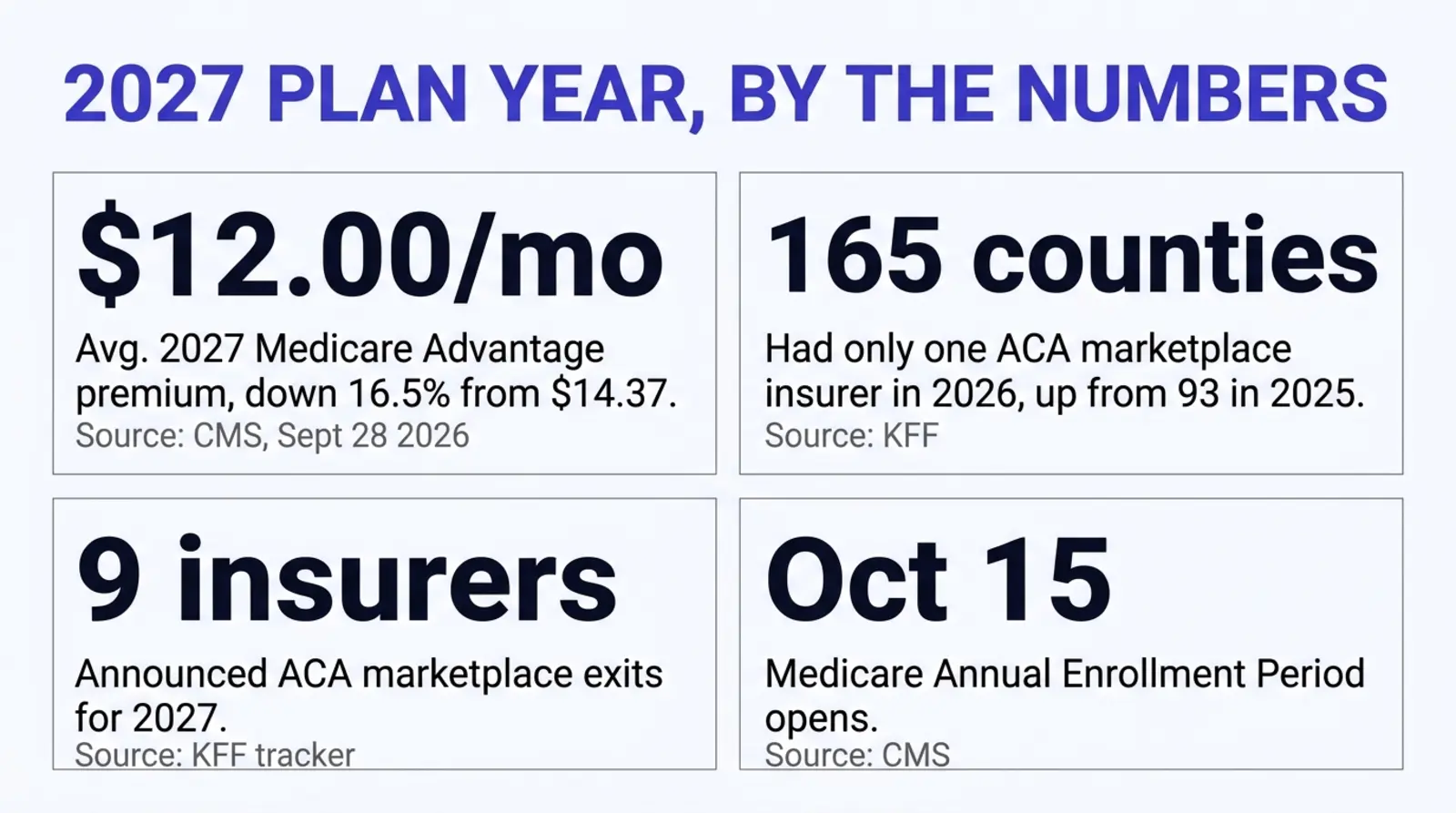
Here's the actual mechanism. CMS and KFF both publish their updates on their own schedules, independent of your website. CMS's 2027 release landed September 28. KFF's tracker update landed September 15. Neither one sends your webmaster an email. If the only thing standing between "the data changed" and "your site reflects it" is a human remembering to open the page editor, the gap between those two dates is exactly how long your site stays wrong, for every visitor who lands on it during that gap, which this year includes the entire run up to AEP and the first weeks of ACA Open Enrollment.
The cost isn't abstract. A prospect who reads "$14 a month" on your site, then sees CMS's own $12 figure somewhere else, or sees a different number entirely once they actually check their county, doesn't conclude that national averages are complicated. They conclude your site was wrong. A single wrong number is a forgivable error. A site that's visibly running on last year's data during the one stretch of the year when everyone is comparison shopping is a pattern, not a typo.
Audit your own site in twenty minutes
This doesn't require a developer, a login to your CMS, or any special tool. It requires reading your own site the way a prospect would, with CMS's and KFF's current figures open in another tab.
1. List every page with a specific number on it
Walk your Medicare page, your ACA page, your blog, and any location pages. Note every sentence that states a premium, a plan count, an insurer name, a star rating, or a specific date. That list is your exposure.
2. Check each number against a current source
For Medicare figures, compare against CMS's own release.1 For ACA insurer claims, compare against KFF's tracker for the state or county you're naming.2 If a page names a specific carrier as available in your county, confirm that carrier hasn't filed to exit.
3. Check when the page was actually last touched
If your CMS shows a last modified date, look at it. A Medicare page last edited in November of last year almost certainly reflects last year's figures, whether or not anyone meant for that to be true.
4. Check your schema's dateModified field
If your site publishes Article or BlogPosting schema, its dateModified value should move when the content actually changes. A page with fresh numbers and a year old dateModified is sending answer engines a mixed signal about how current the page really is.
5. Run your own quote tool the way a stranger would
Submit it with a real ZIP code in your service area. If it returns a premium or a plan name, ask whether that output is computed fresh or pulled from a number someone saved months ago. A tool that shows the same figure regardless of what you enter has the same underlying problem as a static page, just with a form in front of it.
6. Check your own site's search results, not just your own pages
Search Google for your agency's name alongside "2027" and alongside "2026." If the 2026 result is what's ranking and getting clicked, that's the page a prospect is most likely to land on first, whether or not you consider it current.
Curious what else is quietly out of date
This same twenty minute habit, checking what a page actually says against what's actually true, is worth running past your plan pages. The free Audit runs a related check automatically across your site's speed, AI citation readiness, and HIPAA safe tracking.
What self updating actually requires
"Self updating" sounds like marketing language until you look at what it actually takes to build, and it's worth being precise about it, because the honest version is more modest than it sounds.
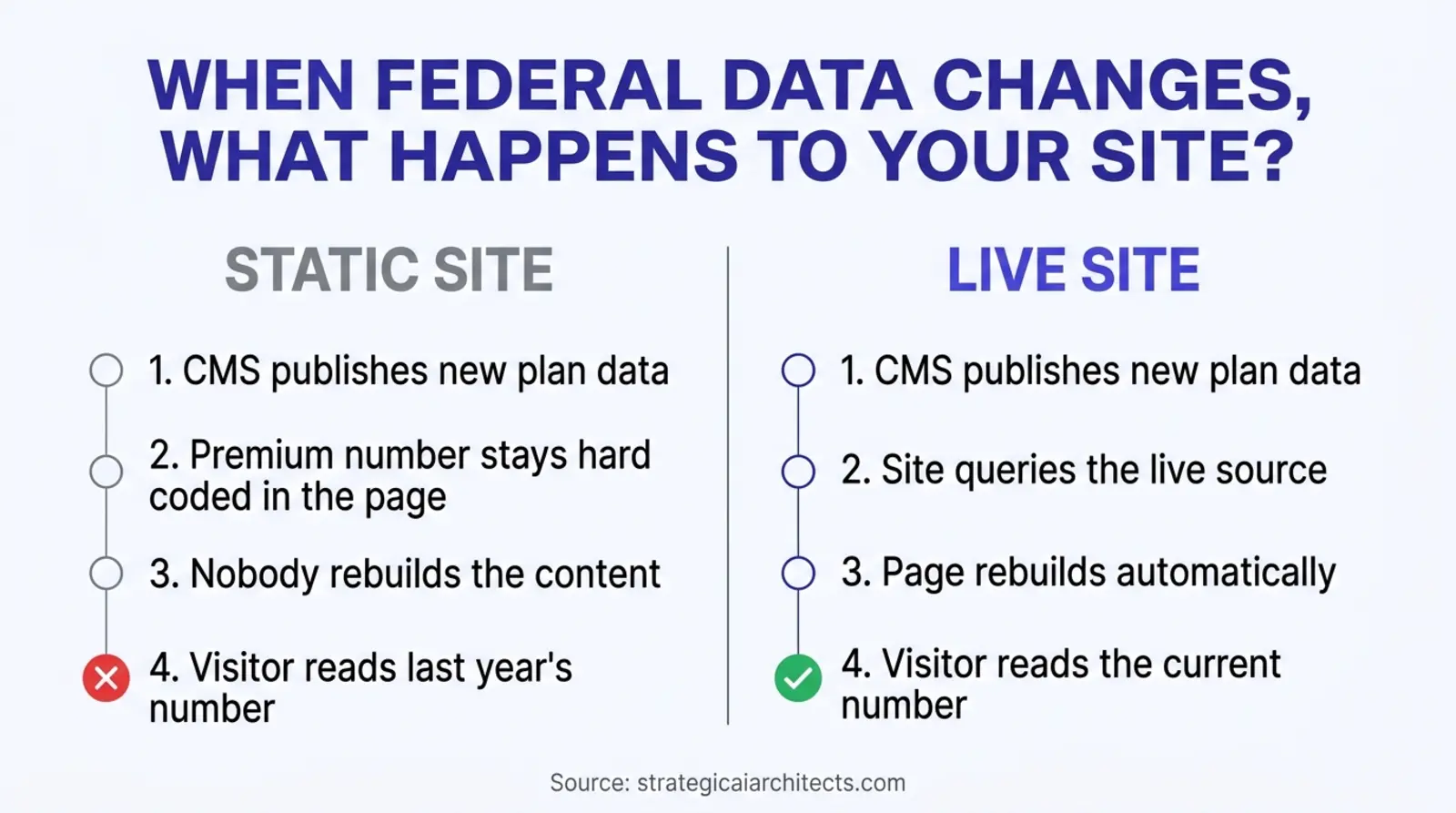
A page that updates itself needs three things a typed sentence doesn't have. First, the number has to live somewhere other than the page's own text, in a data file, a database record, or a live API response, so it can change without a human opening a page editor. Second, something has to trigger a rebuild or a re-query when the underlying source changes, whether that's a scheduled job that checks CMS on a cadence, or a quoter that calls a live data source fresh on every visit instead of displaying a cached answer. Third, and this is the part page builders structurally can't do, the site's publishing process has to actually be a build, something that runs and regenerates the page, not just a saved draft sitting in a database waiting for someone to republish it.
That third piece is the real dividing line. A static site built with a framework like Astro compiles its pages at build time from source data, which means updating the underlying data and triggering a rebuild is a genuinely different, genuinely automatable action than opening a visual editor and retyping a sentence. A page builder site's content lives inside the platform's database as saved blocks, with no equivalent build step, which is exactly why updating it always comes back to a human opening the editor.
When this isn't actually your biggest problem
It's worth saying plainly that not every agency needs to rebuild its plan pages around live data this month. If your book runs almost entirely on referral and renewal, and your website's real job is confirming you're a legitimate, licensed operation before an existing relationship calls you, stale premium figures on a page almost nobody uses to shop are a lower priority than, say, making sure your phone number works and your hours are correct. The exposure described in this guide is highest for cold, comparison shopping traffic, someone who found you through a search and is actively checking your numbers against two or three other agencies in the same sitting. If that's a small share of your traffic, spending a week rebuilding a quoter is probably the wrong week to spend it.
It's also fine to fix this in stages rather than all at once. The single cheapest fix available to almost anyone reading this is removing a specific, undated premium or carrier claim and replacing it with a dated one, "as of October 2026, plans in this area include..." That's a ten minute edit, not a development project, and it closes most of the actual liability even before anything becomes genuinely self updating.
How we build this in
This is the exact problem our build approach is built around, not as an afterthought but as the starting assumption. Every site we build runs on Astro, compiled to static HTML at build time, with the sitemap and llms.txt regenerating themselves the moment new content publishes, carrying the full absolute URL automatically.5 For data that actually needs to be live on every visit, a real quoter wired to a live federal data source, rather than a decorative form with an example number, is listed plainly as part of our custom build scope.5
The practical effect for a page like the one this guide is about: a Medicare or ACA page built this way pulls its headline figures from a maintained source at build time instead of a sentence typed in once. When CMS or KFF publish an update, the fix is updating the underlying source once, not hunting across every page on the site for the sentence that needs to change.
We scope a build like this on a strategy call rather than a fixed package, because an ACA premium estimator is a different build than a page that simply pulls this year's CMS landscape figures into a table. What stays constant is where it runs: on your own accounts and your own domain, working whether or not you keep working with us.5
This is also a blog cadence problem, not just a page problem
The same gap shows up in old blog posts, not just evergreen pages. A post written last December about "2026 subsidy changes" that still ranks and still gets read needs either an update or a clear, dated note that it covers the prior plan year. Our content cadence work pulls every figure from a live source at write time, which is the same discipline applied to publishing instead of to a static page.
What changes for your agency
None of this is a promise about your specific traffic or your specific conversion rate. It's a structural change in what's true on your site the day after CMS or KFF publish an update.
One source of truth per figure
A premium or plan count lives in one maintained place, not retyped across ten pages.
A rebuild, not a reminder
Publishing new content or data triggers a real rebuild instead of depending on someone remembering.
A quoter that can't go stale on its own
Where it matters, the number is computed live against a current federal source, every visit.
A sitemap and llms.txt that keep up
Both regenerate automatically with the full URL the moment something publishes.
You own the build
It runs on your accounts and your domain, and keeps working on its own.
Questions agents ask
When did CMS actually confirm the 2027 Medicare Advantage and Part D numbers?
CMS published the 2027 Medicare Advantage and Part D premium and plan projections in a press release on September 28, 2026, ahead of the Annual Enrollment Period that opens October 15. That release is the source for the premium figures in this guide, and it's dated and citable the same way any federal announcement is.
Are 2027 Medicare Advantage premiums really going down nationally?
Per CMS's own September 28, 2026 release, the projected weighted average Medicare Advantage premium falls from $14.37 a month in 2026 to $12.00 in 2027, a decrease of more than 16%. The average total Part D premium inside Medicare Advantage plans falls further, from $11.32 to $7.00, a 38% drop. Stand alone Part D plans move the other way, rising from $35.09 toward roughly $36, an increase of less than a dollar. A national weighted average isn't a promise about any one county's plans, which is exactly why a page that only shows the national headline number is still incomplete.
How many ACA insurers are actually leaving the marketplace for 2027?
KFF's insurer participation tracker, updated September 15, 2026, counts nine carriers that have announced an exit from ACA Marketplaces for 2027, in some or all of the states where they currently sell, against six carriers announced as entering new state marketplaces. KFF notes its insurer information is based on sources identified as of July 2, 2026, and may still change before open enrollment.
Is Cigna really leaving the ACA marketplace, and where?
Yes. KFF's 2027 tracker names Cigna specifically as exiting the individual market to focus on other business lines, pulling out of the 11 states where it currently participates. KFF cites Cigna's own first quarter reporting of more than 350,000 on exchange enrollees, which gives a sense of scale even though the exact number of affected enrollees for 2027 specifically depends on how many of those members re-shop with a different carrier.
If the national average premium is falling, does that mean my local market is cheaper too?
Not necessarily, and this is the single most important nuance in the whole 2027 story. CMS's figure is a national weighted average across more than 5,500 Medicare Advantage plans. A falling national average is consistent with some counties seeing real premium increases, fewer plan options, or a carrier exit, at the same time. The only way to know what changed in your own county is to look at your own county's 2027 plan data, not the national headline.
How do I check whether my own website is still showing last year's numbers?
Open every page on your site that states a specific premium, a specific count of plans or insurers, or a specific enrollment date, and check two things: does the number match what CMS or KFF currently show for 2027, and does the page's last modified date predate September 2026. The twenty minute audit later in this guide walks through exactly where those numbers tend to hide.
Does a self updating website mean I never have to touch it again?
No, and treating it that way is its own risk. Self updating means the mechanism that pulls a number onto the page runs on a schedule or on request instead of depending on someone remembering to retype it by hand. It doesn't replace a human checking, periodically, that the source feed itself is still returning what you expect. The goal is removing the single point of failure where one person has to remember one task every fall, not removing oversight entirely.
What about old blog posts, not just the main Medicare and ACA pages?
They carry the same risk and they're easier to forget, because a blog post feels finished the day it publishes. A post written last December about 2026 subsidy changes that still ranks and still gets organic traffic needs one of two things this fall: an actual update with 2027 figures, or a clear, dated note at the top saying plainly that it covers the prior plan year, so a reader isn't misled by a post that still looks current because it's still getting clicks.
Sources
- Centers for Medicare and Medicaid Services. "Medicare Advantage and Medicare Prescription Drug Programs Expected to Remain Stable in 2027," press release, published September 28, 2026: weighted average Medicare Advantage premium projected to fall from $14.37 in 2026 to $12.00 in 2027; average total Part D premium within Medicare Advantage plans projected to fall from $11.32 to $7.00; average stand alone Part D premium projected to rise from $35.09 to roughly $36; 5,532 Medicare Advantage plans projected nationally for 2027 versus 5,553 in 2026; more than 99% of beneficiaries projected to have access to at least one Medicare Advantage plan and 97% to ten or more; projected 2027 Medicare Advantage enrollment of 34 million, about 47.4% of the Medicare population; Medicare Open Enrollment confirmed for October 15 through December 7, 2026. Verified live October 4, 2026. cms.gov/newsroom/press-releases.
- KFF. "Tracking Insurer Participation Changes in the ACA Marketplaces in 2027," issue brief, originally published June 11, 2026, updated September 15, 2026: nine carriers have announced exits from ACA Marketplaces for 2027 in some or all states where they participate, against six carriers announced as entering new state marketplaces; Cigna named as exiting the individual market entirely across the 11 states where it currently participates, citing Cigna's own reported first quarter on exchange enrollment of more than 350,000; insurer information based on sources identified as of July 2, 2026, and subject to change. Verified live October 4, 2026. kff.org/affordable-care-act/tracking-insurer-participation-changes-2027.
- KFF. "How Has Insurer Participation in the ACA Marketplaces Changed in 2026?" issue brief, published June 11, 2026: average issuers per state declined from a record high of 9.6 in 2025 to 9.0 in 2026; 165 counties had only one ACA Marketplace insurer in 2026, up from 93 counties in 2025; insurer counts were lower in 2026 than 2025 in 19 states, with Illinois and Michigan each losing three insurers, the largest declines recorded. Verified live October 4, 2026. kff.org/affordable-care-act/how-has-insurer-participation-changed-2026.
- HealthCare.gov. "Health coverage dates and deadlines," official federal Marketplace page: 2027 Open Enrollment confirmed to begin November 1, 2026; December 15, 2026 is the last day to enroll in or change plans for coverage starting January 1, 2027; January 15, 2027 is the last day to enroll in or change Marketplace plans for the 2027 coverage year, with February 1, 2027 coverage start for enrollments made December 16 through January 15. Verified live October 4, 2026. healthcare.gov/quick-guide/dates-and-deadlines.
- Strategic AI Architects. Custom build and Digital Foundation pages: describes static Astro builds with self regenerating sitemap and llms.txt files carrying full absolute URLs, and real quoters and calculators built against live government data as part of the custom build scope, running on the client's own accounts and domain. Verified live October 4, 2026. strategicaiarchitects.com/ai-expert.
- Centers for Medicare and Medicaid Services. "Medicare's 2012 Open Enrollment Drug and Health Plan Data Goes Live Saturday Oct. 1," press release, published September 30, 2011: establishes the long standing annual pattern of CMS publishing new benefit year plan data ahead of each fall's Open Enrollment, cited here only to show the pattern predates this year's release, not as a claim about the 2027 release date. Verified live October 4, 2026. cms.gov/newsroom/press-releases/medicares-2012-open-enrollment.
Talk it through
Want a second pair of eyes on it?
Free 30 minutes. Bring what you found, or bring nothing and we will look together at how AI engines read your site and which fixes move first.
Find out what else your site hasn't caught up on
Run a free Audit and see how your site scores for speed, AI citations, and HIPAA safe tracking, in about a minute.
Related reading: Your quote form doesn't actually quote anything · Why your insurance website isn't ready for AEP · Texas ACA premiums rising for 2027