Playbook
Why Your Insurance Website Isn't Ready for AEP
CMS opens the marketing clock on October 1. Enrollment opens October 15. Most agency sites are not ready for either date.

20 min read

CMS's own rules give Medicare agents a head start most never use. Marketing for the new plan year can begin October 1, but the annual coordinated election period, and the ability to actually take an application, doesn't open until October 151. Most agencies spend that window doing nothing to their site, then find out on October 15 that it's too slow, too thin, or too invisible to AI answer engines to handle the traffic. Google grades Core Web Vitals as part of what its ranking systems reward, with a 2.5-second Largest Contentful Paint target3, and a page has to be indexed and snippet-eligible before it can appear in an AI Overview at all4.
What actually opens on October 1
Ask a Medicare agent when AEP starts and most will say October 15. That's the date the annual coordinated election period opens, and it's correct for enrollment. It's the wrong date to be thinking about your website for the first time, because CMS's own Medicare Communications and Marketing Guidelines set an earlier clock most agencies never look at.
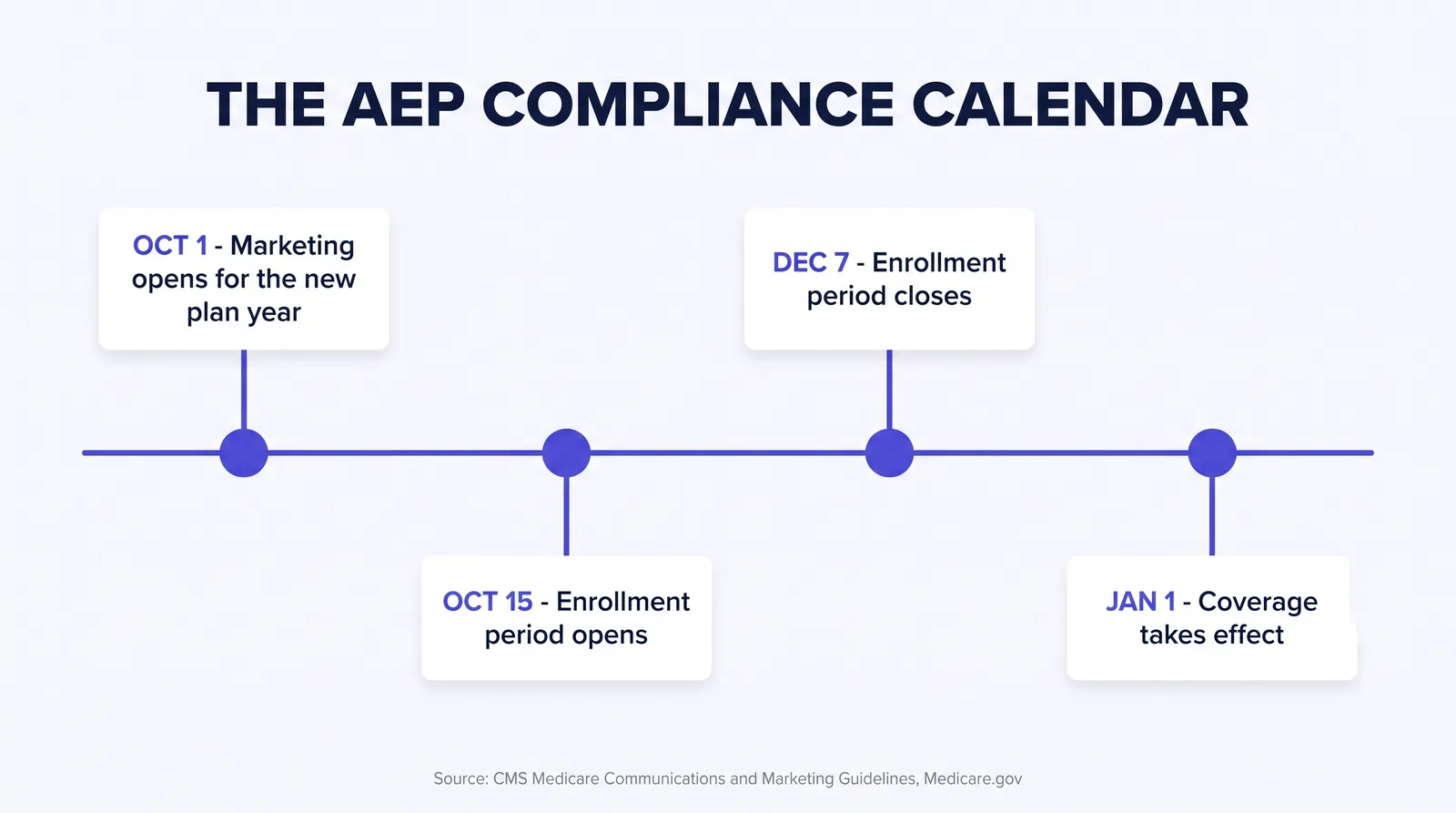
Plans, and the agents and brokers who represent them, may not market the upcoming plan year's offerings before October 11. That's not a suggestion. The guidance is explicit that marketing for the new contract year, meaning any activity or material intended to draw a beneficiary's attention to a plan or influence an enrollment decision, cannot happen before that date, "even in informal settings such as conversations with potential enrollees or community events." Before October 1, an agent can't discuss next year's specific benefits, premiums, or costs, distribute plan-specific materials for the new year, or advertise the upcoming year's plan options in print, digital, broadcast, or social media.
Then on October 1, that restriction lifts. Fourteen days later, on October 15, the actual window opens: CMS's guidance confirms the annual coordinated election period runs October 15 through December 7, and that "enrollment applications may not be solicited or accepted for a January 1 effective date until October 15 of the preceding calendar year"1. Medicare.gov states the same window plainly for beneficiaries: changes made between October 15 and December 7 take effect January 12.
| Window | What's allowed | What isn't |
|---|---|---|
| Now through Sept 30 | Refreshing your site, publishing education, fixing speed and schema | Marketing next plan year's specific benefits, premiums, or costs |
| Oct 1 to Oct 14 | Marketing the new plan year's offerings, publishing plan-specific content | Soliciting or accepting enrollment applications for Jan 1 coverage |
| Oct 15 to Dec 7 | Full marketing and enrollment, the annual coordinated election period | Nothing plan year-specific; this is the open window |
| Dec 8 to Dec 31 | Some coverage changes still process, effective Jan 1 | New AEP-window elections; that door has closed |
That table matters because it means your website's readiness deadline isn't October 15. It's October 1, and realistically, it's now. Whatever isn't fixed by the time marketing legally opens is a site running slow, thin, or invisible through the exact fourteen days when a Medicare shopper first sees your name.
Before you read further
Curious what your own site scores right now? Run it through PageSpeed Insights before the next section. If it comes back under 90 on mobile, the rest of this guide is worth your time.
The two weeks agencies waste
Here's the pattern we see every year. An agency spends August and September on carrier contracting, certifications, and getting their book organized, all necessary work. The website sits untouched, the same one that was slow in March, because nobody's thought about it since the last AEP ended. October 1 arrives, marketing opens, and the agency starts running ads and posting to a site that was never actually evaluated for the traffic about to hit it.
The reason this happens to careful, organized owners too is that the two deadlines feel like one. "AEP starts October 15" is the sentence every agent has memorized, so the fourteen days before it don't register as a deadline at all. But your prospects don't wait for October 15 to start researching. They see your first plan-year ad on October 1, or your new content, and they act on that first impression immediately, whether that means calling, bouncing, or asking an AI assistant to compare you against three other agents in the same search.
A site that's slow or thin doesn't announce itself as broken. It just quietly loses the visitor before they ever see your phone number, and nothing in your CRM tells you that happened. The lead simply never existed.
Waiting until Oct 15
- Homepage still showing last year's plan-year language on Oct 1
- No one has run PageSpeed Insights since last AEP
- New content published Oct 14 has zero days to get indexed
- Accessibility and leaving-site notices never built
- Sitemap and llms.txt last updated whenever the site was built
First impressionMade during your worst two weeks of the year
Fixed by Sept 30
- Plan-year content live and indexed before marketing even opens
- Mobile Lighthouse score checked and fixed in September
- New pages have weeks of trust built up before Oct 1 traffic hits
- Accessibility and disclosure requirements already built in
- Sitemap and llms.txt update themselves the moment something publishes
First impressionMade on your highest-intent traffic of the year
What AEP shopping actually looks like
It helps to picture the actual shopper behind the traffic, because "AEP traffic" understates how much comparison happens before anyone picks up a phone. KFF's analysis of CMS enrollment data found the typical Medicare beneficiary can already choose from Medicare Advantage plans offered by 8 different parent organizations, and nearly three in ten beneficiaries can choose among plans from 10 or more5. That's not a shopper deciding between two agents. That's a shopper with a genuine wall of options, actively looking for something, anything, that helps them narrow it down before AEP closes on December 7.
That's exactly the shopper an AI assistant is built to help, and exactly why a slow or thin site loses more than it used to. A person willing to wade through eight or ten carriers' worth of options one at a time is rare. A person willing to ask an assistant to summarize the differences and name a local agent who can explain them is common, and getting more common every AEP. If your site isn't fast enough, structured enough, or specific enough to be the source that assistant names, a competitor's site is standing in for you in that conversation, whether or not you ever hear about it.
The same logic holds for the shopper who does still Google something directly. A search for "Medicare Advantage plans near me" during the first week of October returns a page that has to win in roughly the same second or two it takes to load. Eight or ten carrier options compressed into one comparison question rewards whichever result actually answers it fastest and most specifically, not the one with the nicest hero photo.
What a slow site costs during AEP
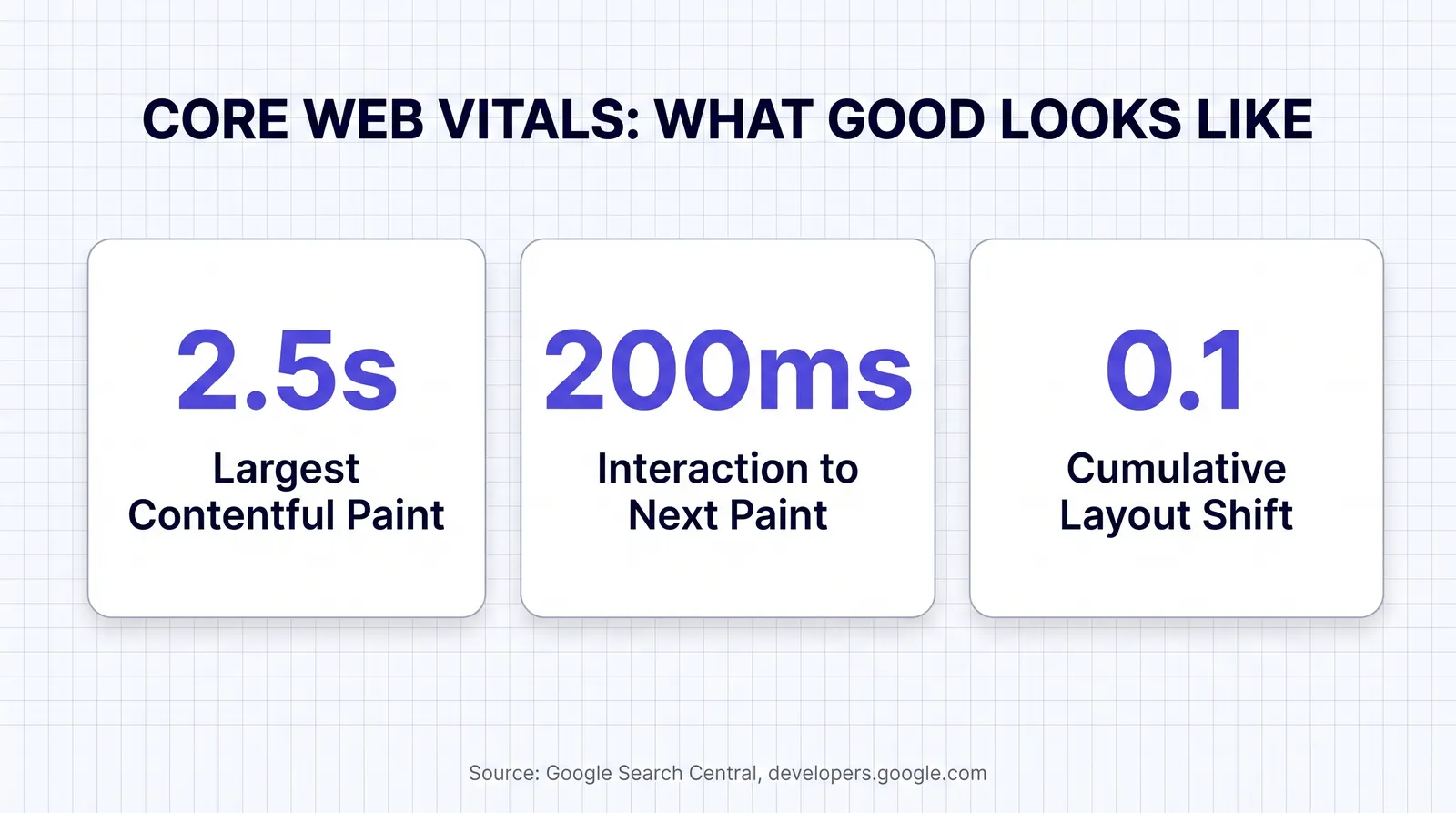
Google states plainly that Core Web Vitals performance "aligns with what our core ranking systems seek to reward"3, and it publishes the actual thresholds agencies are graded against: a Largest Contentful Paint within 2.5 seconds, an Interaction to Next Paint under 200 milliseconds, and a Cumulative Layout Shift under 0.1. Those numbers apply to your site every day of the year, but AEP is the one stretch where the traffic volume, the ad spend, and the competing agencies are all peaking at the same time, so a slow page costs more per visitor than it does in June.
| Metric | What it measures | "Good" threshold |
|---|---|---|
| Largest Contentful Paint (LCP) | How fast the main content loads | 2.5 seconds or less |
| Interaction to Next Paint (INP) | How fast the page responds to a tap or click | Under 200 milliseconds |
| Cumulative Layout Shift (CLS) | How much the page jumps around while loading | Under 0.1 |
Page-builder platforms, the funnel-page tools built into most CRMs and the visual builders in WordPress, load a runtime, a theme, and a stack of plugins before the content appears. A static, Astro-built site renders as finished HTML the browser can paint immediately, which is the architectural reason it clears those thresholds where a builder page often doesn't. We cover the actual mechanism, and how mobile and desktop get graded as separate experiences, in our guide to why insurance websites fail Google's speed test. If you want the aggregate picture across the industry, our 1,080-site study found the median agency site scores 61 on mobile, and we walk through that dataset in the full Core Web Vitals research.
Why AI answer engines raise the stakes this AEP
A growing share of your prospects are no longer typing a search into Google and scrolling ten links. They're asking an assistant a direct question, "what's the difference between a Medicare Advantage plan and a supplement," "how do I switch plans during AEP," and getting one synthesized answer with a short list of named sources. If your site isn't one of the sources, you don't just rank lower. You don't exist in that conversation at all.
Google's own AI optimization guide is direct about the gate a page has to clear first: "to be eligible to be shown in generative AI features on Google Search, a page must be indexed and eligible to be shown in Google Search with a snippet"4. AI Overviews and AI Mode are grounded in retrieval-augmented generation, meaning the system pulls from Google's core Search index and ranking systems, then uses what the guide calls query fan-out to gather more detail before answering. A page that's slow enough to hurt its index standing, blocked from crawling, or marked noindex never enters that pool, no matter how good the content on it is.
That's the compounding problem with waiting until October 15 to fix a site: speed and AI-citation eligibility are the same underlying technical foundation. A page that's well-indexed and snippet-eligible in classic search is also the page that's eligible to be lifted into an AI answer. Fix one and you've moved toward the other. Ignore both until AEP traffic is already live and you're asking a slow, poorly indexed page to compete for both a click and a citation at the same time.
We wrote a deeper build order for getting cited, not just ranked, in our guide to what changed in AEO this year, and a Medicare-specific version of the same question set in our AEO field guide for Medicare and health agencies. If you want to know whether your site is actually showing up when an assistant gets asked about your market, that's a separate measurement problem we cover in our guide to measuring AI search traffic.
Who's actually shopping
About 64.2 million people were enrolled in Medicare Parts A and B as of March 2026, and 55 percent of eligible beneficiaries, roughly 35.2 million people, were already in a Medicare Advantage plan5. Every one of them gets exactly one window a year to switch, and a meaningful share of them will ask an AI assistant a question before they call anyone.
A pre-AEP self-check
Run through this before October 1, not after. Most of it takes minutes to check and, if something fails, more than a few days to properly fix, which is exactly why the check belongs now.
Seven questions worth answering honestly
- Have you actually run your homepage and your top plan page through PageSpeed Insights on mobile in the last thirty days?
- Does your site have a sitemap.xml and an llms.txt file that update automatically when you publish?
- Is your robots.txt welcoming AI crawlers like GPTBot and PerplexityBot, or silently blocking them?
- Does your homepage answer a Medicare shopper's first question in the opening sentence, or does it open with a mission statement?
- Are your plan-year pages carrying Article, FAQPage, and Organization schema that actually matches what's on the page?
- If a visitor leaves your Medicare information pages for a non-Medicare page on your own site, does anything notify them?
- Could your site handle a week of AEP-level traffic without your host, plugins, or page builder slowing down?
Two or more "no" answers means your site needs real work before October 1, not a quick plugin update the week enrollment opens. Zero or one, and you're in better shape than most of the industry; the fixes below are still worth confirming.
Fix one: the technical foundation
Speed isn't a nice-to-have during AEP, it's the floor everything else stands on. If a page hasn't painted by the time a Medicare shopper decides to give up, none of the content, schema, or compliance work underneath it matters, because nobody stayed to see it.
The fastest fix available to most agencies isn't a plugin or a setting, it's the platform itself. A page-builder site (the funnel pages built into most CRMs, or WordPress with a visual builder layered on top) sends the browser a runtime, a theme, and a stack of plugins to boot before your content shows up. A static site built on a framework like Astro renders to finished HTML at build time, so the browser downloads a page that's already done. That architectural difference is the entire speed story, and it's why our builds score 90 or higher on Lighthouse performance for both mobile and desktop, with a number of pages reaching 100.
Beyond the platform, the specific things worth checking before October 1: images converted to WebP instead of shipped as raw PNG or JPG, a hero image that isn't animating in from invisible on page load, fonts that aren't blocking the page while they download, and no third-party chat widget or tracking script loading in the critical path before your content does.
| Check | How to check it | What a fail looks like |
|---|---|---|
| Mobile speed | Run your homepage and top plan page through PageSpeed Insights | Performance score under 90 on mobile |
| Image weight | View source, look for .png or .jpg on photos | A photo over roughly 250KB, or any photographic PNG |
| Hero animation | Reload the page and watch the hero on first paint | The hero fades in from invisible instead of appearing immediately |
| Font loading | Check for a fonts.googleapis.com link in the page source | A live request to Google Fonts instead of a self-hosted file |
| Third-party scripts | Open dev tools, check what loads before your content paints | A chat widget or tracking script blocking the initial render |
None of these require a rebuild to check, only a few minutes and a browser. What they do require, once you find one, is real fix time, which is the entire argument for running this check in September instead of the week AEP opens.
Fix two: publish the answers first
A fast page that says nothing useful still loses to a page that answers the question. Once the technical foundation is solid, the content itself has to open with the answer, not build up to it. A Medicare shopper landing on your AEP page wants to know what changed for the new plan year, what their options are, and what to do next, in that order, in the first few sentences.
That means writing for the actual questions people ask this time of year: what's different about this year's plans, how does switching during AEP work, what happens if they miss the window. Every page should carry FAQPage schema that matches real questions phrased the way a person would type or ask them, not marketing copy dressed up as a heading. It also means every specific claim, a premium, a plan count, a deadline, needs a named, dated source next to it, because both search engines and AI answer engines weight sourced, specific content over vague reassurance.
Compare the two ways an agency typically answers "when can I switch Medicare plans" on its own site. The first version reads: "AEP is coming up soon, so now's a great time to review your coverage and reach out to our team." It's friendly, and it answers nothing. The second version reads: "The Annual Enrollment Period runs October 15 through December 7 this year. Changes you make in that window take effect January 12. You can switch Medicare Advantage plans, add or drop Part D coverage, or move back to Original Medicare." That second paragraph is self-contained, dated, and specific enough that both a human skimming for an answer and an AI system deciding what to quote can use it without reading anything else on the page.
The gap between those two paragraphs is the entire difference between content that fills space and content that gets cited. It costs nothing extra to write the specific version. Most agencies just haven't been shown the difference matters this much.
If you want a faster read on where you stand
The free Audit scores your site's AEO readiness and speed in about a minute, no login required. Run a free Audit.
Fix three: the website rules CMS actually enforces
Speed and content get most of the attention, but CMS's Medicare Communications and Marketing Guidelines also set specific, checkable requirements for plan websites themselves, and they're easy to miss because they don't show up in a typical SEO audit.
The guidance requires that Medicare Advantage and Part D plan websites comply with anti-discrimination and accessibility provisions, specifically naming Section 508 of the Rehabilitation Act, alongside 45 CFR § 92.1041. It also requires that a visitor be notified when they're leaving the plan's Medicare information pages for a different, non-Medicare website, a detail most agency sites never implement because nobody thought to check for it.
Neither of these is exotic to build. An accessible site needs real semantic HTML, labeled form fields, sufficient color contrast, and keyboard navigation that actually works, not a bolted-on accessibility widget layered over an inaccessible page underneath. A leaving-site notice is a small, one-time build. Both are the kind of thing that's trivial to include from the start of a build and expensive to retrofit into an existing page-builder site three weeks before AEP opens.
We build this into every site we ship
If you'd rather see it than read about it, look at Digital Foundation. See Digital Foundation.
Fix four: one homepage can't cover every county
If your agency writes business across more than one county, or you're an FMO or IMO with downline agents spread across several markets, a single generic homepage is doing the same job for a shopper in one county as it does for a shopper three hours away, which means it's doing that job poorly for almost everyone. Plan availability, carrier presence, and even which questions a shopper asks first vary by county, and CMS's own AEP calendar applies the same everywhere, so the traffic surge hits every one of your markets on the same two dates.
The fix isn't a page per city with the same paragraph and the city name swapped in, which reads as thin to both a person and an AI system evaluating whether to trust it. It's a page per market with what's actually different there: which carriers are active locally, what a shopper in that county specifically needs to know, and content that would stand on its own even if every other location page on the site didn't exist. We cover the actual build pattern, and the doorway-page trap that catches agencies who try to shortcut it, in our guide to why one homepage can't rank for a multi-county territory.
For an FMO or IMO, this compounds across every downline site rather than just one, which is exactly the kind of work a real publishing cadence exists to handle: a new location page and a new blog post published on a schedule, not in one rushed burst the week before AEP opens.
How we get a site AEP ready
This is the exact gap Digital Foundation closes. Every site we build is static, served from the edge on Cloudflare, and scores 90 or higher on Lighthouse performance for both mobile and desktop, with a number of pages reaching 100, because the architecture doesn't give the browser a runtime to boot before your content shows up.
Every build ships with a sitemap.xml, an llms.txt, and a robots.txt that welcomes AI crawlers by name, and all three update themselves the moment a new page or post goes live, with the full absolute URL, so nothing has to be remembered or maintained by hand. Schema is built per page type, Organization, LocalBusiness or InsuranceAgency, Article, FAQPage, and BreadcrumbList, matched to what's actually on the page rather than generic boilerplate.
For agencies on Digital Foundation's Pro or Scale tiers, that includes a new blog post and a new location page every week or every business day, which matters specifically right now: content published this week has time to get indexed and earn trust before October 1 traffic hits it, where content published on October 14 is asking Google and AI systems to trust a page that's a day old.
Starter tier includes the complete compliant site itself, built for AI citation from the first page, plus Google Business Profile management and an AI chat widget. Pro adds the weekly content cadence and a 24/7 AI receptionist, so a call that comes in at nine at night during AEP, when a shopper finally has time to call after work, doesn't roll to voicemail. Scale adds a daily publishing cadence for agencies, FMOs, and IMOs that need to move faster across more markets than a weekly schedule covers. Every tier ships on a fourteen day free trial, month to month, with setup free within limits: live in days, and if it isn't a fit, you walk away with no fees owed.
None of this requires ripping out your CRM or your carrier integrations. The website and the content layer sit on top of whatever you already run for quoting, applications, and pipeline management. What changes is what a prospect sees and experiences in the seconds before they ever reach that CRM.
Oct 1
When plan-year marketing can legally begin
Oct 15
When enrollment applications can actually be accepted
2.5s
Google's "good" Largest Contentful Paint threshold
64.2M
People enrolled in Medicare Parts A and B, March 2026
What changes by October 15
Not a promised ranking, a lead count, or an enrollment number, because no one honestly building a website can guarantee any of those. What changes is specific and checkable: a homepage and plan-year pages that load fast on a phone, not just a laptop. Schema that matches the page it's sitting on. A sitemap and llms.txt that already list your newest content the day it publishes. An accessibility baseline and a leaving-site notice that meet what CMS's own guidance actually asks for.
The agency that fixes this in September spends AEP running ads to a site that's ready for them. The agency that waits until October 15 spends the first, highest-attention days of the season finding out what's broken while competitors, already fixed, are the ones an AI assistant names when a shopper asks who to call.
It's worth being honest about the DIY path here too, because not every agency needs to hire anyone for this. If you're comfortable running PageSpeed Insights yourself, rewriting your top pages to answer the actual question in the first sentence, and manually checking your robots.txt for blocked AI crawlers, you can close most of this gap without spending a dollar beyond your time. Where that path runs out is speed: fixing a page-builder platform's architecture from the inside is slow, sometimes impossible, and the countdown to October 1 doesn't pause while you figure it out.
Questions agents ask
When can insurance agents legally start marketing for the new Medicare plan year?
October 1. CMS's Medicare Communications and Marketing Guidelines state plans may not market prior to October 1 for the upcoming contract year, even informally, and that rule applies to agents and brokers representing those plans too. Nothing plan-specific for the new year can go out before that date.
What's the difference between October 1 and October 15 for Medicare marketing?
October 1 is when marketing can begin. October 15 is when CMS's annual coordinated election period actually opens, and enrollment applications for a January 1 effective date cannot be solicited or accepted before then. You can promote starting October 1. You cannot enroll anyone until October 15.
Does website speed actually affect Google rankings for insurance agents?
Google states Core Web Vitals performance 'aligns with what our core ranking systems seek to reward,' and it publishes specific thresholds: Largest Contentful Paint within 2.5 seconds, Interaction to Next Paint under 200 milliseconds, and Cumulative Layout Shift under 0.1. Mobile and desktop are measured as separate experiences.
Can ChatGPT or Google's AI Overviews cite my insurance website during AEP?
Only if the page clears a gate first. Google's own AI optimization guide states a page must be indexed and eligible to show with a snippet in regular Search results before it can appear in AI Overviews or AI Mode at all. A slow, blocked, or noindexed page never reaches the pool AI answers are drawn from.
Does my Medicare Advantage or Part D website have to meet accessibility requirements?
Yes. CMS's Medicare Communications and Marketing Guidelines require plan websites to comply with anti-discrimination and accessibility provisions, including Section 508 of the Rehabilitation Act, and to notify visitors when they're leaving the plan's Medicare information pages for a non-Medicare site.
How many people will actually be shopping during this AEP?
About 64.2 million people were enrolled in Medicare Parts A and B as of March 2026, and 55 percent of eligible beneficiaries, or roughly 35.2 million people, were in a Medicare Advantage plan, according to KFF's analysis of CMS enrollment data. Every one of them gets a once-a-year window to switch.
Is it too late to fix my website before AEP if I'm starting now?
No, but the runway is shorter every week you wait. A static, Astro-built site with the compliance and speed items already handled typically ships in days, not weeks, which is enough time to be ready before the October 1 marketing window opens if you start now rather than October 14.
Sources
- Centers for Medicare & Medicaid Services. "Medicare Communications and Marketing Guidelines," dated February 9, 2022, including marketing start date, annual coordinated election period, and website accessibility/disclosure requirements. cms.gov.
- Medicare.gov. "Joining a Plan," Annual Enrollment Period dates and coverage effective date. medicare.gov.
- Google Search Central. "Core Web Vitals: Metrics and Thresholds." developers.google.com.
- Google Search Central. "AI optimization guide," last updated 2026-07-10. developers.google.com.
- KFF. "Medicare Advantage in 2026: Enrollment Update and Key Trends," updated July 1, 2026, reflecting March 2026 CMS enrollment data. kff.org.
Talk it through
Want a second pair of eyes on it?
Free 30 minutes. Bring what you found, or bring nothing and we will look together at how AI engines read your site and which fixes move first.
See if your site is ready before October 1
Run the free Audit, a live AEO Audit plus a HIPAA tracking scan of your site, in under a minute.