Playbook
Why Your Insurance Website's Subsidy Calculator Is Wrong
Enhanced ACA tax credits expired at the end of 2025 and the subsidy cliff is back. If the calculator on your site has not been touched since, it is quoting the wrong plan year.


19 min read
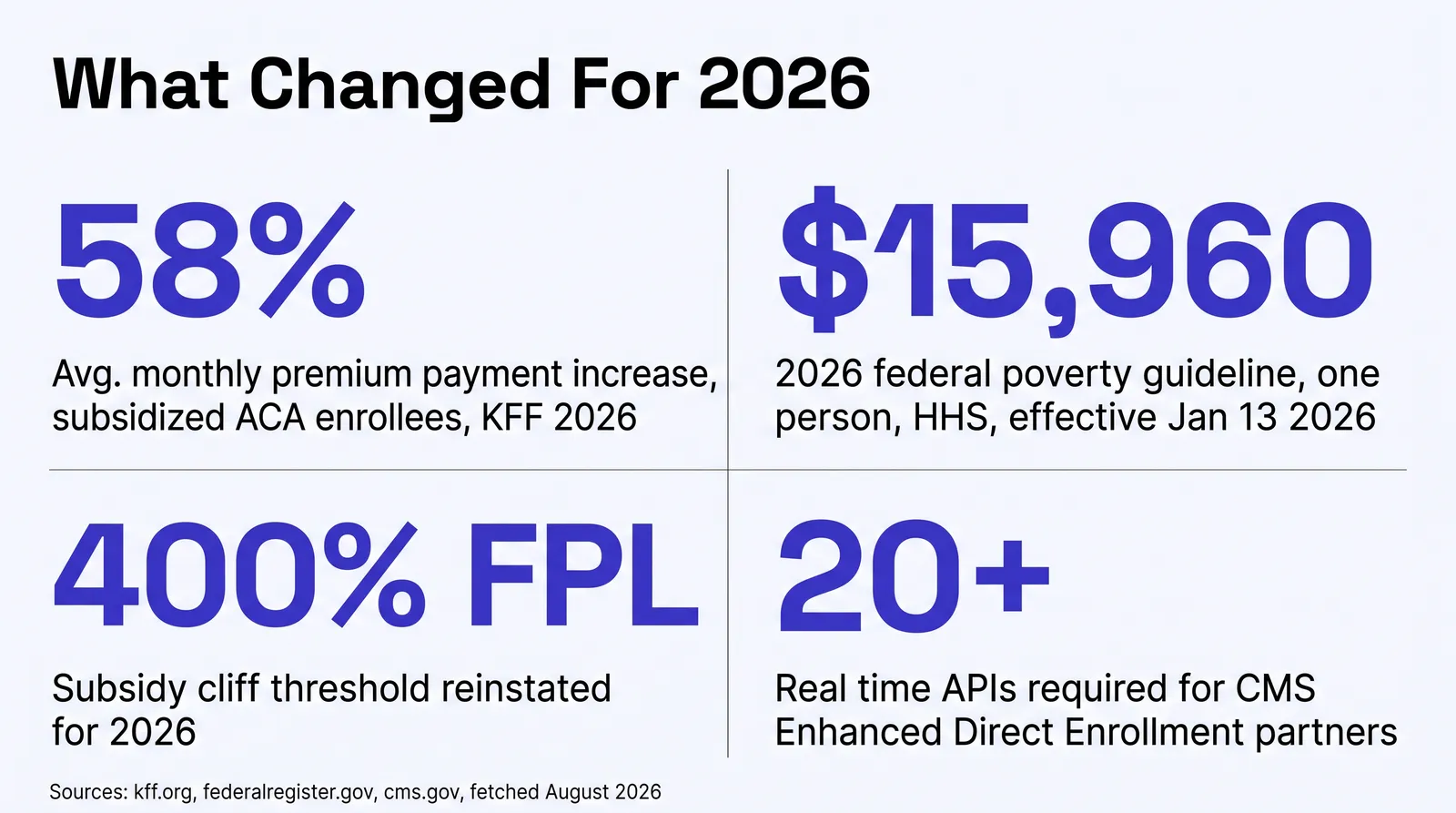
The enhanced ACA premium tax credits expired at the end of 2025, and the 400% federal poverty level subsidy cliff is back for 20261,2. KFF's tracking found the average monthly premium payment for subsidized marketplace enrollees rose 58%, from $113 to $1781. A quote calculator on your site that has not been rebuilt around this year's poverty guideline, this year's benchmark premium, and this year's tax credit formula is not approximating the wrong number. It is calculating a formula that no longer exists.
The number your calculator gave out last week
Most agency websites built in the last few years have some version of a quote tool on the ACA page. Sometimes it is a real calculator with a few input fields. More often it is a static example, a number typed in once when the page was built: "clients like you save up to $400 a month," or a little slider that spits out an estimate against numbers nobody has opened since launch. Either way, somebody built it once, and then the agency moved on to selling.
That was a survivable shortcut for a few years. It is not one anymore. The temporary premium tax credit enhancements that Congress passed under the American Rescue Plan and extended under the Inflation Reduction Act expired at the end of 2025, and the subsidy cliff at 400% of the federal poverty level, the hard ceiling those enhancements had removed, is back for plan year 20261,2. A household that priced coverage on your site's calculator using last year's assumptions, or using a formula frozen from whenever the widget was built, is not getting an approximation. It is getting a number computed under rules that stopped applying on January 1.
This is not a marginal shift. KFF's tracking of the 2026 marketplace found the average monthly premium payment for subsidized enrollees rose 58%, from $113 in 2025 to $178 in 2026, alongside a 37% increase in average deductibles to a record $3,7861. Those are national averages across every income band, not a worst case. For a specific household sitting near the cliff, the swing is far larger, and it is the swing this guide walks through in real numbers a few sections down.
Who this guide is for
This is written for an agency with any kind of subsidy estimate, quote form, or calculator on its ACA or marketplace pages right now, whether it is a real tool wired to live data or a static example someone typed in years ago. If your site has no such tool at all, the fix section near the end still applies, since it is describing what a tool should be built on, not just how to patch one.
Why a subsidy formula cannot be hardcoded once
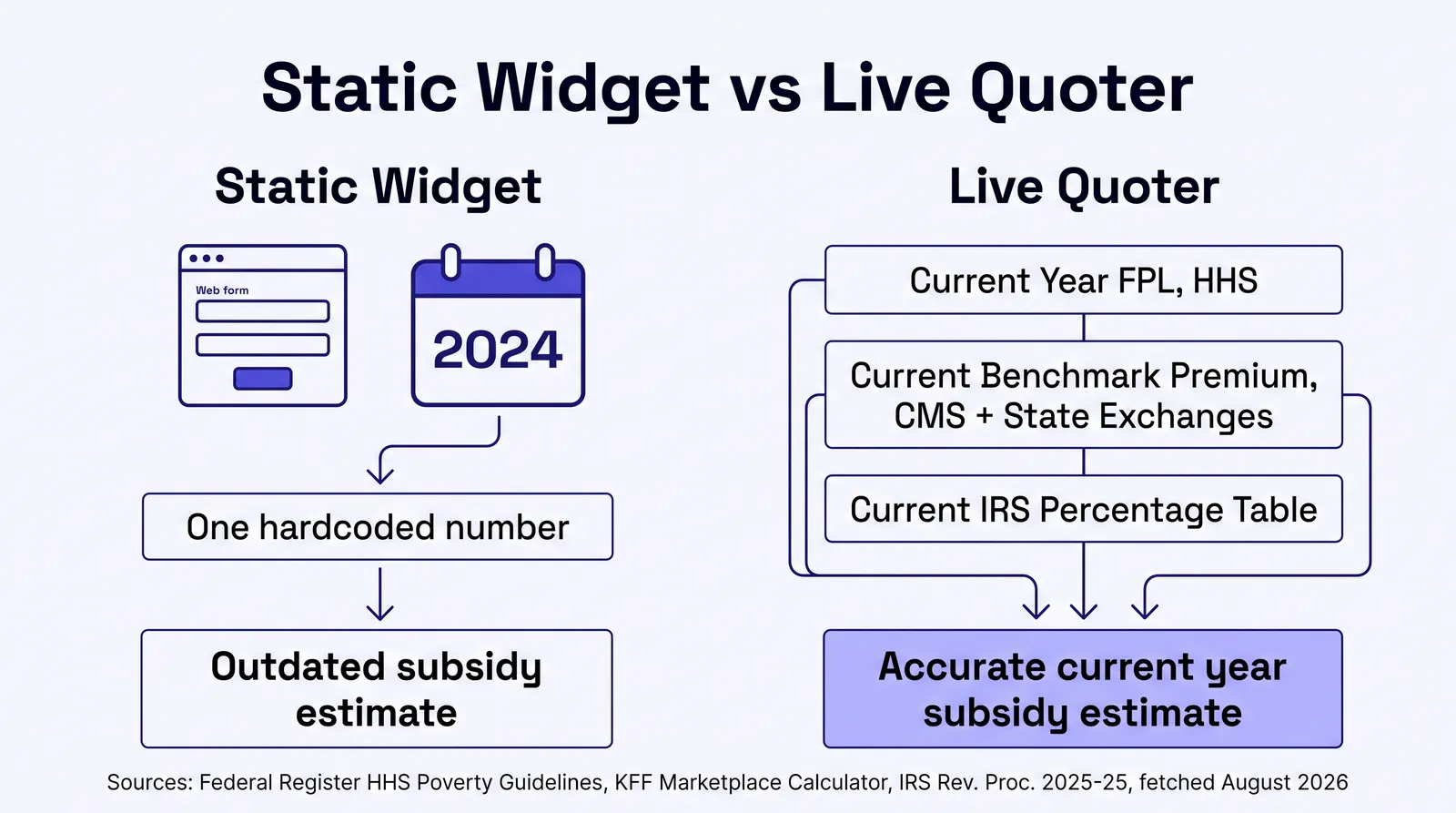
The premium tax credit is not a fixed dollar amount you can bake into a page template and leave alone. It is the output of three separate inputs, and every one of the three changes on its own schedule, independent of the other two.
The federal poverty guideline is republished by HHS every January, and it moves every single year, not by a rounding error but by a real percentage tied to consumer prices2. The benchmark premium, the second lowest cost silver plan in a household's county or rating area, is repriced by insurers every plan year and can move sharply county to county, which is exactly why KFF's own calculator draws directly from CMS and state exchange filings rather than a single national number5. And the applicable percentage table, the schedule that converts a household's income as a percent of poverty into what it is expected to contribute toward that benchmark premium, is republished annually by the IRS in a revenue procedure sized for the coming tax year9. This year that table did not just get new numbers. It reverted to the ACA's original statutory structure now that the temporary enhancement expired, which reinstates the flat cutoff at 400% of poverty where a household received no credit before the temporary law lifted that ceiling starting in 2021.
A calculator that hardcodes any one of those three numbers is accurate for exactly one plan year, and only if nothing about the underlying law changes in the meantime. A calculator that hardcodes all three, which is what most static widgets do, was already fragile. This year it broke on schedule, the moment the enhanced credits expired and the cliff came back.
How the premium tax credit is actually calculated
It helps to see the mechanism plainly rather than take "the formula changed" on faith. The premium tax credit equals the benchmark silver plan premium for the household's area minus the household's required contribution, and the required contribution is the household's income multiplied by a percentage set by the applicable percentage table, based on where that income falls as a share of the federal poverty level.
| Input | What it is | How often it changes |
|---|---|---|
| Benchmark premium (SLCSP) | Second lowest cost silver plan for the household's rating area | Repriced by insurers every plan year, by county5 |
| Federal poverty guideline | Income threshold published for household size, 48 states and DC | Republished by HHS every January4 |
| Applicable percentage table | Schedule converting income-as-percent-of-poverty into required contribution | Republished annually by the IRS9 |
| Result above 400% FPL, 2026 | Required contribution exceeds the benchmark premium | Credit equals zero, the cliff reinstated for 20261,2 |
Notice what is missing from that table: a single number you could type into a form once. Every row is a moving part, and the last row is the one that changed most for 2026, since the "required contribution exceeds the premium" case did not produce a zero credit for the several years the enhanced subsidies were in effect. It produces one now.
The cliff, in real numbers
KFF worked an example that makes the mechanism concrete rather than abstract: a 60-year-old couple earning $85,000 a year, about 402% of the federal poverty level, just over the line, sees yearly premium payments rise by more than $22,600 once the enhanced credits expire, because they go from receiving a substantial credit to receiving nothing at all3. That is not a gradual taper. Two percentage points of income either side of that line is the entire difference between meaningful help and none.
$15,960
2026 poverty guideline, household of one, 48 states and DC4
$63,840
400% of that guideline, the 2026 cliff for one person
$33,000
2026 poverty guideline, household of four4
$132,000
400% of that guideline, the 2026 cliff for a family of four
Those two right hand figures are simple arithmetic on the published 2026 guideline, not a separate government estimate, and that is deliberate. Anyone can check that math against the Federal Register notice in about a minute4. A household applying for coverage with income just under one of those numbers is looking at a real credit. The same household a few thousand dollars over it is looking at none. A calculator that does not know where that line sits this year cannot warn a prospect they are near it, which is exactly the conversation an agent should be having before the application, not after.
What actually changed for 2026
It is worth separating what changed from what stayed the same, since not every part of ACA subsidy math moved this year.
| Rule | 2025, enhanced credits | 2026, reverted rules |
|---|---|---|
| Income ceiling for eligibility | None, credits available above 400% FPL | 400% FPL hard cliff, credit equals zero above it2 |
| Contribution at higher incomes | Capped near 8.5% of income | Reverts to the ACA's original statutory percentage schedule9 |
| Avg. monthly premium payment, subsidized | $1131 | $178, up 58%1 |
| Avg. deductible | Roughly $2,759 (implied by 37% increase) | $3,786, a record, up 37%1 |
The benchmark premium itself, the SLCSP, also moves every year independent of any of this, since it is set by what insurers actually filed for the coming plan year in each rating area, which is one more reason a number typed into a page template during a previous plan year cannot be trusted without checking it again.
One more variable: which exchange you are even quoting
There is a fourth moving part most agency calculators skip entirely: which exchange a household actually shops on. CMS's own 2026 national snapshot splits the 23.0 million total plan selections into 15.8 million through HealthCare.gov, the federal platform covering 30 states, and 7.2 million through the 20 states plus DC that run their own state-based exchange, each with its own eligibility and enrollment system6. A calculator built once around HealthCare.gov's federal poverty guideline and federal applicable percentage table is still using the right numbers for a household in a state-based exchange state, since the federal poverty guideline and the tax credit formula itself are national. What differs by state is the benchmark premium data feed and, in a handful of states, an additional state-funded subsidy layered on top of the federal credit.
California, New York, and several other state-based exchange states run their own supplemental subsidy programs that reduce premiums further for residents who qualify, on top of whatever the federal premium tax credit calculates. A calculator that only knows the federal formula will understate the actual help available to a household in one of those states, the mirror image of the more common problem this guide has been describing. If your agency writes business in more than one state, or in a state-based exchange state specifically, that is one more reason a single hardcoded formula cannot serve every visitor correctly, and one more reason the fix has to be a live data connection rather than a page someone edits once a year.
What a wrong number costs an agency
A wrong quote is not a rounding problem for the prospect who gets one. CMS's own final snapshot for the 2026 open enrollment period recorded 23.0 million plan selections nationwide, through January 15, 20266, and KFF separately estimates plan sign-ups actually fell to about 23.1 million, down from 24.2 million in 2025, with projected effectuated enrollment dropping by 4.8 million as higher net premiums pushed some applicants away entirely1. A share of that decline is people who priced coverage against a number that turned out wrong once they actually applied, got sticker shock at the real figure, and walked away rather than come back to the agent who quoted it.
For the agency, the immediate cost is time. A prospect who planned around your site's estimate and then hears a different number from the Marketplace application calls back confused, sometimes annoyed, and the producer spends the call re-explaining math the website should have gotten right the first time. The slower cost is trust. An insurance shopper comparing three or four agencies is already skeptical of round numbers and vague savings claims. A specific number that turns out wrong is worse than no number at all, because it reads as either careless or misleading, and a prospect rarely stays to find out which.
There is a compliance angle worth naming plainly rather than dodging. TPMO marketing rules and state insurance advertising regulations generally require that quoted figures be accurate and not misleading. A calculator running last year's formula was not built to deceive anyone, but "the widget was outdated" is a weak answer if a regulator or a client ever asks why a published estimate was materially wrong. The fix here is not a legal opinion, it is simply keeping the underlying data current, which removes the question before it gets asked.
The mistake that is easy to miss
This is not only a problem for agencies with a broken calculator. An agency with no calculator at all, just a "get a quote" contact form, is not exposed to a wrong number, but it is also not giving a comparison shopper any reason to stay on the page instead of clicking to a competitor or a carrier's own site that does show a number, even a rough one.
How to check what your site is doing right now
Before anything else, find out what your own site is actually running. This takes about ten minutes and does not require touching any code.
Find the widget or the claim
Locate every place on your site that states or estimates a subsidy, a premium, or "clients like you save." Screenshot each one.
Check the poverty figure behind it
If a developer or a form tool can show you the underlying formula, check whether it references $15,960 and $33,000 or an older number.
Check whether it uses a real benchmark premium
Does the tool ask for a zip code and pull a real county-level SLCSP, or does it apply one national average to every visitor?
Check when it was last touched
Ask whoever built the site, or check the file's edit history if you have access, for the last date the subsidy logic was actually updated.
Check what happens above the cliff
Enter a household income above 400% of poverty for the relevant household size and see whether the tool correctly shows zero, or still shows a discount.
Check the age and tobacco handling
A premium varies by exact age and tobacco use. A tool that asks only for income and household size is estimating, not quoting, and should say so.
If you want a second opinion on your own site
The free Audit checks more than your calculator, it scores your whole site for AI citation readiness and HIPAA compliant tracking in about a minute. Run a free Audit.
The honest DIY fix
You can do a version of this yourself, and for a single producer with a light site and no development budget, it may be the right stopping point. The honest fix is not to rebuild a live calculator from scratch. It is to stop pretending a static widget is one.
If your site currently states a specific dollar figure or percentage, the lowest effort fix is to replace it with a link to a calculator that is actually kept current. KFF's Health Insurance Marketplace Calculator pulls current CMS and state exchange premium data, was last refreshed with 2026 premiums on March 16, 2026, and states its own limitations plainly, including that it relies on user-entered income rather than a verified figure and does not add a tobacco surcharge5. HealthCare.gov's own eligibility tool does the same for Federally-facilitated Exchange states. Neither is a fake widget. Both are honest about being an estimate, which is the standard your own site should meet too.
If you would rather keep a tool on your own domain, the minimum discipline is a yearly calendar entry: recheck the federal poverty guideline every January when HHS republishes it, recheck your state's benchmark premium data at the start of open enrollment, and confirm the applicable percentage logic against the current IRS revenue procedure before the new plan year opens. That is three checks a year, not a rebuild, and it is genuinely better than nothing. Where it falls short is a benchmark premium that reprices mid-year in some states, or a household near the cliff who needs a precise answer rather than a once-a-year approximation.
There is also a manual version of this that costs nothing but a few minutes on a call. Rather than quoting a number from memory or from an old page, pull up the current federal poverty guideline for the household's size, note how many percentage points of poverty their stated income represents, and walk them through whether that lands them comfortably under the 400% line, close to it, or over it. A prospect who hears "here is exactly why you qualify, and here is the number your income would need to cross before you would not" trusts that explanation more than a black box widget ever earns, wrong or right. The transparency is the product here as much as the number itself.
What a real fix requires
CMS holds its own approved partners to a higher standard than an annual manual check. Its Enhanced Direct Enrollment program requires primary entities to integrate with more than 20 real-time APIs covering eligibility determination, plan comparison, and enrollment, specifically so a consumer working with an approved partner sees the same live numbers HealthCare.gov itself would show7. That is the honest benchmark for what "real time" means in this space. A calculator is only as good as how current its underlying feed is, and a feed that updates once a year, or once at launch, is not that.
This is the exact problem the Brain, our data engine, exists to solve. It stays connected to CMS, the Census Bureau, HealthCare.gov, and dozens of other federal sources, so a calculator built on it is not running a number someone typed in during a previous plan year. Every build we ship includes calculators wired this way rather than a decorative form with an example number, verified live on the Digital Foundation pricing page, where the Website tier starts at $84 a month10. Our own custom builds page states the same standard plainly: quoting tools "backed by live government data, so the numbers are right for their county, not a fake widget," scoped on a call for an agency that needs something more specific than the base tier11.
It is fair to ask whether this is worth fixing if your agency is small and your traffic is mostly referral based. If nobody is landing on your ACA page cold and pricing coverage against your calculator before ever talking to you, the honest DIY fix above, checked once a year, is a reasonable stopping point. Where this matters most is an agency actively running paid traffic or organic content to a marketplace or subsidy page, where a stranger is forming their first impression of your accuracy from a number your site generated with no human in the loop.
What changes once it is accurate
Strip away the mechanics and the outcome this guide is describing is narrow. A prospect who prices coverage on your site sees a number close to what they will actually see on the real application, which means the conversation you have with them starts from agreement instead of correction. The calculator updates itself every January when HHS republishes the poverty guideline, and every plan year when benchmark premiums reprice, without anyone on your team remembering to open the file.
There is a second, compounding benefit worth naming. A page built on a fast, statically rendered site, the kind Astro produces, is also the same foundation that helps a site get found organically and cited by name in an AI generated answer, since Google states plainly that Core Web Vitals performance aligns with what its core ranking systems reward8. Fixing a quoting tool and building a fast, AI-citable site are not two separate projects. A sourced, accurate, quotable number on a fast page is exactly the kind of passage an answer engine can lift and attribute correctly, which a stale, unsourced estimate never will be.
Worth a real conversation if you run more than one site
Standardizing a quoter that pulls live data across several agency sites or downline offices is exactly the kind of work we scope on a call. Book a call.
Questions agencies ask
What is the ACA subsidy cliff, in one sentence?
It is the point where a household's income crosses 400% of the federal poverty level and their premium tax credit drops straight to zero, a hard ceiling that returned for 2026 after several years without one, according to KFF's 2026 marketplace analysis.
Did the enhanced premium tax credits actually expire, or could they still come back?
They expired at the end of 2025. KFF's May 2026 analysis and healthinsurance.org's 2026 subsidy explainer both confirm Congress did not extend the temporary enhancements, and the 400% FPL cliff is back in effect for plan year 2026.
How much are 2026 premium payments actually up compared to 2025?
KFF's tracking of 2026 marketplace activity found the average monthly premium payment for subsidized enrollees rose 58%, from $113 to $178, alongside a 37% jump in average deductibles to a record $3,786. Those are national averages, not a forecast for any one household.
What federal poverty level figures should my calculator be using right now?
For 2026, HHS set the poverty guideline at $15,960 for a household of one and $33,000 for a household of four in the 48 contiguous states and DC, effective January 13, 2026. Any subsidy math using last year's numbers is already out of date.
Can I just link out to KFF's or HealthCare.gov's calculator instead of building my own?
Yes, and for a solo producer that is often the more honest move than maintaining a homemade widget. KFF's calculator pulls current CMS and state exchange premium data and states its own limitations plainly, which is more than most embedded agency-site forms do.
What does a website actually need to keep a quoter accurate year over year?
Three things that all change on their own schedule: the current federal poverty guideline, published by HHS every January, the current benchmark silver plan premium for the household's rating area, and the current year's applicable percentage table, republished annually by the IRS. A static form has none of the three.
Does this affect Medicare quotes too, or only ACA marketplace plans?
This guide is specifically about ACA premium tax credits. Medicare Advantage and Part D use a different low income subsidy structure with its own federal poverty level thresholds, updated on its own annual schedule, so a Medicare quoting tool needs the same discipline applied to a different data set, not this same fix.
What does Digital Foundation actually include for quoters and calculators?
The Website tier, verified live on the Digital Foundation pricing page, includes calculators connected to the Brain, our data engine wired to CMS, Census, HealthCare.gov, and other federal sources. Custom quoting tools built to a specific workflow are scoped on a call under AI Expert instead.
Sources
- KFF. "What We Know So Far About 2026 ACA Marketplace Enrollment, Premiums, and Deductibles," published 2026-05-19, verified live 2026-08-07. kff.org.
- healthinsurance.org. "2026 Obamacare Subsidy Calculator," enhanced credit expiration and subsidy cliff status, page updated 2026-07-30, verified live 2026-08-07. healthinsurance.org.
- KFF. "ACA Marketplace Premium Payments Would More Than Double on Average Next Year if Enhanced Premium Tax Credits Expire," published 2025-09-30, verified live 2026-08-07. kff.org.
- Federal Register / U.S. Department of Health and Human Services. "Annual Update of the HHS Poverty Guidelines," 91 FR, document 2026-00755, published 2026-01-15, effective 2026-01-13, verified live 2026-08-07. federalregister.gov.
- KFF. "Health Insurance Marketplace Calculator," inputs, data sourcing, and stated limitations, last updated with 2026 premiums 2026-03-16, verified live 2026-08-07. kff.org.
- Centers for Medicare and Medicaid Services. "Marketplace 2026 Open Enrollment Period Report: National Snapshot," published 2026-01-28, data through 2026-01-15, verified live 2026-08-07. cms.gov.
- Centers for Medicare and Medicaid Services. "Enhanced Direct Enrollment," partner API requirements, page dated 2026-04-14, verified live 2026-08-07. cms.gov.
- Google Search Central. "Understanding Core Web Vitals and Google search results," ranking systems statement, last updated 2025-12-10, verified live 2026-08-07. developers.google.com.
- Internal Revenue Service. "Rev. Proc. 2025-25," indexing adjustments to the section 36B applicable percentage table for calendar year 2026, verified live 2026-08-07. irs.gov.
- Strategic AI Architects. "Digital Foundation," pricing, tiers, and calculator/Brain features, verified live 2026-08-07. strategicaiarchitects.com.
- Strategic AI Architects. "AI Expert," custom quoting tools backed by live government data, verified live 2026-08-07. strategicaiarchitects.com.
Talk it through
Want a second pair of eyes on it?
Free 30 minutes. Bring what you found, or bring nothing and we will look together at how AI engines read your site and which fixes move first.
See what your own site actually shows a prospect
Run the free Audit, a live AEO Audit plus a HIPAA tracking scan of your site, in under a minute.
Related reading: why cost per lead keeps climbing · can an AI shopping agent use your site · what an agency website really costs