Playbook
What Your Insurance Agency's Website Really Costs
GoHighLevel lists $297 a month. WordPress looks free until you count the page builder, the hosting, and the plugin renewal. Here is the real number, sourced live.


19 min read
The sticker price on an agency website is never the real price. GoHighLevel's Unlimited plan lists at $297 a month1, and a WordPress site built on Elementor Pro plus WP Engine hosting plus a forms plugin adds up to roughly $96 to $130 a month before anyone touches a theme, a security plugin, or a developer's invoice2,3,4. Digital Foundation bundles the equivalent stack, plus AEO, weekly content, and a 24/7 AI receptionist at the Pro tier, into one $497 a month line5. The real comparison was never the sticker. It is what is actually included, and what happens the day something breaks.
The subscription you can name, and the four you can't
Ask most agency owners what their website costs and you get one number, fast. Ninety seven a month for GoHighLevel. Or nothing, because WordPress is free and a cousin set it up years ago. Ask a second question, what does it cost you when the quote form stops routing leads to your inbox, or when the page builder update breaks your layout the week before AEP, and the answer gets a lot less certain.
That gap between the number you can name and the number you actually pay is the subject of this guide. Not because either platform is a bad choice on its own. GoHighLevel and WordPress both power a huge share of the insurance agency websites live today, and plenty of agencies get along with them fine. The problem is that almost nobody adds up the full stack before they commit to it, and the full stack is rarely the one line item on the credit card statement.
A website is not one purchase. It is hosting, a page builder license, at minimum one plugin for forms or quotes, and, sooner or later, someone's time when a piece of it stops working. Every one of those has a real, published price. This guide fetches every one of them live and adds them up so you can see the actual monthly number next to what a bundled alternative charges for the same job.
What this guide is and is not
This is a pricing breakdown built from live, published rate cards, not a claim that GoHighLevel or WordPress are bad platforms. Plenty of agencies run both well. The goal is simply to show the full stack next to the sticker price, so the comparison to a bundled site is an honest one.
Why one website becomes five line items
The reason a website turns into a stack instead of a single purchase comes down to how each platform is built. A page builder like Elementor is a plugin, not a website. It needs a place to run, which is hosting, sold separately by a company like WP Engine. It needs a way to capture a quote request, which is a forms plugin, sold separately again. It usually needs a security plugin, an SEO plugin, and a caching plugin on top, each with its own free tier and its own paid tier that turns on the features an agency actually needs, like conditional form logic or spam filtering that works.
GoHighLevel solves this differently by bundling the funnel builder, the CRM, and the hosting into one subscription, which is genuinely convenient. The tradeoff shows up in the fine print instead of a separate invoice. HighLevel's own pricing page states plainly that usage based charges apply for telecommunications and AI services on top of the subscription price1, and its add-on catalog, also published on that page, ranges from $10 to $497 a month per sub-account or feature for things like an AI Employee plan, a branded mobile app, or HIPAA compliance1. The bundle is real. So is the list of things that are not in it.
Either path, the pattern is the same. A website is a stack of separately priced components, and the sticker price you can name is almost always the smallest piece of that stack, not the whole thing.
What GoHighLevel, WordPress, and Elementor actually charge
Here is every price, fetched live from each company's own pricing page this session, with nothing rounded up or estimated. Start with GoHighLevel, since it is the platform most agency owners can quote from memory.
| Plan | Price | What it includes |
|---|---|---|
| Starter | $97/mo | 3 sub-accounts, unlimited contacts and users, core features1 |
| Unlimited | $297/mo | Unlimited sub-accounts, phone and email rebilling, basic API access1 |
| Agency Pro | $497/mo | SaaS mode, automated sub-account creation, advanced API access1 |
Note what is not in that table. Usage based telecom and AI charges are billed on top of every tier, and HighLevel's own add-on catalog lists optional features like HIPAA compliance and a white label mobile app running an additional $10 to $497 a month each1. A single agency running one site rarely needs the Agency Pro tier at all, which is built for reselling the platform to other businesses, so the honest comparison for most independent agencies is the Unlimited plan at $297 a month, plus whatever usage and add-ons get layered on top.
Now the other path. WordPress itself is free software, and that is true and also close to beside the point, because a WordPress site is not one download. It is hosting plus a page builder plus, for almost every agency, at least one paid plugin to make the quote form actually work.
| Component | Price | Source |
|---|---|---|
| WP Engine hosting, Professional tier | $55/mo | wpengine.com/plans3 |
| Elementor Pro, Advanced Solo, 1 site | $99/yr ($8.25/mo) | elementor.com/pricing2 |
| WPForms Pro, renewal rate | $399/yr ($33.25/mo) | wpforms.com/pricing4 |
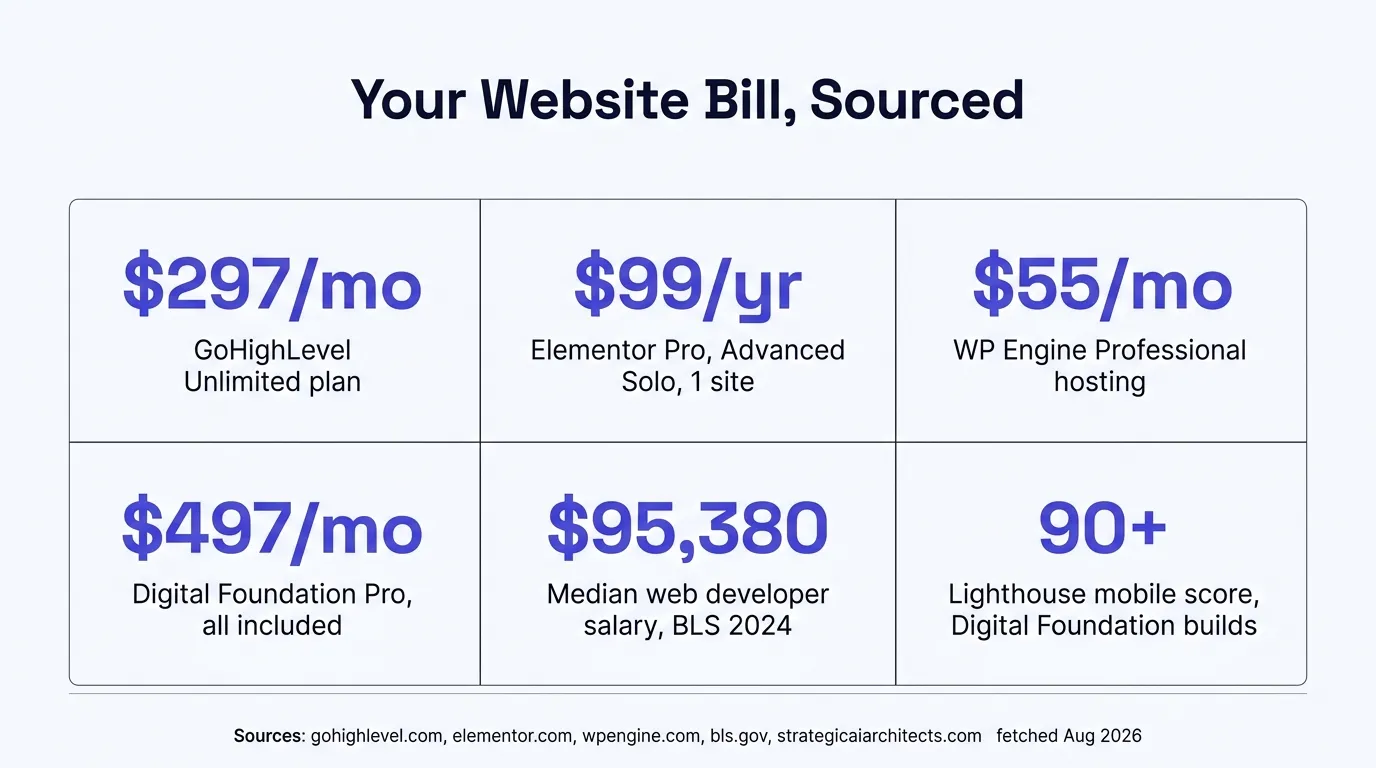
Add those three together and the baseline is $96.50 a month, and that is the floor, not the ceiling. It assumes the free tier of every security, backup, and SEO plugin is good enough for an insurance agency, which for a Medicare or ACA site handling lead data, it usually is not. WPForms is worth a specific callout, because its own pricing page is unusually candid about the pattern this whole guide is describing: the Pro tier shows an introductory price of $199.50 a year, with a note that "all renewals are at full price" of $399 a year4. The first year price and the price you actually pay every year after are not the same number, and that gap is easy to miss when you sign up looking at the smaller one.
Check your own renewal dates
If you are running WordPress today, pull up your last three plugin renewal charges before you read further. Most agencies can name their hosting bill. Almost none can name what their forms plugin, security plugin, and page builder renewed at last time, and that blind spot is exactly where this guide's math lives.
What it costs when something breaks
Every stack breaks eventually. A plugin update conflicts with your theme. A form stops sending notifications and you find out three weeks later when a client asks why nobody called them back. An automated attack finds the one unpatched plugin on your site and defaces the homepage the Friday before open enrollment. None of this is hypothetical. It is the normal lifecycle of running software with a dozen moving, independently updated parts.
When it happens, somebody has to fix it, and that somebody's time has a real market value. The Bureau of Labor Statistics states the 2024 median annual wage for the combined occupation of web developers and digital designers at $95,3805. Divide that across a standard 2,080 hour work year and you get roughly $45.86 an hour, which is the value of a skilled person's time, not a freelance quote. A one-off contract rate for an urgent fix typically runs higher than that number, since a salaried wage already has benefits and steady work priced into it that a single emergency project does not.
$95,380
Median annual wage, web developers and digital designers, 20245
$45.86
That wage divided across a 2,080 hour work year
$96.50/mo
Baseline WordPress stack before plugins break2,3,4
$497/mo
Digital Foundation Pro, everything included6
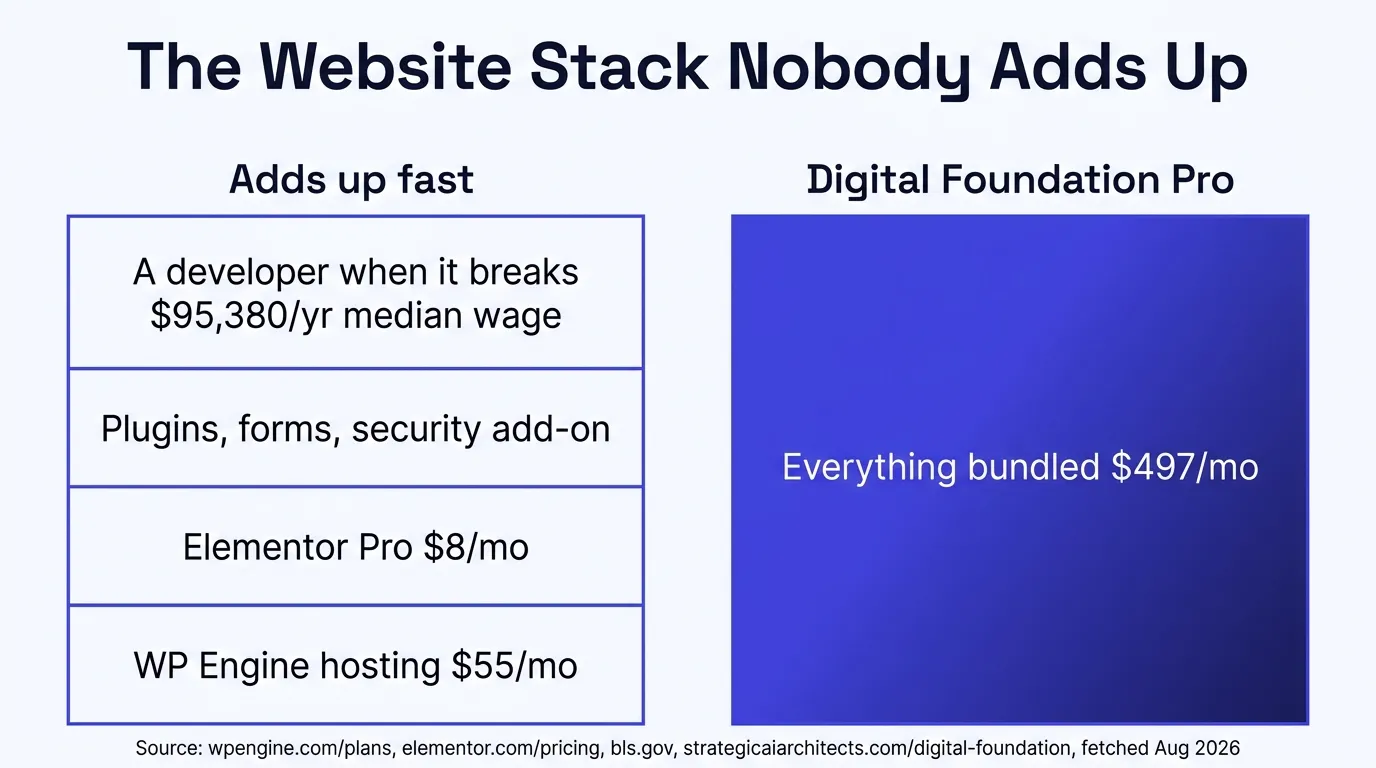
Nobody budgets for the hour a developer spends untangling a plugin conflict, because it does not show up until it happens, and by then it is urgent, not planned. That is the part of the bill that never makes it onto a comparison chart, and it is exactly the part that turns a $96.50 a month stack into a much larger number the one month it actually matters.
If you want a second set of eyes on your own stack before something breaks on its own schedule instead of yours, the free Audit checks your site's technical health in under a minute. Run the free Audit.
A real worked example, month by month
Numbers are easier to trust when you can see the arithmetic, so here it is, plainly, using only the figures verified above. A one-location agency running WordPress with Elementor Pro, WP Engine hosting, and WPForms Pro pays $96.50 a month in software alone, once the WPForms renewal rate is counted rather than its first-year discount2,3,4. That number does not include a theme, an SEO plugin, image optimization, a security plugin beyond the free tier, or a single hour of anyone's time.
Add a modest, realistic estimate: a security plugin's paid tier and an SEO plugin's paid tier together commonly run in a similar range to the forms plugin above, and most agencies eventually add at least one of the two once the free tier's limits get in the way. Do that and the stack crosses $150 a month before a single hour of custom work happens. Add the hour or two a quarter that something genuinely breaks, priced at the market rate this guide just calculated, and a "free" WordPress site is running an agency real money every single month, just not in one visible line.
WordPress, Elementor, WP Engine, WPForms
- $96.50/mo in software alone, floor not ceiling2,3,4
- Security and SEO plugin upgrades typically add more
- No content, no AEO, no receptionist included
- You are the person who fixes it, or you hire one at roughly $45.86/hr and up5
What's includedThe parts, not the assembly or the upkeep
One bundled line item
- $497/mo, everything included6
- Weekly blog post and weekly location page
- 24/7 AI receptionist plus AI chat widget
- AEO optimization and Google Business Profile management
What's includedThe site, the content, and the upkeep, in one number
Read that chart carefully rather than just picking the smallest bar. The $96.50 figure buys you software licenses. It does not buy you weekly content, AEO work, or an AI receptionist, and it does not include the hour someone spends the day the form breaks. The $297 figure buys you a bundled funnel and CRM platform, with usage and add-on charges layered on top of that number, not inside it. The $497 figure is the only one of the three that is a complete, finished product with nothing else to add for the features it lists.
Why the platform underneath still matters
Cost is this guide's focus, but it does not stand alone from architecture, so it is worth naming the connection briefly. We build on Astro, which ships zero JavaScript to the browser by default7, meaning pages arrive as finished HTML instead of a runtime that assembles the page after it loads. A page builder like Elementor or a funnel platform like GoHighLevel loads a heavier stack before the visitor sees anything — it is why WordPress sites are statistically slow and what the static alternative changes — and Google states plainly that Core Web Vitals performance "aligns with what our core ranking systems seek to reward"8, with published thresholds of 2.5 seconds for Largest Contentful Paint, 200 milliseconds for Interaction to Next Paint, and 0.1 for Cumulative Layout Shift9. The score that headroom buys is not theoretical: our production client builds measure 99-100 on mobile PageSpeed, named sites included.
That is not this guide's main argument, and it does not need to repeat what we have already covered in full elsewhere. If you want the complete breakdown of why a site can feel fast on your laptop and fail Google's mobile test anyway, see our guide on why insurance websites fail Google's speed test, and for the short, sourced version of the pass line itself, see what PageSpeed score an agency website actually needs. What is worth saying here is narrower: the cost of a page builder stack and the performance cost of a page builder stack are not two separate problems. They are the same architectural decision showing up on two different bills, one in dollars and one in load time.
What multiplies when you run more than one site
Everything in this guide so far assumes one agency, one site. The math changes shape entirely for an FMO or IMO running downline agents across several offices, or an agency with a location page for every county it writes business in, because a DIY stack does not get a volume discount the way a bundled platform can.
On the WordPress side, a separate site for each location means a separate hosting plan, a separate page builder license, and a separate forms plugin renewal for every single one of them, unless someone builds and maintains a WordPress multisite network, which is its own specialized skill and its own added cost. Three locations on the stack priced out earlier is not $96.50 a month. It is closer to three times that, since WP Engine's own tiers price by traffic and site count rather than offering a flat per-additional-site rate, and Elementor's own pricing page shows the same pattern: the Advanced tier covers 3 sites for $199 a year, but a fourth site pushes you to the Expert tier at $399 a year for up to 252,3.
GoHighLevel handles multi-location differently, and it is worth being fair to that design. Its Unlimited plan includes unlimited sub-accounts at the $297 a month price, and Agency Pro adds automated sub-account creation and reseller-style billing on top1. For an FMO standing up a sub-account per downline agent, that structure genuinely avoids the per-site multiplication a WordPress network runs into. What it does not avoid is the usage based telecom and AI charges, which HighLevel's own pricing page states apply on top of the subscription and which scale with how many sub-accounts are actually active and calling or texting leads1.
This is the kind of thing worth a real conversation
Multi-site cadence, one blog post and one location page a week across several offices, is exactly the kind of work we handle for agencies running more than one site, each keeping its own brand and its own calendar. Worth a conversation if that describes your agency. Book a call.
Digital Foundation's Scale tier is built for exactly this shape of problem: one new blog post every business day, 20 to 22 a month, plus two new location pages every week, all for $997 a month6. Compared against three to five separately hosted WordPress sites, or a GoHighLevel Agency Pro account with usage charges scaling across a dozen active sub-accounts, the single bundled number tends to look a lot more competitive at scale than it does for a single one-location agency, precisely because the DIY alternative does not flatten out the way a built-for-multi-site product can.
What you can fix yourself, honestly
None of this means WordPress or GoHighLevel is the wrong choice for every agency, and it would be dishonest to pretend otherwise. A single producer with a simple site and no location pages to manage can run either platform for years without a real problem, especially with a few habits in place.
Audit your renewals once a year
Pull every plugin and hosting charge into one list on the same day each year, so the real annual number stops being a surprise.
Cut what you are not using
Deactivated plugins still renew if you never cancel them. A yearly audit catches the ones nobody has opened in months.
Keep a maintenance calendar
Update plugins and themes on a set schedule, in a staging copy first if your host offers one, instead of reacting after something breaks.
Price a fix before you need one
Get a quote from a developer before an emergency, so you are not negotiating rate under pressure the week of AEP.
Watch the renewal, not the intro price
Any plugin or platform offering a discounted first year, as WPForms does, will renew at the full rate. Budget to that number, not the teaser.
Know your own threshold
The DIY math above is fine for one location and light traffic. It gets harder to justify past that, and that is a real threshold, not a sales line.
If you read that list and it sounds manageable for where your agency is today, the DIY path is a fine answer, and staying on it is not a mistake. Where agencies tend to reach for something else is not because the DIY stack is unworkable, but because nobody signed up to be the person who tracks six renewal dates and diagnoses plugin conflicts on top of selling policies.
How Digital Foundation prices the same problem
This is the same stack this guide just priced out, built and maintained as one product instead of five separately billed ones. Digital Foundation's Starter tier includes a complete, compliant website with every educational page, AEO optimization, Google Business Profile management and review harvesting, and an AI chat widget, verified live on the pricing page, launching in one to three days6.
| Tier | Price | What it adds |
|---|---|---|
| Starter | $247/mo | Complete, compliant site with AEO optimization, GBP management, AI chat widget6 |
| Pro | $497/mo | Plus weekly blog post, weekly location page, 24/7 AI receptionist6 |
| Scale | $997/mo | Plus daily blog cadence, 2 new location pages weekly6 |
Every tier is month to month with a 14 day free trial and no setup fee for a limited time, and the stated guarantee reads plainly: live in days, and if you do not love it, you walk away with no fees6. That structure matters as much as the price itself. You are not signing a page builder license, a hosting contract, and a plugin subscription on three different renewal cycles. You are signing one line, and if it stops earning its keep, canceling it is one decision instead of five.
What Digital Foundation is not
It is not a custom build. If your agency needs something the three published tiers do not cover, conversational AI with deep CRM context, voice AI, or a fully custom quoting tool, that is scoped on a call under our AI Expert or Enterprise tiers instead of sold as a fixed monthly line. See how we build custom.
What a bundled foundation actually gets you
The honest case for paying more per month than the smallest sticker price on this page is not that the smallest sticker is a scam. It is that the smallest sticker never included the whole job. Once you count hosting, the page builder, at least one plugin, and the hours someone spends keeping all of it running, the gap between the DIY stack and a bundled site narrows a great deal, and what is left over buys you weekly content and AEO work that the DIY stack was never going to produce on its own.
That is the actual trade being made here. Not cheap versus expensive, but assembled-yourself versus built-and-maintained-for-you, with the second option also producing the ongoing content and search visibility work an agency needs but rarely has the hours to do consistently.
If you are still not sure which side of that line your agency sits on, run the numbers on your own current stack the way this guide ran them, and compare the honest total to what you would be signing for instead. The answer is usually more obvious once both numbers are actually on the page. See Digital Foundation.
Questions agencies ask
Is GoHighLevel actually cheaper than a custom built website?
On the sticker price alone, often yes. GoHighLevel's Starter plan lists at $97 a month and Unlimited at $297 a month, verified live on its pricing page. What that number leaves out is usage based telephony and AI charges on top of the subscription, and the fact that you are renting a funnel builder, not a site that gets more citable over time the way a static, indexed site does.
How much does a typical WordPress insurance agency website cost per year?
The software alone runs at least a few hundred dollars a year once you count hosting and a page builder. WP Engine's Professional hosting tier lists at $55 a month, Elementor Pro's Advanced Solo tier lists at $99 a year, and a forms plugin like WPForms Pro renews at $399 a year, all verified live this session. That is before a theme, a security plugin, an SEO plugin, or the person who fixes it when something breaks.
What does Digital Foundation include for $497 a month?
The Pro tier includes the full Starter website, AEO optimization, Google Business Profile management, an AI chat widget, one new blog post and one new location page every week, and a 24/7 AI receptionist, verified live on the Digital Foundation pricing page. It is billed as one line, month to month, with no setup fee and a 14 day free trial.
Can I build my agency's site myself and skip all of this?
Yes, and for a small book with simple needs, that is a genuinely reasonable choice. A single producer comfortable in WordPress or GoHighLevel can run a serviceable site on the DIY stack this guide prices out. Where it stops being reasonable is at real volume, multiple locations, or the moment nobody on your team has the time to be the unofficial IT department.
Why does hiring someone to fix a WordPress site cost so much?
Because it is skilled labor with real market value. The Bureau of Labor Statistics puts the 2024 median annual wage for web developers and digital designers at $95,380, which works out to roughly $45.86 an hour across a standard 2,080 hour work year. A freelance or contract rate for a one off fix typically runs higher than that figure, since a W-2 wage already has benefits and steady work built into it that a single project does not.
Does a slower page builder site actually cost an agency leads?
Google states plainly that Core Web Vitals performance aligns with what its core ranking systems reward, and a page that does not meet the LCP, INP, and CLS thresholds it publishes is working against you in search, not just on paper. This guide focuses on cost rather than speed. For the full mobile versus desktop breakdown, see our guide on why insurance websites fail Google's speed test.
Is there a cheaper way to get a fast, AI-citable site than Digital Foundation?
If you have the time and the technical comfort, yes, you can assemble a fast static site yourself on a framework like Astro. What you are paying Digital Foundation for is not the parts, it is not having to be the person who assembles, maintains, and troubleshoots them, plus the weekly content and AEO work that a DIY stack does not do on its own.
Sources
- HighLevel. "Pricing," Starter, Unlimited, and Agency Pro plans, usage charges and add-on catalog, verified live 2026-08-04. gohighlevel.com.
- Elementor. "Pricing," Essential, Advanced Solo, Advanced, Expert, and Agency plans, verified live 2026-08-04. elementor.com.
- WP Engine. "Plans," Startup, Professional, Growth, Scale, and Core hosting tiers, verified live 2026-08-04. wpengine.com.
- WPForms. "Pricing," Basic, Plus, Pro, and Elite plans, introductory and renewal rates, verified live 2026-08-04. wpforms.com.
- U.S. Bureau of Labor Statistics. "Web Developers and Digital Designers," Occupational Outlook Handbook, median annual wage $95,380, May 2024 reference year. bls.gov.
- Strategic AI Architects. "Digital Foundation," pricing verified live 2026-08-04. strategicaiarchitects.com.
- Astro. "Why Astro," zero JavaScript by default, verified live 2026-08-04. docs.astro.build.
- Google Search Central. "Understanding Core Web Vitals and Google search results," ranking systems statement, verified live 2026-08-04. developers.google.com.
- web.dev. "Web Vitals," LCP, INP, and CLS thresholds, verified live 2026-08-04. web.dev.
Talk it through
Want a second pair of eyes on it?
Free 30 minutes. Bring what you found, or bring nothing and we will look together at how AI engines read your site and which fixes move first.
See what your own stack actually adds up to
Run the free Audit, a live AEO Audit plus a HIPAA tracking scan of your site, in under a minute.