Playbook
Insurance Broker Website: One Page Can't Sell Five Lines
A single generic services page works until you're writing auto, home, life, and commercial at once. Then it starts costing you rankings, leads, and maybe a line you shouldn't be implying you write.


18 min read
A multi line broker site built around one "Services" page is built for an agency that sells one thing, even when the agency behind it sells five. The fix isn't a redesign, it's architecture: one dedicated page per line of business, a carriers page that states your actual appointments instead of a vague claim, and forms that ask line specific questions instead of funneling everything into one inbox. Google's own documentation treats page experience as a ranking input1, and a thin page trying to cover five topics at once competes against itself for all five instead of winning any of them. The same structure that helps you rank also decides whether an AI answer engine can quote you at all.
One page, five jobs
You started as one thing. Maybe you got licensed writing ACA business, or you came up through a captive carrier selling one product, and your first website had one job: explain that one thing and collect a phone number. Somewhere along the way you added a second line, then a third, and now you write auto, home, life, and commercial, maybe through four different carrier relationships, and your website still has the same one "Services" page it had five years ago, with four bullet points added under a single paragraph.
That page still technically mentions everything you sell. It just doesn't actually sell any of it, because a prospect who typed "commercial umbrella insurance broker near me" into Google or asked an AI assistant the same question is not looking for a paragraph that also talks about your auto and life business. They're looking for a page that is about the thing they asked about, written by someone who clearly handles that specific line, with a form built for that specific conversation.
The same one page problem shows up in your lead form. One contact form, one generic "What can we help you with?" dropdown, feeding one inbox that someone on your team has to manually sort before the right person even sees the lead. Every line you've added since your first website made that sorting job bigger, and nothing about the form itself got smarter to handle it.
Why this happens to multi line agencies
Nobody sits down and decides to build a site that undersells four of their five product lines. It happens by accretion. Your original site was built, or templated, around the one line you started with. Each new line you picked up got added the fast way, a new bullet point, a new paragraph, because rebuilding the page architecture every time you picked up a new carrier appointment was never anyone's actual job. It was always the thing to get to later.
Templates make this worse, not better. A generic local business template, the kind sold on a theme marketplace or built into a page builder, ships with one "Services" section designed for a business that sells one category of thing with a few variations, a lawn care company offering mowing, edging, and fertilizing. It was never built around the idea that "life insurance" and "commercial general liability" are two entirely different buying decisions, with different questions, different disclosures, and often a different person on your staff handling each one.
And the form problem compounds the page problem. Once the services page stops distinguishing between lines, the contact form built to match it stops asking line specific questions too. By the time an agency is four or five lines deep, the website's entire structure is still quietly assuming it sells one thing, because nothing about the architecture ever forced a rethink.
A two minute check
Open your own site and count: how many lines of business does your agency actually write, and how many dedicated pages does your site have, one page per line, not one bullet point per line? If those two numbers don't match, the rest of this guide is describing your site specifically.
Agent or broker: what your site can actually say
Before the page architecture fix, there's a smaller, sharper problem worth checking first: what your site claims you are, and whether that claim matches your actual license and appointments.
"Agent" and "broker" get used interchangeably in a lot of marketing copy, including a lot of agency websites, but they aren't always the same thing legally, and the distinction isn't just semantic. State insurance codes generally build the terms around who the licensed producer represents. North Carolina's General Statutes define an insurance producer as a person licensed to sell, solicit, or negotiate insurance, and state directly that the term "includes an agent and a broker." The same statute then separates the two: an agent is defined as a person licensed to solicit applications for, or negotiate a policy of, insurance, generally understood as representing the carrier side of the transaction. A broker is defined as a licensed producer who procures insurance for a party other than himself, meaning the broker is understood to represent the buyer2.
That distinction matters for a multi line site specifically because a carriers page, or any page that implies which companies you can place business with, is a factual claim your state can check against your actual license and appointment records. If your homepage calls you a "broker representing twelve top carriers" but your actual license and appointments only support the word "agent" for some of those relationships, that's not a copywriting choice, it's a claim that doesn't match your license.
The practical move: check your own state's department of insurance for how it defines the terms, and make sure your homepage, your footer, your carriers page, and your organization schema markup all use the term your actual license supports, consistently, everywhere on the site. This is a five minute fix once you know which word is correct. It's also the kind of inconsistency a regulator, or a careful prospect, notices faster than you'd expect.
What the one page approach costs
None of this is free to ignore, even though the cost doesn't show up as a single line item on a bill. It shows up in three places: search visibility you never win, leads that take longer to reach the right person, and staff time spent sorting instead of selling.
Start with the ranking cost. Google's own Search Central documentation states plainly that Core Web Vitals, the technical page experience signals, "are used by our ranking systems," while also being clear there's no single ranking factor and that core ranking systems weigh a variety of signals aligned with overall page experience1. Page experience is only part of the story. Content relevance is the bigger one, and a single page trying to be the definitive answer for "auto insurance," "home insurance," "life insurance," and "commercial insurance" simultaneously is structurally working against itself on all four, competing against single topic competitor pages with nowhere near the same depth problem.
Then there's the time cost, which is easier to put a real number on. Picture a multi line agency running one contact form that funnels every lead, regardless of line, into one inbox. Someone still has to read each submission, figure out which line it's actually about, and route it to the right producer or CSR. Say that triage takes fifteen minutes per lead for a modest ten misrouted or ambiguous submissions a month, 150 minutes, or two and a half hours. At the median hourly wage for an insurance sales agent, $29.94 as of May 2025 according to the U.S. Bureau of Labor Statistics, that's close to $75 a month, or roughly $900 a year, spent sorting mail that a line specific form would have routed automatically3. That's an illustrative estimate built from a real wage figure, not a claimed industry average, and it only accounts for triage time, not the slower response time a misrouted lead experiences while it sits in the wrong queue.
The compliance cost is harder to price but not hypothetical. A carriers page or a homepage claim that overstates your actual appointments is a factual misstatement your state licensing board can check against its own records, independent of anything related to your website's design or speed.
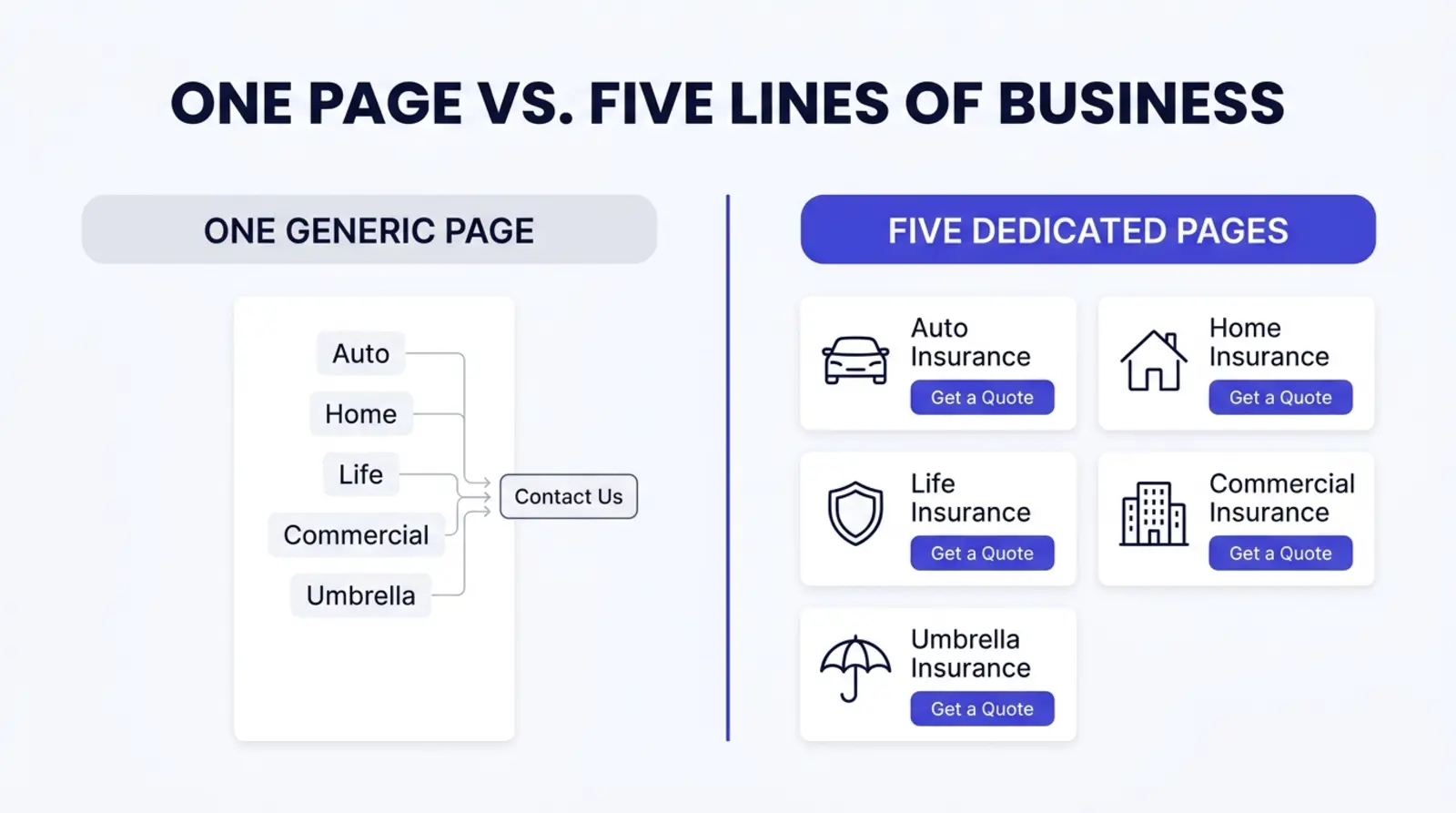
The page architecture a multi line site needs
The fix is architectural, not cosmetic. It doesn't require new copywriting talent or a rebrand. It requires splitting what's currently one page doing five jobs into five pages, each doing one job well.
One page per line
Auto, home, life, commercial, umbrella, each with its own URL, its own heading, and its own content built around that line's actual buyer questions.
A real carriers page
The companies you're actually appointed with, stated plainly, checked against your license, not a vague "we work with top carriers" claim.
Line specific disclaimers
A Medicare page carries the disclaimer Medicare pages require. A commercial page doesn't, because it doesn't apply there. One blanket disclaimer at the footer covers neither correctly.
Forms built per line
A life insurance form asks about beneficiaries and health history. A commercial form asks about entity type and payroll. One generic form asks neither well.
Location pages where they matter
If you write business across more than one county or metro with genuinely different content, a shared regional page undersells all of them the same way a shared services page does.
Matching schema per page
Each line's page carries structured data describing that specific service, not one generic Organization schema trying to describe everything at once.
None of this means every line needs the same depth on day one. A line that brings in two leads a month doesn't need the same page budget as the line that's your actual revenue driver. It does mean every line that's live on your site gets its own page, even a modest one, instead of a sentence buried on a page about something else.
What this looks like in practice
Instead of one URL, /services, with a paragraph and five bullet points, you'd have
/auto-insurance, /home-insurance, /life-insurance,
/commercial-insurance, and /umbrella-insurance, each a real page, each
linked from your main navigation, each with its own quote path. The services page can still exist
as a short index linking to all five. It just stops trying to be the whole answer by itself.
Routing the right lead to the right line
The form problem is the part most agencies fix last, even though it's often the fastest win. If every line has its own page, every line should also have its own quote path, with questions built for that specific conversation instead of one generic contact form bolted onto every page on the site.
| Line | Intake questions a generic form skips | Who should get the lead |
|---|---|---|
| Auto | Vehicles on the policy, current carrier, prior claims | Personal lines CSR |
| Home | Year built, roof age, square footage, bundled with auto | Personal lines CSR |
| Life | Coverage amount sought, beneficiaries, basic health history | Life producer |
| Commercial | Entity type, payroll or revenue, industry classification | Commercial lines producer |
| Umbrella | Underlying policy limits, assets to protect | Whichever producer holds the underlying policy |
None of this requires a complicated system. It requires each line's page to link to a form built for that line, routed by a simple rule, a field, or an automation, to the person who should see it first, instead of one shared inbox and a human doing that sorting after the fact, every time, for every lead.
If you want to see where your own site stands
The free Audit checks your current site's structure, speed, and AI citation readiness in under a minute, and it's a fast way to see whether your pages are built per line or still lumped into one services page. Run a free Audit.
What a multi line site needs for AI search
A growing share of insurance shoppers now ask an AI assistant a question directly instead of typing it into a search box and scrolling through links. The same page architecture problem that hurts your Google ranking hurts your odds of being the source an assistant names, in a slightly different way.
When someone asks ChatGPT, Perplexity, or Google's AI Overview something like "what does an independent broker charge to place commercial umbrella coverage," the system is looking for a passage it can lift cleanly and attribute to a real source. A paragraph buried inside a page that also covers auto, home, and life insurance doesn't give it that. The paragraph is tangled up with four other topics, and there's no clean boundary telling the model where the commercial umbrella answer starts and the auto insurance answer ends.
A dedicated page, answer first, with its own heading structure and its own schema markup describing exactly what service it covers, is the structure these systems are built to read and quote. That's not a different fix from the SEO fix above. It's the same fix, because both systems reward the same thing: a page that is clearly, completely about one question.
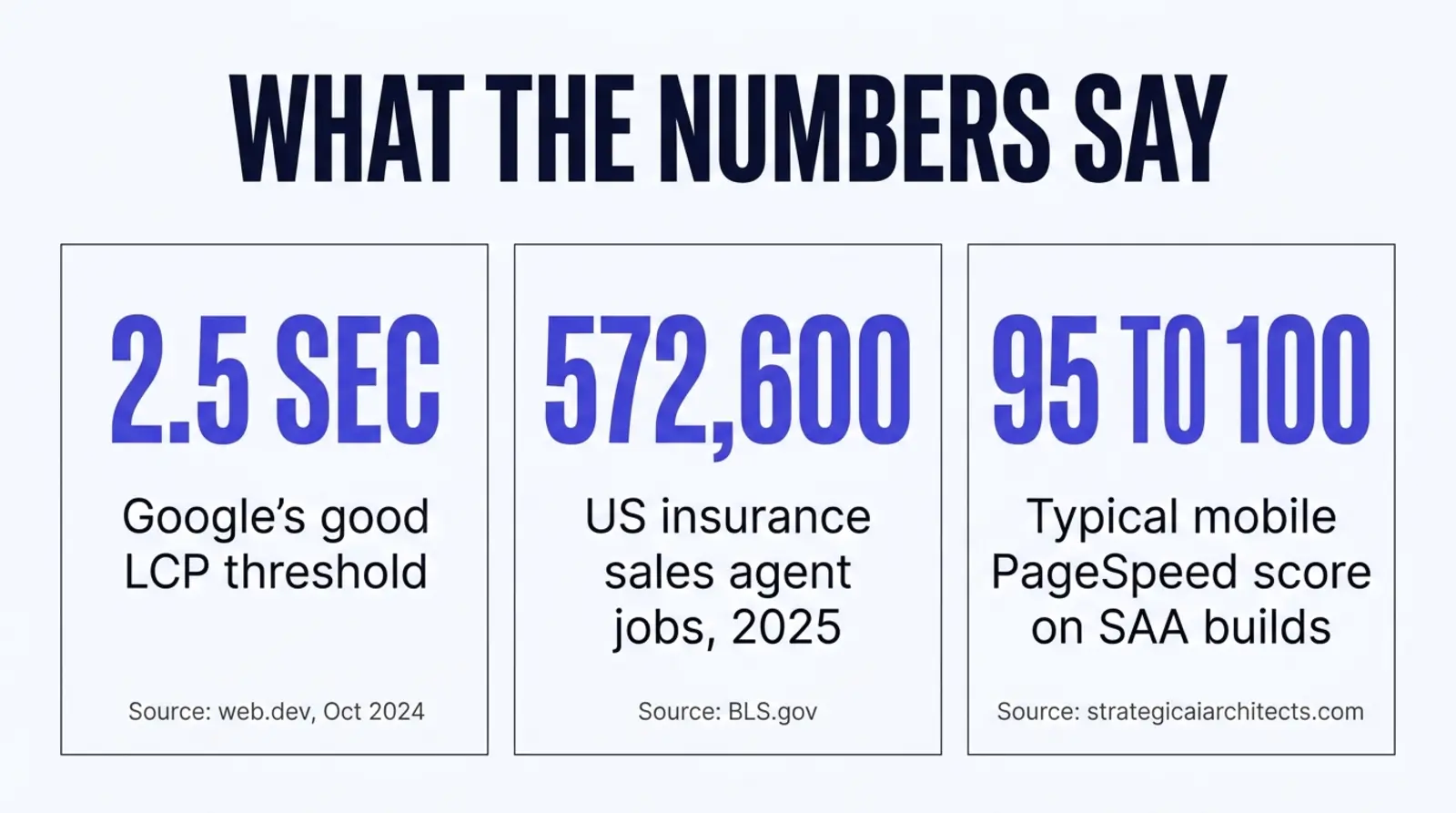
Speed is still part of this too. Google's web.dev documentation sets the "good" thresholds at 2.5 seconds or less for Largest Contentful Paint, 200 milliseconds or less for Interaction to Next Paint, and 0.1 or less for Cumulative Layout Shift, each measured at the 75th percentile of real page loads4. A page built on a platform that loads a runtime before the content appears has more weight to clear those numbers with than a page that ships as finished HTML, regardless of how well the page's content is structured. Architecture and speed are two separate fixes, and a multi line site usually needs both.
How we build this
We re-fetched our own Digital Foundation pricing page live while writing this guide, the same standard we hold every other number in this article to5. The Website tier, $84 a month billed annually, ships a complete site with 30 pages live on launch day, built around the lines of business you actually write rather than a generic local business template retrofitted after the fact. Starter, $247 a month, adds a weekly publishing cadence and Google Business Profile management. Pro, $497 a month, adds up to 17 new pages a month and a 24/7 AI voice receptionist. Scale, $997 a month, scales content to roughly one new page every business day. A one time Full Clone option runs $1,0005.
We build on Astro, which ships zero JavaScript to the browser by default, so a page arrives as finished HTML instead of a runtime a visitor's phone has to download and boot before anything appears. Our builds score 90 or higher on Lighthouse performance for both mobile and desktop, and some score 100. Every line of business page carries its own matching schema markup, every carrier appointment claim matches what you've told us about your actual license, and the sitemap and llms.txt file update themselves with the full URL the moment a new page publishes, so a new line you add next year doesn't sit invisible to search and AI crawlers because someone forgot a manual step.
You can do this yourself
Nothing in this guide requires hiring anyone. Splitting your services page into dedicated pages and rebuilding your forms to ask line specific questions is work a lot of agents are capable of doing on whatever platform they're already running. Some will read this and decide they'd rather do it themselves. That's a fine outcome.
What changes for your agency
None of this promises a ranking position, a specific traffic number, or a lead count, because none of those can be honestly promised by anyone. What the architecture fix changes is more concrete than that.
1:1
A dedicated page for every line you actually write
0
Leads that need a human to manually sort before routing
1
Consistent agent or broker claim across every page and schema field
90+
Lighthouse mobile and desktop target on a rebuilt site
A prospect who lands on a page built around the exact question they asked converts at a different rate than one who lands on a paragraph that mentions it in passing. A lead that routes to the right producer automatically gets a faster first response than one sitting in a shared inbox waiting to be sorted. And a site where every page, every schema field, and every carrier claim says the same consistent thing about who you are and what you're licensed to place is a site that holds up to scrutiny, from a prospect, a regulator, or an AI system trying to decide whether to trust it as a source.
Questions multi line brokers ask
What's the legal difference between an insurance agent and an insurance broker, and does my website need to say which one I am?
It varies by state, and the terms are not interchangeable everywhere even though a lot of marketing copy treats them as synonyms. North Carolina's insurance code, for example, defines an insurance producer as anyone licensed to sell, solicit, or negotiate insurance, and states plainly that the term includes both an agent and a broker. It then separately defines an agent as someone licensed to solicit applications for or negotiate a policy of insurance, and a broker as a licensed producer who procures insurance for a party other than himself, meaning a broker represents the buyer rather than the carrier. Other states draw that line differently, and some use producer as the only formal license category. The practical answer: check your own state's department of insurance before your homepage, your footer, and your schema markup all describe you the same way, and make sure that description matches what your actual carrier appointments and your license say, not just what sounds better in a headline.
How many pages does a multi line broker website actually need?
At minimum, one dedicated page per line of business you actively write, plus a carriers page, a quote or contact page per line if the intake questions genuinely differ, and your compliance pages. A broker writing auto, home, life, and commercial needs at least four service pages, not four bullet points on one services page. Add location pages if you serve more than one county or metro with meaningfully different content, and add FAQ or educational pages for the questions prospects in each line actually ask. There's no fixed number that is right for every agency, but a services page that lists five lines in one paragraph is never enough once you're past your first year or two of writing more than one kind of business.
Should auto, home, life, and commercial insurance all route through the same contact form?
Only if the exact same person reads and triages every single lead the same way, which is rare past a one producer shop. A life insurance prospect and a commercial umbrella prospect need different intake questions, different disclosures, and often a different person on your team to follow up. One generic form with a single dropdown labeled 'What are you interested in?' forces that triage to happen after the lead already converted, by a human reading free text, instead of the form itself doing the routing. That's an extra step that costs time and occasionally loses the lead entirely when nobody catches it.
Does spreading one agency across more pages hurt SEO instead of helping it?
No, and this is the opposite of what a lot of agents assume. Search engines reward pages that answer one specific question thoroughly, not pages that mention five topics briefly. A single services page trying to rank for 'auto insurance,' 'home insurance,' 'life insurance,' and 'commercial insurance' all at once is competing against itself and against every dedicated single topic page a competitor has built, on all four keywords simultaneously, with none of them getting the depth needed to actually win. Splitting those into four focused pages, each answering one line's actual questions in depth, is the standard architecture any SEO reference will tell you to build toward. It isn't duplication. It's depth.
What happens to AI answer engines like ChatGPT and AI Overviews when a broker site mixes every line on one page?
The same structural problem shows up, in a slightly different form. An answer engine trying to cite a source for 'how much does commercial umbrella coverage cost through an independent broker' needs a passage that is actually about that question, with its own context, not one paragraph buried inside a page that also talks about auto and life. A page built around one question is easier for a model to lift cleanly and attribute correctly. A page built around five topics forces the model to either quote something too broad to be useful or skip the page as a source entirely.
How much does a properly structured multi line website cost?
We re-fetched our own pricing live while writing this guide, the same standard we hold every number in it to. Our Digital Foundation Website tier runs $84 a month billed annually and ships 30 pages live on launch day, built around the lines of business you actually write. Starter runs $247 a month and adds a weekly publishing cadence and Google Business Profile management. Pro runs $497 a month and adds up to 17 new pages a month plus a 24/7 AI receptionist. Scale runs $997 a month and adds roughly one new page every business day. A one time Full Clone option runs $1,000. Those are the live prices on our own service page as of this writing, not an estimate.
Can I fix this by adding pages to my current site, or do I need to start over?
In most cases you can add to what you have. If your site is on a platform that lets you create new pages, WordPress, a page builder, or a custom build, the fix is usually architectural rather than a rebuild: split the one services page into one page per line, build a real carriers page that states your actual appointments, and fix your forms to ask line specific questions. The platform underneath matters for speed and for how cleanly you can control schema markup and crawler files, which is a separate decision covered in our guide on builder, template, and custom paths. But the page architecture problem this guide describes is usually fixable on whatever you're already running.
Sources
- Google. "Understand page experience in Google Search results." Search Central Documentation: "Core Web Vitals are used by our ranking systems," and "there is no single signal... our core ranking systems look at a variety of signals that align with overall page experience." Last updated 2026-09-22. Fetched live October 27, 2026. developers.google.com/search/docs/appearance/page-experience.
- North Carolina General Assembly. General Statute 58-33-10, Definitions. Subsection (7): "'Insurance producer' or 'producer' means a person required to be licensed under this Article to sell, solicit, or negotiate insurance... [and] includes an agent and a broker." Subsection (1) defines "agent"; subsection (3) defines "broker" as a licensed producer who "procures insurance for a party other than himself." Most recent session law amendment 2025-45, s. 7(a). Fetched live October 27, 2026. ncleg.gov, G.S. 58-33-10.
- U.S. Bureau of Labor Statistics, Occupational Outlook Handbook, Insurance Sales Agents: median annual pay $62,280 ($29.94 per hour), May 2025. Fetched live October 27, 2026. bls.gov/ooh/sales/insurance-sales-agents.htm.
- web.dev (Google). Core Web Vitals thresholds, measured at the 75th percentile of page loads: LCP good is 2.5 seconds or less; INP good is 200 milliseconds or less; CLS good is 0.1 or less. Page last updated 2024-10-31. Fetched live October 27, 2026. web.dev/articles/vitals.
- Strategic AI Architects. Digital Foundation service page: Website $84/mo billed annually (30 pages live on launch day); Starter $247/mo (weekly publishing cadence, Google Business Profile management); Pro $497/mo (up to 17 new pages/mo, 24/7 AI voice receptionist); Scale $997/mo (roughly one new page per business day); Full Clone $1,000 one time. Fetched live October 27, 2026. strategicaiarchitects.com/digital-foundation.
Talk it through
Want a second pair of eyes on it?
Free 30 minutes. Bring what you found, or bring nothing and we will look together at how AI engines read your site and which fixes move first.
See where your current site actually stands
Run a free Audit and see how your site scores on structure, speed, and AI citation readiness, in about a minute, whether you write one line or five.
Related reading: Insurance agency website design: pages that sell policies · Websites for insurance agents: builder, template or custom · Insurance agency SEO in 2026: what actually moves you up