Playbook
Ranking Isn't What Gets Insurance Agencies Cited by AI
Insureon, Progressive, and The Hartford each hold under three percent of insurance AI citations. The gate was never who ranks first.


20 min read
AI Overviews cite a different pool of pages than the organic top 10 ranks. Ahrefs analyzed 863,000 keywords and found only 37.9 percent of cited pages ranked in the top 10, down from about 76 percent in July 20251. Conductor's insurance-specific study of 3.6 million citations found 53.3 percent of insurance AI Overview citations came from outside the top 10 entirely2, and the single biggest named brand, Insureon, held just 2.9 percent of all citations2. Ranking first was never the gate.
The assumption that is actually costing you
Ask most agency owners why they have not touched their site's structure for AI search and you get some version of the same answer. Progressive spends more on marketing in a quarter than most independent agencies will spend in a career. State Farm owns page one for half the searches that matter. Why restructure a site for AI citation when a national carrier with a nine figure budget already owns the rankings those citations are supposedly built on.
That reasoning made sense as recently as last year, and it is exactly backwards now. It rests on a premise that used to be roughly true and has quietly stopped being true: that an AI Overview mostly just re-reads whatever already sits at the top of the organic results and repeats it back to you. If that premise held, outranking Progressive would in fact be a precondition for getting cited instead of them. It does not hold anymore, and the agencies still operating as if it does are leaving a specific, measurable opportunity on the table.
Here is the version of that reasoning we hear most often, almost word for word: "I write Medicare and ACA in one metro. Three national brands already own every top-10 slot for the phrases my clients search. Why would I spend a weekend restructuring my site for AI citation when I cannot even crack page one." It is a reasonable question if the underlying premise is true. It stops being reasonable the moment you learn that the biggest of those three national brands is, by an independent research firm's own count, capturing under three citations out of every hundred tracked in the entire industry. Owning page one for a phrase and owning the AI answer to that phrase turned out to be two different contests, and the data says plainly they are not won the same way.
Before you keep reading
If you want a straight answer on where your own site stands for AI citation right now, the free Audit scores it in about a minute. strategicaiarchitects.com/audit
What changed between rank and citation
For most of Google's history, one search produced one ranked list, and whatever appeared near the top of that list was, by definition, the material Google trusted most for that exact phrase. An AI Overview looked, for a while, like a compressed version of the same process: take the top few organic results, summarize them, cite them. Under that model, citation and rank were nearly the same thing wearing different clothes.
Google's own documentation describes something different now. It calls the mechanism query fan-out: the model generates "a set of concurrent, related queries" to pull in more information than the one visible search box ever asked for3. A shopper who types "how much does Medicare Part B cost" is not really asking one question to the system building the answer. Behind the scenes, the model may also be asking about IRMAA brackets, late enrollment penalties, and what changed for the current plan year, each of those a separate retrieval that can surface an entirely different set of pages than the visible search results ever showed.
That is the mechanical reason a page sitting on page four, or a page that would not crack the top 100 for the visible query at all, still gets pulled into the answer. It was not competing for the front page phrase. It was the best match for one of the sub-questions the model generated on its own, a question with a much smaller, much less contested field of candidates. Rank against the visible query stops being the whole game the moment the system is running several invisible queries behind it.
Run the same logic against an ACA question instead of Medicare and the pattern holds. A shopper types "how much is a silver plan with a subsidy for a family of four." The visible phrase is broad and contested; a dozen national brands and comparison sites have built pages chasing exactly that wording for a decade. But query fan-out is not limiting itself to that one phrase. It is plausibly also generating sub-questions about the 400 percent federal poverty level cliff, what counts as household income for the subsidy calculation, and what changes at the next open enrollment. A page that answers one of those narrower questions precisely, with the current plan year's numbers and a named source, is competing in a field of a few dozen candidates instead of a few thousand. That narrower field, not the broad phrase, is where an independent agency's page actually has a realistic shot.
The page built to rank vs the page built to be cited
Put the two approaches side by side and the difference in what each one is optimized for becomes obvious. Most agency sites, ours included in years past, were built for the first column. The data in this guide argues for spending new effort on the second.
The broad-phrase page
- Targets one high-volume phrase everyone else is also targeting
- Answer arrives after paragraphs of scene-setting
- Numbers stated without a source or a date
- One page tries to cover the whole topic at once
- Competing directly against national ad budgets
Field sizeThousands of pages chasing the same phrase
The narrow, sourced answer
- Answers one sub-question a fan-out query would actually generate
- Direct answer in the first two sentences under the heading
- Every figure named, sourced, and dated inline
- One page, one question, answered completely
- Competing on structure and sourcing, which budget does not buy
Field sizeA few dozen pages that actually answer the narrow question
What the data says now
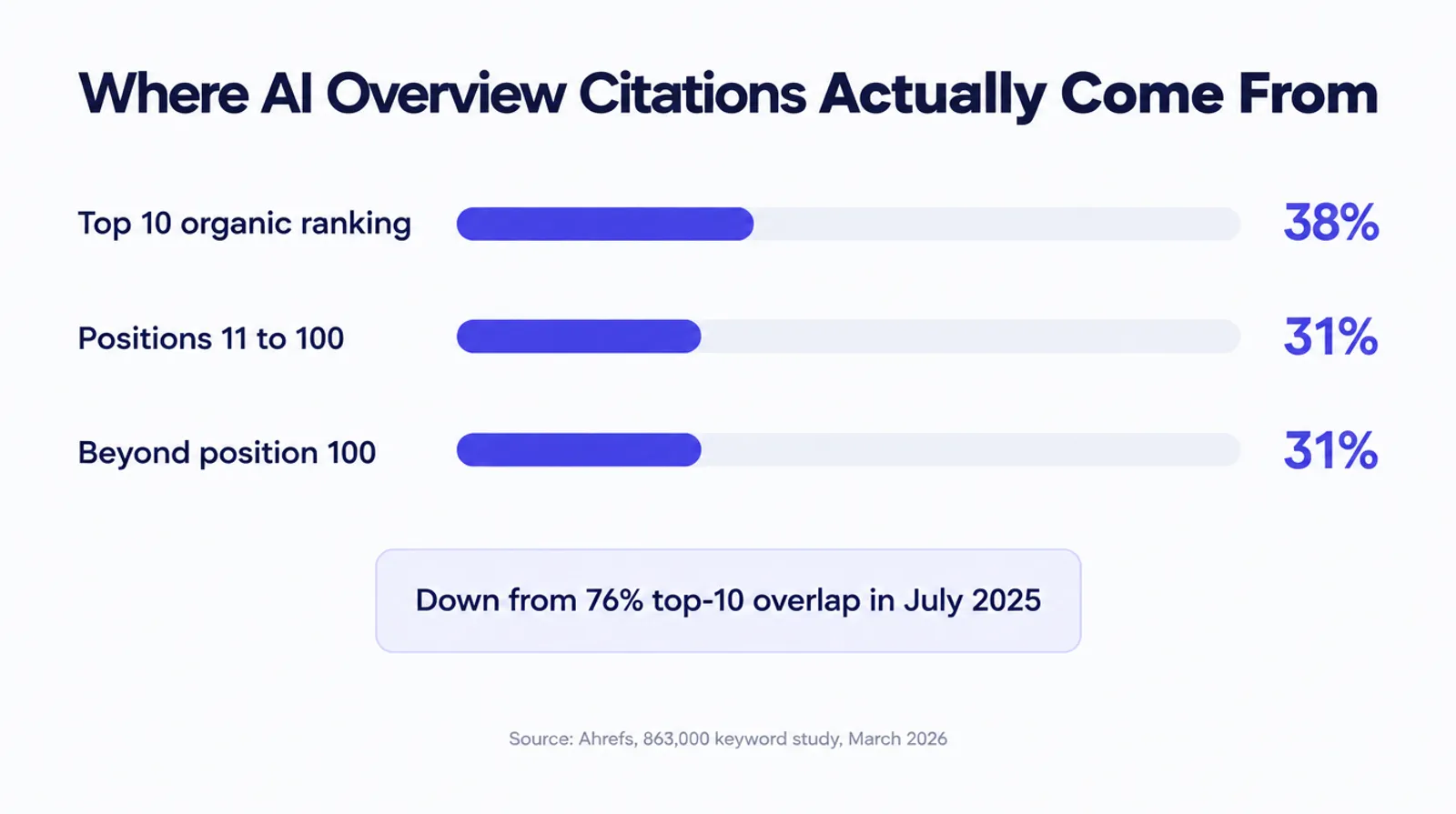
Ahrefs put a number on how much this has shifted with a study of 863,000 keyword SERPs and 4 million AI Overview URLs, published March 2, 20261. Looking across every SERP block, only 37.9 percent of cited pages also ranked in the organic top 10 for the same query. Positions 11 through 100 accounted for another 31.2 percent, and 31.0 percent of citations came from pages ranking beyond position 100, meaning they were barely, if at all, visible in the classic search results a human would scroll through1.
The comparison point makes the shift concrete rather than abstract. The same measurement, run in July 2025, found roughly 76 percent top-10 overlap1. In under a year, the share of AI Overview citations coming from the pages you would expect, the ones sitting where a human eye would land first, dropped by half. Ahrefs' own read on the change: the system is "selecting far fewer pages straight from the original SERP," leaning instead on the sub-query results query fan-out generates1.
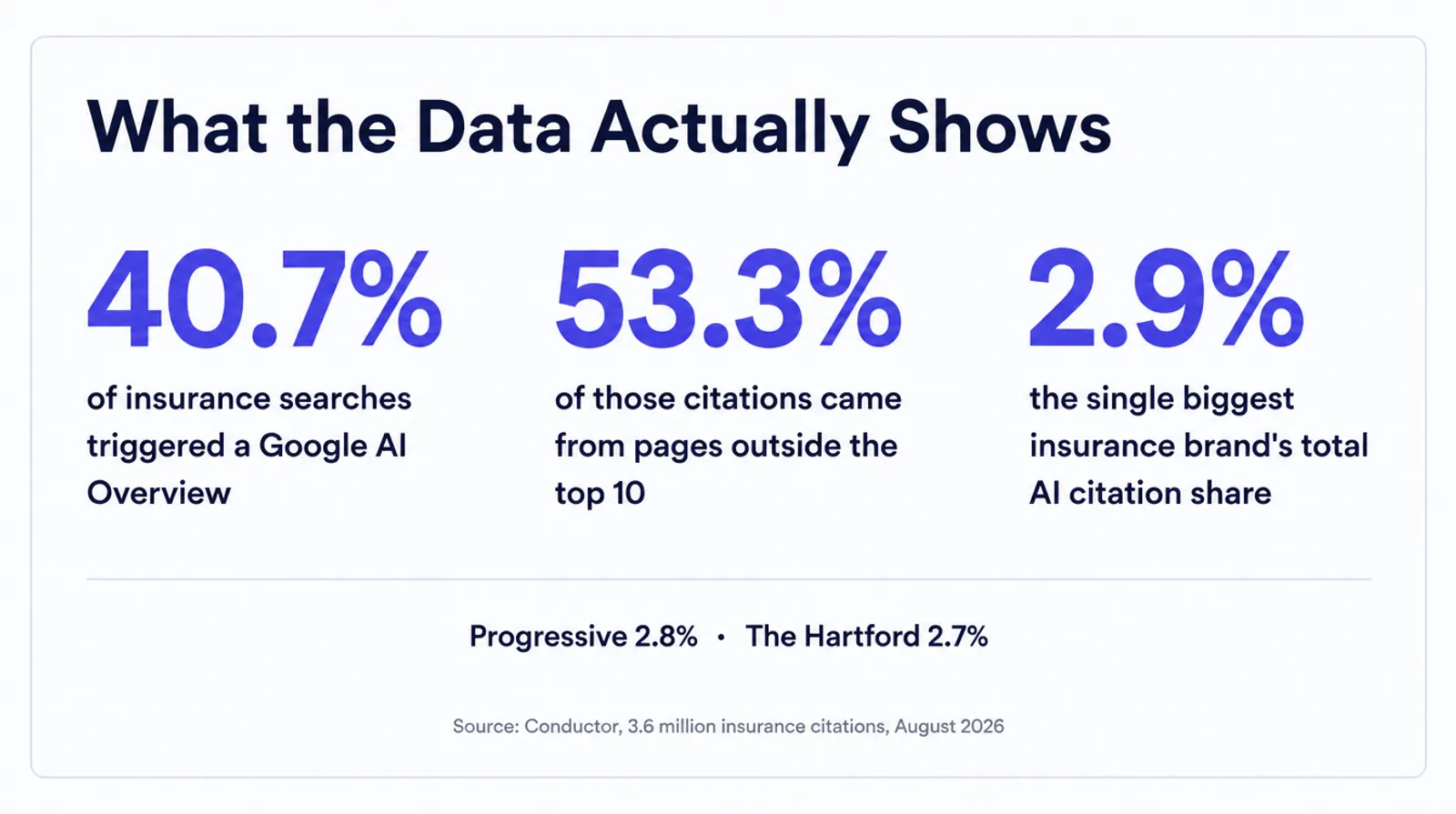
Conductor ran the same question specifically inside insurance. Its report, last updated August 13, 2026, tracked more than 178,000 prompts and 3.6 million-plus insurance brand citations across seven AI engines between January and May 2026, with a dedicated AI Overviews measurement window from May 20 to June 20, 20262. The headline finding for anyone selling insurance online: a Google AI Overview appeared for 40.7 percent of insurance searches in the study, and 53.3 percent of those citations came from pages outside Google's organic top 102. Two different research teams, two different methodologies, one general and one insurance-specific, landed on the same direction: less than half of what gets cited was already sitting where classic rank would predict.
The two studies do not use identical methodology, and it would be dishonest to present them as one dataset. Ahrefs measured across all industries and all SERP block types, and defines "cited" as any URL appearing inside an AI Overview panel1. Conductor measured insurance queries specifically, across seven separate AI engines rather than Google alone, with its AI Overviews figure isolated to a narrower June measurement window2. Different questions, different scopes, and the raw percentages differ as a result, 37.9 percent top-10 overlap in one, 46.7 percent in the other. What makes them worth citing together is not that they agree on a single number. It is that neither one comes anywhere close to the near-total overlap you would expect if rank still decided the citation, and that is the only claim this guide is actually making.
| Measurement window | Share of citations from the organic top 10 |
|---|---|
| July 2025 baseline | About 76% |
| March 2026 (863K keywords, 4M AI Overview URLs) | 37.9% |
| Same study, positions 11 to 100 | 31.2% of all citations |
| Same study, beyond position 100 | 31.0% of all citations |
| Measure | Finding |
|---|---|
| AI Overview appearance rate for insurance searches | 40.7% of searches studied |
| Share of insurance citations from outside the organic top 10 | 53.3% |
| Share of insurance citations from inside the organic top 10 | 46.7% |
Why no single brand owns this
The second half of Conductor's data is arguably the more useful half for an independent agency, because it answers the question that actually stops most owners from trying: if I cannot outspend the biggest names, is any of this winnable at all. Across 3.6 million-plus tracked insurance citations, the single largest named brand, Insureon, held 2.9 percent of citations. Progressive held 2.8 percent. The Hartford held 2.7 percent2.
Read those three numbers together and the shape of the field changes. This is not a market with one or two names capturing the majority of the answer space the way one page usually captures position one in classic search. It is a field so fragmented that the biggest player in it, by a real research firm's own count, holds well under one citation in thirty. A market that fragmented is not a market where scale is the deciding variable. It is a market where structure and sourcing are, because those are the variables an independent agency can actually control on the same afternoon a national carrier's marketing department is still routing the request through legal review.
| Brand | Share of total insurance AI citations |
|---|---|
| Insureon | 2.9% |
| Progressive | 2.8% |
| The Hartford | 2.7% |
The practical implication for content strategy is specific, not just reassuring. It means the right unit of competition for an independent agency is the single page answering one question, not the brand as a whole. You are not trying to out-market Progressive's entire content operation. You are trying to have the better-sourced, better-structured page the next time a fan-out query asks about your exact plan type in your exact market, a contest that resets with every question and every metro rather than being locked in by whoever already has the biggest domain. That is a genuinely different, and genuinely more winnable, game than the one most agency owners think they are being asked to play.
What Google itself says about it
It is worth going to Google's own documentation rather than a secondhand summary, because the company has been unusually direct about this. Google's guide on optimizing for generative AI features, last updated July 10, 2026, states the eligibility bar in one sentence: "To be eligible to be shown in generative AI features on Google Search, a page must be indexed and eligible to be shown in Google Search with a snippet, fulfilling the Search technical requirements"3. No mention of rank. No mention of domain age or budget. Indexed, and snippet eligible.
The same guide goes further and pushes back on the idea that a separate "AI SEO" discipline even exists: "From Google Search's perspective, optimizing for generative AI search is optimizing for the search experience, and thus still SEO"3. Google is not describing a new game with new winners. It is describing the same technical fundamentals, crawlability, indexability, a clean and truthful page, applied to a retrieval system that now casts a much wider net than one ranked list.
That framing matters because it rules out two opposite mistakes. The first is assuming rank is
everything, which the data in the last section already disproves. The second, just as common,
is assuming AI citation is some exotic new specialty requiring its own separate tactics
disconnected from ordinary technical hygiene. It is not. A page that is not indexed, blocked
from a snippet by a stray max-snippet directive, or otherwise technically broken
fails both the classic ranking test and the citation test at once, for the same underlying
reason. We cover that specific eligibility mechanism, and how to check your own site for it,
in a separate guide on why your insurance website doesn't show up in AI Overviews.
What actually predicts a citation
If rank is not the gate, something else is doing the selecting once a page clears Google's indexed-and-snippet-eligible bar. Across the sites we build and audit, the pages that get lifted and quoted share a short list of properties, none of which require a marketing budget to build.
Answer-first structure
The direct answer sits in the first two sentences under each heading, not buried after a page of setup.
Named, dated sources
Every figure carries who published it and when, inline, not a vague "studies show."
Schema that matches the page
Article, FAQPage, and Dataset markup that describes what is actually visible on the page, not aspirational markup nobody reads.
Real freshness
A visible review date tied to an actual review, matched to the schema's dateModified field.
A clean technical baseline
Indexed, snippet eligible, fast, and readable without JavaScript, since a broken crawl fails Google's own stated bar before anything else is evaluated.
A specific, narrow answer
A page built to answer one sub-question well beats a page trying to rank for one broad phrase, because query fan-out is generating narrow sub-questions to begin with.
None of that list is exotic, and none of it requires outranking anyone. It is the same list Google's own guidance points toward when it says generative AI search is "still SEO," just applied with the knowledge that the retrieval net is wider and the winning unit is a well-sourced answer to a narrow question rather than a page optimized to rank for a broad one.
A few of those six are worth slowing down on, because they are also where most agency sites quietly fail without anyone noticing. Answer-first structure sounds simple until you actually count sentences on your own service page and find three paragraphs of scene-setting before the number a reader came for. Schema that matches the page sounds like a technicality until you remember that FAQPage markup describing a question your visible copy never actually answers is not neutral, it is a mismatch a crawler can detect, and Google's own guidance singles out matching structured data to visible text as one of its few explicit rules for AI features. A "real" freshness date is the one agencies fake most casually, bumping a timestamp in a CMS without touching a word of the page, which is precisely the difference between a page that looks current and one that actually is.
An honest caveat
None of this guarantees a citation. Nothing does, and anyone who promises a specific AI citation outcome is not being straight with you. What the data in this guide actually supports is narrower and still worth acting on: without a clean technical baseline and sourced, structured content, a page's odds are close to zero regardless of where it ranks. With them, the odds are real, and they do not depend on your ad budget.
How to check your own site this week
You do not need a research team or a paid tool subscription to see where your own pages stand against the six properties above. Most of this fits into an afternoon.
Pick five real questions your last five clients actually asked, in their own words. Not the broad phrase you would guess from a keyword tool. The actual sentence a client texted or said on a call. Those are the closest thing you have to the sub-questions a fan-out query would generate.
Search your own site for the direct answer to each one. If the honest answer is not on a page anywhere, or it is buried past two paragraphs of introduction, that page is not currently eligible to be lifted for that question no matter how the rest of your site performs.
Open the page's source and check whether the visible copy carries a source and a date for every number on it. A rate, a deadline, a coverage limit stated with no attribution is exactly the kind of claim a citation-seeking system has no reason to trust over a competitor who did name a source.
View your page's structured data with a free schema testing tool and read it against the visible page, side by side. Flag anything the markup claims that a visitor cannot actually see on the page. That mismatch is the one Google names explicitly, and it is a five-minute check most agencies have never run once.
Look at the "last updated" date you show a visitor, and ask honestly whether the content actually changed the last time that date moved. If the answer is no, the freshness signal on your site is decorative, not real, and a page reviewed for this article's plan-year figures should say so plainly.
Ask the assistant you use personally the same five questions, by name, and note whether your agency gets named as a source. That is not a scientific measurement, but it is the closest thing to ground truth you can check for free before deciding whether any of the fixes above are working.
None of these six steps requires new software or a developer, and the hardest one is usually the first, because most owners default to guessing a broad keyword phrase instead of writing down the actual sentence a real client used. Once you have the real questions, the rest of the check is mechanical.
What chasing the wrong metric costs
The practical cost of this mistake is not a wasted line item. It is a wasted year. An agency that spends its content and technical budget trying to out-rank State Farm or Progressive for a broad head-term phrase is competing on the one variable, budget and domain authority, where scale wins. Ahrefs' and Conductor's data both point at the same overlooked lane: 53 to 62 percent of the citation pool, by either study's measurement, is coming from pages that never won that broad-phrase fight at all12.
Skipping that lane because it seems less prestigious than a page-one rank is how an agency spends real hours and real content budget chasing 38 to 47 percent of the available citation opportunity while ignoring the majority share. The fix is not spending more. It is redirecting the same effort toward the narrower, answer-first, sourced pages that the fan-out mechanism is actually built to surface, which happen to be exactly the pages an independent agency can produce as fast as, or faster than, a carrier's marketing department can clear one page through review.
There is a second, quieter cost worth naming. Search Console's Search Generative AI performance report, live on every property since June 2026, will show you AI Overview and AI Mode impressions on your own pages, but it still will not tell you which query triggered them or send you the click4. An agency with no sourced, structured content to show for a query where it should be citable is not just missing the citation. It is missing the ability to even diagnose the miss, because there is nothing in the report to point at except a page that was never built to be found in the first place.
It is worth being honest about what this does not mean. It does not mean every agency needs to rebuild its whole site this quarter. An agency with a handful of pages, a real answer to its clients' actual questions, and no glaring schema mismatch is probably fine running the six-step check above on its own and fixing what it finds without paying anyone. Where the math changes is scale and cadence: an agency running a dozen pages across two producers hits a ceiling on how much of this it can maintain by hand, especially the freshness and sourcing discipline, which is where an ongoing build or a managed cadence starts paying for itself instead of staying a nice-to-have.
How we build for this instead
Every site we build ships with the technical baseline Google's own guidance names as the actual gate: indexed, fast, crawlable, and snippet eligible by default, because we build on Astro and serve from the edge on Cloudflare rather than a page-builder platform that loads a runtime before your content ever paints. On top of that baseline, every page carries the schema stack this guide describes, Article with an organization author, FAQPage, and Dataset for anything citing outside data, matched to what is actually on the page rather than markup nobody wrote copy to support.
The free Audit scores exactly this: content depth and answer placement, question-and-answer formatting, E-E-A-T signals, schema markup, and the technical and agentic readiness this article's data says actually decides a citation, benchmarked against more than 56,000 audited agency websites5. It takes about a minute, costs nothing, and tells you specifically which of the six properties in the last section your own site is missing, rather than leaving you to guess.
Digital Foundation builds and maintains that structure on an ongoing basis, including a weekly or daily blog and location page cadence on the Pro and Scale tiers5, so the answer-first, sourced content this data rewards keeps publishing on a real schedule instead of arriving in one burst and going quiet. None of it depends on outspending a national carrier's marketing department. It depends on the page actually being built the way the data in this guide says the citation pool now selects.
What you get
Concretely, an agency that acts on this gets a site that clears Google's stated eligibility bar by default, a schema stack that actually matches its content instead of drifting from it, and a cadence of narrow, sourced, answer-first pages built for the sub-questions query fan-out actually asks, not just the broad phrase a carrier's budget already owns. It gets a real shot at a citation pool where the single biggest named competitor still holds under three percent, without needing a fraction of that competitor's marketing spend to compete for it.
It also gets something less tangible but just as real: a way to measure the work that is not "did I outrank the incumbent," a question an independent agency will keep losing indefinitely against a national ad budget, but "did I answer the specific question a real client asked, sourced and dated, on a page a system could actually find and trust." That is a question this size of agency can answer yes to on a normal week, and the data in this guide says it is the one that was actually being scored all along.
Questions agents ask
Does my insurance agency need to rank number one on Google to get cited by AI Overviews?
No. Ahrefs analyzed 863,000 keywords and 4 million AI Overview URLs and found only 37.9 percent of cited pages ranked in Google's organic top 10, down from about 76 percent in July 2025. A page ranking eleventh, fiftieth, or well outside the top 100 gets cited regularly, provided it is indexed, snippet eligible, and structured in a way the system can extract and trust.
What is query fan-out, and why does it matter for an insurance agency's website?
Query fan-out is Google's own term for how an AI Overview actually gets built. Google defines it as the model generating "a set of concurrent, related queries" to fetch more results beyond the one you typed. That means your page can get pulled in to answer a sub-question the visible search never showed, which is exactly how a page far outside the top 10 still earns a citation.
If ranking does not decide AI citations, why do big carriers still show up so often?
They show up often but they do not dominate. Conductor tracked 3.6 million insurance brand citations across seven AI engines and found the single largest name, Insureon, held only 2.9 percent. Progressive held 2.8 percent and The Hartford held 2.7 percent. Scale gets a brand cited more often in raw count, not a bigger share of the pool, because the pool is this fragmented.
Does having an llms.txt file get an insurance agency cited by AI?
Not on its own, and Google has said plainly it does not use the file for Search or AI Overviews. It can help other engines and agent tooling discover callable pages, but the citation decision comes from indexability, snippet eligibility, and structured, sourced content, not from a text file. We cover the llms.txt question on its own in a separate guide.
What actually predicts whether a page gets cited by an AI Overview?
Google states the baseline requirement plainly: a page must be indexed and eligible to be shown in Search with a snippet. Past that gate, the pages that get lifted and quoted share the same traits: an answer in the first two sentences under each heading, a named source for every figure, FAQ and Article schema that match the visible text, and a real, dated review, not a script bumping a timestamp.
Should my agency stop trying to rank in Google search results at all?
No. Google is explicit that generative AI search still runs on the same underlying index and ranking systems as classic Search, so a slow, unindexed, or badly structured site fails both. What changes is the ceiling. Ranking well is necessary groundwork. It is no longer the thing that decides whether an AI system quotes you.
How can I check whether my own site is actually getting cited?
Ask the assistants your buyers actually use the questions they would ask about your market, by name, and record which sources get named. Search Console's Search Generative AI performance report now shows AI Overview and AI Mode impressions for your pages too, though it still will not show which query triggered a citation or how many clicks it sent, so treat it as a directional signal, not a full picture.
Does this ranking-versus-citation gap apply to ChatGPT and Perplexity too, or only Google?
The specific 38 percent and 53.3 percent figures in this guide describe Google's AI Overviews specifically. Conductor's broader 3.6 million citation study spans seven engines, including ChatGPT, Perplexity, Gemini, Copilot, Claude, and Google AI Mode, and found citation share fragmented across all of them, with no single engine or brand capturing a dominant slice. The mechanism differs by engine, but the pattern, that raw ranking is not the deciding factor, holds broadly.
Sources
- Linehan, Louise. Ahrefs. "AI Overview Citations Are Increasingly Coming From Outside Google's Top 10," published March 2, 2026: analysis of 863,000 keyword SERPs and 4 million AI Overview URLs; 37.9% of cited pages ranked in the organic top 10 across all SERP blocks (37.10% for organic blue links only), 31.2% ranked positions 11 to 100, 31.0% ranked beyond position 100; compared against approximately 76% top-10 overlap measured in the same firm's July 2025 study. Verified live 2026-09-21. ahrefs.com.
- Li, Jia-Rong. Conductor. "2026 Insurance AI Search Benchmarks," last updated August 13, 2026: analysis of 178,000+ prompts and 3.6 million+ insurance brand citations across seven AI engines (Google AI Mode, Perplexity, ChatGPT, Gemini, Copilot, Claude) from January 1 to May 31, 2026, plus a dedicated AI Overviews measurement window of May 20 to June 20, 2026; Google AI Overview results appeared for 40.7% of insurance searches studied; 53.3% of those citations came from pages outside Google's organic top 10; top citation shares by brand: Insureon 2.9%, Progressive 2.8%, The Hartford 2.7%. Verified live 2026-09-21. conductor.com.
- Google Search Central. "Optimizing your website for generative AI features on Google Search," last updated 2026-07-10 UTC: "To be eligible to be shown in generative AI features on Google Search, a page must be indexed and eligible to be shown in Google Search with a snippet, fulfilling the Search technical requirements"; query fan-out defined as "a set of concurrent, related queries" the model generates to fetch more information; "optimizing for generative AI search is optimizing for the search experience, and thus still SEO." Verified live 2026-09-21. developers.google.com.
- Google Search Central Help. Search Generative AI performance report documentation: AI Overviews and AI Mode impression and page data available in Search Console for all properties since June 2026, without query-level or click-level attribution for individual AI citations. Referenced per Google's own Search Console documentation. Verified live 2026-09-21. developers.google.com.
- Strategic AI Architects. Free Audit and Digital Foundation service pages: the free Audit scores content depth and answer placement, question-and-answer formatting, E-E-A-T signals, schema markup, and technical and agentic readiness, benchmarked against more than 56,000 audited agency websites; Digital Foundation includes a weekly or daily blog and location page cadence on its Pro and Scale tiers. Verified live 2026-09-21. strategicaiarchitects.com/audit and strategicaiarchitects.com/digital-foundation.
Talk it through
Want a second pair of eyes on it?
Free 30 minutes. Bring what you found, or bring nothing and we will look together at how AI engines read your site and which fixes move first.
See where your own site actually stands
Run the free Audit, a live AEO Audit plus a HIPAA tracking scan of your site, in under a minute.
Related reading: why your insurance website doesn't show up in AI Overviews · why AI Mode may never cite the same page AI Overviews do · does an llms.txt file get your agency cited by AI · what Search Console's AI Overviews report actually shows