Playbook
Why AI Mode May Never Cite the Same Page AI Overviews Do
Two Google AI answers can reach the same conclusion and still name almost none of the same sources.

22 min read

AI Overviews and AI Mode are two separate Google products with two separate citation pools. Ahrefs analyzed over 500,000 query pairs and found only 13.7% URL overlap between what each one cites, even though their answers agree 86% of the time4. AI Mode alone has crossed a billion monthly active users3. Passing the eligibility check for one tells you nothing about the other. Here's what the research actually says decides both.
Cited in one, invisible in the other
Say you did the work. You read through what actually blocks a page from AI Overviews, checked your response headers, cleaned up a stray directive, and confirmed it: type your core Medicare or ACA question into Google and there you are, named in the AI Overview panel above the ten blue links. You'd be forgiven for thinking the AI citation problem is solved.
Then a client mentions they asked Google something on their phone and landed in a full-screen chat thread instead of a search results page. Or you open the Google app yourself, tap into the tab labeled AI Mode, and ask the exact same question you're cited for. A different answer comes back. Different sources. You're not in it.
That's not a bug and it's not a personalization quirk. It's two different Google products, built by two different teams inside the same search organization, pulling from two citation pools that barely touch. Google says as much in its own documentation, in one sentence easy to skim past: AI Mode and AI Overviews "may use different models and techniques, so the set of responses and links they show will vary"1. Most agencies read past that line because it sounds like a minor technical footnote. The research on how much they actually vary says it's closer to the whole story.
If you've already worked through what changed in AI citation this year or you're relying on rankings to tell you whether your AI search traffic even exists, this is the layer most of that work never touches: a second, separate surface with its own separate list of who gets named, growing faster than the one everybody's been optimizing for.
The honest version of the problem is that most of the AEO advice circulating right now, including plenty of what we've published, was written back when "AI citation" mostly meant one thing: the summary panel sitting above search results. That was a reasonable place to start, since AI Overviews got there first and was the surface everyone could actually see and screenshot. AI Mode spent its first year as a smaller, opt-in feature most agencies never noticed, which is exactly why the research on how differently it behaves is only now catching up to how big it's actually gotten.
Why this is easy to miss
AI Overviews shows up automatically, sitting right above results you were already checking. AI Mode is a separate tab or a separate app experience you have to open on purpose. Nothing forces you to compare the two, so most agencies never do, and never learn the citation lists barely overlap until a client mentions it first.
AI Mode is not AI Overviews with a new name
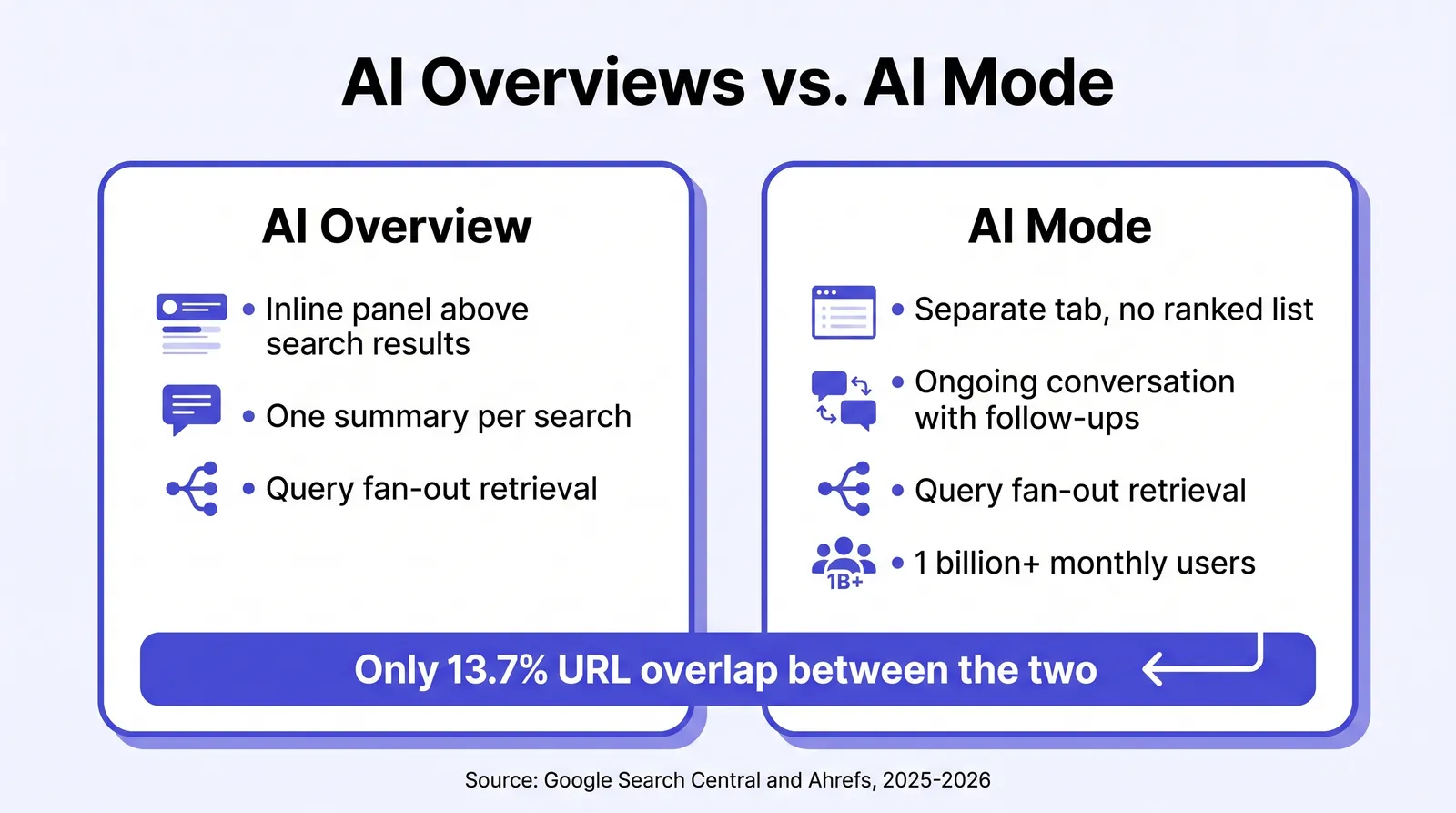
AI Mode launched in the United States in May 2025 as a limited, opt-in experiment. By May 2026, Google's own report on the feature said it had surpassed a billion monthly active users globally, with query volume more than doubling every quarter since launch3. That's not a beta feature anymore. It's a full search product with its own dedicated tab in Google Search and the Google app, and it works nothing like the panel sitting above your regular results.
AI Overviews sits inline, above the ten blue links, inside a search you were always going to run anyway. You can ignore it and scroll straight to the organic results underneath. AI Mode replaces that experience entirely: there's no ranked list under the answer, just a conversational thread you can keep questioning, the way you'd keep talking to an assistant rather than re-typing a search box ten times3.
The query behavior backs that up. Google's own data shows the average AI Mode search runs three times the length of a typical Google query, more than one in six U.S. searches inside AI Mode now include voice or an image, and planning-style questions, the kind that start with "where should I" or "ideas for," grew 80% faster over six months than AI Mode's overall query volume3. Read that against what a Medicare or ACA shopper actually asks: not a three-word keyword, but something closer to "I'm turning 65 in March and my current job's insurance ends, what do I need to figure out first." That's exactly the query shape AI Mode is built for, and exactly the query shape a ten-word landing page never answers in one place.
| Feature | AI Overviews | AI Mode |
|---|---|---|
| Where it appears | Inline, above the normal ranked results | A separate tab or dedicated experience, no ranked list shown |
| Format | One summary per search | A running conversation with follow-up questions |
| Retrieval technique | Query fan-out, generating related sub-queries1 | Query fan-out, generating related sub-queries1 |
| Scale, as of May 2026 | Shown on a large share of everyday Google searches1 | Over 1 billion monthly active users globally3 |
| Average query length | Typical Google search length | About 3x the length of a typical search query3 |
| Fastest growing query type | Not broken out separately by Google | Planning questions, growing 80% faster than overall query volume3 |
Notice the row that's identical on both sides: retrieval technique. Both surfaces run on query fan-out, the same mechanism, described the same way in the same Google documentation1. That similarity is exactly why it's tempting to assume the two surfaces behave the same way and cite the same pages. The data says the shared mechanism produces two almost entirely different outcomes.
The voice and image share of AI Mode queries matters here too, since it's one more way the input itself differs from a typed search box. More than one in six U.S. searches inside AI Mode now include voice or an image3, which means a real, if smaller, share of your prospects are photographing a plan document or a bill and asking what it means, out loud, in the car or at the kitchen table, rather than typing a phrase into a box at all. None of that changes what wins the citation. It does mean the "query" your page has to answer was never a keyword to begin with. It was always a sentence someone said the way they'd say it to a person.
The 13.7 percent number
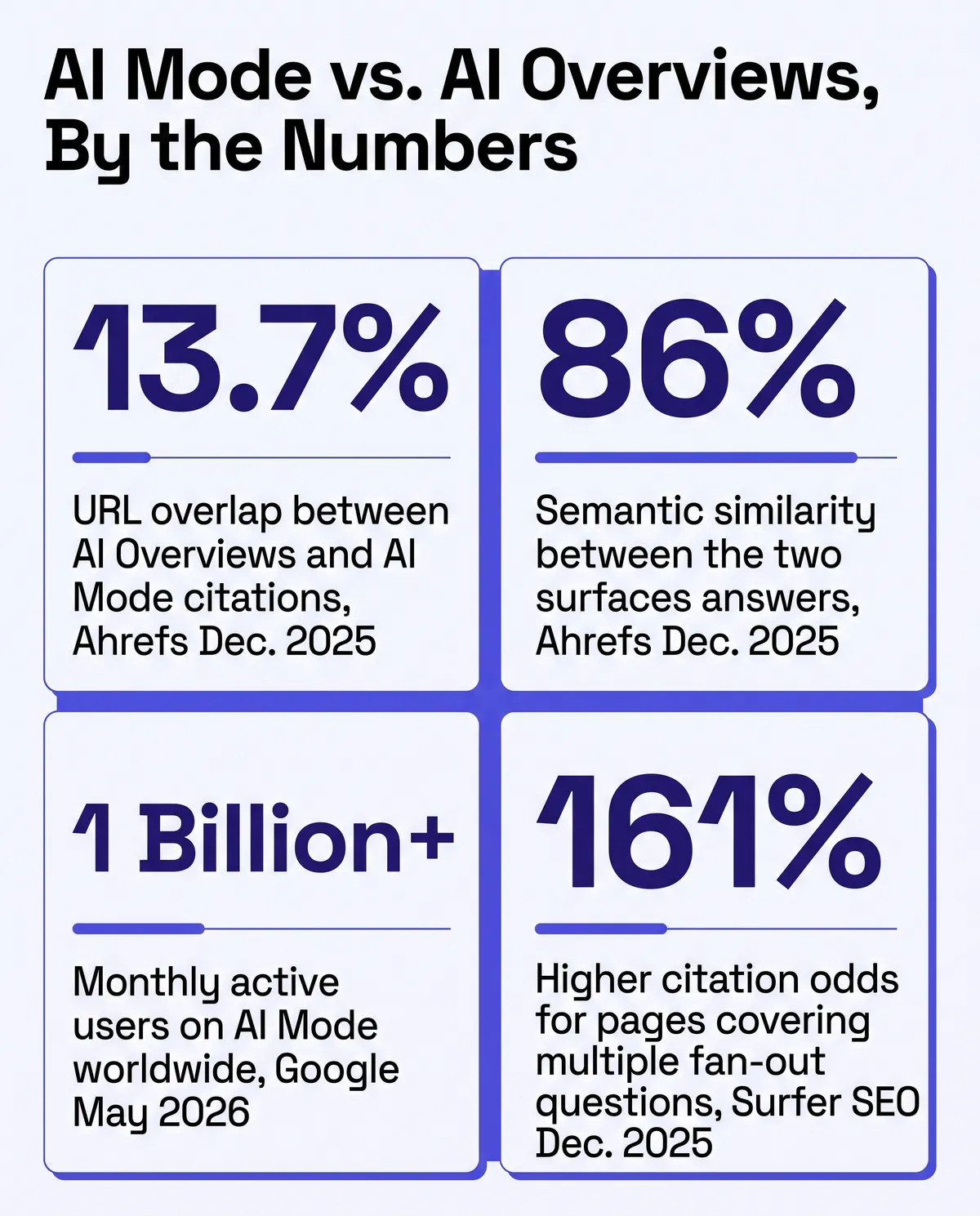
Ahrefs published the most direct comparison of the two surfaces to date on December 15, 2025. Analysts Despina Gavoyannis and Xibeijia Guan ran roughly 540,000 query pairs through both AI Overviews and AI Mode to compare which URLs each one cited, and a further 730,000 query pairs to compare how similar the actual written answers were, using data pulled in September 20254. The headline finding: only 13.7% of the URLs cited overlapped between the two surfaces for the same query. Narrow that to just the top three citations each surface showed, and the overlap rose only slightly, to 16.3%4.
Here's the part that makes the number strange instead of just low. The two surfaces largely agreed on the substance of the answer. Average semantic similarity between AI Overview and AI Mode responses to the same query came in at 86%, and 89.7% of the response pairs scored above 0.8 on a cosine similarity scale, a standard measure of how closely two pieces of text match in meaning4. In plain terms: ask the same question in both places and you'll usually get close to the same conclusion, delivered by an almost entirely different set of messengers.
Translate that into an agency's own book of business. If your top five Medicare or ACA landing pages are all cited, correctly and consistently, inside AI Overviews, Ahrefs' data says the honest expectation for AI Mode is that roughly four of those five citations don't carry over at all. Not because the pages are wrong. Because AI Mode is, functionally, a different publication asking a different set of sub-questions and keeping its own separate list of who answered them well.
13.7%
URL overlap between AI Overviews and AI Mode citations, Ahrefs, Dec. 2025
86%
Average semantic similarity between the two surfaces' answers, same study
1B+
Monthly active users on AI Mode worldwide, Google, May 2026
2x
AI Mode query volume, roughly, every quarter since launch
Why fan-out decides who gets named
Both surfaces run on the same underlying mechanic, and Google defines it in one sentence: query fan-out is "a set of concurrent, related queries generated by the model to request more information and fetch additional relevant search results to address the user's query"2. Instead of matching your page to the one phrase a prospect typed, the model spins that phrase into several related sub-questions behind the scenes and goes looking for a source for each piece separately. Your page doesn't need to win one query. It needs to win several, asked by a system that never shows you which ones it asked.
Surfer SEO put a number on how much that breadth matters, in a study published December 18, 2025. Analysts pulled 10,000 keywords, extracted 173,902 ranking URLs and 33,000 distinct fan-out sub-queries generated for those keywords, and found that 76% of the original 10,000 keywords triggered an AI Overview at all5. The core finding: pages ranking for multiple fan-out sub-queries, not just the original keyword, were 161% more likely to get cited than pages ranking for the main query alone, a relationship the researchers measured at a Spearman correlation of 0.77, a strong statistical link5.
| Finding | Number | Source |
|---|---|---|
| Sample analyzed | 10,000 keywords, 173,902 ranking URLs, 33,000 fan-out sub-queries | Surfer SEO, Dec. 2025 |
| Keywords that triggered an AI Overview | 76% | Surfer SEO, Dec. 2025 |
| Citation odds boost for ranking multiple fan-out queries | 161% higher than main-query-only pages | Surfer SEO, Dec. 2025 |
| Correlation between fan-out coverage and citation | Spearman 0.77 | Surfer SEO, Dec. 2025 |
| URL overlap between AI Overviews and AI Mode citations | 13.7% (16.3% for the top 3) | Ahrefs, Dec. 2025 |
Put those two studies together and the overlap number stops looking mysterious. AI Overviews and AI Mode both fan a question out into sub-queries, but nothing says the two systems generate the same sub-queries, in the same order, weighted the same way. AI Mode's average question already runs three times longer and often continues across follow-up turns, each one triggering its own fresh fan-out3. A page can win the exact sub-query slice AI Overviews happened to run, and simply never surface for the different slice AI Mode ran for what looks, on the surface, like the identical question.
The practical read for an agency site isn't complicated, even if the mechanism underneath it is. A single page that thoroughly answers a topic and its adjacent questions has more fan-out slices it can win, in either system, than ten narrow pages each built around one keyword variant. Google's own guidance says the narrow-page approach doesn't just underperform, it's a spam-policy risk, not a growth tactic2.
Worth defining the three terms this whole guide sits on top of, since they get used loosely enough that it's easy to lose track of which one you're actually working on. SEO is being found in classic search results at all, the ranking, indexing, and speed work underneath everything else. AEO, answer engine optimization, is being the passage an AI system lifts and attributes when it builds an answer. GEO, generative engine optimization, is writing that passage so it stays accurate, sourced, and quotable once it's extracted and rephrased somewhere else entirely. Fan-out coverage sits inside AEO and GEO both: it's the property that decides whether your passage gets pulled into the answer in the first place, on either surface.
Worth doing yourself first
You can widen a page's fan-out coverage without hiring anyone: open the page, list every sub-question a prospect would ask right after reading it, and answer each one in the same piece with a sourced number attached. Most agents can do this in an afternoon per page. Whether you'd rather have it done for you across the whole site is a separate question, and either answer is fine.
What this looks like by product line
Fan-out and low citation overlap are abstract until you run them against the actual questions your prospects ask, which look different depending on what you sell. Three examples, one per product line, show why a single narrow landing page keeps losing to a page built around the whole question.
Medicare. A prospect turning 65 rarely asks one question. Inside an AI Mode thread it might run: "what do I need to do before I turn 65 in March," followed by "does that change if I'm still working," then "what happens if I miss the window." Google's own fan-out definition means each of those is treated as its own retrieval pass, pulling from whichever eligible pages answer that specific piece2. A page that covers only the Initial Enrollment Period, with nothing on working past 65 or the late-enrollment penalty, wins the first fan-out slice and loses the next two, in the same conversation, to whichever competitor's page does cover them.
ACA and health. The planning-question growth Google measured, "where should I," "ideas for," questions that grew 80% faster than AI Mode's overall query volume, shows up here almost word for word3. "Where should I look for a plan that covers my current doctor" is a planning question, not a keyword. It fans out into coverage area, network participation, and subsidy eligibility as three separate sub-questions, and a subsidy calculator page that never mentions provider networks only ever wins one of the three.
Life and final expense. These conversations skew even further into the multi-turn format AI Mode was built for: "how much life insurance do I actually need," followed by "what's the difference between term and whole life for someone my age," followed by "how does underwriting work if I have a health condition." Three follow-ups, three fresh fan-out passes, three separate chances to be named or skipped, all inside one conversation a single narrow page can't keep up with turn by turn.
The mistake this usually produces
Agencies that notice this pattern often respond by building more pages, one per sub-question, rather than deepening the pages they already have. That's the ten-thin-pages trap Google's own guidance flags directly as a spam-policy risk rather than a growth tactic2. The fix isn't more pages. It's fewer pages that actually cover the adjacent questions a real conversation would ask next.
What it costs while you're not looking
The backdrop to all of this is a search landscape that increasingly never sends a click at all. SparkToro's Rand Fishkin analyzed Similarweb's U.S. desktop and mobile clickstream panel for January through April 2026 and found 68.01% of Google searches ended without a click, published June 9, 20266. That's not a click going to a competitor instead of you. It's a search that used to become a website visit for someone, and now more often becomes an answer, read and acted on, with no visit at all.
Insurance buyers are already inside that shift. J.D. Power's AI Insurance Experience Study, fielded June through July 2026, found nearly one in three auto and home insurance customers, 29%, already use AI tools to research coverage, service a policy, or shop for a new one7. Among customers who used AI specifically to research products or coverage, 37% changed their policy based on what the AI told them. Among those who used AI to shop for a new policy, 42% went on to purchase one7. Those aren't people idly browsing. They're people whose next carrier or agent gets shaped, in part, by whichever source an AI system happened to name, before any human conversation ever starts.
Now run the two studies together. A meaningful share of your prospects already form a decision from an AI answer before they call anyone. That AI answer increasingly comes from a system, AI Mode, with over a billion monthly users and query volume still doubling roughly every quarter3. And whatever citation work already earned you a mention in the older AI Overview panel carries over to that faster-growing surface only about 14% of the time4. Optimizing for one surface and assuming it covers the other isn't a small gap. It's closer to running half the race.
Put a rough number on it using your own analytics. Pull your current monthly organic sessions on the one page that answers your single most-asked question, the one a prospect types or asks during AEP or open enrollment. Whatever that number is today, the honest read from the research above is that a shrinking share of it arrives as a click at all, SparkToro's 68.01% zero-click figure says as much across the board6, and of the share that does turn into an AI answer instead, being cited in AI Overviews buys you a citation shot in AI Mode roughly 14% of the time, not automatically. That's not a reason to stop measuring rankings. It's a reason to stop treating rankings as the whole measurement.
How to check your own site in AI Mode
None of this requires a paid monitoring tool to start finding out where you stand. It requires about twenty minutes and a spreadsheet.
- Open AI Mode directly, in a private or logged-out window. Results inside AI Mode are generated live per session rather than pulled from a cached, stable list, so a private window keeps your own search history and account from skewing what you see.
- Ask your real client questions, in their words. Not keyword phrases. Pull five to ten questions straight from actual calls or emails, the way a prospect would actually type or say them. A Medicare agency might start with "what do I need to figure out before I turn 65." An ACA agency might start with "where should I look for a plan that covers my current doctor." A life agency might start with "how much coverage do I actually need for my family." Whatever your book of business actually fields calls about, start there.
- Log every domain named, not just whether you appear. A simple sheet: date, question asked, every source cited, whether you were one of them. This tells you who's winning the fan-out slices you're not, which is the more useful signal over time.
- Ask a follow-up question in the same thread. AI Mode's conversational format is exactly what a single AI Overview panel can't test, and each follow-up triggers its own fresh round of fan-out, sometimes naming an entirely different set of sources than the opening answer did.
- Repeat monthly. Fan-out coverage shifts as competing content changes and as Google's models change, neither of which you control. A one-time check tells you where you stood on one day. A repeated check tells you whether you're gaining or losing ground.
You can run this whole check yourself
Nothing above needs a developer or a subscription. If you'd rather have your site's structural and sourcing readiness checked at the same time, against everything both surfaces reward, the free Audit runs that in about a minute. Run a free Audit.
How we build for both surfaces at once
Nobody, including Google, can promise a citation in either surface for a specific query. What the research above does make clear is what widens your odds in both at once, and it isn't two separate strategies. It's one: pages built around the full breadth of what a prospect actually needs to know, sourced inline, instead of thin pages chasing one keyword variant apiece.
That's the build standard behind every site we ship. We build on Astro, which ships zero
JavaScript by default, so pages arrive as finished HTML instead of a runtime that has to load,
boot, and then draw the content, the way a page-builder platform works. Our builds score 90+ on
Lighthouse performance on mobile and desktop, and some score 100. Every site ships a schema stack,
an llms.txt, and a sitemap that update themselves the moment a new page publishes, so
nothing about the technical side of citation eligibility is left to a plugin default nobody chose
on purpose8.
The content cadence matters just as much as the build. Digital Foundation's Pro and Scale tiers add one or more new, sourced blog posts every week, each one built to cover a topic's full breadth rather than a single narrow phrase, which is exactly the property both the Ahrefs and Surfer SEO research point to as what actually widens fan-out coverage45. Starter, verified live on the pricing page at 247 dollars a month, includes the complete compliant website with AI citation optimization built in from the start, alongside Google Business Profile management and an AI chat widget, on a 14-day free trial8.
One more piece of that cadence is worth naming, because it's the difference between a page that widens fan-out coverage and a page that just adds word count. Every figure in a post we publish comes from a primary source pulled and cited the same session the page is written, not recalled from memory or lifted from another site's roundup. That's the same standard this guide was held to: every statistic above traces to a named study or a Google document fetched while writing it. A page built on invented or stale numbers can still rank. It has a much harder time getting quoted by a system that's checking whether a claim actually holds up before repeating it.
We don't run an AI Mode citation guarantee, because nobody honestly can. What we can tell you is that a site built around thorough, sourced answers has a real shot at both surfaces, and a site built around ten thin keyword pages has a real shot at neither, and that difference shows up in the research above regardless of which company builds the site.
Answers the follow-up, not just the opener
Each page covers the sub-questions a real conversation would ask next, not just the headline keyword.
Every figure sourced inline
A number without a named source and a year is a number an AI system can't safely repeat.
One page, not ten thin ones
Breadth inside a page wins more fan-out slices than the same content split across separate URLs.
Schema that matches the page
Article, FAQ, and breadcrumb markup that describes what's actually on the page, not boilerplate.
A publishing cadence, not a burst
Weekly or daily sourced posts build the breadth one launch of pages never covers on its own.
Fast enough to get crawled at all
A slow, plugin-heavy build is expensive for any crawler, human or AI, to fully read.
What actually changes
Not a guaranteed spot in either AI answer. Nobody can promise that, and anyone who does is guessing. What changes is that you stop treating an AI Overview citation as proof the whole AI citation question is settled, because the research says it settles roughly 14% of it.
You start testing the surface that's actually growing, not just the one that's easiest to check because it sits above results you were already looking at. And the next time a client mentions getting a different answer from Google's AI on their phone, you'll already know why, instead of hearing about a gap in your citation strategy for the first time from someone you're trying to keep as a client.
Questions agents ask
What's the actual difference between AI Overviews and AI Mode?
AI Overviews is a summary panel that appears above the ten blue links inside a normal Google search. AI Mode is a separate, fully conversational surface with no ranked list at all, built for multi-step questions and follow-ups. Google states plainly that the two may use different models and techniques, so the sources each one shows will vary.
If my page is cited in an AI Overview, will it also be cited in AI Mode?
Not automatically. Ahrefs analyzed over 500,000 query pairs and found only 13.7% URL overlap between what AI Overviews and AI Mode cite for the same questions, even though the two systems reach a similar conclusion 86% of the time. Being named in one tells you almost nothing about the other.
What is query fan-out, in plain language?
It's the technique both AI Overviews and AI Mode use to answer a question: instead of matching one query to one page, the system generates several related sub-queries behind the scenes and pulls a source for each piece. A page with broad, thorough coverage of a topic has more chances to get pulled into that fan-out than a page built around one narrow keyword.
How many people actually use AI Mode?
Google's own May 2026 report says AI Mode has surpassed a billion monthly active users worldwide, with query volume more than doubling every quarter since its May 2025 launch in the United States. Planning-style questions, the kind an insurance shopper asks, are growing faster than AI Mode's overall query volume.
Do I need different schema markup to appear in AI Mode specifically?
No. Google's own optimization guide states structured data isn't required for generative AI search and there's no special schema type built for AI Mode. Schema still helps your broader SEO and helps other AI systems parse your page, which is why we ship it on every build, but it isn't what decides AI Mode citation.
Can I test whether my own site shows up in AI Mode?
Yes, and you don't need a paid tool. Open AI Mode directly, ideally in a private or logged-out browser window, and type the actual questions your prospects ask, in their words. Log every domain the answer names, not just whether you appear, and repeat the same questions over a few weeks since fan-out coverage shifts as competing content and model behavior change.
If two out of three Google searches end without a click, does content and SEO still matter?
It matters more, not less. SparkToro's analysis of Similarweb clickstream data found 68.01% of Google searches ended without a click between January and April 2026. The searches that used to become a visit increasingly become an AI answer instead, which makes being the source that answer names the only way left to reach that same prospect.
Sources
- Google Search Central. "AI Features and Your Website," on the difference between AI Overviews and AI Mode and the shared query fan-out technique. Last updated 2025-12-10. developers.google.com.
- Google Search Central. "Google's Guide to Optimizing for Generative AI Features on Google Search," defining query fan-out and warning against fragmenting content into narrow keyword pages. Last updated 2026-07-10. developers.google.com.
- Google. "How AI Mode is changing and expanding the way people search," on 1 billion+ monthly active users, quarterly query growth, average query length, and planning-query growth. Published May 19, 2026. blog.google.
- Ahrefs. "Are AI Mode and AI Overviews Just Different Versions of the Same Thing?" by Despina Gavoyannis and Xibeijia Guan, analysis of roughly 540,000 query pairs (citations) and 730,000 query pairs (content similarity), September 2025 data. Published December 15, 2025. ahrefs.com.
- Surfer SEO. "Ranking for Multiple Fan-Out Queries Dramatically Increases Your Chances of Getting Cited in AIOs," analysis of 10,000 keywords, 173,902 URLs, and 33,000 fan-out sub-queries. Published December 18, 2025. surferseo.com.
- SparkToro. "In 2026, Less Than One-Third of Google Searches Still Send a Click," by Rand Fishkin, using Similarweb U.S. clickstream data for January through April 2026. Published June 9, 2026. sparktoro.com.
- J.D. Power. 2026 AI Insurance Experience Study, fielded June through July 2026, as reported by Insurance Journal, August 28, 2026. insurancejournal.com.
- Strategic AI Architects. "Digital Foundation," service pricing page, verified live. strategicaiarchitects.com.
Talk it through
Want a second pair of eyes on it?
Free 30 minutes. Bring what you found, or bring nothing and we will look together at how AI engines read your site and which fixes move first.
See what your own site shows across both surfaces
Run the free Audit, a live AEO Audit plus a HIPAA tracking scan of your site, in under a minute.