Playbook
Health Insurance Agent Website Not Ready for Enrollment
Open Enrollment for 2027 coverage starts November 1. Most agency websites were last touched before the subsidy math changed, and it shows.


17 min read
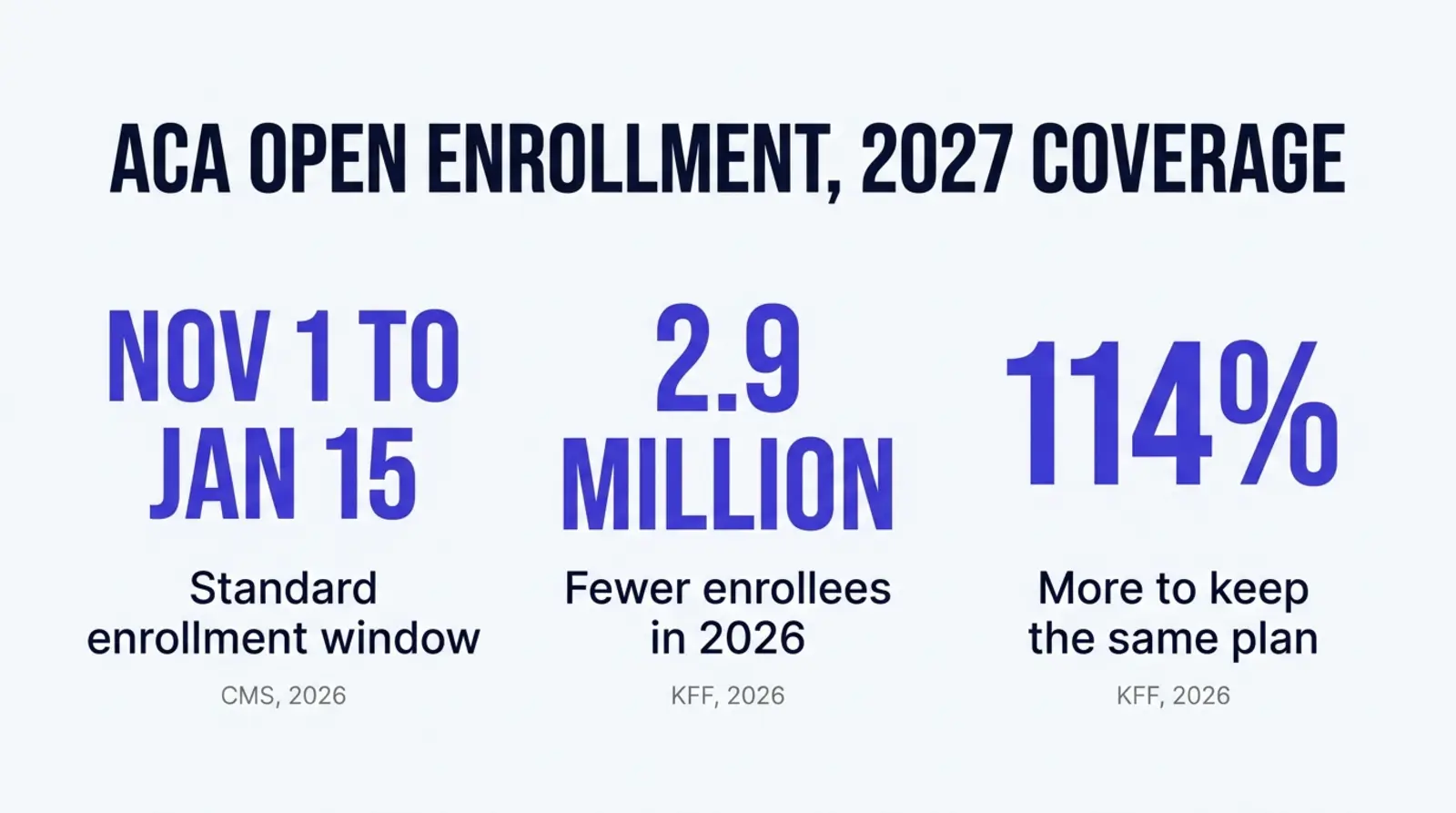
Open Enrollment for 2027 ACA coverage runs November 1, 2026 through January 15, 2027 on HealthCare.gov and in most states12, and the subsidy math changed underneath it: KFF's analysis of a June 2026 federal issue brief found enrollees who kept the same plan paid 114% more on average to do it, with enrollment already down roughly 2.9 million people from 20254. A website built or last reviewed before that shift is handing this year's shopper last year's dates, last year's price expectations, and often a slow mobile page during the ten weeks that carry most of the year's organic traffic. None of that requires a rebuild to fix. It requires knowing what to check.
Three days out, and the site still says last year
As this guide publishes, a health insurance agent website has three days left before Open Enrollment for 2027 ACA coverage opens. HealthCare.gov's own enrollment page, fetched for this guide, still carries the same banner it runs every year: get ready now, enroll November 1 through January 152. CMS's key dates sheet spells out the mechanics behind that window: enroll by December 15, 2026 for coverage starting January 1, 2027, or enroll between December 16 and January 15, 2027 for coverage starting February 1, 20271.
A lot of agency websites will not say any of that correctly on November 1. Some still show the 2026 window. Some show a generic "Open Enrollment runs in the fall" line with no dates at all. Some send every visitor to HealthCare.gov regardless of which state they live in, even though a growing number of states run their own exchange. None of these are exotic failures. They are the predictable result of a page built once, during a previous enrollment season, and never opened again until this guide's checklist, or a client's confused phone call, forces the question.
A 30 second check before you read further
Open your own ACA or health insurance page right now. Find the sentence that states the enrollment window. Does it say November 1, 2026 through January 15, 2027, or a close variant for your state? If it says anything about 2026 coverage, or nothing specific at all, that is the first fix this guide covers.
Why the site falls out of date in the first place
Most agency websites are not built to change. A page gets written once, usually when the site first launches, with that year's enrollment dates typed directly into the text. Nobody puts a reminder on the calendar to come back and edit it, because editing a website is not most agents' job and most page-builder platforms make it enough friction that it keeps getting pushed to next week. Next week turns into next year, and the page that was accurate in October 2025 is still live, unedited, in October 2026.
This year the problem compounds, because it is not only the dates that moved. The enhanced premium tax credits that lowered marketplace premiums for millions of buyers expired at the end of 2025. A page written before that expiration describes a subsidy environment that no longer exists, and a returning visitor comparing this year's quote to what they remember paying last year has no explanation on the page for why the number changed.
There is also a compliance wrinkle specific to this year. A federal rule finalized in 2025 would have shortened Open Enrollment to a nine week window starting with 2027 coverage. It was challenged in court, and a federal judge in Maryland vacated the challenged provisions on June 12, 20263. CMS confirmed in guidance dated July 27, 2026 that "HHS has not altered the dates for the Open Enrollment period contained in 45 CFR 155.410(e)(4)"3. An agency that read about the shortened window when it was first proposed, and never checked back, may still be advertising a December 15 cutoff that does not apply on the federal exchange this year.
We cover the state by state dates separately
This guide focuses on what your website needs to say and do. For the full exchange by exchange breakdown of 2027 enrollment deadlines, including the states running past January 15, see our related guide on open enrollment dates by state.
What a stale site costs during the busiest ten weeks of the year
Open Enrollment is not evenly distributed traffic. It is the window where most of an ACA agent's organic search volume, paid search competition, and referral conversations all land inside the same ten to eleven weeks. A mistake on the page during that window does not get averaged out over the rest of the year the way a typo on an interior page might. It gets seen by the majority of this year's shoppers, during the exact weeks they are deciding who to call.
The shopper arriving this year is also a different shopper than the one who arrived in past years, and the data explains why. KFF's analysis of a Department of Health and Human Services issue brief released June 26, 2026 found that enrollment had already fallen roughly 13%, from a high of 22.1 million effectuated enrollees in 2025 to 19.2 million in February 2026, a drop of about 2.9 million people, with the decline projected to reach closer to 17.5 million by the end of 20264. The same analysis found that enrollees who kept the same plan into 2026 faced an average premium payment increase of 114%, with net premium payments up 58% overall, and average deductibles rising 37%, more than $1,000 per person4.
Fewer total shoppers, paying noticeably more, and comparing prices more carefully than a buyer who felt the subsidy cushion absorb most of the increase, is exactly the environment where a slow or confusing page loses a visitor to the next search result. The cost is not a number this guide can invent for your specific agency. It is the shape of the exposure: the same ten weeks that carry most of your organic traffic are now carrying a smaller, pricier-feeling, more comparison-driven audience than last year's.
The dates your site actually needs to get right
Start with the mechanics, because these are the facts a visitor checks against memory and catches fastest when they are wrong.
| Date | What it means |
|---|---|
| November 1, 2026 | Open Enrollment begins |
| December 15, 2026 | Enroll by this date for coverage starting January 1, 2027 |
| January 1, 2027 | Coverage begins for plans chosen by December 15 |
| January 15, 2027 | Standard federal deadline to enroll for coverage starting February 1, 2027 |
| February 1, 2027 | Coverage begins for plans chosen between December 16 and January 15 |
Those five dates come directly from CMS's own key dates reference for the Health Insurance Marketplace1, and HealthCare.gov's live enrollment page states the same November 1 through January 15 window2. A New Jersey Department of Banking and Insurance bulletin dated August 10, 2026 independently confirms the November 1, 2026 start for plan year 2027 and notes that New Jersey's own enrollment period runs through January 31, 2027 under state law, longer than the federal minimum3. That bulletin is also where the court history lives: it cites City of Columbus v. Kennedy, decided in Maryland federal court on June 12, 2026, which vacated the provisions of CMS's 2025 Marketplace Integrity and Affordability Final Rule that would have shortened the window, and it quotes CMS's own July 27, 2026 guidance stating plainly that the federal dates in 45 CFR 155.410(e)(4) were not altered3.
The practical takeaway for your website: the standard federal window is real and current, but it is not universal. If you write business in a state running its own exchange, your page needs that state's actual deadline, not a copy and paste of the HealthCare.gov dates. We built the full exchange by exchange table for this in a related guide, linked above, specifically so this guide could stay focused on what to do with the dates once you have them right.
The subsidy math your site has to explain now
Dates are the easy fix. The subsidy explanation is the one most agency sites skip entirely, usually because it is uncomfortable to write and there is no single clean sentence that covers every household's situation. That discomfort is exactly why a page that handles it well stands out.
The core fact, sourced from KFF's analysis of the June 2026 HHS issue brief: enrollees who kept their 2025 plan into 2026 paid, on average, 114% more to do it, and net premium payments across the marketplace rose 58% overall as the enhanced premium tax credits expired at the end of 20254. Average deductibles rose alongside premiums, up 37%, or more than $1,000 per person4. A returning shopper who remembers a specific monthly number from last year and sees something very different this year is not imagining things. The math genuinely changed.
A page that ignores this leaves the visitor to find out the hard way, usually after they have already invested time filling out a quote form. A page that addresses it plainly, in a sentence or two near the top, before any form, does the opposite: it tells the visitor you already know why the price moved and you are not hiding it. That is a trust signal a slower, vaguer competitor page will not have.
One sentence that does the work
You do not need a financial breakdown. A single accurate sentence, something like "subsidies changed at the end of 2025, so this year's price may look different from what you paid before, and we can walk you through exactly why," placed before your quote form, answers the question most returning visitors are silently asking.
What an Open Enrollment ready page actually needs
Put together, the fixes are not complicated. None of them require a developer. What follows is the checklist, in the order a visitor actually encounters it on the page.
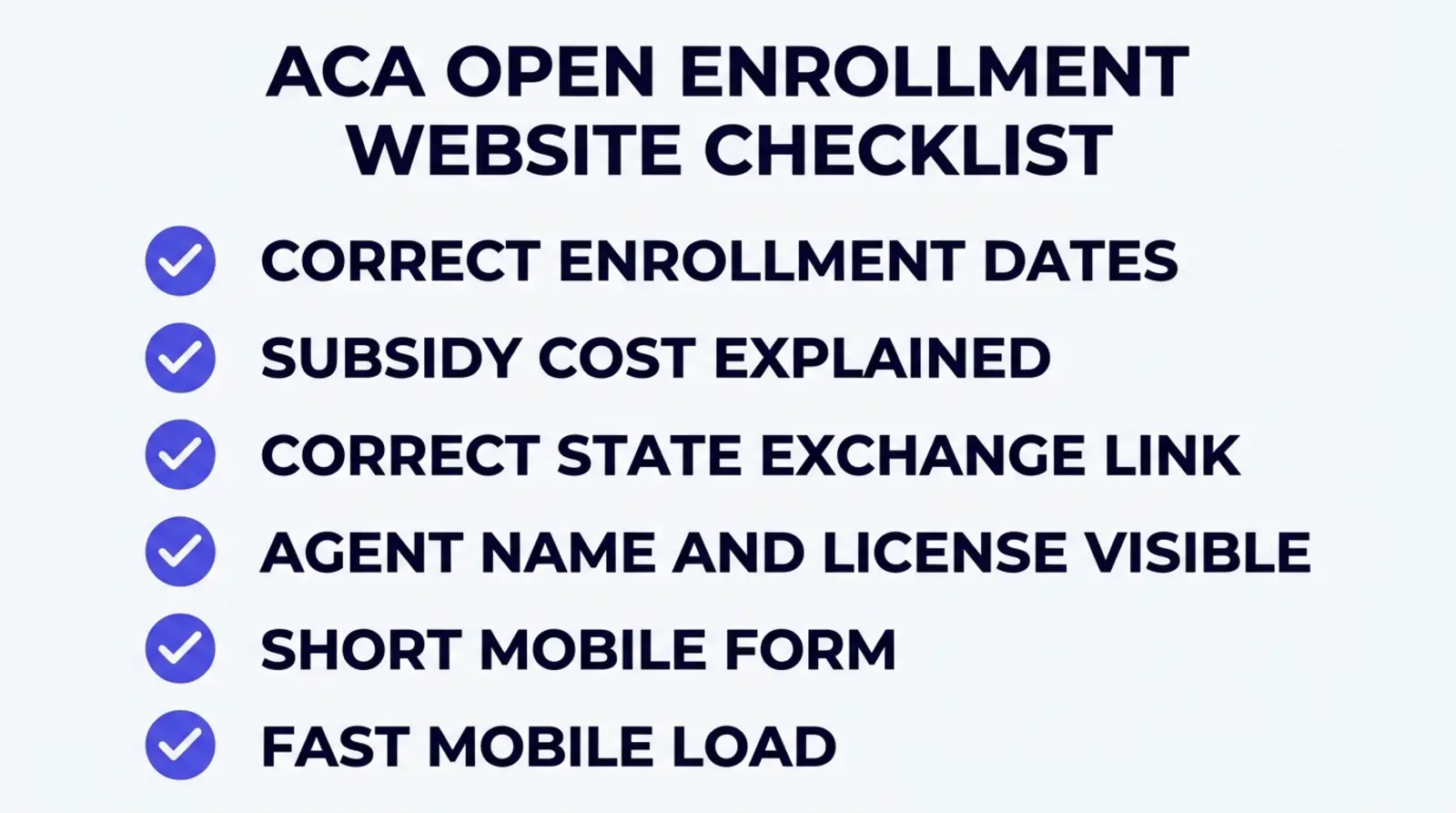
The correct window, for the correct exchange. State the actual start and end date for the exchange your visitor uses, sourced to CMS or your state's own marketplace, not a number remembered from a previous year or copied from a national news article that may already be out of date by the time you publish it.
The subsidy change explained in plain language. One or two sentences, placed before the quote form, telling the visitor that the math changed and why, as covered above.
A link to the correct exchange, not a default to HealthCare.gov. If you write multiple states, make sure the page either detects or asks which state the visitor is in, and routes them to the right enrollment platform. Sending a Georgia resident to HealthCare.gov, a platform that no longer processes that state's applications, wastes the visit entirely.
The agent's name, license, and contact information visible without hunting. A page asking a worried shopper to trust it with personal and financial information should not make that shopper dig for who is actually behind the page.
A short form matched to a mobile visitor. This is the busiest traffic window of the year, most of it arriving on a phone. A long, multi-field form built for a desktop visitor with time to spare is friction this specific window cannot afford.
A fast mobile load, measured, not assumed. Covered in detail in the next section, because it deserves its own explanation rather than a single checklist line.
What CMS requires if your site touches enrollment
Beyond what makes a page convert well, there are real federal requirements that apply depending on how your site is set up, and getting the category wrong is a compliance risk worth five minutes of attention.
If your own website functions as a web-broker site, meaning it facilitates enrollment directly and other agents or brokers may use it under a contractual arrangement, CMS's clarification of the standards at 45 CFR 155.220(c)(4) requires that your name and National Producer Number prominently appear on every page of the site, and on the cover or first page of any printed materials containing qualified health plan information that can be printed from the site5. The same standard requires you to verify that any agent or broker using your site is licensed in the state where the consumer is selecting a plan, and has completed current FFM registration and training5.
If you are a standard registered agent or broker rather than operating a web-broker arrangement, that specific per-page display rule does not apply the same way, but your Marketplace agreement still requires active FFM registration for the current plan year, and HHS can suspend your credential if that registration lapses. Either way, the practical lesson for a website is the same: know which category you actually fall into, because the two carry different obligations, and "I did not know which one applied to me" is not a defense CMS accepts.
This is not legal advice
This section describes what CMS's own published guidance says as of this guide's publication date. Confirm your current registration category and obligations directly with CMS's agent and broker resources, or your compliance counsel, before relying on a summary from any website, including this one.
The stale page against the page built for this window
| Element | Typical unreviewed page | Page built for this window |
|---|---|---|
| Enrollment dates | Last year's dates, or no specific dates at all | November 1, 2026 to January 15, 2027, sourced to CMS1 |
| Exchange link | Always HealthCare.gov, regardless of the visitor's state | Routes to the visitor's actual state exchange |
| Subsidy change | Not mentioned | Explained in one or two sentences before the form |
| Agent identity | Buried in a footer or missing | Name, license, and contact visible without scrolling |
| Form length | Built for a desktop visitor with time to spare | Short, matched to a mobile visitor during a busy window |
| Mobile speed | Whatever the platform's runtime happens to deliver | Built to clear Google's own Core Web Vitals thresholds6 |
If you want a second set of eyes on your own page
The free Audit scores your current site for speed, AI citation readiness, and HIPAA safe tracking in about a minute. It is a reasonable starting point before Open Enrollment traffic arrives. strategicaiarchitects.com/audit
How we keep this current without you remembering to
We re-fetched our own Digital Foundation pricing page while writing this guide, the same standard this article holds every other claim to. The Website tier runs $84 a month billed annually ($1,008 a year) and ships a complete, 30 page site live on launch day, scoring 95 or higher on mobile PageSpeed by the page's own stated figure, with a full 60 point SEO and AEO checklist and a monthly report plus an annual data update built in7. Starter at $247 a month adds roughly seven new pages monthly and Google Business Profile management; Pro at $497 adds 14 to 17 new pages a month, up to two languages, and a 24/7 AI voice receptionist; Scale at $997 scales content to as many as 71 new pages a month7.
The detail worth noting is the annual data update built into every subscription tier. It exists for exactly the problem this guide describes: a page whose enrollment dates, subsidy figures, or plan year numbers were accurate when written and quietly go stale the next year because nobody revisits them. A one time site build, the kind that ships once and is never touched again, does not have that update built in, which is precisely why its numbers age the way this guide's first section describes.
We build on Astro, which ships zero JavaScript to the browser by default, so a page arrives as finished HTML instead of a page-builder runtime your visitor's phone has to download and boot before anything appears. Every build ships a sitemap, an llms.txt file, and a robots.txt file that regenerate themselves the moment a page publishes, with the full absolute URL, and a robots.txt written to welcome every crawler including the named AI crawlers, so nothing about a correction gets lost between the page and the index.
None of that is a reason a page built elsewhere cannot also be fixed. Everything in this guide's checklist works on any platform willing to let you edit it before November 1.
What changes for your agency
None of this promises a specific lead count, a ranking position, or a conversion rate, because none of those can be honestly promised by anyone who has not built and measured your specific page. What a page actually reviewed for this window changes is more concrete than that.
Dates a visitor can trust
The correct window for the correct exchange, sourced and current, instead of a number copied from a previous year.
A subsidy explanation that builds trust
A plain sentence addressing why the price changed, before the visitor reaches a form, not after.
A page built for this year's traffic
A short mobile form and a fast load, matched to the ten weeks that carry most of your organic visits.
Compliance basics you have actually checked
Knowing which CMS requirements apply to your specific registration, instead of assuming.
Questions agents ask
When does Open Enrollment actually start and end for 2027 ACA coverage?
On HealthCare.gov and in most states, Open Enrollment for 2027 coverage runs November 1, 2026 through January 15, 2027. CMS's own key-dates sheet lays out the mechanics: enroll by December 15, 2026 and coverage starts January 1, 2027; enroll between December 16 and January 15, 2027 and coverage starts February 1, 2027. A federal rule that would have shortened this window to nine weeks was challenged in court and partially vacated on June 12, 2026, and CMS confirmed in guidance dated July 27, 2026 that it has not altered the dates in 45 CFR 155.410(e)(4). Some states run longer: New Jersey's Open Enrollment for plan year 2027 runs through January 31, 2027. Your site needs to state the window for the exchange your visitor actually uses, not a single number copied from a national article.
Why does the subsidy situation matter for what my website says this year?
Because the math changed and a lot of returning shoppers do not know it yet. The enhanced premium tax credits that lowered marketplace premiums expired at the end of 2025. KFF's analysis of a June 2026 HHS issue brief found enrollees who kept the same plan faced a premium payment increase averaging 114%, with net premium payments up 58% overall. A visitor who remembers last year's price and assumes this year is similar is working from a number that is no longer true. A page that explains why the price moved, in plain language, before the visitor gets to a quote, builds more trust than a page that stays silent and lets them find out at checkout.
Does every state use HealthCare.gov for enrollment?
No, and this is one of the more common website mistakes. A growing number of states run their own exchange: Georgia moved to Georgia Access, and states like California, New Jersey, New York, Pennsylvania, and others run their own marketplaces with their own URLs, their own deadlines, and sometimes their own enrollment windows. A site that sends every visitor to HealthCare.gov regardless of state sends some of them to the wrong platform entirely. If you write multiple states, your enrollment page needs to know which exchange applies to which visitor, or at minimum link out to a resource that does.
What does CMS actually require on an agent's or broker's own website?
It depends on your registration type. CMS's clarification of the web-broker standards at 45 CFR 155.220(c)(4) requires that if you operate a web-broker site, meaning your own website facilitates enrollment and other agents or brokers may use it under agreement, your name and National Producer Number must prominently appear on every page of the site and on any printed material containing qualified health plan information. You must also verify that any agent or broker using your site is licensed in the consumer's state and has completed FFM registration and training. If you are a standard registered agent or broker rather than a web-broker, the specific per-page NPN display rule does not apply the same way, but your Marketplace agreement still requires current FFM registration and a Privacy Notice Statement before collecting personal information. Check your own registration type against CMS's current agent and broker resources before assuming which rule applies to you.
How fast does my website actually need to load during Open Enrollment?
By the same standard Google applies the rest of the year, just with less room for error because the traffic is heavier and the visitor is comparison shopping. Google's Search Central documentation, fetched for this guide, defines a good Largest Contentful Paint as 2.5 seconds or less, a good Interaction to Next Paint as under 200 milliseconds, and a good Cumulative Layout Shift under 0.1, each measured at the 75th percentile of real visits and scored separately on mobile and desktop. Google states that page experience aligns with what its core ranking systems reward. A ten week window where most of your organic traffic arrives at once is a bad time to find out your site misses those thresholds on a mid-range phone.
Should ACA content and Medicare content live on the same page?
No. They are different programs, different enrollment calendars, different eligibility rules, and in Medicare's case, different CMS marketing and disclaimer requirements that have nothing to do with ACA coverage. A visitor searching for ACA open enrollment who lands on a page mixing in Medicare Advantage language has to do translation work to figure out which parts apply to them, and a page trying to serve both audiences at once usually serves neither one well. Keep the lines separate, the way we cover for final expense and term life in a related guide on this site.
What actually happens if my site still shows last year's enrollment dates?
At minimum, a visitor who catches the error loses trust in everything else the page tells them, including the parts that are still accurate. At worst, a visitor acts on the wrong date, for example assuming they have until a date that has already passed, and misses the window entirely. Neither outcome is hypothetical. Dates are the easiest fact on an insurance website to get wrong, because most sites are built once and then never revisited until something breaks or a visitor complains.
How do I find out if my own site is losing ACA shoppers right now?
Start with the basics you can check in under a minute: open your site on your phone, time how long it takes to load, and read your own enrollment dates as if you were a new visitor who knows nothing about your agency. Then run it through the free Audit, which checks your site's speed, AI citation readiness, and HIPAA safe tracking in about a minute and gives you a concrete list rather than a guess.
Sources
- Centers for Medicare & Medicaid Services. "Key dates for the Health Insurance Marketplace." CMS Product No. 11660. November 1: Open Enrollment starts. December 15: enroll for coverage starting January 1. January 15: enroll for coverage starting February 1. Published September 2025. Fetched live October 29, 2026. cms.gov/marketplace/outreach-and-education/key-dates-health-insurance-marketplace.pdf.
- HealthCare.gov. Marketplace enrollment page banner states to get ready now and enroll November 1 to January 15. Fetched live October 29, 2026. healthcare.gov/get-coverage.
- New Jersey Department of Banking and Insurance. Bulletin No. 26-07, "Open Enrollment Period for Individual Market Health Insurance for Plan Year 2027." Open Enrollment for plan year 2027 begins November 1, 2026 and ends January 31, 2027 in New Jersey; cites City of Columbus v. Kennedy, Civil No. 25-2114 (D. Md. June 12, 2026), vacating certain portions of CMS's Patient Protection and Affordable Care Act Marketplace Integrity and Affordability Final Rule, and CMS guidance dated July 27, 2026 stating HHS has not altered the dates in 45 CFR 155.410(e)(4). Dated August 10, 2026. Fetched live October 29, 2026. nj.gov/dobi/bulletins/blt26_07.pdf.
- KFF. Cynthia Cox, "ACA Marketplace Enrollment Is Down By 3 Million After Big Jump in Premium Payments," analyzing an HHS Office of the Assistant Secretary for Planning and Evaluation issue brief released June 26, 2026. Effectuated enrollment fell 13% (about 2.9 million), from 22.1 million in 2025 to 19.2 million in February 2026, projected to fall further to roughly 17.5 million by end of 2026; net premium payments up 58%; premium payment to keep the same plan up 114% on average; deductibles up 37%, more than $1,000 per person. Published June 29, 2026. Fetched live October 29, 2026. kff.org/quick-insights/aca-marketplace-enrollment-is-down-by-3-million-after-big-jump-in-premium-payments.
- Centers for Medicare & Medicaid Services. "Clarification of Web-Broker Regulatory Standards at 155.220(c)(4)." Requires a web-broker's name and NPN to prominently appear on every page of its website and on printed materials containing QHP information; requires verifying that agents or brokers using the site are licensed in the consumer's state and have completed FFM registration and training. Fetched live October 29, 2026. cms.gov/cciio/.../clarification-web-broker-standards-155-220.pdf.
- Google. "Understand and measure Core Web Vitals," Search Central Documentation: good thresholds of 2.5 seconds or less for Largest Contentful Paint, under 200 milliseconds for Interaction to Next Paint, and under 0.1 for Cumulative Layout Shift, measured at the 75th percentile of real visits; page experience "aligns with what our core ranking systems seek to reward." Last updated 2025-12-10. Fetched live October 29, 2026. developers.google.com/search/docs/appearance/core-web-vitals.
- Strategic AI Architects. Digital Foundation service page, live pricing: Website $84/mo billed annually ($1,008/yr, 30 pages live on launch day, 95+ mobile PageSpeed, full 60-point SEO/AEO checklist, monthly report plus annual BRAIN update); Starter $247/mo (7 new pages/mo, Google Business Profile management); Pro $497/mo (14 to 17 new pages/mo, up to 2 languages, 24/7 AI voice receptionist); Scale $997/mo (up to 71 new pages/mo, up to 4 languages). Fetched live October 29, 2026. strategicaiarchitects.com/digital-foundation.
Talk it through
Want a second pair of eyes on it?
Free 30 minutes. Bring what you found, or bring nothing and we will look together at how AI engines read your site and which fixes move first.
See how your ACA page scores before November 1
Run a free Audit and see how your site scores on speed, AI citation readiness, and HIPAA safe tracking, in about a minute, before Open Enrollment traffic arrives.
Related reading: Open Enrollment ends on different days in different states · Insurance agency website design: pages that sell policies · Why your insurance website fails Google's speed test