Playbook
Open Enrollment Ends on Different Days in Different States
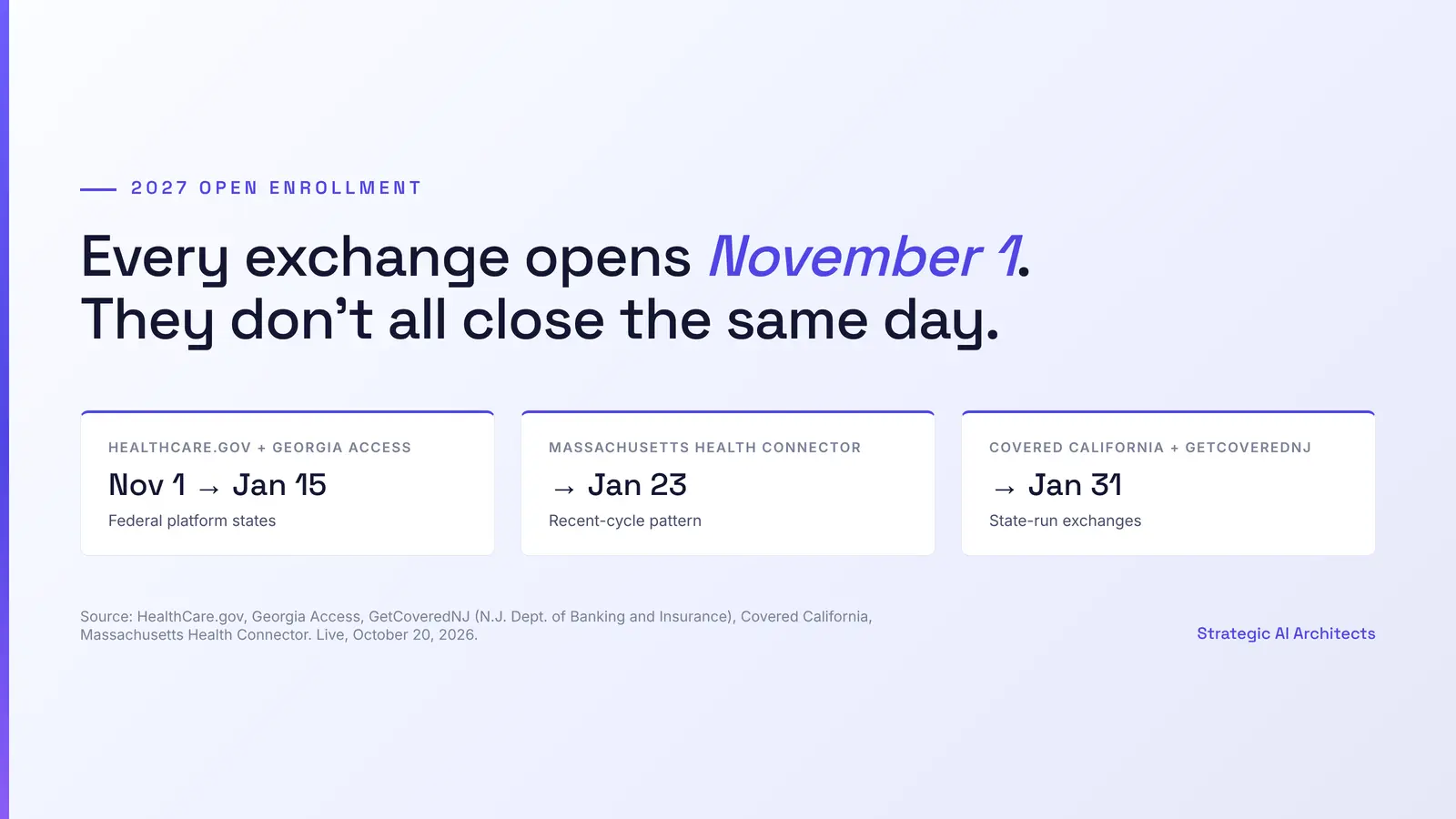
Every exchange opens November 1. The rule that tried to make them all close on the same day just lost in federal court, for now.

16 min read
Open Enrollment for 2027 ACA coverage opens November 1, 2026 everywhere, but it does not close on the same day everywhere. HealthCare.gov and Georgia Access both run through January 15, 2027.17 Covered California and GetCoveredNJ both run through January 31, 2027.56 A 2025 federal rule tried to force every exchange onto a single nine-week calendar starting this plan year, but a Maryland court vacated that provision on June 12, 2026, and the government's appeal is still pending.23 If your site states one hardcoded Open Enrollment deadline, it is already wrong for some of the people reading it, and it was almost wrong for all of them.
What Open Enrollment actually is, right now
Every year, the ACA Marketplace holds a window called the annual Open Enrollment Period, when anyone can sign up for individual or family health coverage, or switch plans, without needing a qualifying life event. HealthCare.gov's own current guidance puts the 2027 coverage window at November 1, 2026 through January 15, 2027, with coverage starting January 1 for anyone who enrolls by December 15.1 That is the number most agency sites, call scripts, and landing pages have been trained to repeat for years, because for most of the country it has been true.
It is not true everywhere. Thirty-some states and D.C. use HealthCare.gov as their Marketplace, but more than twenty states run their own exchange, and a state-run exchange sets its own Open Enrollment calendar.9 Georgia runs Georgia Access instead of HealthCare.gov, and happens to land on the same November 1 to January 15 window this year.78 New Jersey's GetCoveredNJ and Covered California both run three months longer, through January 31, 2027.56 Massachusetts Health Connector has run through January 23 in its recent cycles.9 None of that is a typo or a rounding error. It is the actual, current design of the program: one national start date, several different end dates, decided state by state.
That design goes back to how the ACA itself was built. The law gave states a choice: run your own exchange, or default to the federal one the government built for everyone who didn't. Most states took the default. A couple dozen didn't, and the ones that run their own have always had latitude to set their own enrollment calendar, their own plan certification rules, and their own consumer assistance programs. A hardcoded national Open Enrollment date was never fully accurate for the whole country. It was just close enough, for long enough, that nobody's website got caught being wrong about it. This year's litigation didn't create that gap. It just made the gap wider and more visible, by briefly threatening to close it entirely and then reopening it at the last minute.
It also matters more for a multi-state book than a single-state one, and it matters most of all for an FMO or IMO whose downline writes across a dozen states or more. A single agency licensed only in Ohio can get away with one hardcoded HealthCare.gov date on every page, because Ohio uses HealthCare.gov. An agency, or a network of agencies, writing business in Ohio, New Jersey, and California at the same time cannot, because one of those three sentences is simply false for two of the three states. The more states a book of business touches, the more a single shared template line turns from a convenience into a liability.
This is not the Medicare AEP
The Medicare Annual Election Period, October 15 through December 7, is a completely separate calendar for a completely separate program, and it is not touched by anything in this guide. If your agency writes both ACA and Medicare business, you are tracking two different clocks, and conflating them on a page is its own kind of wrong date.
The rule that tried to make every date the same
The reason this got complicated for 2027 specifically traces back to a single federal rule. On June 25, 2025, CMS finalized the Patient Protection and Affordable Care Act; Marketplace Integrity and Affordability Rule, published in the Federal Register at 90 FR 27,074.2 Among a long list of changes to eligibility verification, special enrollment periods, and income redeterminations, the rule added a new limit on the length of the annual Open Enrollment Period itself, starting with benefit years beginning in 2027.2
The rule's own text is specific. It caps the Open Enrollment Period so that it "does not exceed 9 weeks" under 45 CFR 155.410(e)(5)(ii), and requires that for 2027 and later benefit years, the period "must begin no later than November 1 and end no later than December 31" of the preceding calendar year for any exchange that sets its own dates.2 For exchanges running on the federal platform, meaning HealthCare.gov, the rule did not leave room for variation at all: it fixed "the dates of the OEP each year for Exchanges operating on the Federal platform" at November 1 through December 15.2 That is a full month shorter than the January 15 close HealthCare.gov is actually using for 2027 right now, which is the first clue that the rule, as written, is not the rule currently in effect.
9 wks
Maximum Open Enrollment length the 2025 rule tried to set for every exchange2
Nov 1
Universal start date, both under the vacated rule and under every exchange operating today12
Dec 15
The HealthCare.gov close date the rule specified, a month earlier than what is actually live2
16 days
Spread between the earliest 2027 close (Jan 15) and the latest (Jan 31) among the exchanges checked for this guide16
CMS framed the rule as part of a broader package meant to tighten eligibility verification and curb improper enrollments, alongside a pause on the low-income special enrollment period and changes to how exchanges verify income.2 Shortening and standardizing the enrollment window was presented as one piece of that integrity push, not an isolated change. It mattered to agencies for a narrower reason: a shorter, uniform calendar is simple to write once into a template and never think about again. That is exactly the version of 2027 that did not end up shipping.
How a Maryland court undid it, for now
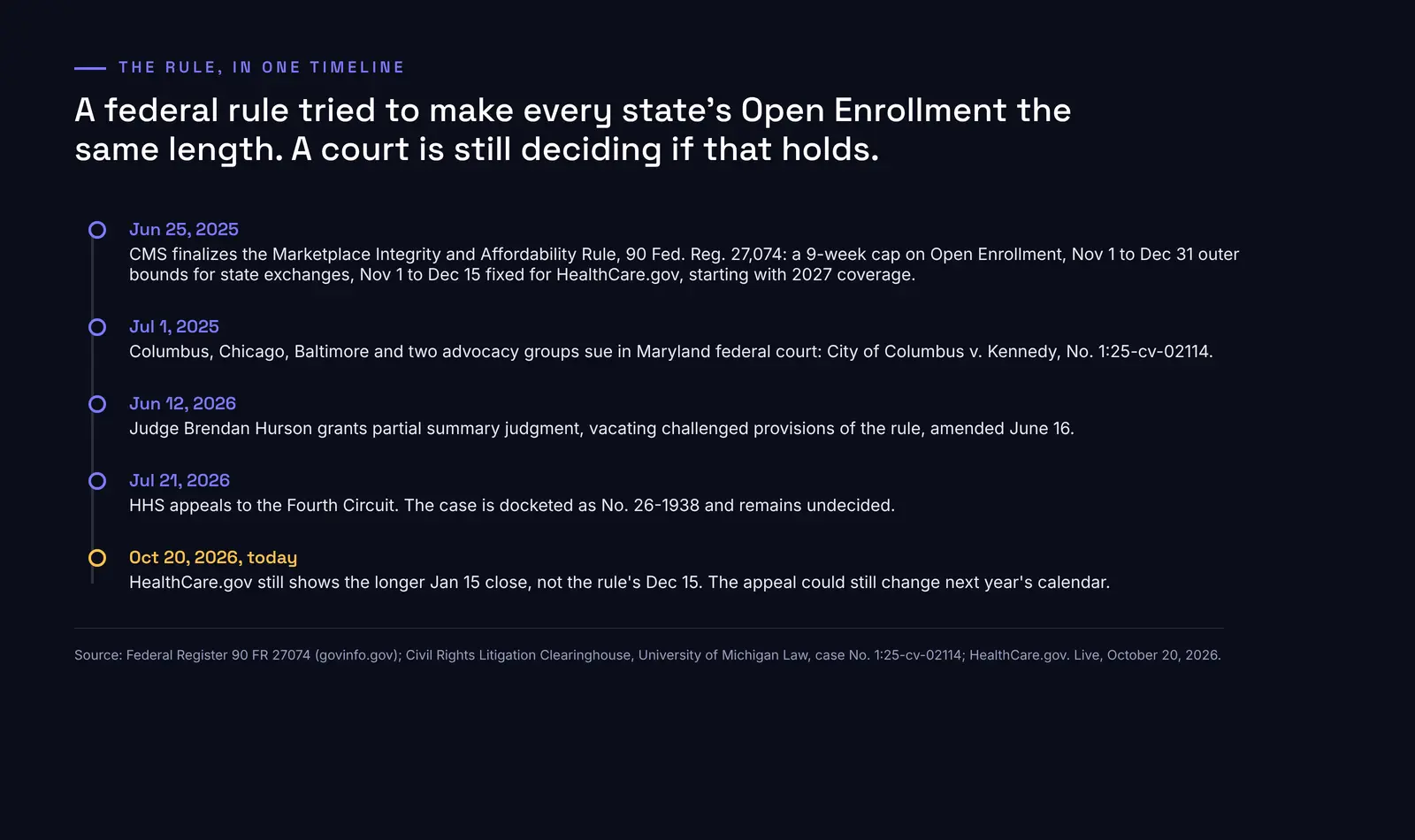
The rule did not go unchallenged. On July 1, 2025, the cities of Columbus, Chicago, and Baltimore, joined by Doctors for America and the Main Street Alliance, sued HHS, CMS, and their administrators in the U.S. District Court for the District of Maryland, in a case captioned City of Columbus v. Kennedy, No. 1:25-cv-02114, arguing the rule was unlawful under the Administrative Procedure Act.3 Judge Brendan Abell Hurson had already paused parts of the rule on a preliminary basis in August 2025, before it even took effect.3
The case ran for nearly a year before it reached a final decision on the merits. On June 12, 2026, Judge Hurson issued a memorandum opinion and order granting the plaintiffs' motion for summary judgment in part and denying the government's cross-motion in part, vacating the challenged provisions of the rule "as specified herein," with a clarifying amendment entered June 16.3 Trade press coverage of the ruling, including Becker's Payer Issues, reported that the vacated provisions specifically included the rule's shortened, standardized Open Enrollment Period for 2027 coverage.4 HHS did not accept the loss quietly: it filed a notice of appeal to the U.S. Court of Appeals for the Fourth Circuit on July 16, 2026, and the appeal was docketed there as No. 26-1938 on July 21, 2026.3
| Date | What happened |
|---|---|
| Jun 25, 2025 | CMS finalizes the Marketplace Integrity and Affordability Rule, 90 FR 27,074, including the 9-week Open Enrollment cap for 2027 and later2 |
| Jul 1, 2025 | Columbus, Chicago, Baltimore, Doctors for America, and Main Street Alliance sue in Maryland federal court3 |
| Aug 22, 2025 | Judge Hurson preliminarily stays several challenged provisions before the rule's effective date3 |
| Jun 12 to 16, 2026 | Court grants partial summary judgment and vacates challenged provisions, amended June 16; reporting ties this to the shortened Open Enrollment Period34 |
| Jul 16 to 21, 2026 | HHS appeals to the Fourth Circuit; case docketed as No. 26-19383 |
| Oct 20, 2026, today | HealthCare.gov's live page still shows the longer January 15 close, not the rule's December 15. The appeal remains undecided13 |
A few of those legal terms are worth defining plainly, since they're doing real work in this story. Summary judgment is a court's ruling that the undisputed facts already decide the case, without needing a full trial, because no reasonable judge or jury could come out the other way on those facts. When a court vacates a rule, it is not merely pausing it, the way a preliminary injunction does while a case is still being argued. Vacatur sets the rule aside as if it were never validly issued, which is why HealthCare.gov's live page can simply revert to the longer, pre-rule calendar rather than waiting for some future effective date. An appeal to the Fourth Circuit doesn't undo that on its own. It asks a higher court to review whether the district court got the law right, and until that appellate court rules, the district court's vacatur stands.
A federal rule tried to put every exchange on one calendar. A federal court put most of them back on their own. The only thing both sides agree on right now is November 1.
The 2027 window, exchange by exchange
Here is what each exchange checked for this guide is actually telling consumers today, not what the vacated rule would have required. Confirm your own state's exchange directly before publishing a date, since this is exactly the kind of fact that can move again before January.
| Exchange | 2027 window | Source |
|---|---|---|
| HealthCare.gov (federal platform) | Nov 1, 2026 to Jan 15, 2027 | HealthCare.gov1 |
| Georgia Access | Nov 1, 2026 to Jan 15, 2027 | Atlanta Journal-Constitution; healthinsurance.org78 |
| GetCoveredNJ | Nov 1, 2026 to Jan 31, 2027 | N.J. Dept. of Banking and Insurance5 |
| Covered California | Nov 1, 2026 to Jan 31, 2027 | Covered California6 |
| Massachusetts Health Connector | Closed Jan 23 in the most recent published cycle; 2027 dates not yet posted at writing | Massachusetts Health Connector, via BusinessWire9 |
| Oregon | Moves off HealthCare.gov to its own exchange, ExploreHealthOR.gov, starting with 2027 Open Enrollment | HealthCare.gov10 |
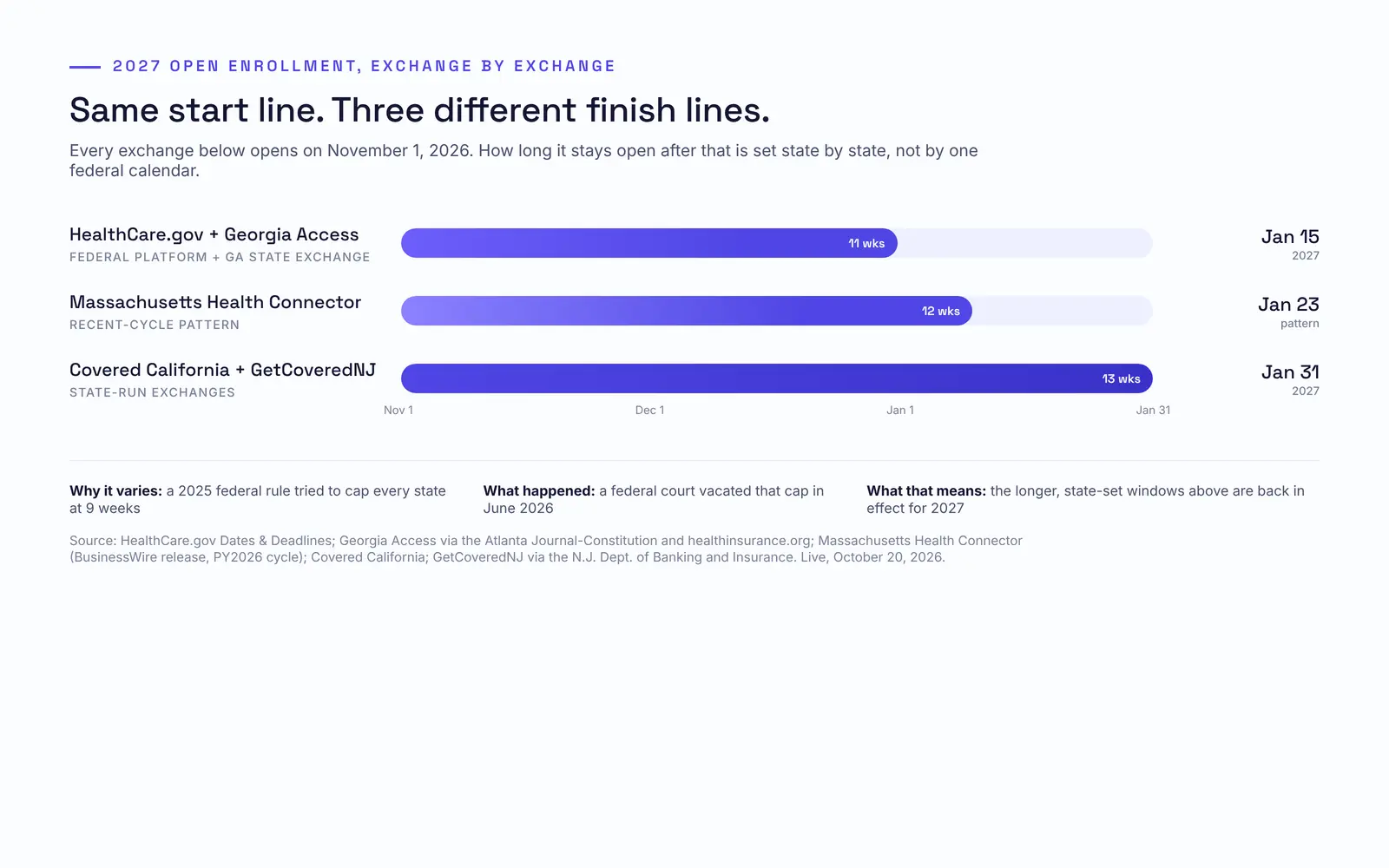
Two things are worth sitting with in that table. First, every single exchange opens on the same day. The variation is entirely on the back end, which means a date you see confidently stated as "Open Enrollment runs November 1 to [X]" is doing two different jobs: the November 1 half is safe to say for any audience, and the end-date half is not safe to say for any audience until you know which exchange that specific reader is shopping on. Second, more than one state kept a longer window than HealthCare.gov on purpose, not by accident. New Jersey's own regulator says so directly: "a recent court decision restored the ability for States to set longer Open Enrollment periods," and New Jersey "historically offered a three-month window" and chose to keep it.5 That is a state deliberately diverging from the federal platform's calendar, which is a detail a lot of national-template content never bothers to check for.
Why agency sites keep publishing one date anyway
None of this is because agencies don't care about getting it right. It's because the way most agency websites get built makes a single hardcoded date the path of least resistance, and nobody revisits it until something forces the issue.
A page builder platform or a page cloned from a competitor site tends to carry whatever Open Enrollment sentence was already sitting in the template when the page was copied. Nobody checks whether that sentence was written for HealthCare.gov, for a specific state exchange, or for a plan year that's already over. A seasonal landing page built fast for one AEP and OEP cycle, meant to be rebuilt next year, often just gets its year swapped and ships again, with the end date untouched because whoever updated it assumed the calendar doesn't change. And a multi-state agency that grew by adding licenses one state at a time usually started with a single home-state page, then copied it for every new state without re-checking the one line that doesn't travel: the deadline.
Put those three habits together and you get exactly what shows up in an audit: a site with a dozen state-specific landing pages that all carry the identical Open Enrollment sentence, because it was correct the one time, for the one state, that the sentence was first written.
None of this is a criticism of how those pages were built in the first place. A static date is a completely reasonable thing to write down when the underlying fact actually is static, and for most of the program's history, the Open Enrollment calendar changed rarely enough that treating it as fixed was a safe bet. What changed this year isn't that agencies got careless. It's that the fact underneath the sentence became unusually unstable, first because a rule tried to overwrite it nationally, then because a court overwrote the rule, with an appeal still pending that could overwrite it again. A sentence built to be typed once stops being safe exactly when the fact behind it stops holding still.
What could still change before January
None of this is settled law in the sense of being finished. The Fourth Circuit appeal docketed as No. 26-1938 was still open as of this guide's publication, with no decision issued.3 If the Fourth Circuit reverses the Maryland ruling, the nine-week cap and the December 15 HealthCare.gov close could come back into force, though CMS would need to work out timing for any plan year already underway when that happens. If the ruling is affirmed or the appeal is dismissed, the current state-by-state picture in the table above is likely to be closer to the durable baseline going forward.
There's a reason to take the appeal seriously rather than assume it fizzles out. The government didn't let its first appellate attempt in this case lapse by accident: when an earlier appeal was voluntarily dismissed so the case could finish at the district court first, HHS came back with a fresh notice of appeal within weeks of the June 12 ruling, and the Fourth Circuit opened the new case the following week.3 That's the posture of an agency still actively pursuing the rule as written, not one that's content to let the longer, state-set windows become the permanent status quo by default.
Either way, the practical lesson for an agency site is the same: this is not a fact you learn once and publish forever. It is a fact with an open court docket attached to it, which means the right way to handle it on a website is closer to how you'd handle a stock price than how you'd handle a ZIP code. A page that states the plan year and the date you last checked, like "Open Enrollment runs November 1, 2026 to January 15, 2027 on HealthCare.gov, current as of October 2026," survives a future change far better than a page that just says "Open Enrollment ends January 15" with nothing to tell a reader, or a crawler, how fresh that claim is.
The failure mode to watch for
An agency that wrote its Open Enrollment page back when the shortened rule was still expected to take effect may have already published the wrong date for 2027, the rule's intended December 15, rather than the January 15 that is actually live on HealthCare.gov right now. A page written early, against a rule that later got vacated, can be wrong in the opposite direction from the stale-template problem this guide opened with.
What one hardcoded date actually costs you
Picture the sentence a lot of agency homepages and funnel pages carry: "Open Enrollment runs November 1 to January 15. Don't miss your window." If that agency writes business in New Jersey, California, or Massachusetts, that sentence is quietly telling some share of its own prospects that they have less time than they actually do, which is the kind of thing that either rushes a decision unnecessarily or, worse, convinces someone who still had weeks left that they already missed their shot.
There's also a citation angle here that matters beyond any one reader. When a prospect asks an AI assistant "when does Open Enrollment end in [state]," the assistant is looking for a source that answers the actual question asked, with the actual state named, not a generic national answer copy-pasted from HealthCare.gov. A page that only has room for one number, with no state attached, is giving an answer engine nothing it can confidently attribute to the right reader. An earlier guide on this blog covered how AI Overviews get a documented share of life insurance answers outright wrong; a vague or unstated-state date isn't a factual error in the same way, but it's the same category of problem, a claim that reads as precise while actually being underspecified for the question being asked.
Work through a concrete case. Say an FMO's downline writes ACA business across Ohio, New Jersey, and California, three states among the handful checked for this guide. A single shared "Open Enrollment ends January 15" banner, pushed to every downline agent's site at once, is accurate for the Ohio pages, wrong by sixteen days for the New Jersey pages, and wrong by sixteen days for the California pages too. That's two-thirds of this small example actively telling prospects the wrong thing, not because anyone made an error, but because the banner was written once and distributed everywhere. Scale that to a downline of dozens of agents across a dozen states, and the share of pages quietly carrying the wrong date can be the majority of the network, not the exception.
The claim nobody checks state by state
- "Open Enrollment ends January 15" on every page, regardless of who's reading it
- No plan year stated, no state named
- Written once, during a season when the shortened rule still looked likely
- No source, nothing a reader or a model can verify it against
RiskWrong for New Jersey, California, and Massachusetts readers, with no signal it might be
The claim that holds up state by state
- "Open Enrollment for 2027 coverage runs November 1, 2026 to January 15, 2027 on HealthCare.gov. New Jersey and California residents have until January 31, 2027."
- Plan year and exchange both named
- Sourced to the exchange itself, dated to when it was checked
- Built to be re-verified, not re-typed, the next time the docket moves
RiskCorrect for every reader on the page, and visibly dated so staleness is obvious
Checking your own site in the next fifteen minutes
This needs nothing but your own site's search box and the sources linked at the bottom of this guide.
First, find every page that states an Open Enrollment date. Search your own site for "open enrollment," "November 1," "January 15," and "January 31." Check your homepage, any seasonal landing page built for this AEP and OEP cycle, and any funnel or ad landing page running paid traffic right now, since those are the pages most likely to have been written fast and never revisited.
Second, check which exchange each page's audience actually uses. If a page targets a specific state, check that state's exchange directly rather than assuming HealthCare.gov applies. If a page is written for a multi-state or national audience, either name the exchanges that differ explicitly, the way the table above does, or drop the specific end date entirely and link to the reader's own exchange instead.
Third, attach the plan year and a check date to every claim you keep. "Open Enrollment ends January 15" with nothing else is a sentence with an invisible expiration date and no visible state. "Open Enrollment for 2027 coverage ends January 15, 2027 on HealthCare.gov, current as of October 2026" is a sentence a reader, a regulator, or an AI assistant can all check against the same public source.
Fourth, put a reminder on your own calendar for the Fourth Circuit's decision. This is the one piece of this story that is not yet finished. Whichever way No. 26-1938 comes out, it is worth a five-minute check against HealthCare.gov the week it's decided, rather than waiting for next AEP to notice the calendar moved again.
None of that fifteen-minute version requires anything beyond a search box and a free afternoon. If your site only has one or two pages that mention a specific date, doing it yourself this week is probably faster than scoping out a vendor to do it for you. Where the DIY version stops being worth it is scale: a dozen state landing pages, a few seasonal funnels, and a downline of other agents' sites all carrying some version of the same sentence is a lot of individually small checks that add up to a real afternoon, and one you'd have to repeat the next time a court docket like this one moves.
Not sure where to start
If you'd rather have this checked than hunt for it yourself, the free Audit scores your site's sourcing, schema, and AI citation readiness in about a minute, no login required.
How we keep a date like this current
This is the same standard every guide on this blog argues for, applied to our own pricing: we re-fetched the Digital Foundation page live before writing this section, rather than quoting it from memory, so we weren't about to repeat the mistake this guide is warning against.
Digital Foundation's Starter tier runs $247 a month and ships 7 new pages a month, 2 blog posts, 2 location pages, 2 answer pages, and 1 custom page, alongside a full SEO/AEO checklist. Pro runs $497 a month and adds up to 14 to 17 new pages a month across blog, location, and answer content, plus a 24/7 AI voice receptionist. Scale runs $997 a month and ships up to 71 new pages a month, roughly one blog post, one location page, and one answer page every business day.11 Every subscription tier includes a free look before billing starts.11
The reason that matters for a guide about a date tied to an open court docket: a location page or FAQ answer we ship for a multi-state agency isn't a one-time publish with a number typed into it once. It's content that states which exchange it's talking about, cites the source, and gets revisited on a real schedule, the same way this guide names the exchange for every date it states, rather than a seasonal landing page nobody looks at again until a client calls confused in December.
We build on Astro, which ships zero JavaScript by default, so a page like this one arrives as finished HTML rather than a runtime the browser has to boot before anything loads. Our builds score 90+ on Lighthouse performance on both mobile and desktop, and some score 100, which matters for a practical reason here: a state-specific Open Enrollment answer a prospect can't load fast enough on a phone during the exact six weeks that matter never gets read closely enough for the correct date to matter in the first place.
What changes for your agency
None of this promises a ranking position, a citation, or a specific enrollment outcome, because none of those can be promised honestly. What it changes is narrower and more concrete.
A deadline that's right for the reader in front of it
State-specific Open Enrollment content instead of one national date guessed to apply everywhere.
A date tied to a source, not a memory
Every claim names the exchange and the date it was checked, so a reader or a model can verify it independently.
One fewer seasonal fire drill
You don't have to remember which of your landing pages still says last cycle's number, or the vacated rule's number.
A page built to survive the Fourth Circuit's decision
Content that states the plan year and the check date ages into "worth re-verifying," not "silently wrong."
The underlying lesson isn't really about Open Enrollment specifically. It's that a fact which looks permanent, a date, a count, a rule, can be sitting on top of an open court docket you never checked for. The only real defense is a page that names its source and its check date, so staleness is visible instead of silent.
Questions agents ask
When does Open Enrollment actually end for 2027 coverage?
It depends on the exchange. HealthCare.gov and Georgia Access both run November 1, 2026 through January 15, 2027. Massachusetts Health Connector has closed on January 23 in recent cycles. Covered California and GetCoveredNJ both run through January 31, 2027. There is no single national end date this year, and a page that states one as if there were is wrong for some of the people reading it.
Why did the federal government try to shorten Open Enrollment to nine weeks?
CMS's 2025 Marketplace Integrity and Affordability Rule, published in the Federal Register as 90 FR 27,074, capped every exchange's Open Enrollment Period at nine weeks starting with 2027 coverage, with state exchanges required to begin no later than November 1 and end no later than December 31, and HealthCare.gov fixed at November 1 through December 15. CMS framed it as part of a broader package meant to curb improper enrollments and stabilize premiums.
What happened to that rule?
Three cities, a physicians' group, and a small-business group sued in federal court in Maryland: City of Columbus v. Kennedy, No. 1:25-cv-02114. On June 12, 2026, Judge Brendan Hurson granted the plaintiffs partial summary judgment and vacated challenged provisions of the rule, amended June 16. HHS filed a notice of appeal to the Fourth Circuit on July 16, 2026, and the case was docketed there as No. 26-1938 on July 21, 2026. It had not been decided as of this guide's publication.
Could the shortened nine-week window still come back?
Yes, and that is exactly why a hardcoded date is risky. The Fourth Circuit appeal is still open. If it reverses the Maryland ruling, the nine-week cap and the HealthCare.gov December 15 close could take effect for a future plan year. Nothing here is a once-and-done fact to publish and forget.
Why do some states run a longer Open Enrollment than HealthCare.gov?
A state that runs its own exchange, rather than using HealthCare.gov, sets its own calendar. New Jersey's Department of Banking and Insurance says plainly that the Maryland court decision restored states' ability to set longer Open Enrollment periods, and New Jersey and California both kept their traditional three-month windows for 2027 rather than adopting the federal platform's shorter one.
Is this the same as the Medicare Annual Election Period?
No. This guide covers the ACA Marketplace's annual Open Enrollment Period, for individual and family health coverage under 65. Medicare's Annual Election Period runs October 15 through December 7 every year, nationwide, and is not affected by this rule or this litigation. An agency that writes both ACA and Medicare business needs both calendars correct, and they are not the same calendar.
What happens if someone misses their state's Open Enrollment deadline?
Outside of Open Enrollment, a consumer can only enroll in or change ACA Marketplace coverage during a Special Enrollment Period triggered by a qualifying life event, such as losing other coverage, moving, marriage, or the birth of a child. A website that states the wrong deadline risks a prospect believing they are locked out of SEP-eligible options, or believing they still have time when they do not.
How can an agency make sure its website shows the right deadline for every client?
Start by finding every page on your own site that states an Open Enrollment date, then check it against the specific exchange that page's audience actually uses, not against HealthCare.gov by default. For a multi-state book, that usually means the date needs to live in content tied to the right state or exchange, generated or checked against a live source, rather than typed once into a template footer.
What exactly is a Special Enrollment Period, and how is it different from Open Enrollment?
Open Enrollment is the one window every year when anyone can enroll or switch ACA Marketplace plans without a reason. A Special Enrollment Period is a separate, shorter window, typically 60 days, available only to someone who just had a qualifying life event: losing other coverage, moving to a new area, getting married, or having a baby, among others. SEP eligibility doesn't depend on which exchange's Open Enrollment calendar is longer or shorter, which is why getting the OEP dates right still matters even for agents who place a lot of SEP business.
If New Jersey and California kept a longer window on purpose, why didn't every state just adopt the federal government's shorter nine-week calendar?
Because the vacated rule only required state exchanges to stay within outer bounds, beginning no later than November 1 and ending no later than December 31, it never required every state to match the shorter window exactly, and in any case a state-run exchange was always free to run longer than that floor. New Jersey's own regulator said directly that it kept its traditional three-month window once the Maryland court's ruling restored states' ability to do so. A state-run exchange answers to its own state regulators and legislature, not to CMS's preference for a uniform national calendar.
Sources
- HealthCare.gov. "Health coverage dates & deadlines," Quick Guide: Open Enrollment for 2027 coverage runs November 1, 2026 through January 15, 2027; enroll by December 15, 2026 for coverage starting January 1, 2027. Fetched live October 20, 2026. healthcare.gov/quick-guide/dates-and-deadlines.
- U.S. Government Publishing Office, Federal Register. "Patient Protection and Affordable Care Act; Marketplace Integrity and Affordability," 90 FR 27,074, final rule published June 25, 2025: caps the Open Enrollment Period at 9 weeks under 45 CFR 155.410(e)(5)(ii) for benefit years 2027 and later; state exchanges must begin no later than November 1 and end no later than December 31; Exchanges on the Federal platform fixed at November 1 through December 15. Fetched live October 20, 2026. govinfo.gov/content/pkg/FR-2025-06-25/html/2025-11606.htm.
- Civil Rights Litigation Clearinghouse, University of Michigan Law School. Case page, City of Columbus v. Kennedy, No. 1:25-cv-02114 (D. Md.): filed July 1, 2025 by Columbus, Chicago, Baltimore, Doctors for America, and Main Street Alliance; Judge Brendan Abell Hurson; preliminary stay of challenged provisions, August 22, 2025; June 12, 2026 memorandum opinion and order (ECF 73/74) granting partial summary judgment and vacating challenged provisions, amended June 16, 2026 (ECF 76); notice of appeal filed July 16, 2026 (ECF 79); Fourth Circuit appeal docketed as No. 26-1938 on July 21, 2026 (ECF 81). Fetched live October 20, 2026. clearinghouse.net/case/46755.
- Becker's Payer Issues. "HHS appeals decision vacating provisions of 2025 ACA marketplace rule": reports that the June 12, 2026 ruling in City of Columbus v. Kennedy vacated provisions including the shortened, standardized Open Enrollment Period for 2027 coverage, and that HHS has appealed. Fetched live October 20, 2026. beckerspayer.com/payer/aca/hhs-appeals-decision-vacating-provisions-of-2025-aca-marketplace-rule.
- New Jersey Department of Banking and Insurance. Press release: Open Enrollment for GetCoveredNJ's 2027 Plan Year runs November 1, 2026 through January 31, 2027; states "a recent court decision restored the ability for States to set longer Open Enrollment periods," and notes New Jersey's traditional three-month window. Fetched live October 20, 2026. nj.gov/dobi/pressreleases/pr260810.html.
- Covered California. "Open Enrollment" page: states the Open Enrollment window runs November 1 through January 31. Fetched live October 20, 2026. coveredca.com/enrollment/open-enrollment.
- The Atlanta Journal-Constitution. "Georgia's 2027 ACA Marketplace, Higher Prices": reports Georgia Access Open Enrollment begins November 1 and runs through January 15, and that proposed 2027 rate changes show increases upward of 20% over 2026 prices. Fetched live October 20, 2026. ajc.com/news/2026/10/georgia-2027-aca-marketplace-higher-prices.
- healthinsurance.org. Georgia health insurance marketplace page: states Georgia Access 2027 coverage can be selected between November 1, 2026 and January 15, 2027, the annual Open Enrollment Period. Fetched live October 20, 2026. healthinsurance.org/health-insurance-marketplaces/georgia.
- Massachusetts Health Connector, via BusinessWire. "There's Still Time: Massachusetts Health Connector Open Enrollment Continues Through January 23," published January 15, 2026, for the PY2026 coverage cycle; the Health Connector had not published confirmed 2027 Open Enrollment dates as of this guide's publication. businesswire.com/news/home/20260115145817/en.
- HealthCare.gov. "Marketplace in your state": states Oregon residents will use ExploreHealthOR.gov to enroll in 2027 coverage, starting November 1, moving off HealthCare.gov. Fetched live October 20, 2026. healthcare.gov/marketplace-in-your-state.
- Strategic AI Architects. Digital Foundation service page: Starter $247/mo (7 pages/mo: 2 blog, 2 location, 2 answer, 1 custom), Pro $497/mo (14 to 17 pages/mo plus a 24/7 AI voice receptionist), Scale $997/mo (up to 71 pages/mo), subscription tiers include a free look before billing starts. Fetched live October 20, 2026. strategicaiarchitects.com/digital-foundation.
Talk it through
Want a second pair of eyes on it?
Free 30 minutes. Bring what you found, or bring nothing and we will look together at how AI engines read your site and which fixes move first.
See whether your own site's enrollment dates are still current
Run a free Audit and see how your site scores for sourcing, freshness, and AI citation readiness, in about a minute.
Related reading: Does your Georgia insurance site still say HealthCare.gov? · Your insurance website is behind on 2027 plan data · Google's AI gets 57% of life insurance answers wrong