Playbook
Digital Marketing for Insurance Agents: The Budget Leak
You're paying for clicks, impressions, and rankings. The page those clicks land on decides whether any of it turns into a client.


19 min read
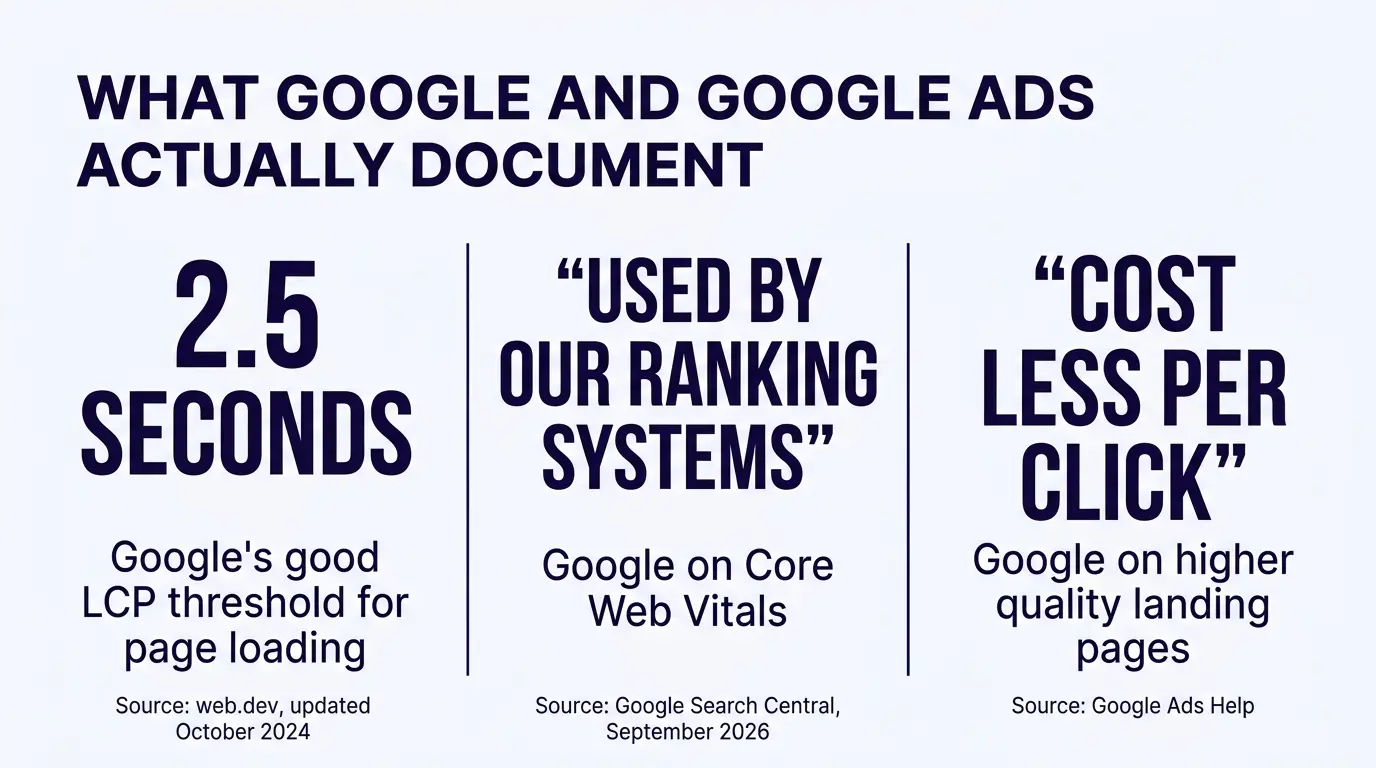
Every dollar you spend on digital marketing passes through your website before it becomes a client. Google says plainly that ad quality includes the experience someone has once they click through to your landing page, and that higher quality ads cost less per click1. Google also says Core Web Vitals, the technical speed and stability signals, are used by its ranking systems2. If the page your ads, your SEO, and your social posts all point to is slow, generic, or doesn't actually answer what the visitor came for, you are paying full price for traffic that never had a real chance to convert. The fix isn't more marketing. It's the foundation every channel depends on.
The campaign worked. The website didn't
Somebody searched "Medicare Advantage plans near me," or clicked a Facebook ad for final expense coverage, or typed your agency's name into Google after seeing your truck wrap. The marketing did its job. It got a real person, actively interested in what you sell, to click through to your site.
Then they left. Not because they weren't interested. Because the page took five or six seconds to finish loading on their phone, or it opened to a stock photo and a paragraph about "trusted service since 2009" with no clear next step, or the contact form asked for a name and email and then nothing happened for two days. The marketing spent money to create a moment of interest, and the website spent that moment badly.
This is the part of digital marketing nobody sells you, because it isn't a channel. It's not a platform you can buy ads on or a service you can hire out in isolation. It's the page underneath every channel, and if it's weak, you are quietly discounting the return on everything else you pay for, SEO, paid ads, social media, email, review requests, all of it.
Run the numbers on your own funnel for a second. If your website converts one in a hundred visitors into a lead instead of three in a hundred, you need to triple every number upstream, every ad dollar, every SEO hour, every social post, just to land the same number of leads you'd get from a site converting at three percent. Nobody frames it that way when they're deciding whether to add another $500 a month to the ad budget, but that's the actual math. A weak website doesn't just lose some leads. It silently triples the cost of every lead you still manage to get.
A two minute check
Pull up your own site on your phone, on cellular data, not office wifi. Time how long it takes before you can actually read the headline and tap something. If you count past three seconds, a real prospect, mid scroll, comparing you to two other agents, counted with you.
Why marketing budget and website quality got disconnected
This isn't a story about agents who don't care about their website. It's a story about how agency marketing budgets usually get built. The website gets built once, early, often on whatever platform a prior marketing vendor or a well meaning relative set up. It's treated as a fixed cost, a thing you paid for once and now own, like a sign on the building.
Everything that comes after, the ad spend, the SEO retainer, the social media management, gets treated as the active, ongoing part of marketing, the part you can turn a dial on. So when leads slow down, the instinct is to turn the dial you can see: more ad spend, a new SEO contract, a social media posting schedule. The website, the one thing every single one of those dollars has to pass through, never gets revisited, because nobody built a line item for revisiting it.
We see this pattern constantly in the agencies we talk to. An agent will describe, in detail, exactly what they're spending on three or four different marketing vendors, down to the dollar, and then describe their own website in one sentence: "a guy set it up a few years ago." Nobody budgets to revisit the thing every other budget line depends on, because it was never framed as an ongoing cost in the first place. It was framed as a one time project, finished the day it went live, even though the marketing pointed at it never stopped evolving.
Templates and page builder platforms make this worse in a specific, measurable way. A GoHighLevel funnel page, a WordPress site running a visual page builder, a Wix or Squarespace site, all of them load a runtime, a theme engine, and often a stack of plugins before your actual content appears on screen. A static, Astro built site renders to finished HTML at build time, so the browser downloads a page that's already done instead of downloading a framework, booting it, and then drawing the content. That architectural difference is most of the speed gap between a templated agency site and a site built to be fast from the ground up, and it's not something a plugin or a setting fixes after the fact.
There's a second, quieter disconnect worth naming: who actually owns the thing all this traffic lands on. A lot of agency websites live on a platform the agent is renting, a funnel builder tied to a marketing vendor's account, a theme licensed through a subscription, a domain pointed at someone else's hosting. If the vendor relationship ends, the ad campaigns and the SEO work keep existing, but the page they point to can disappear or go dark overnight. Marketing spend compounds when it's building equity in something you own. It resets every time the something it's pointed at changes hands.
What actually decides whether a click becomes a lead
Two separate but related systems decide this, and both of them are documented by the platforms themselves, not guessed at by marketers.
The first is Google's Core Web Vitals, a set of three measured values: Largest Contentful Paint (LCP), how long until the main content finishes rendering; Interaction to Next Paint (INP), how quickly the page responds once someone taps or scrolls; and Cumulative Layout Shift (CLS), whether things jump around while loading. Google's own web.dev documentation sets the "good" threshold at 2.5 seconds or less for LCP, 200 milliseconds or less for INP, and 0.1 or less for CLS, each measured at the 75th percentile of real page loads, split between mobile and desktop devices3. Google's Search Central documentation states directly that "Core Web Vitals are used by our ranking systems," while also being clear there's no single factor and that its core ranking systems weigh "a variety of signals that align with overall page experience"2. Page experience is one input among many, and content relevance still does most of the work, but it is a documented input, not a theory.
The second is Google Ads Quality Score, which runs independently of organic ranking but follows a similar logic. Google's own help documentation states that ad quality includes "the quality of their experience once they reach your landing page," and that "higher quality ads typically cost less per click than lower quality ads." It adds that with a low quality ad, "your actual CPC is close to your maximum CPC" even when competition for the keyword is light1. In plain terms, Google rewards ads that send people to pages Google judges to be a good match and a good experience, and it charges more per click for ads that don't.
Neither system cares what platform built your website or how much you spent on it. Both measure the thing the visitor actually experiences.
Google breaks Quality Score itself into three separate components, each rated above average, average, or below average: expected click through rate, the likelihood your ad gets clicked when it's shown; ad relevance, how closely your ad matches what the person actually searched for; and landing page experience, described in Google's own words as "how relevant and useful your landing page is to people who click your ad"4. Notice that two of the three components are about the ad itself, the words and the targeting, which most agents already pay an agency or a platform to manage carefully. The third component, landing page experience, is the one most agents never touch after the site first went live, even though it's rated on every single auction the same way the other two are.
What this is not
This is not a claim that fixing your website alone will fix your ranking or lower your cost per click by a specific amount. Google does not publish a formula linking page speed to a dollar figure, and nobody honestly can. What's documented is the direction: a weak landing page costs you more per click and gets weighed against you in ranking. The size of the effect is specific to your market, your competitors, and your current baseline.
What a weak website costs every channel you already pay for
Here's a worked example, built to illustrate the mechanism, not to claim it's your exact number. Say you run Google Ads for "medicare advantage plans" style keywords, and your current average cost per click is $35, a plausible figure for competitive insurance keywords but not one we're asserting as a verified average. If Google rates your landing page experience below average because it loads slowly and doesn't clearly answer the search, your actual cost per click drifts toward your maximum bid instead of settling lower, the exact pattern Google's own documentation describes1. On a modest $1,500 monthly ad budget, that's the difference between roughly 43 clicks at $35 and meaningfully fewer at a higher effective rate, before you even get to how many of those visitors actually convert once they land. The ad platform is charging you a premium for sending traffic to a page it doesn't rate well, on top of whatever that page already loses in abandoned visits.
SEO carries a quieter version of the same cost. Writing a thorough, well sourced page about a topic your buyers search for is real work, and it's wasted if the page it lives on can't clear the technical bar search engines check before content quality even enters the picture. An agency paying for a blog post every week, on a site that takes four or five seconds to paint on mobile, is paying twice: once for the content, and again in the ranking ceiling a slow page quietly imposes before the content gets evaluated on its own merits.
Social media and referral traffic lose differently. Nobody charges you per click when someone taps the link in your Instagram bio or clicks a link you texted a referral, so there's no visible toll the way there is with paid ads. The cost shows up as a dead end instead: a visitor who was already warm, already inclined to trust you, landing on a page that doesn't match the specific thing they came for and leaving without converting. That's not a cost you can calculate in dollars per click. It's a cost you can only see in how many of those warm visitors never become a lead at all.
| What you're seeing | Likely cause | Where to check |
|---|---|---|
| Cost per click keeps climbing | Below average landing page experience in Quality Score | Google Ads, Landing page experience column, per keyword |
| Lots of clicks, almost no leads | Page doesn't match what the ad or search promised | Bounce rate and time on page in your site analytics |
| Blog posts published, rankings flat | Technical speed or crawl issues capping every page's ceiling | PageSpeed Insights and Search Console's Core Web Vitals report |
| Social traffic arrives, converts at near zero | Clicks land on the homepage instead of a matching page | Which URL each social link actually points to |
| Form submissions, no follow through | Form asks generic questions instead of the ones that line of business needs | Compare your form fields against what your producers actually ask on the call |
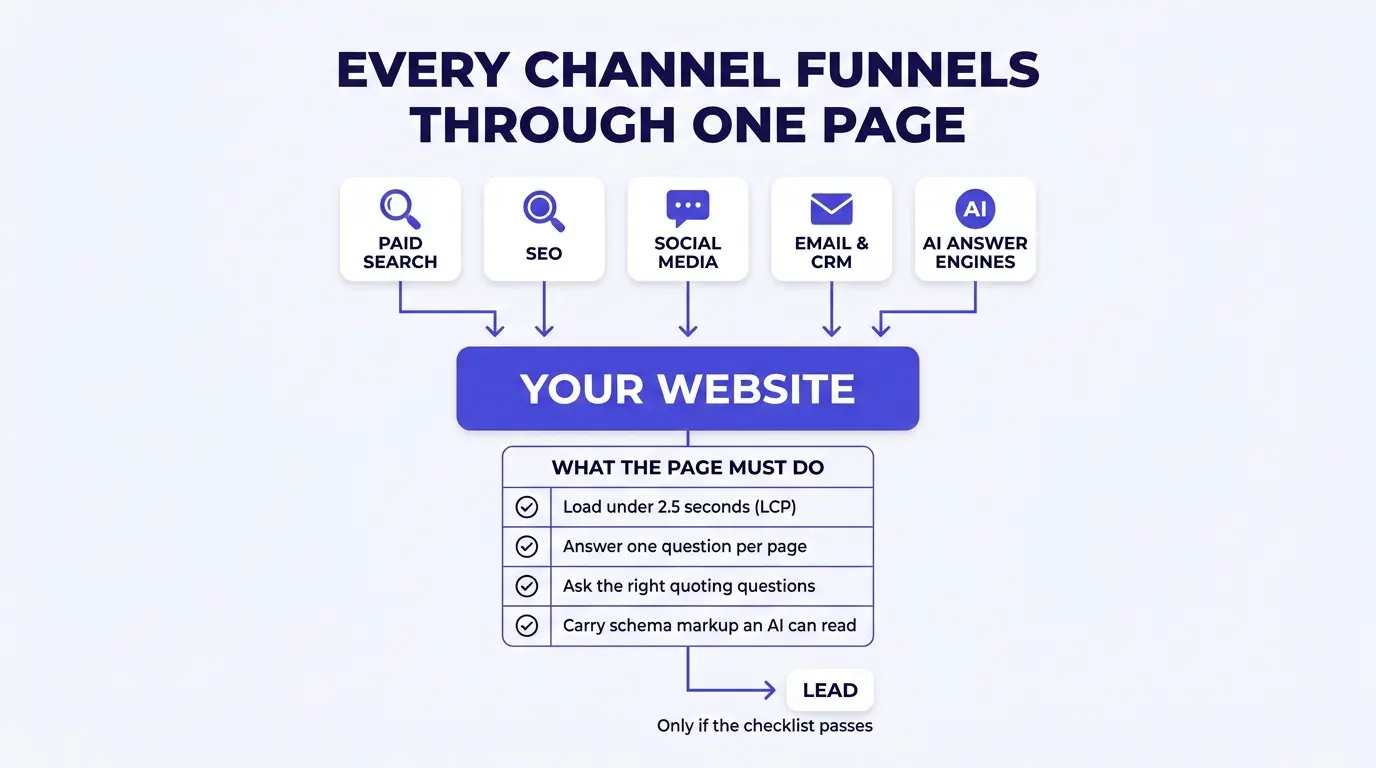
What a conversion ready website needs before you spend another dollar
None of this requires hiring anyone, and we'll say that plainly before describing how we build it. The checklist below is the actual method, not a teaser for a sales call.
Work through it in order. Speed and page structure come first because nothing else matters if the visitor never sees the content. Forms and calls to action come next because they're what turns an engaged visitor into a lead. Schema and crawler files come last, not because they matter less, but because they only pay off once the first two are solid, a well structured page describing bad content is still bad content, just more legible to a machine.
Speed that clears the bar
Under 2.5 seconds for Largest Contentful Paint on mobile, the "good" threshold Google itself publishes. Test your own pages with PageSpeed Insights before assuming you're fine.
One page, one question
Your Medicare page answers Medicare questions. Your auto page answers auto questions. A page trying to be the answer to five different searches at once loses to a focused competitor on all five.
Forms that ask the right questions
A generic "name, email, message" box forces every visitor through the same funnel regardless of what they actually need, and it's the first thing a rushed prospect abandons.
A real next step, stated plainly
Not "learn more." A specific action: get a quote, book a call, run a free audit. Vague calls to action get vague results.
Schema markup that matches the page
Structured data describing what the page actually offers, so search engines and AI systems can read it correctly instead of guessing.
A sitemap and llms.txt that stay current
Every new page you publish should register itself automatically. A sitemap that's months stale tells a crawler your site isn't maintained, even when it is.
If you want to know where your own site stands
The free Audit checks your current site's speed, structure, and AI citation readiness in under a minute. Run a free Audit before you decide what to fix first.
What each marketing channel needs from your website
"Digital marketing for insurance agents" isn't one thing. It's a handful of different channels, and each one depends on the website in a slightly different way. Knowing which dependency is broken tells you exactly what to fix first.
Most agencies build their budget channel by channel instead of dependency by dependency. An agency might spend $1,000 a month on Google Ads, $800 on an SEO retainer, and a few hours a week on social media, and treat each of those as a separate line item with its own separate success or failure. In practice they share one point of failure. If that point fails, all three budgets underperform at once, and because the failures show up differently in each channel, slow conversions here, flat rankings there, dead clicks somewhere else, it's easy to diagnose each one separately and miss that they're the same problem wearing three different outfits.
| Channel | What it needs from the site | What breaks without it |
|---|---|---|
| Paid search | A fast, relevant landing page matched to the exact ad and keyword | Higher cost per click, lower ad position, wasted spend |
| Organic SEO | Technical speed, clean crawlability, a dedicated page per topic | Content ranks below the ceiling a slow or generic site imposes |
| Paid and organic social | A landing page that matches the specific post or offer, not a generic homepage | Warm, interested clicks land on an unrelated page and leave |
| Email and CRM nurture | A page built for the exact link clicked, with one clear next step | Already engaged leads go cold at the last step |
| Local and Google Business Profile | A site and listing that agree on category, name, and service area | Map pack visibility suffers independent of website quality |
| AI answer engines | Structured, sourced, machine readable pages with real schema | The site is never the source an AI assistant names |
Look at that table and notice what's missing: a column for "budget." Every channel's dependency is architectural, not financial. You cannot out-spend a slow landing page. You can only fix it.
Local and Google Business Profile deserves its own note, because it's the one channel where the dependency runs partly in the other direction. Your Business Profile listing feeds information into Google's local results and increasingly into its AI generated answers, independent of your website's speed. But the category you select, the services you list, and the website link you point to still have to agree with what's actually on your site, or you create a mismatch that confuses both the person looking at your listing and the system deciding how much to trust it. Fixing your website doesn't fix a mismatched or outdated Business Profile. It does remove one more reason for that mismatch to exist.
The newest channel: getting named in an AI answer
A growing share of insurance shoppers now ask ChatGPT, Perplexity, or Google's AI Overview a question directly instead of typing it into a search box and scrolling through ten blue links. Treat this as a channel with its own requirements, because it is one, and it depends on the same foundation as everything else with one addition: the page has to be structured for a machine to read and quote, not just for a person to scroll through.
That means an answer sitting in the first paragraph, not buried after three paragraphs of agency history. It means real schema markup, FAQPage and BreadcrumbList and Organization data that match what's actually on the page, not boilerplate copied from a template. And it means a named, real source for every figure you publish, because an AI system deciding whether to quote you is deciding whether it can trust you, and a page full of unsourced numbers doesn't earn that trust any more than it earns a human reader's.
None of that works if the page underneath it is slow or poorly structured to begin with. AI crawlers still have to fetch and render your pages, and a site that's expensive to crawl because it depends on a heavy JavaScript runtime is easier for a crawler to skip than a site that arrives as finished HTML.
There's also a plumbing piece most agents never see because it happens automatically or doesn't happen at all. A sitemap and an llms.txt file, a plain text index of your pages aimed at AI crawlers, tell these systems what exists on your site and when it changed. If your site doesn't generate those automatically, every new page you publish sits invisible until someone remembers to update a file by hand, which on most agency sites means it never gets updated at all. A page that's genuinely well written and well sourced still can't get cited if the crawler never learns it exists.
None of this replaces the SEO and content work covered in our guide to insurance agency SEO. It's the layer underneath that work, the one that decides whether the content work you're already paying for even has a chance to be seen.
How we build the foundation under all of it
We re-fetched our own Digital Foundation pricing page live while writing this guide, the same standard we hold every other number in this article to5. The Website tier, $84 a month billed annually, ships a complete site with 30 pages live on launch day, built around the services you actually sell rather than a generic local business template retrofitted after the fact. Starter, $247 a month, adds a weekly publishing cadence and Google Business Profile management. Pro, $497 a month, adds up to 17 new pages a month and a 24/7 AI voice receptionist. Scale, $997 a month, scales content to roughly one new page every business day. A one time Full Clone option, with no ongoing subscription, runs $1,0005.
We build on Astro, which ships zero JavaScript to the browser by default, so a page arrives as finished HTML instead of a runtime a visitor's phone has to download and boot before anything appears. Page builder platforms, GoHighLevel funnel pages, WordPress with a visual builder, Wix, Squarespace, load a runtime and plugins before the content shows up. Our builds score 90 or higher on Lighthouse performance for both mobile and desktop, and some score 100. Every page ships with schema markup that matches its actual content, and the sitemap and llms.txt file update themselves with the full URL the moment a new page publishes, so a new campaign landing page doesn't sit invisible to search engines and AI crawlers because someone forgot a manual step.
What changes once the foundation is right
None of this promises a specific ranking position, a traffic number, or a lead count, because no one can honestly promise those. What changes is more concrete than that, and it compounds across every channel you're already running instead of requiring a new one.
2.5s
Google's own "good" LCP threshold your landing pages should clear
1:1
One dedicated, answer-first page per service or question you want leads for
90+
Lighthouse mobile and desktop target on a rebuilt site
0
Manual steps to register a new page with the sitemap and llms.txt
A paid click that lands on a fast, matching page costs less and converts more than the exact same click landing on a slow, generic one. An SEO page built on a site that already clears the technical bar gets evaluated on what it actually says instead of losing before it starts. A warm referral or social click lands somewhere that matches what made them click in the first place. None of that is a new channel. It's the same marketing you're already paying for, finally reaching the person it was supposed to reach.
And it compounds in a specific, practical way for agencies that sell seasonal products on top of year round ones. The weeks around the Medicare Annual Enrollment Period are when a Medicare focused agency spends the most on ads in the shortest window of the year. A landing page problem that quietly inflates cost per click or loses visitors in those few weeks does more damage, in dollar terms, than the exact same problem would during a slower month, simply because more budget is moving through the same leaky page at once. Fixing the foundation before your highest spend weeks arrive is worth more than fixing it during them.
You can do this yourself
Checking your Core Web Vitals, splitting a crowded services page into dedicated pages, and rewriting a vague contact form are all things a lot of agents are capable of doing on whatever platform they're already running. Some will read this and decide they'd rather pay someone to handle it. Either outcome is fine. The point is knowing which one you're choosing and why.
Questions agents ask about marketing and their website
Does a slow website actually affect what I pay for Google or Meta ads?
Google says plainly that ad quality, which includes "the quality of their experience once they reach your landing page," factors into Quality Score, and that "higher quality ads typically cost less per click than lower quality ads." Google also states that with a low-quality ad, your actual cost per click runs close to your maximum bid even when competition for the keyword is light. Google's own help documentation does not spell out page speed as its own line item inside that landing page experience factor, so be careful not to overstate the mechanism. What is documented is this: a landing page that performs poorly for the person who clicks, slow, confusing, or not actually answering what the ad promised, lowers your assessed ad quality, and lower ad quality costs more per click. A fast, relevant, single-purpose landing page is one of the few things in paid search you control completely and that Google explicitly rewards.
I already pay someone for SEO. Why isn't it working?
The two most common reasons are a site that cannot physically pass the technical bar search engines check, and content that never answers the specific question a buyer typed. SEO work on a slow, JavaScript heavy, template built site is work spent fighting the platform instead of fighting competitors. You can write a perfect page about Medicare Advantage enrollment deadlines, and if the page takes six seconds to paint on a phone, you are competing with one hand tied. Before paying for more SEO work, check whether the foundation underneath it, the actual code the browser has to download and run, is even capable of holding a ranking once the content earns one.
Should I fix the website first or keep running ads while I fix it?
You do not have to stop running ads to fix your site, and stopping entirely usually costs you more in lost momentum than it saves. What is worth doing immediately is routing a portion of your ad budget, even 10 to 20 percent, to a single rebuilt landing page for your highest volume campaign, and comparing its performance against your current page over two to four weeks. That gives you a real, measured answer specific to your own agency instead of a guess, and it tells you how much of your current spend is actually reaching people versus how much is leaking at the page.
How much website do I actually need before digital marketing is worth doing at all?
At minimum: a site that loads fast on a phone, a dedicated page for each product or service you actually want leads for, a form or quoter that asks the right questions for that specific line instead of one generic contact box, and basic schema markup and a sitemap so search engines and AI systems can read the site correctly. None of that requires your full site to be finished. It does mean your highest priority landing pages, the ones your ad budget and SEO work point to, need to clear that bar before more marketing spend on top of a weak foundation makes sense.
Does posting on social media count as digital marketing if my website can't convert the traffic?
It counts as visibility. It does not count as marketing that pays for itself until the page someone lands on after clicking your profile link or your post actually does something: states what you offer, to whom, and gives them an obvious next step. A lot of agents measure social media by likes and followers because that is what the platform shows them first. The number that actually matters is what happens after someone leaves the platform and lands on your site, and that number lives in your own analytics, not the platform's.
Do I need a separate landing page for every single ad campaign I run?
Not every campaign, but every distinct offer or audience should have its own matching page rather than all of them pointing at your homepage. If you're running one campaign for Medicare Advantage during the Annual Enrollment Period and a separate one for final expense coverage year round, those two campaigns are selling fundamentally different things to different people, and a shared landing page forces both audiences to wade through content meant for the other one. A good rule of thumb: if you had to write a different headline for the ad than what your homepage says, the ad needs its own page. You don't need fifty pages for fifty ad variations. You do need a page per distinct offer, built around the specific question or need that offer is answering.
How much does a website built to support all of this cost?
We re-fetched our own pricing live while writing this guide, the same standard we hold every number in it to. Our Digital Foundation Website tier runs $84 a month billed annually and ships a complete, 30 page site live on launch day. Starter runs $247 a month and adds a weekly publishing cadence, Google Business Profile management, and an AI chat widget. Pro runs $497 a month and adds up to 17 new pages a month and a 24/7 AI voice receptionist. Scale runs $997 a month and adds roughly one new page every business day. A one time Full Clone option, a copy of a Website tier build with no ongoing subscription, runs $1,000. Those are the live prices on our own service page as of this writing, not an estimate.
Sources
- Google. "About ad quality." Google Ads Help: ad quality includes "the quality of their experience once they reach your landing page"; "Higher quality ads typically cost less per click than lower quality ads"; with a low quality ad, "your actual CPC is close to your maximum CPC." Fetched live October 28, 2026. support.google.com/google-ads/answer/156066.
- Google. "Understand page experience in Google Search results." Search Central Documentation: "Core Web Vitals are used by our ranking systems"; "there is no single signal... our core ranking systems look at a variety of signals that align with overall page experience." Last updated 2026-09-22. Fetched live October 28, 2026. developers.google.com/search/docs/appearance/page-experience.
- web.dev (Google). Core Web Vitals thresholds, measured at the 75th percentile of page loads, segmented by mobile and desktop: LCP good is 2.5 seconds or less, needs improvement up to 4.0 seconds, poor above that; INP good is 200 milliseconds or less, needs improvement up to 500 milliseconds, poor above that; CLS good is 0.1 or less, needs improvement up to 0.25, poor above that. Page last updated 2024-10-31. Fetched live October 28, 2026. web.dev/articles/vitals, web.dev/articles/lcp, web.dev/articles/inp, web.dev/articles/cls.
- Google. "Quality Score: what it is and how it's calculated." Google Ads Help, on the three Quality Score components: expected click through rate, ad relevance, and landing page experience, defined as "how relevant and useful your landing page is to people who click your ad." Fetched live October 28, 2026. support.google.com/google-ads/answer/6167118.
- Strategic AI Architects. Digital Foundation service page: Website $84/mo billed annually (30 pages live on launch day); Starter $247/mo (weekly publishing cadence, Google Business Profile management); Pro $497/mo (up to 17 new pages/mo, 24/7 AI voice receptionist); Scale $997/mo (roughly one new page per business day); Full Clone $1,000 one time. Fetched live October 28, 2026. strategicaiarchitects.com/digital-foundation.
Talk it through
Want a second pair of eyes on it?
Free 30 minutes. Bring what you found, or bring nothing and we will look together at how AI engines read your site and which fixes move first.
See where your own marketing dollars are actually landing
Run a free Audit and see how your site scores on speed, structure, and AI citation readiness, in about a minute, before you spend another dollar on ads, SEO, or social media.
Related reading: Why your insurance agency's cost per lead keeps climbing · Insurance agency SEO in 2026: what actually moves you up · Why your insurance website fails Google's speed test