Playbook
Your Website's Testimonials Might Already Be a Violation
Insurance agency reviews and client testimonials look like simple marketing copy. They're actually governed by at least three separate bodies of law, and most agency CRMs were never built to track any of them.


21 min read
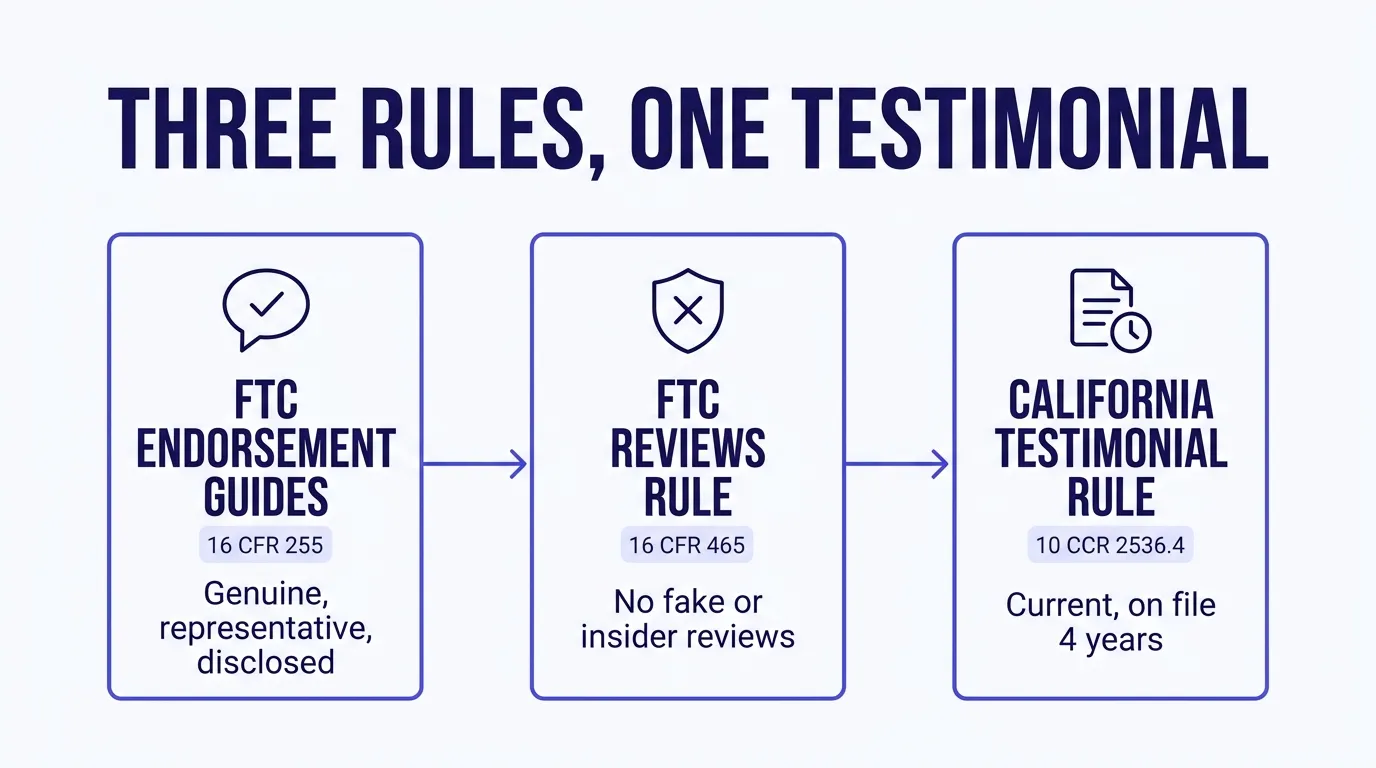
A testimonial on your website answers to three rules at once. The FTC's Endorsement Guides at 16 CFR 255 require it to be genuine and representative, with any material connection disclosed1. The FTC's 2024 Rule on the Use of Consumer Reviews and Testimonials, 16 CFR 465, separately bans fake, insider, and suppressed reviews, effective since October 21, 20242. And at least one state, California, layers an insurance-specific rule on top, requiring testimonials to be current, applicable to the policy advertised, and kept on file for four years4. Violating an FTC rule can run up to $53,088 per violation under the 2025-adjusted maximum3, and 49% of consumers already trust a review as much as a personal referral, so a weak or noncompliant reviews page costs you twice6.
The quote on your homepage and what's actually backing it up
Somewhere on your website there's probably a section that says something like "What Our Clients Say," with three or four short quotes under first names and last initials: "Jenny helped us find a plan that actually covered our daughter's medication," that kind of thing. Maybe there's a screenshot of a five-star Google review pasted in as an image. Maybe the quotes were pulled from a text message a happy client sent two years ago and cleaned up a little so they'd read better on the page.
None of that feels like it needs a compliance review. It's not a quote form collecting a condition or a medication, it's not an ad claiming a specific premium, it's just proof that real people had a good experience. That instinct is exactly why testimonials are one of the most under-examined pieces of content on an agency site: they feel like social proof, not advertising, so nobody runs them past the same checks as a rate flyer or a Facebook ad.
They are advertising, under federal law and, in a growing number of states, under insurance law specifically. A testimonial is a representation that a product or service worked, made by someone the reader is meant to trust more than the business making the pitch. That's precisely what the FTC's endorsement rules exist to police, and it's precisely the category state insurance regulators have written specific rules for since long before anyone had a website at all.
It also happens to be some of the highest-converting content on the page. A visitor reading your testimonials section has typically already decided your agency is a plausible option; what they're looking for is confirmation that someone like them had a good outcome. That's a lot of persuasive weight to put on four quotes nobody has checked in a while, and it's exactly why regulators treat the format as worth writing specific rules for, rather than leaving it to fall under generic advertising law alone.
Worth checking before you read further
The free Audit flags common AEO and compliance gaps on your live site in about a minute, including whether your reviews content is structured the way search and answer engines expect. strategicaiarchitects.com/audit.
Why one piece of marketing copy answers to three bodies of law
Most agency owners who've thought about review compliance at all have thought about one thing: not routing happy and unhappy customers to different places, the practice called review gating. That's a real rule, and it's worth understanding, but it's only one rule, and it governs how you solicit reviews, not what you're allowed to put on the page once you have them.
The testimonial itself, the actual words quoted on your homepage, sits under a completely different set of requirements, layered three deep. The first layer is general advertising law that applies to every business in the country: the FTC's Endorsement Guides. The second layer is a newer, more specific federal rule written directly at the review and testimonial format, adopted in 2024. The third layer is whatever your own state's insurance code says about testimonials in insurance advertising, which in a number of states is older and more detailed than either federal rule. An agency can be perfectly clean on review gating and still be running a testimonials section that violates two or three of these at once, because nobody who built the "What Our Clients Say" section was thinking about any of them.
There's also a practical mechanism behind why this slips through, and it has nothing to do with anyone cutting corners on purpose. A testimonials widget, whether it's a hand-built section in a page builder or a plugin that pulls in Google reviews automatically, treats every quote the same way: text in, text displayed. Nothing in that pipeline asks when the quote was given, whether the client is still a client, whether the person is related to anyone on staff, or whether the words on the page still match what the client actually said. The system has no concept of "testimonial provenance," so the compliance questions these three rules ask never get triggered, not because anyone decided to skip them, but because nothing in the tooling ever surfaces them.
Rule one: the FTC's Endorsement Guides, 16 CFR 255
The FTC's Endorsement Guides are the oldest and broadest of the three. They're not a law Congress passed; they're the FTC's own interpretation of Section 5 of the FTC Act, the general ban on unfair or deceptive practices, as it applies to endorsements and testimonials specifically. The current version was adopted in a final rule published July 26, 2023, and sits at 16 CFR Part 2551.
Two provisions matter most for an agency's testimonials section. Under 255.2, an advertisement containing an endorsement about a central or key attribute of the product is read as representing that the endorser's experience is what consumers will generally achieve. In plain terms: if your testimonial says "SAA Insurance found me a plan $200 cheaper a month," the regulation treats that as an implied promise that most clients get similar savings, unless you either have substantiation that this is typical or clearly disclose what's generally achieved instead1. Under 255.5, any material connection between you and the endorser that a reader wouldn't already expect, a family relationship, an employee, a gift or payment for the review, has to be clearly and conspicuously disclosed, not left implied1.
Neither provision bans testimonials. Both require that a testimonial represent something true and typical, stated plainly, with any hidden relationship surfaced rather than buried.
Rule two: the FTC's 2024 reviews and testimonials rule, 16 CFR 465
The Endorsement Guides are interpretive guidance. 16 CFR Part 465 is an actual trade regulation rule, with civil penalty authority behind it, adopted specifically to target fake and manipulated reviews. It became effective October 21, 20242, and four of its provisions are the ones an agency's testimonials page needs to clear.
Section 465.4 bars creating, buying, selling, or otherwise procuring a fake consumer review, meaning one that misrepresents that it reflects the reviewer's own actual experience with the business2. Section 465.5 covers insider reviews: a business's officers, managers, employees, or their immediate family members writing or sharing a review about that business without clearly disclosing the relationship2. Section 465.6 prohibits a business from creating or operating a fake independent review platform, one that misrepresents itself as unaffiliated when it's actually company-controlled2. And section 465.7 bars suppression, which includes threatening or intimidating someone over a negative review and misrepresenting that the reviews displayed on your site represent all or most of the reviews actually submitted2, the provision most directly connected to the review-gating issue covered elsewhere on this site.
A testimonial your agency genuinely received, worded the way the client actually said it, from someone with no undisclosed connection to the business, clears 465 without difficulty. The failure cases are specific and avoidable: writing a glowing review yourself and attributing it to a composite "client," having your spouse or an employee post a five-star review with no disclosure that they work for you, or curating your testimonials page so heavily that it no longer resembles the actual mix of feedback the agency receives.
| Section | What it bans |
|---|---|
| 465.4, fake reviews | Writing, buying, selling, or procuring a review that doesn't reflect the reviewer's genuine experience. |
| 465.5, insider reviews | An owner, manager, employee, or their immediate family reviewing the business without disclosing the relationship. |
| 465.6, fake review sites | A company-controlled site or page that misrepresents itself as an independent review platform. |
| 465.7, suppression | Threatening reviewers over negative reviews, or implying a displayed review set represents all reviews received. |
Rule three: your state's insurance-specific testimonial regulation
Federal rules apply everywhere, but insurance is regulated state by state, and a number of states have had testimonial-specific rules in their insurance code for decades, written for print ads and brought forward largely unchanged into the web era. California's is one of the most detailed and a useful model for what this layer typically requires: 10 CCR 2536.4 governs testimonials and endorsements by third parties in disability insurance advertising4.
Under that regulation, a testimonial must be genuine, must represent the current opinion of the person who gave it, and must be applicable to the policy being advertised, not borrowed from a review of a different product4. If a testimonial is used more than a year after it was originally given, the insurer must obtain a confirmation that the opinion still holds4. Any financial interest the endorser has in the insurer must be disclosed, and a paid endorsement must be identified as one4. And the insurer has to retain the underlying claim and verification data, including the date the testimonial was given, for inspection by the Commissioner for four years4, which functionally means someone at the agency needs to be able to produce proof a testimonial is real on request, not just the quote itself.
Illinois administrative rules similarly bar testimonials that don't correctly reflect the insurer's current practices or that aren't applicable to the specific policy or benefit being advertised, and Connecticut's regulation on third-party testimonials and endorsements in accident and sickness advertising covers much of the same ground: the testimonial has to reasonably reflect the current relationship between the endorser and the insurer, and it has to be clear whether the person giving it is an actual policyholder or simply a paid spokesperson. Neither state frames this as a web-specific rule, because both predate agency websites by decades, but neither carves out an exception for digital advertising either. A testimonial published on a homepage is advertising under these regulations exactly the way a printed brochure or a newspaper ad was when the rule was written.
The pattern across states is consistent even where the specific wording isn't: genuine, current, applicable, and disclosed if there's a financial relationship. Because this layer is state-specific and changes state by state, and because many independent agents and FMOs hold licenses in more than one state at once, the safest posture is to build to the strictest version you're subject to rather than track each state's rule separately for every testimonial. In practice, that means treating every testimonial as if California's four-part standard, genuine, current, applicable, retained, applied to it, regardless of which state actually licenses the agency publishing it.
Check your own state's regulation before relying on this summary
Insurance testimonial rules vary by state and by line of business, and some states regulate this through case law or bulletins rather than a standalone regulation. Confirm your own state's current rule with your state insurance department or counsel before treating any single state's text as universal.
This is a different problem than review gating
It's worth being precise about the difference, because the two problems get conflated often enough that fixing one can leave an agency thinking it's handled both. Review gating is about the ask: filtering customers by predicted sentiment before deciding who gets invited to leave a public review5. That's a 465.7 suppression issue and a Google Business Profile policy issue, and it happens upstream of any specific testimonial existing at all.
This guide is about what happens after you have reviews and testimonials in hand: whether the specific words on your website are genuine, current, properly attributed, and disclosed where a relationship exists. An agency that fixed its CRM's review-request workflow last year, so it no longer filters by sentiment, can still have a homepage testimonials section built from quotes nobody has verified in three years, some lightly rewritten for flow, with no record of who said what or when. Both problems are real, and they require different fixes.
What getting it wrong actually costs
Start with the downside. The FTC enforces both the Endorsement Guides and 16 CFR 465 through Section 5 of the FTC Act, and civil penalties for rule violations adjust for inflation every January. The current maximum under Section 5(m)(1)(A), the provision covering knowing violations of an FTC trade regulation rule, is $53,088 per violation, effective January 17, 20253. The rule doesn't carry a private right of action, meaning an unhappy client can't personally sue your agency under 16 CFR 465, but the Commission itself can bring an enforcement action, and the penalty is assessed per violation, not per case, which is the same structure that makes HIPAA's per-violation penalties add up faster than agencies expect.
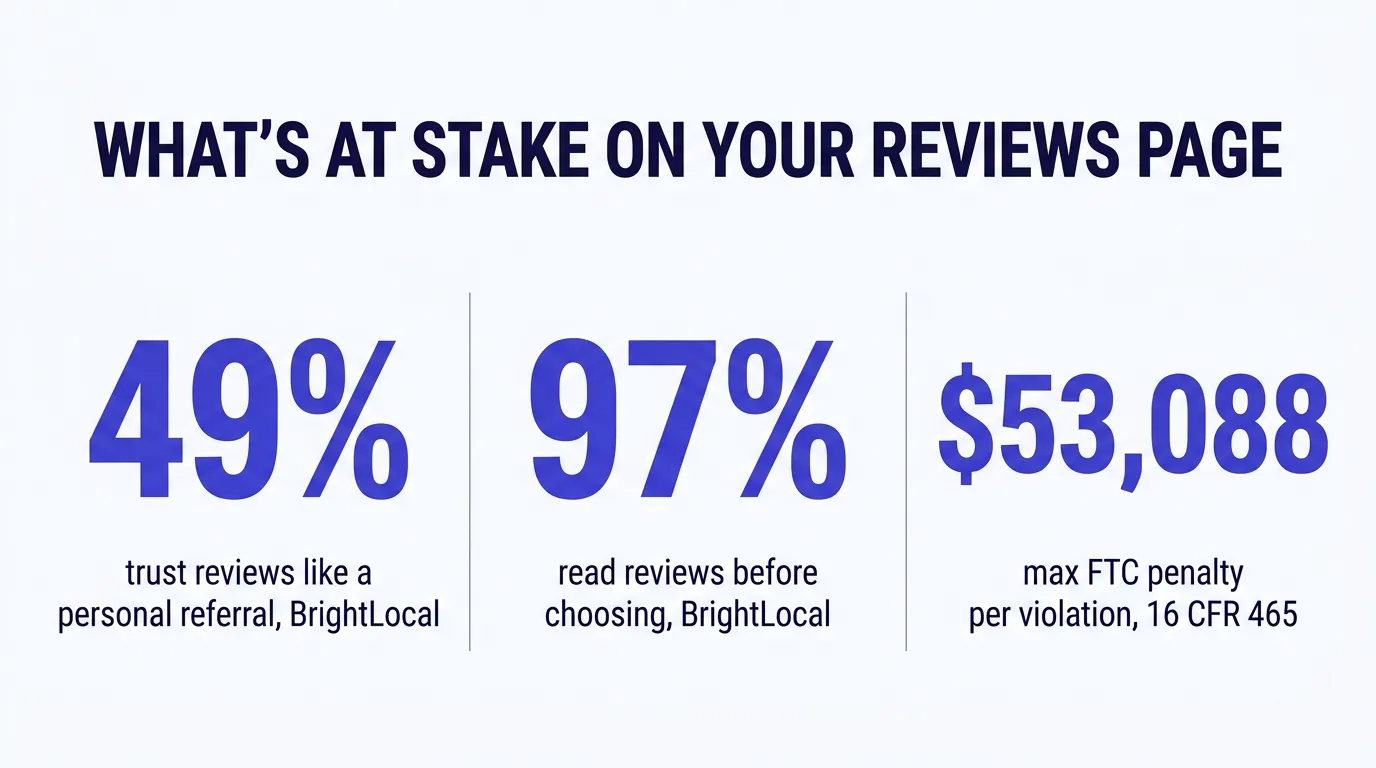
Now the upside you're risking by getting it wrong. BrightLocal's 2026 Local Consumer Review Survey, drawn from a panel of 1,002 US adult consumers, found that 97% of consumers read online reviews before choosing a local business, and 49% now trust an online review about as much as a personal recommendation from someone they know6. The same survey found 47% of consumers won't use a business with fewer than 20 reviews, and 68% require at least a 4-star average before they'll consider a business at all6. Reviews aren't a nice-to-have section on an agency site, they're one of the heaviest-weighted trust signals a prospect checks before ever picking up the phone.
Put the two halves together and the real cost of getting this wrong isn't just a hypothetical FTC fine. It's an agency either leaving a powerful trust signal off the table out of uncertainty, or running one built on quotes nobody can verify, which is exactly the version that's both legally exposed and, if it ever has to come down, the one that does the most damage to a prospect's trust right when they're deciding who to call.
A worked example: auditing a twelve-testimonial homepage
Put the three rules side by side against a realistic page. An agency's "What Our Clients Say" section carries twelve quotes, built up over about four years with no particular process behind any of them. Running each one against the checklist below is what an actual review would look like.
Eight of the twelve hold up without changes: recent, attributed to a named client, quoted close to verbatim, no relationship to the agency beyond being a customer. Three are over a year old, one of them nearly four years old, with no record that anyone checked whether the client still feels the same way, which is exactly the gap California's rule addresses by requiring a reconfirmation past the one-year mark4. One was written by the office manager's sister, who is also a client, phrased like any other testimonial with nothing to flag the relationship, a straightforward 255.5 disclosure gap1 and, because she's immediate family of someone managing the agency's operations, arguably an insider review under 465.52 as well.
None of that requires taking the page down. The fix is three small actions: reach out to the three clients behind the stale quotes and either get a fresh confirmation or retire the testimonial, add a one-line disclosure to the office manager's sister's quote noting the relationship, and start a simple log, client name, date given, date last confirmed, so the next audit takes five minutes instead of a full afternoon of guesswork. That's the entire difference between a testimonials page that's technically exposed and one that isn't, and none of it required removing content that was actually working.
| Practice | Allowed | Not allowed |
|---|---|---|
| Trimming a long quote | Cutting whole sentences for length | Rewriting the remaining words to sound better |
| A client who's a relative or employee | Featuring their quote with the relationship stated | Featuring it with no disclosure at all |
| A testimonial older than a year | Reconfirmed with the client, then kept live | Left up indefinitely with no check-in |
| Curating which reviews to show | Featuring a representative sample of positive feedback | Hiding so much negative feedback that the displayed set misrepresents the whole |
| A testimonial written for one product | Used on that product's own page | Reused under a different policy type it was never about |
The compliant testimonial checklist
Stripped of the legal language, a testimonial program that clears all three rules comes down to six habits, most of which take minutes to build into a process once and then just follow.
Quote verbatim, or cut whole sentences only
Don't rewrite a client's words to sound better. Trim for length by removing full sentences, not by editing the ones you keep.
Keep a dated record of every testimonial
Who said it, when, and how you got permission to feature it. This is the file a regulator, or a client, would ask to see.
Reconfirm anything older than a year
Ask whether the opinion still holds before leaving a stale testimonial live, the standard California's rule sets explicitly.
Disclose every material connection
Family, employees, gifts, payment. If a reader wouldn't already assume it, say it next to the quote, not in a footer disclaimer.
Never post an undisclosed insider review
A spouse's or an employee's review needs the relationship stated plainly if it's going to run as a testimonial.
Show a representative set, not a filtered one
Don't curate so hard that your displayed reviews imply a rating the full, unfiltered set wouldn't support.
You can run this yourself
None of the six items above require special software. A spreadsheet with the client's name, the date, the quote, and a permission note covers most of it. Most agents read this and decide the harder part is remembering to do it consistently, not knowing how.
Where agency sites usually fail this
In order of how often we see each one during an Audit: a testimonials section built once at launch and never touched again, with quotes from clients who may no longer be with the agency. A screenshot of a Google review pasted in as an image, with no record of when it was captured or whether it's still current. A spouse's or a staff member's glowing review sitting in the public review set with no disclosure that they're connected to the business. A testimonial written for one product, life insurance, say, reused under a different product line's landing page where it doesn't actually apply. And a testimonials page that only shows the five best reviews out of a much larger, more mixed set, which edges toward the same misrepresentation problem the suppression rule targets.
Every one of these is fixable without taking the testimonials section down. The harder part on a hand-maintained site is simply knowing the list exists in the first place, since nothing in a typical page builder flags a testimonial as "three years old" or "missing a disclosure."
There's a sixth pattern worth naming on its own, because it's the one that turns a small gap into a bigger one: treating the testimonials section as a page that was finished once, rather than content that needs the same periodic review as a rate table or a plan year reference. An agency that redesigns its website every few years tends to carry the old testimonials section forward wholesale into the new design, quotes and all, because nobody wants to lose social proof during a redesign. That's the moment stale quotes get a fresh coat of paint instead of a fresh confirmation, and it's worth treating any site redesign as the trigger to run the checklist above against every existing testimonial, not just an opportunity to make them look nicer.
What this doesn't fix on its own
Cleaning up your own testimonials page doesn't retroactively cover a lead vendor or a marketing partner who fabricated reviews on your behalf without your knowledge. That's a conversation with the vendor, and worth having before you find out about it from a regulator instead.
How we build review harvesting that stays inside the lines
This is one of those problems that's expensive to retrofit and nearly free to build in from day one, which argues for handling it at the process level rather than page by page. Every testimonial we publish for a client site is dated, attributed, and kept on file with the permission record behind it, not just pasted in as a quote with no paper trail.
Digital Foundation's Pro and Scale plans include review harvesting built into the CRM workflow, verified live on the Digital Foundation pricing page this session7, which asks every customer for a public review the same way rather than filtering by predicted sentiment, the fix for the review-gating problem covered separately. Paired with a testimonials record that tracks the date and source of every quote actually published, that closes both the solicitation-side risk and the content-side risk this guide covers. The free Audit checks your current site's AEO and compliance posture in about a minute, with a fuller report following after8.
The same underlying principle that runs through every build we ship applies here too: every figure, every quote, and every claim on a page should trace back to a real source someone could check, not a line that got typed in once and never revisited. A testimonials section is a small piece of that larger discipline, but it's often the first place a prospect looks, which makes it a reasonable place to start if you're auditing your own site's claims for the first time.
What changes once it's handled
A testimonials section built this way doesn't get smaller or more cautious-sounding. It gets more durable: every quote has a name, a date, and a record behind it, so nothing on the page is one uncomfortable question away from having to come down. And because a complete, honestly-represented review set is exactly the kind of signal AI answer engines and Google's own review features reward over a thin, filtered one, the same cleanup that reduces legal exposure tends to make the reviews section a stronger trust signal, not a weaker one.
None of this is a one-time project that gets checked off and forgotten, the same way none of the other compliance layers covered on this site are. New testimonials come in, old ones age past a year, and staff turn over, which means a review set that's clean today drifts out of date on its own schedule, not on a schedule anyone remembers to check. Building a short, repeatable review into whatever cadence you already use for the rest of the site, a quarterly pass, an annual one tied to license renewal, whatever fits, is what keeps the testimonials page from quietly becoming the thing this guide describes again in two years.
Questions agents ask
Do these rules really apply to a small independent agency, or just big insurers?
They apply regardless of size. The FTC's Endorsement Guides at 16 CFR 255 and its Rule on the Use of Consumer Reviews and Testimonials at 16 CFR 465 both carry no small-business exemption, and 16 CFR 465's reach extends to "any person" who uses, procures, or disseminates a consumer review or testimonial. A one-agent shop with a testimonials section on its homepage is squarely inside the rule's scope. What changes with size is the likelihood of an actual enforcement action, not whether the rule technically reaches you.
Can I lightly edit a testimonial for length or to clean up a typo?
Trimming for length without changing the substance is generally fine. Substantively editing the words, tone, or meaning is not. California's insurance testimonial regulation, 10 CCR 2536.4, states a testimonial "must be genuine" and prohibits using a statement that has been "altered or edited" in a way that distorts the author's actual opinion. The safer practice is to quote verbatim or cut only whole sentences, never rewrite a client's words to sound better.
Do I need a client's permission to put their Google review on my website?
A review posted publicly on Google or Facebook can typically be quoted or linked to, since the reviewer chose to publish it where anyone can read it. Republishing it on your own site as a featured testimonial is a step further, and the cautious approach, and the one 16 CFR 255.2 points toward, is to keep a record of the reviewer's permission to feature their words as an endorsement, not just a screenshot of the public post.
What counts as a "material connection" I'd have to disclose?
Under 16 CFR 255.5, a material connection is anything that could affect how much weight a reader gives the endorsement and that the reader wouldn't already expect. That includes a client being a family member or employee, a discount or gift given in exchange for the review, or any payment at all. If the connection isn't obvious from context, it has to be disclosed clearly next to the testimonial, not buried in a footer-wide disclaimer.
Can my spouse, an employee, or I leave a review for my own agency?
Only with clear disclosure of the relationship. 16 CFR 465.5 specifically addresses "insider reviews": a business's officers, managers, employees, or their immediate family members writing or editing a consumer review about that business without clearly disclosing the relationship. The review itself isn't automatically illegal, the undisclosed relationship is what creates the violation.
How is this different from the FTC review-gating rule you've written about before?
Review gating is about how you solicit reviews, selectively routing happy customers to a public review site and unhappy ones to a private form, which both the FTC and Google separately prohibit. This guide is about the content and handling of the testimonials themselves once they exist: whether they're genuine, current, properly disclosed, and retained the way your state requires. An agency can fix its solicitation process perfectly and still be running stale, undisclosed, or fabricated testimonials on its homepage, and the reverse is just as true.
Does a star-rating snippet or review schema on my homepage count as a testimonial?
Structured data describing your aggregate rating is a separate issue from a written testimonial quote, and it carries its own rule: Google's guidelines exclude a business from showing review-rich-result stars for ratings sourced from the business's own site rather than a third-party review platform. A featured written testimonial and a star-rating snippet are both review content, but they're governed and displayed differently, and getting the structured data right doesn't satisfy the testimonial content rules covered here, or the other way around.
How long do I actually need to keep proof that a testimonial is real?
California's insurance testimonial regulation requires insurers to maintain claim and verification data, including the date a testimonial was given, for inspection by the Commissioner for four years. Even outside California, keeping a dated record of who gave a testimonial, when, and any confirmation that it still reflects their opinion is the practical minimum, since it's the only evidence you'd have if a regulator or a departed client ever asked where a quote on your site came from.
Can I use a testimonial that mentions a specific dollar amount saved or a specific plan?
Yes, but a dollar figure or a named plan raises the bar on substantiation. Under 16 CFR 255.2, a testimonial citing a specific result on a central attribute, like a premium savings figure, is read as implying that result is typical unless you either have data showing it's representative or clearly disclose what clients generally achieve instead. A vague "they saved me money" carries less of that burden than "they saved me $2,400 a year," so a specific figure needs either backing data or a nearby disclosure, not just a happy client willing to say it.
What if a client asks me to take their testimonial down?
Take it down. Beyond the straightforward courtesy of it, continuing to display a testimonial after the person who gave it has withdrawn consent undermines the "genuine" and "current opinion" standard that runs through every layer of this: the FTC's Endorsement Guides, the 2024 reviews rule, and state insurance testimonial regulations all rest on the premise that a published endorsement reflects the endorser's actual, present view. A dated record of when each testimonial was collected and from whom makes honoring a takedown request straightforward instead of a search through old emails.
Sources
- Legal Information Institute, Cornell Law School. 16 CFR Part 255, Guides Concerning the Use of Endorsements and Testimonials in Advertising, sections 255.2 and 255.5, mirroring the current Code of Federal Regulations, verified live 2026-11-09. law.cornell.edu.
- U.S. Government Publishing Office, Federal Register. "Trade Regulation Rule on the Use of Consumer Reviews and Testimonials," 16 CFR Part 465, effective October 21, 2024, sections 465.4 through 465.7, verified live 2026-11-09. govinfo.gov.
- U.S. Government Publishing Office, Federal Register. "Adjustments to Civil Penalty Amounts," 2025 maximum of $53,088 per violation under Section 5(m)(1)(A) of the FTC Act, effective January 17, 2025, verified live 2026-11-09. govinfo.gov.
- Legal Information Institute, Cornell Law School. California Code of Regulations, 10 CCR 2536.4, Testimonials or Endorsements by Third Parties, verified live 2026-11-09. law.cornell.edu.
- Strategic AI Architects. "Why Your Insurance Agency's Review Funnel Could Get Fined," the FTC's review suppression and review-gating rules, published 2026. strategicaiarchitects.com.
- BrightLocal. "Local Consumer Review Survey 2026," 1,002 US adult consumers surveyed, figures on review trust and reliance, verified live 2026-11-09. brightlocal.com.
- Strategic AI Architects. "Digital Foundation," pricing, tiers, and the Pro and Scale review harvesting feature, verified live 2026-11-09. strategicaiarchitects.com.
- Strategic AI Architects. "Free Audit," what the scan checks, verified live 2026-11-09. strategicaiarchitects.com.
Talk it through
Want a second pair of eyes on it?
Free 30 minutes. Bring what you found, or bring nothing and we will look together at how AI engines read your site and which fixes move first.
Find out what your own reviews page is actually exposed to
Run the free Audit, a live AEO Audit plus a compliance scan of your site, in under a minute.
Related reading: why your review funnel could get fined · why your reviews show no stars in Google · is Google's AI already summarizing your reviews