Playbook
Is Google's AI Summarizing Your Insurance Reviews?
Google's own reviews page still uses an algorithm. Its newest feature uses Gemini, and it is already writing a paragraph about your agency for prospects who never scroll past it.


17 min read
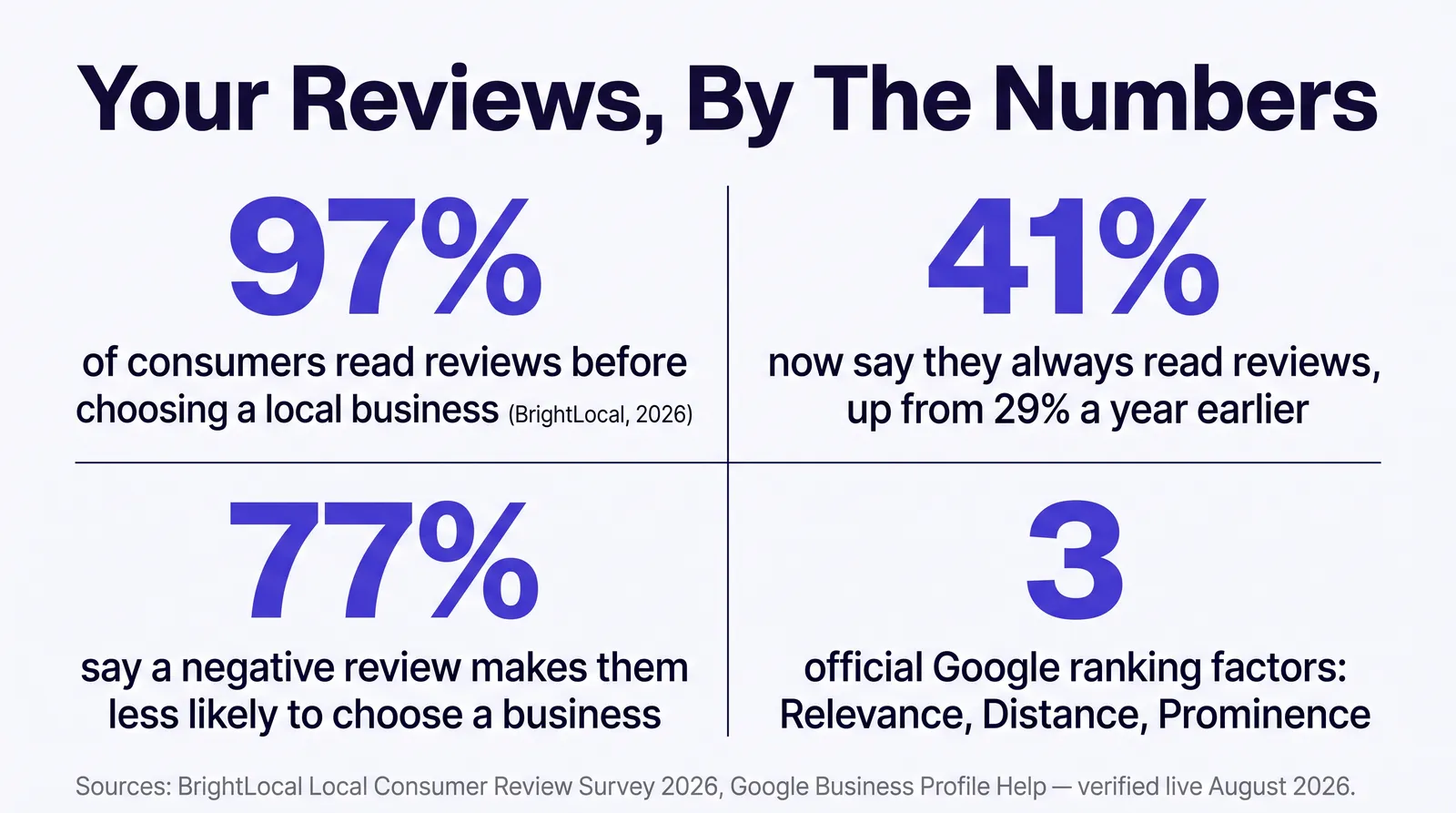
Google now writes an AI-generated paragraph summarizing your reviews before most prospects ever open one. Google's own Ask Maps announcement confirms these summaries are "generated by Google AI"2, built with Gemini reading across your reviews, photos, and business information2. BrightLocal's 2026 survey of 1,002 US consumers found 97% read reviews before choosing a local business, and 41% now say they always do, up from 29% a year earlier4. Google's own local ranking guidance names your review count and rating as a direct input to prominence, one of only three official ranking factors3. None of this requires new reviews to fix. It requires making the reviews you already have worth summarizing.
The summary that speaks before your reviews do
You have a decent Google Business Profile. Forty some reviews, a 4.6 or 4.7 average, nothing embarrassing. You have not thought about it much lately because the star rating has looked fine for a year. What you probably have not checked is what shows up in Google Maps or Search directly next to that star rating now: a short block of AI-written text summarizing what your reviewers actually said, generated the moment a prospect searches, not something you wrote or approved.
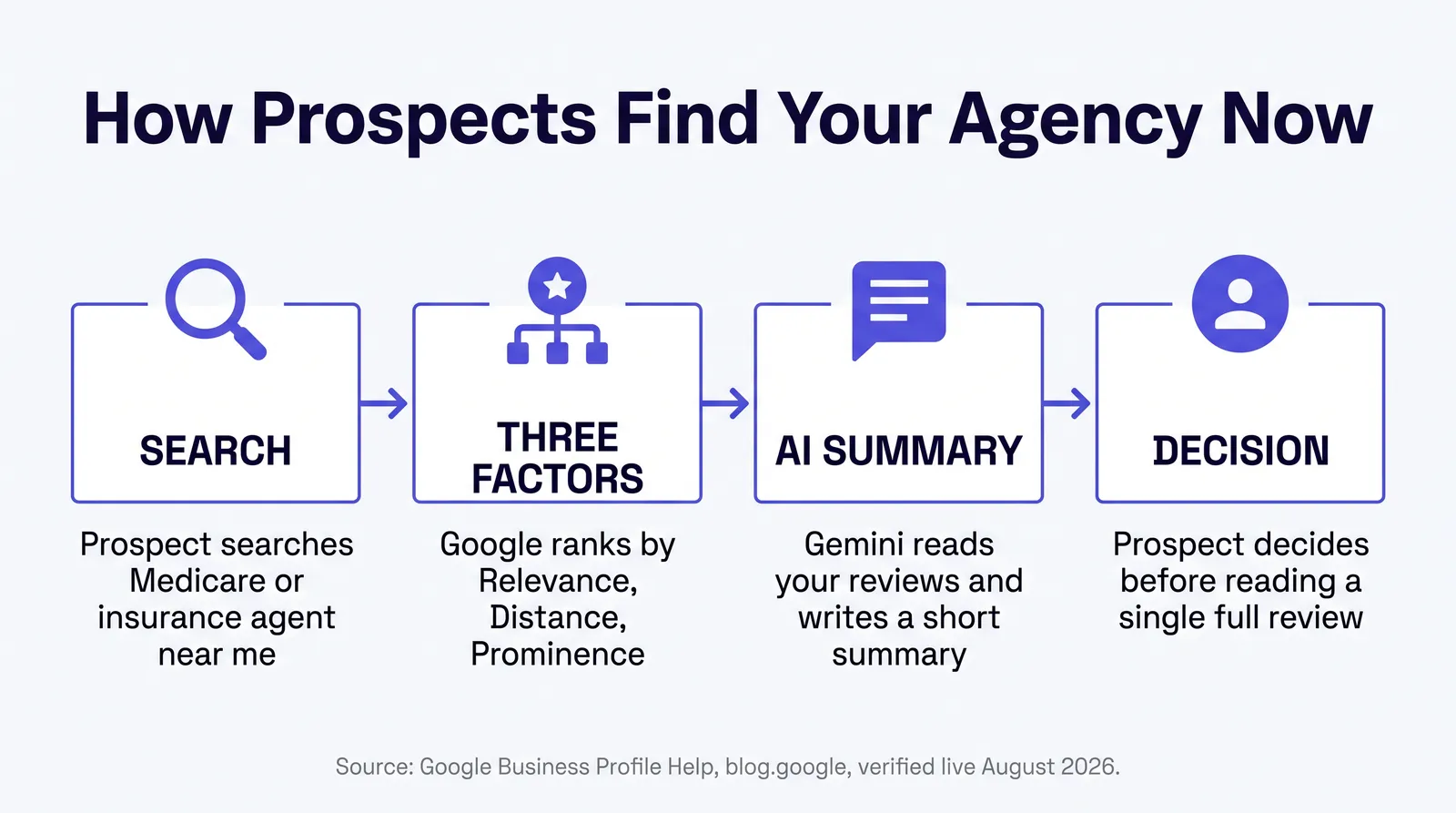
That text did not exist a couple of years ago. It exists now because Google has been rolling Gemini into Maps and local search, and one of the results is a feature that reads across a business's reviews and produces a short synthesized description of what customers experience there. A prospect comparing three Medicare agents in the same county can now read three AI-generated paragraphs, one per agency, before opening a single individual review from any of them.
This is not the same feature you might already know about
Google has had "review snippets," short quoted phrases pulled from reviews, for years. Its own Business Profile Help page describes those as selected "by an algorithm," not written. The newer AI summary is a different animal entirely: generative text, written fresh, that synthesizes across the whole body of your reviews rather than quoting a phrase from one of them.
The practical effect is that your reviews now have two audiences: the human who eventually reads a few of them directly, and the model that reads all of them and decides what to say on your behalf first. Most agencies have spent years optimizing for the first audience, chasing a star rating, and have never thought about the second one at all.
It helps to picture the two extremes side by side. An agency with thirty reviews that mostly say "great service" or "highly recommend" gives an AI summary tool almost nothing to work with beyond a generic sentence about friendliness. An agency with the same review count, where a meaningful share of those reviews describe something specific, comparing Medicare Advantage plans, catching a coverage gap on a life policy, explaining an ACA subsidy calculation clearly, gives the model actual material to synthesize into something a prospect will remember. Same star rating. Same review count. Completely different paragraph shows up next to each listing.
How Google's AI summary actually works
Google announced Ask Maps, the feature this summary sits inside of, on March 12, 2026, describing it as "a new conversational experience that answers complex, real-world questions a map could never answer before"2. The underlying models draw on "over 300 million places, including reviews from our community of more than 500 million contributors"2. Google is upfront that the output is generative and imperfect: results are labeled "Read AI-generated summary," and the company states plainly that "summaries were generated by Google AI. Generative AI is experimental"2.
It is worth being precise about how this differs from the older, more familiar feature on the same page. Google's Business Profile Help documentation describes three kinds of short text you might see near a business listing: a business description you write yourself, an editorial summary written by Google's own staff for popular businesses, and customer review snippets, which the documentation says "show keywords most mentioned in quotes from Google reviewers" and are "selected by an algorithm"1. None of those three is generative AI. The AI summary is a fourth, newer thing layered on top, built specifically to synthesize rather than quote.
| Type | Who or what produces it | How Google describes it |
|---|---|---|
| Business description | You, the business owner | Details about the business, not promotions or pricing1 |
| Editorial summary | Google's own writers | A short phrase for select, popular businesses1 |
| Review snippet | An algorithm | Keywords most mentioned in quotes from reviewers1 |
| AI-generated summary | Gemini, via Ask Maps | "Generated by Google AI. Generative AI is experimental."2 |
The reason this matters more than a routine feature update is what it changes about your reviews as an asset. A review snippet just repeats a phrase someone already wrote. An AI summary can synthesize a pattern across many reviews that no single reviewer ever stated outright, "clients consistently mention clear explanations of Medicare Advantage drug coverage," for instance, if enough reviews happen to touch on that theme. Vague, generic reviews give the model almost nothing to synthesize. Specific, detailed reviews give it real material.
The three ranking factors behind it
Before a prospect ever reads an AI summary, your agency has to actually show up, and Google is unusually direct about how that happens. Its Business Profile Help documentation names exactly three official local ranking factors: relevance, distance, and prominence3. Relevance is "how well a Business Profile matches what someone is searching for." Distance is "how far each business is from the customer who's searching." Prominence is "how well-known a business is," and Google states directly that this factor "is also based on info like how many websites link to your business and how many reviews you have," adding that "more reviews and positive ratings can help your business's local ranking"3.
| Factor | What Google says it measures | What an agency can influence |
|---|---|---|
| Relevance | How well a Business Profile matches the search3 | Complete, accurate categories and business information |
| Distance | How far the business is from the searcher3 | Accurate address and service area settings |
| Prominence | How well known the business is, including reviews3 | Review count, rating, and recency, directly named by Google3 |
Notice what is absent from Google's own language: a specific number. Plenty of marketing blogs will tell you that you need 50 reviews, or 75, or 100. Google has never published a threshold like that, and treating an invented number as the goal misses what Google actually says matters, which is a pattern over time, not a finish line you cross once.
Relevance is worth a closer look too, because it is the factor most agencies set once at signup and never revisit. Google's definition ties relevance directly to how well your profile "matches what someone is searching for," which for an insurance agency means the categories selected, the services listed, and the specific lines of business named on the profile itself, Medicare Advantage, ACA marketplace plans, life, final expense, whichever you actually write. An agency licensed for five lines but categorized and described as a generic "insurance agency" is asking Google to guess at a match it could otherwise make directly. That is a five minute fix that costs nothing and has nothing to do with reviews at all.
The mistake we see most
An agency runs one review push, gets to forty or fifty reviews, and stops. Prominence is influenced by how many reviews you have and how positive they are, not by whether you once crossed an arbitrary number. A profile that collected forty reviews two years ago and nothing since reads very differently to both the ranking algorithm and the AI summary tool than one adding three or four a month, indefinitely.
What this actually costs you
Start with how much weight reviews carry with an actual buyer, not just with Google's algorithm. BrightLocal's Local Consumer Review Survey 2026, based on 1,002 US adult consumers surveyed via SurveyMonkey and published February 11, 2026, found that 97% read reviews for local businesses before choosing where to spend their money4. Of those, 41% now say they "always" read reviews when browsing for a business, up sharply from 29% the year before4. On the downside, 77% said a negative review makes them less likely to choose a business4.
97%
Read reviews before choosing a local business4
41%
Now say they always read reviews, up from 29%4
77%
Say a negative review makes them less likely to choose4
3
Official Google ranking factors, one directly tied to reviews3
The profile with thin reviews
- Reviews say "great agent," "very helpful," "highly recommend"
- No mention of a specific plan type, service, or outcome
- A handful of reviews from two or three years ago, then silence
- No owner responses adding any additional detail
AI summary resultA generic sentence that could describe any local business
The profile with detailed reviews
- Reviews describe comparing plans, catching gaps, explaining costs
- A mix of recent reviews, added steadily rather than in one burst
- Owner responses that name the specific service provided
- Accurate categories and services listed on the profile itself
AI summary resultA specific summary that gives a prospect an actual reason to call
Put those two facts together and the exposure gets concrete. Almost every prospect is reading something about your reputation before they call, a large and growing share of them are reading it every single time, and a meaningful share will cross you off the list over one bad signal. Whether that signal is a low star average or a thin AI summary that makes your agency sound generic next to a competitor's specific one, the outcome for your phone is the same: a call that never comes in, with no way to know it almost did.
For Medicare and ACA agents specifically, the timing compounds the problem. A large share of the comparison shopping happens inside a narrow enrollment window, when a prospect is actively looking at two or three local agents in the same sitting rather than researching over months. There is no second chance to catch that prospect a week later once the window closes. A generic AI summary competing against a specific one from another agent in the same search results has one shot to matter, and it either does or it doesn't, in the same few minutes the prospect is comparing all three.
Check your own listing before you read the fix section
Search your agency's name on your phone right now and look at what shows up next to your star rating. If there is an AI summary, read it as if you were a prospect who had never heard of you. If there is not one yet, this is worth rechecking monthly, because Google is still actively expanding where this feature appears.
How to fix it, step by step
None of this requires chasing a specific review count or manipulating anything. It requires treating your existing review flow as content that a model is going to read and summarize, not just a star average for a human to glance at.
Audit what the AI summary currently says about you
Search your agency name, look for the AI-generated summary if one appears, and read it cold. Note whether it mentions anything specific, plan types, a service, a quality clients call out repeatedly, or whether it reads as generic filler that could describe any local business.
Ask for reviews on a steady monthly rhythm, not a burst
Google's own guidance ties prominence to review count and rating without naming a finish line, which means a steady trickle of new reviews signals differently than a one-time push followed by silence. Build the ask into a repeatable moment in your process, right after a successful enrollment or renewal, rather than an occasional campaign.
Ask clients to describe what you actually helped with
A review that says "great agent, very helpful" gives an AI summary tool almost nothing to synthesize. A review that describes comparing specific plan options, explaining a formulary, or catching a coverage gap gives it real, specific material. Ask the question that prompts that answer: "what was most helpful about working with us?" rather than just "leave us a review."
Respond to every review, not just the negative ones
A response is more text about your specific services, written by you, added to the same pool of content a summarization model reads. Mention what the client actually came in for when you thank them. It costs a minute and adds specific material an AI summary can draw from later.
Keep your business information and categories accurate
Relevance, the first of Google's three ranking factors, depends on how well your profile matches what someone is searching for. An outdated category, a stale service list, or missing details about the specific insurance lines you write all work against you before reviews even enter the picture.
Recheck the summary quarterly as your review base grows
Because the AI summary is generated fresh from current reviews, it changes as your review base changes. A quarterly check tells you whether the fixes above are actually shifting what a prospect reads about you, not just whether your star average moved.
This part you can genuinely do yourself
Everything in the six steps above is something any agency owner can start doing this week, at no cost beyond a few minutes a day. Where it becomes a recurring job instead of a one-time fix is doing it consistently, month after month, on top of everything else running an agency requires.
How we handle this differently
This section stays narrow, on purpose, and sticks to what is on our own live pages. Digital Foundation's Starter tier includes Google Business Profile management and review harvesting as a standard feature, verified live on the Digital Foundation pricing page this session at $247 a month5. In practice that means an actual, running process asking clients for reviews on a consistent schedule, the exact habit step two above describes, instead of an occasional reminder that stops the moment things get busy.
Every site we build is also wired for AI citation more broadly, which is the same underlying skill this problem calls for: writing and structuring content, whether it is a review response or a service page, in a way that gives an AI system specific, sourced material to work with instead of generic filler it has nothing to say about. The mechanism behind an AI-generated Google review summary and the mechanism behind an AI Overview citing a blog post are closer than they look. Both are a model reading a body of text and deciding what is worth repeating. A profile or a page built around specific, verifiable detail keeps winning that decision. One built around generic language keeps losing it, regardless of which AI system is doing the reading.
See where your own profile stands
The free Audit checks your site's AEO and technical readiness in about a minute, a useful companion check alongside a look at what your Google Business Profile's AI summary currently says. Run a free Audit.
What changes once it's fixed
The outcome here is narrower than "you'll rank first" or "you'll get more calls," and we are not going to promise either, because nobody can honestly guarantee a ranking position or a lead count. What changes concretely is that the paragraph Google's AI writes about your agency starts drawing from specific, current, detailed material instead of whatever happened to accumulate by accident. A prospect comparing you against two other local agents reads a summary that actually says something, rather than one that could describe any business in town.
There is a compounding element worth naming. Reviews you collect today do not just help today's summary. They become part of the corpus a model reads every time it regenerates that summary going forward, which means a steady habit started now keeps paying into a paragraph a prospect reads for years, not a one-time score.
It is also worth being honest about the limits of any single fix. A profile with a genuinely low star average is not going to be rescued by better review copywriting alone. If your rating itself reflects a real service problem, that is the thing to fix first, because no amount of specific detail in a review changes what an AI summary tool does with a consistent pattern of dissatisfaction. This guide assumes a decent underlying rating that simply is not saying much yet, which describes most agencies far more often than an actual service problem does.
Keeping it up, and when DIY is fine
If you run a single office and can genuinely build the habit of asking for a review after every good interaction and responding to each one, the six steps above are entirely something you can sustain without paying anyone. There is no reason to outsource a task that size.
This starts to matter more as an agency grows, multiple producers, multiple offices, a profile nobody has specifically owned in months, where "we should ask for more reviews" is true but nobody's actual job. That is usually the point where a standing process, rather than good intentions, becomes the difference between a profile that compounds and one that quietly goes stale.
You can do all of this yourself
None of the steps in this guide require a specialist. Most agents who read this and check their own AI summary for the first time are surprised by how generic it sounds, and surprised by how quickly that changes once a handful of specific, detailed reviews start coming in on a regular basis.
Questions agencies ask
What is Google's AI-generated review summary, and how is it different from the review snippets I've seen before?
A review snippet is an older, algorithmic feature: Google's own documentation states these snippets "show keywords most mentioned in quotes from Google reviewers" and are "selected by an algorithm," not written by AI. The newer feature, part of Google's Ask Maps and Gemini-powered tools, is explicitly generative. Google's own announcement labels these results "Read AI-generated summary" and adds the disclosure that "summaries were generated by Google AI. Generative AI is experimental." One is a keyword highlight reel. The other is an AI writing a paragraph about your agency based on what your reviewers actually said.
How many Google reviews does my insurance agency actually need?
Google has never published a specific number, and any article that hands you one, 50, 75, 100, is estimating, not quoting Google. What Google's own guidance says is that prominence, one of three official local ranking factors, is influenced by "how many reviews you have" and that "more reviews and positive ratings can help your business's local ranking." The honest answer is that more matters, recency matters, and there is no threshold where you can stop. Chasing a specific number is less useful than building a steady monthly habit of collecting a handful of new, detailed reviews.
Does responding to reviews actually affect my local ranking?
Google's own local ranking guidance does not name review responses as a direct ranking input the way it names review count and rating. What responding does is add more text, written by you, about your specific services, to the same pool of content an AI summary tool reads when it writes about your agency. A response that mentions "thank you for trusting us with your Medicare Advantage enrollment" gives a future summary more specific material to draw from than silence does.
Can I fix or remove an inaccurate AI-generated summary?
Google's Business Profile Help Center hosts an active community where owners report exactly this problem, an AI-generated summary that misrepresents their business, but neither that documentation nor the newer Ask Maps materials describe a direct edit button for the AI-written text itself. The practical lever you do control is the underlying review content the summary is generated from. A summary drawing from three vague, year-old reviews will read differently than one drawing from twenty recent, specific ones, because the AI has more and better material to work with.
Is this the same thing as Google's local ranking algorithm?
No, and the distinction matters. Google's local ranking algorithm decides which businesses appear and in what order, based on relevance, distance, and prominence. The AI-generated review summary is a separate, newer feature that decides what a prospect reads about a business once they find it. You can rank third in the local pack and still lose the prospect if the AI summary sitting next to your listing reads thinner or less specific than a competitor's.
Should I ask clients to mention the specific type of policy in their review?
It genuinely helps, within the limits of what is appropriate to ask for. A review that says "great service" gives an AI summary tool almost nothing to work with. A review that says "helped me compare Medicare Advantage plans in my county and explained the drug formulary differences clearly" gives it real material. Ask satisfied clients to describe what you actually helped them with, in their own words, rather than asking them to use specific phrases, which most review platforms' policies do not allow.
Does this apply differently to Medicare and ACA agents versus other insurance lines?
The mechanism is identical across every insurance line, because it runs on Google's general local search infrastructure, not anything insurance-specific. What differs is the stakes: a Medicare or ACA prospect is often comparing several agents during a single enrollment window, so a thin or dated AI summary competing against a detailed, current one from another local agent has a narrower window to matter before the decision gets made. A life or final expense agent, by contrast, is more likely to be found by a prospect browsing without a hard deadline, which gives a thin summary more time to be outgrown before it costs an actual call, though it is worth fixing either way.
How does Strategic AI Architects handle review management differently?
Digital Foundation's Starter tier includes Google Business Profile management and review harvesting as a standard feature, verified live on the Digital Foundation pricing page this session at $247 a month. That means an actual process for asking clients for reviews on a consistent schedule, rather than an occasional reminder email, which is the single biggest lever an agency controls over what material Google's AI has to summarize in the first place.
Sources
- Google Business Profile Help. "Understand business summaries on Google Maps," definitions of business descriptions, editorial summaries, and algorithmically selected review snippets, verified live 2026-08-10. support.google.com.
- Google. "Ask Maps and Immersive Navigation: New AI features in Google Maps," published 2026-03-12, verified live 2026-08-10. blog.google.
- Google Business Profile Help. "Tips to improve your local ranking on Google," definitions of relevance, distance, and prominence as local ranking factors, verified live 2026-08-10. support.google.com.
- BrightLocal. "Local Consumer Review Survey 2026," survey of 1,002 US adult consumers via SurveyMonkey, published 2026-02-11, verified live 2026-08-10. brightlocal.com.
- Strategic AI Architects. "Digital Foundation," Starter tier pricing and Google Business Profile management plus review harvesting feature, verified live 2026-08-10. strategicaiarchitects.com.
Talk it through
Want a second pair of eyes on it?
Free 30 minutes. Bring what you found, or bring nothing and we will look together at how AI engines read your site and which fixes move first.
Find out what your own listing says about you
Run the free Audit, a live AEO Audit plus a HIPAA tracking scan of your site, in under a minute.
Related reading: why your insurance website only ranks in one county · why 91% of AI citations change within a month