Playbook
Insurance Agency Logo: What a Mismatched Brand Costs
Before anyone reads a word of your website, they have already decided whether to trust it. Your logo and your name are what they decided on.


18 min read
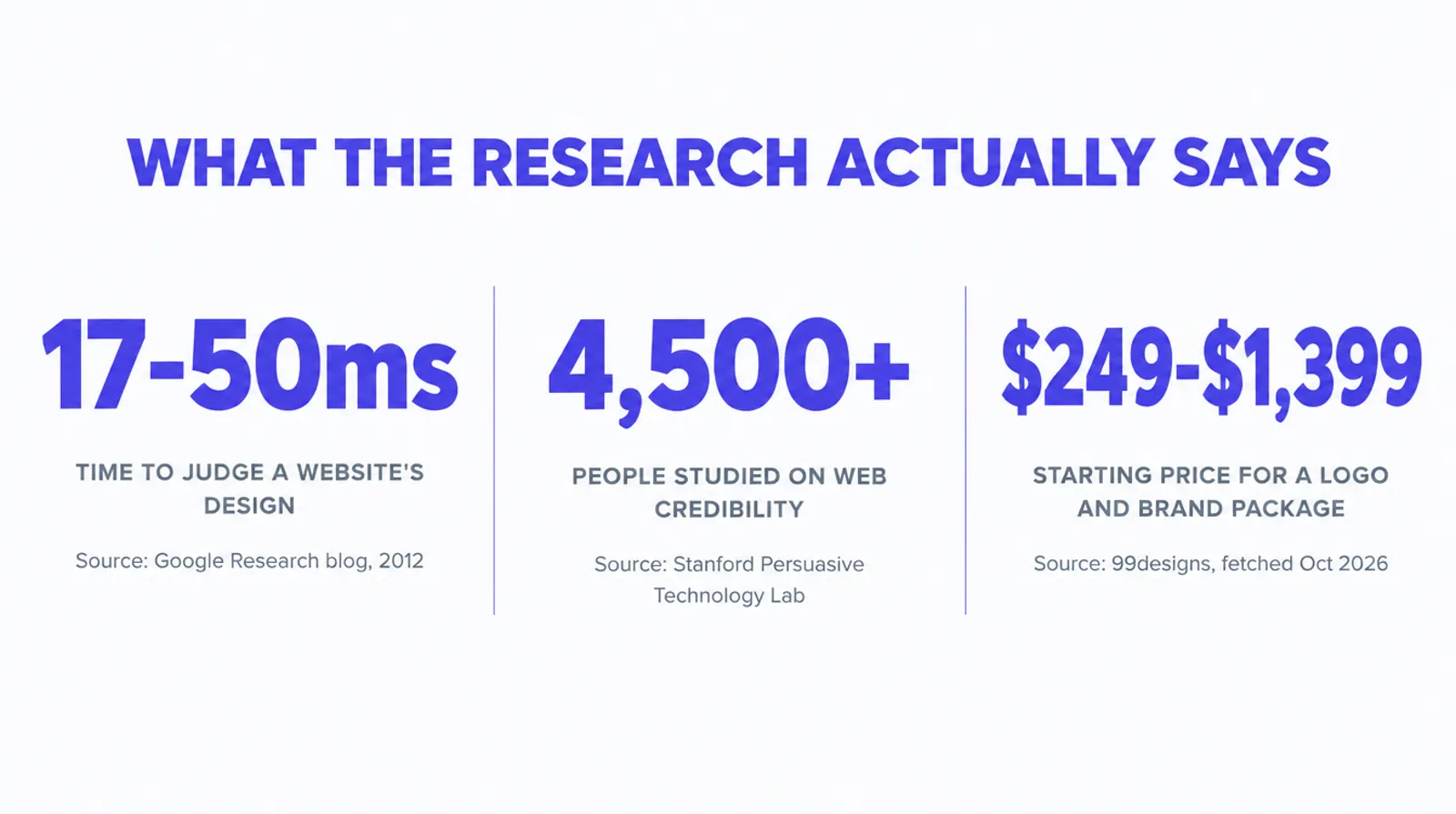
A visitor forms an aesthetic judgment of your website in 17 to 50 milliseconds, Google's own research found, faster than a single eye blink1. Stanford's Persuasive Technology Lab, in research covering over 4,500 people, found that design and the appearance of a legitimate organization are two of the strongest levers on whether a visitor trusts a site at all2. A generic or mismatched logo loses that instant judgment before your content gets a chance to argue back. And in insurance specifically, a name that does not match across your license, your Google Business Profile, and your website is not just a trust problem. In states like California and Nevada it can be a filing problem too34.
The verdict lands before the headline loads
Someone searches "Medicare agent near me" or clicks a link a friend texted them, and your site opens. For the next fraction of a second, before they have read a single sentence, they have already decided something: does this look like a business I can trust with my health coverage or my family's money, or does this look like a page somebody threw together. Your insurance agency logo is the first thing their eye actually lands on, and the verdict forms before your words get a vote.
That is not a metaphor. Google's own research team measured it. A study hosted on Google's research site, run with researchers from the University of Basel, found that people form aesthetic judgments of a website's visual design within 17 to 50 milliseconds of first seeing it1. For comparison, the same Google research post notes that the average human eye blink takes 100 to 400 milliseconds1. The verdict on how your site looks lands before a single blink finishes.
Your logo is the first fixed shape a visitor's eye lands on. If it is a stretched stock icon, a default template mark nobody ever replaced, or a name that reads differently than the one on your Google Business Profile or your license, that is the first data point feeding a judgment that has already started before you had any say in it.
A 30 second check
Open your own website, your Google Business Profile, and your state's license lookup for your agency in three separate tabs. Compare the exact name and logo on all three. Most agents have never put these three side by side at the same time. It's worth doing before you read another paragraph of this guide.
Why agency branding ends up a mess
Nobody sets out to build an inconsistent brand. It happens in small, reasonable sounding steps, each one made in isolation, years apart.
A new agent gets licensed under their own legal name, because that is the fastest path to writing business. A year or two later, growth means hiring a producer or two, and "Jane Smith Insurance" stops fitting, so the agency files a DBA, a doing business as name, something like "Lakeside Insurance Group." The website gets built around whichever name was handy at the time, sometimes the personal name, sometimes the DBA, sometimes both on different pages. A logo gets commissioned once, early, on a tight budget, built around whichever name existed that week. The Google Business Profile gets created separately, often by a different person, and picks up whatever name felt natural to type in at the time.
None of these decisions were wrong on their own. The problem is that nobody ever went back and reconciled them, because reconciling a name across five different properties is not a task anyone's calendar ever prompts. It only becomes visible when a prospect, or a reviewer at Google, or a state insurance examiner, looks at more than one of those properties at once and notices they do not agree.
Template websites make the visual half of this worse in a specific, measurable way. A page builder theme ships with a placeholder logo slot sized for a square icon plus short wordmark. An agency logo built years before that template was chosen, often a rectangular mark with a tagline baked in, gets squeezed, cropped, or stretched to fit the slot instead of redrawn to fit it. The result is a logo that was fine in its original file and distorted everywhere a visitor actually sees it.
Multi-producer agencies pick up a second, harder version of the same problem. An agency with three or four producers under one roof often ends up with each producer's own social media profile, each one carrying whatever name and photo that individual producer chose on their own, none of it coordinated with the agency's actual logo or website. A prospect who finds one producer on Facebook and the agency's own site through a Google search is looking at what reads as two different businesses, even though it is one. Franchise style and multi-location agencies face the inverse problem: a shared parent brand and logo that each location is supposed to use consistently, but that drifts location by location as individual office managers reach for whatever logo file they happen to still have on a hard drive, often an outdated version a few redesigns behind the current one.
None of this is anyone's fault in the moment it happens. A producer setting up their own social profile on a Tuesday afternoon is not thinking about brand governance. They are thinking about getting a profile live before a prospect asks for it. The mismatch only becomes a liability later, compounding quietly every time one more property gets created without checking what already exists.
What is actually happening in a visitor's head
The 17 to 50 millisecond figure comes from a specific mechanism the Google-hosted research describes in two parts: visual complexity, how busy or cluttered a design looks, and prototypicality, how closely a design matches what a visitor already expects a site in that category to look like1. A simpler, more familiar looking layout rates as more beautiful in that first instant, independent of the words on the page, because the visitor has not had time to read any of them yet.
Stanford's Persuasive Technology Lab ran a parallel, longer running line of research specifically on web credibility, built on three years of work covering more than 4,500 people2. Two of its published guidelines matter directly here. Guideline 2 says to show that there is a real organization behind your site, and names a physical address as the easiest way to do that. Guideline 6 says to design your site so it looks professional, or appropriate for its purpose, because visitors use design quality as a proxy for whether an organization is legitimate and actively maintained2.
Put the two findings together and the mechanism is plain. A visitor's brain renders an instant, pre-verbal verdict on your visual design, and separately, consciously or not, it scans for concrete signs that a real, maintained organization sits behind the page: a consistent name, a real address, a logo that looks drawn for this page rather than dragged onto it. A mismatched or generic brand fails both tests at once, the instant one and the deliberate one.
What this research does not say
Neither study measured insurance buyers specifically, and neither claims design alone sells a policy. What they document is narrower and still useful: the visual judgment comes first, arrives in well under a second, and it is driven by how clean and familiar your design reads, not by how good your actual coverage or service is. Your content still has to do the rest of the work, once someone sticks around long enough to read it.
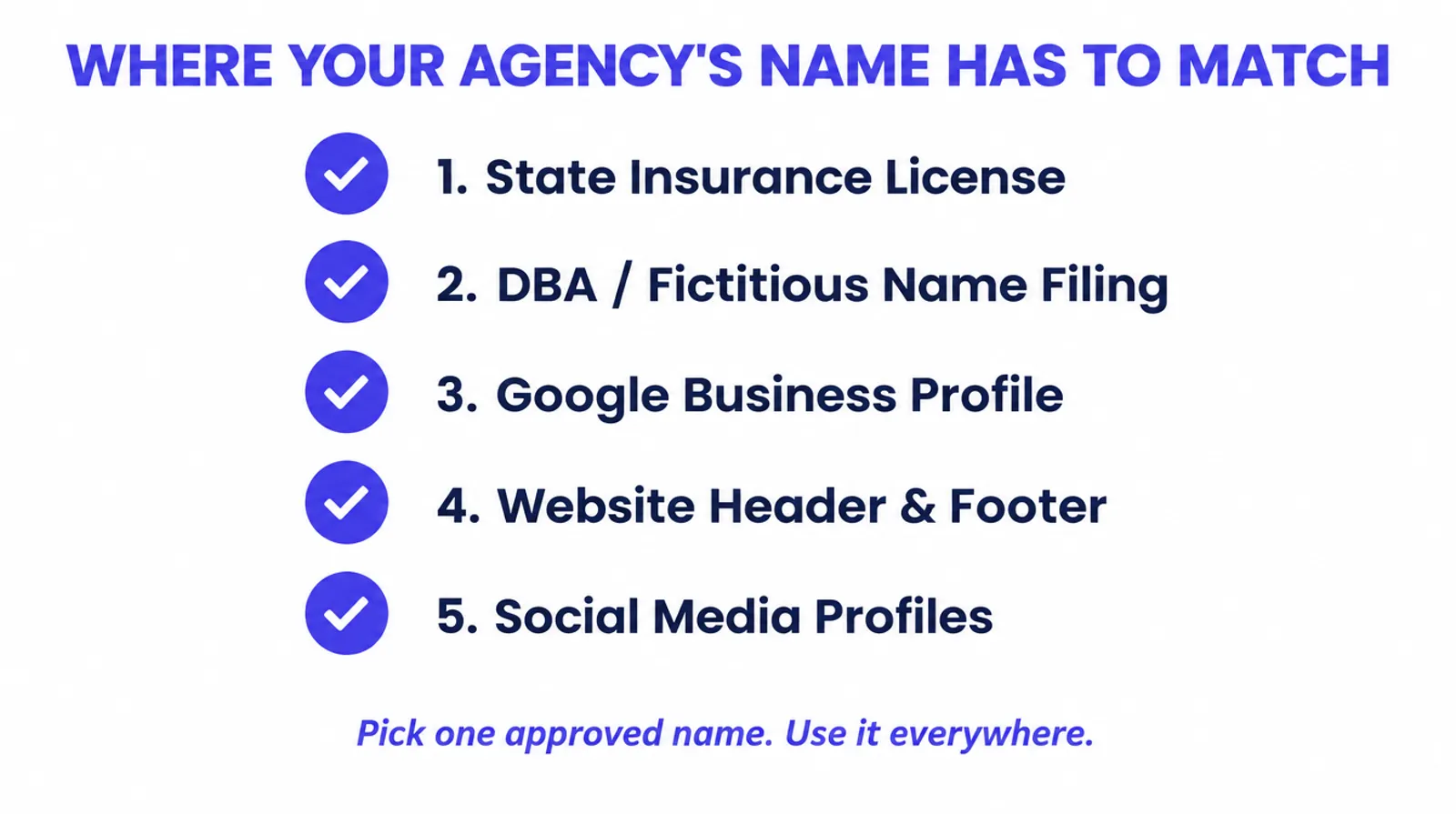
The other reader: your state insurance department
A human visitor is not the only party reading your agency's name. Most states regulate what name a licensed insurance producer or agency may actually transact business under, and a growing number of them require specific approval before you can use anything other than your exact licensed legal name.
California is explicit about this. Under Section 1724.5 of the state's Insurance Code, licensees must file their true name and every fictitious name, every DBA, in writing with the Department of Insurance3. The Department can reject a name for several reasons: it is too similar to an already approved name, it could mislead the public or imply a connection to a well known company, or it fails to clearly identify the business as an insurance producer. The page gives "Advisor" and "State" as examples of words it will not approve, and names "Administrators," "California," and "County" as words that get flagged when used improperly3. And once a DBA is approved and the licensee has committed to using it exclusively, the original true name can no longer be used for insurance business in California at all. Every piece of advertising, every business card, every directory listing has to use only the approved DBA from that point forward3.
Nevada runs a similar, separately administered process. Under NRS 683A.301, a producer or agency may not transact business under a fictitious name or DBA until the Division of Insurance approves it. Approval has to happen before the name is filed with the county clerk where it will be used, and the statute also requires a licensee to notify the commissioner in writing if a fictitious name later changes or is discontinued4.
Zoom out to the full country and the picture gets more varied, which is exactly why checking your own state matters more than assuming a national rule applies. The National Association of Insurance Commissioners maintains a state by state chart of domestic fictitious name rules for insurers, last updated October 16, 2025. It shows a wide range of approaches: Alabama, Colorado, Connecticut, Georgia, Illinois, Iowa, New York, Pennsylvania, and Washington are listed as barring fictitious names for insurers outright, while states including Idaho, Rhode Island, Texas, and Utah allow them with approval, filing, or registration conditions attached5.
| State | What the rule requires | Source |
|---|---|---|
| California | True name and every DBA filed in writing (Ins. Code §1724.5); name must clearly read as an insurance producer; once a committed DBA is approved, the true name can no longer be used in advertising | California Dept. of Insurance, Name Approval Criteria |
| Nevada | Fictitious name/DBA must be approved by the Division of Insurance before it is filed with the county clerk (NRS 683A.301); changes must be reported to the commissioner | Nevada Division of Insurance, Name Change page |
This is state specific. Check your own department
The NAIC chart alone lists more than a dozen different approaches across the states it covers5. Nothing here is a substitute for checking your own state insurance department's current rule before you register, change, or start advertising under a new name. Treat California and Nevada as two worked examples of how specific these rules can get, not as a national standard.
This matters more for agencies than it does for a typical local business, because an insurance license is not a one time registration you file and forget. It is a standing record your state department can compare against your actual advertising at any point, and a mismatch is not just a branding inconsistency in that comparison, it can read as evidence that the name on your marketing was never properly filed at all. The agencies most exposed are the ones that grew fast, added a DBA or a second office, and never circled back to confirm the new name cleared the same approval the original one did.
What a mismatched brand actually costs
Three separate costs stack on top of each other here, and most agents only ever notice one of them.
The first is the instant trust cost described above: a cluttered or mismatched logo loses part of that sub-blink first impression before your content gets read at all. That cost is real but hard to put a dollar figure on, because nobody can tell you precisely how many visitors it turns away on any given day.
The second is more concrete. We already covered, in a separate guide, how Google's own guidelines name insurance agents directly and require Business Profile names to match real world, consistent usage, and how Google removed over 13 million fake Business Profiles in a single year as part of enforcing that6. A logo and name that drift from what is on your Business Profile is the exact pattern that triggers a review, and a suspended profile does not just look bad, it disappears from the map pack and local search entirely while under review.
The third is the one almost nobody budgets for: the actual cost, in time and in dollars, of fixing a brand that was never consistent to begin with. Rebuilding a logo and a basic identity through a crowdsourced design marketplace is not free. We pulled live pricing from 99designs while writing this guide. A standalone logo starts at $249. A Brand Starter Package starts at $499, a Brand Launch Package at $599, a logo bundled with a written brand guide at $329, and a logo bundled with a new website at $1,3997. Those are starting prices for a design contest, not a finished brand deployed correctly across a fast, compliant website, a Google Business Profile, and every page that needs it resized and optimized.
| Package | Starting price | What it covers |
|---|---|---|
| Logo design | $249 | A single logo design, crowdsourced contest format |
| Logo & brand guide | $329 | Logo plus a written style guide for colors, type, and usage |
| Brand Starter Package | $499 | Logo plus a starter set of brand assets |
| Brand Launch Package | $599 | Logo plus a fuller launch set of brand assets |
| Logo & website | $1,399 | Logo bundled with a separately built website |
None of these prices are wrong or a bad deal on their own. The missing piece is what happens after the file is delivered: who actually resizes the mark for a favicon, who checks it against a dark background, who makes sure the name on the new logo matches the name on your license and your Business Profile instead of creating a fourth variant to add to the pile.
Run a plain cost comparison. An agency that pays $599 for a Brand Launch Package, then spends another few hours of someone's time getting the new mark onto the website, the Business Profile, and the social profiles, has spent real money and real time arriving back at square one if nobody checked the underlying name against the state filing first. Compare that to the forty minute audit in the next section, which costs nothing and tells you, before you spend a dollar, whether you have a design problem, a consistency problem, or an actual filing problem. Those are three different fixes with three different price tags, and guessing which one you have is the most expensive mistake in this whole process.
The audit, and what to fix first
You do not need a designer to start. You need forty minutes and the five tabs from the check earlier in this guide. Work through these in order.
Find your one approved name
Check your state insurance department's producer or agency lookup for the exact name on file. If you have a DBA, confirm it is actually approved, not just in use.
Compare it against four other places
Your website header, your website footer, your Google Business Profile, and your social media profiles. Write down every variant you find, including abbreviations.
Pick one name and retire the rest
Not the easiest name. The approved one. Update every property to match it exactly, spelling, punctuation, and all, before touching the logo itself.
Test your current logo at favicon size
Shrink it to 32 pixels square, the size a browser tab actually uses. If it turns into a smear or an unreadable blob, that is your real signal to redesign, not a hunch.
Check it on a dark background
A logo that only works on white fails on a dark nav bar, a social media profile photo, or a dark mode screen. A usable mark needs a one color version that holds up both ways.
Save it as a real vector file
A logo that only exists as a JPEG someone screenshotted off an old flyer cannot be resized cleanly for anything. Get it into SVG or a high resolution PNG you actually control.
If you want a second opinion on where your site stands
The free Audit checks your current site's speed, structure, and AI citation readiness in under a minute. Run a free Audit before deciding whether your brand needs a redesign or just a cleanup.
If the audit above turns up a genuine mismatch with your state filing, not just a cosmetic inconsistency, that is worth a direct call or email to your state insurance department before you spend a dollar on a new logo. A new logo built around a name your state has not approved just creates a sixth variant to clean up later.
How we build the brand into the foundation
We are not a logo design shop, and this guide is not a pitch to become one. What we build is the website your brand actually has to live on, and we treat name and logo consistency as part of that build rather than a separate project someone has to remember to circle back to.
We re-fetched our own Digital Foundation pricing live while writing this guide, the same standard we hold every number in this article to8. Starter runs $247 a month and includes a complete, compliant website with Google Business Profile management built in, so your site and your profile stay on the same page, literally, instead of drifting into two different names. Pro runs $497 a month and adds a weekly publishing cadence and a 24/7 AI receptionist. Scale runs $997 a month and adds a daily publishing cadence. All three carry a 14-day free look and no long term contract8.
Every build we ship carries one Organization name, used identically in the page footer, in the Organization schema markup search engines and AI systems read, and in the Google Business Profile work included at the Starter tier and up. We build on Astro, which ships zero JavaScript to the browser by default, so your logo and your name render as finished HTML the moment the page opens, not after a runtime boots and a theme engine finishes drawing itself. Our builds score 90 or higher on Lighthouse performance for both mobile and desktop, some score 100, which matters here specifically because the first impression research above is a race against milliseconds, and a slow page spends those milliseconds on a blank screen instead of your brand.
The schema markup piece is worth spelling out, because it is easy to miss and it is exactly where name drift becomes machine readable to the systems deciding whether to trust your site. Every page we build carries Organization schema, the structured data block search engines and AI answer systems read to identify who actually operates a site. If your visible logo says one name and your schema, pulled from an old template years ago, still says another, that contradiction is invisible to a human visitor scrolling past your header, but it is not invisible to a crawler comparing the two. Keeping one name consistent across the visible logo, the footer copyright line, and the schema markup underneath the page closes a gap most agencies never knew existed.
What changes once your name matches everywhere
None of this promises a specific traffic number or a guaranteed ranking. What changes is more concrete than that.
1
Approved name, used identically across license, GBP, site, and social
<50ms
The window your logo has to make a good first impression, per Google's own research1
90+
Lighthouse mobile and desktop target so that window is not spent on a blank screen
0
Variants of your agency name left for a visitor, Google, or your state to question
A prospect who lands on a page with one consistent, legible name and a logo that actually renders cleanly spends that first fraction of a second confirming trust instead of questioning it. That is a small thing to get right, and it is the thing almost every agency site gets wrong by accident, not by neglect.
It also removes a specific, slow burning risk rather than just improving a first impression. An agency with one approved name used identically everywhere has nothing for a state examiner to flag during a routine license review, nothing for Google's automated systems to catch as a mismatch worth suspending a profile over, and nothing for a competitor's attorney to point to if a dispute over your advertising ever came up. None of those outcomes are likely in any given week. They are the kind of risk that sits quietly for years and then becomes expensive all at once, which is exactly the kind of risk a forty minute audit is worth running once, now, rather than discovering later.
You can do this yourself
Checking your name across five properties and resizing a logo for a favicon are both things most agents are capable of doing this week, for free. Some agents will read this and decide they would rather pay someone to handle the whole thing, website included. Either outcome is fine. The point is knowing which problem you actually have before you spend money on the wrong fix.
Questions agents ask about their logo and brand
How fast does someone actually judge my agency's website or logo?
Google's own research, published on its Google Research blog, found that visitors form an aesthetic judgment of a website within 17 to 50 milliseconds, faster than a single eye blink, which Google notes takes 100 to 400 milliseconds. That is a gut reaction to visual complexity and how familiar the layout looks, not a reasoned opinion about your services. It happens before anyone reads your headline, so a cluttered logo, mismatched colors, or a page that looks half finished sets the tone before your copy gets a chance to argue back.
Does my agency's logo need to match my insurance license exactly?
Your logo itself is not licensed, but the name printed inside it often is. Most states regulate what name a licensed producer or agency can do business under, and several, including California and Nevada, require any name other than your exact licensed legal name, meaning any DBA or fictitious name, to be filed and approved before you use it in advertising. If your logo displays a shortened or stylized version of your agency name that differs from what your state has on file, that is worth checking, not assuming is fine.
Can I use my own name and my agency's DBA interchangeably on my website and social media?
Not safely, and not consistently, in most states. California's Department of Insurance explicitly bars using an approved true name once a committed DBA is in place, stating that all advertising, business cards, brochures, and directory ads must use only the approved DBA. Nevada requires separate Division of Insurance approval before a fictitious name is filed with the county clerk. Pick the one name your state has approved, use it everywhere, your website, your Google Business Profile, your social profiles, your business cards, and retire the others.
How much does a logo and basic brand identity actually cost?
We re-fetched live pricing from 99designs while writing this guide. A standalone logo design runs from $249. A Brand Starter Package runs from $499, a Brand Launch Package from $599, a logo plus a written brand guide from $329, and a bundled logo plus website package from $1,399. Those are starting prices for a crowdsourced design contest, not a finished, deployed brand system, and they do not include getting that logo correctly placed, sized, and optimized on an actual fast website.
Could a mismatched name or logo actually get my Google Business Profile suspended?
It is a real risk, separate from the trust question. Google's own guidelines name insurance agents directly and require your Business Profile name to match what you actually use in the real world, consistently, across your website and your signage. We cover the mechanics of that specific failure mode, and the fix, in a separate guide: Why Google Suspends Insurance Agency Business Profiles. If your logo shows one name and your license or GBP shows another, that inconsistency is the exact pattern Google's policy flags.
I already pay for ads and SEO. Is fixing my logo and brand worth it before spending more there?
Fixing a logo in isolation, without fixing the page it sits on, buys you very little. The research on first impressions is about the whole visual experience, your logo, your colors, your layout, and how fast the page actually renders, arriving together. We cover the broader version of this problem, where marketing budget leaks through a weak website regardless of channel, in Digital Marketing for Insurance Agents: The Budget Leak. A clean, consistent brand is one input into that page, not a substitute for the rest of it.
Do I need a professional designer, or can I build a usable logo myself?
You can build something workable yourself, especially a simple wordmark in your approved agency name set in a clean typeface. Where DIY tools struggle is legibility at small sizes, a logo that looks fine at full width on a desktop screen but turns into a smear at the 32 pixel favicon size in a browser tab, and color contrast that fails against both a light and a dark background. If you go the DIY route, test your logo at favicon size and in a single flat color before you call it finished. If that test fails, that is the moment to pay for a redesign rather than a from scratch build.
What is the single most common branding mistake you see on agency websites?
A name that does not match itself across the agency's own properties: one spelling on the website header, a different legal entity name in the footer copyright line, a third variant on the Google Business Profile, and a fourth on the state license lookup. No single one of those is a disaster by itself. Together, they tell both a human visitor and an automated reviewer at Google or your state insurance department that nobody is actually maintaining this business's basic paperwork, which is a strange thing to signal in an industry built entirely on trust.
Sources
- Google Research. "Users love simple and familiar designs: why websites need to make a great first impression," by Javier Bargas-Avila, citing Tuch, Presslaber, Stoecklin, Opwis, and Bargas-Avila. Finding: aesthetic judgments of a website form within 17 to 50 milliseconds; a human eye blink takes 100 to 400 milliseconds. Published August 29, 2012. Fetched live October 30, 2026. research.google/blog/users-love-simple-and-familiar-designs-why-websites-need-to-make-a-great-first-impression.
- Stanford Persuasive Technology Lab. Web Credibility Research guidelines, based on three years of research covering over 4,500 people. Guideline 2: show that there's a real organization behind your site (physical address). Guideline 6: design your site so it looks professional, or appropriate for your purpose. Fetched live October 30, 2026. credibility.stanford.edu/guidelines.
- California Department of Insurance. "Name Approval Criteria" (business entity licensing). True name and all DBAs filed in writing under Insurance Code §1724.5; disapproval grounds including misleading names and names that fail to identify the licensee as an insurance producer; a committed DBA, once approved, replaces the true name in all advertising. Fetched live October 30, 2026. insurance.ca.gov/0200-industry/0020-apply-license/0300-business-license/name-approval-criteria.cfm.
- Nevada Division of Insurance. "Name Change" (license maintenance). Fictitious name/DBA requires Division approval before county clerk filing, per NRS 683A.301; changes must be reported to the commissioner. Fetched live October 30, 2026. doi.nv.gov/Licensing/Maintain-License-Association/Name-Change.
- National Association of Insurance Commissioners. "Domestic Use of Fictitious Names" chart. State by state rules on insurer fictitious/DBA names; last updated October 16, 2025. Fetched live October 30, 2026. content.naic.org/industry/ucaa/chart-domestic-use-fic-name.
- Strategic AI Architects. "Why Google Suspends Insurance Agency Business Profiles," citing Google's guidelines naming insurance agents directly and Google's 2025 Trust & Safety Report figure of over 13 million fake Business Profiles removed. strategicaiarchitects.com/post/insurance-agency-google-business-profile-suspended.
- 99designs. Logo design and brand package pricing: Logo design from $249; Logo & brand guide from $329; Brand Starter Package from $499; Brand Launch Package from $599; Logo & website from $1,399. Fetched live October 30, 2026. 99designs.com/logo-design.
- Strategic AI Architects. Digital Foundation service page: Starter $247/mo (complete compliant website, Google Business Profile management, AI chat widget); Pro $497/mo (adds weekly publishing cadence, 24/7 AI voice receptionist); Scale $997/mo (adds daily publishing cadence). 14-day free look, no contract, on all tiers. Fetched live October 30, 2026. strategicaiarchitects.com/digital-foundation.
Talk it through
Want a second pair of eyes on it?
Free 30 minutes. Bring what you found, or bring nothing and we will look together at how AI engines read your site and which fixes move first.
See how your brand actually renders in that first second
Run a free Audit and see how your site scores on speed, structure, and AI citation readiness, in about a minute, before you spend a dollar on a new logo.
Related reading: Why Google suspends insurance agency Business Profiles · Insurance agency website design: pages that sell policies · Digital marketing for insurance agents: the budget leak