Playbook
Why Insurance Agents Can't Buy Google Verified Ads
The pay-per-lead badge covers plumbers and lawyers in every state. Insurance agents get it in exactly two.

19 min read

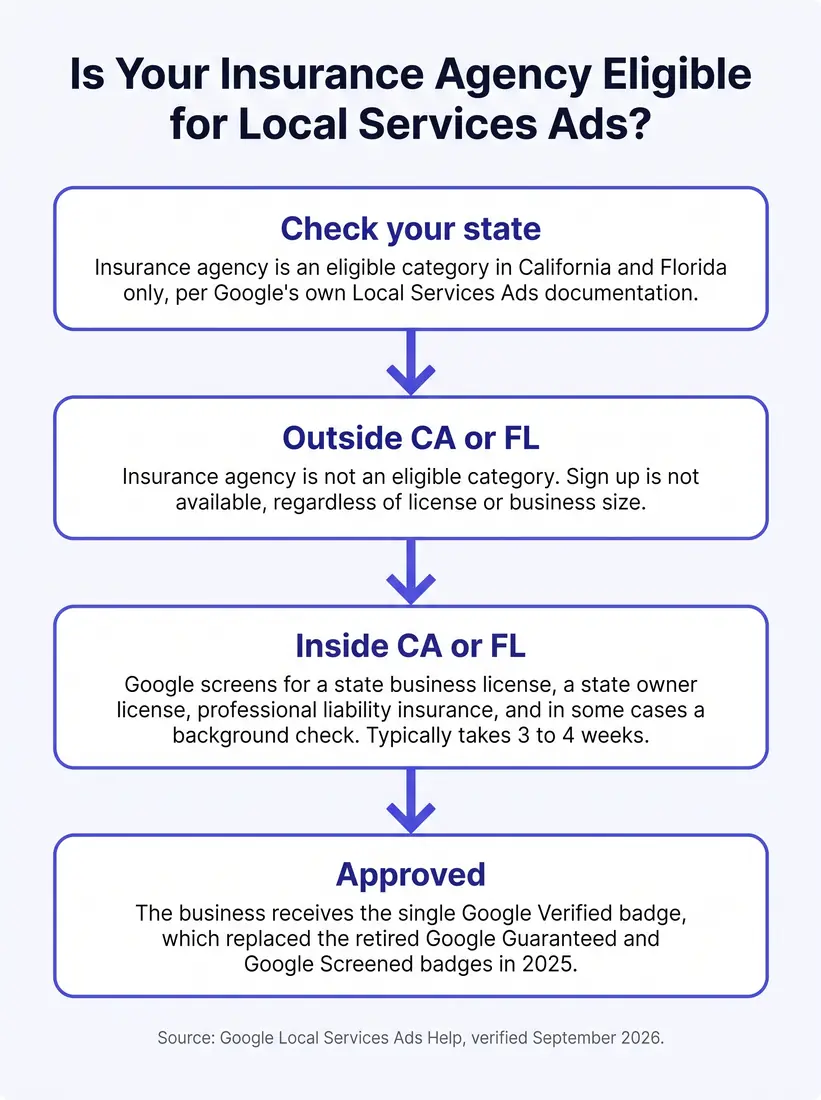
The badge you're picturing has already been renamed, and the program underneath it is narrower than you think. Google retired the separate Google Guaranteed and Google Screened badges for a single Google Verified badge in 20257, and its own Local Services Ads documentation for the United States lists the exact line "Insurance agency (California and Florida only)"1. If your agency sits in one of the other 48 states, this specific pay-per-lead product isn't an option you're missing out on by accident. It isn't offered there at all.
The badge search that goes nowhere
You've seen the green checkmark on a plumber's listing, or the badge under a lawyer's name in a search result, and you've wondered why your agency doesn't have one. So you go looking. You type "Google Local Services Ads for insurance agents" or "how to get Google Guaranteed as an insurance agent" into the search bar your marketing person told you to try, and what comes back is a pile of contradictory blog posts, a few outdated screenshots, and a sign-up flow that either doesn't list your industry or quietly stalls out after you enter your ZIP code.
Nobody tells you why. There's no error message that says "this category isn't available where you practice." The form just stops behaving the way the tutorials say it should, and you're left assuming you did something wrong, or that your agency isn't established enough, or that the whole thing requires a corporate account you don't have. None of those are the actual reason. The actual reason is sitting in Google's own published category list, and it has nothing to do with your agency's size, your license, or how long you've been in business.
Why the sign-up flow feels broken
Google's Local Services Ads onboarding doesn't reject you with a message that explains the geographic limit. It behaves as if the category isn't there, because for most of the country, it isn't. The flow was never built to tell an agent in Ohio or Texas that insurance agency is a two-state pilot. It just doesn't surface the option.
Google Guaranteed doesn't exist anymore
Before going further, it's worth clearing up a piece of terminology that's actively out of date, because it's the exact phrase most agents are still searching. For years, Local Services Ads carried two separate consumer-facing badges: the green "Google Guaranteed" checkmark, mostly associated with home-service trades, and "Google Screened," used for licensed professional categories. Google's own Local Services help center now describes a change away from that split: it is "simplifying our advertiser badging by launching a single badge for all advertisers"7, called Google Verified, and states that existing advertisers who had already completed verification were moved over automatically, with no action required on their end7.
A second, related change landed alongside the badge consolidation. Google's own page on the Google Guarantee states plainly that "Google will be discontinuing the Money Back Guarantee associated with the Google Guarantee badge," and that eligible consumers could still submit a reimbursement request for services already booked through Local Services Ads only "before December 7, 2025," with any such request needing to land "within 30 days of the initial service completion date"9. By the time you're reading this, that window has closed. The consumer-facing financial guarantee that used to come bundled with the old Google Guaranteed badge is gone, and the badge itself no longer exists under that name.
None of that changes the eligibility question this guide is actually about. Whether the badge is called Google Guaranteed, Google Screened, or Google Verified, the underlying product is still Local Services Ads, and the underlying category list is still the thing that decides whether an insurance agency can enroll at all. Renaming the badge didn't touch the geography.
What Local Services Ads actually is
Local Services Ads is a separate advertising product from the search and display ads most agencies already run. Instead of bidding on keywords and paying per click, an advertiser pays per qualified lead, a phone call or a message from someone who found them through the Local Services listing. The verified badge sits next to the listing as a trust signal, and Google's own screening process is the gate that determines who gets to display one.
That screening process, per Google's own qualification documentation, is built around a handful of checks that vary by category and location: license verification for the business and, "to the extent practical," for its workers; an insurance requirement, where "the insurance type and minimum amount required depend on the category and location"; and, for some categories, a business entity check, a business owner background check, or a service professional background check2. For some categories Google also layers on what it calls "Advanced verification," which can include a review of the advertiser's existing Google Ads account, a look at publicly available data, or a video interview2.
The billing mechanic is worth walking through concretely, because it's genuinely different from how most agencies think about a Google Ads bill. There's no bid to set on a keyword and no impression share to chase. A prospect finds your listing inside the Local Services surface, calls or messages, and that contact is what triggers a charge, not the click that got them there. Compare that to a standard Google Ads campaign, where you pay for every click regardless of whether the visitor ever picks up a phone, and the appeal is obvious: on paper, every dollar spent on Local Services Ads is tied to an actual attempt at contact, not a page visit that may or may not have gone anywhere. That's also exactly why the category and location gate matters so much. The pricing model only helps you if the category is open where you practice. Outside California and Florida, there's no bid to place and no budget to set, because the sign-up form never gets that far.
Pay per lead, not per click
You're billed when a prospect calls or messages through the listing, not for impressions or clicks.
A separate sign-up flow
Local Services Ads is administered outside the standard Google Ads dashboard most agencies already use.
Category-gated eligibility
Every advertiser signs up under a specific service category, and each category has its own rules.
Location-gated eligibility
Some categories are open everywhere Local Services Ads runs. Others are restricted to a short list of states.
A verified Google Business Profile is the floor
Every advertiser needs "a public and verified Google Business profile" before anything else is reviewed3.
The Google Verified badge, not a guarantee
The consumer-facing money-back guarantee tied to the old badge name is discontinued9.
Why "insurance agency" means California and Florida
This is the fact most of the confusion traces back to, and it's stated plainly on Google's own getting-started page for Local Services Ads in the United States. The page lists every eligible service category, and for some of them, the category name carries a parenthetical restricting where it can run. The exact line for this industry reads: "Insurance agency (California and Florida only)"1.
That's not a typo, and it's not unique to insurance. Google runs a genuine two-state pilot model for a specific set of categories, mostly licensed professional and specialty trades, before deciding whether to expand them further. The same page lists "Architect (California and Florida only)," "Drain expert (California and Florida only)," and "Home insulation (California and Florida only)" using the identical phrasing1. Insurance agency sits in that same small group of categories Google has chosen to test narrowly rather than launch everywhere at once.
| Category | Where it's listed as eligible | Same restriction pattern? |
|---|---|---|
| Insurance agency | California and Florida only | Yes, two-state pilot |
| Architect | California and Florida only | Yes, two-state pilot |
| Drain expert | California and Florida only | Yes, two-state pilot |
| Home insulation | California and Florida only | Yes, two-state pilot |
Follow the arithmetic and the practical reach of this product for insurance agents is small. Two states carry the eligible category. Forty-eight states, plus the territories and the District of Columbia, don't. An agency licensed in Ohio, Texas, Georgia, or any state outside that pair isn't being outcompeted for Local Services leads by an agency down the street with a better application. The category simply isn't open where they practice, and no amount of paperwork changes that until Google decides otherwise.
It's worth naming what this guide can't tell you, too, since guessing here would be worse than leaving it open. Google's own pages don't publish a reason insurance agency was scoped to these two states specifically, and neither does any other primary source we could find this week. It could be market size, regulatory complexity, internal capacity to review a licensed-professional category at scale, or something else entirely. What we can say with confidence is what's actually published: the category, the two states, and nothing more. Anyone telling you they know Google's exact reasoning is speculating, same as we'd be if we filled in that blank for you.
What it takes to qualify, if you're in CA or FL
For agencies that do practice in California or Florida, eligibility isn't automatic either. Google's own screening and verification page for the United States lays out what an insurance agency listing has to clear, and the requirements lean on the same categories Google uses across every licensed professional vertical: a business check, an owner check, a state-level business license, a state-level owner license, and professional liability insurance, each flagged as applying "where applicable by local law"3.
| Requirement | What Google checks | Notes |
|---|---|---|
| Business license | State-level license for the agency itself | Where applicable by local law |
| Owner license | State-level license for the owner or managing agent | Where applicable by local law |
| Professional liability insurance | Proof of coverage, type and minimum vary by category | Where applicable by local law |
| Business and owner checks | Entity and background verification | Applies to select advertisers |
| Verified Google Business Profile | A public, verified GBP listing tied to the same business | Required across every category3 |
| Review timeline | Time from document submission to a decision | Approximately 3 to 4 weeks3 |
None of this is unusual by the standards of a licensed professional category. It's a similar shape to what Google asks of attorneys and financial planners on the same platform, and it exists for the same reason: a pay-per-lead product that puts a trust badge next to your name is only worth anything to a consumer if Google has actually checked that the license, the coverage, and the business itself are real. The three-to-four-week window is the part worth planning around. That's not a same-week fix if you're trying to have a badge live before a specific campaign or before AEP call volume ramps up in October.
Most licensed agents already carry a professional liability policy, commonly called errors and omissions coverage, as a condition of their carrier appointments or their state license itself, so this specific requirement rarely means buying a new policy from scratch. Where it does slow an application down is the paperwork trail: Google's screening needs proof that ties the policy to the exact legal business name and the exact owner or managing agent listed on the application, and a mismatch between what's on your E&O certificate and what's typed into the Local Services form is a plausible, avoidable reason for a review to stall past the typical window. Pulling your current E&O certificate and your state license number before you start the application, rather than mid-review when Google asks for it, is the single easiest way to keep the three-to-four-week estimate from turning into six.
The mistake we see most
An agency in California or Florida starts the application the same week they want leads flowing, assumes a few days of processing, and finds out the review window runs closer to a month. If Local Services Ads is genuinely part of your plan and you're in one of the two eligible states, start the paperwork well before the season you're building toward, not during it.
How a lead gets billed, and why you can't dispute one the old way
Even for the agencies that do qualify, it's worth understanding how the meter runs, because the dispute process changed and a lot of advice still floating around describes the old one. Google's own documentation on lead crediting states that leads are "first assessed when the potential customer makes initial contact, and leads determined to be invalid or low quality are not charged" in the first place4. That's the front-end filter, and it's meant to catch the obvious junk before it ever hits your balance.
What changed is what happens after a lead is charged and later turns out to be bad. Google's help center is direct about it: "Google no longer supports credits for 'job type not serviced' and 'geo not serviced' leads"4, the two most common manual dispute reasons agencies used to file. In their place, an automated system reassesses charged leads over time and can issue a credit on its own, with most credits landing "within 30 days," and some lower-quality leads flagged and credited "within the first 24 hours"4. You can still flag a lead as low quality through the rating tool in your dashboard, and doing so with a specific reason can trigger a credit, but the manual dispute button most agencies learned to rely on for a clearly wrong-category or wrong-location lead no longer exists in the form it used to.
If you're already running Local Services Ads
Rate every lead in your dashboard, even the good ones, since the automated crediting model reassesses based on that feedback over time. And don't assume a bad lead you flagged will show a credit within a day. Google's own documentation says most take up to 30 days to land on your balance.
Why this probably isn't expanding to your state soon
It's a fair question to ask whether the two-state limit is temporary, a pilot on its way to a national rollout the way plenty of Google products eventually go. The evidence right now points the other direction. Google is in the middle of migrating Local Services Ads into the standard Google Ads platform as a specialized Performance Max campaign type, and its own documentation lays out the schedule in three phases: an August 2026 first phase for "select U.S. home and storefront service advertisers," specifically naming "plumbing, HVAC, electrical, appliance repair, house cleaning, lawn care, roofing, pest control, and moving"; a late-2026 second phase covering "service-area businesses without physical storefronts and accounts with custom bidding or booking configurations"; and a 2027 third phase for "non-U.S. accounts and remaining business categories"6.
Insurance agency isn't named in any of the three phases. That's not proof it will never move, but it does tell you where Google's near-term product attention is actually pointed: the skilled home-service trades that make up the bulk of Local Services Ads volume, not the smaller, more heavily regulated licensed-professional categories that already sit behind a two-state gate. An industry Google hasn't prioritized for a migration it's actively running right now isn't the safest bet to plan a lead strategy around.
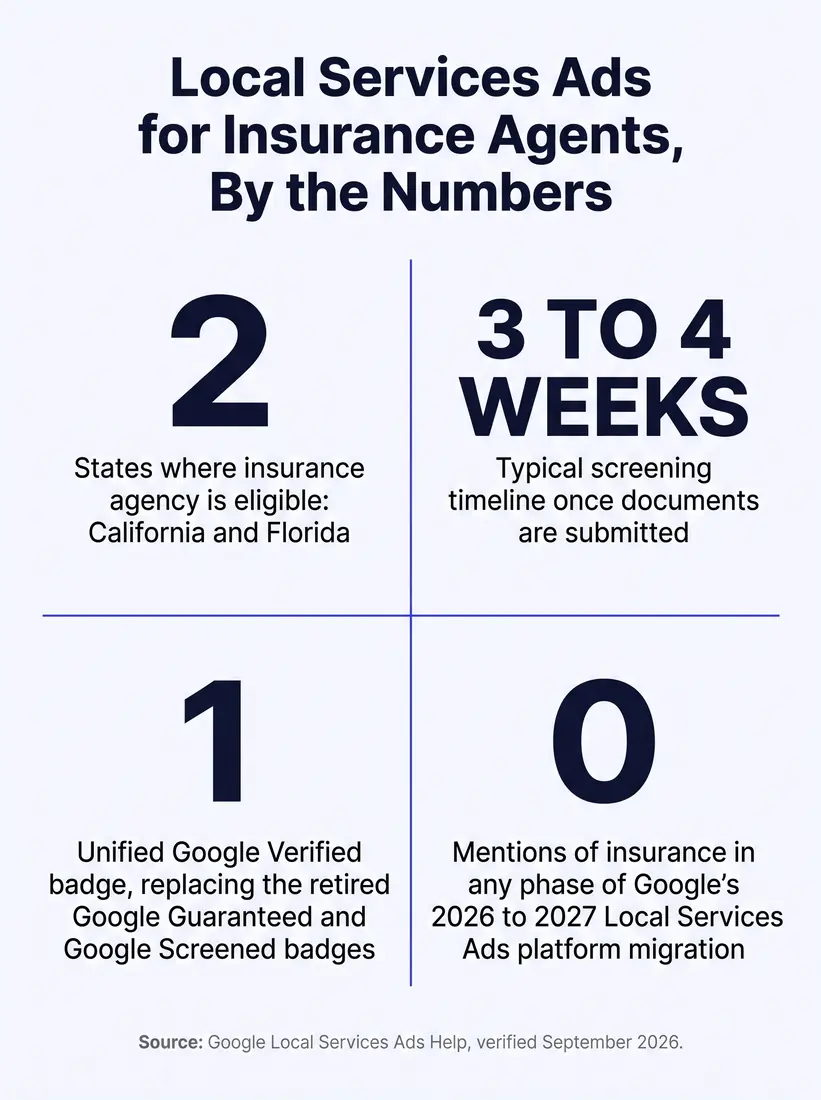
2
States where insurance agency is an eligible Local Services Ads category1
3 to 4 wks
Typical screening timeline once documents are submitted3
1
Unified badge, Google Verified, replacing two prior badges7
0
Mentions of insurance in any phase of the 2026 to 2027 platform migration6
How to check your own eligibility this week
None of this requires waiting on us, a marketing vendor, or a phone call to Google support. Confirming where your agency actually stands takes about ten minutes, and it settles the question for good instead of leaving you guessing at a stalled sign-up form.
- Confirm your Google Business Profile is claimed and verified first. Every category on Local Services Ads requires "a public and verified Google Business profile" before anything else gets reviewed3. If yours isn't claimed, verified, and showing accurate hours, address, and phone number, that's the actual first step, not the Local Services sign-up form itself.
- Start the Local Services Ads sign-up flow directly at ads.google.com/local-services-ads, not through a general Google Ads account. Enter your ZIP code and select "Insurance agency" as the category. If you're in California or Florida, the flow should continue into document upload. If you're anywhere else, it will either fail to list the category or stop without explanation, which by itself confirms the geographic gate rather than something wrong with your application.
- Pull your E&O certificate and state license number before you upload anything. Have both ready and confirm the legal business name on each matches exactly, character for character, including any DBA. A name mismatch here is a quiet, common reason a review runs long.
- If you're already enrolled, check what your badge is called today. If your listing or dashboard still shows "Google Guaranteed" or "Google Screened" language anywhere you're referencing in your own marketing, update it. Google's own documentation confirms the badge is now Google Verified for every advertiser, and the money-back guarantee tied to the old name has been discontinued79.
- If you're outside California or Florida, stop budgeting time against this specific product. Redirect that time to the Google Business Profile, review generation, and site work covered in the next section, since all of it is available to you today regardless of what Google decides about Local Services Ads next year.
- Re-check the category list periodically, not obsessively. Once or twice a year is enough. Google does expand and contract Local Services Ads categories and locations over time, and the getting-started page is the same one page to bookmark and revisit rather than relying on secondhand blog posts that may already be stale by the time you read them.
The channel Google didn't gate to two states
Here's the part worth actually acting on. Every requirement Google lists for Local Services Ads, the verified Google Business Profile, real reviews, a legitimate license on file, a business Google can confirm is real, is infrastructure your agency needs regardless of which state you practice in or whether the pay-per-lead badge is even available to you. None of that work is wasted just because the badge itself is off the table for 48 states.
A verified, actively managed Google Business Profile feeds your map pack listing, the same local ranking factor our guide on why insurance agencies don't show up in the map pack covers in detail, and it's increasingly the same profile an AI answer engine draws from when a shopper asks it to name a local agent. None of that requires Local Services Ads eligibility. It requires the profile to exist, be verified, and be kept current, which is exactly the kind of ongoing task that gets skipped when nobody owns it.
It's also worth keeping this distinct from a related gate you may have already run into. Standard Google Ads for health, Medicare, or ACA insurance content requires a separate certification process, G2RS, which we cover in our guide on why Google keeps blocking insurance ads before AEP. That's a different program with a different application, and clearing it does nothing for Local Services Ads eligibility, the same way clearing Local Services Ads screening in California or Florida would do nothing for a G2RS application. They're two separate gates on two separate products, and conflating them is an easy way to spend effort on the wrong form.
Concretely, that means the checklist for a national channel looks nothing like the Local Services checklist, even though a few of the underlying pieces overlap. Claim and verify your Google Business Profile, listing accurate hours, service areas, and every license or designation you actually hold. Respond to every review, not just the good ones, since an answered review is itself a signal of an active, managed profile. Build or update location pages for every county or metro you actually write business in, rather than one generic homepage trying to rank for a whole state at once. And make sure the schema markup on your site actually describes what's on the page, since that's the machine-readable layer an AI answer engine leans on when it decides whether to name your agency at all. None of these four things asks Google's permission the way Local Services Ads does.
Local Services Ads, insurance category
- Eligible only in California and Florida, per Google's own documentation
- A separate sign-up flow outside standard Google Ads
- Pay-per-lead, with a 3 to 4 week screening window
- No published timeline for a wider rollout
ReachTwo states, if you qualify
A verified profile, a fast site, real reviews
- Google Business Profile verification and management, available anywhere
- Map pack visibility built on the same profile
- AI citation visibility built on schema, speed, and sourced content
- Review generation that compounds independent of any ad program
ReachFifty states, no application to file
How we build the part that works everywhere
We don't manage anyone's Local Services Ads eligibility, since that's Google's call to make and it isn't ours to influence. What we build is the half of this that Google didn't restrict to two states. Digital Foundation's Starter tier, currently $247 a month on our live pricing page, includes "Google Business Profile management + review harvesting" alongside AEO optimization built to help your pages get cited by AI answer engines, and Pro and Scale tiers layer a weekly or daily content cadence and a 24/7 AI receptionist on top of the same foundation8. None of it depends on which state you're licensed in.
The free Audit runs the same underlying check regardless of geography: content depth, schema, technical crawlability, and whether AI crawlers can actually reach your pages, benchmarked against a dataset of 56,609 audited insurance agency websites5. It's a useful first look specifically because it doesn't care whether Google has decided to open Local Services Ads in your state. It measures the channel that's already open to you. Run a free Audit and see where your own site actually stands.
You can do most of this yourself
Claiming and verifying a Google Business Profile, requesting reviews after a policy closes, and checking whether AI crawlers can reach your site are all things an agency can handle without outside help. This section exists for agencies who'd rather that whole cadence, the profile management, the weekly content, the schema, already be running instead of managed as a side project squeezed between renewals.
What you get
Stop treating Local Services Ads eligibility as a marketing problem to solve and start treating it as a fact to check once. If you're in California or Florida and want to pursue it, budget the three-to-four-week review window and get your Google Business Profile verified first, since it's a baseline requirement either way. If you're anywhere else, the honest move is to stop spending time on a sign-up flow that isn't going to open for your category, and put that time into the profile, the site, and the content that work in all fifty states starting today.
What this doesn't do is promise Local Services Ads will stay closed forever, or that Google won't rename the badge again. Category lists, screening requirements, and migration timelines are all things Google can and does change, the way it already renamed the badge once and is actively migrating the whole product to a new platform. The facts in this guide are current and sourced as of this week. Check Google's own Local Services Ads eligibility page directly before you assume last year's, or last month's, answer still holds.
Questions agents ask
Can insurance agents use Google Local Services Ads?
Only in two states. Google's own Local Services Ads documentation lists the eligible categories and their locations, and the exact line for this industry reads "Insurance agency (California and Florida only)". Outside those two states, insurance agency is not an eligible category at all, no matter how the sign-up flow is entered.
Is Google Guaranteed still a thing for insurance agents in 2026?
Not by that name. Google's own Local Services help center confirms it retired the separate Google Guaranteed and Google Screened badges and moved every advertiser to one Google Verified badge, and separately confirms it is discontinuing the Money Back Guarantee tied to the old Google Guarantee badge, with a reimbursement request deadline of December 7, 2025 for services already booked. If you're searching for "Google Guaranteed insurance agent," the badge you're picturing has already been renamed.
What exactly does an agency in California or Florida have to pass to qualify?
Based on Google's own screening and verification requirements page for the United States, an insurance agency category listing includes a state-level business license, a state-level owner license, professional liability insurance, and in some cases a business or owner background check, each marked as applying "where applicable by local law." Google's general qualification page adds that a verified Google Business Profile is required and that the whole review, once documents are submitted, typically takes about three to four weeks.
How are Local Services Ads leads billed, and can I dispute a bad one?
Google's own documentation on lead crediting says leads are assessed when the prospect first makes contact, and leads found invalid or low quality at that point aren't charged in the first place. What changed is the old manual dispute button. Google's help center states plainly that manual credits for categories like "job type not serviced" and "geo not serviced" are no longer supported, replaced by an automated system that reassesses charged leads over time and issues credits, usually within 30 days, sometimes within the first 24 hours.
Will Local Services Ads for insurance expand to more states soon?
There's no published timeline that says so, and the direction of the product right now points the other way. Google's own support documentation for the platform's migration into standard Google Ads Performance Max campaigns names an August 2026 first phase covering only home and storefront categories like plumbing, HVAC, electrical, and roofing, a late-2026 second phase for service-area businesses, and a 2027 third phase for everything else. Insurance agency isn't named in any of the three phases, which reads less like an industry about to get a green light and more like one Google hasn't prioritized moving at all.
What should an agency outside California or Florida do to get found instead?
Build the channel Google didn't gate to two states. A verified, actively managed Google Business Profile, a fast site with the right schema, and a review pipeline all work in every state, because none of them are the Local Services Ads product. Our own free Audit checks exactly those signals in about a minute.
Does a Google Business Profile matter even without Local Services Ads eligibility?
Yes, and it's worth treating as the foundation regardless of state. Google's own qualification requirements list a public, verified Google Business Profile as a baseline for the Local Services product itself, and the same profile is what feeds your map pack listing, your review display, and increasingly what AI answer engines quote when someone asks for a local agent. It's infrastructure you need with or without a badge.
Is Local Services Ads the same program as the Google Ads insurance certification (G2RS)?
No, they're separate gates on separate products. G2RS is a certification Google requires before it will run a standard search or display ad for health, Medicare, or ACA insurance content, covered in our guide on why Google keeps blocking insurance ads before AEP. Local Services Ads is a different, pay-per-lead product with its own category and location restrictions, described in this guide. An agency can clear one and still not qualify for the other.
Sources
- Google. "Getting started with Local Services Ads - United States," category list including "Insurance agency (California and Florida only)," checked September 2026. support.google.com.
- Google. "How providers qualify for Local Services Ads," license, insurance, and background check requirements. support.google.com.
- Google. "Business screening and verification requirements - United States," insurance agency category requirements and the 3 to 4 week screening timeline. support.google.com.
- Google. "About Automated Local Services Ads lead credits," lead assessment, discontinued manual disputes, and auto-crediting timeline. support.google.com.
- Strategic AI Architects. "Free AEO Audit," scope and the 56,609-site benchmark, verified this week. strategicaiarchitects.com.
- Google. "Local Services Ads transition to Performance Max campaigns with pay-per-lead goals," migration phases and named categories. support.google.com.
- Google. "About Google Verified badge," single-badge consolidation and automatic transition for existing advertisers. support.google.com.
- Strategic AI Architects. "Digital Foundation" pricing and tier features, verified this week. strategicaiarchitects.com.
- Google. "The Google Guarantee," Money Back Guarantee discontinuation and the December 7, 2025 reimbursement deadline. support.google.com.
Talk it through
Want a second pair of eyes on it?
Free 30 minutes. Bring what you found, or bring nothing and we will look together at how AI engines read your site and which fixes move first.
See what's actually open to you in every state
Run the free Audit, a live AEO Audit plus a HIPAA tracking scan of your site, in under a minute.