Playbook
Why Google Keeps Blocking Your Insurance Ads Before AEP
A certificate you never applied for is quietly deciding whether your AEP campaign runs at all.

19 min read

Google won't run a health, Medicare, or ACA insurance ad without a separate certificate. Since 2021, US advertisers have needed G2RS certification before Google will serve a health insurance ad1, ACA campaigns need a second certificate on top of that2, and the standard review runs about 14 calendar days4. Medicare's Annual Enrollment Period starts October 156, which means an agent who starts the application in October is already behind, and getting certified still doesn't guarantee approval if the landing page fails its own separate review10.
The disapproval that doesn't explain itself
You built the campaign the way you always build it. New landing page, ad groups split by plan type, budget set aside for the six weeks that decide your year. You hit publish sometime in late September, expecting the usual review lag, and instead of impressions you get a policy violation notice that reads like it was written for someone else's business: something about "health insurance advertiser certification," a status you don't remember applying for, on a campaign you've run in some form for years.
If this hasn't happened to you yet, it's worth understanding before it does, because the mechanism behind it isn't new, isn't a glitch, and isn't going away. It's just quiet. Google doesn't put "you need a separate certificate for this" in the ad-builder flow where you'd see it while setting up a campaign. It shows up after, as a disapproval, usually with just enough time left before AEP to be stressful and not quite enough time to fix casually.
The frustrating part isn't the requirement itself. It's how it's communicated. Nothing in the standard Google Ads campaign-creation flow flags that health insurance is a restricted category the way it flags, say, a missing billing method. You can build a full campaign, ad groups, keywords, extensions, budget, and get all the way to "review in progress" before the certification gate even enters the picture. By the time it does, you've already spent the setup hours, and now you're spending calendar days you didn't budget for on top of them.
This guide walks through exactly what the certificate is, who actually needs it, the second certificate most ACA agents don't know exists, why a certified account can still get disapproved for a completely different reason, and the timeline that tells you whether you can still make this year's Annual Enrollment Period.
This is not legal or advertising-compliance advice
This guide describes Google's published advertising policies and G2 Risk Solutions' own certification page, sourced and checked this week. Google's policies change, sometimes without much notice, so treat this as a map of the current terrain rather than a permanent rule, and confirm your own account's status directly in Google Ads before you build a budget around any of it.
What G2RS actually is, and why it exists
Google announced the requirement plainly on its own advertising blog: "in the United States, health insurance advertisers are now required to complete a new certification process in order to advertise on our platforms," rolled out with applications opening May 3, 2021 and a compliance deadline of June 2, 2021 for advertisers already running campaigns1. Google's current policy still states the same requirement in force today: "in the United States, you must be certified by Google in order to advertise health and medical insurance coverage," with government advertisers pre-approved and everyone else routed through G2 Risk Solutions, the third-party verification firm Google uses2.
G2RS's own certification page describes what the process actually checks: that the entity applying is "fully licensed or registered to sell or promote health insurance coverage" in every state it wants to advertise in, with a one-time application fee and an annual subscription fee that scale by the number of states certified, and ongoing monitoring afterward to confirm the license stays active through the year4.
Google didn't build this because insurance advertisers in general are a problem. It built it because a specific, well-documented kind of fraud kept using paid search to reach people shopping for coverage. As recently as April 2026, the FTC asked a federal court to halt a telemarketing operation that ran under names like "Innovative Partners" and "American Collective," selling what it called "state issued" PPO plans with "no deductible and full coverage," when the actual product was a capped medical discount plan that excluded hospital care entirely5. The complaint states the operation collected "millions in 'premiums' for products consumers did not want or need"5, and cases like it are exactly the pattern Google's certification is built to filter out before an ad ever runs, not after a consumer has already been misled.
It's also worth understanding that this isn't a one-time hurdle you clear and forget. G2RS describes an "annual subscription fee" that covers "ongoing monitoring, where we ensure that your licensure or registration remains active throughout the year"4. A license that lapses, a state you stop renewing in, or a change in your agency's registered entity name can all trigger a recheck outside the normal renewal cycle. Certification is a status you maintain, not a badge you earn once and file away.
The extra certificate ACA agents miss
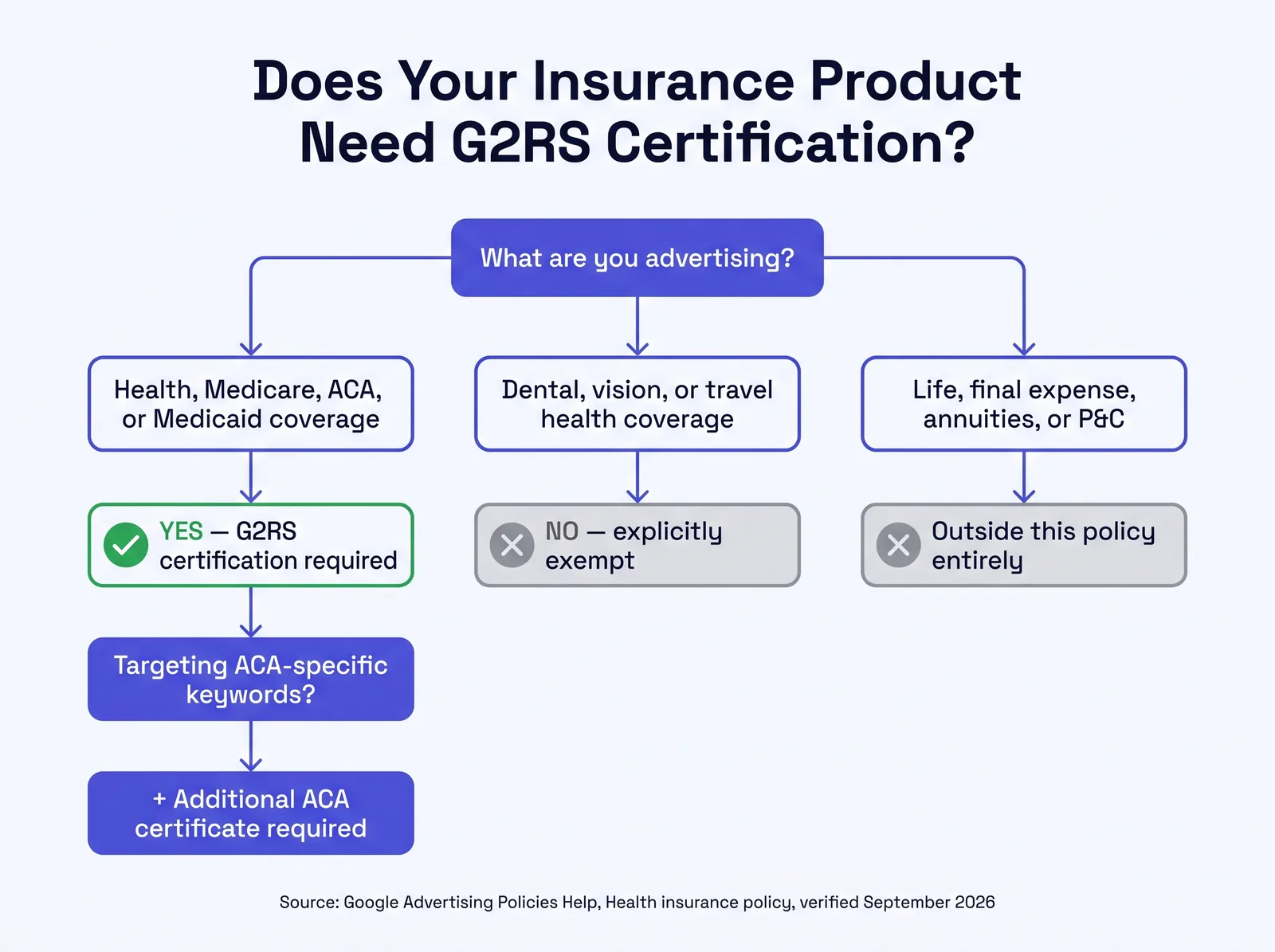
Here's the layer that catches even agents who did their homework and got the base certification. Google's policy adds a second requirement on top of it: "advertisers that are registered with the U.S. government to promote and sell Affordable Care Act-compliant health plans are required to obtain an additional certificate in order to promote and bid on ACA health insurance related keywords"2. G2RS confirms this can be requested at the same time as the general certification, but it is a separate checkbox, not something that comes bundled automatically with the base approval4.
Picture the agent this actually happens to. You write ACA business, you're registered correctly with the Marketplace, and you get your G2RS health insurance certification approved without issue. You launch a campaign built around Marketplace open enrollment keywords, "ACA subsidy," "obamacare plans near me," the terms your book of business actually converts on, and the ad groups targeting those specific keywords get disapproved anyway, even though your account shows as certified. The general certificate cleared. The ACA-specific one, the one nobody mentioned needing separately, didn't.
Worth checking on your own account this week
If you write both Medicare and ACA business, check your Google Ads certification status under Account > Policy > Certifications for both the general health insurance certificate and the ACA-specific one separately. It's a two-minute look, and it's the single most common gap that disapproves an otherwise-clean ACA campaign. If you want a broader read on how the rest of your site's compliance signals stack up, the free Audit checks that in about a minute. Run a free Audit.
What needs this certificate, and what doesn't
The certification requirement is scoped narrowly to health and medical insurance coverage. Google's policy names the products it covers directly, and it's a longer list than most agents expect, but it has real edges.
| Product | Needs G2RS certification? | Extra requirement |
|---|---|---|
| Individual & family health plans | Yes2 | None beyond base certification |
| ACA / Marketplace-compliant plans | Yes2 | Additional ACA keyword certificate2 |
| Medicare Advantage & Medigap | Yes2 | None beyond base certification |
| Medicaid | Yes2 | None beyond base certification |
| Short-term & fixed indemnity plans | Yes2 | None beyond base certification |
| Dental, vision & travel health insurance | No, explicitly exempt2 | — |
| Life, final expense & annuities | Outside this policy entirely2 | — |
| P&C / commercial lines | Outside this policy entirely2 | — |
Government advertisers are the one category Google pre-approves without routing through G2RS2. Everyone else selling into a covered category, whether a solo producer or a fifty-agent FMO downline, goes through the same third-party check.
The exemption boundary is worth reading twice if your agency writes a mixed book. A single practice selling both ACA plans and final expense life insurance is certified for one line of business and not the other, under the same Google Ads account. That's not a contradiction in Google's policy, it's the policy working as scoped: the requirement targets health and medical insurance specifically because that's where the fraud pattern the FTC keeps documenting actually shows up, not because Google treats every insurance product as equally risky to advertise.
Why this hits multi-state and FMO agencies hardest
A single-state, single-office agent has one certification to track. An agency licensed across a dozen states, or an FMO with a downline of sub-agents each running their own local campaigns, has a combinatorial problem instead. G2RS prices the certification "based on the number of U.S. jurisdictions" being certified4, which means adding a state you newly expanded into isn't free or automatic. It's a new line item on the application and, if it's added after the fact, potentially a new review cycle.
FMOs and IMOs running content and ad campaigns across several branded sites face a version of this that's easy to miss entirely: certification status lives at the Google Ads account level, not at the brand or agent level. If a downline agent spins up their own Google Ads account to run local campaigns independently of the FMO's main account, that individual account needs its own certification, with its own state list, its own ACA certificate if applicable, and its own landing page clearing destination review. An FMO that assumes "we're certified" because the parent brand handled it once can discover, mid AEP, that half a dozen sub-accounts never went through the process at all.
The practical fix is the same one that shows up everywhere else in agency compliance: centralize what can be centralized. One compliant landing page template, one certification checklist tracked per Google Ads account rather than assumed at the brand level, and one person responsible for confirming every active account's status before budget goes live each fall. Agencies already managing this kind of coordination across a downline of sites tend to run into the same content-quality and Google-penalty questions covered in our guide on why a downline's websites can get penalized together, and the certification gate is effectively that same centralization problem wearing an advertising-policy hat instead of a content one.
The clock problem: certification vs. AEP
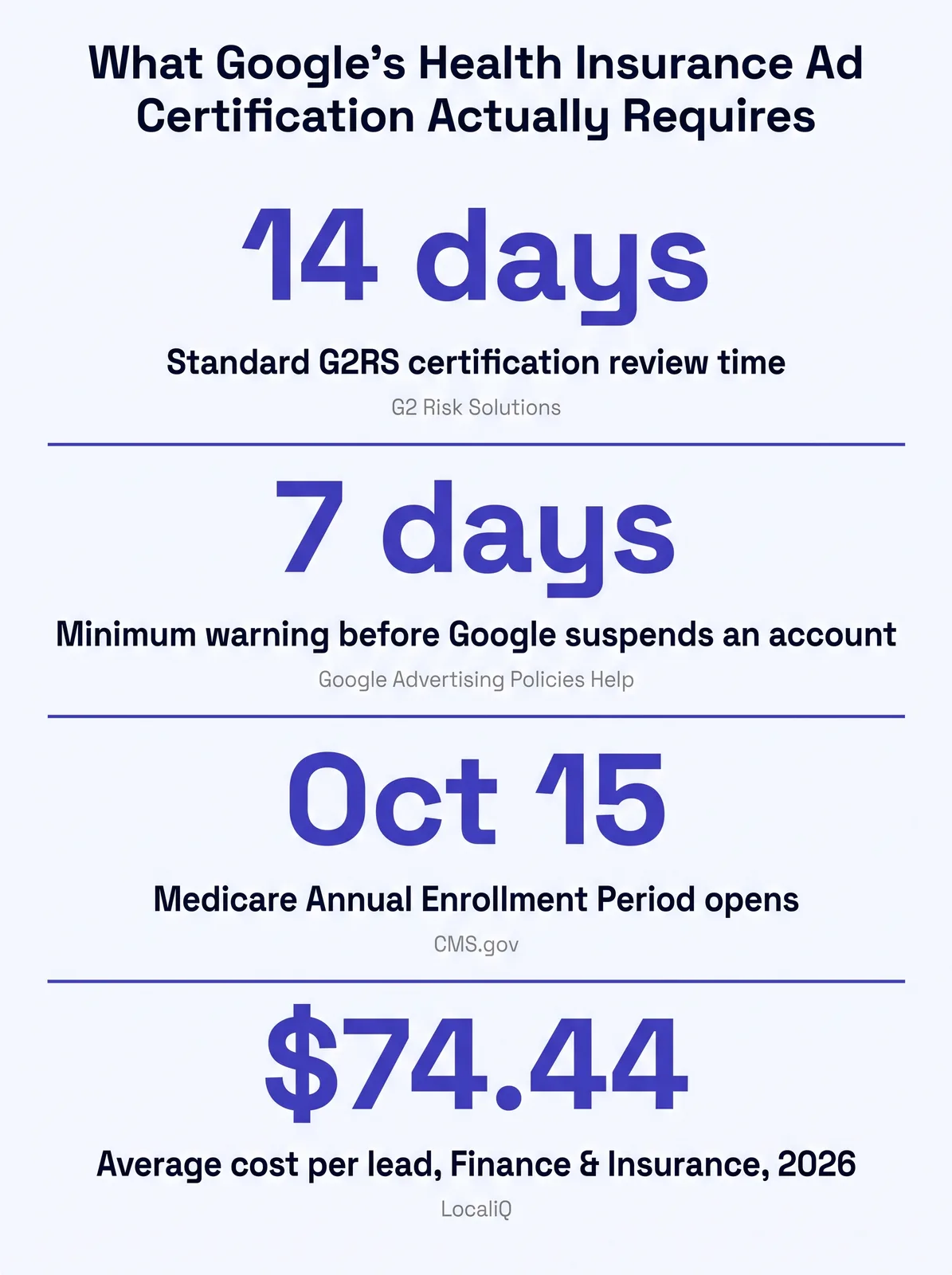
Even a clean application has a real processing time, and insurance advertising runs on a calendar that doesn't move for anyone's paperwork. G2 Risk Solutions states standard turnaround is "typically 14 calendar days or fewer" for a complete application, with no expedited track available4. Medicare's Annual Enrollment Period runs October 15 through December 7 every year6. The ACA Marketplace's Open Enrollment Period for 2027 coverage runs November 1 through January 15, with December 15 as the last day to enroll for coverage starting January 17.
Lay those two facts next to each other and the problem is arithmetic, not opinion. An agent who starts the G2RS application on October 1, thinking they have two weeks of buffer before AEP opens, is assuming a first-pass approval with no back-and-forth. Any request for additional documentation, any state missing from the original application, any mismatch between the applicant name and the license on file, restarts that clock. An agent who waits until the first week of October to even think about certification is, in practice, gambling on being fully live by October 15 with zero margin for a single hiccup.
| Milestone | Date | What it means for an uncertified account |
|---|---|---|
| Apply for G2RS certification | Any time, ongoing4 | Standard review, ~14 calendar days, no expedited option |
| Latest safe application date for AEP | Late September | Leaves buffer for a resubmission before October 15 |
| Medicare AEP opens | October 156 | Uncertified Medicare, MA, and Medigap ads still won't serve |
| Medicare AEP closes | December 76 | Every week uncertified is a week of the highest-intent traffic gone |
| ACA Open Enrollment opens | November 17 | Also needs the separate ACA keyword certificate cleared |
| Deadline for January 1 ACA coverage | December 157 | The highest-converting window of ACA OEP closes here |
The mistake we see most
An agency budgets for AEP, builds the campaign in early October, and treats certification as a formality to knock out once the ads are ready to launch. By the time the disapproval notice arrives, a third of AEP is already gone, and the 14-day clock still hasn't started. Certification isn't the last step before launch. It's the first one, and it has to happen before the campaign is built, not alongside it.
Certified and still disapproved: the landing page gate
Certification proves who you are. It does nothing for what your ad points to, and Google reviews that separately, every time, on every ad. Two policies govern it. The first is Google's business information requirement, which is specific and unforgiving about one detail: "advertiser's business name not clearly present on the landing page of the ad" is a stated cause for disapproval9. A funnel page built around a generic headline and a lead form, with your agency's actual name buried in a footer or missing entirely, fails this even with a fully certified account behind it.
The second is Google's destination requirements policy, which covers whether the page itself works. Ads are disapproved when the destination "doesn't function properly or has been set up incorrectly," when it "returns an HTTP error code for Google AdsBot," when the URL shown in the ad doesn't match where the click actually lands, or when the page is "unnecessarily difficult or frustrating to navigate"10. Google's AdsBot has to be able to crawl the page at all before any of the rest of the review can happen, which means a landing page that loads slowly enough to time out a crawler, or that sits behind a heavy JavaScript funnel builder that renders content client-side after the initial request, can fail before a human reviewer ever sees the content.
Google states the same enforcement pattern here as it does for certification: a warning goes out at least 7 days before an account is suspended for a policy violation, rather than an immediate cutoff10. That's real breathing room if you catch the problem early. It's much less useful if the disapproval lands two weeks into AEP and the fix requires rebuilding the funnel page from scratch under deadline pressure.
The mechanism worth understanding here is the crawler itself. Google AdsBot isn't Googlebot, and it doesn't behave identically. It fetches your destination URL specifically to verify the page a click will actually land on matches the ad, and it does that fetch on a tighter budget than an organic search crawl. A page-builder platform that assembles its content with client-side JavaScript, common on many funnel-page tools built for lead capture, forces AdsBot to execute that script before it can see anything worth reviewing. A static HTML page skips that step entirely: the content AdsBot needs is already in the first response, the same response a visitor's browser gets. That's the same architectural gap that shows up in page-speed comparisons between static and page-builder sites, just applied to an ad crawler instead of a human visitor or a search index.
The typical AEP funnel page
- Built on a page-builder platform that renders content after the initial page load
- Generic headline, agency name absent or buried in small print
- Loads slowly enough to risk an AdsBot crawl timeout
- URL shown in the ad differs from the final landing domain
ResultDisapproved on destination review, certified or not
A static, compliant page
- Static HTML at the edge, fully rendered on the first request
- Agency's legal business name clearly present, not just in a footer
- Fast enough that AdsBot crawls it without incident
- Self-referencing domain that matches the ad's display URL exactly
ResultPasses destination review on the first pass
What guessing wrong costs
Insurance keywords are already some of the most expensive real estate in Google Ads, which raises the stakes of every wasted day. LocaliQ's 2026 search advertising benchmarks, drawn from its own cross-industry campaign data and last updated June 1, 2026, put the Finance & Insurance category at a $3.39 average cost per click, a 9.83% average click-through rate, a 2.64% average conversion rate, and a resulting $74.44 average cost per lead8.
Run the arithmetic on a modest AEP budget. An agency spending $3,000 across the six-and-a-half-week Medicare AEP window, at a $74.44 average cost per lead, is buying roughly 40 leads for the season at benchmark efficiency. Every week that budget sits idle behind a certification disapproval, or gets spent on a campaign that's about to be shut down for a landing page violation, is a proportional slice of those 40 leads that never converts into an appointment, because the ad simply never served, or served briefly before Google pulled it.
| Weeks of the 7.5-week AEP window running | Budget actually spent | Leads at $74.44 CPL |
|---|---|---|
| Full window (certified before Oct 15) | $3,000 | ~40 |
| 2 weeks lost to a certification delay | ~$2,200 | ~30 |
| 4 weeks lost to certification + a landing page rebuild | ~$1,330 | ~18 |
That's a straight-line illustration, not a guarantee. It assumes an even weekly pace and benchmark performance, and a real campaign's results move with bids, seasonality, and creative quality. What it shows plainly is the shape of the problem: every week spent untangling a certification or landing page issue is a week of the highest-intent traffic of the year that a competitor's already-certified, already-compliant campaign gets to keep for itself.
The quieter cost is the one that doesn't show up in a spend report at all: the campaign an agent never launches because a disapproval in early October reads as a dead end instead of a fixable, two-part problem. Most agents who hit this wall don't debug it. They pull the budget, write off paid search for the season, and lean entirely on organic traffic and referrals instead, which may be the right call for some agencies and a genuinely avoidable retreat for others.
If paid search isn't worth fixing for you this year
That's a legitimate call, not a failure. A slow, uncertified funnel losing money on $74 leads is worse than no campaign at all. If you'd rather put the same effort into organic visibility instead, our guide on why insurance agency cost per lead keeps climbing walks through the landing-page speed side of that math in more depth.
How to get certified without losing the season
None of this requires buying anything. It requires doing the paperwork in the right order and early enough that a hiccup doesn't cost you AEP. Most of the agents who get burned by this aren't doing anything wrong so much as doing the steps in the order the campaign-builder interface implies, which is build the ads first and worry about approval second. Flip that order and the whole problem mostly disappears.
- Check your certification status today, not in October. Google's Health Insurance Advertiser page is where the certification actually lives and where your account's current status shows up3. In Google Ads, go to Admin > Policy > Account (or the Certifications section under Account settings) and look for a health insurance certification status. If it says nothing, you haven't applied.
- Apply for the base G2RS certification with every state you're licensed in listed. Missing a state you plan to advertise in later means a second application and a second 14-day clock, so list every state you're actually licensed in now, even ones you're not actively advertising in yet.
- Request the ACA keyword certificate at the same time if you write ACA business. G2RS allows this to be requested alongside the general certification in one pass. Skipping it because you're "mostly Medicare right now" just means a second application later when your ACA campaigns need it.
- Have your license documentation ready before you start. The most common reason a "14-day" review stretches longer is an applicant missing a document on the first submission. Pull your current state license numbers and any government ACA registration before opening the application, not after G2RS asks for them.
- Build or fix the landing page in parallel, not after. Certification and destination review are two separate gates, and there's no reason to solve them sequentially. While the G2RS application processes, confirm your landing page actually displays your agency's legal business name prominently, loads fast enough for AdsBot to crawl it cleanly, and matches the domain shown in your ad exactly.
- Apply by mid-September for AEP, not early October. Fourteen calendar days from a mid-September submission leaves real buffer before October 15, even if the first pass comes back with a request for more documentation.
- Calendar the annual renewal separately from the application. Since certification is monitored on an ongoing basis rather than granted once and forgotten, put a reminder on next year's calendar now, roughly two months ahead of the AEP you're planning for, so this never becomes a surprise again.
Six steps, none of them technically difficult, and all of them doable without a developer, an agency, or a compliance consultant. The entire obstacle is timing. An agent who treats this list as a September task instead of an October emergency spends the actual enrollment window selling, not troubleshooting a policy notice.
How we build the landing page half of this
The G2RS application has to come from you, since it verifies your license, not ours. What we build is the part that determines whether a certified account still gets its ads approved and its ad spend used well: a landing page that clears Google's destination and business-information review on the first pass, and keeps clearing it, instead of adding a second delay stacked on top of the certification wait.
We build on Astro, which ships zero JavaScript by default, so a page arrives as finished HTML rather than a shell that renders after the fact, exactly the kind of page Google's AdsBot crawls without incident. Our builds score 90+ on Lighthouse performance on both mobile and desktop, and some score 100, and every site we ship carries the compliant, clearly displayed business information Google's landing page policy asks for by default, not as an afterthought bolted onto a template. Digital Foundation, starting at $247 a month, includes a complete, compliant website with a 14-day free trial before billing starts11, which is enough time to see whether your own certified campaign clears review before you commit to anything.
You can absolutely do this yourself
G2RS certification, the ACA keyword certificate, and a landing page rebuild are all things an agency can handle in-house with enough lead time. This guide gives you the actual mechanism and the order to do it in. This section exists for agencies that would rather the landing page half of it already be built correctly instead of managed as a side project during the busiest six weeks of the year.
The same static foundation that clears AdsBot's crawl also carries the sitemap and llms.txt that keep the rest of your site's crawl path current automatically, so a new location page or a new blog post doesn't need a manual step to show up where Google, or an AI answer engine, looks for it. None of that is specific to Google Ads. It's the same underlying build quality showing up in two different reviews at once, one run by an ad crawler and one run by whatever an insurance shopper's AI assistant fetches when it's deciding who to name.
What you get
Handle both gates correctly and the outcome is specific: your health, Medicare, or ACA campaigns actually serve when you turn them on, instead of stalling behind a certification you didn't know you needed or a landing page that was never going to pass destination review. Budget you set aside for AEP goes toward leads at something close to the benchmark $74.44 cost per lead, instead of sitting idle behind a disapproval notice you're debugging mid-season.
What this doesn't do is make Google's policies permanent. G2RS could change its processing time, Google could add a new certification layer the way it did for ACA keywords, and the landing page requirements could tighten further. The mechanism described here is current and sourced as of this week. Confirm your own account's status directly before you build a season's budget around any of it.
Questions agents ask
Do all insurance agents need a special certificate to run Google Ads?
No. Google's certification requirement, run through its verification partner G2 Risk Solutions, only applies to ads for health and medical insurance coverage, which Google's own policy lists as including individual health plans, short-term and limited-duration plans, fixed indemnity coverage, Medicare Advantage, Medigap, Medicaid, and ACA-compliant plans. Dental, vision, and travel insurance ads are explicitly exempt, and life, final expense, and P&C insurance fall outside this specific policy entirely.
What is G2RS, and is it the same thing as my state insurance license?
G2 Risk Solutions (G2RS) is the third-party verification company Google uses to confirm an advertiser is actually licensed to sell what it's advertising. Your state license is what G2RS checks against, but the certificate itself is a separate credential Google requires on top of that license before it will serve a health insurance ad, and it has to be applied for directly through Google's certification process.
I sell ACA plans. Does the general health insurance certificate cover me?
Not by itself. Google's policy requires a second, additional certificate specifically for bidding on ACA-related keywords, on top of the general health insurance certification. An agent who only completes the base G2RS certification can still have ACA-targeted campaigns rejected because that second certificate was never requested.
How long does certification take, and will it be ready before AEP?
G2 Risk Solutions states standard processing is typically 14 calendar days or fewer for a complete application, with no expedited option. Medicare's Annual Enrollment Period starts October 15, so an agent who begins the application in the first week of October is cutting it close even before accounting for a landing page review or an incomplete first submission sending the clock back to zero.
My account is already certified. Why did Google still disapprove my ad?
Certification confirms who you are; it doesn't clear your landing page. Google separately requires the destination page to load correctly, be crawlable by its AdsBot, match the domain shown in the ad, and clearly display your business name. A certified advertiser with a slow, broken, or generic funnel page still fails that second, independent review.
What happens if I run health insurance ads without getting certified first?
Google states that a policy violation won't trigger immediate suspension without warning, and that a warning goes out at least 7 days before an account is suspended. In practice that means an agent can spend real budget on a campaign that later gets shut down mid-flight, right in the middle of the enrollment window it was built to capture.
Do Medicare Advantage and Medigap ads need the same certificate as ACA ads?
They fall under the same general health insurance certification requirement, since Google's policy names Medicare Advantage and Medigap alongside individual and short-term health plans as coverage types requiring G2RS certification. The additional, second certificate is specific to ACA-related keywords, so a pure Medicare campaign doesn't need that extra layer, but it still needs the base certification.
Can Strategic AI Architects get my Google Ads account certified for me?
The G2RS application itself has to be filed by the licensed entity it verifies, so that part stays with you or your agency's compliance contact. What we build is the half of this that actually determines whether a certified account still gets its ads approved: a fast, compliant landing page that passes Google's destination and business-information review the first time, instead of adding a second delay on top of the certification wait.
Sources
- Google Ads & Commerce Blog. "A new certification for health insurance advertisers in the U.S.," announced April 20, 2021, applications opened May 3, 2021. blog.google.
- Google Advertising Policies Help. "Health insurance," certification requirement, ACA keyword certificate, exemptions, and enforcement, checked September 2026. support.google.com.
- Google Ads Help. "Health Insurance Advertiser" certification status and application page. support.google.com.
- G2 Risk Solutions. "Health Insurance Providers Certification," application fee structure by state count and standard 14 calendar day processing time. g2risksolutions.com.
- Federal Trade Commission. "FTC Sues to Stop Deceptive Health Care Scheme," press release, April 22, 2026. ftc.gov.
- Centers for Medicare & Medicaid Services. Medicare Open Enrollment partner resources, Annual Enrollment Period dates October 15 to December 7. cms.gov.
- HealthCare.gov. "When can you get health insurance?" Quick guide to dates and deadlines, 2027 coverage Open Enrollment November 1 to January 15, December 15 deadline for January 1 coverage. healthcare.gov.
- LocaliQ. "Search Advertising Benchmarks for Every Industry," Finance & Insurance category CPC, CTR, CVR, and CPL, data last updated June 1, 2026. localiq.com.
- Google Advertising Policies Help. "Business information requirements," advertiser business name must be clearly present on the landing page. support.google.com.
- Google Advertising Policies Help. "Destination requirements," page function, crawlability, domain match, and the 7-day warning before suspension. support.google.com.
- Strategic AI Architects. "Digital Foundation," tier pricing and trial terms, verified this week. strategicaiarchitects.com.
Talk it through
Want a second pair of eyes on it?
Free 30 minutes. Bring what you found, or bring nothing and we will look together at how AI engines read your site and which fixes move first.
See if your site would clear a Google Ads landing page review
Run the free Audit, a live AEO Audit plus a HIPAA tracking scan of your site, in under a minute.