Playbook
Why Your Downline's Websites Could Get Penalized Together
Google's own spam policy now has a name for a downline running the same article on forty domains. It is not a compliment.


18 min read
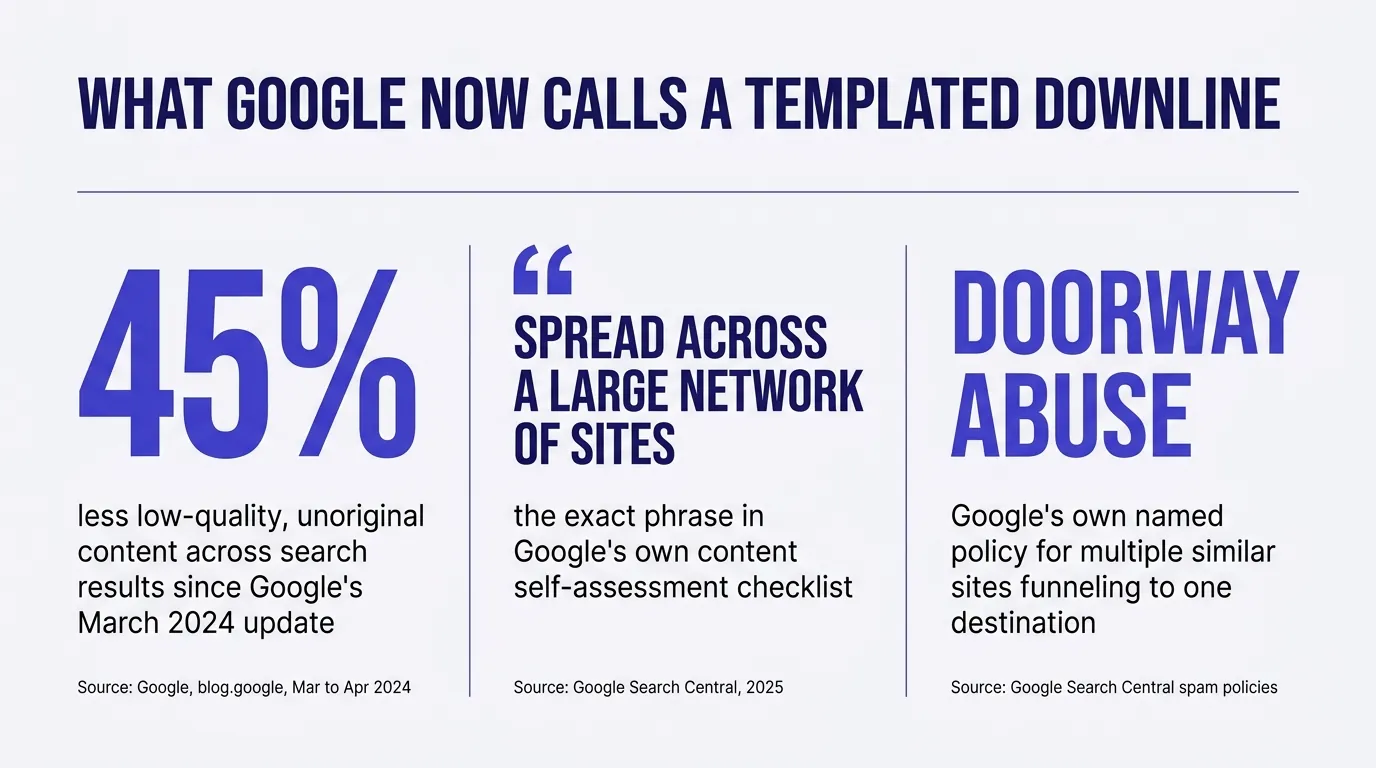
Google's spam policies, refreshed in March 2024, now name this exact pattern directly: "scaled content abuse" for mass-produced pages with little individual value, and "doorway abuse" for multiple sites with slight variations that funnel visitors to the same destination1. Google reported the update cut low-quality, unoriginal content in search results by 45%2. Its own content self-assessment asks plainly whether a page is "mass-produced by or outsourced to a large number of creators, or spread across a large network of sites, so that individual pages or sites don't get as much attention or care"3, which describes how a lot of FMO and IMO downlines actually get their content written. Insurance content carries extra scrutiny on top of that, since Google's own quality rater guidelines treat health and financial topics as its strictest content category5. None of this means stop publishing. It means the shared-template model most downlines run on is the exact pattern these policies were built to catch.
Why every site in the network reads the same
If you run or work inside an FMO or IMO, you already know the pattern. Forty, eighty, two hundred downline agents, each with their own domain, each needing a website that at least looks current. Building two hundred genuinely original sites is not realistic on any budget, so the practical answer has always been a shared template: same layout, same page structure, same rough copy, swap the agent's name, the headshot, and the city.
The blog is usually where this gets worst. A content vendor, sometimes a single freelance writer, sometimes an AI tool with no oversight, produces one article a month and republishes a lightly reworded version of it across every site in the network. "5 Things to Know About Medicare Advantage in Springfield" becomes "5 Things to Know About Medicare Advantage in Fairview" on the next domain over, same five things, same order, same sentences, different city name dropped in twice.
Location pages tend to follow the identical pattern, and often predate the blog problem by years. Someone built a "Medicare Advantage Plans in [City]" template once, and every new agent onboarded to the network gets a copy with their city and phone number dropped in. Nobody treats this as risky, because it looks exactly like what every competitor's downline is also doing, and it has looked that way for long enough that it reads as normal rather than as a policy violation waiting to be noticed.
For years this was just a minor waste of a content budget. It is no longer just that. Google has spent the last two years building specific, named policies around exactly this pattern, and a downline that runs on shared templates and syndicated blog posts is not a gray area under those policies. It is close to the textbook example.
The reason this has changed is worth naming plainly: the tools that make templated content cheap to produce are the same tools that made it cheap for everyone else, too. An FMO that once had a real, if thin, advantage from simply having a website for every agent is now competing against every other FMO doing the identical thing, at the identical scale, often through the identical handful of vendors serving the whole industry. When the differentiator disappears because everyone has access to the same production shortcut, what is left is exactly what Google's newer policies were built to weed out: a lot of pages that look like content but function like inventory.
None of this is a hypothetical concern about some other industry's problem finding its way to insurance eventually. It already describes how a large share of downline websites are built today, quietly, as a cost-saving decision nobody framed as a policy risk at the time it was made.
What Google actually calls this now
In March 2024, Google rewrote its spam policies to name two patterns that map directly onto a templated agent network. The first is scaled content abuse, defined as pages "generated for the primary purpose of manipulating search rankings and not helping users," a policy Google states is deliberately method-agnostic, covering AI-generated pages, scraped and stitched content, and human-written pages produced at scale with equal weight1.
The second is doorway abuse, which Google defines as "sites or pages... created to rank for specific, similar search queries" that "lead users to intermediate pages that are not as useful as the final destination"1. Google's own examples read like a direct description of an agent downline: "having multiple websites with slight variations to the URL and home page to maximize their reach for any specific query," and "having multiple domain names or pages targeted at specific regions or cities that funnel users to one page"1.
| Google's policy | Google's own definition | The downline pattern it describes |
|---|---|---|
| Scaled content abuse | Pages generated to manipulate rankings, not help users, regardless of method1 | The same article, lightly reworded, across every site |
| Doorway abuse | Multiple sites with slight variations, funneling to one destination1 | Forty near-identical domains, same layout, city swapped |
Google refined its related site reputation abuse policy again in November 2024, tightening the rules around third-party content borrowing an established site's authority4. That specific policy targets a different mechanic, one big site hosting outside content, and is not the closest match for a downline of separate small domains. The two that matter most for an agent network are the first two in the table above.
It is worth being precise about what these policies do not say, too, since overcorrecting is its own kind of mistake. Google is not banning templates, is not banning multi-location business websites, and is not banning agencies from covering the same general topics as competitors, which would be an impossible standard for any industry. The policy language targets the combination of similarity and low individual value at the same time. A page can share a layout with a thousand siblings and still clear this bar, provided the content filling that layout genuinely reflects that one page's specific place, plans, or audience. The failure mode is producing volume as a substitute for substance, not producing volume itself.
The mistake we see most
An FMO reads "doorway pages" and pictures something obviously spammy, a page stuffed with keywords and nothing else. Google's actual examples are more mundane than that: ordinary looking local pages, built the normal way agencies have always built them, that simply share too much structure and too little unique substance across too many domains at once.
The one question Google asks about your content
Google publishes a self-assessment checklist for what it calls helpful, people-first content, and one question on that list is not subtle about who it is aimed at: "Is the content mass-produced by or outsourced to a large number of creators, or spread across a large network of sites, so that individual pages or sites don't get as much attention or care?"3
Read that again with a downline of agent sites in mind. It is not asking whether your content is written by AI. It is not asking whether you use a template. It is asking whether each individual site gets real, individual attention, or whether it is one of many outputs from a process built to produce volume. A single writer or tool covering two hundred domains a month answers that question for you, honestly, whether or not you meant it to.
Google's own guidance is explicit that scale itself is not the violation. A large publisher with real editorial staff covering many topics is not automatically penalized for having a lot of content. What draws scrutiny is volume without proportional care, exactly the tradeoff a downline makes when the content budget for two hundred sites works out to a few dollars per site per month.
Why insurance content gets extra scrutiny
General web content gets judged against these policies. Insurance content gets judged harder, because of a separate, older Google framework called YMYL, short for Your Money or Your Life. Google's Search Quality Rater Guidelines apply this designation to any topic that could affect a person's health, financial stability, or safety, and treat health, medical, and insurance subject matter as YMYL essentially by default5.
That matters here because YMYL is not a separate penalty system, it is a lens that makes Google's existing quality standards stricter for exactly this content category. A shared template about a low-stakes topic might just underperform quietly. The same shared template applied to Medicare Advantage plan comparisons, ACA subsidy eligibility, or life insurance underwriting sits inside the category Google has built its most rigorous review standards around, precisely because getting it wrong carries real consequences for the reader.
This is also where the two things covered so far in this guide, the scaled content and doorway abuse policies and the older YMYL framework, actually reinforce each other rather than operating as separate checklists. Google built YMYL to raise the bar on accuracy and expertise for sensitive topics. It built the newer spam policies to catch volume produced without individual care. A downline running templated Medicare content is failing the newer volume-without-care test on a topic already held to the older, stricter accuracy test, which is a worse combination than either policy applied on its own to a lower-stakes industry.
It helps to see how this plays out on an actual page. A generic home-services business publishing "5 Tips for Winter Maintenance" with the city name swapped across twenty domains is producing low-value content, but the downside of a reader acting on bad advice in that article is modest. An insurance downline publishing "5 Things to Know About Medicare Advantage" with the same treatment is doing the identical structural thing to content that could actually steer someone toward the wrong plan for their health needs or their prescriptions. Google's quality raters are trained to weigh exactly that difference, which is the entire point of a YMYL classification existing in the first place5.
What a network-wide penalty actually costs
The mechanism here is what makes it expensive in a way a single bad blog post never was. Google's algorithmic systems, not a manual reviewer working one site at a time, are what detect scaled content and doorway patterns, and those systems look for the pattern across a set of related pages or sites, not in isolation1. That means the exposure does not sit with one underperforming site while the rest of the network is fine. The pattern that triggers scrutiny is the network itself.
This is a meaningful shift from how most agents were trained to think about SEO risk. The older mental model, one site, one set of problems, one fix, assumes each site is evaluated on its own. A pattern-based policy evaluates the relationship between sites, which means an agent who has done everything right on their own individual site can still be affected by a pattern that exists because of what their FMO's other downline sites are doing, simply by sharing the same production pipeline. That is an uncomfortable fact for an individual agent to sit with, and it is exactly why this is worth raising with whoever runs the network's content program, not something to quietly hope doesn't apply.
Put concretely: an FMO that built its content operation around one vendor producing the same article shell across its whole downline has, by definition, built a single point of failure across every site that vendor touches. A change that affects how Google treats that pattern does not average out. It applies everywhere the pattern exists at once, which is the opposite of how most agencies think about SEO risk, where one site's problems normally stay that site's problem.
Recovery is slower than the initial drop, too, which is the part that tends to surprise people used to thinking of SEO setbacks as temporary. A single site with a content problem can often fix that one site and see signals recover within weeks. A pattern detected across dozens of related sites requires genuinely reworking the content on every affected site before the underlying pattern goes away, because a partial fix, ten sites out of forty rewritten, still leaves the same detectable pattern present across the other thirty. The scale that made the original content cheap to produce is the same scale that makes a real fix expensive to execute quickly.
45%
Less low-quality, unoriginal content Google reports across search results since its March 2024 update2
2
Named spam policies that map directly onto a templated agent downline1
1
Self-assessment question Google asks specifically about networks of sites3
How to check your own network in twenty minutes
You do not need to guess at how similar your downline's sites actually are. Some of it is checkable directly.
Pull the most recent blog post from five sites in the network
Open the newest article on five different agent sites in your downline. Read the opening two paragraphs of each back to back. If the structure, the examples, and the sentence rhythm are interchangeable and only the city or agent name changed, that is the pattern Google's scaled content policy describes.
Search a distinctive phrase from one article in quotes
Copy a full sentence from one site's blog post, paste it into Google in quotation marks, and see how many other domains in your network the same or a near-identical sentence appears on. More than one or two is worth investigating further.
Check whether location pages contain any real local data
Open a "plans in [city]" style page and look for anything specific to that actual place: real county-level enrollment or plan-count figures, a real local phone number, a named nearby landmark or service area. If every location page reads identically except for the city name, that is doorway abuse's clearest example, almost verbatim1.
Ask who actually wrote last month's content, and how
Find out whether one vendor, freelancer, or AI tool is producing content for a large share of your downline without a review process specific to each site. That single point of production, not the tool used, is the actual risk factor.
Compare a shared metric across the whole network, not just one site
Pull organic traffic or impressions for every site in the downline over the past three months and look for a simultaneous drop across several sites at once, rather than the normal, staggered ups and downs a healthy set of independent sites usually shows. A shared dip is the clearest early sign that a network-wide pattern, not a single site's issue, is what's actually being evaluated.
If you want a second opinion
The free Audit checks a site's technical and AI-citation readiness in about a minute, a useful first look before you start comparing content across a whole downline. Run a free Audit at strategicaiarchitects.com/audit.
What actually counts as different, page to page
A shared layout is not the problem. Every well-run multi-location business, insurance or otherwise, uses a consistent structure across its pages, and Google's policies do not ban templates or consistent design. What they target is content where the substance underneath the structure is interchangeable.
A useful way to think about it: a template is a container, and the question that actually matters is what fills it. Two location pages can share the exact same headings, the exact same section order, and the exact same call to action, and still be genuinely different pages if the sentences inside those sections describe two different places with two different sets of facts. Two location pages can also look superficially distinct, different colors, different stock photography, slightly reordered sections, and still be functionally identical if the actual claims made on each one are interchangeable. Structure is a design decision. Substance is the part that determines which policy applies.
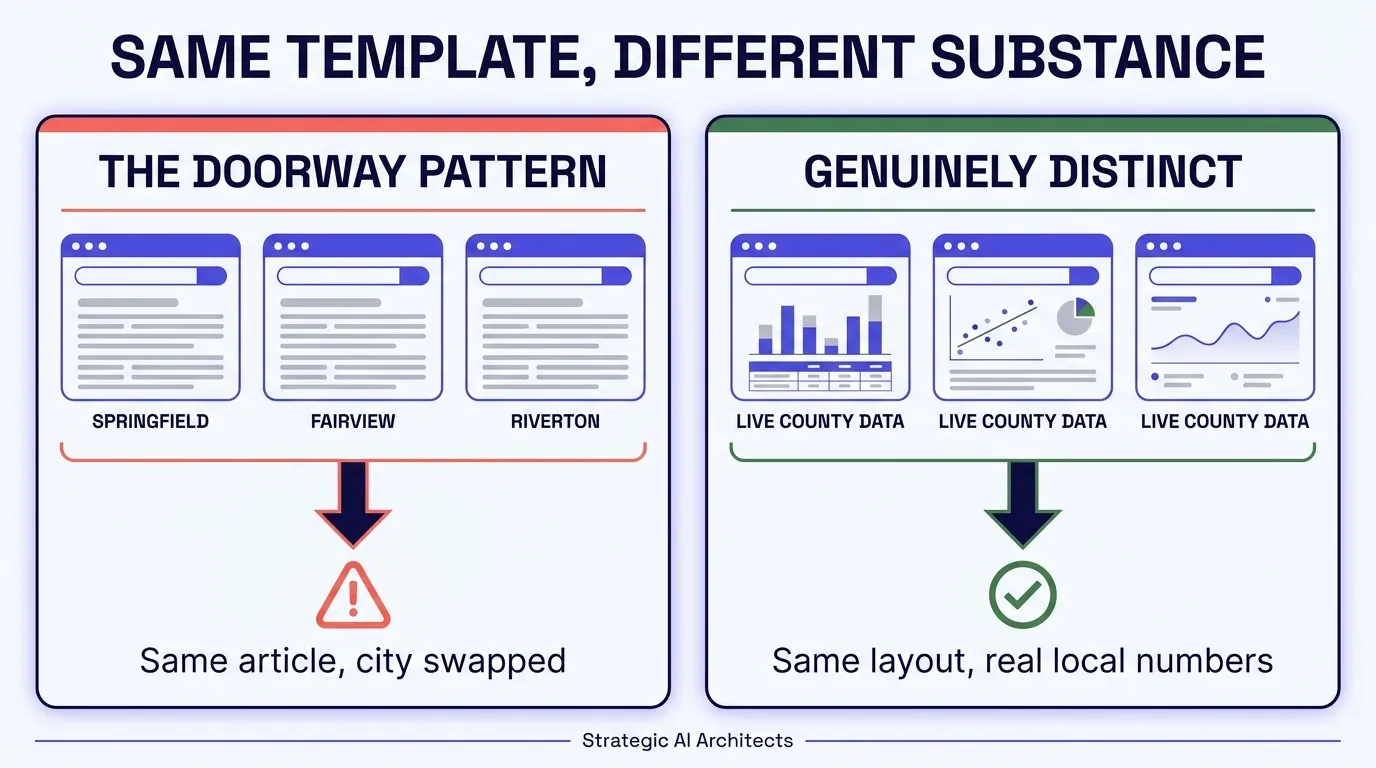
The doorway pattern
- Same five talking points on every location page, city name swapped
- Generic claims with no local data, plan counts, or named sources
- One blog post republished with light rewording across the network
- No one site's content reflects anything specific to that market
ResultMatches Google's own doorway abuse examples1
The genuinely distinct pattern
- Same page layout, but real county-level plan and enrollment data per site
- Each blog post pulls a live figure specific to that agent's actual market
- A real local phone number, service area, and named nearby communities
- Content reviewed for that specific site, not mass-approved once for all
ResultStructurally consistent, substantively unique
Why a canonical tag doesn't fix this
Agents who know a little technical SEO sometimes reach for the standard duplicate content fix the moment this topic comes up: add a canonical tag. It is worth explaining why that does not apply here, because the misunderstanding is common and the fix genuinely does not transfer.
Google's own guidance on consolidating duplicate URLs describes canonical tags as a tool for telling search engines which version of a page, among duplicates that exist within one site you control, should receive the ranking signals7. That system exists to solve a problem like the same page being reachable at two URLs on your own domain. It has nothing to do with a separate agent's separate domain publishing similar content, because there is no shared site for a canonical tag to consolidate signals within. Each domain in a downline is its own independent entity to Google's indexing systems, with its own authority, its own crawl budget, and its own evaluation against the scaled content and doorway abuse policies described above.
That is precisely why the fix has to happen at the content layer, not the markup layer. There is no tag, redirect, or sitemap entry that makes forty separately owned domains running the same article shell stop looking like forty separately owned domains running the same article shell. The only lever that actually changes what Google's systems see is making the content itself genuinely different, site by site.
How we build cadence that doesn't trip this
This section sticks to what is on our own live pages, verified this session. Digital Foundation's Pro tier ships one new blog post and one new location page every week per site, and the Scale tier ships one new blog post every business day, roughly 20 to 22 a month, plus two new location pages every week6. That cadence applies per site, each one written and published against that site's own data, not one article distributed across a network.
The mechanism that actually prevents the doorway pattern is not a promise to write differently, it is where the numbers come from. Every figure in a post we publish is pulled live at write time from a primary source, county-level CMS enrollment data, HealthCare.gov plan figures, Census data specific to that site's actual service area, cited by endpoint. Two sites in the same network covering the same general topic end up with two different sets of real numbers, because they are two different places, which is what keeps the pages structurally similar and substantively distinct at the same time.
That data engine, not any individual writer, is what scales safely. A human writer covering two hundred sites runs out of attention long before the two hundredth article. A system that queries live, place-specific federal data for each site and writes from what it actually finds does not have that ceiling in the same way, because the substantive difference between site forty and site forty-one is built into the data itself, not dependent on a person remembering to make each article feel fresh. It also means publishing to one of our sites automatically updates that site's own sitemap and llms.txt with the new URL the same day, so the crawl path stays live without anyone on the account having to remember a manual step.
This is the kind of thing worth a real conversation
Content cadence across a downline of more than a handful of sites is exactly the case we built Digital Foundation's Pro and Scale tiers for. If that is your situation, it is worth a call. Book an appointment.
What changes once every site is genuinely distinct
Your downline keeps the operational efficiency a shared platform gives you, one system, one bill, one process to manage, without the content itself being the interchangeable part. Each site publishes on the cadence its tier calls for, and each post is built from that site's own data rather than copied from a sibling site with the city name changed.
We are not going to promise a ranking outcome, because nobody honestly can promise that. What changes concretely is that the specific pattern Google's own policies and self-assessment questions describe, mass production with little individual attention, spread across a network of sites, stops describing how your downline's content actually gets made.
There is a second, quieter benefit worth naming. Content built from live, place-specific data is also the material an AI answer engine can actually cite with confidence, because a specific, sourced number tied to a specific place is exactly the kind of passage a model can lift and attribute correctly. Generic, interchangeable text gives an AI system nothing worth quoting, the same way it gives Google's ranking systems nothing worth ranking highly. Fixing the doorway pattern and building AI-citable content turn out to be the same underlying fix, approached from two different angles.
When a single agency site doesn't need to worry
If you run one office and one website, almost none of this applies to you directly. Doorway abuse and the "large network of sites" language in Google's self-assessment checklist describe a pattern across multiple sites or pages, not a single agency publishing its own content on its own schedule. A solo agent who writes or commissions original posts for one domain is simply not the shape of business these policies were written to catch.
This becomes relevant the moment you add a second location page competing for a similar query, or the moment your agency becomes part of a downline where someone else controls the content template. That is usually a gradual shift, not a decision anyone makes on purpose, which is exactly why it is worth checking rather than assuming your situation hasn't changed.
It is also worth being honest about what this guide cannot tell you: whether your specific network has already been affected, and to what degree. Google does not publish a list of which sites got caught by which policy, and the usual signal, a sudden shared drop in traffic, can also be explained by other things, a broader core update, a seasonal shift in search volume around open enrollment, or a change somewhere else in the network's technical setup. The steps above are a genuine, useful check. They are not a diagnosis, and a network seeing a real, unexplained drop across multiple sites at once is worth a closer technical look before assuming any single cause, ideally from someone who can look at more than one site's data side by side rather than one office guessing at its own numbers in isolation.
Either outcome is fine
A solo agency running the twenty-minute check above and finding nothing to worry about is a genuinely good outcome, not a wasted twenty minutes. The point is knowing which situation you're actually in, rather than assuming.
Questions FMOs and agents ask
Is publishing similar blog posts across our downline's websites actually against Google's rules?
Google's spam policies define scaled content abuse as pages generated for the primary purpose of manipulating rankings rather than helping users, and doorway abuse as multiple sites or pages with slight variations that funnel visitors to the same destination. A downline of sites running the same article shell with only the city or agent name swapped fits both definitions, not because of the swap itself, but because of how little unique value each individual page adds.
Does this only apply to huge networks, or could a small FMO's downline be affected too?
Google's policy language is method-agnostic and does not set a minimum site count. It applies to the pattern, many pages built the same way with little individual attention, not to a specific network size. A downline of ten sites running an identical template is the same pattern as one running a thousand, just smaller in scale.
What is the difference between doorway abuse and site reputation abuse?
Doorway abuse involves multiple separate pages or sites, often with slight variations, built to rank for similar queries and funnel visitors to one destination. Site reputation abuse is different: it is when one established, high-authority site hosts unrelated third-party content specifically to borrow that site's own ranking power. A downline of separate agent domains running templated content is a doorway abuse pattern, not a site reputation abuse one.
Why does insurance content get extra scrutiny from Google?
Google's Search Quality Rater Guidelines apply their strictest standard, called YMYL, or Your Money or Your Life, to content that can affect a person's health, finances, or safety. Health, medical, and insurance topics are treated as YMYL by default, which means the same duplication pattern that might just underperform on a low-stakes site is judged more harshly on an insurance site.
Can location pages ever be safe if they're built from a template?
Yes, a template is not the problem by itself. The problem is a template with nothing genuinely local inserted into it. A location page built from a shared structure but filled with real county-level Medicare enrollment data, a real local phone number, and specific plan availability for that area is structurally similar to its siblings while still being substantively different, which is what actually matters.
How would we even know if our downline's sites got hit by this?
The usual signs are a sudden, simultaneous drop in organic traffic or rankings across several sites in the network at once, rather than one site slipping gradually. Because the policies target a pattern that spans a network by definition, a network-wide algorithmic effect tends to look different from a single site's normal ranking fluctuation, which usually moves alone.
Does using AI to write the content make this worse?
Not inherently. Google states plainly that its scaled content abuse policy is method-agnostic, meaning the concern is unoriginal, low-value content regardless of whether it was written by a human, generated by AI, or some mix of both. A single freelance writer producing forty near-identical human-written articles across forty sites fits the same policy as an AI tool doing the same thing.
Sources
- Google Search Central. "Spam Policies for Google Web Search," definitions of scaled content abuse, doorway abuse, and site reputation abuse, verified live 2026-08-11. developers.google.com.
- Google. "Google Search: New updates to address spam and low-quality results," published 2024-03-05, updated 2024-04-26, verified live 2026-08-11. blog.google.
- Google Search Central. "Creating helpful, reliable, people-first content," self-assessment questions, last updated 2025-12-10, verified live 2026-08-11. developers.google.com.
- Google Search Central Blog. "Updating our site reputation abuse policy," published 2024-11, verified live 2026-08-11. developers.google.com.
- Google. Search Quality Rater Guidelines, YMYL (Your Money or Your Life) content classification, general guidelines dated 2025-09-11, verified live 2026-08-11. guidelines.raterhub.com.
- Strategic AI Architects. "Digital Foundation," Pro and Scale tier blog and location page cadence, verified live 2026-08-11. strategicaiarchitects.com.
- Google Search Central. "Consolidating duplicate URLs," canonical URL guidance, last updated 2026-07-10, verified live 2026-08-11. developers.google.com.
Talk it through
Want a second pair of eyes on it?
Free 30 minutes. Bring what you found, or bring nothing and we will look together at how AI engines read your site and which fixes move first.
Find out what your own downline's content actually looks like site to site
Run the free Audit, a live AEO Audit plus a HIPAA tracking scan of your site, in under a minute.
Related reading: why your agency's blog stopped getting cited by AI · why your insurance website only ranks in one county