Playbook
Can Your Website's AI Chatbot Get Your Agency Sued?
A tribunal already ruled that a chatbot is just part of the website that runs it. If yours answers a coverage question wrong, that's your agency talking, not a vendor's.


19 min read
Yes, an AI chatbot on your insurance website can get your agency sued, and there's already case law on it. A Canadian tribunal ordered Air Canada to pay a customer after its website chatbot gave wrong bereavement fare information, ruling the chatbot was simply "part of Air Canada's website."3 Twenty five states have now adopted the NAIC's model bulletin telling insurers to govern AI systems that touch consumers, as of April 1, 2026.2 The FTC says plainly there's "no AI exemption from the laws on the books."4 And the insurance industry's own standard setting body added a generative AI exclusion to commercial policy forms in January 2026, which means the E&O policy you already carry may not even cover a claim your own chatbot causes.6 None of that means rip out your chat widget. It means know what it's allowed to say.
What happens when your chat widget gets it wrong
Here's the scenario, and if you run an agency site with a chat widget bolted on, it's probably already happened in some small way you never heard about. A prospect lands on your site at 9:40 on a Tuesday night, types a question into the little bubble in the corner, and gets an answer. Maybe it's about whether a specific drug is covered, whether a particular hospital is in network, or when open enrollment actually ends this year. The bot answers confidently, in full sentences, because that's what these tools are built to do. The prospect believes it, because why wouldn't they. It's your logo next to the message.
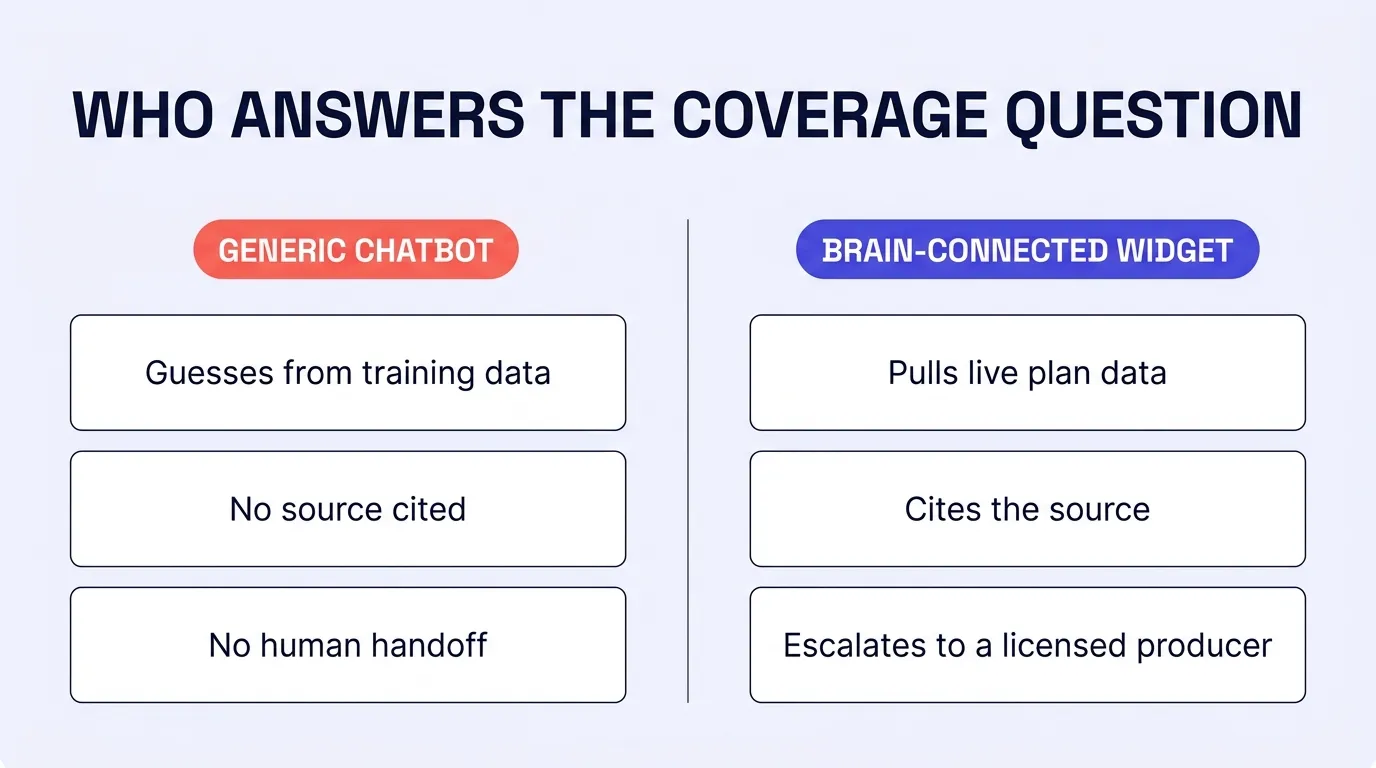
Sometimes the answer is right. Sometimes it's close enough that nobody notices. And sometimes it's flatly wrong, because the chatbot isn't looking anything up. It's a language model predicting what a plausible answer sounds like, based on patterns in whatever it was trained on, with no live connection to your actual carrier contracts, your actual book, or this year's actual plan details. It doesn't know it's wrong. It has no mechanism for knowing that. It just answers.
This already happened, publicly, to a major airline
In November 2022, a customer named Jake Moffatt asked Air Canada's website chatbot about bereavement fares after his grandmother died. The bot told him he could book now and apply for the discount retroactively. That wasn't true. Air Canada refused to honor it, he took them to the BC Civil Resolution Tribunal, and in February 2024 he won.3
Why a bolt-on chatbot invents coverage answers
A generic AI chatbot invents coverage answers because it was never given your actual data to work from, only a general purpose language model's training and, at best, a short list of FAQ text someone pasted into a settings panel. Most of the chat widgets agencies add to their sites are exactly that: a plugin, a script tag, or a bundled feature inside a page builder or CRM, wired to a general model with a system prompt telling it to "be helpful and answer questions about insurance."
That works fine for "what are your office hours" and falls apart the moment someone asks "does this plan cover my cardiologist," "what's my deductible if I switch mid year," or "can I still enroll after a move." Those questions have specific, factual, sourceable answers that live in a carrier's plan documents, a state's enrollment rules, or your own book of business. A general model has none of that. It has a statistical sense of what an answer to an insurance question usually looks like, and it writes one that sounds like it, confidently, every time, whether or not it's correct.
This is the same failure mode that shows up in generic subsidy calculators built on outdated formulas, which we cover in our guide on why your insurance website's subsidy calculator is wrong. A calculator and a chatbot are different interfaces on the same underlying problem: a tool on your website is answering a factual question without being connected to a factual source.
Try this on your own site right now
Open your website's chat widget in an incognito window and ask it something specific: a deductible on a real plan you sell, whether a particular carrier is still writing new business in your state, or when this year's enrollment period ends. Read the answer slowly. If you can't immediately point to where that answer came from, neither can the bot. If you want an outside read on what your site is exposing, the free Audit checks this along with speed and tracking safety, in about a minute.
Is your agency liable for what your chatbot says?
Under the reasoning a tribunal has already applied to a website chatbot, yes, your agency is liable for what it says, in the same way you're responsible for a typo on your rates page or a wrong phone number in your footer. The chatbot isn't a separate legal actor. It's a feature of your website, and your website is your agency's statement to the public.
The clearest precedent so far is Moffatt v. Air Canada, 2024 BCCRT 149, decided February 15, 2024 by the British Columbia Civil Resolution Tribunal. Air Canada argued it couldn't be held responsible for its own chatbot's words, essentially treating the bot as a separate entity. The tribunal rejected that outright. Tribunal member Christopher C. Rivers found the chatbot was "just a part of Air Canada's website," and that the airline had to stand behind everything published there, static page or interactive tool. Air Canada also argued the correct information was available elsewhere on its site, and the tribunal rejected that too, reasoning there was no reason a customer should know one part of a company's website is accurate and another isn't. Moffatt was awarded $650.88 in damages for negligent misrepresentation, plus interest and fees.3
There is no reason why a customer should know that one section of a company's website is accurate, and another is not.
The dollar amount is small because the underlying dispute was small, a plane ticket. The reasoning is what travels. An insurance chatbot that misstates a network, a deductible, or a deadline isn't dealing in a few hundred dollars of fare difference. It's dealing in coverage decisions, and the same "it's just part of your website" logic applies whether the wrong statement comes from a paragraph you wrote or a language model you plugged in.
Federal regulators are drawing the same line. The FTC's Operation AI Comply, announced September 25, 2024, is a standing enforcement sweep against businesses that use AI to deceive consumers, and the agency's language leaves no room for a "the AI did it" defense. "Using AI tools to trick, mislead, or defraud people is illegal," then FTC Chair Lina Khan said at the launch. "There is no AI exemption from the laws on the books."4
That sweep isn't theoretical. In February 2025, the FTC finalized an order against DoNotPay, a company that marketed itself as "the world's first robot lawyer." The agency's complaint said DoNotPay never tested whether its AI actually performed at the level of a human lawyer and never employed or retained any attorneys, despite the marketing. DoNotPay paid $193,000 in monetary relief and had to notify every subscriber from 2021 to 2023 about the settlement.5 An insurance agency's chat widget claiming, implicitly or explicitly, that it can tell a prospect what their plan covers sits in the same category: a tool making a factual claim about coverage or service that it hasn't actually verified.
| Date | What happened | Why it matters to your agency |
|---|---|---|
| Dec 4, 2023 | NAIC adopts its Model Bulletin on the use of AI systems by insurers | States begin telling insurers AI must be governed like any other regulated decision tool1 |
| Feb 15, 2024 | BC tribunal rules Air Canada liable for its chatbot's wrong answer | First clear precedent: a chatbot is "just part of" the website that runs it3 |
| Sep 25, 2024 | FTC launches Operation AI Comply | Federal regulator states plainly there's no AI exemption from existing consumer protection law4 |
| Feb 11, 2025 | FTC finalizes $193,000 order against DoNotPay over deceptive AI claims | Confirms the agency will pursue a company for overselling what its AI actually does5 |
| Jan 2026 | ISO adds a generative AI exclusion to commercial general liability forms | The industry's own standard setter starts writing AI out of default coverage6 |
| Apr 1, 2026 | NAIC tracker shows 25 jurisdictions have adopted the AI model bulletin | A majority of the country now has some state level AI insurance governance in place2 |
| Sep 9, 2026 | Independent Agent magazine publishes guidance on AI driven E&O exposure | The agency channel's own trade press is now telling members to check their E&O terms7 |
What NAIC's AI bulletin means for your website
The NAIC's Model Bulletin on the Use of Artificial Intelligence Systems by Insurers, adopted December 4, 2023, tells insurers that any decision or action affecting a consumer that's made or supported by AI still has to comply with existing unfair trade practices and unfair claims settlement laws, full stop, regardless of what tool produced it. It asks insurers to keep a written AI governance program, to document how they test AI systems for accuracy, and to give consumers notice that AI is in use.1
As of April 1, 2026, 25 jurisdictions, 24 states plus the District of Columbia, have adopted the bulletin directly. Four more states, California, Colorado, New York, and Texas, have their own separate insurance specific AI regulation instead of adopting the model bulletin language. That leaves 22 states with no tracked bulletin specific action yet, though general consumer protection and unfair trade practice law still applies everywhere regardless.2
The bulletin's obligations are written to insurers, not to independent agencies directly. But two things make it worth an agency owner's attention anyway. First, an insurer's AI governance program is expected to reach third party technology used in its distribution chain, which can include the tools an appointed agency uses on its own site. Second, and more practically, the bulletin is a signal about direction. Regulators are actively building AI specific oversight muscle inside the insurance vertical, not leaving AI to generic tech policy. An agency that treats its own AI tools the way a governed insurer would, testing for accuracy, documenting what the tool can and can't say, giving consumers notice, is simply ahead of where this is heading.
| Category | Jurisdictions | Count |
|---|---|---|
| Adopted the bulletin | Alaska, Arkansas, Connecticut, Delaware, DC, Hawaii, Illinois, Iowa, Kentucky, Maryland, Massachusetts, Michigan, Nebraska, Nevada, New Hampshire, New Jersey, North Carolina, Oklahoma, Pennsylvania, Rhode Island, Vermont, Virginia, Washington, Wisconsin, West Virginia | 25 |
| Own insurance specific AI regulation | California, Colorado, New York, Texas | 4 |
| No tracked bulletin specific action | The remaining states not listed above | 22 |
Does your E&O policy even cover an AI chatbot claim?
Increasingly, maybe not, and this is the part most agency owners haven't checked. The Insurance Services Office, the organization that writes the standard policy language most U.S. commercial insurance is built on, introduced a generative AI exclusion into its commercial general liability forms in January 2026. Law firms tracking the broader professional and management liability market report the same trend spreading into E&O, D&O, and fiduciary liability policies, with some carriers filing broad "absolute" AI exclusions that remove coverage for claims arising from any use, development, or deployment of artificial intelligence. The exclusions don't always arrive as a headline change either; they sometimes show up quietly in revised coverage forms or underwriting practices, which is exactly why you can't assume your policy is fine just because nobody flagged it to you.6
Independent Agent magazine, published by the Big I, ran a piece on September 9, 2026 walking agencies through AI driven E&O exposure directly. Its core point: AI generated information can be inaccurate, leading to improper advice or coverage misrepresentations, and overreliance on AI increases exposure to E&O claims and litigation. One of its five recommended practices is reviewing your own E&O coverage terms specifically for how they treat AI generated or AI assisted communications, alongside licensed producer oversight of anything client facing, a written AI use policy, and documentation of how AI tools are actually used.7
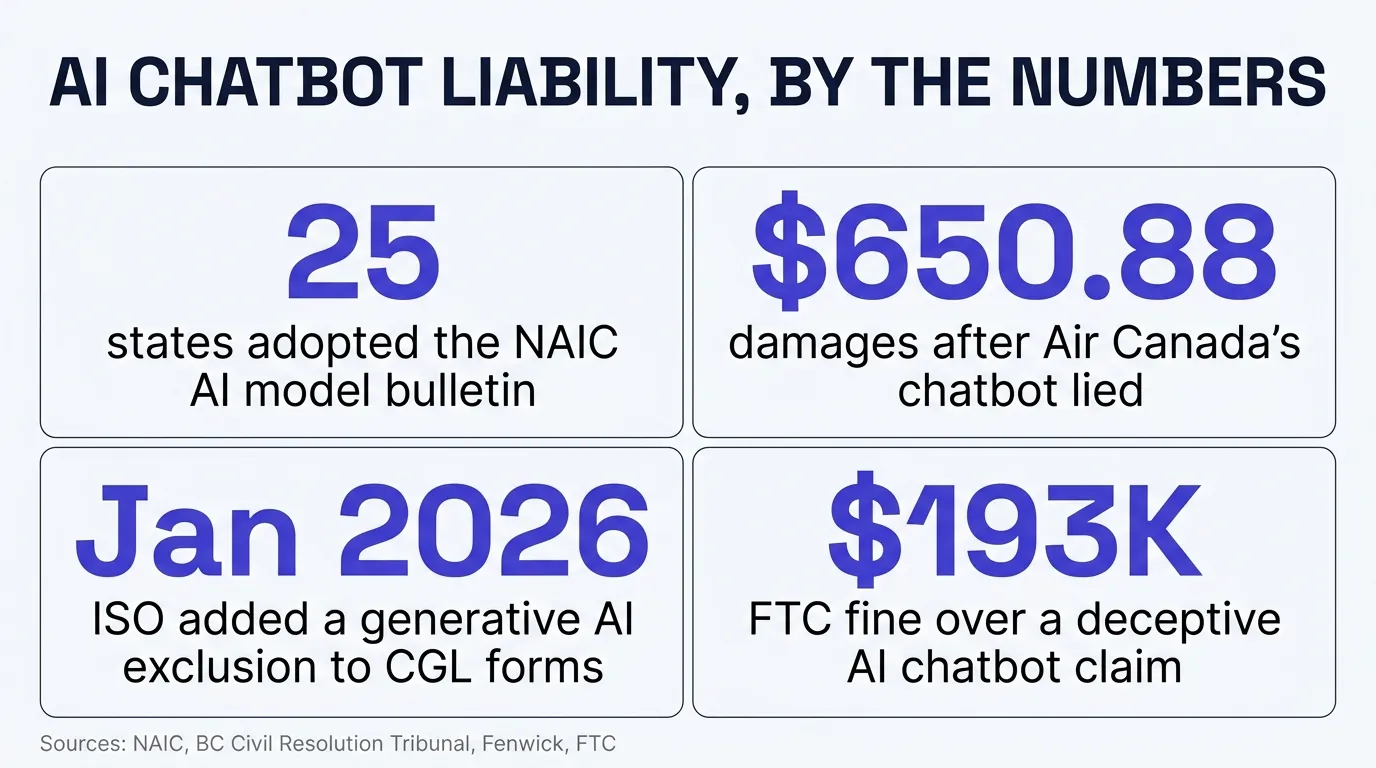
Jan 2026
ISO adds a generative AI exclusion to CGL policy forms6
25
States with an NAIC AI governance bulletin in force2
$193K
FTC monetary relief order over overstated AI claims5
Put plainly: you can carry a real E&O policy, pay real premiums, and still discover after a claim that the policy doesn't respond because the loss traces back to an AI tool the exclusion language now carves out. The fix isn't complicated. Call your E&O carrier, ask the direct question, "does my coverage include claims arising from AI generated or AI assisted communications on our website, including a chat widget," and get the answer in writing. If the answer is no or unclear, that's a conversation with your broker about an endorsement, not something to find out during a claim.
How to lock down what your chat widget can say
You can meaningfully cut this risk yourself, without replacing anything, by scoping what your chat widget is allowed to answer, logging every conversation, and building in a hard handoff to a licensed human before anything specific gets promised. Here's that as an order of operations.
1. Write down what the bot is allowed to answer
Most chat widget platforms let you set a system prompt or a scope of topics. Restrict it explicitly: office hours, general "what lines do you write," how to book an appointment, how to reach a human. Anything touching a specific deductible, network, premium, or enrollment deadline should trigger a "let me connect you with an agent" response, not an attempted answer.
2. Turn on conversation logging, and actually read it
If your platform logs chats, enable it and check the log weekly for the first month, then monthly after that. You're looking for exactly the failure mode in this guide: the bot answering a factual coverage question with something that isn't sourced from your real book or your carriers' current documents.
3. Add a visible, honest disclosure
State plainly, at the start of the chat, that the visitor is talking to an AI assistant and that specific coverage questions get handed to a licensed producer. This is good practice regardless of which state's disclosure law technically reaches you, and it sets the right expectation before the bot ever gets a chance to overreach.
4. Call your E&O carrier and ask the AI question directly
Don't infer coverage from the policy's general language. Ask specifically about AI generated or AI assisted communications, including a website chatbot, and get the answer in writing.
5. Never let the widget quote a binding number
A chat widget can gather information and route a lead. It should not be the system of record quoting a final premium, confirming a specific plan's coverage of a specific drug or provider, or stating an enrollment deadline as fact without a source. Reserve those answers for a tool actually connected to current data, or for a human.
The mistake we see most
An agency installs a chat widget, accepts the default "be a helpful insurance assistant" prompt that shipped with it, and never revisits it. Eighteen months later nobody remembers it's live, let alone what it's been telling visitors at 2 a.m. Put a recurring calendar reminder on this the same way you'd remind yourself to renew a license.
You can do all of this yourself
Every step above works on a generic chat widget plugin, no rebuild required. Most agents who read this list decide they'd rather have it built right the first time. Either outcome is fine. If you want to talk through what your current setup can and can't safely say, book a short call and we'll look at it with you.
How we build a widget that can't make things up
We build the AI chat widget in Digital Foundation sites to answer from the Brain, the same live federal data engine that powers our quoters, our location pages, and our content, rather than guessing from a general model's training data. When a visitor asks something that needs a real number, current plan detail, or sourced fact, the widget pulls it from that dataset. When a question crosses into something that has to come from a licensed producer, it hands off instead of inventing an answer.
The chat widget is one feature inside Digital Foundation, our done for you package for Medicare, health, life, and annuity agencies. Per the live pricing page, the website on its own is $84 a month, billed annually. Starter is $247 a month and adds the AI chat widget, Google Business Profile management, and 2 blog posts, 2 location pages and 2 answer pages a month. Pro is $497 a month and adds a 24/7 AI receptionist, review harvesting, and a new blog post, location page and answer page every week. Scale is $997 a month and adds one of each every business day. Every plan starts with a 14-day free look period, and the page states the site is live by day 14.8
What changes for your agency
The practical result of grounding a chat widget in real, sourced data instead of a general model's guesswork is that the tool stops being a liability surface and starts being what it was supposed to be: a way to capture a lead at 9:40 on a Tuesday night without promising anything you can't stand behind.
Answers come from real data
Coverage and plan facts pull from the Brain's sourced datasets, not a language model's guess.
A real handoff, not a guess
Anything requiring a licensed producer routes to one instead of getting answered anyway.
Every conversation is logged
You can review what the widget actually told visitors, not just trust that it behaved.
Honest disclosure, by default
Visitors are told they're talking to an AI system before the conversation goes anywhere.
One less thing to explain to an E&O carrier
A tool that cites its source and defers what it can't verify is a much easier claim to defend, if one ever comes.
None of this promises a claim will never happen, and nobody honest promises that. What it does is take the most avoidable version of this exposure, a bot inventing an answer with nothing behind it, off the table.
Who this fits, and who's fine as is
It matters most if your current chat widget will answer literally anything a visitor types, if you've never checked your E&O policy's stance on AI, or if you're licensed in several states and want one build that meets the strictest bar instead of a patchwork. It matters less if your widget is already scoped tightly to general questions, logged, disclosed, and you've confirmed your E&O coverage in writing. In that case, keep doing what you're doing and revisit it yearly as the exclusion trend keeps moving.
Questions agents ask about chatbot liability
Can my insurance agency be held legally liable for what an AI chatbot says on our website?
Yes, that's the working assumption a court or tribunal will start from. In Moffatt v. Air Canada, 2024 BCCRT 149, the British Columbia Civil Resolution Tribunal held Air Canada responsible for its website chatbot giving a customer incorrect bereavement fare information, reasoning that the chatbot was simply part of the airline's website and the airline had to stand behind everything published there, whether from a static page or an interactive tool. Nothing in that reasoning is specific to airlines. A chat widget on an insurance agency's site that tells a prospect the wrong thing about a deductible, a network, or an enrollment deadline is the agency's statement in the same way a page of text would be.
Does my agency's AI chat widget have to disclose that it's AI, not a person?
That's a separate question from accuracy, and a few states already require it. California's B.O.T. Act and Utah's Artificial Intelligence Policy Act both create disclosure duties for certain AI tools that interact with consumers. We cover exactly what those laws require and who they reach in our guide on whether your agency's AI has to admit it's not human. This guide is about what happens when the bot answers a question wrong, which is a liability question that exists whether or not the bot properly discloses itself.
Does the NAIC AI Model Bulletin apply to my independent agency, or only to insurance carriers?
The bulletin's text is written to insurers, and its examination and documentation requirements land on the carrier. But two things matter for an agency. First, when a carrier's AIS Program reaches third party vendors and technology used in distribution, your agency's tools can come into that review. Second, and more directly, most states' general unfair trade practices and deceptive advertising laws already reach a producer's own marketing tools, chatbot included, independent of whether the NAIC bulletin itself names agencies. The bulletin is worth knowing because it shows regulators are actively building AI specific enforcement infrastructure in insurance specifically, not treating it as a generic tech issue.
Will my agency's E&O policy cover a claim caused by our website's AI chatbot?
Don't assume it will. The market is moving the other way. The Insurance Services Office added a generative AI exclusion to its commercial general liability forms in January 2026, and law firms tracking professional and management liability lines report carriers introducing AI specific exclusions on E&O, D&O, and fiduciary policies too, sometimes through quiet changes to coverage forms rather than a headline exclusion. The only way to know where your own policy stands is to ask your E&O carrier directly whether AI generated or AI assisted communications, including a website chatbot, are covered, and to get the answer in writing.
What's the difference between a subsidy calculator being wrong and a chatbot being wrong, for liability purposes?
Very little, and that's the point. A calculator that runs an outdated formula and a chatbot that hallucinates an answer both produce a wrong number a prospect relied on, delivered by your website. The Moffatt tribunal didn't care that Air Canada's tool was conversational rather than a fixed form. It asked whether the airline's website gave the customer inaccurate information, and it did. Any tool on your site that answers a coverage or cost question carries this exposure, not just the ones branded as AI.
Should I just turn off my AI chat widget until this gets sorted out?
For most agencies, no. A chat widget that only answers general questions, that's scoped away from binding coverage statements, that logs every conversation, and that hands off to a licensed producer before anything specific gets promised is a low risk, high value tool. The exposure comes from an ungoverned widget that will answer anything a visitor asks, including questions about a specific plan's deductible or network, using nothing but a general purpose language model's best guess. Scope it down before you shut it off.
How is Strategic AI Architects' AI chat widget different from a generic chatbot plugin?
The widget we build into Digital Foundation sites answers from the same live data engine, the Brain, that powers our quoters and content, rather than guessing from a general model's training data. When a question needs a real number or a specific plan detail, it pulls that from a sourced, current dataset and hands off to your team instead of inventing an answer. It's one feature among Starter, Pro, and Scale, alongside the site itself, AEO optimized content, and Google Business Profile management, per the live Digital Foundation pricing page.
Sources
- National Association of Insurance Commissioners. "NAIC Model Bulletin: Use of Artificial Intelligence Systems by Insurers." Adopted by the Innovation, Cybersecurity, and Technology (H) Committee December 1, 2023, and by the Executive (EX) Committee and Plenary December 4, 2023. AIS Program governance, consumer notice, and third party AI oversight requirements. Verified live 2026-09-29. content.naic.org.
- National Association of Insurance Commissioners. "Implementation of NAIC Model Bulletin: Use of Artificial Intelligence Systems by Insurers," status as of April 1, 2026: 25 jurisdictions adopted (24 states plus DC); 4 states (California, Colorado, New York, Texas) have their own insurance specific AI regulation instead. Verified live 2026-09-29. content.naic.org.
- Dentons. "Airline ordered to compensate a B.C. man because its chatbot provided inaccurate information," summarizing Moffatt v. Air Canada, 2024 BCCRT 149 (British Columbia Civil Resolution Tribunal, decided February 15, 2024): damages of $650.88 for negligent misrepresentation plus $36.14 interest and $125 in fees; tribunal member Christopher C. Rivers held the chatbot was "just a part of Air Canada's website." Verified live 2026-09-29. dentonsdata.com.
- Federal Trade Commission. "FTC Announces Crackdown on Deceptive AI Claims and Schemes," press release, September 25, 2024, announcing Operation AI Comply: "Using AI tools to trick, mislead, or defraud people is illegal. There is no AI exemption from the laws on the books," then Chair Lina M. Khan. Verified live 2026-09-29. ftc.gov.
- Federal Trade Commission. "FTC Finalizes Order with DoNotPay That Prohibits Deceptive 'AI Lawyer' Claims, Imposes Monetary Relief, and Requires Notice to Past Subscribers," press release, February 11, 2025: $193,000 in monetary relief; DoNotPay did not test whether its AI operated at the level of a human lawyer. Verified live 2026-09-29. ftc.gov.
- Fenwick. "The End of 'Silent AI'? Emerging AI Exclusions, Coverage Fragmentation, and Practical Implications for Policyholders": the Insurance Services Office introduced a generative AI exclusion into commercial general liability forms in January 2026; several insurers have introduced broad "absolute" AI exclusions into management liability lines (D&O, EPLI); some tech E&O carriers are declining to cover AI generated output liabilities. Verified live 2026-09-29. fenwick.com.
- IA Magazine (Independent Insurance Agents & Brokers of America). "5 Ways Insurance Agencies Can Reduce AI-Driven E&O Exposures," by Timothy Ventura and Dana A. Gittleman, published September 9, 2026, sourced from the PLUS Blog: AI generated information may be inaccurate, leading to improper advice or coverage misrepresentations; recommends licensed producer oversight, a written AI policy, third party risk management, usage documentation, and reviewing E&O coverage terms for AI treatment. Verified live 2026-09-29. iamagazine.com.
- Strategic AI Architects. Digital Foundation pricing page: Website $84/mo billed annually (complete site with 30 pages live on Launch Day, calculators and widgets, AI CLI access, monthly report); Starter $247/mo (adds 2 blog posts, 2 location pages and 2 answer pages a month, Google Business Profile management, AI chat widget); Pro $497/mo (adds 1 blog post, 1 location page and 1 answer page every week, up to 4 languages, review harvesting, 24/7 AI receptionist); Scale $997/mo (adds 1 of each every business day, up to 10 custom pages, monthly newsletter); Full Clone, Update and Handoff $1,000 one time; 14-day free look period. Verified live 2026-10-12. strategicaiarchitects.com/digital-foundation.
See what your own site's AI tools are exposing
Run a free Audit and see how your site scores for speed, AI citations, and HIPAA safe tracking, in about a minute.
Related reading: Does your agency's AI have to admit it's not human? · Why your insurance website's subsidy calculator is wrong · Does your CRM integration need to see raw client PHI?