Playbook
Your Quote Form Might Already Be a HIPAA Violation
A hosting plan with "HIPAA" in its name is not the same thing as a HIPAA compliant website. The actual requirement is a contract, a set of technical safeguards, and a breach plan, named in the federal regulation itself.


20 min read
HIPAA has no certification and no seal. What it actually requires of a website is a signed Business Associate Agreement with every vendor that touches protected health information, the technical safeguards named in 45 CFR 164.312 (access control, audit controls, encryption in transit), and a breach plan under 45 CFR 164.400 to 164.4141. Violations run $145 to $73,011 per incident depending on culpability, capped near $2.19 million a year per violation type4. Most agency sites that call themselves "HIPAA compliant" have none of this written down.
The quote form that might already be handling ePHI
You run Medicare Advantage business. Your website has a plan finder that asks a visitor to list a few conditions and medications so the results filter correctly, and a CRM behind it that stores the answer against that person's record. Somewhere in your footer, or maybe nowhere at all, there's a line that says the site is "HIPAA compliant," usually because your web host or your CRM told you it was.
That line is doing more work than it can actually support. HIPAA does not certify websites, hosts, or software products. There is no HIPAA seal a vendor can earn and hand you. What exists instead is a set of federal rules that apply to specific activities, specific data, and specific contracts, and your plan-finder form, the CRM it feeds, and any tracking script riding along on that same page are each judged separately against those rules. One compliant piece does not make the chain compliant.
The practical question is narrower and more answerable than "is my site HIPAA compliant": does your website create, receive, maintain, or transmit protected health information, and if so, do you have the contract, the safeguards, and the breach plan the regulation actually requires for that. Most agency websites that collect a condition, a medication, or a plan type tied to a named person clear that first bar without anyone noticing.
This matters more every renewal season, not less, because the trend on agency sites is toward more of this exact data, not less. A static brochure site with a phone number and a contact form has little to answer for here. A modern agency site with a live plan finder, an eligibility checker, a drug-cost estimator, and a chat widget that asks a few qualifying questions before handing off to a human has built, piece by piece, exactly the kind of system this guide is about, usually without anyone on the team ever deciding "now we're handling protected health information." The tools that make a site convert better are the same tools that create the obligation.
This is a different question than consumer health data law
Washington and Nevada's consumer health data statutes regulate any business that collects health-adjacent data from a resident, HIPAA status aside. HIPAA is narrower and older: it applies only to covered entities and their business associates, defined below, and it predates those state laws by almost 30 years. An agency can be clear of one and still exposed under the other, so neither question answers the other.
Why a hosting badge is not the same thing as compliance
HIPAA's text never uses the phrase "HIPAA compliant website," and no federal agency issues that certification. What a hosting company usually means by it is that its own servers meet certain technical safeguards and that it will sign a Business Associate Agreement if you ask for one. That is one input to compliance, not the whole of it.
The gap shows up in three places almost every time. First, the host's BAA covers what happens on the host's own infrastructure, not the third-party CRM, email tool, or ad pixel you layered on top of it. Second, "HIPAA compliant hosting" says nothing about whether your web forms are actually configured with the access controls, audit logging, and encryption the Security Rule names, since those are application-level choices, not server-level ones. Third, a host cannot write your breach notification procedure for you, because that depends on your own relationship with the covered entity you're working for and your own incident response, not on where the server sits.
None of this means compliance is unreachable. It means the actual requirement is a short, specific list, covered next, and a hosting plan's marketing claim is at best one line item on it.
Are you a covered entity, a business associate, or neither
HIPAA regulates two kinds of parties, defined at 45 CFR 160.103: a covered entity, which is a health plan, a health care clearinghouse, or a health care provider that transmits health information electronically, and a business associate, which is anyone who creates, receives, maintains, or transmits protected health information on a covered entity's behalf, for a function like claims processing, benefit management, or data analysis2. An insurance carrier, as a "health insurance issuer," is itself a covered entity under the regulation's own definition of "health plan"3.
An independent agency is almost never a covered entity. You're not a health plan, a clearinghouse, or a provider. But the regulation's definition of business associate is broad enough to catch most of what an agent actually does for a carrier: helping someone enroll, managing their benefit selection, assisting with a claim, or any activity that involves "claims processing or administration... data analysis, processing or administration... [or] benefit management" performed on the carrier's behalf2. The moment your website's plan finder, your CRM, or your follow-up sequence touches a named person's health information as part of that work, you are functioning as a business associate, whether or not anyone signed a document saying so.
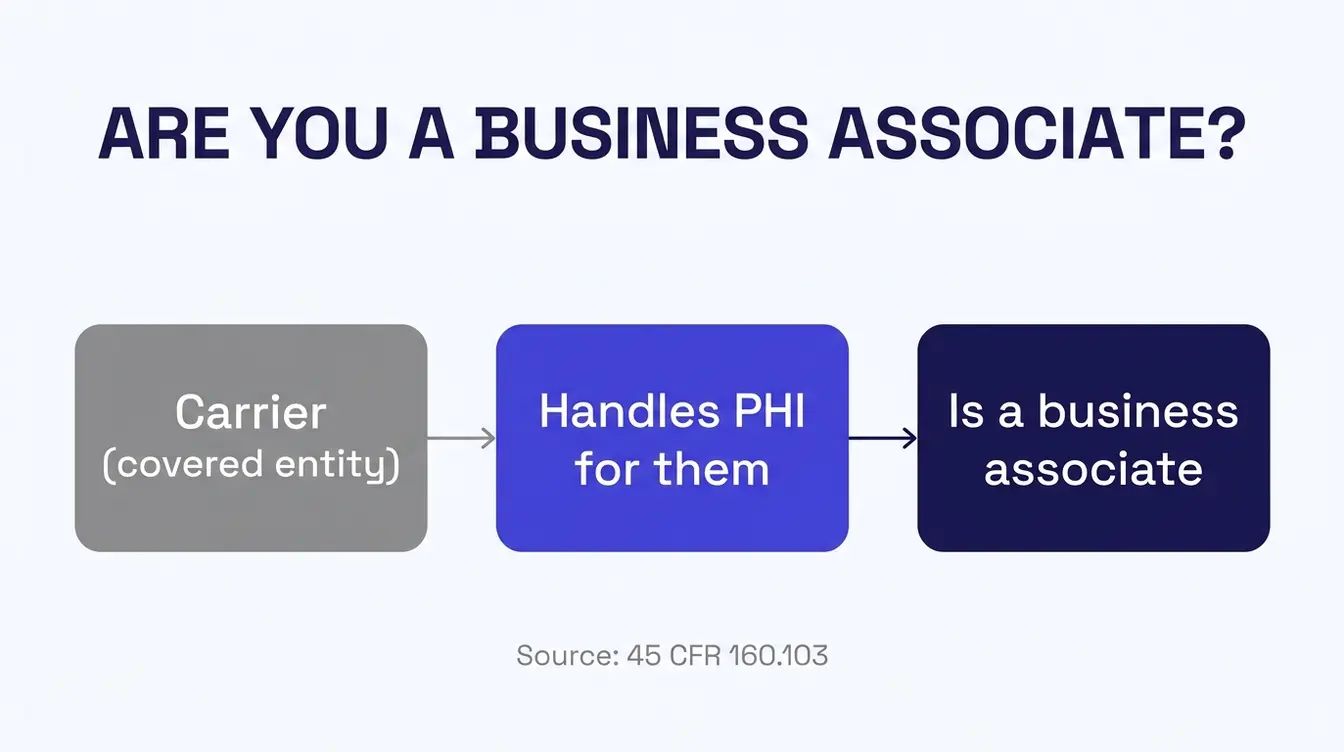
That status is what triggers everything else in this guide. A business associate is bound by the Security Rule and the Breach Notification Rule in essentially the same way a covered entity is, enforced by HHS directly against the business associate, not just indirectly through the carrier1. "No one told me I was one" is not a defense the regulation recognizes; the definition turns on what you actually do, not on what paperwork exists.
Worth checking before you read further
The free Audit flags trackers firing before consent on health-adjacent pages, which is the single fastest way an otherwise careful agency ends up exposed. It takes about a minute. strategicaiarchitects.com/audit.
What if you're genuinely neither
Some agency websites really do fall outside HIPAA. A life insurance site that only collects a name, a date of birth, and a coverage amount, with no medical underwriting questions and no carrier relationship that involves claims or benefit management, is not handling protected health information and is not acting as a business associate for that activity. The analysis is activity by activity, not agency by agency: the same agency can be a business associate on its Medicare funnel and completely outside HIPAA on its term life quote form, at the same time, on the same domain.
Being outside HIPAA doesn't mean being outside every data protection law, and it's worth saying plainly that "not HIPAA" is not the same finding as "no exposure." The Federal Trade Commission has brought enforcement actions against health-adjacent companies for sharing sensitive data with ad platforms under its general unfair-and-deceptive-practices authority, Section 5 of the FTC Act, entirely apart from HIPAA, and its Health Breach Notification Rule separately covers certain vendors of personal health records. Washington's and Nevada's consumer health data statutes apply to any business collecting health-adjacent data from their residents regardless of HIPAA status at all. A quote form that's genuinely clear of HIPAA can still be a problem under one of those, which is why "am I HIPAA compliant" is the wrong single question to ask about a website that touches anything health-adjacent.
The Business Associate Agreement your website actually needs
Once you're a business associate, 45 CFR 164.504(e) requires a covered entity to obtain "satisfactory assurances" from you in the form of a written contract, and 45 CFR 164.314(a) sets what that contract must say: the business associate will comply with the applicable requirements of the Security Rule, and will ensure any subcontractor that creates, receives, maintains, or transmits electronic protected health information on its behalf agrees to the same terms through its own contract5. That second clause is the one agency websites miss most often.
In practice, a website touching PHI has a chain of vendors behind it, and each one that handles that data needs its own BAA: the web host, the CRM, the form or quote-engine provider, any SMS or email platform that sends a follow-up referencing a plan or condition, and any analytics or ad platform receiving data from the page. A signed BAA with your CRM covers what the CRM does inside its own systems. It does not extend to a Meta Pixel or a Google Analytics tag you added to the page yourself, because that vendor never signed anything and was never asked to6.
This is the exact gap behind GoHighLevel's $297 a month HIPAA add-on: it covers conversations, forms, and data inside GoHighLevel's own HIPAA-configured sub-account, not a script you dropped into the page's header yourself6. A full compliance picture requires inventorying every vendor that touches the page, confirming which ones have signed a BAA, and removing or consent-gating anything that doesn't.
| Requirement | What it means for a website vendor |
|---|---|
| Comply with the Security Rule | The vendor agrees in writing to the same safeguards named in section 164.312, not just its own internal policy. |
| Bind its own subcontractors | If your CRM uses a sub-processor to send text messages, that sub-processor needs its own BAA too. |
| Report security incidents | The vendor must tell you about a breach on its end so your own notification clock can start. |
| Return or destroy PHI at termination | When you switch CRMs or form tools, the old vendor cannot simply keep the data. |
What the Security Rule requires of the website itself
45 CFR 164.312 sets the technical safeguards a covered entity or business associate "must" implement for electronic protected health information, split into required and addressable items1. "Addressable" does not mean optional: it means implement it, or document why an equally effective alternative was used instead. For a public-facing website or web form, four of these standards do almost all the work.
Access control requires technical policies that allow access only to people or software with granted access rights, with a required unique login for every user and a required emergency access procedure1. On a website, that means whoever can view form submissions in the CRM logs in with their own credentials, not a shared login, and automatic session logoff after inactivity is implemented or formally addressed. Audit controls require hardware, software, or procedural mechanisms that record and examine activity in any system holding ePHI, which for a web form means logging who accessed a submission and when, not just storing the submission itself1. Transmission security requires technical measures against unauthorized access to ePHI while it moves across a network, with encryption as the named mechanism1, which in practice means TLS on every page that collects or displays health-adjacent data, no exceptions for a "just a quick form" page.
| Safeguard | Type | What it requires on a web form |
|---|---|---|
| Unique user identification | Required | Every staff member who can view submissions has their own login, never a shared one. |
| Emergency access procedure | Required | A documented way to reach the data if the normal access path fails. |
| Automatic logoff | Addressable | Sessions end after a set idle period, or an equivalent control is documented. |
| Encryption in transit | Addressable | TLS on every page that collects or shows health-adjacent data. |
| Audit controls | Required | A record of who accessed which submission and when. |
| Person or entity authentication | Required | Confirming that whoever is logging in is actually who they claim to be. |
None of this requires exotic infrastructure. It requires the form's backend to log access the way any competent CRM already can, TLS that any modern host provides by default, and individual logins instead of one shared password taped to a monitor. The failure mode on most agency sites isn't a missing feature. It's that nobody configured the feature that was already there.
The Security Rule also names administrative and physical safeguards alongside the technical ones, and two of them matter even for a small agency with no server room to secure. 45 CFR 164.308 requires a "risk analysis," an accurate and thorough assessment of the potential risks and vulnerabilities to any ePHI the agency holds, as a required implementation specification, not an optional best practice, plus workforce termination procedures so a departed employee's CRM access is actually revoked, not just forgotten1. Most agencies never conduct the risk analysis at all, which means the very first document HHS would ask for in an investigation, the one proving you looked for your own gaps before something happened, doesn't exist. Physical safeguards under 45 CFR 164.310 cover facility access controls for wherever the systems holding ePHI actually live, which for a cloud-hosted CRM and website means the hosting provider's own physical security, documented through that vendor's BAA rather than anything the agency itself has to build1.
If a web form leaks: the Breach Notification Rule
45 CFR 164.400 through 164.414 require a covered entity, following "the discovery of a breach of unsecured protected health information," to notify each affected individual "without unreasonable delay and in no case later than 60 calendar days" after discovery7. A breach affecting 500 or more individuals must also be reported to HHS within that same 60-day window and is then posted to HHS's public breach portal, the list commonly called the "wall of shame." A business associate that discovers a breach has its own duty: notify the covered entity "without unreasonable delay and in no case later than 60 calendar days," so the covered entity's own clock can start7.
For a website, the realistic breach scenario is rarely a dramatic hack. It's an analytics or ad pixel that was firing before consent on a page where a visitor entered a condition or a plan tied to one, sending that data to a third party that was never authorized to receive it. HHS's own guidance on tracking technologies treats that kind of disclosure as a reportable breach if it involves PHI sent to a non-business-associate vendor without authorization, which is exactly the fact pattern an unconfigured pixel creates. That's a mechanism, not a one-time event: every submission the pixel touches while misconfigured is its own exposure, which is why the "500 or more individuals" threshold is easier to cross on a website than most agencies assume.
HHS's breach portal is a public record, and recent years show the scale of what gets reported industry wide: 772 large data breaches, each affecting 500 or more people, were reported to OCR in calendar year 2025, together affecting about 138.5 million individuals, per an analysis of the public portal covering data through August 20268. Most of those are hospitals and health plans, not insurance agencies, but the mechanism that catches a solo agent's quote page, an improperly consented tracking tag, is the same category of incident driving a meaningful share of that total.
What a HIPAA violation on a website actually costs
HHS's civil penalty structure at 45 CFR 160.404 sets four tiers based on culpability, each with a per-violation range and an annual cap per identical violation type4. The dollar figures are adjusted for inflation every year under 45 CFR 102.3; the amounts below are the current 2025-adjusted figures in effect now9.
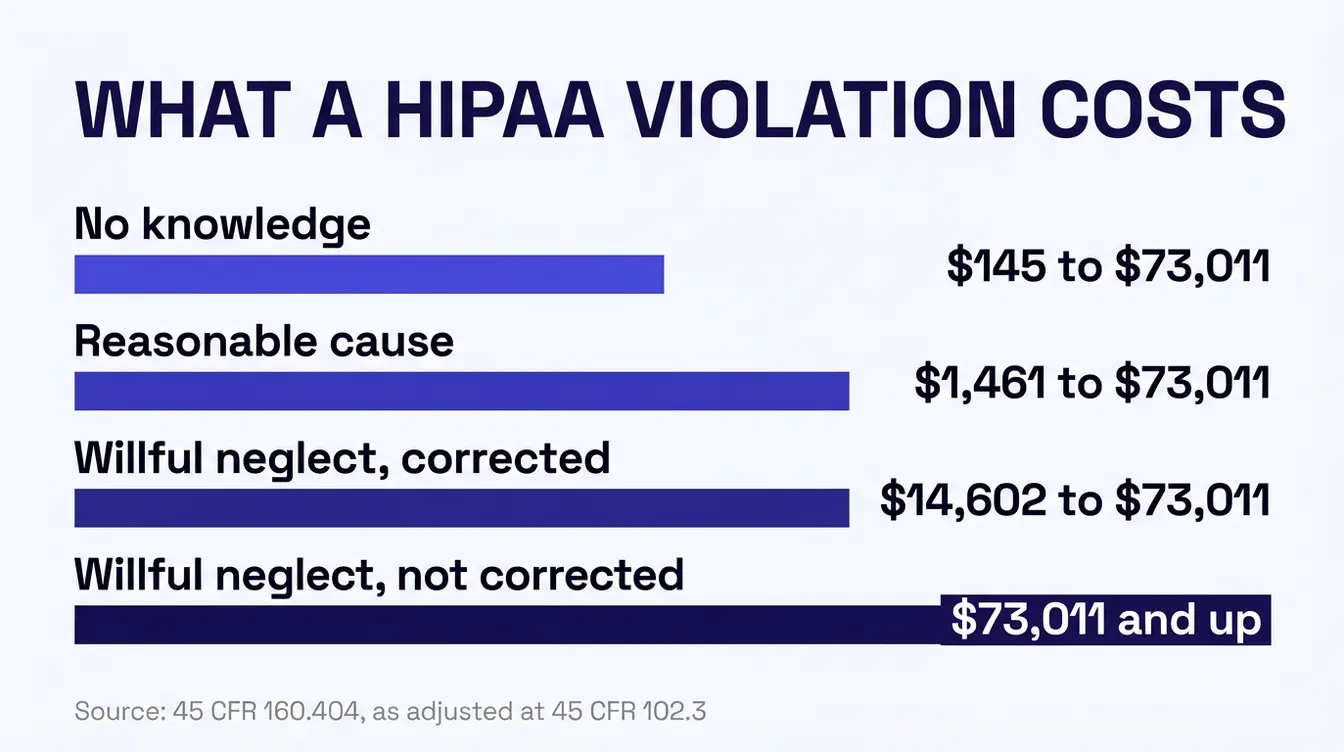
Two details change how exposed a small website actually is. First, violations are counted per occurrence, not per incident: HHS determines the number of violations "based on the nature of the covered entity's or business associate's obligation to act," and "in the case of continuing violation... a separate violation occurs each day" the violation persists4. A pixel that fired on every quote submission for a month is not one violation; it's as many as there were submissions, or as many days as it ran uncorrected. Second, the annual cap of $2,190,294 applies per violation type, not as a single ceiling on everything HHS could ever assess against you in a year, so a single bad quarter touching two different requirements, say unauthorized disclosure and no BAA, can draw penalties under both caps at once9.
A worked example: one unconfigured pixel, ninety days
Put a number on it with a realistic, deliberately conservative scenario. An agency runs Medicare Advantage business through a plan-finder page that asks for a chronic condition to filter results. A Meta Pixel on that page fires on load, before any consent decision, the way most agency funnel pages still ship by default. Over a 90-day stretch during AEP, 340 people complete that form, each submission tying a named visitor to a plan search filtered by a specific condition, each one sent to Meta the instant the page loaded.
The agency didn't know the pixel was firing early; nobody built it that way on purpose, which under the regulation's own language points toward "reasonable cause" rather than "did not know and, by exercising reasonable diligence, would not have known," since a basic review of the page's own network requests would have caught it4. That tier's 2025-adjusted range is $1,461 to $73,011 per violation9. HHS determines the number of violations based on the nature of the obligation violated, and a continuing violation counts separately for "each day the covered entity or business associate is in violation"4, so the relevant count here is not automatically "one pixel, one violation." Treated illustratively at the stated per-violation floor across 340 exposed submissions, the arithmetic alone, 340 times $1,461, comes to just under $500,000, well short of the $2,190,294 annual cap for that violation type and nowhere near what a single enforcement action would necessarily assess in practice, since HHS weighs mitigating and aggravating factors on every actual case. The exercise isn't a prediction of what HHS would charge. It's a demonstration that the math behind "it's just one pixel" breaks down fast once the per-violation structure is applied to actual submission volume instead of to the single script tag that caused it.
The fix that would have prevented all of it costs nothing: hold the pixel behind the same consent gate every other non-essential script sits behind, so it never fires until a visitor has made an affirmative choice. That's a configuration change, not a rebuild, and it's the single highest-leverage item on the checklist below.
The HIPAA compliant website checklist
Stripped of the legal language, the actual requirement set for a website that touches PHI comes down to six things, each tied to a specific regulation above.
BAA with every vendor
Host, CRM, form tool, SMS or email platform, and anything else that creates, receives, maintains, or transmits ePHI from the page.
No unauthorized vendors on PHI pages
Any ad pixel or analytics tag on a page collecting health-adjacent data either has its own BAA or doesn't load until after consent.
Unique logins and an access log
Every person who can view a form submission has their own credentials, and the system records who looked at what.
TLS everywhere PHI moves
Every page that collects or displays health-adjacent information is served over HTTPS with no mixed content.
A written breach procedure
Who gets notified, in what order, and within how many days, before you need it rather than while you're scrambling.
A real consent gate
Nothing non-essential loads before a visitor makes an explicit choice, decided before first paint, not faded in after the fact.
Five places agency sites usually fail this
In order of how often we see each one on a prospect's existing site during an Audit: an analytics or ad pixel firing on load, before any consent decision, on a plan-finder or health-questionnaire page. A CRM with a HIPAA add-on enabled, while a script the agency added directly to the page template sits entirely outside that add-on's coverage. A shared login for the whole team to view leads in the CRM, which fails the unique-identification requirement outright. A contact or quote form submitted over plain HTTP on a staging subdomain nobody remembers is still live. And a BAA signed with the CRM vendor years ago that was never updated when a new SMS platform or quoting widget was added to the stack.
Each of these is fixable without rebuilding the site from scratch. The harder part on a hand-maintained page builder is finding every script that fires early in the first place, since there's rarely a single place that lists every third-party tag touching every page. A page builder's own editor doesn't show you what a third-party embed is doing once it loads, and a plugin added two redesigns ago by someone no longer at the agency rarely gets revisited until an audit or an incident forces the question.
There's a sixth, quieter failure worth naming on its own: treating the question as answered once rather than as a standing practice. A risk analysis done once at launch and never repeated misses every vendor added since, every CRM automation built after the fact, and every new quote tool bolted on for a new product line. 45 CFR 164.306 requires the safeguards to be reviewed and modified "as needed" to keep providing reasonable protection, which in plain terms means this is a maintenance item, not a one-time project, the same way a Lighthouse score or a broken link check needs to run again after every real change to the site, not just once at launch.
What this doesn't fix on its own
A compliant website doesn't retroactively cover a lead vendor relationship that fed you PHI with no BAA of its own, and it doesn't rewrite a carrier contract that never addressed your status as a business associate. Those are conversations with the vendor or the carrier, separate from the website itself.
How we build this in from the start
This is expensive to retrofit and close to free to build in from day one, which is the case for doing it at the architecture level instead of page by page. Every site we build runs on Astro, shipping pages as finished HTML rather than loading a page-builder runtime and a stack of plugins before anything on the page can run, and nothing non-essential, analytics included, loads before a visitor makes an explicit consent decision, decided before first paint rather than faded in by a script after the page has already rendered.
Digital Foundation's entry Website plan ships the consent gate and the technical safeguards covered above on every build, starting at $84 a month billed annually, with a 14-day free look period before any billing starts11, which covers most agencies whose exposure is on the marketing and funnel side. For agencies that need the full architecture, not just a consent-gated marketing site, Enterprise builds on an agency-owned AWS or Azure stack with a Business Associate Agreement signed before any protected health information is handled, using only HIPAA-eligible cloud services with no third-party vendor handling PHI off that stack, and every access to it logged in the agency's own tenant, verified live on the Enterprise page this session12. The free Audit checks whether your current site's trackers fire before consent on health-adjacent pages in about a minute, with a fuller report following after10.
What changes once it's handled
A site built this way doesn't stop collecting leads or running analytics. It just does both after a real consent decision instead of before one, with a documented chain of BAAs behind every vendor actually touching the data, access logged instead of invisible, and a breach procedure that exists on paper before anyone needs it. The "HIPAA compliant" line in the footer becomes something you could actually walk an auditor through, rather than a claim borrowed from a hosting plan.
Questions agents ask
Does HIPAA apply to my insurance agency's website at all?
Only if your agency is a covered entity or a business associate under 45 CFR 160.103. Most independent agencies are neither a health plan nor a clearinghouse, so you become a business associate the moment you create, receive, maintain, or transmit protected health information on behalf of a carrier, such as handling enrollment, benefit management, or claims assistance.
What's the difference between a covered entity and a business associate?
A covered entity is a health plan, a health care clearinghouse, or a provider that transmits health information electronically, per 45 CFR 160.103. A business associate is anyone else who handles protected health information on a covered entity's behalf. Your carrier is the covered entity. You become the business associate the moment you touch PHI for them.
Does a "HIPAA compliant hosting" plan from my web host make my site compliant?
No. Hosting is one Security Rule safeguard among many, and a host's own compliance covers its own systems, not your forms, your CRM integration, or the pixel you added yourself. 45 CFR 164.312 requires access control, audit controls, integrity controls, and transmission security on the information system as a whole, not just the server it sits on.
What does the Security Rule actually require a web form to do?
Under 45 CFR 164.312, a required unique login for anyone who can view submissions, an audit trail of who accessed what and when, and encryption of the data in transit. Encryption at rest and automatic logoff are "addressable," meaning you must implement them or document an equally effective alternative, not skip them.
What happens if my website leaks protected health information?
The Breach Notification Rule at 45 CFR 164.400 to 164.414 requires notifying each affected individual without unreasonable delay, and HHS within 60 days if 500 or more people are affected, with the breach posted to HHS's public portal. A business associate must notify the covered entity, which then has its own notification duty to the individuals.
How much can a HIPAA violation on a website actually cost?
Civil penalties run in four tiers under 45 CFR 160.404, currently $145 to $73,011 per violation depending on culpability, capped at $2,190,294 per identical violation type per year under the 2025 inflation adjustment at 45 CFR 102.3. A website issue, such as a leaking pixel, typically counts once per affected record, not once per incident.
Does a signed BAA with my CRM or hosting vendor cover my whole funnel?
No. A BAA only covers what that specific vendor does with PHI inside its own systems. A tag you added yourself, such as a Meta Pixel or GA4 script firing on a quote confirmation page, sits outside any vendor's BAA and is your exposure alone, regardless of what your CRM's HIPAA add-on covers.
How much does a website built to handle this correctly cost?
Digital Foundation's entry Website plan is $84 a month, billed annually, verified live on the Digital Foundation pricing page this session, with a 14-day free look period before any billing starts. A custom HIPAA-eligible build on an agency-owned AWS or Azure stack, scoped on a call, starts at $2,000 through Enterprise.
Sources
- Electronic Code of Federal Regulations. 45 CFR Part 164, Subpart C, Security Standards for the Protection of Electronic Protected Health Information, including section 164.312, verified live 2026-11-08. ecfr.gov.
- Electronic Code of Federal Regulations. 45 CFR 160.103, definitions of "covered entity" and "business associate," verified live 2026-11-08. ecfr.gov.
- Electronic Code of Federal Regulations. 45 CFR 160.103, definition of "health plan," verified live 2026-11-08. ecfr.gov.
- Electronic Code of Federal Regulations. 45 CFR 160.404, Amount of a civil money penalty, four-tier structure, verified live 2026-11-08. ecfr.gov.
- Electronic Code of Federal Regulations. 45 CFR 164.504(e) and 164.314(a), Business Associate Agreement requirements, verified live 2026-11-08. ecfr.gov.
- Strategic AI Architects. "Your GoHighLevel BAA Doesn't Make Your Funnel HIPAA Safe," the scope of a platform-level HIPAA add-on versus a page-level tracking script, published 2026. strategicaiarchitects.com.
- Electronic Code of Federal Regulations. 45 CFR 164.400 to 164.414, the Breach Notification Rule, notification timing and the business-associate-to-covered-entity duty, verified live 2026-11-08. ecfr.gov.
- HIPAA Journal. "Healthcare Data Breach Statistics," 772 large breaches and about 138.5 million individuals affected in calendar year 2025, data covering through August 25, 2026, verified live 2026-11-08. hipaajournal.com.
- Electronic Code of Federal Regulations. 45 CFR 102.3, HHS civil monetary penalty inflation-adjustment table, 2025 maximum adjusted penalty column for 45 CFR 160.404, verified live 2026-11-08. ecfr.gov.
- Strategic AI Architects. "Free Audit," what the scan checks including tracking before consent, verified live 2026-11-08. strategicaiarchitects.com.
- Strategic AI Architects. "Digital Foundation," pricing, tiers, and the 14-day free look period, verified live 2026-11-08. strategicaiarchitects.com.
- Strategic AI Architects. "Enterprise," the BAA-covered custom AWS/Azure build and pricing starting point, verified live 2026-11-08. strategicaiarchitects.com.
Talk it through
Want a second pair of eyes on it?
Free 30 minutes. Bring what you found, or bring nothing and we will look together at how AI engines read your site and which fixes move first.
Find out what your own site is actually exposed to
Run the free Audit, a live AEO Audit plus a HIPAA tracking scan of your site, in under a minute.
Related reading: why a signed GoHighLevel BAA doesn't cover your funnel pixel · why your virtual assistant may already be a business associate · the separate question of state consumer health data law