Playbook
Your Website Can Break a Health Data Law You've Never Read
Washington and Nevada both let a visitor's own state trigger a fine or a lawsuit over your quote form, no matter which state your agency calls home.


19 min read
Washington and Nevada each regulate "consumer health data" based on where your website visitor lives, not where your agency is licensed or based. Washington lets a resident sue directly, with damages capped at $25,000 per case plus attorney's fees1. Nevada bars private suits but lets the state fine you up to $15,000 per violation6. A quote form that fires an analytics tag before consent, on a page asking about a medical condition or a plan tied to one, is the exact fact pattern both statutes were written to catch.
The quote form that answers to a law you've never read
Say your agency is based in Texas. You write ACA and Medicare Advantage business, your quote form sits on a page you built two years ago, and it has a Meta Pixel and a Google Analytics tag firing the second the page loads, the way most agency funnel pages still do. A visitor from Spokane fills it out, picks a plan filtered by a chronic condition note in the free text field, and leaves. You never advertised in Washington. You may not even hold a Washington license yet. None of that matters.
That visitor's state now has a say in what just happened on your website, because the data your form collected and the pixel passed along, a plan search tied to a health condition, is exactly what Washington's My Health My Data Act defines as regulated. The law doesn't ask where your agency sits. It asks where the consumer was when your site collected the data, and whether you had their consent before you collected or shared it.
Nevada passed a similar law the same year, with its own definitions, its own penalty structure, and one important difference in who can bring a case. Between the two, an agency running quote forms and plan finders that reach a national audience, which is most independent agency websites, now has two separate state laws to answer to that have nothing to do with where the agency's office actually is.
This is not a HIPAA question
Neither law is HIPAA. HIPAA covers protected health information handled by a covered entity or business associate, like a carrier, a clearinghouse, or a provider. These two state laws cover "consumer health data" collected by any business, insurance agencies included, and they exempt only the narrow slice of data HIPAA already governs. A HIPAA-compliant CRM does not make your public quote-form pixel compliant with either statute.
Why your state doesn't matter. The visitor's does.
Both statutes define who they regulate the same way, and it is worth reading the actual language once because most agencies assume the opposite. Washington's definition of a "regulated entity" is any legal entity that conducts business in Washington or produces or provides products or services targeted to consumers in Washington, and alone or jointly with others determines the purpose and means of collecting, processing, sharing, or selling consumer health data2. Nevada's definition is almost identical in structure: any person who conducts business in Nevada or produces or provides products or services targeted to consumers in Nevada, and who determines the purpose and means of processing, sharing, or selling that data7.
Neither definition requires a physical office, a mailing address, or even a state insurance license in that state. It requires conducting business with, or targeting, a consumer there. Taking a quote from a Washington or Nevada resident, through a form that collects or a pixel that shares health-adjacent data, is conducting business with that consumer. A national SEO strategy, a Facebook ad set to "United States," or an organic blog post that ranks nationally is, by definition, targeting consumers in every state it reaches, these two included.
That is the mechanism the rest of this guide is built around. It is not about whether you operate in Washington or Nevada. It is about whether your website's quote forms, plan finders, and tracking scripts can reach a resident of either state, and almost every agency website that ranks organically or runs national ads can.
Washington's My Health My Data Act, in plain terms
Washington's statute, codified at RCW 19.373, defines consumer health data broadly: personal information linked or reasonably linkable to a consumer that identifies their past, present, or future physical or mental health status. The statute's own list includes health conditions, treatments, diagnoses, and surgeries; prescription medication use; bodily functions, vital signs, or symptoms; reproductive or sexual health information; gender-affirming care information; biometric and genetic data; and location data that could reveal someone is seeking health services3. It also covers data inferred from non-health information through an algorithm, so a plan recommendation engine that infers a likely condition from a few quiz answers is squarely inside the definition even if the visitor never typed the word "diagnosis."
Collecting that data requires consent for a specified purpose, or it must be necessary to deliver a product or service the consumer actually requested. Sharing it with anyone else, including an ad platform, requires a second, separate consent, distinct from the consent to collect, and both consents have to be obtained before the collection or sharing happens, not after, with the request clearly disclosing the data categories, the purpose, who receives it, and how to withdraw4. That "before, not after" timing is the exact detail most agency quote pages get wrong, because most consent banners on agency sites today exist to look compliant, not to actually gate anything that loads before a click.
The statute separately bans geofencing: implementing a virtual boundary around any place that provides in-person health care services for the purpose of identifying or tracking people seeking care, collecting their health data, or sending them notifications or ads tied to their health data or health care5. Washington's law does not state a distance for this ban, which makes it broader on its face than Nevada's, covered below.
Enforcement runs through Washington's Consumer Protection Act: a violation of the health data statute is automatically an unfair or deceptive act under RCW 19.868, and that chapter lets a court treble the actual damages a plaintiff proves, up to a cap of $25,000 per case, plus attorney's fees and costs1. The Washington Attorney General's own guidance confirms the Act is enforced both by the Attorney General and through private action, meaning an individual resident, not just the state, can bring a case9. Per that same guidance, regulated entities that are not small businesses had to be in compliance by March 31, 2024, with small businesses given until June 30, 20249.
Nevada's consumer health data law, and where it differs
Nevada's statute lives in NRS Chapter 603A, and its definition of consumer health data covers much of the same ground: personal information linked or reasonably capable of being linked to a consumer that identifies their past, present, or future physical or mental health status, including conditions, treatments, prescription use, reproductive or sexual health information, gender-affirming care information, and biometric or genetic data7. It excludes information used solely to enable video game play or to identify ordinary shopping habits, as long as that information doesn't reveal health status.
Nevada requires a regulated entity to maintain and post a consumer health data privacy policy on its main website describing what it collects, how it's used, its sources, who it's shared with, and how it's processed, with a separate consent required before collecting or sharing any category, recipient, or purpose not already disclosed in that policy10. Collection and sharing each require their own affirmative, voluntary consent, obtained before the activity happens, disclosing the categories, purposes, recipients, and withdrawal method, mirroring Washington's structure almost exactly 11.
Where Nevada goes further is on the sale of health data specifically. Selling it to anyone requires a separate written authorization in plain language naming the buyer, the data involved, and the purpose. That authorization expires automatically one year after it's signed, can be revoked at any time, cannot be made a condition of receiving a product or service, and a copy has to be given to both the consumer and the buyer and kept on file for six years12. Washington's consent rule for sharing covers a sale as a form of sharing, but Nevada's statute adds this standalone set of mechanics on top, which an agency's data-licensing or list-rental arrangements, if it has any, would need to satisfy separately.
Nevada's geofencing ban is more specific than Washington's: it is unlawful to implement a geofence within 1,750 feet of a medical facility, a facility for people with disabilities, or another in-person health care provider, for the purpose of identifying or tracking consumers seeking care, collecting their health data, or sending them related messages13.
Enforcement is where the two states split hardest. A violation of Nevada's consumer health data provisions is treated as a deceptive trade practice, which puts it under the penalty structure in NRS 598, and the statute says plainly that it creates no private right of action14. Only the state can bring a case, through the Attorney General or the Nevada Commissioner of Consumer Affairs, and the available administrative penalty is a fine of up to $15,000 per violation, or treble the restitution ordered, whichever is greater6. Independent legal trackers covering Nevada's 2023 legislative session place the law's effective date at the same March 31, 2024 date as Washington's1516, though unlike Washington, Nevada gave no extra runway for small businesses.
Washington versus Nevada, side by side
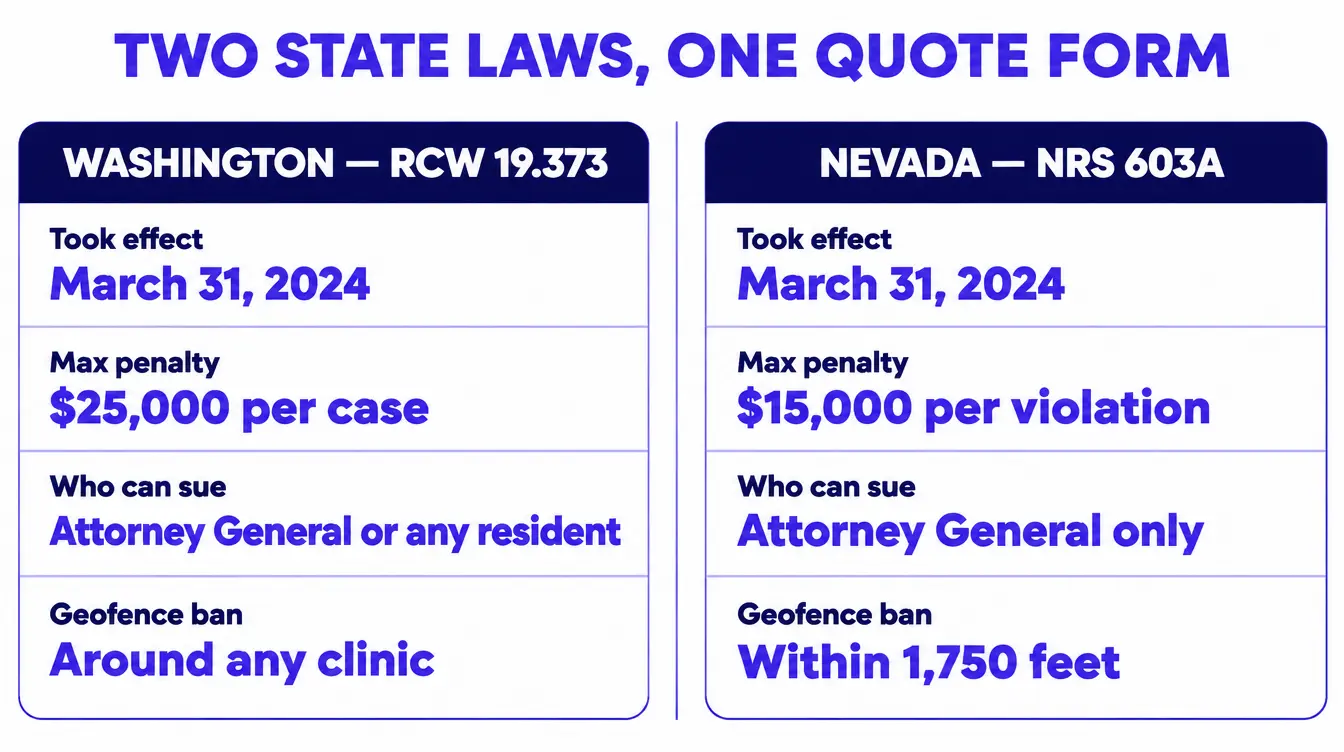
The two statutes share a structure, a definition of health data, and an effective date, but they diverge on exactly the points that decide how exposed an agency actually is: who can bring a case, and what it costs.
| Question | Washington, RCW 19.373 | Nevada, NRS 603A |
|---|---|---|
| Who can bring a case | Attorney General or any Washington resident, as a private suit | Attorney General or the Commissioner of Consumer Affairs only, no private right of action |
| Maximum financial exposure | Treble damages, capped at $25,000 per case, plus attorney's fees and costs | Administrative fine up to $15,000 per violation, or treble restitution, whichever is greater |
| Consent timing for collection and sharing | Separate, prior, specific consent for each | Separate, prior, specific consent for each |
| Selling health data | Covered under the general sharing-consent rule | Separate written authorization required, expires after one year, copy retained six years |
| Geofence ban around a clinic | Banned, no stated distance | Banned within 1,750 feet |
| Compliance deadline | March 31, 2024 (June 30, 2024 for small businesses) | March 31, 2024, no small-business extension |
What a violation actually costs
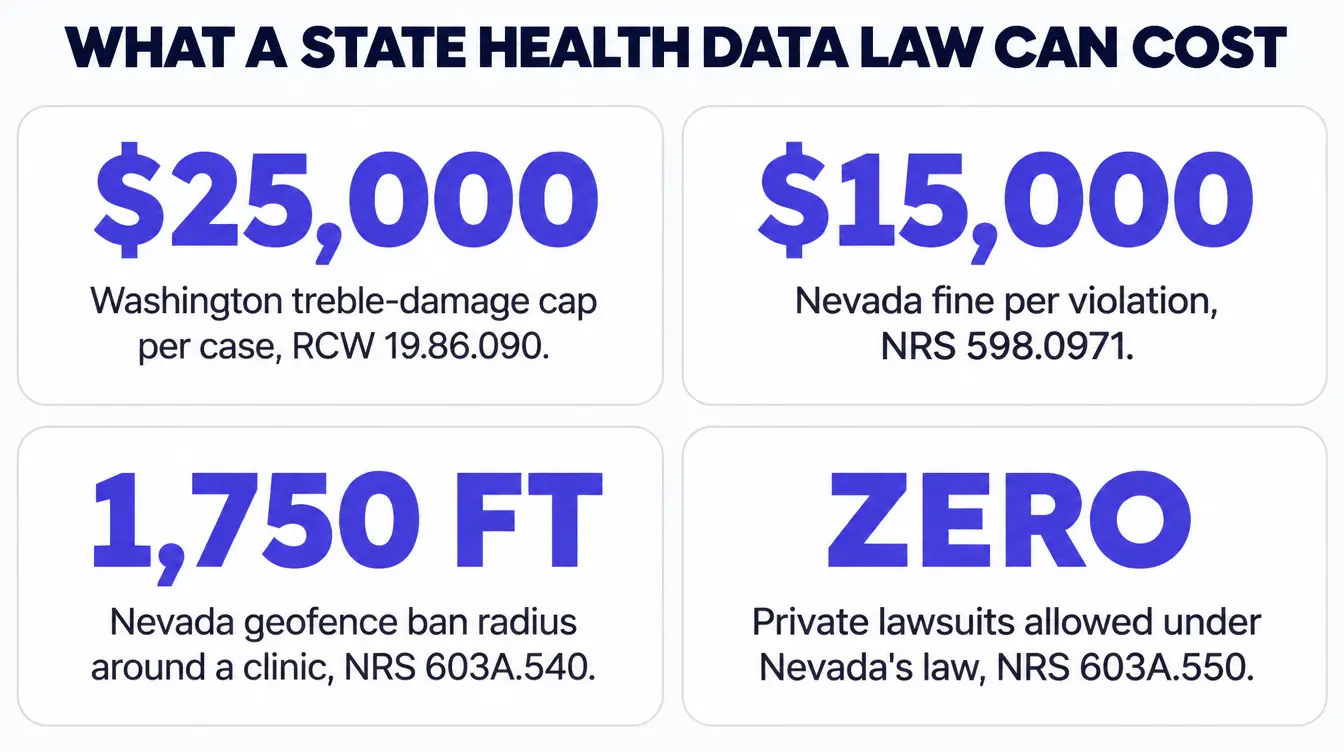
Run the numbers on a single incident. Say a Washington resident's quote, tied to a Medicare Advantage search filtered by a chronic condition, gets passed to an ad platform through a pixel that fired before any consent was captured. If that resident sues, RCW 19.86.090 lets a court treble their actual damages up to the $25,000 cap, and separately award the cost of the suit and a reasonable attorney's fee1. The $25,000 is a cap on the trebled portion, not a ceiling on total recovery once fees are added, and nothing in the statute requires the state to act first. One resident with a real grievance and a lawyer is enough.
Nevada's exposure runs differently but isn't smaller in practice once volume enters the picture. NRS 598.0971(3)(d) lets the state impose an administrative fine of up to $15,000 for each violation, or treble the restitution ordered, whichever is greater6, and because the statute counts per violation rather than per case, a single misconfigured pixel firing across a month of Nevada quote submissions is not automatically one violation. No private resident can bring that case, which caps the practical risk at a regulatory action rather than a wave of individual lawsuits, but a state investigation into an agency's ad tags is not a theoretical event either. Both state Attorneys General enforce consumer protection statutes as a normal part of their office's work, and a health data complaint from a single resident is what typically opens that door.
Worth checking before you read further
If you want to know where your own site actually stands on tracking before consent, the free Audit checks whether trackers fire before opt-in in under a minute. strategicaiarchitects.com/audit.
What on an insurance site counts as health data
Neither statute requires a medical record to trigger. Ordinary insurance shopping tools collect exactly the categories both laws define, once you look at them through that lens instead of through "this is just how a quote form works."
| What's on the page | What it collects | Statutory category |
|---|---|---|
| Medicare Advantage plan finder | A search filtered by a chronic condition or needed drug list | Health conditions and prescription medication use |
| ACA subsidy calculator | Household health status fields used to estimate eligibility | Health status, inferred from the inputs |
| Final expense or life health questionnaire | Diagnoses, treatments, and medications entered to pre-qualify a lead | Health conditions, treatments, and prescription use |
| Retargeting pixel on a quote confirmation page | Confirmation that this visitor searched or bought a plan tied to a condition | Data identifying someone seeking health care, shared with a third party |
| Location-based ad targeting near a clinic | Device presence near a health care facility used for ad delivery | Geofencing, separately banned in both states |
How to check your own exposure
None of this requires a lawyer to start checking. Twenty minutes with your own site's quote and plan pages open will tell you most of what you need to know.
Open the network tab
Load your quote or plan-finder page with no prior cookies and watch whether any analytics or ad pixel fires before you click anything.
Check the consent banner
If accepting or declining it makes no visible difference to what already fired, it is not a consent gate. It is decoration.
Look for the policy link
Both statutes require a consumer health data privacy policy, separate from a general privacy policy, linked from your homepage.
Review your ad targeting
If your ad platform account runs any location radius targeting near medical facilities, confirm it is not within Nevada's 1,750-foot ban or Washington's unqualified one.
Trace your lead vendor's flow
If a third-party lead vendor feeds your CRM, ask what consent, if any, was captured before that data reached you. You inherit that gap.
Count where your traffic actually comes from
Pull your analytics by state. An agency assuming "we don't do business there" is often wrong the moment organic or paid traffic is checked.
How we build this in from the start
This is the kind of problem that is expensive to retrofit and nearly free to build in from day one, which is the whole argument for doing it at the architecture level instead of page by page. Every site we build runs on Astro, which ships pages as finished HTML rather than loading a runtime and a stack of plugins before anything on the page can run, and nothing non-essential, analytics included, loads before a visitor makes an explicit consent decision. The consent state is decided before first paint, not faded in by a script after the page has already rendered, which is also part of what lets our builds score 90 or higher on Lighthouse performance on both mobile and desktop.
The free Audit checks exactly this: whether your site's trackers fire before consent, alongside how well AI answer engines can read and cite your pages, in about 30 seconds on screen with a fuller report emailed after18. Digital Foundation builds the fix in permanently, starting at $84 a month for a complete, compliant site with a 14-day free look period before any billing starts17.
What this doesn't fix on its own
A consent-gated website doesn't retroactively fix a lead vendor relationship that never captured consent, and it doesn't rewrite an ad platform account's existing geofence settings. Those are conversations worth having with whoever manages your paid traffic, separate from the website itself.
What changes once this is handled
A site built this way stops being a liability that happens to also be a marketing asset. Tracking still works, because consent-gated analytics is still analytics, it just loads after a real decision instead of before one. The privacy policy both statutes require is a standing page instead of a scramble if a resident or an Attorney General's office ever asks for it. And because the fix is architectural rather than a page-by-page patch, it holds the next time a state adds a similar law, which, per the next section, is worth planning for.
Washington and Nevada are not the end of the list
Washington and Nevada were the first two states to pass a consumer health data law this specific, both in 2023 and both effective the same day in 2024, which is itself a signal that this was not a one-state experiment. We're not going to name every state considering similar legislation here, because a bill's status changes faster than a guide like this can stay current, and this article holds itself to only the language actually in force and verified this session. The practical takeaway doesn't depend on the exact count: if your agency's website reaches a national audience, which organic search and national ad campaigns both do by design, treating consent and consumer health data as a two-state problem is already behind where the law is heading.
Questions agents ask
What exactly counts as "consumer health data" under these laws?
Both statutes define it broadly: personal information linked or reasonably linkable to a consumer that identifies their past, present, or future physical or mental health status, including conditions, treatments, prescription use, reproductive or sexual health information, biometric or genetic data, and even location data suggesting someone sought health care. Washington's version is at RCW 19.373.010(8); Nevada's is at NRS 603A.430.
Does this apply to my agency if I'm not licensed or based in Washington or Nevada?
Yes, if you take a quote from or market to a resident of either state. Both laws define a "regulated entity" as one that conducts business in the state or targets products or services to its consumers, with no exception for an out-of-state business (RCW 19.373.010(23); NRS 603A.465). Your office address is irrelevant. The visitor's state is what counts.
Isn't my agency exempt because insurance is already a regulated industry?
Not automatically. These laws exempt specific data types already covered by other federal law, such as protected health information handled by a HIPAA covered entity or business associate, not entire industries. An ad platform receiving pixel data from your ACA quote page is typically not a HIPAA business associate for that data flow, so the exemption usually doesn't reach the part of your site these laws actually target.
What's the single biggest mistake we see on agency quote pages?
A tracking pixel or analytics tag that fires the instant the page loads, before any consent decision, on a page where the visitor is about to enter health-adjacent information like a Medicare Advantage search filtered by a condition or an ACA household health status. The data category trips the statute; the timing of the consent is what turns that into a violation instead of a compliant collection.
Can I get sued personally, or only my agency?
Washington's law applies to the "regulated entity," which for most independent agencies is the business itself, and any damages or penalties run against that entity, with RCW 19.86.090 allowing a court to award treble damages up to $25,000 per case plus attorney's fees. Nevada's law (NRS 603A.550) creates no private right of action at all; only the state, through NRS 598.0971(3)(d), can impose an administrative fine of up to $15,000 per violation.
What is a "geofence" and why does it matter to an insurance website?
A geofence is a virtual boundary tied to a physical location, often built into an ad platform's targeting tools, used to detect when a device enters or leaves that area. Both states ban using one around a health care facility to identify people seeking care, collect their health data, or message them about it. Nevada sets the boundary at 1,750 feet (NRS 603A.540); Washington bans it with no stated distance (RCW 19.373.080). An agency running location-based retargeting around a clinic or hospital, intentionally or through a vendor's default settings, can trip this without ever meaning to.
Does fixing this actually require rebuilding my whole website?
No. It requires knowing which scripts fire before consent and moving the ones that touch health-adjacent pages behind a real consent gate, plus publishing the privacy policy language both statutes require. On a site built with a hand-maintained page builder, finding every tag that fires early can take longer than the fix itself. The free Audit checks whether trackers fire before consent on your site in under a minute.
How much does a website that handles this correctly from the start cost?
Digital Foundation's entry Website plan is $84 a month, billed annually, and every tier above it adds more pages and change requests, verified live on the Digital Foundation pricing page this session. Every tier ships with a consent gate decided before tracking loads, not bolted on afterward, and a 14-day free look period before any billing starts.
Sources
- Washington State Legislature. RCW 19.86.090, Consumer Protection Act, damages and treble damages up to $25,000, verified live 2026-11-07. app.leg.wa.gov.
- Washington State Legislature. RCW 19.373.010(23), definition of "regulated entity," verified live 2026-11-07. app.leg.wa.gov.
- Washington State Legislature. RCW 19.373.010(8), definition of "consumer health data," verified live 2026-11-07. app.leg.wa.gov.
- Washington State Legislature. RCW 19.373.030, consent required to collect or share consumer health data, verified live 2026-11-07. app.leg.wa.gov.
- Washington State Legislature. RCW 19.373.080, geofence restrictions, verified live 2026-11-07. app.leg.wa.gov.
- Nevada Legislature. NRS 598.0971(3)(d), administrative fine up to $15,000 per violation or treble restitution, verified live 2026-11-07. leg.state.nv.us.
- Nevada Legislature. NRS 603A.430 (definition of "consumer health data") and NRS 603A.465 (definition of "regulated entity"), verified live 2026-11-07. leg.state.nv.us.
- Washington State Legislature. RCW 19.373.090, application of the Consumer Protection Act, verified live 2026-11-07. app.leg.wa.gov.
- Washington State Office of the Attorney General. "Protecting Washingtonians' Personal Health Data and Privacy," FAQ on compliance dates and enforcement, verified live 2026-11-07. atg.wa.gov.
- Nevada Legislature. NRS 603A.495, consumer health data privacy policy requirement, verified live 2026-11-07. leg.state.nv.us.
- Nevada Legislature. NRS 603A.500, consent to collect or share consumer health data, verified live 2026-11-07. leg.state.nv.us.
- Nevada Legislature. NRS 603A.535, written authorization required to sell consumer health data, verified live 2026-11-07. leg.state.nv.us.
- Nevada Legislature. NRS 603A.540, geofence restrictions within 1,750 feet of a health care facility, verified live 2026-11-07. leg.state.nv.us.
- Nevada Legislature. NRS 603A.550, enforcement as a deceptive trade practice and no private right of action, verified live 2026-11-07. leg.state.nv.us.
- Bass, Berry & Sims. "Nevada Consumer Health Data Law Takes Effect on March 31, 2024," effective-date tracker, accessed 2026-11-07. bassberry.com.
- Orrick, Herrington & Sutcliffe. "Nevada's New Consumer Health Data Privacy Law: 6 Things to Know," effective date and private-right-of-action summary, accessed 2026-11-07. orrick.com.
- Strategic AI Architects. "Digital Foundation," pricing, tiers, and the 14-day free look period, verified live 2026-11-07. strategicaiarchitects.com.
- Strategic AI Architects. "Free Audit," what the scan checks including tracking before consent, verified live 2026-11-07. strategicaiarchitects.com.
Talk it through
Want a second pair of eyes on it?
Free 30 minutes. Bring what you found, or bring nothing and we will look together at how AI engines read your site and which fixes move first.
Find out if your own site is already exposed
Run the free Audit, a live AEO Audit plus a HIPAA tracking scan of your site, in under a minute.
Related reading: the full deep dive on Washington's My Health My Data Act · why a tracking pixel alone can get an insurance site sued · why a signed BAA doesn't make your funnel HIPAA safe