Playbook
Your GoHighLevel BAA Doesn't Make Your Funnel HIPAA Safe
A Business Associate Agreement is a promise about what happens inside GoHighLevel's own systems. It says nothing about the tracking code your team pasted onto the funnel page.


18 min read
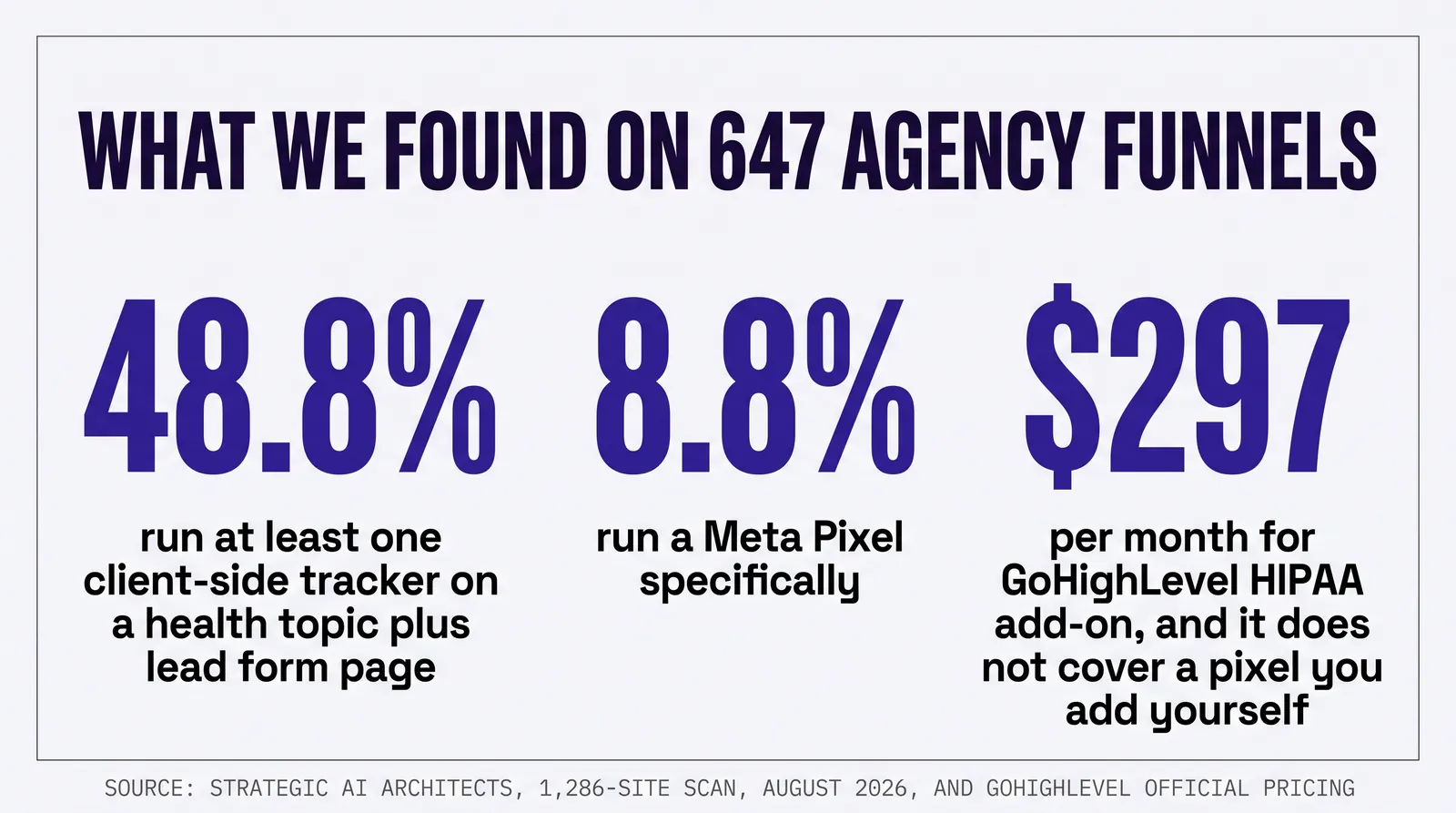
GoHighLevel's HIPAA compliance add-on costs $297 a month, or $2,970 a year, and its own support documentation says that once you turn it on, you can't turn it back off2. What it buys is real: encryption, access logs, and a signed Business Associate Agreement for what happens inside GoHighLevel's own systems1. What it does not buy is coverage for a Meta Pixel, a Google Analytics tag, or a chat widget your own team embedded on the funnel page, because a BAA only binds the business associate that signed it3. The FTC has already fined two health companies, GoodRx and BetterHelp, a combined $9.3 million for sharing exactly that kind of data with advertising platforms56. Here's where the boundary actually sits, and how to check whether your own funnel crosses it.
The add-on everyone assumes covers everything
Somewhere in the last year, someone on your team probably found the toggle inside GoHighLevel's settings labeled "HIPAA Compliance." Maybe a carrier's compliance department asked whether your intake forms were secure. Maybe you just got nervous after reading a headline about a health app getting fined. You clicked it on, signed the agreement that popped up, and moved on with your day.
That single click cost $297 a month, or you paid $2,970 up front for the year1. And GoHighLevel's own support article is blunt about what happens next: "Once purchased and enabled, HIPAA Compliance cannot be deactivated"2. You didn't just buy a feature. You made a permanent commitment on the strength of an assumption most agencies never actually check: that paying for this add-on and signing this agreement means the whole funnel, the quote form, the ad pixels, the chat widget, is now HIPAA safe.
It doesn't mean that. Not because GoHighLevel is doing anything wrong, and not because the add-on doesn't work as described. It's because a Business Associate Agreement was never designed to cover an entire website. It's a contract about one specific relationship, and everything outside that relationship is still your problem.
This decision usually gets made fast, and rarely by anyone with a compliance background. It's an office manager who saw the toggle, or an agency owner who got a pointed question from a carrier and wanted to be able to answer "yes" quickly. Nobody in that moment is being careless. They're doing what the interface in front of them suggests: pay the fee, sign the document, check the box. The interface just doesn't tell you where the box's edges actually are.
Who this guide is for
If your agency runs any Medicare, ACA, or other health-adjacent quote form through GoHighLevel and you've either signed the HIPAA add-on or are wondering whether you should, this is written for you. Every figure below is pulled from a primary source fetched this session.
What a BAA legally is
Start with the actual legal mechanics, because the gap only makes sense once you see how narrow a BAA is by design. The U.S. Department of Health and Human Services defines a business associate as a person or company that performs certain functions on behalf of a covered entity, functions that involve creating, receiving, maintaining, or transmitting protected health information3. A Business Associate Agreement is the contract that governs that relationship. It requires the business associate to use protected health information only as the agreement permits, to comply with the relevant HIPAA rules, and to report breaches3.
Read that definition again and notice what it's built around: one business associate, one set of functions, one agreement. HHS's own guidance is direct about the boundary this creates. A BAA covers business associate functions specifically, the activities where that associate is handling PHI on your behalf. It does not automatically extend to your agency's entire website or marketing stack unless a specific vendor is itself handling protected health information3. Sign a BAA with GoHighLevel, and you've covered GoHighLevel. You have not covered Meta. You have not covered Google. You have not covered whatever chat widget vendor your marketing person installed last spring.
What GoHighLevel's HIPAA add-on actually covers
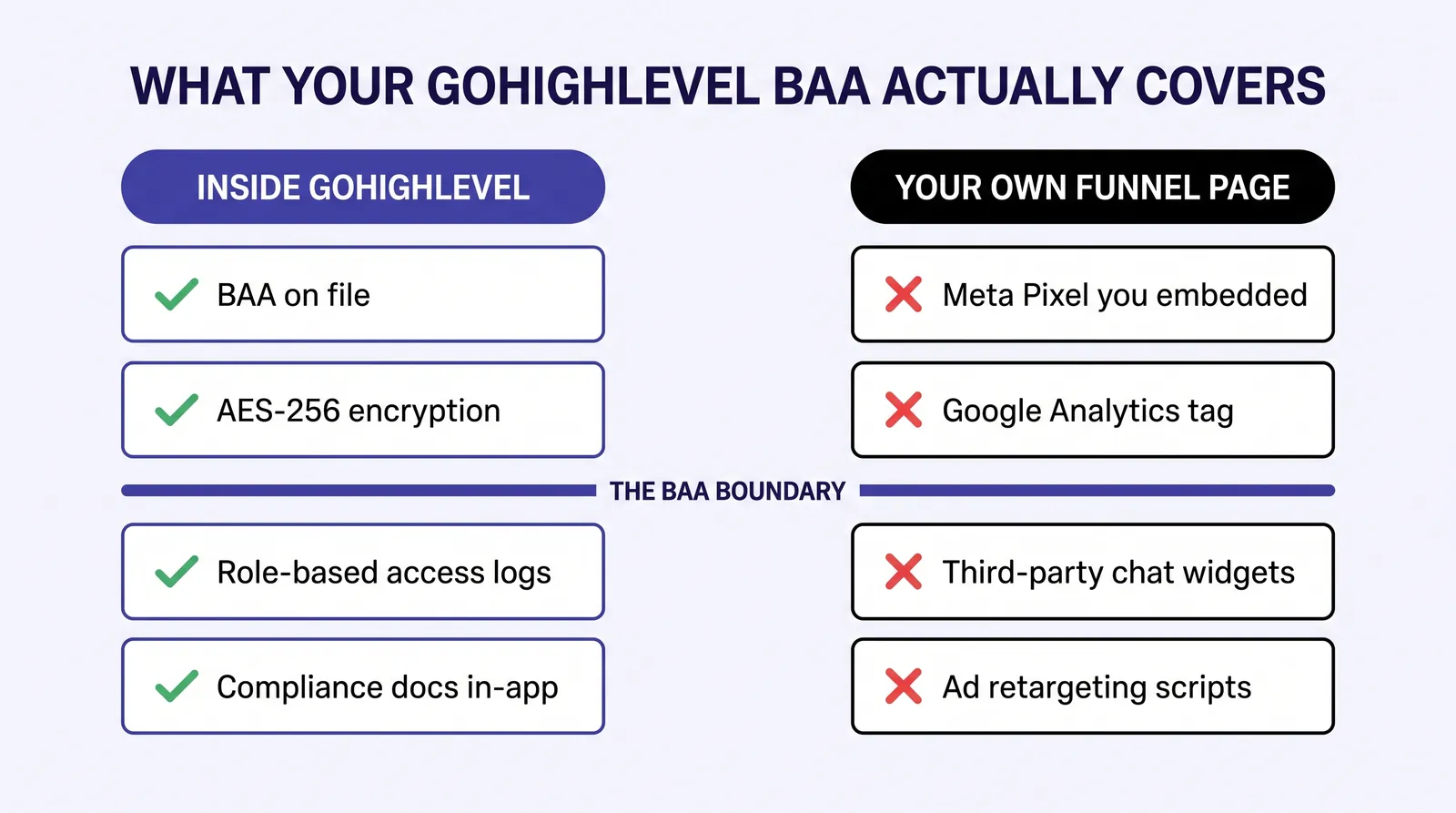
To be fair to the add-on itself: what it does, it does for real. GoHighLevel's own HIPAA compliance materials describe data encrypted with AES-256 and regular key rotation, role-based access permissions, detailed activity logs, and a Business Associate Agreement you can view, sign, and download directly inside the app1. Once enabled, the module also restricts how HIPAA-ready sub-accounts can be transferred between agencies, which is a real operational safeguard for franchises and multi-office setups1. None of that is decoration. If your agency stores protected health information inside GoHighLevel's own database, contact records, notes, form submissions saved to a contact, that data sits behind real technical controls once the add-on is on.
The add-on is also honest about where its own responsibility ends. GoHighLevel's documentation states plainly that "your organization is ultimately responsible for meeting all HIPAA requirements"1. That's not a hedge. It's the correct legal position, and it's the sentence most agencies skim past on their way to clicking the checkout button.
AES-256 encryption
Data stored inside GoHighLevel's systems is encrypted with regular key rotation.
Role-based access logs
Detailed activity logs track who inside your organization touched what record.
A signed BAA
Available directly inside the app, covering GoHighLevel's own handling of PHI.
Sub-account transfer limits
HIPAA-ready sub-accounts can only move between agencies that both have the module on.
What it does not cover
Here's the part that matters more than anything in the previous section. A funnel page built inside GoHighLevel is a web page like any other, and web pages accumulate scripts: a Meta Pixel for ad retargeting, a Google Analytics 4 property for traffic reporting, a third-party chat widget, a heatmap or session-replay tool someone added to see where visitors clicked. None of those vendors signed your GoHighLevel BAA. Most of them were never asked to.
This is exactly the gap the SAA research team found when we scanned insurance agency websites earlier this month, and it's worth stating plainly: Meta does not offer a Business Associate Agreement for its standard advertising Pixel7. There is no BAA to sign with Meta for that product, at any price, on any plan. If a Meta Pixel fires on a page where a visitor enters health information, you cannot make that disclosure HIPAA compliant by paying anyone anything, because the vendor receiving the data won't enter into the agreement that would make it compliant in the first place.
| Where it runs | Covered by your GoHighLevel BAA? | Why |
|---|---|---|
| Contact records stored in GoHighLevel | Yes | GoHighLevel is the business associate handling that data1 |
| Form submissions saved to a GoHighLevel contact | Yes | Same system, same signed agreement1 |
| Meta Pixel on the funnel page | No | Meta isn't party to your GoHighLevel BAA and offers no BAA for its standard Pixel7 |
| Google Analytics 4 tag on the funnel page | No | Google is a separate vendor, outside the GoHighLevel agreement3 |
| A third-party chat widget you installed | No, unless that vendor separately signed a BAA | A BAA covers business associate functions specifically, not every script on the page3 |
If you want a fast read on your own funnel first
The free Audit includes a HIPAA tracking scan alongside the standard AEO checks, and it takes about a minute to run. strategicaiarchitects.com/audit9.
Two FTC cases that show why the gap matters
This isn't a theoretical risk. The Federal Trade Commission has already brought two major enforcement actions against health companies for exactly this pattern, sharing health data with advertising platforms outside the boundary of any HIPAA relationship.
In February 2023, the FTC announced an enforcement action against GoodRx, the prescription discount and telehealth company, for sharing sensitive personal health information, including users' prescription medications and personal health conditions, with third-party advertising companies like Facebook, Google, and Criteo5. The FTC's press release states GoodRx "falsely promised users it would never share their health data with advertisers" and failed to notify consumers of the unauthorized disclosures as required by the Health Breach Notification Rule5. GoodRx paid a $1.5 million civil penalty.
Five months later, in July 2023, the FTC finalized an order against BetterHelp, the online counseling service, requiring it to pay $7.8 million and banning it from sharing consumers' health data for advertising6. The FTC alleged BetterHelp disclosed consumers' email addresses, IP addresses, and health questionnaire information to Facebook, Snapchat, Criteo, and Pinterest for advertising purposes, despite promising consumers it would only use their data for limited purposes6. The $7.8 million went back to consumers as partial refunds.
$1.5M
FTC penalty against GoodRx for sharing health data with ad platforms5
$7.8M
FTC order against BetterHelp for the same underlying pattern6
$9.3M
Combined penalty across both cases
2023
Year both enforcement actions were finalized
| Company | Penalty | What the FTC alleged | Date finalized |
|---|---|---|---|
| GoodRx | $1.5 million | Shared prescription and health-condition data with Facebook, Google, and Criteo for advertising, and failed to notify consumers as required5 | February 1, 2023 |
| BetterHelp | $7.8 million | Shared email addresses, IP addresses, and health questionnaire answers with Facebook, Snapchat, Criteo, and Pinterest for advertising, despite promising limited use6 | July 14, 2023 |
Neither GoodRx nor BetterHelp is an insurance agency, and neither case turned on whether the company had a HIPAA-covered relationship with the ad platforms it shared data with. That's the point. The FTC didn't need a HIPAA violation to bring these cases. It used its general consumer protection authority and the Health Breach Notification Rule to go after the underlying conduct: sensitive health data reaching an advertiser that had no business relationship, no agreement, and no obligation to protect it. A signed BAA with your CRM provider does nothing to change that exposure if a pixel on your own page is doing the same thing GoodRx and BetterHelp got fined for.
What federal regulators say about tracking pixels
HHS's Office for Civil Rights has issued specific guidance on this exact question: when do tracking technologies on a regulated entity's website create HIPAA exposure. The current version of that guidance, last updated June 26, 2024, states plainly that "regulated entities are not permitted to use tracking technologies in a manner that would result in impermissible disclosures of PHI"4. It also confirms the BAA principle from the other direction: "a tracking technology vendor is a business associate if it meets the definition of a business associate, regardless of whether the required BAA is in place"4. In other words, not having a BAA with a vendor doesn't excuse the disclosure. It just means you made the disclosure without the agreement HIPAA requires for it.
Worth knowing, in the interest of not overstating the guidance: a June 2024 court order vacated part of OCR's earlier December 2022 position, specifically the rule that an online technology connecting a visitor's IP address to a visit on an unauthenticated public webpage about specific health conditions was, by itself, always enough to count as individually identifiable health information4. HHS says it's still evaluating its next steps in light of that ruling4. That narrowing matters for a general informational page about, say, what Medicare Advantage covers. It matters much less for the page this guide is actually about: a quote form where a visitor enters their name, contact information, and answers questions about current coverage or health conditions, because that combination looks like individually identifiable health information under a much more settled reading of the rule.
The mistake we see most
An agency reads a headline about the OCR guidance being partly struck down and concludes the whole tracking-pixel question went away. It didn't. The part that was vacated is narrow and specific. The FTC's authority, the BAA mechanics, and the underlying disclosure risk on an actual quote form are unaffected.
Is your agency even a HIPAA business associate?
It's worth answering this honestly before you spend another dollar on any compliance product, because the answer isn't the same for every agency. An independent insurance agency is typically HIPAA-regulated only when it's acting as a business associate, creating, receiving, or transmitting protected health information on a carrier's behalf. A pure life-insurance marketing site with no health questions on the intake form can fall outside HIPAA's reach almost entirely.
A Medicare Advantage or ACA quote form is a different animal, and it's the one this guide is written around. The moment your form asks about current health coverage, medications, or health conditions, and that information flows toward a carrier relationship where you're acting as their business associate, you're inside HIPAA's scope for that specific data. That's also the exact configuration where a client-side pixel is most dangerous, because the same form field that makes you HIPAA-regulated is the one a Meta Pixel or a poorly configured analytics tag can silently transmit off your site.
This isn't a new determination we're making up for this post. It's consistent with how the Business Associate framework is defined by HHS3, and it's the same conditional standard we've applied on every compliance-focused guide on this site. If you're not sure which category your agency falls into, that's a question for whoever handles your compliance, not something to guess at from a blog post, including this one.
What we found scanning 647 agency funnels
This isn't abstract for us. Our research team scanned 1,286 U.S. insurance agency websites on August 17, 2026, and identified 647 of them, just over half, that combined health-topic content with a lead form, the configuration this whole guide is about7. Among those 647 sites, 316 of them, 48.8%, run at least one client-side tracking technology: Google Analytics, a Google Tag Manager container, an ad pixel, or a session replay tool7. Fifty-seven of them, 8.8%, run a Meta Pixel specifically7, the exact product Meta offers no BAA for.
We don't know how many of those 647 sites are built on GoHighLevel specifically, our scan checked what was firing on the page, not the underlying platform. But GoHighLevel is one of the most widely used CRM and funnel platforms in this industry, and the pattern we found, health-topic content, a lead form, and a client-side tracker running underneath it, is precisely the pattern a GoHighLevel HIPAA add-on does not fix on its own. The add-on secures what's inside GoHighLevel. It has no mechanism to detect or remove a pixel your team pasted into a custom code block on the funnel page.
Worth ten minutes before AEP
If you haven't checked your own funnel for this since you signed up for GoHighLevel's HIPAA add-on, do it before your next enrollment push. The next section walks through exactly how.
How to check your own funnel today
You don't need a developer for this part, just about ten minutes and your own browser.
Open the specific funnel page where a visitor enters health-related information, not your homepage. Right-click anywhere on the page and choose "View Page Source," or open your browser's developer tools and look at the Network tab while you reload the page. Search the page source for the terms "fbq" or "facebook" (the signature of a Meta Pixel), "gtag" or "G-" followed by letters and numbers (Google Analytics 4), and "GTM-" (a Google Tag Manager container, which can load additional trackers you won't see directly in the page source).
If you find a Google Tag Manager container, treat that as a yellow flag rather than a clean bill of health. GTM containers can load dozens of tags dynamically, ones that never appear in the raw page source at all, which is exactly why our own research flagged GTM containers as a likely undercount in what we could detect from the outside7. If your agency uses Tag Manager, log into that account directly and review every tag configured to fire on the funnel page.
Run the check from a plain browser window without an ad blocker or privacy extension active. Those tools routinely strip out the exact scripts you're trying to find, and a clean-looking page source on a locked-down browser can quietly hide a pixel that fires normally for the vast majority of your actual visitors, who aren't running one.
The DIY fix, step by step
You can do this yourself. Here's the actual sequence.
Inventory every script on the funnel page
Use the page-source and Network-tab check above, plus a direct login to any Google Tag Manager or Meta Business Suite account tied to your domain, to build a complete list of what's actually firing.
Remove anything without a signed BAA
For each vendor on your list, confirm whether you have a signed Business Associate Agreement with that specific vendor. If you don't, and the vendor doesn't offer one, like Meta's standard Pixel7, remove it from the page entirely.
Gate what's left behind consent
For any tracking technology you keep, make sure it does not fire until the visitor has affirmatively consented, and that the consent mechanism actually blocks the script rather than just displaying a banner while the tag fires underneath it anyway.
Re-check after any funnel edit
A funnel builder makes it easy for anyone on your team to paste a new snippet into a custom code block. Re-run the check above any time the page changes, not just once a year.
Why the DIY fix alone doesn't close the gap
The steps above genuinely help, and an agency that does them is meaningfully safer than one that doesn't. They also don't change the structural reality underneath the problem: your public-facing funnel and your CRM are the same platform, built by the same non-technical team member using the same drag-and-drop editor that made it easy to add a tracker in the first place. Nothing stops the next well-meaning hire from pasting a new pixel into a custom code block six months from now, because the tool that makes GoHighLevel powerful for marketing, fast, flexible, anyone-can-edit-it funnel building, is the same property that makes an untracked script easy to introduce.
There's also a limit to what any add-on inside a single platform can do about vendors outside it. GoHighLevel's HIPAA module can encrypt what GoHighLevel stores. It has no ability to stop your marketing agency, your ad consultant, or your own staff from adding a new third-party script to a page GoHighLevel is hosting. The compliance boundary and the editing boundary are two different lines, and right now they don't sit in the same place.
Staff turnover makes this worse in a way that's easy to miss. The person who did the careful audit last spring may not be the person managing your funnel this fall. A new hire, a new marketing contractor, or a new agency you brought in to "refresh the landing page" has no way of knowing which scripts you already ruled out and why, unless that decision is written down somewhere they'll actually see it before they start editing. Most agencies don't have that document. The audit lives in someone's memory, and memory doesn't survive a hire.
CRM and public site, one editor
- Anyone with funnel-builder access can add a script
- HIPAA add-on secures GoHighLevel's own data, not third-party tags
- A cleared audit can be undone by the next edit
- No structural separation between marketing tools and PHI-adjacent forms
RiskRe-accumulates every time the funnel is edited
Public site and CRM, split by design
- GoHighLevel stays the CRM and automation layer, where it's strong
- The public site and forms live on infrastructure built for consent-gated tracking
- Tracking is server-side and opt-in by default, not opt-out after the fact
- Fewer hands with the ability to quietly add a new script to a live form
RiskDoesn't reset every time someone edits a funnel
How we build this differently
We integrate with GoHighLevel deeply, and we keep it exactly where it's genuinely the right tool: your CRM, your pipeline, your automation and follow-up. What we don't do is build your public-facing website and lead-capture forms inside a general-purpose funnel builder alongside everything else. Digital Foundation ships as a complete, compliant website with AI-citation optimization, Google Business Profile management, and an AI chat widget built in from the Starter tier, $247 a month8. Tracking on that site is server-side and consent-gated by default rather than something you have to remember to lock down after the fact.
We're not going to tell you a GoHighLevel-built funnel can never be made safe, because it can, with enough discipline about what gets added and who has access to add it. What we can say plainly is what's on our own live page: the free Audit runs a HIPAA tracking scan alongside the standard AEO checks, in about a minute, at no cost9. That's the same starting point we'd point you to before any bigger conversation, whether you end up working with us or just fixing your GoHighLevel funnel yourself using the steps above.
What you actually get
Concretely, separating your public site from your GoHighLevel-hosted CRM gets you three things. A funnel where tracking is gated behind actual consent by default, not something your team has to remember to configure correctly on every new page. A structural reduction in how many people can quietly introduce a new third-party script onto a form that touches health information. And a clear, defensible answer the next time a carrier's compliance department, or your own conscience, asks whether your intake process is safe: you'll know exactly what's running on the page, because far fewer things can be added to it without your knowledge.
None of that is a promise about a specific legal outcome, a guaranteed audit result, or immunity from every possible claim. It's an infrastructure decision about where the line between your CRM and your public site sits, and after reading the FTC's own enforcement history, it's worth treating that line as more than a checkbox.
When GoHighLevel's add-on genuinely is enough
Say this plainly: if your agency sells life insurance or annuities with no health questions anywhere in your intake process, and your GoHighLevel funnel never asks a visitor about coverage, medications, or a health condition, most of this guide doesn't apply to you. Run a basic script check anyway, since a stray Meta Pixel is still worth knowing about for advertising-policy reasons even without a HIPAA angle, but you're not carrying the same exposure a Medicare or ACA agency is.
Even for a health-adjacent agency, if you've done the DIY audit above, removed every script without a BAA, and you're disciplined about reviewing new additions before they go live, that's a genuinely defensible position for a single-office agency with a small, careful team. The math in this guide starts mattering most once you're running multiple offices, multiple hands with funnel-editing access, or a marketing team that moves faster than your compliance review does.
Questions agencies ask
Is GoHighLevel HIPAA compliant?
GoHighLevel offers a paid HIPAA compliance add-on, $297 a month or $2,970 a year, that includes encrypted storage, role-based access logs, and a Business Associate Agreement you can sign inside the app. That makes GoHighLevel itself capable of handling protected health information under a BAA. It does not make your agency's use of GoHighLevel, including the pixels and scripts your own team adds to a funnel page, automatically compliant.
What does GoHighLevel's HIPAA add-on actually cost?
$297 a month, billed account-wide rather than per sub-account, or $2,970 if paid annually. GoHighLevel's own support documentation states that once you purchase and enable it, it cannot be deactivated.
Does signing a BAA with GoHighLevel make my whole website HIPAA compliant?
No. A Business Associate Agreement is a contract between your agency and one specific business associate, in this case GoHighLevel, covering what that business associate does with protected health information inside its own systems. It does not extend to a Meta Pixel, a Google Analytics tag, or any other third-party script your agency embeds on the same funnel page, because those vendors are not party to your GoHighLevel BAA.
Is my independent insurance agency even subject to HIPAA?
Usually only when you handle protected health information on a carrier's behalf as a business associate, not automatically just because you're an insurance agent. A pure marketing site with no health questions on the intake form can fall outside HIPAA's reach entirely. A Medicare or ACA quote form that asks about current coverage, medications, or health conditions is a different situation, and that's the form this guide is about.
Does turning off Meta Pixel and GA4 fix the problem?
It closes the specific gap this guide describes, which is real progress. It doesn't address other exposure, like a chat widget that logs conversation content to a third party without a BAA, or state wiretapping laws like California's CIPA and Washington's My Health My Data Act that apply regardless of your HIPAA compliance status.
If I already pay for HIPAA compliance, do I still need something like Digital Foundation?
That depends on where your public-facing funnel actually lives. If your lead-generation pages are built and hosted inside GoHighLevel, the HIPAA add-on covers GoHighLevel's handling of the data, but your agency still owns auditing and removing every third-party script on those pages. Digital Foundation separates the public site from the CRM, ships with server-side, consent-gated tracking by default, and includes a HIPAA tracking scan in the free Audit that checks this specific gap.
How does Strategic AI Architects handle this differently?
We keep GoHighLevel exactly where it's strong, as the CRM and the automation layer, and we build the public-facing site and lead forms separately, on infrastructure where tracking is server-side and gated behind consent rather than firing by default. That's a structural difference, not an add-on you switch on inside someone else's platform.
Should I cancel GoHighLevel's HIPAA add-on if I move my public site elsewhere?
Not necessarily, and remember GoHighLevel's own documentation says the add-on cannot be deactivated once purchased, so that decision is effectively permanent the moment you turn it on. If you still route health-related communication, like appointment confirmations or intake follow-up, through GoHighLevel's CRM side, the BAA covering that data may still matter. Talk to whoever handles your agency's compliance before touching it either way.
Sources
- GoHighLevel, Inc. "HIPAA Compliance in HighLevel," official product page, $297/month pricing, encryption, access logs, and BAA availability, verified live 2026-08-19. gohighlevel.com.
- HighLevel, Inc. "HighLevel Pricing & Billing" support article, HIPAA Compliance add-on priced at $297/month account-wide and cannot be deactivated once enabled, verified live 2026-08-19. help.gohighlevel.com.
- U.S. Department of Health and Human Services, Office for Civil Rights. "Business Associates" guidance, definition of business associate and scope of a Business Associate Agreement, verified live 2026-08-19. hhs.gov.
- U.S. Department of Health and Human Services, Office for Civil Rights. "Use of Online Tracking Technologies by HIPAA Covered Entities and Business Associates," guidance page last updated 2024-06-26, verified live 2026-08-19. hhs.gov.
- Federal Trade Commission. "FTC Enforcement Action to Bar GoodRx from Sharing Consumers' Sensitive Health Info for Advertising," press release, $1.5 million civil penalty, published 2023-02-01, verified live 2026-08-19. ftc.gov.
- Federal Trade Commission. "FTC Gives Final Approval to Order Banning BetterHelp from Sharing Sensitive Health Data for Advertising, Requiring It to Pay $7.8 Million," press release, published 2023-07-14, verified live 2026-08-19. ftc.gov.
- Strategic AI Architects. "We Scanned 1,286 Insurance Agency Websites for Tracking Pixels," 647-site health-topic-plus-form sample, 48.8% running a client-side tracker, 8.8% running a Meta Pixel, Meta's lack of a standard-Pixel BAA, scanned 2026-08-17, verified live 2026-08-19. strategicaiarchitects.com.
- Strategic AI Architects. "Digital Foundation," Starter tier pricing and included features, verified live 2026-08-19. strategicaiarchitects.com.
- Strategic AI Architects. "Free Audit," HIPAA tracking scan description, verified live 2026-08-19. strategicaiarchitects.com.
Talk it through
Want a second pair of eyes on it?
Free 30 minutes. Bring what you found, or bring nothing and we will look together at how AI engines read your site and which fixes move first.
Find out what's actually running on your funnel
Run the free Audit, a live AEO Audit plus a HIPAA tracking scan of your site, in under a minute.
Related reading: we scanned 1,286 insurance agency websites for tracking pixels · why your insurance website's pixel could get you sued · GoHighLevel website vs. custom-built site for an insurance agency