Playbook
Google Just Banned Pricing From Business Profile Listings
Pricing, deadlines, and direct calls to action are out of your listing description. Posts have their own new rules too.


20 min read
Google quietly rewrote the rules for what can appear on a Business Profile listing. As of an update first reported October 6, 2026, a listing cannot carry time-bound promotions, pricing, or direct calls to action.12 Posts have a separate rule: no email addresses, phone numbers, social links, or unrelated website links, though offers are still allowed there.1 If your listing description reads anything like "Free quotes this week" or lists a starting premium, it is now out of policy, right in the middle of Medicare's Annual Enrollment Period.
What Google actually changed
On October 6, 2026, Search Engine Roundtable reported that Google had quietly expanded the Advertising and Solicitation section of its Google Maps and Business Profiles prohibited and restricted content policy, adding a new "For merchants" subsection spelling out, in more detail than before, exactly what a business can and cannot post.2 The change was spotted by Hiroko Imai, who shared before and after screenshots of the policy page on LinkedIn; the Roundtable article does not give Google a specific date it made the edit, only the date it was publicly noticed.2
We fetched Google's own policy page directly this session to confirm the exact language rather than take a secondhand summary at face value.1 Here is what it says, as of this writing. For merchants, in the listing itself: promotional or commercial content is not allowed if it includes "time-bound promotions, pricing, or direct calls-to-action."1 For merchants, in Posts: email addresses, phone numbers, social media links, or links to other websites are not allowed if they are unrelated to your business, though "offers and updates that may seem promotional" are otherwise permitted.1 The same advertising and solicitation section also covers reviews: a customer's review cannot contain promotional content, and it cannot contain an email address, phone number, social link, or outside link either.1
Read that closely, because the distinction matters more than it first appears. Google did not ban pricing and promotions from Business Profile outright. It drew a line between two different parts of the product. The listing, meaning your business name, category, description, and the core profile a searcher sees first, is now meant to read as a factual identity, not an advertisement. Posts, the separate feed of time-stamped updates you can publish under a profile, still has room for promotional language, just not contact details or outside links. That is a narrower, more specific set of rules than "don't advertise," and it is also easy to get backward if you only read a headline about it.
There is also a citation angle worth naming, since this blog spends a lot of time on it elsewhere. A Business Profile listing was never a strong source for an AI assistant to cite in the first place, since it carries no schema, no byline, and no stated date for when the content was last checked. This update does not change that math much. What it does is remove one more reason to treat the listing as a place worth investing persuasive copy in at all. The pricing, the offer, and the reason to call belong on a page built to be indexed, dated, and quoted, which a Business Profile description has never been.
Policy page, not a press release
Google has not published a blog post or a press release announcing this change as a named feature. It lives entirely in the support documentation at support.google.com/business/answer/7400114, under Advertising and Solicitation. That is exactly the kind of update a working agent never sees unless someone else is watching the policy page for them.
What "time-bound promotion" and "direct call to action" actually mean
Google's policy text uses three specific phrases, and none of them are defined further on the page, which leaves room for an agency to guess wrong in either direction. Worth being precise about what each one covers in practice, based on how the phrase is used in the rest of Google's merchant content guidelines.
A time-bound promotion is any offer tied to a date, a deadline, or a window of availability. "Free quotes through the end of open enrollment" is time-bound. So is "limited appointments this week." A plain description of what you do, with no date attached, is not. Pricing is any specific number presented as what a customer will pay or save, whether that is a dollar figure, a percentage, or a phrase like "plans starting at." A direct call to action is an instruction telling the reader what to do right now: call, book, click, visit, or sign up, especially paired with an imperative verb at the start of a sentence.
What a lot of listings still say
- "Plans starting at $0 a month"
- "Call now before AEP ends"
- "Free quote this week only"
- "Book your appointment today"
RiskPricing, a deadline, and an instruction, all in the listing field itself
What still reads as a listing
- "Licensed Medicare and ACA agent serving Minnehaha County"
- "Specializing in Medicare Advantage, Part D, and ACA marketplace plans"
- "Independent agent, not captive to one carrier"
- "Serving clients across South Dakota and Iowa since 2014"
RiskNone of it is a price, a deadline, or an instruction
Why so many agency listings already break it
None of this is because agency owners weren't paying attention. It is because, for years, the standard advice for a local business profile was the opposite of what the policy now says.
Walk through how a typical insurance agency's Business Profile description gets written. An agent sets up the listing themselves during a slow afternoon, or a marketing vendor writes it as part of an onboarding package, and the template almost always leans on the same handful of moves: a starting price ("plans from $0 a month"), an urgency phrase ("call before open enrollment ends"), and a direct instruction ("book your free quote today"). None of that was ever against the rules as most agencies understood them. A description that reads like a tiny landing page was, until this update, treated as good marketing practice, not a policy violation.
It is also the kind of content that survives untouched for years, because nobody treats a Business Profile listing as a page that needs maintenance. A website gets redesigned, a blog gets a new post, a funnel gets A/B tested. The GBP description gets written once, at setup, and almost never revisited unless the business changes its name or address. That makes it one of the stalest pieces of copy most agencies have live anywhere, which is exactly the kind of copy a policy change like this one catches off guard.
Listing versus Posts, side by side
The clearest way to apply this is to stop thinking about your Business Profile as one piece of content and start thinking about it as two separate surfaces with two separate rulebooks.
| Surface | Not allowed | Still allowed |
|---|---|---|
| Listing (business description) | Time-bound promotions, pricing, direct calls to action1 | A factual description of your services, service area, and specialties |
| Posts | Email addresses, phone numbers, social links, unrelated website links1 | Offers and updates that may read as promotional1 |
| Customer reviews | Promotional content, email addresses, phone numbers, social links, outside links1 | A genuine account of the customer's experience |
| Your own website | Nothing in this policy applies here | Pricing, promotions, and direct calls to action, with no restriction |
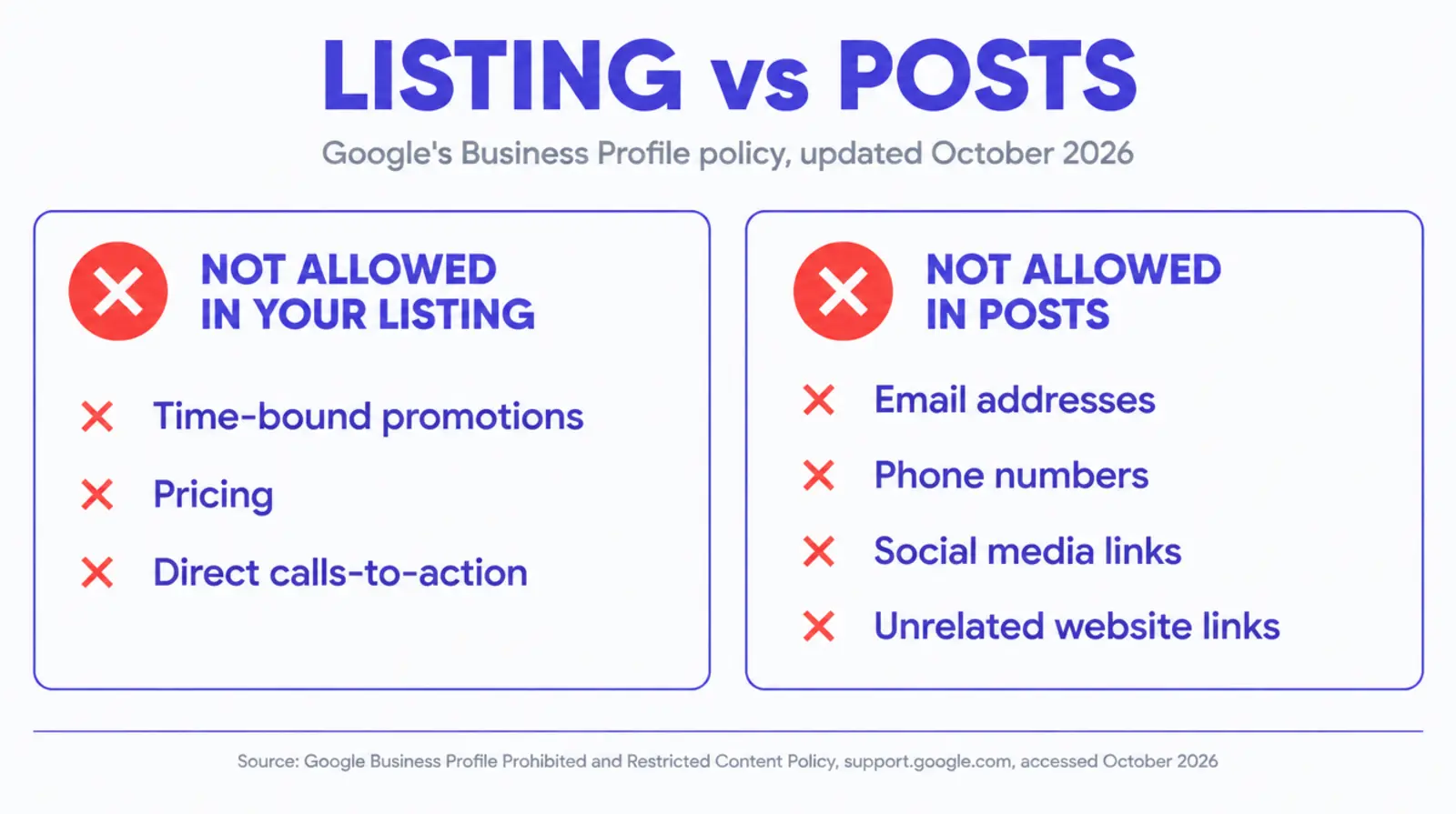
Notice what survives in every row: a plain, factual description of what you do and where you do it. "Licensed Medicare and ACA agent serving Minnehaha County" is a description. "Plans starting at $0, call now before AEP ends" is an advertisement wearing a description's clothes, and it is the second one that the October update targets.
What a flagged listing costs you during AEP
This update landed on October 6, 2026, nine days before the Medicare Annual Enrollment Period opened for the year, which is the single highest-stakes stretch most Medicare and ACA agencies see on their local listing all year. That timing is what makes it worth fixing now rather than whenever you get around to it.
Here is the mechanism, stated plainly. A suspended, edited, or demoted Business Profile does not show up as a lower search ranking, it shows up as a listing that is harder or impossible to find at the exact moment a local prospect searches "Medicare agent near me" or "ACA enrollment help" during the six weeks that matter most. The review and star-rating signals attached to that same listing carry more weight with a prospect than most agencies assume.
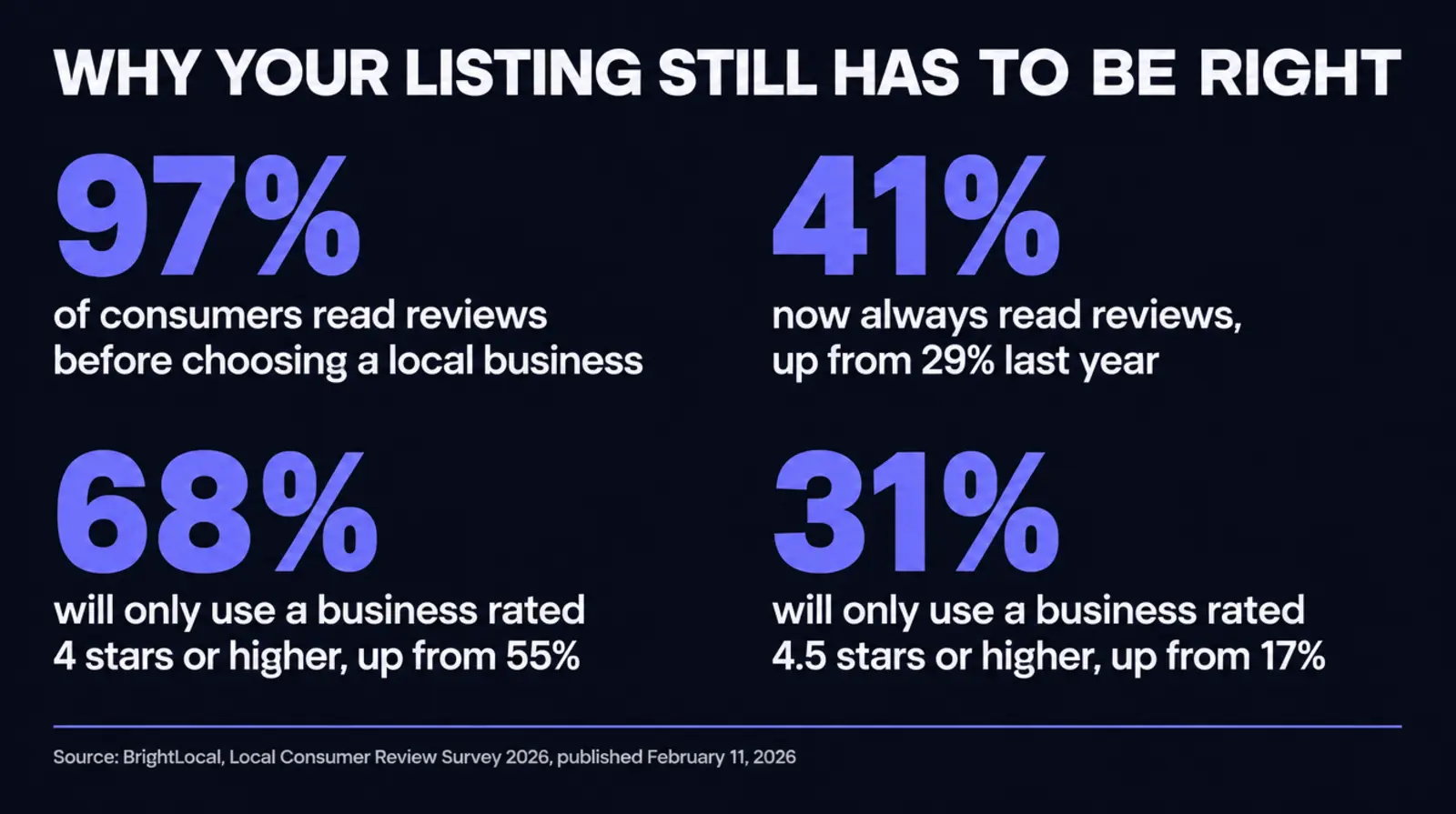
BrightLocal's 2026 Local Consumer Review Survey, published February 11, 2026, found that 97% of consumers read reviews for local businesses, and that 41% now "always" read reviews when browsing for a business, up from 29% the year before.3 The same survey found that 68% of consumers will only use a business rated four stars or higher, up from 55% the year before, and 31% will only use a business rated 4.5 stars or higher, up from 17%.3 That is a single survey, so treat the exact percentages as one data point rather than settled fact, but the direction is hard to argue with: consumers are getting pickier about local listings year over year, not less so, and a listing that is suspended, stripped of content, or sitting on a policy violation is not in a position to clear that bar at all.
Work through what that means for one agency. Say a book of business in a mid-sized county pulls thirty Business Profile searches a week during AEP, a plausible number for an established local agent. If the listing is suspended for even a few days while a review and an appeal work through Google's process, that is not thirty missed impressions, it is thirty missed chances to be the name a prospect calls instead of a competitor's, during the exact window when that prospect is actively comparing agents. Nothing about this guide can tell you how many of those thirty would have converted. What it can tell you is that zero of them convert from a listing nobody can find.
The math gets worse, not better, for an FMO or IMO. A downline of fifty producers, each running their own Business Profile with some version of the same pricing-heavy description a vendor template handed them years ago, is not one listing at risk, it is fifty independent chances for a flag, an edit, or a suspension to land during the exact window the whole downline is being pushed to write business. A single-agent book can absorb a few days of listing trouble as an inconvenience. A network absorbs it fifty times over, usually without anyone at the top finding out until an agent further down calls asking why their listing disappeared.
Not sure where your own listing stands
The free Audit checks your site's AEO readiness and a HIPAA tracking scan in about a minute. It will not grade your GBP description for you today, but it is the fastest way to see what else on your site needs attention while you're already looking at this.
Is insurance specifically restricted
Worth answering directly, since it changes how cautious an agency should be. Google's restricted content section, a separate part of the same policy page, lists categories that need extra care when posting content: "alcohol, gambling, tobacco, guns, health and medical devices," along with "regulated pharmaceuticals, adult services, and financial services."1 Insurance is not named as its own category.
That same section is specific about what it restricts regardless of category: content "may not feature calls to action or offers for the sale of products or services" that are "subject to local legal regulations," and it should not display "links to a landing page where it is possible to purchase restricted goods or services," contact information for purchasing them, or "promotional offers for restricted goods or services."1 Insurance products are about as thoroughly regulated at the state level as a local service gets. Reading Google's "financial services" category broadly enough to include insurance is a reasonable, cautious interpretation, even though the page does not say so by name.
Put the two sections together and the practical guidance for an agency gets more conservative, not less. Even before this October update, an insurance agency's Business Profile description arguably should not have carried a direct sales pitch. The new Advertising and Solicitation language closes off any remaining ambiguity for every merchant, insurance included.
Part of a wider pattern, not an isolated edit
The October update did not happen in isolation. The same prohibited and restricted content policy already bars a merchant from offering an incentive for a review, and separately bars a merchant from discouraging negative reviews or selectively asking only satisfied customers to leave one.1 Google's own language is direct about it: merchants may not "offer incentives" for reviews, and may not "discourage or prohibit negative reviews, or selectively solicit positive reviews from customers."1
Line those rules up next to the October 6 update and a pattern comes into focus. Google is not picking off individual practices at random. It is narrowing the entire category of content a merchant can shape on a page they do not own, listing description, Posts, and the reviews attached to them alike. An agency that has been asking happy clients for five-star reviews while quietly ignoring unhappy ones was already out of policy before this month. An agency whose description reads like an ad just joined them.
None of this means Google Business Profile is becoming less useful. It means the parts of it you can write yourself are narrowing to what they were probably always meant to be: a factual record of who you are and where you operate, with the genuine signals, real reviews, real photos, real hours, doing the persuading instead of copy you wrote yourself.
Checking your own listing in fifteen minutes
This needs nothing beyond your own Google Business Profile dashboard and a few minutes of reading.
First, read your business description exactly as a stranger would. Open your Business Profile, find the description field, and read it the way a Google policy reviewer would: does it state a price, does it reference a deadline or a limited-time offer, does it tell someone to call, book, or click right now. Any yes is worth rewriting.
Second, rewrite it as a factual description, not a pitch. Name your license type, your carriers if you want to, your service area, and what you specialize in. "Independent Medicare and ACA agent licensed in South Dakota and Iowa, specializing in Medicare Advantage and prescription drug plans" survives this policy intact. "Call today for the lowest Medicare rates in town" does not.
Third, check your last several Posts for contact information and outside links. Posts can still carry an offer or an update, but not an email address, a phone number, a social link, or a link to a page unrelated to your business. If a recent Post links out to a Facebook page or lists your cell number, update it or let it expire rather than leaving it live.
Fourth, scan your most recent reviews for red flags you don't control. You can't edit what a customer writes, but you can flag a review that includes contact information or an outside link for Google's review, since the policy prohibits that in reviews too, not just in your own content.
Fifth, if you run or oversee more than one listing, build a simple checklist instead of relying on memory. An FMO, an IMO, or an agency owner with a few producers each running their own profile is really managing a small portfolio of listings, not one. The fastest version of this is a shared spreadsheet with one row per listing: the agent's name, the listing URL, whether the description currently states a price or a deadline, and the date it was last checked. That turns an invisible, scattered risk into something you can see at a glance and assign out.
None of that fifteen-minute version requires anything beyond your own GBP dashboard. If you manage one listing, doing this yourself this afternoon is faster than scoping out help for it. Where it stops being a quick fix is scale: an FMO or IMO with a downline of dozens of agent listings, each written by whoever set it up, each with its own pricing language or stale Post history, turns a fifteen-minute check into a full afternoon multiplied by however many listings you're responsible for.
3
Things banned from a listing description: time-bound promotions, pricing, direct CTAs1
4
Things banned from Posts: emails, phone numbers, social links, unrelated links1
9 days
Between this policy update being reported and AEP opening for the year2
0
Restrictions this policy places on pricing or offers published on your own website1
How we handle this for the agencies we manage
We re-fetched the Digital Foundation page live before writing this section rather than quoting pricing from memory, the same standard this guide has been holding Google's policy page to.4
Digital Foundation's Starter tier runs $247 a month and includes Google Business Profile management with weekly Google Business Profile posts, alongside 7 new pages a month and a full 60-point SEO and AEO checklist.4 Pro, at $497 a month, adds review harvesting through a CRM workflow on top of weekly GBP management, plus 14 to 17 new pages a month and a 24/7 AI voice receptionist.4 Scale, at $997 a month, keeps the same GBP and review harvesting and scales content to up to 71 new pages a month.4
| Tier | Price | Google Business Profile |
|---|---|---|
| Website | $84/mo | Not included |
| Starter | $247/mo | Weekly Google Business Profile posts4 |
| Pro | $497/mo | GBP management plus review harvesting (CRM workflow)4 |
| Scale | $997/mo | GBP management plus review harvesting (CRM workflow)4 |
The reason that matters for a policy change like this one: a Business Profile description we write for a client gets checked against the current policy, not whatever advice was standard when the listing was first set up years ago. When Google tightens the Advertising and Solicitation rules again, which this update suggests is an active area of enforcement rather than a settled one, that description gets revisited as part of ongoing management, not left to go stale until a client calls confused about a suspended listing.
We build the website itself on Astro, which ships zero JavaScript by default, so your pages arrive as finished HTML instead of a runtime your visitor's phone has to boot before anything loads. Our builds score 90+ on Lighthouse performance on both mobile and desktop, and some score 100, which is the reason your own pricing and offers, moved off a restricted listing and onto a page you control, load fast enough on a phone to actually convert the search that brought someone there.
There is a schema angle here too, and it is one most agencies never think about until it is explained plainly. A Business Profile listing has no mechanism for structured data the way a webpage does. A service page on your own site can carry InsuranceAgency, Service, and FAQPage schema that tells Google, and an AI assistant reading the page, exactly what you offer and what it costs, in a format built to be parsed rather than guessed at from prose. The listing Google just restricted was never going to be the more citable surface anyway. This update just removes the temptation to treat it like one.
A Google Business Profile listing proves you exist at an address. Your website is where you prove what you actually do, and the only one of the two Google lets you price.
Where the pricing and the offer actually belong
If your Business Profile description can't say "plans starting at $0" anymore, your own website still can, and it is the stronger place to say it anyway. A website page carries schema markup, gets indexed with the rest of your content, and is something an AI answer can cite. A Business Profile listing is neither of those things. We build this into every site we ship. If you'd rather see it than read about it, look at Digital Foundation.
What changes for your agency
None of this promises a ranking position, a restored listing, or a specific number of calls, because none of those can be honestly promised. What it changes is narrower and more concrete.
A listing built to the current policy
A factual description that reads as a business identity, not an advertisement a reviewer can flag.
Pricing and offers on a page you control
Moved to your own website, where there is no restriction and the content can actually be indexed and cited.
Posts checked for the newer rule
No stray phone number, email, or outside link left live on a Post that no longer qualifies.
One fewer AEP fire drill
A listing that stays visible through the exact weeks it matters most, instead of getting caught mid-season.
The underlying lesson is not really about Google Business Profile specifically. A platform you don't own can change the rules for what you're allowed to say on it, with no announcement beyond a quiet edit to a support page. The only real defense is treating every piece of content you publish on a platform like that as something to recheck, not something to set once and trust forever, the same discipline this guide applied to its own pricing table above rather than quoting Digital Foundation from memory.
Questions agents ask
What exactly did Google change about Business Profile listings?
Google expanded the Advertising and Solicitation section of its Google Maps and Business Profile prohibited and restricted content policy. The listing itself, meaning your business description and the core profile content, can no longer contain promotional or commercial content that includes time-bound promotions, pricing, or direct calls to action. Google's own policy page states plainly that promotional content is not allowed if it includes time-bound promotions, pricing, or direct calls-to-action. The change was first reported publicly on October 6, 2026.
Does this apply to Posts too, or just the listing itself?
Posts get a different rule, not the same one. Posts cannot include email addresses, phone numbers, social media links, or links to websites unrelated to your business. Offers and updates that might otherwise look promotional are still permitted in Posts. In plain terms, Google moved commercial language out of the permanent listing and is still allowing it, with its own limits, in the temporary Posts feed.
Will Google remove my existing listing content automatically?
Nobody outside Google has confirmed an enforcement timeline or whether existing listings get edited automatically. The policy update itself does not state one. The safer assumption for an agency is that a profile under review, whether from a competitor flag, a routine audit, or an automated scan, is the moment this policy gets applied to older content, not some future date you can plan around.
Is insurance specifically restricted on Google Business Profile?
Not by name. Google's restricted content section lists categories that need extra care, including alcohol, gambling, tobacco, guns, health and medical devices, regulated pharmaceuticals, adult services, and financial services. Insurance is not named separately, though it is reasonable to read financial services broadly enough to cover it. What we can say for certain, sourced from Google's own page, is that calls to action or offers for products subject to local legal regulation are restricted regardless of category, and insurance is about as regulated as a local service gets.
What should I do with the 'free quote this week' line on my listing right now?
Move it. A time-bound offer like that is exactly the kind of content the updated policy names as not allowed in the listing description. It still has a home, just not there: your website, a Post, your Google Business Profile's own offers feature where applicable, or a landing page you control and can actually track.
Does this affect my Google ranking or map pack position?
The policy update is about what content is allowed, not a stated ranking factor, and Google has not framed it as one. The more direct risk isn't a ranking drop, it's a flagged, edited, or suspended listing, which removes you from the map pack entirely rather than lowering your position in it. A agency that has been suspended before knows the difference between ranking lower and not showing up at all.
Is this related to the review-quota rules Google announced earlier this year?
They are two different updates to the same overall policy document, and both point the same direction: Google is tightening what a business can control about how it presents itself on Maps and in Business Profile. The review rules bar incentivizing reviews and discouraging or selectively soliciting negative ones. The October update restricts promotional content in listings and contact information in Posts. Read together, they are Google narrowing the gap between a genuine business profile and a self-written advertisement.
Where can I still legally put pricing and offers if not on the listing?
Your own website is the one place none of this touches. A page you control can state your pricing, your current promotions, and a direct call to action with no restriction from this policy, and it is also the one surface where that content can carry schema markup, get indexed, and get cited by an AI answer. The Business Profile listing was never meant to be a landing page. This update just made that distinction harder to ignore.
Sources
- Google. "Prohibited and restricted content policy," Google Maps and Business Profile Help, Advertising & Solicitation and Restricted Content sections. Fetched live October 21, 2026. support.google.com/business/answer/7400114.
- Barry Schwartz, Search Engine Roundtable. "Updated Google Maps Policy: What Merchants Can't Post In Listings Or Posts," published October 6, 2026, 7:51am, reporting the policy change spotted by Hiroko Imai. Fetched live October 21, 2026. seroundtable.com/google-maps-policy-listings-or-posts-42228.html.
- BrightLocal. "Local Consumer Review Survey 2026," published February 11, 2026: 97% of consumers read reviews for local businesses; 41% now "always" read reviews, up from 29%; 68% will only use a business rated 4 stars or higher, up from 55%; 31% will only use a business rated 4.5 stars or higher, up from 17%. Fetched live October 21, 2026. brightlocal.com/research/local-consumer-review-survey.
- Strategic AI Architects. Digital Foundation service page: Website $84/mo (no GBP management); Starter $247/mo (weekly Google Business Profile posts, 7 new pages/mo); Pro $497/mo (GBP management plus review harvesting CRM workflow, 14 to 17 new pages/mo, 24/7 AI voice receptionist); Scale $997/mo (GBP management plus review harvesting, up to 71 new pages/mo). Fetched live October 21, 2026. strategicaiarchitects.com/digital-foundation.
Talk it through
Want a second pair of eyes on it?
Free 30 minutes. Bring what you found, or bring nothing and we will look together at how AI engines read your site and which fixes move first.
See how your site handles what your listing no longer can
Run a free Audit and see how your site scores for sourcing, speed, and AI citation readiness, in about a minute.
Related reading: Why your insurance agency's Google Business Profile got suspended · Why your star rating isn't showing in search · Getting your agency into the Google map pack