Playbook
Will Google Penalize Your Agency's AI-Written Blog?
Roughly half of what's published online right now is primarily AI-written. Google says that isn't the part your agency's blog should worry about.


19 min read
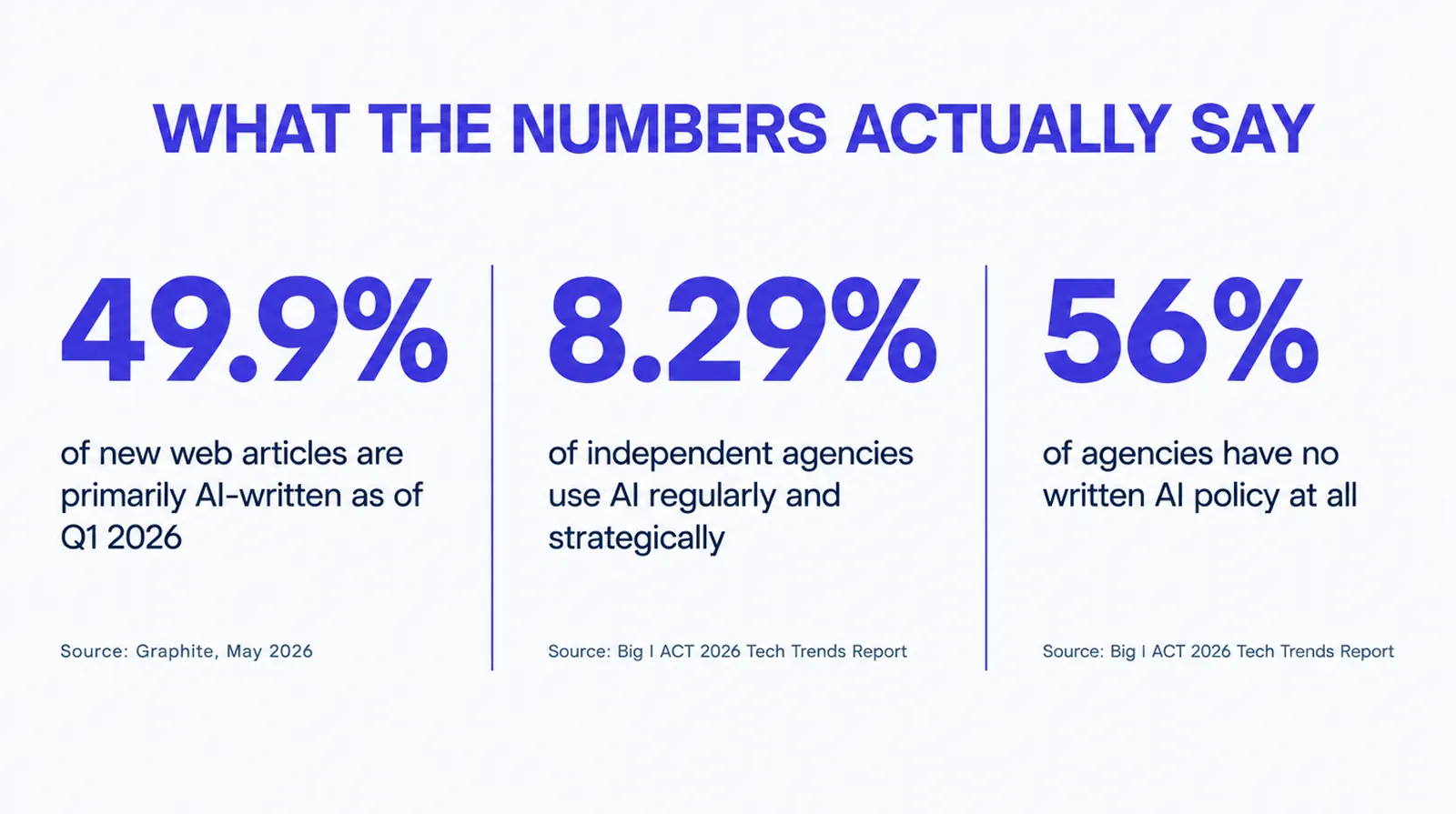
Google does not penalize content for being AI-written. Its own Search Central guidance says its systems focus on the quality of content, not how it was produced1. What its spam policy does penalize is scaled content abuse: publishing many pages, by any method, primarily to manipulate rankings instead of to help a reader, and Google names generative AI directly as one way that happens2. Almost half of new web articles are already primarily AI-written4, and only 8.29% of independent agencies say they use AI regularly and strategically today5. That gap between volume and process is where an agency blog actually gets exposed.
The question you're actually asking
You've been keeping the blog alive with ChatGPT or a similar tool because there is no version of your week that includes four uninterrupted hours to write a post from a blank page. Some weeks you edit the draft line by line. Other weeks, the week you had three appointments, a claim escalation, and a carrier training deadline, you skim it, fix the obvious stuff, and publish. You've seen a Facebook group post or a LinkedIn thread saying Google punishes AI content now, and you don't know if that's true, if it applies to you, or if it already happened and you just haven't noticed the traffic drop yet.
That worry is reasonable, and it is also aimed at the wrong target. Google is not scanning your posts for the fingerprint of a language model and quietly suppressing anything it finds. What it is doing, and has been doing consistently since it first addressed the question in writing, is evaluating whether your content was made for a reader or made to rank, and whether a real person stands behind what it claims. That distinction matters more for an insurance agency than for almost any other kind of small business blog, because the claims in your posts touch plan rules, premiums, and enrollment deadlines that a carrier, a regulator, or a client can check.
Before you keep reading
If you'd rather see where your own site stands than read the theory first, the free Audit checks your site's AI citation readiness and HIPAA safe tracking in about a minute. strategicaiarchitects.com/audit
What Google's own policy says
Google addressed AI-written content directly in a Search Central blog post, and the position it took has not changed since. The core line is this: "Our focus on the quality of content, rather than how content is produced, is a useful guiding principle that has helped us deliver reliable, high quality results to users for years"1. Google's own ranking systems aim to reward content that demonstrates experience, expertise, authoritativeness, and trustworthiness, what it calls E-E-A-T, regardless of whether a human or a machine typed the first draft1.
Google's separate, more current documentation on what it calls "helpful, reliable, people-first content" sharpens that same idea into a test you can actually run against your own posts. The guidance asks you to evaluate the "who, how, and why" behind a piece of content, whether AI-generated or not, and it draws the line plainly: "People-first content means content that's created primarily for people, and not to manipulate search engine rankings." If the honest answer to why a post exists is that you're primarily making it to attract search visits, "that's not aligned with what our systems seek to reward"3. Of the four E-E-A-T qualities, Google's own guidance says trust matters most, and that the others exist mainly to build trust rather than as separate boxes to check3.
Read those two documents together and the shape of the rule is clear. Google is not asking who or what typed the sentence. It is asking whether the sentence would still have been worth publishing if it had never ranked for anything, and whether a real person is willing to stand behind it being accurate.
| Practice | Where it lands |
|---|---|
| A post drafted with AI, then fact-checked, corrected, and given your agency's own numbers by a person who knows the subject | Fine. Quality is judged by the output, not the drafting method1. |
| A weekly, single-agency post built around a real client question, with sources named | Fine. Not the "many pages, primarily to manipulate rankings" pattern the policy defines2. |
| Dozens of AI-written pages published with no human review, primarily to rank for keyword variants | Scaled content abuse. Google names generative AI directly as one method this happens through2. |
| The same AI-generated template published across a network of downline or franchise sites | Scaled content abuse, independent of the AI question, because it is content "spread across a large network of sites"2. |
What actually gets a blog penalized
Google's spam policy has a specific name for the pattern that gets a site penalized, and it is worth reading in its own words rather than a paraphrase. "Scaled content abuse is when many pages are generated for the primary purpose of manipulating search rankings and not helping users"2. The policy then lists the methods this shows up through, and generative AI is on that list by name, alongside older tactics: "using generative AI tools or other similar tools to generate many pages without adding value for users," scraping and reformatting other sites' content with minimal rewriting, "stitching or combining content from different web pages without adding sufficient value," and building multiple sites specifically to obscure how templated the underlying content really is2.
Notice what every item on that list has in common. It is not the presence of a language model anywhere in the workflow. It is volume without value, produced by whatever tool makes volume cheap. Ten years ago the tool was a content mill of freelance writers paid by the word with no fact-checking budget. Today the tool can be an AI model with no editorial review at all. The policy targets the pattern, not the specific technology that makes the pattern cheap to run.
This is also where Google's two recent 2026 updates fit in, and it is worth being precise about what they actually were, because vague references to "the algorithm changing" get repeated a lot in agent Facebook groups without anyone checking the source. Google's own Search Status Dashboard confirms a spam update that ran from March 24 to March 25, 2026, and a separate core update that rolled out from March 27 to April 8, 202667. Google describes a core update generally as a broad set of changes to its ranking systems meant to surface more relevant, satisfying results across all kinds of sites, not a new AI-specific rule layered on top of the existing spam policy. Nothing in the public description of either 2026 update introduces a new standard beyond the scaled content abuse definition that was already published. What changed in March 2026 was enforcement pressure on an existing rule, not the rule itself.
Why this matters more for a multi-site FMO or downline
If your agency's content also runs across a downline of sub-agent sites, the "large network of sites" language in Google's own policy applies whether or not a single page is AI-written2. We've written separately about how that specific pattern gets flagged and the fix for it in why your downline's websites could get penalized together. That article and this one describe two different mechanisms. This one is about content quality and process on a single site. That one is about duplicate structure across many sites.
How many agencies are already doing this
The uncomfortable context here is that AI-written content is not a fringe practice you need to worry about catching up to. It is already the majority pattern on the open web, and independent agencies are adopting it faster than most of them have built a process around it.
Graphite, a content and SEO research firm, sampled 55,400 English-language URLs from Common Crawl with schema markup and at least 100 words, published between January 2020 and March 2026, and classified each one using three separate AI detectors, Pangram, Copyleaks, and GPTZero, averaging the results. An article counted as "primarily AI" when the AI-detected share of the text exceeded the human-written share. In the twelve months after ChatGPT launched in November 2022, 35.9% of newly published articles were already primarily AI-generated by that measure. By the first quarter of 2026, that figure had climbed to 49.9%, essentially parity with human-written content, after briefly crossing 50% in the fourth quarter of 20254. Graphite published the study in May 2026 and is explicit that this is one methodology's estimate from a sample, not a census of the entire web, and we're treating it the same way here.
Set that next to what independent insurance agencies themselves report. The Big "I" Agents Council for Technology's 2026 Tech Trends Report, based on a national survey of independent agencies, found that 68% plan to increase their AI use over the next twelve months, but only 8.29% say they are using AI regularly and strategically today. More strikingly for this specific topic, 56% of agencies report having no written AI policy or guidance at all, and 44% rely on informal, peer-to-peer training to figure out how to use these tools5.
Put those two data points together and you get the actual risk picture. Half of what's published online is already AI-assisted, which means AI involvement itself was never going to be the dividing line Google draws. But only a small fraction of agencies using AI have anything resembling a written process for using it, which means the agencies most likely to publish unreviewed, unsourced, volume-first content, the exact pattern the spam policy describes, are disproportionately agencies with no governance around the tool at all. The risk was never the AI. It's the missing process next to it.
Why an insurance blog is riskier than most
A general lifestyle blog publishing an AI-written post with a wrong fact risks looking sloppy. An insurance agency blog publishing one risks something with actual regulatory teeth, because the claims your posts make sit inside rules that CMS, state regulators, and carriers actively enforce. An AI model has no live connection to this year's plan year rules unless something in your workflow gives it one. It will still answer confidently, because fluency and accuracy are two different things a language model can produce independently of each other.
We covered the compliance side of this specifically in why your AI-written Medicare ad might violate CMS rules, which walks through the exact disclaimer language and prohibited claims CMS requires on Medicare marketing content. That article and this one are about two different exposures from the same habit. That one is about a regulator fining you for what the content says. This one is about a search engine deciding your content, as a pattern, isn't worth surfacing. An unreviewed AI draft can trip both at once, on the same post, for two unrelated reasons.
The overlap matters because it changes what "review" has to mean for an agency blog specifically. A general small business editing an AI draft is checking tone, checking it reads naturally, and checking nothing embarrassing snuck in. An agency editing an AI draft about a Medicare Advantage plan change, an ACA subsidy figure, or an enrollment deadline is doing all of that plus verifying every number against a source you could produce if a client, a carrier, or a regulator asked where it came from. That second layer of review is the one most agencies skip, not because they don't care, but because nobody told them it was a separate step from a normal proofread.
Here's what that looks like on an actual sentence, because the abstract version of this is easy to agree with and hard to apply. Ask a general AI model to draft a paragraph about ACA subsidies for a 2027 plan year post, with no source fed to it, and a typical output reads something like: "Most shoppers qualify for premium tax credits that can reduce monthly costs by hundreds of dollars, depending on income." That sentence is fluent, plausible, and not obviously wrong to a reader who doesn't already know the current numbers. It is also unsourced, unsigned, and impossible to verify without going and finding the number yourself, which is exactly the work an AI draft was supposed to save you.
The reviewed version of the same paragraph names the actual figure for the actual plan year, cites where it came from, either the CMS marketplace data or KFF's tracking of the same enhanced credits, and states the year the figure applies to. That's not a rewrite for style. It's the difference between a sentence a model guessed at and a claim your agency is willing to have its name on. The drafting tool did the same job in both cases. The outcome is only the same if nobody checked.
Edge cases: what's actually low risk
Not every AI-assisted task on a blog carries the same exposure, and treating all of them as equally risky just makes the tool less useful without making your site any safer. It helps to know where the real line sits.
Low risk, generally fine without a heavy review pass: generating three headline variants to pick from, tightening a sentence's grammar, suggesting a meta description within the length limit, drafting alt text for an image you already know the content of, or reorganizing a section you wrote yourself for better flow. None of these introduce a new factual claim. They're editing assistance, not content generation, and Google's own guidance was never aimed at a person using a tool to polish their own writing.
Higher risk, needs the full review pass every time: any sentence stating a number, a deadline, a rule, or a plan detail; any paragraph recommending a specific action a client might take based on what it says; any claim about what a carrier, CMS, or a state requires. These are the sentences that can be wrong in a way that matters, and they're exactly the sentences an AI model will write with the same fluent confidence whether the underlying fact is current or three years stale.
The practical rule that falls out of this: the review burden should scale with how checkable and how consequential a claim is, not with how the paragraph was drafted. A post that's ninety percent your own framing and ten percent factual claims needs those specific sentences checked, not a line-by-line rewrite of the whole thing.
Check your own blog
You don't need a tool or an audit to get a first honest read on where your own agency's blog stands. Pull up your last ten published posts and run three questions against each one.
Did a person who actually knows the subject read this before it went live? Not skimmed for typos. Read it the way you'd read a client's application before submitting it, checking whether the substance is right, not just the spelling.
Does every factual claim trace to a source you could point to today? A specific premium figure, an enrollment date, a plan rule, a statistic about your market. If you can't say where a number in your own post came from, an AI model probably generated it from a pattern in its training data rather than from anything current, and that's exactly the kind of claim that ages badly and reads as unreliable to both a regulator and a reader.
Would you have published this specific post if it never ranked for anything? This is Google's "who, how, and why" test in practical form3. A post that exists only because a keyword tool flagged the phrase as searchable, with nothing behind it your agency actually knows, fails this test regardless of how well it's written.
If most of your last ten posts pass all three, you're already doing the thing Google's guidance asks for, whatever tool you used to draft them. If several fail, that's specific and fixable, and it has nothing to do with whether you keep using AI at all.
You can run this check yourself, right now
This audit takes about twenty minutes with your last ten posts open in separate tabs. It requires no software. Most agents who run it find the problem isn't every post, it's a specific few written during a busy week that never got the second pass. Fixing those, or unpublishing the ones that can't be fixed, moves the needle more than rewriting posts that were already fine.
How to use AI for your blog without the risk
None of this means putting the tool down. It means putting a process next to it, and the process is shorter than most agents expect.
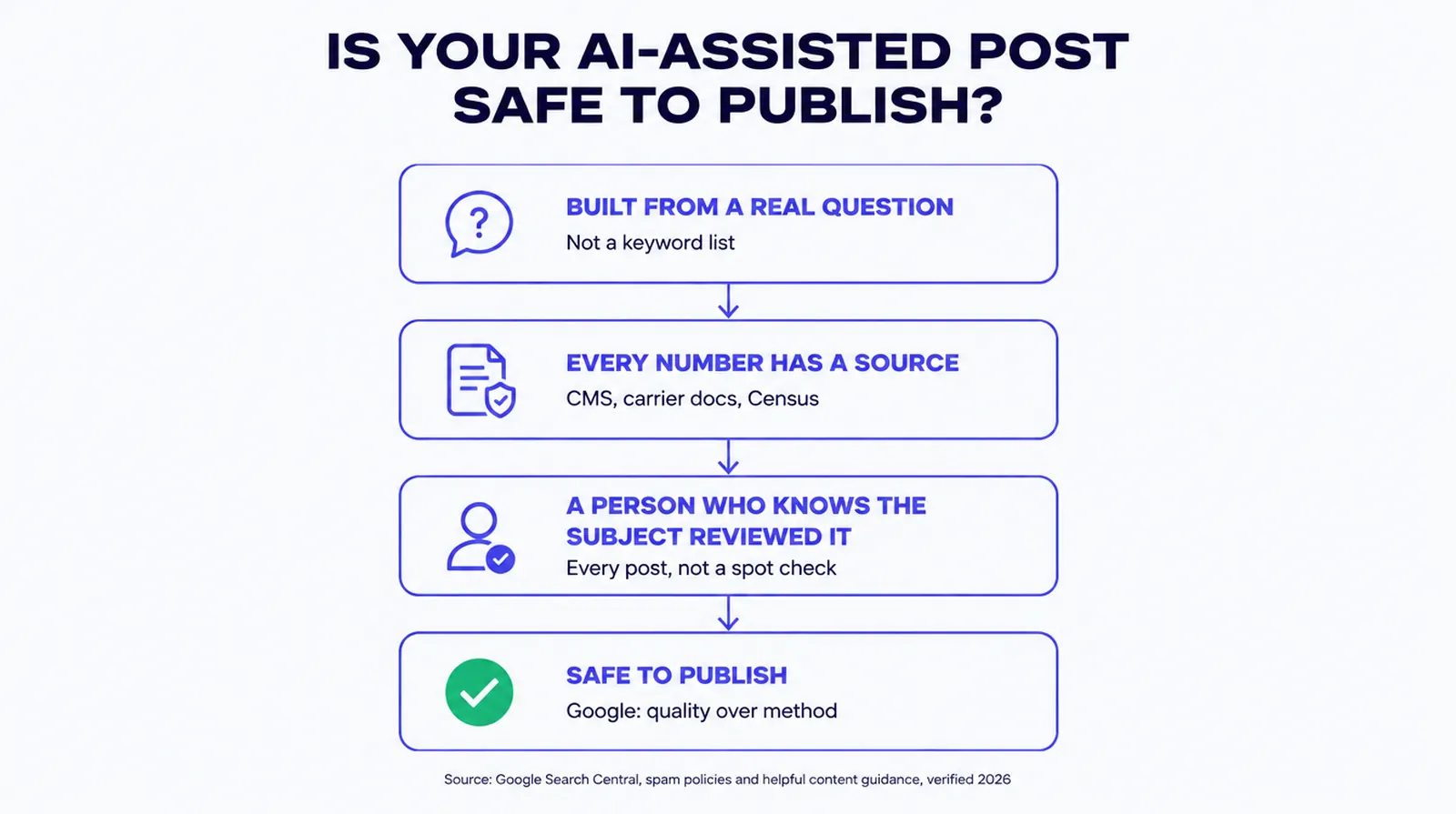
Start every post from a real question, not a keyword. "What happens to my Medicare Advantage plan if my doctor leaves the network" is a question a client actually asked you. "Medicare Advantage network changes 2026" is a keyword phrase. The first produces content built for a reader by construction. The second produces content built for a search box, and it shows in the writing even when the sentences are grammatically fine.
Source every number before you publish, not after someone questions it. If the draft states a premium, a deadline, a percentage, or a rule, find the primary source for it, CMS.gov, your carrier's current documentation, the Census Bureau, HealthCare.gov, and link or cite it. If you can't find a source for a number the AI produced, cut the number rather than guess whether it's right.
Have a person who knows the subject read the whole thing before it publishes, every time. Not spot checks on busy weeks. Every post. This is the single step the Big "I" survey data suggests most agencies without a written policy are skipping under deadline pressure, and it's the step Google's own guidance is actually asking about when it asks who reviewed the content and why it exists3.
Write fewer posts you fully stand behind rather than more posts you don't. A weekly cadence of genuinely reviewed, sourced posts beats a daily cadence of unreviewed ones on every measure that matters here: ranking, citation by AI answer engines, regulatory exposure, and the honest question of whether you'd want a client to read it.
| Step | Unreviewed AI content | AI-assisted, agency-reviewed content |
|---|---|---|
| Where the topic comes from | A keyword list | A real client question |
| Where the numbers come from | Whatever the model recalled | A source cited in the post |
| Who reads it before it publishes | Nobody, or a spell-check pass | A person who knows the subject, every time |
| Where it sits under Google's policy | The pattern scaled content abuse describes2 | Ordinary, allowed content production1 |
How we build this
This is the actual difference in our own blog service, not a marketing line layered on top of it. Every figure in a post we publish, on our own site or a client's, is pulled from a live primary source at write time through integrated APIs and our data engine, CMS, HealthCare.gov, Census, and other government and platform sources, with the endpoint cited directly in the post. That's the opposite of a model recalling a number it saw during training. It's a number fetched the day the post was written, with a URL a reader, a carrier, or a regulator can check.
A named source doesn't replace a human review step, and we don't treat it that way. Every post still goes through a person before it publishes. What sourcing does is make that review faster and more accurate, because the reviewer is checking a cited claim against its source instead of trying to remember whether a figure sounds roughly right.
Publishing to one of our sites also updates the sitemap and llms.txt with the new post's full URL the same day, automatically, so the crawl path to a new post is live immediately rather than depending on someone remembering to update a file by hand. For agencies running more than one site, which is the normal case for FMOs and IMOs on our platform, each site keeps its own topics, its own calendar, and its own sourced cadence rather than the same templated content copied across domains, which is precisely the network pattern Google's own spam policy names separately from the AI question2.
What you get
Concretely, an agency that runs its blog this way gets posts that hold up to the same test twice: a search engine asking whether the content was made for a reader, and a client, carrier, or regulator asking where a specific number came from. It gets a cadence that compounds instead of resetting every time an algorithm update makes the news, because the underlying practice, sourced claims reviewed by someone who knows the subject, was never the thing at risk in the first place. And it gets a blog that a reader, human or AI, can actually trust enough to quote, which is the entire point of publishing one.
None of that is a promise of a specific ranking, a traffic number, or a lead count, and we're not going to pretend otherwise. What sourced, reviewed content changes is whether the blog is built on the pattern Google rewards or the pattern its spam policy names directly. That's a real difference, even without a guarantee attached to it.
Questions agents ask
Does Google penalize a blog post just because AI wrote it?
No. Google's own Search Central blog says plainly that its focus is on the quality of content, not how it was produced, and that appropriate use of AI or automation is not against its guidelines. What Google's spam policy prohibits is a specific pattern called scaled content abuse: generating many pages primarily to manipulate rankings rather than to help a reader. A single, edited, sourced post drafted with an AI tool is not that pattern.
What is scaled content abuse, in plain terms?
It is Google's name for publishing a large volume of pages, by any method, where the primary purpose is ranking rather than helping a reader. Google's spam policy names generative AI directly as one method this can happen through, alongside scraping, content stitching, and templated pages spread across a network of sites. The word doing the work in the definition is scaled, not AI.
What percentage of blog content online is already AI-written?
A Graphite study of 55,400 Common Crawl URLs found that 49.9% of English-language articles published in the first quarter of 2026 were primarily AI-generated, up from 35.9% in the twelve months after ChatGPT launched in November 2022. That is one study with one detection methodology, and Graphite itself frames it as an estimate, not a census of the entire web.
Why would an insurance agency's AI-written post be riskier than a general blog's?
Because the factual claims carry regulatory weight that a general blog's don't. An AI tool with no connection to CMS.gov or your carrier's current plan documents can state a wrong disclaimer, an expired rule, or a made-up premium figure with the same fluent confidence as a correct one, and nothing in Google's ranking systems checks that for you. The risk isn't only a ranking risk at that point. It's a compliance one.
Is it safe to draft a post with ChatGPT if I edit it myself before publishing?
That is exactly the distinction Google draws. Its own helpful-content guidance asks whether content was made primarily for people or primarily to attract search visits, and whether a person with real subject knowledge reviewed and stands behind it. A draft you fact-check, correct, and add your own agency's numbers to is a different object than raw, unreviewed output published at volume.
What happened in Google's March 2026 updates, and does it change any of this?
Google shipped a spam update March 24 to 25, 2026 and a core update March 27 to April 8, 2026, both confirmed on its own Search Status Dashboard. Google's own description of a core update is a broad set of changes aimed at surfacing more relevant, satisfying results, not a new AI-specific rule. Nothing in either update's public description introduces a policy beyond the scaled content abuse definition that was already in place.
How do I check whether my own agency's blog looks like scaled content abuse?
Pull up your last ten posts and ask three questions honestly: did a person who knows the subject review each one before it published, does every factual claim in each one trace to a source you could point to today, and would you have published this specific post if it never ranked for anything. If the honest answer to any of those is no across most of your posts, that's the pattern to fix, regardless of how the drafts were produced.
How does Strategic AI Architects handle this differently?
Every figure in a post we publish is pulled from a live primary source at write time, through integrated APIs to CMS, HealthCare.gov, Census, and other government and platform sources, with the endpoint cited in the post. That is the opposite of a model recalling a number from training data. Publishing to one of our sites also updates the sitemap and llms.txt with the new URL the same day, so the crawl path is live immediately.
Sources
- Google Search Central Blog. "Google Search's guidance about AI-generated content," February 2023: "Our focus on the quality of content, rather than how content is produced, is a useful guiding principle;" Google's ranking systems aim to reward content demonstrating E-E-A-T regardless of production method; appropriate use of AI or automation is not against Google's guidelines. Verified live 2026-09-16. developers.google.com.
- Google Search Central. "Spam policies for Google web search," scaled content abuse section: "Scaled content abuse is when many pages are generated for the primary purpose of manipulating search rankings and not helping users," naming "using generative AI tools or other similar tools to generate many pages without adding value," scraping, content stitching, and multi-site templating as examples. Page last updated 2026-08-28. Verified live 2026-09-16. developers.google.com.
- Google Search Central. "Creating helpful, reliable, people-first content": defines E-E-A-T as experience, expertise, authoritativeness, and trustworthiness; "People-first content means content that's created primarily for people, and not to manipulate search engine rankings;" states trust is the most important of the four qualities. Page last updated 2025-12-10. Verified live 2026-09-16. developers.google.com.
- Graphite. "AI Now Writes as Many Online Articles as Humans," May 2026: sample of 55,400 English-language Common Crawl URLs, 100+ words, published January 2020 to March 2026, classified using Pangram, Copyleaks, and GPTZero averaged; 35.9% primarily AI-generated within 12 months of ChatGPT's November 2022 launch; 49.9% in Q1 2026, after briefly exceeding 50% in Q4 2025. Verified live 2026-09-16. graphite.io.
- Big "I" Agents Council for Technology (ACT). 2026 Tech Trends Report, released February 19, 2026, based on a national survey of independent insurance agencies: 68% of agencies plan to increase AI use over the next 12 months; 8.29% report using AI regularly and strategically today; 56% have no written AI policy or guidance; 44% rely on informal, peer-to-peer tech training. Verified live 2026-09-16. independentagent.com.
- Google Search Status Dashboard. "March 2026 spam update" incident: released March 24, 2026, 12:00 PT, applying globally to all languages; rollout completed March 25, 2026, 7:30 AM PT. Verified live 2026-09-16. status.search.google.com.
- Google Search Status Dashboard. "March 2026 core update" incident: released March 27, 2026, 2:00 AM PT; rollout complete April 8, 2026, 6:00 AM PT. Verified live 2026-09-16. status.search.google.com.
- Strategic AI Architects. Digital Foundation service page: Starter $247/mo, Pro $497/mo adds one new blog post and one new location page weekly, Scale $997/mo adds one new blog post every business day (20 to 22 a month) and two new location pages weekly. Verified live 2026-09-16. strategicaiarchitects.com/digital-foundation.
Talk it through
Want a second pair of eyes on it?
Free 30 minutes. Bring what you found, or bring nothing and we will look together at how AI engines read your site and which fixes move first.
See what your own blog looks like right now
Run the free Audit, a live AEO Audit plus a HIPAA tracking scan of your site, in under a minute.
Related reading: why your agency's blog stopped getting cited by AI · why your AI-written Medicare ad might violate CMS rules · why your downline's websites could get penalized together