Playbook
CMS Just Cut Five-Star Medicare Plans From 22 to 15 for 2027
CMS's own count of last year's five-star plans changed twice before this release. Here's what that means for every rating claim on your site.

17 min read
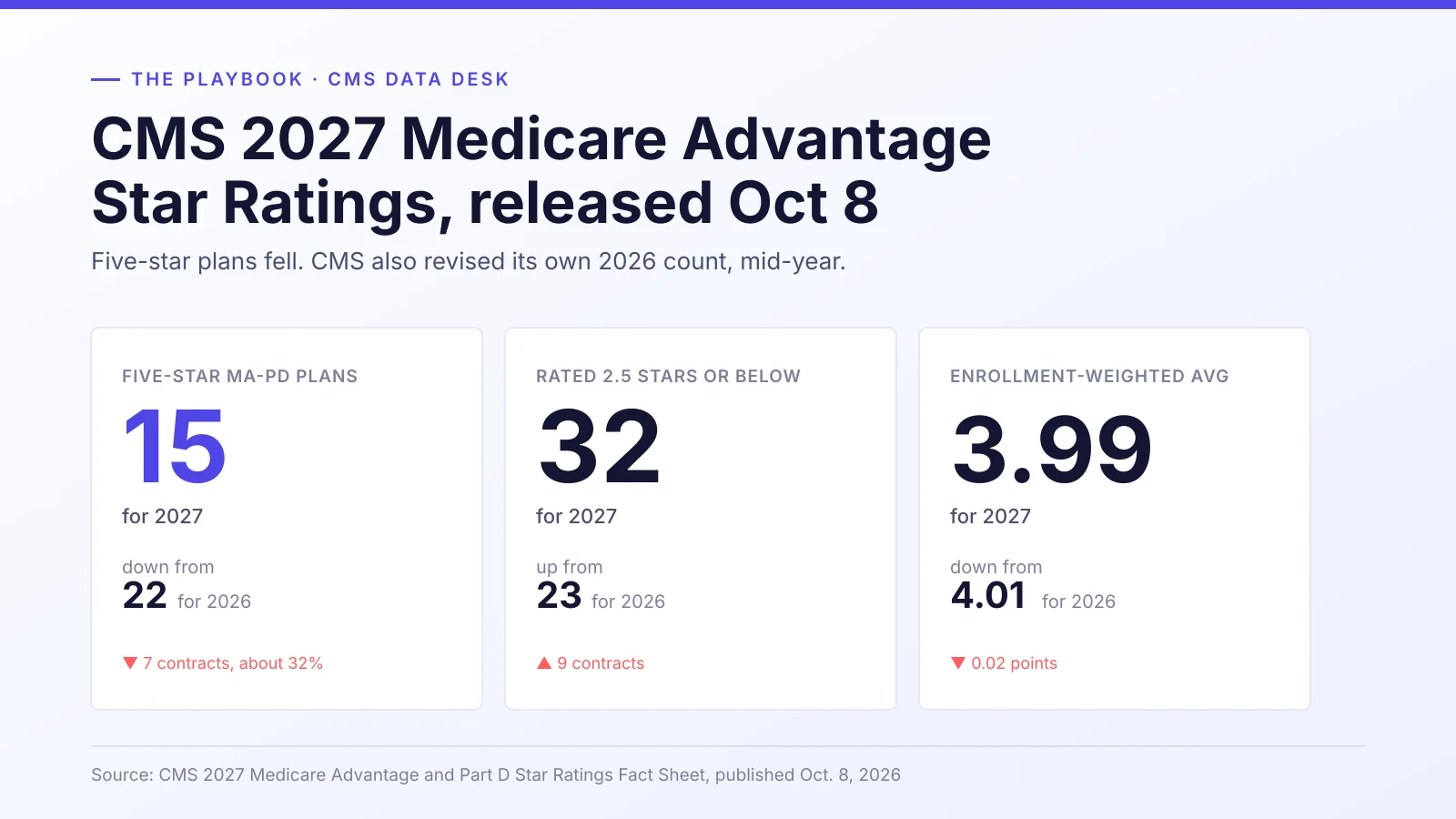
CMS published the 2027 Medicare Advantage and Part D Star Ratings on October 8, 2026. Five-star MA-PD contracts dropped to 15, down from the 22 CMS now lists for 2026 in the same comparison table.1 Thirty-two contracts rated 2.5 stars or below, up from 23.1 The stranger fact: CMS's own published five-star count for 2026 wasn't 22 when CMS first published it. It was 18, in a fact sheet dated November 18, 2025.2 CMS revised its own number for an already-published plan year after a mid-year update. If a federal agency's own figure can move under a page that already shipped, a star-rating sentence sitting untouched on your site since last AEP is not a safe assumption anymore.
What CMS actually released on October 8
Every October, a week or so before the Annual Election Period opens, CMS recalculates the Star Ratings for every Medicare Advantage and Part D contract in the program and posts them to the Medicare Plan Finder. This year that happened on October 8, 2026, one week ahead of AEP's October 15 start, and the ratings now showing for 2027 will run through plan selections made between October 15 and December 7, 2026.1 They'll also set 2028 quality bonus payments for the plans themselves, which is a separate story for plan sponsors and not the one this guide is about.1
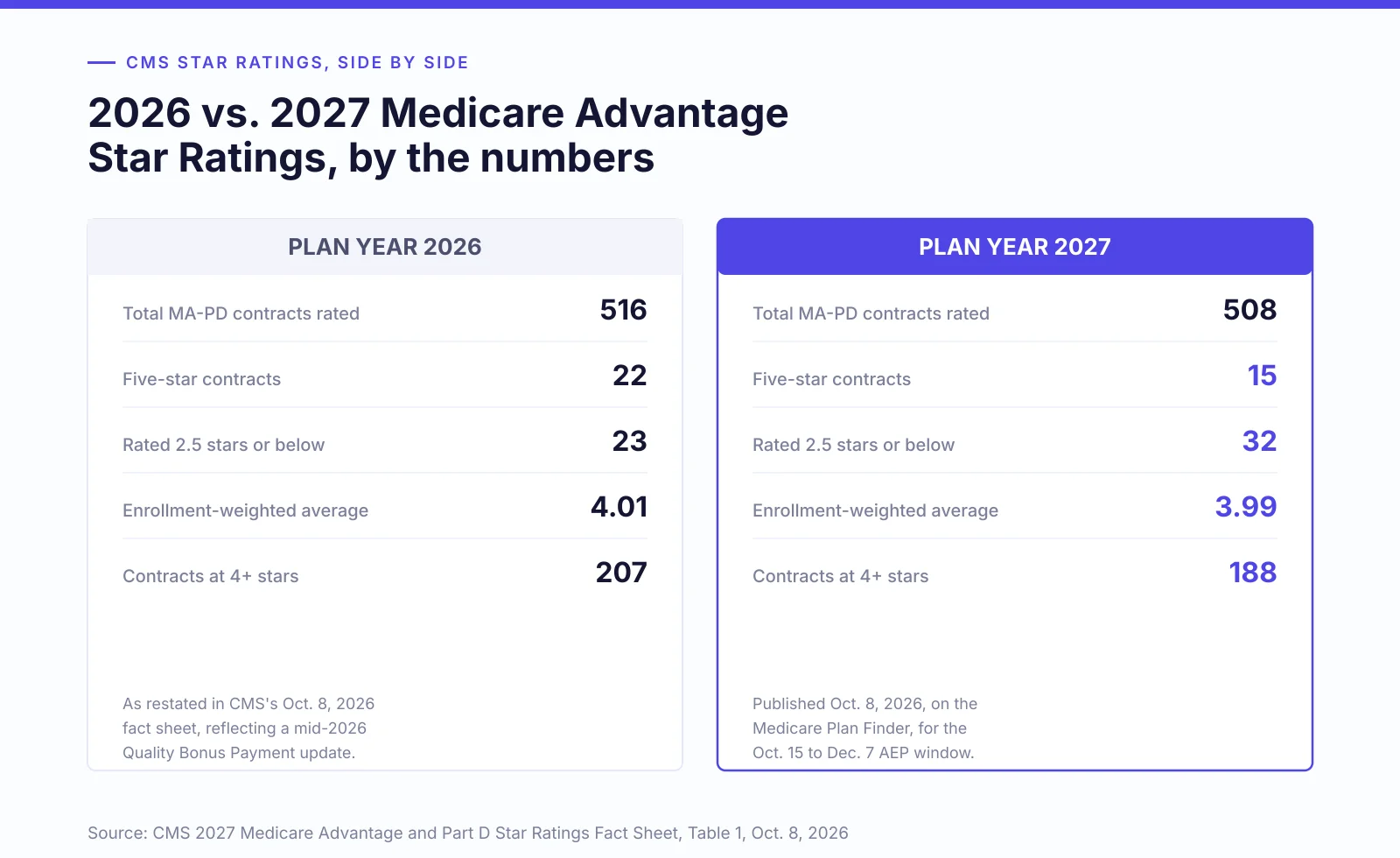
The headline number is a cut. Of 508 MA-PD contracts rated for 2027, 15 earned five stars.1 In the same fact sheet's own historical table, CMS lists 22 five-star MA-PD contracts for 2026, which makes the year-over-year drop look like 7 contracts, down about 32%.1 On the other end of the scale, 32 MA-PD contracts rated 2.5 stars or below for 2027, up from 23 the year before, and the enrollment-weighted average overall rating across every MA-PD contract slipped from 4.01 to 3.99.1
15
MA-PD contracts earned five stars for 2027, out of 508 rated1
32
MA-PD contracts rated 2.5 stars or below for 2027, up from 23 in 20261
3.99
Enrollment-weighted average MA-PD rating for 2027, down from 4.011
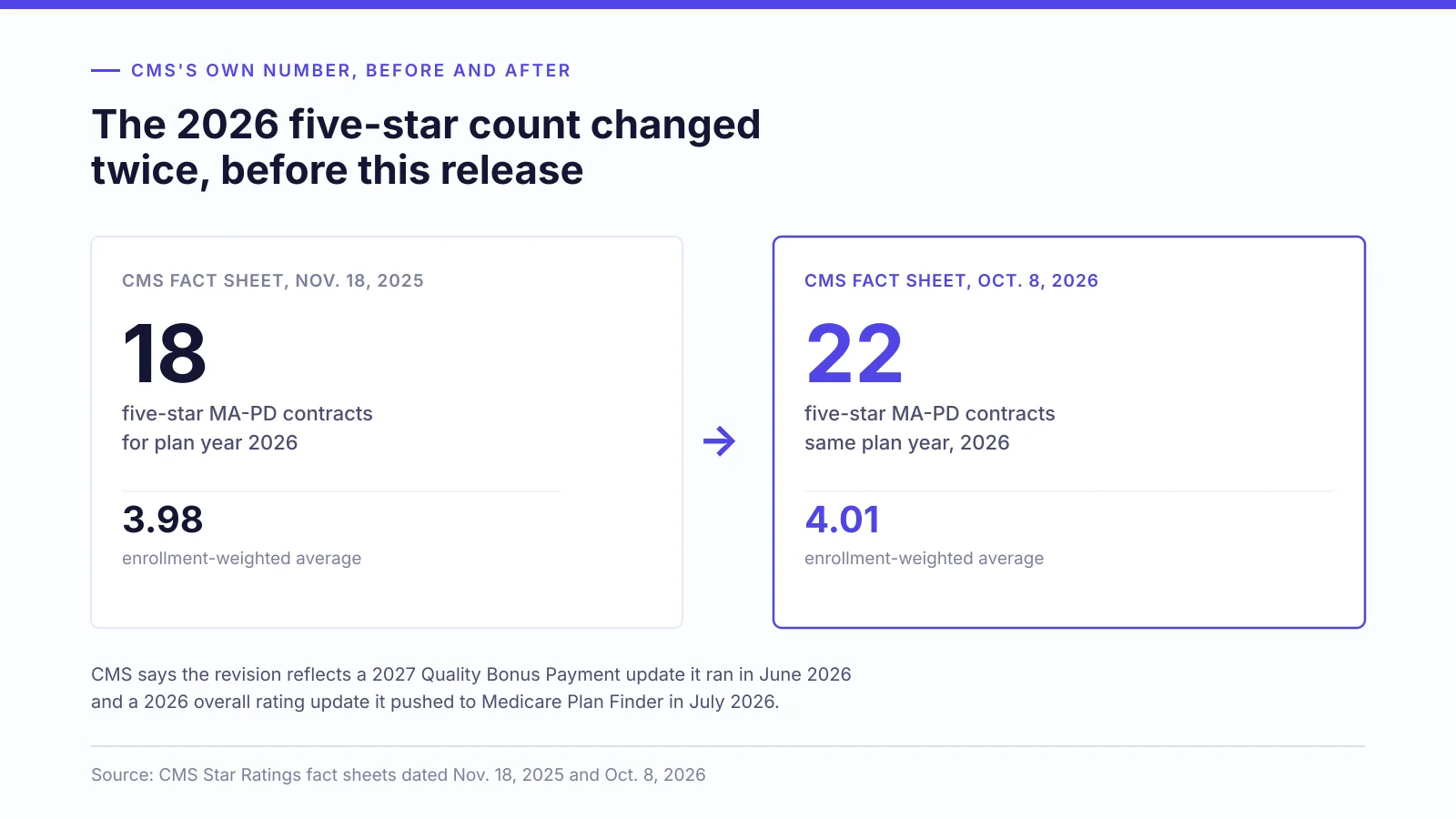
18 → 22
CMS's own published five-star count for 2026, before and after a mid-year revision12
None of that is unusual on its own. CMS recalculates cut points, the performance thresholds for each star level, every year based on how the whole program performed, and it says plainly that "changes in Star Ratings year-over-year are normal and expected and vary by measure."1 A plan can hold its care quality completely flat and still move a half star because the rest of the field improved faster, or because CMS reweighted what counts. What's less normal, and worth sitting with before you get to the part where this affects your website, is what CMS's own number for last year did in the meantime.
CMS's own 2026 number changed twice
Pull the fact sheet CMS actually published for the 2026 Star Ratings, dated November 18, 2025, and its Table 1 shows 18 MA-PD contracts rated five stars out of 516 total, with a 3.98 enrollment-weighted average overall rating.2 Roughly 40% of MA-PDs, 207 contracts, earned four stars or higher for 2026, and about 64% of MA-PD enrollees were weighted into those four-plus-star contracts.2 That was the number every agent, every plan comparison page, and every AI assistant summarizing "2026 five-star Medicare Advantage plans" had to work with for most of the past year.
Now open the fact sheet CMS published eleven months later, on October 8, 2026, for the 2027 ratings. Its own Table 1 restates 2026 at 22 five-star MA-PD contracts and a 4.01 average.1 That's not a typo and it's not a different data pull by a different team. CMS explains it directly in the same paragraph: "the 2026 overall rating data reflect the updates for MA contracts that had their 2027 Quality Bonus Payment rating updated in June 2026 and their 2026 overall rating updated in Medicare Plan Finder in July 2026."1 CMS ran a mid-year correction on a plan year it had already published, rated, and let agents sell against for months, and the correction moved the headline five-star count up by four contracts and the average up three hundredths of a point.
Two CMS documents, two different 2026 numbers
The 18-contract figure comes from CMS's own November 18, 2025 fact sheet for the 2026 Star Ratings, the one published alongside the original October 9, 2025 Plan Finder release.2 The 22-contract figure comes from CMS's own October 8, 2026 fact sheet for the 2027 ratings, which restates 2026 in its comparison table using the post-revision data.1 Both are primary CMS documents. Both are correct for the moment they were published. Only one of them is what a page written in November 2025 and never revisited is still quoting.
This is the detail most coverage of the 2027 release skips, because most coverage of a Star Ratings release is written to answer "what changed this year," not "how stable is the number I already published." For an agent, the second question is the one that actually matters. If the federal source of record for a star rating can revise its own figure for a plan year that's already live, mid-cycle, with no announcement beyond a footnote in next year's fact sheet, then treating a star rating you published once as permanently true is a bet you're taking without realizing you're taking it.
Why a plan's rating moves without changing
Three separate mechanisms drive a star rating up or down in a given year, and an agent doesn't need to memorize CMS's full Technical Notes to understand the shape of each one.
Cut points move every year. For each of up to 43 quality and performance measures a MA-PD contract is rated on, CMS sets a threshold, called a cut point, that determines whether a given score earns one star or five.1 Those cut points are recalculated annually based on how the whole program performed during the measurement period, which CMS describes as "the cut points are recalculated each year based on performance during the measurement period."1 A plan can hold the exact same raw performance on a measure and still drop a star if the rest of the industry got better around it, because the bar moved, not the plan.
Measures get added, retired, and reweighted. For 2027, CMS added two entirely new measures: Concurrent Use of Opioids and Benzodiazepines, and Polypharmacy: Use of Multiple Anticholinergic Medications in Older Adults, both weighted at one.1 It also tripled the weight of two existing measures, Improving or Maintaining Physical Health and Improving or Maintaining Mental Health, from a weight of one in 2026 to a weight of three in 2027, following what CMS calls "a substantive measure specification change."1 A measure that carries three times the weight it carried last year can move a contract's overall rating on its own, independent of anything else in the plan's performance.
Mid-year corrections happen, and they land quietly. That's the mechanism behind the 18-to-22 revision covered above: a 2027 Quality Bonus Payment update CMS ran in June 2026, and a 2026 overall rating refresh it pushed to Medicare Plan Finder in July 2026.1 Neither of those events generated the kind of press coverage the October release gets. They happened inside a plan year that had already been live for half the year, to a dataset most agency sites had already stopped checking.
| Change | What it means for a rating |
|---|---|
| Two new Part D safety measures | Concurrent Use of Opioids and Benzodiazepines (COB) and Polypharmacy: Use of Multiple Anticholinergic Medications in Older Adults (Poly-ACH) enter the ratings for the first time, each weighted at one1 |
| Physical and mental health measures tripled in weight | Improving or Maintaining Physical Health and Improving or Maintaining Mental Health move from a weight of one to a weight of three, after a substantive specification change1 |
| Two measures return after respecification | Care for Older Adults, Functional Status Assessment, and a respecified Colorectal Cancer Screening measure replacing the legacy version, both weighted at one1 |
| Two measures retired | Care for Older Adults, Pain Assessment, and Medication Reconciliation Post-Discharge no longer count toward the overall rating1 |
| MTM completion rate moved to display, returns 2029 | The Part D Medication Therapy Management measure sat on CMS's display page for measurement years 2025 and 2026 and comes back into the Star Ratings for measurement year 2027, reflected in the 2029 release1 |
| New appeals data integrity check | CMS began cross-checking Independent Review Entity data against Part C Reporting Requirements data, with scaled rating reductions where it finds a gap1 |
The full 2024 to 2027 picture
Looking at one year in isolation makes the swing from 2026 to 2027 look sharper than the broader trend actually is. CMS's own Table 1 covers four plan years in one place, and the five-star count has swung in both directions before: 38 contracts in 2024, down to just 9 in 2025, up to 22 in the revised 2026 figure, now down to 15 for 2027.1 None of those moves are small, and none of them read as a steady trend in either direction. That volatility is itself the point: a single year's rating, cited without the year attached, tells a reader almost nothing about how stable it is.
| Rating band | 2024 | 2025 | 2026 | 2027 |
|---|---|---|---|---|
| 5 stars | 38 | 9 | 22 | 15 |
| 4 to 4.5 stars | 204 | 205 | 207 | 173 |
| 3 to 3.5 stars | 267 | 285 | 264 | 288 |
| 2 to 2.5 stars | 36 | 22 | 23 | 32 |
| Total rated contracts | 545 | 521 | 516 | 508 |
| Enrollment-weighted average | 4.07 | 3.95 | 4.01 | 3.99 |
2026 figures shown as restated in CMS's October 8, 2026 fact sheet. Source: CMS 2027 Medicare Advantage and Part D Star Ratings Fact Sheet, Table 1.1
Standalone Part D plans tell a slightly different story worth a sentence, since some agencies write both lines. For 2027, zero PDP contracts earned five stars, down from 2 in 2026, 2025, and 2024, and 12 of 41 rated PDPs fell at or below 2.5 stars.1 But the enrollment-weighted Part D average actually rose, from 3.01 in 2026 to 3.22 in 2027, and the share of PDP enrollees in four-plus-star contracts jumped from about 2% to about 22%.1 MA-PD quality dipped slightly this year. Standalone Part D quality, weighted by where people actually enrolled, improved. A page that only tracks one of the two is only telling half the story for an agency that writes both.
What a stale claim actually costs you
None of this is abstract once you connect it to what's actually sitting on an agency website right now. Picture the sentence a lot of county-level Medicare pages have carried since last AEP: "We offer [Carrier]'s 5-star rated plan, the highest rating available." If that sentence was written against the 2026 ratings and never revisited, it's now wrong in one of two directions. Either the plan dropped out of five stars entirely for 2027, in which case the claim is simply false, or it held five stars and the page is still citing 2026 data for a reader comparing 2027 options during AEP that opened October 15.
The compliance exposure here is narrower than the superlative-claim rule this blog covered in an earlier guide, because a specific star rating isn't a vague adjective like "best" or "top."3 It's a factual claim with a correct answer for a given plan and plan year, and CMS's general ban on misleading or confusing marketing material was never tied to the documentation requirement that rule loosened. A wrong star rating is a wrong fact on a page a prospect is reading to make an enrollment decision during the exact window, October 15 to December 7, when that decision gets made.
There's also a real business reason to get this specific fact right that has nothing to do with compliance. KFF's Medicare FAQ, published October 9, 2026, describes a Special Enrollment Period that lets a Medicare beneficiary switch to an available five-star Medicare Advantage or Part D plan in their area, usable once between December 8 and November 30 of the following year.4 That's an enrollment opportunity outside the normal AEP and lock-in rules, and it only works if the plan a prospect reads about on your site is actually the one holding five stars this year. A stale claim doesn't just risk being wrong. It risks quietly costing you the one piece of information that would have told a prospect they had an extra door open.
The part worth sitting with
CMS revised its own five-star count for 2026, a plan year that had already been live for months, by four contracts. If the federal agency that sets the rating can't guarantee its own number stays fixed for a plan year already in progress, a page that states a star rating with no date attached to it was never going to age well, regardless of how carefully it was written the day it was published.
A real audit of your own site
This takes under fifteen minutes and needs nothing but your own site's search function and the CMS fact sheet linked in the sources below.
First, find every page that names a star rating. Search your own site for "star," "5-star," "rated," and the name of any specific plan or carrier you write often. Check county and city landing pages first, they're where this claim tends to live longest between revisions, along with any comparison chart, PDF rate sheet, or seasonal AEP page built fast and not touched since.
Second, check the rating against CMS's current table, not your memory of it. CMS's 2027 fact sheet and Medicare Plan Finder are both live right now.1 A plan's contract ID doesn't change year to year even when its star rating does, so look the specific contract up rather than assuming a rating carried over.
Third, attach the plan year to every rating you publish. "5-star rated" with nothing else is a claim with an invisible expiration date. "The only 5-star-rated Medicare Advantage plan available in [county] for 2027, per CMS's October 2026 Star Ratings release" is a claim a reader, a regulator, or an AI assistant can all verify against the same public document.
Fourth, update your page's dateModified when you update the claim. Google's own documentation on Article structured data describes dateModified as something you add "if you want to provide more accurate date information to Google," separate from datePublished.5 A page that updates its star-rating sentence in October but leaves a dateModified timestamp from the prior AEP is sending a crawler the same mixed signal a reader would get from the two different numbers.
The claim nobody revisits
- "We offer the area's 5-star rated Medicare Advantage plan"
- No plan year stated
- No source, no contract ID, nothing to check it against
- Page's dateModified untouched since last AEP
RiskWrong the moment the rating changes, with no signal that it did
The claim that survives a fact-check
- "[Carrier]'s Plan [ID] holds a 5-star rating for 2027, per CMS's October 2026 release"
- Plan year named in the sentence itself
- Source and date a reader or a model can independently verify
- dateModified updated the same week the claim was checked
RiskCorrect until CMS's next release, and clearly dated so staleness is visible
Not sure where to start
If you'd rather have this checked than hunt for it yourself, the free Audit scores your site's sourcing, schema, and AI citation readiness in about a minute, no login required.
How we keep this current for you
This is the same thing every guide on this blog argues for applied to our own build: a figure doesn't go on a page unless it's sourced, dated, and current, and we re-checked our own pricing before writing this so we weren't about to repeat the mistake this guide is warning against.
Digital Foundation's Starter tier runs $247 a month and ships 7 new pages a month, 2 blog posts, 2 location pages, 2 answer pages, and 1 custom page, alongside the full 60-point SEO/AEO checklist.6 Pro runs $497 a month and adds up to 15 to 18 new pages a month across blog, location, and answer content, plus a 24/7 AI voice receptionist.6 Scale runs $997 a month and ships up to 76 new pages a month, roughly one blog post, one location page, and one answer page every business day.6 Every plan except the one-time Full Clone includes a 14-day free look before billing starts.6
The reason that matters for a guide about a number that moves every October: a county or plan comparison page we ship isn't a one-time publish. It's a page that gets revisited on the same cadence CMS updates the underlying data, with the source and the plan year stated in the text and the dateModified property updated to match, not a static asset nobody looks at again until next AEP forces someone to notice it's wrong.
We build on Astro, which ships zero JavaScript by default, so a page like this one arrives as finished HTML rather than a runtime the browser has to boot before anything loads.6 Our builds score 90+ on Lighthouse performance on both mobile and desktop, and some score 100, which matters here for a plain reason: a plan comparison page a prospect can't load fast enough on a phone during AEP never gets read closely enough for an accurate star rating to matter in the first place.
What changes for your agency
This doesn't promise a ranking position, a citation, or a specific enrollment outcome, because none of those can be promised honestly. What it changes is narrower and more concrete.
A rating claim that's current, not inherited
Every star rating on your site tied to the plan year it actually applies to, checked against CMS's current release instead of carried over from last AEP.
One fewer annual fire drill
You don't have to remember to re-check every county page in the week before AEP opens. The cadence does it on schedule every year.
A page a reader or a model can verify
A specific, sourced, dated claim is the shape of fact an AI assistant can check and cite. "5-star rated" with no year attached isn't.
A dateModified that tells the truth
Schema and visible content move together, so a crawler and a reader get the same answer about how current the page actually is.
The underlying lesson here isn't really about Star Ratings specifically. It's that federal data you treat as a fixed, one-time fact can move under you, sometimes within the same plan year, with nothing louder than a footnote to announce it. CMS just did that to its own 2026 numbers. The only real defense is a page that gets looked at again on a real schedule, not a page that's technically correct the day it ships and silently wrong every day after.
Questions agents ask
What changed in the 2027 Medicare Advantage Star Ratings?
CMS published the 2027 Star Ratings on the Medicare Plan Finder on October 8, 2026. Fifteen MA-PD contracts earned five stars, down from the 22 contracts CMS now lists for 2026 in the same comparison table. Thirty-two MA-PD contracts rated 2.5 stars or below, up from 23. The enrollment-weighted average MA-PD rating slipped from 4.01 to 3.99. CMS also added two new Part D safety measures and tripled the weight of two existing measures, which is part of why individual plans moved even without changing anything about the care they deliver.
Why did CMS's own count of 2026 five-star plans change from 18 to 22?
CMS first published the 2026 Star Ratings on November 18, 2025, listing 18 five-star MA-PD contracts out of 516 rated, with a 3.98 enrollment-weighted average. The 2027 fact sheet, published October 8, 2026, restates 2026 at 22 five-star contracts and a 4.01 average, and explains why in a footnote: those figures reflect a 2027 Quality Bonus Payment rating update CMS ran in June 2026 and a 2026 overall rating update it pushed to Medicare Plan Finder in July 2026. The underlying plan year didn't change. CMS's own published number for it did, twice, within the same year.
How many Medicare Advantage plans are rated 2.5 stars or below for 2027?
Thirty-two MA-PD contracts, per CMS's 2027 Star Ratings fact sheet: 31 at 2.5 stars and 1 at 2 stars. That's up from 23 in 2026 (21 at 2.5 stars, 2 at 2 stars), a figure that matches in both the original November 2025 fact sheet and the October 2026 restatement. Four MA-PD contracts carry CMS's low-performing icon for 2027, the same number as 2026.
Does a plan's star rating affect when someone can enroll?
Yes, separate from the Annual Election Period. KFF's Medicare FAQ, published October 9, 2026, describes a Special Enrollment Period that lets a Medicare beneficiary switch into an available five-star Medicare Advantage or Part D plan in their area, usable once between December 8 and November 30 of the following year. A page that names which plan in a county actually holds a five-star rating this year is pointing at something a prospect can act on outside AEP. A page that still names last year's five-star plan is pointing at nothing.
Is a star-rating claim covered by the CMS rule that loosened documentation for superlatives?
Not in the way that matters here. CMS's CY2027 marketing rule, covered in an earlier Playbook guide, dropped the requirement to print supporting documentation on the page for a superlative like "best" or "most." A specific star rating isn't a superlative, it's a fact with a right and wrong answer for a given plan and plan year. That rule change doesn't touch whether the fact you published is still true. Only CMS's annual re-rating does that, and it just ran.
How often should an agency update star-rating claims on its website?
At minimum, once a year, within days of CMS's October release, since that's when the number a reader or an AI assistant would otherwise fact-check against actually changes. The harder lesson from the 18-to-22 revision is that even CMS's own mid-year updates can move a figure for a plan year you already published. A page that states the plan year the rating applies to and the date you last checked it is more defensible than one that doesn't, regardless of how often you re-check.
What's the difference between the Star Ratings release date and a website's dateModified?
The Star Ratings release date is when CMS published the data. dateModified is a property in Article structured data that, per Google's own documentation, you add "if you want to provide more accurate date information to Google" about when a page last changed. The two should move together. A blog post or plan comparison page that cites 2027 Star Ratings but carries a dateModified from AEP 2025 is telling both a reader and a crawler two different things about how current the page is.
Sources
- Centers for Medicare & Medicaid Services. "2027 Medicare Advantage and Part D Star Ratings," Fact Sheet: 508 MA-PD contracts rated, 15 five-star contracts, 32 at 2.5 stars or below, 3.99 enrollment-weighted average; Table 1 restates 2026 at 22 five-star contracts and a 4.01 average, with the footnote "the 2026 overall rating data reflect the updates for MA contracts that had their 2027 Quality Bonus Payment rating updated in June 2026 and their 2026 overall rating updated in Medicare Plan Finder in July 2026"; also covers the 2027 methodology changes, Part D (PDP) distribution, five-star and low-performing icon counts, and tax-status breakdown. Published October 8, 2026. Fetched live October 18, 2026. cms.gov/files/document/fact-sheet-2027-ma-part-d-star-ratings-october-8-2026.pdf.
- Centers for Medicare & Medicaid Services. "2026 Medicare Advantage and Part D Star Ratings," Fact Sheet: original 2026 release, 516 MA-PD contracts rated, 18 five-star contracts (3.98 enrollment-weighted average), 23 contracts at 2.5 stars or below, 207 contracts (about 40%) at four stars or higher, about 64% of enrollees in four-plus-star contracts, 4 contracts carrying the low-performing icon. Published November 18, 2025. Fetched live October 18, 2026. cms.gov/files/document/2026-star-ratings-fact-sheet.pdf.
- Strategic AI Architects, The Playbook. "CMS Just Let You Call Your Plan 'The Best' Again": covers the CY2027 rule change that dropped the on-page documentation requirement for superlative marketing claims, and why that rule doesn't extend to a specific, factual claim like a star rating. Published October 17, 2026. strategicaiarchitects.com/post/medicare-best-plan-claim-rule-2027.
- KFF. "Can I switch from my current Medicare Advantage or Medicare Part D plan to a plan with a 5-star quality rating in my area outside the Open Enrollment Period?": describes the Five-Star Special Enrollment Period, usable once between December 8 and November 30 of the following year. Published October 9, 2026. Fetched live October 18, 2026. kff.org/faqs/medicare-open-enrollment-faqs.
- Google Search Central. "Article (BlogPosting, NewsArticle, Article) structured data": defines dateModified as "the date and time the article was most recently modified" and states you add it "if you want to provide more accurate date information to Google," separate from datePublished. Verified live October 18, 2026. developers.google.com/search/docs/appearance/structured-data/article.
- Strategic AI Architects. Digital Foundation service page: Starter $247/mo (7 pages/mo: 2 blog, 2 location, 2 answer, 1 custom), Pro $497/mo (15 to 18 pages/mo plus a 24/7 AI voice receptionist), Scale $997/mo (up to 76 pages/mo, one of each page type per business day), all subscription tiers include a 14-day free look and the 60-point SEO/AEO checklist. Verified live October 18, 2026. strategicaiarchitects.com/digital-foundation.
Talk it through
Want a second pair of eyes on it?
Free 30 minutes. Bring what you found, or bring nothing and we will look together at how AI engines read your site and which fixes move first.
See whether your own star-rating claims are still current
Run a free Audit and see how your site scores for sourcing, freshness, and AI citation readiness, in about a minute.
Related reading: CMS just let you call your plan "the best" again · 10.6 million Medicare Advantage members are in plans rated below 4 stars · Your insurance website is behind on 2027 plan data