Playbook
The Medicare Drug Cost Cap Just Jumped to $2,400 for 2027
CMS finalized the 2027 numbers back in April. Medicare's Annual Enrollment Period opens October 15. Most agency websites still show whatever was true the day they were built.

18 min read
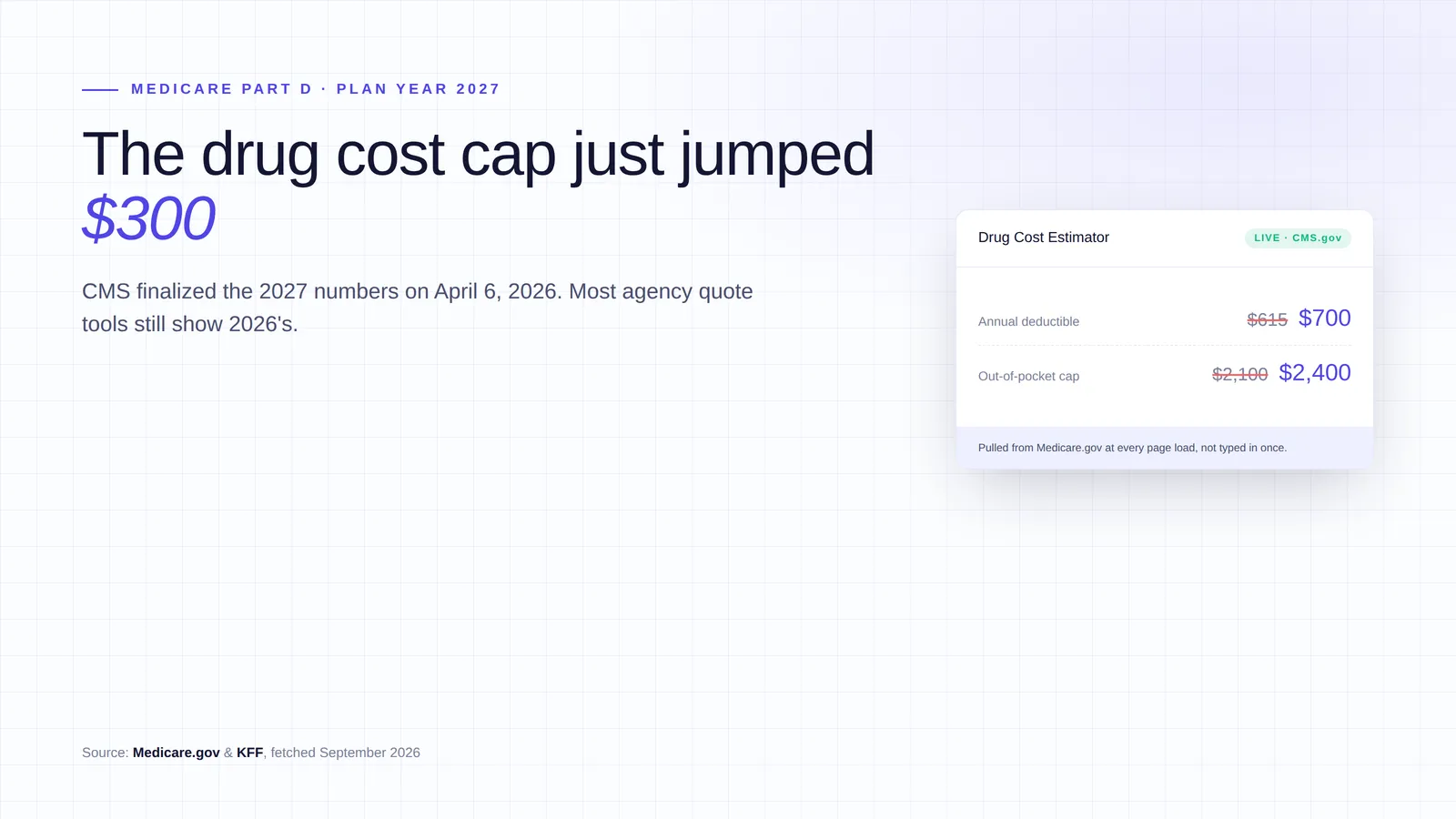
CMS finalized the 2027 Part D deductible at $700 and the out-of-pocket cap at $2,400, up from $615 and $2,100 for 202612. That is a 14 percent jump in the number that answers "what will I actually pay for my drugs," landing right as Medicare's Annual Enrollment Period opens October 154. A static calculator or PDF built with last year's figures gives a wrong answer on the first day it matters most. A live tool wired to the current CMS parameters does not.
What actually changed for 2027
Every year, the Centers for Medicare & Medicaid Services sets new numbers for the Part D defined standard benefit, the deductible a beneficiary pays before coverage starts sharing costs, and the out-of-pocket threshold where catastrophic coverage takes over and the plan covers the rest of the year at no further charge. For 2027, Medicare.gov states plainly that no Part D plan may set a deductible above $700, and that beneficiaries reach catastrophic coverage once their out-of-pocket spending on covered drugs hits $2,4001.
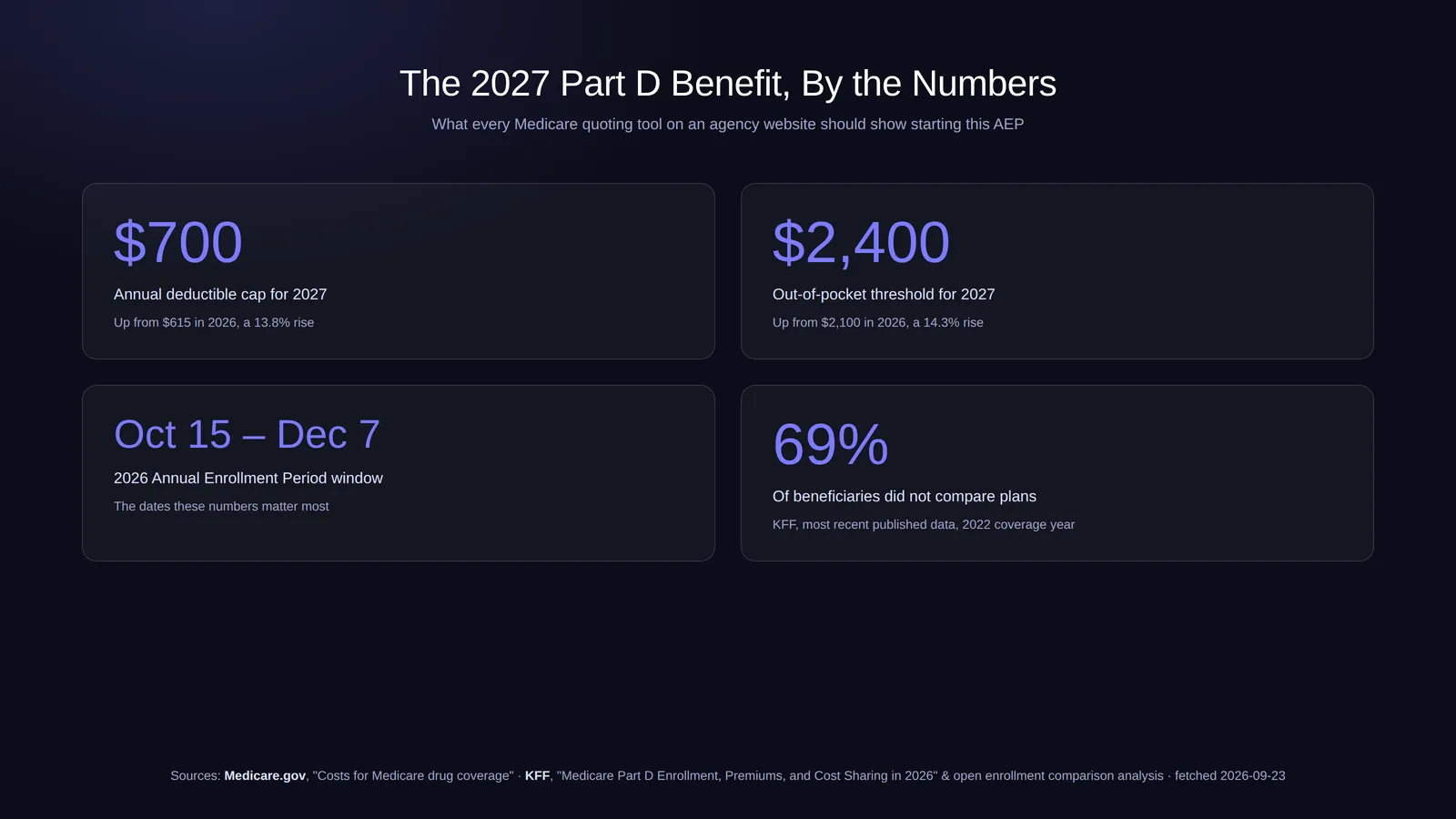
Compare that to what KFF documented for 2026, published in its June 2026 Part D enrollment and cost sharing analysis: a standard deductible of $615 and an annual out-of-pocket cap of $2,1002. Run the math and the deductible rose 13.8 percent, and the out-of-pocket cap rose 14.3 percent, in a single plan year. CMS finalized these 2027 figures in its Medicare Advantage and Part D rate announcement on April 6, 20263, five months before this guide was written and roughly six months before most Medicare agencies will see their first real traffic asking about it.
| Parameter | 2026 | 2027 | Change |
|---|---|---|---|
| Annual deductible cap | $615 | $700 | +13.8% |
| Out-of-pocket threshold | $2,100 | $2,400 | +14.3% |
Sources: Medicare.gov, "Costs for Medicare drug coverage"1; KFF, "Medicare Part D Enrollment, Premiums, and Cost Sharing in 2026"2. Fetched 2026-09-23.
Sources: Medicare.gov, "Costs for Medicare drug coverage," and KFF, "Medicare Part D Enrollment, Premiums, and Cost Sharing in 2026." Fetched 2026-09-23.
A $300 swing in the out-of-pocket cap is not a rounding error for the person asking about it. It is the number a client with a specialty prescription uses to decide whether to switch plans, whether to budget for a January that hits harder than December did, or whether to call you instead of guessing. Get it wrong on your own website and the first thing a careful prospect learns about your agency is that your numbers cannot be trusted.
The cap does not work in isolation, and a website that only quotes the two headline numbers is telling half the story. Medicare.gov lays out three phases. First, the deductible phase, where a beneficiary pays the full cost of covered drugs up to $700 in 2027. Second, the initial coverage phase, where the beneficiary pays 25 percent coinsurance on covered generic and brand-name drugs, a flat percentage that holds for every plan under the defined standard benefit, until out-of-pocket spending reaches the $2,400 threshold1. Third, catastrophic coverage, where the beneficiary owes nothing further on covered Part D drugs for the rest of the calendar year1. A tool that shows the cap without the 25 percent coinsurance step in between is technically not wrong, but it is incomplete in a way that makes a client's monthly budget hard to plan.
Premiums move on a separate track from the deductible and the cap, and it is worth knowing the difference so you do not conflate the two in front of a client. CMS's preliminary 2027 Part D bid information puts the national base beneficiary premium at $41.338, a figure carriers use as an input to set their own plan premiums, not a number any individual beneficiary pays directly. A client asking "how much will my plan cost" is usually asking about premium. A client asking "how much will I actually pay at the pharmacy" is asking about the deductible and the cap. A good cost tool keeps those two questions visibly separate, because collapsing them into one number is its own way of misleading someone, even with figures that are individually correct.
There is also a newer wrinkle worth putting on the same page as the cap, because the two questions arrive together in a client's mind: the Medicare Prescription Payment Plan. It is a voluntary option, available through every Part D and MA-PD plan, that lets a beneficiary spread what they would have paid at the pharmacy across the rest of the calendar year in monthly bills from the plan instead7. Medicare's own program page is explicit about what it is not: "This payment option might help you manage your monthly expenses, but it doesn't save you money or lower your drug costs"7. It changes the timing of a bill, not the size of it, and a website that mentions the option without that caveat sets up a conversation you will have to walk back later.
Before you keep reading
If you want to know whether your own site is showing current figures anywhere, the free Audit checks your AEO readiness in about a minute. strategicaiarchitects.com/audit
Why agency websites get this wrong
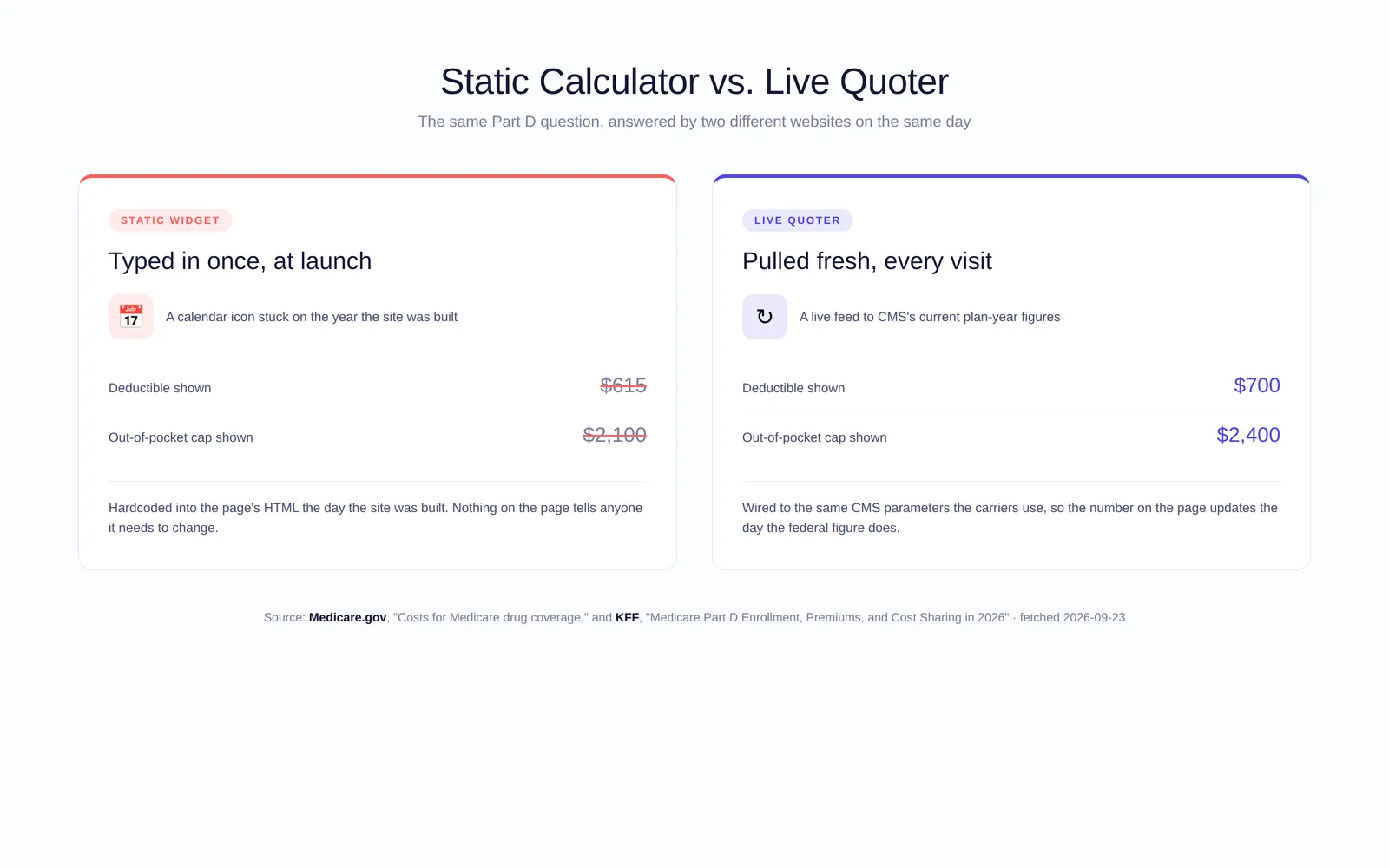
Nobody builds a stale calculator on purpose. It happens because of how most agency websites get built in the first place, and the mechanism is simple enough to explain in one sentence: the number got typed into the page once, at launch, and nothing about the page ever asks anyone to check it again.
Picture the two most common ways a Medicare cost figure ends up on an agency site. The first is a developer or a template hand-writes the deductible and the out-of-pocket cap directly into the page's HTML, the same way you would type a phone number or an address. The second is the number lives inside a linked PDF, a rate sheet or a "what you'll pay" flyer, uploaded once and never revisited. In both cases, the figure is now frozen at whatever it was true the day someone hit publish. CMS can announce new parameters every April3, and nothing on the page reacts to that announcement, because nothing on the page is connected to it.
This is not a competence problem. It is an architecture problem. A pretty quote form with hardcoded numbers looks identical to a live one until the year rolls over, and most agencies have no reason to think about the difference until a client points out that the "you'll pay" figure on the website does not match what their pharmacy just charged them.
It gets worse on a page-builder platform. A GoHighLevel funnel page, a WordPress theme, or a Wix or Squarespace template stores its content inside an editor, not in a file a developer can search and fix in one pass. Updating a cost figure means logging into the admin panel, finding the specific block or module that holds the number, editing it, and republishing, on every page that repeats it. On a static site built from one shared config, that same fix is one line, one place, and every page inherits it the next time the site builds. The gap is not about which platform looks nicer. It is about how many separate places a number has to be found and corrected in.
Typed in once, at launch
- Deductible and cap hardcoded into the page's HTML or a linked PDF
- No date stamp tying the number to a specific plan year
- Correct the day it launched, wrong the moment CMS updates the parameters
- Fixing it means finding and editing every page that quotes it, by hand
ShowsWhatever was true on build day
Pulled from one source of truth
- Deductible and cap held in one config or data feed the whole site reads from
- Tied explicitly to the current plan year, visibly labeled
- Updates once, correctly, the moment CMS publishes new parameters
- Every page referencing the figure inherits the fix automatically
ShowsWhat is true right now
What a wrong number actually costs
The direct cost is trust, and trust is the entire product in an insurance sales conversation. A prospect who catches your website quoting last year's out-of-pocket cap does not think "small mistake." They think "what else on this site is out of date," and that question follows them into the phone call, if they still make the phone call at all.
There is a behavioral cost layered on top of that. KFF's most recently published analysis of Medicare open enrollment behavior, covering the 2022 coverage year, found that nearly 7 in 10 beneficiaries, 69 percent, did not compare their coverage against other options during open enrollment5. Most people are not shopping carefully. The minority who do shop, who actually pull up a cost calculator and read the numbers, are disproportionately the clients paying the most attention to their plan, often because they have a specialty drug or a chronic condition driving real dollars through the benefit. Those are exactly the clients most likely to notice when your number is wrong, and exactly the clients whose business is worth the most to keep.
Put it in a concrete afternoon. A prospect finds your site in late October, types a drug name into your cost estimator, and gets back an out-of-pocket figure built on the $2,100 threshold instead of the actual $2,400 one. They also pull up their current carrier's member portal, which shows the correct 2027 number, because the carrier's own system is wired to CMS parameters as a matter of licensing and compliance, not as a nice-to-have. Your number is now visibly wrong next to a number that is visibly right, on the same screen, in the same sitting. That is not a lead you lost to a competitor's pitch. It is a lead you lost to your own website.
Then there is the compliance angle, which is smaller here than on a subsidy calculator but not zero. CMS marketing guidance expects Medicare Advantage and Part D materials to be accurate and not misleading about plan costs. A stale deductible figure is an accuracy problem before it is anything else, and "the website vendor never updated it" is not a defense a client, or a regulator, is required to accept.
$300
Rise in the out-of-pocket cap for 202712
14%
Increase in the out-of-pocket cap, year over year
Oct 15
When AEP opens and the traffic starts4
69%
Of beneficiaries who did not comparison shop, 2022 data5
How to check what your site shows right now
You do not need a developer to find out whether your own site has this problem. It takes about five minutes and works on any page that quotes a Medicare drug cost figure.
The five minute check
- Open any page on your site that mentions a Part D deductible or an out-of-pocket cap.
- Right-click and choose "View Page Source," then search (Ctrl+F or Cmd+F) for "615" and "2,100," last year's figures.
- If either number appears directly in the HTML, it is hardcoded. It will not update on its own.
- Check any linked PDF, rate sheet, or "what you'll pay" flyer for a date. If it says 2025 or 2026, it needs replacing, not just relabeling.
- Ask whether the number changing requires CMS to publish new parameters, or a developer to edit and redeploy your site. If it is the second one, plan on that redeploy happening every year, on a deadline you control, before AEP.
One more check is worth the extra ninety seconds. Paste your own page's URL into the Wayback Machine at web.archive.org and pull up a snapshot from a year ago. If last year's snapshot shows the exact same numbers your page shows today, the figure has not moved in at least a year, on a benefit whose parameters change every single year. That is proof, not a guess, that the number is disconnected from its source.
If you find the old numbers, the honest fix in the short term is manual: update the page, note the date you did it, and put a recurring reminder on your calendar for next April, when CMS typically finalizes the following year's rate announcement3. That works. It is also exactly the kind of task that gets missed the one year you are busy, which is most years during AEP season, and exactly the kind of task nobody owns once the person who built the original site has moved on or stopped billing hours for small maintenance requests.
How a live quoting tool is actually built
The fix that does not depend on anyone remembering anything is architectural, not procedural. Instead of typing $615 and $2,100 into a dozen different pages, a live tool keeps those numbers in exactly one place, a structured data source the rest of the site reads from. Every page that shows a deductible or an out-of-pocket figure points at that same source instead of carrying its own copy.
On a site built the way we build them, on Astro with static HTML shipped at the edge, that single source is typically a small, versioned configuration keyed to the current CMS plan year, or a lightweight serverless function, what Cloudflare calls a Pages Function, for anything that genuinely needs to be calculated at request time rather than baked in at build time. When CMS updates the Part D parameters, one person updates one value, the site rebuilds, and every page referencing that value is correct within minutes, not whenever someone happens to notice the old number is wrong.
That is a meaningfully different claim than "the website has a calculator on it." A calculator with numbers typed into its own private copy of the config is not meaningfully different from a PDF with a form styled on top of it. The test is not whether a tool exists. It is whether the tool has exactly one place its numbers come from, and whether that place gets touched when the underlying federal figures change.
In practice this comes in three tiers, and which one an agency needs depends on how far past "show the current deductible and cap" the tool needs to go. The simplest tier is a single structured config file, a handful of values keyed to the current plan year, checked into the same codebase as the rest of the site and updated on a fixed annual schedule. It costs almost nothing to build and almost nothing to maintain, and it is enough for a page that states this year's numbers plainly with a source cited. The middle tier adds a small serverless function, a Cloudflare Pages Function in our stack, for anything that needs to combine the plan-year config with something else at request time, a specific drug lookup or a household's existing plan details. The top tier is a genuine calculator wired into a formulary or pricing feed, the kind of build that answers "what will this specific drug cost me on this specific plan," which is a real project with real data licensing questions behind it, not a weekend fix.
Most agency sites do not need the third tier to stop misleading people. They need the first one, done once, done correctly, and left alone until next April.
| Where it lives | Why it goes stale | Fix |
|---|---|---|
| Typed into page HTML | No trigger tells anyone to revisit it | Move the figure into one shared config, referenced everywhere |
| A linked PDF or flyer | Uploaded once, rarely reopened | Regenerate from the same source of truth on a fixed annual schedule |
| A third-party embedded widget | Update cadence is the vendor's problem, not yours, until it is | Confirm in writing when the vendor refreshes plan-year figures |
| A single config or Pages Function | It does not, if someone updates the one value | Calendar reminder tied to CMS's typical April rate announcement |
How we build this into every site
Every site we build on Digital Foundation ships on Astro, which renders pages to static HTML at build time rather than shipping a JavaScript runtime the browser has to boot before content appears. That is the speed story, and it is a separate claim from the freshness story, but they come from the same discipline: build the thing once, correctly, from a single source of truth, instead of hand-maintaining scattered copies.
For a cost figure like the Part D deductible and out-of-pocket cap, that means the number lives in one place tied to the current plan year, not typed into every page that mentions it. When CMS publishes new parameters, we update that one place and rebuild, and the fix reaches every page on the site automatically. That is the same principle behind the sitemap and llms.txt files every Digital Foundation site ships with: they regenerate themselves the moment a page publishes, with the full absolute URL, instead of depending on someone remembering to update a file by hand.
One source of truth
Plan-year figures live in a single config or data feed, never copy-pasted across pages.
Static and fast
Astro ships finished HTML, so the page arrives fast on the phone your prospect is holding.
Sourced on the page
A cost figure cites Medicare.gov or CMS inline, not just "trust us."
Cited by AI
Structured, dated, sourced pages are what an answer engine can lift and attribute.
You can do this yourself
Most of this guide is the actual method, not a teaser for it. If you have a developer or you are comfortable editing your own site, moving a hardcoded number into one shared config is a real, doable fix. Plenty of agents read a guide like this and decide that is exactly what they will do. Either outcome is fine. This section is for the agencies who would rather have it built once and stop thinking about it.
What you get
A cost figure that is correct on the day AEP opens and stays correct without anyone remembering to fix it. Fewer prospects who quietly lose trust in your numbers before they ever call. A page built to cite its source inline, which is the same structure that makes a page easier for an AI answer engine to lift and attribute when someone asks it a Medicare cost question instead of typing it into a search bar.
That last point is worth sitting with. A page that states "$2,400 for 2027, per Medicare.gov" in plain text, with a dated citation and a clean heading structure, is exactly the shape of content an assistant like ChatGPT or Perplexity can lift and attribute when a prospect asks it a Medicare cost question instead of searching for it. A page that hides the same figure inside an image, a PDF, or an uncited form field gives an answer engine nothing to quote. Getting the number right and making it machine-readable are the same project, not two separate ones.
On our live pricing page, Digital Foundation's Starter tier is $247 a month and includes a complete, compliant website built for AI citation from the start. Pro, at $497 a month, adds a weekly blog post and location page plus a 24/7 AI receptionist. Scale, at $997 a month, moves that publishing cadence to daily. All three start with a free, limited setup and a 14 day trial6. A calculator with a genuinely custom shape, tied to your own carrier lineup or a broader quoting workflow, is the kind of project we scope on a call through AI Expert rather than price off a menu.
When this isn't your problem
If your agency writes life, final expense, or P&C business exclusively and never touches Part D, none of this applies to your site. And if you already have a developer who owns your cost figures on a documented annual schedule, and you have confirmed this year's numbers are already correct, you do not need to rebuild anything. This guide is for the more common case: a site that has a cost figure somewhere on it and no clear owner for keeping it current.
What to do before October 15
Whichever path you take, the deadline is the same one CMS sets every year, and it is close. AEP does not ease into traffic. It opens on a fixed date and a meaningful share of a Medicare agency's annual site visits land inside that seven week window, so a page that is wrong on October 15 is wrong for the highest-traffic stretch of the year, not a quiet Tuesday in March. Here is the order that actually gets a site ready before that traffic starts.
| Step | What to do | Why it comes here |
|---|---|---|
| 1 | Run the five minute check above on every page quoting a cost figure | You cannot fix what you have not found |
| 2 | Replace any hardcoded 2026 figure with the 2027 number, dated visibly | The minimum fix, doable today, by anyone |
| 3 | Decide whether the fix is a one-time edit or a structural rebuild | One-time edits repeat every year unless something changes |
| 4 | If structural, move the figure into one shared source referenced sitewide | This is the fix that survives next April without a reminder |
| 5 | Confirm the page states the plan year next to the number | Lets a reader, and an AI system, verify the figure is current |
Questions agents ask
What is the Medicare Part D out-of-pocket cap for 2027?
It is $2,400, per Medicare.gov's published 2027 drug coverage costs. That is the total a beneficiary pays out of pocket on covered Part D drugs before catastrophic coverage kicks in and the plan picks up the rest of the year at no further cost sharing. For 2026 the same threshold is $2,100, per KFF's 2026 Part D cost sharing analysis, so the 2027 figure is a $300 increase.
Why did the Part D cap increase so much for 2027?
CMS adjusts the defined standard benefit parameters, including the deductible and the out-of-pocket threshold, on an annual basis as part of its Medicare Advantage and Part D rate announcement, which it finalized for calendar year 2027 on April 6, 2026. The deductible rose from $615 to $700 in the same announcement cycle, a 13.8 percent increase alongside the out-of-pocket cap's 14.3 percent rise.
When do the 2027 numbers start applying?
January 1, 2027, which is also when any plan changes made during the 2026 Annual Enrollment Period take effect. Medicare's Open Enrollment runs October 15 through December 7 every year, and that seven week window is when a Medicare agent's website gets the most traffic asking exactly this kind of drug cost question.
What's the difference between a static and a live Medicare cost calculator?
A static tool has the deductible and out-of-pocket numbers typed directly into the page's HTML or a linked PDF, usually the day the site or the flyer was built. A live tool pulls those same figures from one maintained source of truth, so when CMS updates the parameters, every page referencing them updates too, instead of someone having to find and edit every page by hand.
How do I check whether my agency's website is showing the old numbers?
View the page source on any page of yours that quotes a deductible or an out-of-pocket figure and search for last year's numbers, 615 or 2,100. If they show up in the raw HTML rather than being pulled from a config file or a data feed, or if a linked PDF has a 2025 or 2026 date on it, that page is showing a number nobody is watching.
Does this affect Medicare Advantage plans too, or just standalone Part D?
The deductible and out-of-pocket cap are parameters of the Part D defined standard benefit, so they generally apply to drug coverage whether a beneficiary gets it through a standalone Prescription Drug Plan or a Medicare Advantage plan that includes drug coverage. A cost tool that only addresses standalone PDPs is already leaving out most of the people who will ask it a question this AEP.
How much does a live quoting widget cost to add to an agency website?
It depends on what you already have. Digital Foundation's Starter tier, $247 a month on our live pricing page, includes a complete compliant website built to be citable by AI. A live cost tool tied to current federal parameters is the kind of build that separates a decorative form from a working one, and it is the difference between our Starter and Pro tiers, or a custom scope through our AI Expert page for an agency with a more specific calculator in mind.
What is the Medicare Prescription Payment Plan, and does it lower drug costs?
It is a voluntary option, available through every Medicare drug plan, that lets a beneficiary spread what they would have paid at the pharmacy across the rest of the calendar year in monthly bills instead. Medicare's own program page states plainly that it 'might help you manage your monthly expenses, but it doesn't save you money or lower your drug costs.' It changes timing, not the total, and a website that explains the cap should mention that distinction.
What percentage do I pay for drugs between the deductible and the out-of-pocket cap?
25 percent coinsurance on covered generic and brand-name drugs, under the Part D defined standard benefit, from the moment the deductible is met until out-of-pocket spending reaches the annual threshold, $2,400 for 2027. That flat percentage is what actually drives someone's monthly bill during the initial coverage phase, and it is worth showing next to the cap, not instead of it.
Sources
- Medicare.gov (CMS). "Costs for Medicare drug coverage": "No Medicare drug plan may have a deductible more than $700 in 2027"; beneficiaries reach catastrophic coverage once out-of-pocket spending on covered Part D drugs reaches $2,400 in 2027. Verified live 2026-09-23. medicare.gov.
- KFF. "Medicare Part D Enrollment, Premiums, and Cost Sharing in 2026," published June 11, 2026: standard deductible of $615; annual out-of-pocket spending cap of $2,100. Verified live 2026-09-23. kff.org.
- CMS. "2027 Medicare Advantage and Part D Rate Announcement," fact sheet dated April 6, 2026. Verified live 2026-09-23. cms.gov.
- Medicare.gov. "Open Enrollment": "Open Enrollment happens from October 15 to December 7," changes effective January 1 of the following year if received by December 7. Verified live 2026-09-23. medicare.gov.
- KFF. "Nearly 7 in 10 Medicare Beneficiaries Do Not Compare Coverage Options During Open Enrollment," published September 26, 2024, reporting 2022 coverage year data: 69 percent of Medicare beneficiaries did not compare their coverage with other Medicare options. Verified live 2026-09-23. kff.org.
- Strategic AI Architects. Digital Foundation pricing page: Starter $247/mo, Pro $497/mo, Scale $997/mo; free limited setup and 14-day trial on all tiers. Verified live 2026-09-23. strategicaiarchitects.com/digital-foundation.
- Medicare.gov. "What's the Medicare Prescription Payment Plan?": voluntary option available through every Medicare drug plan; "This payment option might help you manage your monthly expenses, but it doesn't save you money or lower your drug costs." Verified live 2026-09-23. medicare.gov.
- CMS. "Medicare Part D 2027 National Average Monthly Bid Amount Information," fact sheet: 2027 base beneficiary premium of $41.33; national average monthly bid amount of $296.05. Verified live 2026-09-23. cms.gov.
Talk it through
Want a second pair of eyes on it?
Free 30 minutes. Bring what you found, or bring nothing and we will look together at how AI engines read your site and which fixes move first.
See if your own site is showing current numbers
Run the free Audit, a live AEO Audit plus a HIPAA tracking scan of your site, in under a minute.
Related reading: why your insurance website's subsidy calculator is wrong · why your insurance website isn't ready for AEP · the 2026 Medicare choice overload and the rise of AI search