Playbook
Is ChatGPT Already Selling Insurance to Your Prospects?
Insurify's app compares car insurance and completes a purchase without a search page in sight. What actually changes for Medicare, ACA, and life agents.


19 min read
An insurance comparison app now lives inside ChatGPT itself, not as a link the assistant hands back, but as a tool it calls directly. Insurify's app compares real-time rates from real carriers, and in the six months since its February 2026 launch, ChatGPT-referred traffic to Insurify grew 151% and revenue from those visitors grew 212%23. Right now it only handles car, home, pet, and renters insurance, the commodity lines where price is most of the decision. Medicare Advantage, Part D, and other licensed lines still require a signed Scope of Appointment, a state license, and six years of recorded calls before an agent can discuss specific plan benefits4. That isn't a gap a developer can code around. It's federal law. What it does mean: the research-stage question your prospect asks before they ever call anyone is increasingly getting answered inside a chat window, and whether your agency's name comes up there is worth checking now.
The quote you never saw happen
Somewhere in your market this week, a driver whose policy renews next month opened ChatGPT and typed something close to "find me a cheaper car insurance rate." Inside the same window, without a search results page and without visiting a single agency's website, they got quotes back from real carriers, compared them side by side, asked a follow-up question about coverage limits, and moved toward buying.
That's not a hypothetical demo. It's a live app called Insurify, running inside ChatGPT itself, one of the first 100 apps admitted to OpenAI's new app directory and the first insurance app listed there when it launched on February 9, 20261. At launch it handled comparison shopping across all 50 states and Washington, D.C., pulling from a database of 196 million auto insurance quotes and integrations with more than 500 carriers1. On August 19, 2026, Insurify expanded it further: real-time personalized quotes, AI-answered coverage questions, and the ability to complete a purchase without leaving the chat, live now in 11 states, with a stated plan to reach more than 40 states by the end of the year2.
If you sell Medicare, ACA, life, final expense, or annuities, your first reaction might be that this doesn't touch your book. You'd be half right, and the other half is the point of this guide.
What this guide is and isn't
This isn't a warning that AI is about to enroll your Medicare clients. It's an honest look at what a real, fast-growing AI shopping app can and can't do today, why the line sits exactly where it does, and what actually changes for an advisory-heavy book like Medicare, ACA, life, and annuities. Every figure here is pulled from a primary source fetched this session.
Why this stopped being a link in a chat
For most of ChatGPT's life, asking it about insurance got you a paragraph of generated text and maybe a link to go check yourself. That's changed. OpenAI opened its ChatGPT App Directory to third-party developers on December 17, 2025, and the underlying Apps SDK is built on the open Model Context Protocol, the same open standard behind the agentic web tooling we've covered on this site before, including WebMCP6. The practical difference is significant: instead of generating a plausible-sounding answer from training data, ChatGPT can now call a live tool, get a real number back from a real system, and hand it to the person asking.
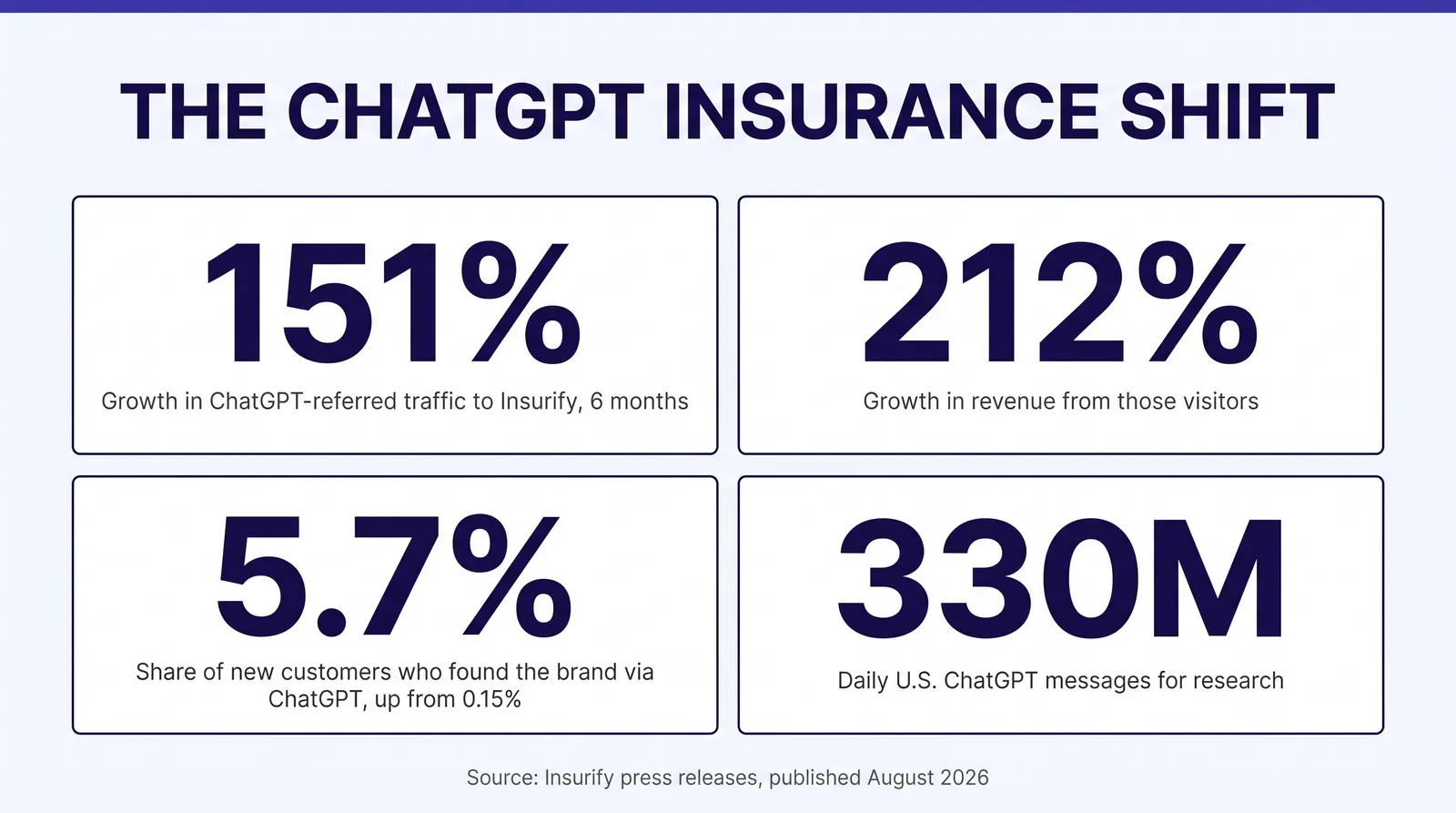
Insurify's own numbers show what that shift looks like in practice. In the six months since its February launch, ChatGPT-referred traffic to Insurify grew 151%, and revenue from those visitors grew 212%23. The share of new Insurify customers who say they discovered the brand through ChatGPT and AI conversations rose from 0.15% in the first half of 2025 to 5.7% in the first half of 2026, a roughly 38-fold jump in one year23. Insurify's own release frames the scale behind that shift plainly: U.S. users send more than 330 million messages to ChatGPT every day for research and education2.
"Insurance shopping behavior is changing, and the Insurify ChatGPT plugin can help consumers find the coverage they're looking for by making ChatGPT a natural place for them to explore, compare, and act on their insurance needs all in one place," said Snejina Zacharia, Insurify's founder and co-CEO, in the August announcement2. That's a company statement, not an independent claim, but the traffic and revenue figures behind it are the kind of number that's hard to fake to your own board.
It helps to be concrete about what "the app calls a tool" actually means, because the phrase sounds more abstract than the thing it describes. Under the old model, you'd ask ChatGPT a question about car insurance and it would generate a paragraph based on patterns in its training data, the same way it might generate a paragraph about the history of Rome, with no live connection to an actual carrier's current rate table. Under the app model, ChatGPT recognizes that your question matches what the Insurify tool is built to answer, hands your details to that tool through a defined interface, waits for Insurify's own system to run an actual rate calculation against actual carrier data, and returns that real result inside the same conversation. The assistant isn't guessing anymore. It's placing a call to a system that knows the answer and reporting back what it said.
Insurance is one category among many. The same App Directory that seated Insurify also seats apps for booking travel, shopping for other product categories, and pulling live data from other verticals entirely6. The pattern isn't specific to insurance and it isn't going to stay confined to auto, home, pet, and renters coverage forever, even if the Medicare and ACA side of the business faces a genuinely different compliance bar, which is the subject of the next section.
What Insurify's ChatGPT app actually does
It's worth being precise about the current scope, because precision is exactly what separates a useful read of this from a panic. The app covers auto, home, pet, and renters insurance2, lines where the product is close to a commodity: the coverage terms are standardized enough that price and carrier reputation carry most of the decision, and a side-by-side comparison genuinely answers the shopper's question.
| Feature | Live since | Where |
|---|---|---|
| Side-by-side rate comparison | February 9, 2026 | All 50 states plus D.C.1 |
| Real-time personalized quotes + in-chat purchase | August 19, 2026 | 11 states, expanding to 40+ by end of 20262 |
| AI-answered coverage questions | August 19, 2026 | Everywhere the app is available2 |
| Lines covered | Since launch | Auto, home, pet, and renters insurance2 |
The 11 states where a shopper can actually complete a purchase today are Arizona, Kentucky, Ohio, Missouri, Nebraska, New Hampshire, New Mexico, Rhode Island, Utah, Vermont, and Wisconsin2. That state-by-state rollout, rather than a single nationwide flip, is itself a tell: even a fully commodity line like auto insurance still runs into state-by-state carrier appointments and regulatory variation before an app can transact everywhere at once. Nothing about this is instant, even for the easiest product to automate.
151%
Growth in ChatGPT-referred traffic to Insurify, 6 months2
212%
Growth in revenue from those visitors, same period2
330M
Daily U.S. ChatGPT messages for research and education2
6 yrs
Minimum call recording retention for a Medicare sales call4
Curious where your own site stands in this shift
The free Audit scores whether AI engines can read, trust, and cite your site in about a minute. It won't tell you if a comparison app has entered your specific market, but it's the same starting point either way. strategicaiarchitects.com/audit8.
Why Medicare, ACA, and life aren't the same fight
Here's the part most coverage of this trend skips, and it's the part that actually matters to the agencies this site is written for. Auto insurance is regulated at the state level, and there's no federal statute requiring a documented appointment or a recorded sales call before a driver can compare rates and buy a policy. That's exactly why a chat app can carry the whole transaction, from question to purchase, without a human agent anywhere in the loop.
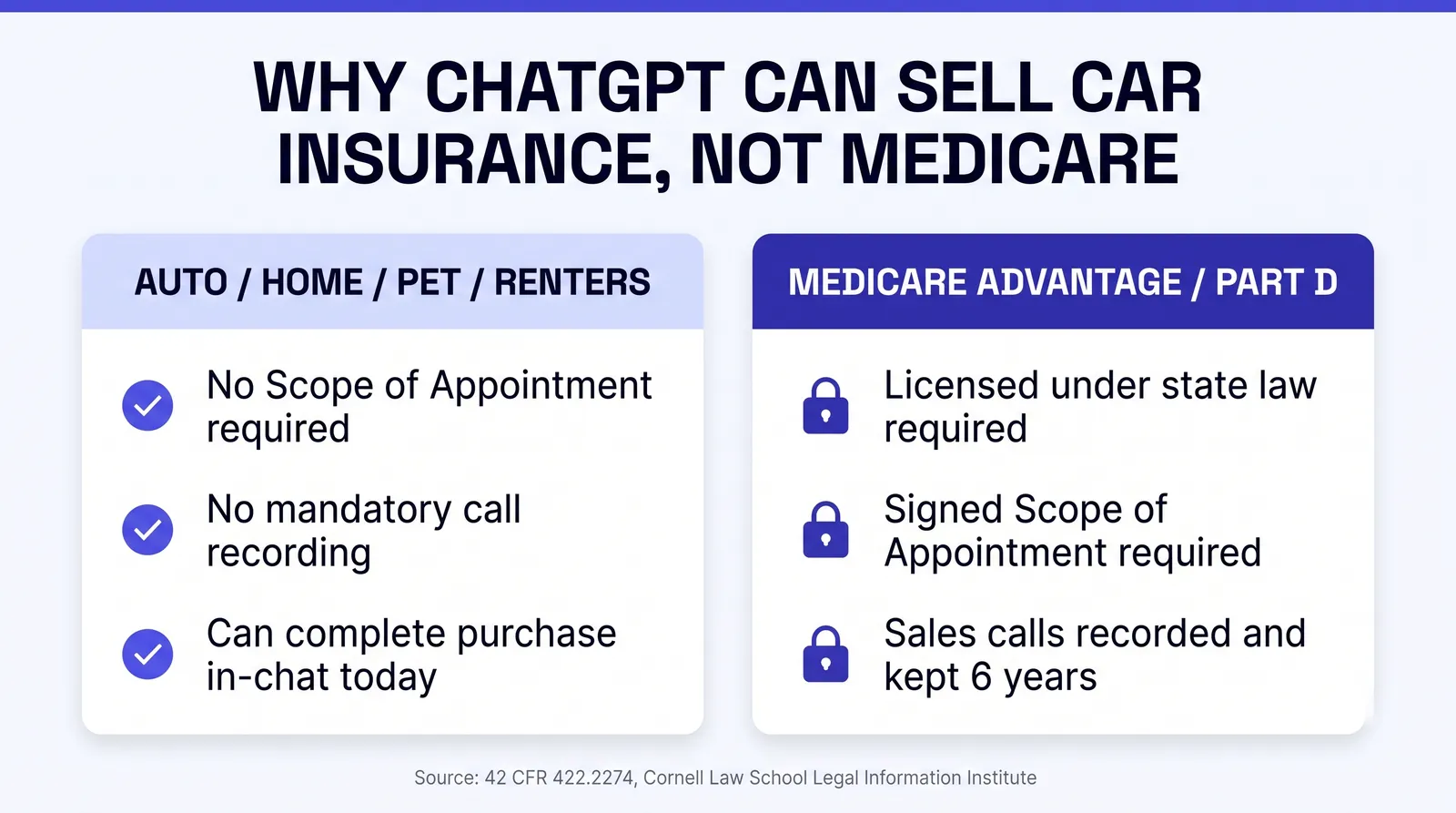
Medicare Advantage and Part D run under a different rulebook entirely, and it comes straight from federal regulation, not company policy. Under 42 CFR 422.2274, the section of federal code governing agent, broker, and third-party marketing requirements for Medicare Advantage plans, anyone marketing specific plan benefits must "be licensed and appointed under State law (if required under applicable State law)"4. Before a "personal marketing appointment," meaning any conversation where specific plan benefits get discussed, that same person must "secure and document a Scope of Appointment" 4. And once that conversation happens, "all marketing and sales calls, including the audio portion of calls conducted via web-based technology, must be recorded and retained in their entirety for a minimum period of 6 years"4.
Read that last requirement again. Six years of retained audio for every sales call. That's not a technical feature a developer bolts onto an app. It's a compliance obligation built around a licensed human having a documented, recorded conversation with a specific beneficiary, and it applies whether the agent is on the phone, in person, or, per the regulation's own language, on a call "conducted via web-based technology"4. An AI chat app answering a general question about Medicare doesn't trip this requirement. The moment it starts discussing your specific plan's premium, your specific plan's network, or trying to move you toward enrollment, it does, and nothing about the ChatGPT App Directory or the Apps SDK changes what federal law requires at that point.
| Requirement | Auto / home / pet / renters | Medicare Advantage / Part D |
|---|---|---|
| Federal marketing statute | None comparable; state insurance regulation applies | 42 CFR Part 422, Subpart V4 |
| Scope of Appointment before discussing specifics | Not required | Required, documented, before the conversation4 |
| Sales call recording | Not federally mandated | Recorded and retained a minimum of 6 years4 |
| Can complete a transaction inside a chat app today | Yes, in 11 states2 | No |
ACA marketplace plans and life insurance don't carry the identical Medicare Advantage rulebook, but the underlying shape holds. Every state requires a producer license to sell life insurance, and the underwriting conversation, health questions, beneficiary structure, term length, riders, is exactly the kind of individualized judgment call a side-by-side rate table doesn't answer. ACA enrollment runs through HealthCare.gov or a state exchange either way, and the subsidy math behind it depends on household income, family size, and county-specific benchmark plans that change every plan year, which is a calculation, not a comparison shop. None of that is the same regulatory citation as the Medicare Advantage rule above, so we're not going to dress it up as one. It's a different, older kind of wall: these are advice-heavy decisions, not commodity purchases, and an app built to compare car insurance rates doesn't become a licensed advisor by adding more product categories to its menu.
Ask ChatGPT directly, today, "how do I sign up for a Medicare Advantage plan" and watch what happens. It will walk you through eligibility windows, explain the difference between Original Medicare and Medicare Advantage in general terms, and probably tell you to contact Medicare directly, a broker, or 1-800-MEDICARE to actually enroll. That's not an accident or a temporary limitation waiting on the next model update. It's the assistant staying on the correct side of the exact line 42 CFR 422.2274 draws: general education is open territory, and a specific plan recommendation tied to your personal enrollment is regulated territory4. The research-stage question gets answered. The regulated, plan-specific conversation still routes to a human, which is precisely why the fight for that routing decision matters.
What this actually costs an agency like yours
So if the compliance wall holds, why does any of this matter to a Medicare or life agent? Because the actual risk isn't that an app enrolls your prospect in a plan. It's that the unregulated, informational part of the decision, the part that happens before anyone needs a license, a Scope of Appointment, or a recorded call, is exactly what a general-purpose assistant already answers today, for free, in a chat window your prospect opened for an entirely different reason.
Consider how much of an insurance decision actually lives in that unregulated, informational stage. LIMRA's 2025 Insurance Barometer Study, released June 25, 2025, found that 51% of Americans between 18 and 75 say they own life insurance5, which leaves the 2025 figure at roughly 100 million Americans without adequate coverage5. Forty percent of consumers told LIMRA they need life insurance, or need more of what they have5. And about one-third of Gen Z and Millennial respondents said they were unsure how much life insurance they need or what type to buy5.
"How much life insurance do I actually need" and "do I qualify for a subsidy" and "what happens if I miss my Medicare enrollment window" are exactly the kind of question that third of underinsured Millennials, or a Medicare beneficiary approaching 65, now types into ChatGPT before they ever type your agency's name into a search bar. Answering that question doesn't require a license. It doesn't trigger a Scope of Appointment. It's the same research-stage territory ChatGPT already operates in comfortably, the same territory that's driving Insurify's 151% traffic growth on the commodity side2, and it's happening whether or not any company ever builds a Medicare-specific app.
Put a rough, illustrative shape on this rather than leaving it abstract. This is a hypothetical worked example, not a sourced statistic: say your agency's site currently gets 40 organic sessions a month from people researching Medicare enrollment timing or ACA subsidy eligibility, the classic top-of-funnel questions. If even a quarter of the people who would have typed that question into Google instead type it into ChatGPT, and your site isn't structured in a way an answer engine can lift and cite, that's roughly ten sessions a month that never reach you, not because your agency did anything wrong, but because the question got fully answered somewhere your name wasn't attached to the answer. Ten sessions a month sounds small until you multiply it across a full enrollment season, or across every office in a downline running the same unstructured content.
The direction of that shift is not speculative. Insurify's own release states plainly that U.S. users send more than 330 million ChatGPT messages a day specifically for research and education2, and their traffic and revenue growth over just six months, 151% and 212%2, is what happens when a business positions itself to be the answer instead of the link underneath it. Nothing about that mechanism is specific to auto insurance. It's specific to whether the underlying content is structured to be cited, and that's a variable every agency site controls directly.
Check your own exposure in ten minutes
You don't need a tool or a subscription to find out where you stand. You need ten questions and both hands on a keyboard.
If you're not sure where to start, borrow from the questions your own prospects already ask you on the phone. A Medicare book might run "when does my Medicare enrollment window open if I'm turning 65 in November" or "what's the difference between a Medicare Advantage plan and a Medigap policy." An ACA book might run "do I qualify for a subsidy if I'm self-employed" or "what happens to my subsidy if my income changes mid-year." A life book might run "how much life insurance do I actually need with two kids and a mortgage" or "can I get coverage if I have a pre-existing condition." Ask each one exactly the way a prospect would type it, not the way an industry insider would phrase it.
Write down the real questions your prospects ask
Not generic ones. The specific phrasing a 64-year-old actually uses about Medicare timing, or the exact way a self-employed parent asks about ACA subsidy eligibility in your county.
Ask ChatGPT and Perplexity each one, cold
No leading context, no mention of your agency. Read the answer the way a stranger researching this for the first time would read it.
Note who, if anyone, gets named
A competitor's agency, a national carrier, a government site, or nobody at all. Nobody at all means the answer engine had nothing structured enough to cite, which is an opening, not a dead end.
Repeat the same ten questions monthly
A single check is a snapshot. The same questions run every month tell you whether you're gaining ground or losing it, and our guide to measuring AI search traffic walks through the tools that automate this once you're past doing it by hand.
The fix: become the source it cites
None of this requires guessing what an answer engine wants. The mechanics are well understood, and none of them are exotic.
Answer the actual question in the first two sentences of the section that addresses it, not after three paragraphs of setup. Attach a named, dated source to every figure you publish, the same standard this guide holds itself to. Give the content a real author and a real organization identity a machine can verify, not an anonymous byline. Ship the technical layer that lets a crawler or an assistant actually reach the content: a fast static site that doesn't make a bot wait on JavaScript to render, a sitemap and an llms.txt file that update themselves the moment a new page goes live, and a robots.txt that welcomes the named AI crawlers instead of quietly blocking them. And run the four-schema stack, BlogPosting, FAQPage, BreadcrumbList, and an Organization or Person identity node, on every page that's meant to be found this way.
Our guide to what changed in AEO this year walks through the build order in more depth. The short version: foundation first, identity second, sourced answers third, machine access fourth, and a real publishing cadence on top of all of it, because one burst of pages decays and a cadence compounds.
The page most agency sites publish
- "Medicare enrollment can be confusing. Contact us to learn more."
- No specific dates, no specific numbers, no named source
- Byline is the agency name, or nobody
- No schema, or schema that doesn't match the page
ResultNothing for an assistant to lift or attribute
The page an assistant can cite
- "Medicare's Initial Enrollment Period runs seven months, starting three months before you turn 65."
- The exact rule, dated, with the federal source named
- A named author and organization identity a machine can verify
- FAQPage and Article schema that match the visible content
ResultA specific claim an answer engine can quote and attribute
The crawl layer matters as much as the writing. Make sure your robots.txt welcomes the named AI crawlers instead of silently blocking them, GPTBot for OpenAI, ClaudeBot for Anthropic, PerplexityBot for Perplexity, and Google-Extended for Google's AI systems among them. A site that blocks these by default, often without anyone realizing a template did it automatically, can't be cited no matter how well the content itself is written.
The other side of the same protocol
Here's the detail worth sitting with. The Apps SDK that lets Insurify's tool answer a question inside ChatGPT is built on the Model Context Protocol, an open standard, not a proprietary Insurify invention or an OpenAI-exclusive one6. WebMCP, the browser-facing sibling of that same protocol family, lets any website register its own tools, a quoter, a subsidy calculator, a coverage lookup, as something an AI agent can call directly, the same way ChatGPT calls Insurify's tool today.
That reframes the question this whole guide has been circling. The mechanism that let a third party build a tool ChatGPT trusts enough to call isn't locked behind a partnership only a large aggregator can get. It's an open protocol. An agency site with a real quoter, one that returns an actual number instead of collecting a lead form and promising a callback, can be built to expose that same capability. Being agent-ready isn't just defense against being replaced. It's the same architecture that could make your own tools callable the same way Insurify's are, on your own site, under your own name.
We're not going to overstate where that stands today. Building a WebMCP-exposed tool doesn't get your agency a listing in OpenAI's App Directory, and it doesn't change anything about the Scope of Appointment or call recording requirements on the regulated side of your business. What it does is put a live, callable, sourced tool in front of any agent, human or automated, that reaches your site through the same open standard Insurify's app runs on, instead of a static form that just sits there waiting to be filled out. Our guide to building an agent-ready insurance website covers what that actually takes to build.
How we build this in
This section sticks to what's stated on our own live pages, verified this session. We build agency websites on Astro, which ships zero JavaScript to the browser by default, so a page arrives as finished HTML instead of a runtime the browser has to boot before anything is readable, whether that reader is a person, a search crawler, or an app like the one this guide is about. Every site we ship carries the schema stack, a self-updating sitemap and llms.txt, and a robots.txt written to welcome the named AI crawlers rather than block them.
Digital Foundation, our done-for-you tier, starts at $247 a month for a complete, compliant site built for AI citations, and steps up to $497 a month for a tier that adds a new blog post and a new location page every week, and $997 a month for a tier that adds one every business day7. Every tier includes a 14-day free trial and no fees to cancel7. For a build outside that ladder, a quoter wired to live data, a custom content engine, or a multi-site setup for an FMO or IMO, that's scoped on a call rather than sold as a fixed package.
Running more than one site
This kind of research-stage citation gap tends to compound across a downline. If you're an FMO or IMO watching this shift across a dozen agency sites at once, that's the kind of conversation worth having directly. Book a call.
What you get
Concretely, closing this gap gets you three things. A site an answer engine can actually read, trust, and cite, instead of one that's technically online but invisible to the systems your prospects are increasingly asking first. Structured, sourced answers to the exact research-stage questions that are moving into chat windows, so that when someone asks "how much life insurance do I need" or "when does my Medicare enrollment window open," your agency has a shot at being the name attached to the answer. And a foundation, fast static pages, clean schema, a machine-readable crawl, that does double duty for regular Google search and for whatever the next version of this shift looks like.
None of that is a promise about a specific ranking, a citation count, or a lead number. It's an infrastructure decision about whether your agency is even in a position to be named, and it's worth treating it like one.
When you genuinely don't need to do anything yet
Say this plainly: if your book runs almost entirely on referrals, you've never noticed a dip in organic quote requests, and you're not competing for cold, top-of-funnel search traffic in the first place, none of this is urgent this quarter. Run the ten-question check above once, see what comes back, and revisit it in three or four months rather than rebuilding a site you don't have a symptom for.
The math in this guide starts mattering once you notice organic research-stage traffic softening, once a colleague mentions a prospect who "already knew everything" from ChatGPT before the first call, or once you've run the ten-question check and found your agency named nowhere while a competitor shows up repeatedly. That's the signal that closing the gap is worth scheduling, not a hypothetical.
Questions agencies ask
Is ChatGPT actually selling insurance now?
For a narrow slice of the market, yes. Insurify's app inside ChatGPT lets a shopper get real-time personalized car insurance quotes, ask coverage questions, and complete a purchase without leaving the chat window, in the 11 states where that transaction flow is currently live, with a rollout planned to more than 40 states by the end of 2026. It covers auto, home, pet, and renters insurance. It does not sell Medicare Advantage, Part D, ACA marketplace plans, life insurance, final expense, or annuities, and there's a specific legal reason that line hasn't moved.
Can an app like this ever sell Medicare Advantage or ACA plans the same way it sells car insurance?
Not under the rules that exist today. Federal regulation requires anyone discussing specific Medicare Advantage or Part D plan benefits with a beneficiary to be licensed and appointed under state law, to secure and document a Scope of Appointment before that conversation happens, and to record and retain the sales call for a minimum of six years. Those are structural requirements built around a licensed human having a documented conversation, not a technical gap a developer can code around the way a comparison app can be built for an unregulated commodity line.
What's the actual difference between this and ChatGPT just answering a question about insurance?
A regular ChatGPT answer is text generated from training data and whatever it can find on the open web, then handed back with maybe a link. An app like Insurify's is a live tool ChatGPT calls directly, built on the Apps SDK OpenAI opened to developers in December 2025, which itself runs on the Model Context Protocol, the same open standard behind the WebMCP tools we build into agency websites. The app returns a real quote from a real carrier's current rates, not a generated guess, and it can carry the conversation through to a completed purchase.
Should I be worried if my agency doesn't write auto, home, pet, or renters insurance?
Not about this specific app taking a sale directly, no. What's worth paying attention to is the pattern underneath it: a growing share of the research that used to happen on Google, and used to land a visitor on an agency's website, is starting to happen inside a chat window instead. The unregulated, informational part of a Medicare or life insurance decision, questions like how much coverage someone needs or whether they qualify for a subsidy, is exactly the kind of question an assistant answers today without any Scope of Appointment or license requirement attached to it.
How do I know if AI answers are already citing or ignoring my agency?
Open ChatGPT and Perplexity and ask the same five to ten questions your actual prospects ask, in your actual market. Note whether your agency gets named, whether a competitor does, or whether the answer has no attributed source at all. Do this once a month, with the same questions, so you're tracking a trend instead of a one-time snapshot.
Does making my site AI-citable also help my regular Google SEO?
Yes, and that overlap isn't a coincidence. Fast, crawlable, well-structured pages with real sourced data and a clean schema stack are exactly what both a search index and an answer engine need to trust and surface a page. Building for one doesn't cost you the other.
Is this the same thing as an AI shopping agent browsing my own website?
No, and the distinction matters. An AI shopping agent browsing your site is a separate mechanism we've covered before: a tool like Perplexity's Comet or ChatGPT's in-app browsing visiting your specific pages and trying to complete a task there, which is what WebMCP tooling is built to support. What this guide describes is a third party's own app, sitting inside ChatGPT itself, answering a shopper's question before they ever get to a website, yours or anyone else's.
What if aggregators eventually build a version of this for Medicare or ACA plans?
We can't promise the compliance wall holds forever, and it would be dishonest to say otherwise. What we can say is that the fix doesn't change based on that uncertainty: an agency whose site already answers the research-stage questions in a sourced, structured, citable way is positioned to be the name an AI answer surfaces regardless of what any single aggregator builds next.
Sources
- Insurify. "Insurify Launches Industry-First ChatGPT Insurance Comparison App," press release, launch date, state coverage, and quote database size, published 2026-02-09, verified live 2026-08-23. prnewswire.com.
- Insurify. "Insurify Expands ChatGPT Plugin with Real-Time Personalized Quotes and In-Chat Shopping," press release, traffic and revenue growth, brand discovery share, daily ChatGPT message volume, and state rollout, published 2026-08-19, verified live 2026-08-23. insurify.com.
- Yahoo Finance. "Insurify Expands ChatGPT Plugin with Real-Time Personalized Quotes and In-Chat Shopping," syndicated release corroborating traffic, revenue, and brand discovery figures, published 2026-08-19, verified live 2026-08-23. finance.yahoo.com.
- Cornell Law School, Legal Information Institute. "42 CFR 422.2274, Agent, broker, and other third-party requirements," licensing, Scope of Appointment, and 6-year call recording requirements, current regulation, verified live 2026-08-23. law.cornell.edu.
- LIMRA. "Adults Age 30 and Younger Overestimate Life Insurance Cost by 10-12 Times," 2025 Insurance Barometer Study release, ownership rate, coverage gap, and need-gap figures, published 2025-06-25, verified live 2026-08-23. limra.com.
- VentureBeat. "OpenAI now accepting ChatGPT app submissions from third-party devs, launches App Directory," App Directory launch date and Model Context Protocol foundation, published 2025-12-18, verified live 2026-08-23. venturebeat.com.
- Strategic AI Architects. "Digital Foundation," tier names, pricing, and included features, verified live 2026-08-23. strategicaiarchitects.com.
- Strategic AI Architects. "Free Audit," verified live 2026-08-23. strategicaiarchitects.com.
Talk it through
Want a second pair of eyes on it?
Free 30 minutes. Bring what you found, or bring nothing and we will look together at how AI engines read your site and which fixes move first.
See if AI engines can cite your agency
Run the free Audit, a live AEO Audit plus a HIPAA tracking scan of your site, in under a minute.
Related reading: can an AI shopping agent use your insurance website · why you can't see your AI search traffic · AEO for life insurance agencies