Playbook
Why Your Insurance Agency's Voice AI Bill Keeps Climbing
The demo quote is one flat number. The invoice at month three is four separate meters running on every call, and none of them slow down when your call volume does.


20 min read
Twilio's own pricing page lists its bundled AI voice product, ConversationRelay, at $0.07 a minute1. The raw phone line underneath any AI voice product, no transcription or reasoning attached yet, costs $0.002 to $0.022 a minute depending on the carrier134. That gap is not a mystery or a markup scandal, it's four separate billable layers, telephony, speech to text, an LLM, and voice synthesis, stacked into one blended rate. A platform like Vapi charges its own $0.05 a minute fee on top of pass-through model costs2. This guide breaks down what each layer actually costs, works a real monthly number for a multi-office agency, and covers what changes when you build the stack yourself instead of renting someone else's bundle.
The bill that doesn't match the demo
The sales call goes well. A vendor shows you an AI receptionist answering a Medicare Advantage question in a natural voice, booking a callback, and logging the note in your CRM. The quote on the screen is a flat number, something like $0.08 a minute or a tidy monthly package. You sign. Three months later, with call volume up across two more offices, the invoice looks nothing like that first number. Line items you never saw on the demo start showing up: a transcription charge, a model usage charge, a "premium voice" surcharge, a per-call connection fee.
Nobody lied to you on the demo call. What happened is more ordinary than that, and more useful to understand. An AI voice product isn't one thing being metered. It's four things being metered at once, on every single call, and most sales conversations show you the blended number without walking through what's inside it.
It's worth being specific about why the demo itself doesn't tip you off. A demo call lasts two or three minutes and gets built by the vendor's own team on their own infrastructure, tuned to look good. Nobody demos what a live receptionist sounds like on call four hundred of the day, handling a caller who mumbles, gets transferred twice, or calls back three times about the same plan question. Each of those calls still runs through all four meters. The demo shows you the product. The invoice shows you the usage pattern, and those are two different things to evaluate.
What this guide is and isn't
This isn't a claim that any specific vendor is overcharging you. Every rate cited here is pulled from that provider's own live pricing page, this session. The point is narrower and more useful: once you can see the four layers separately, you can price out your own call volume honestly, whichever route you take.
Why the bill is stacked, not flat
Walk through what actually happens on one inbound call to an AI receptionist. A caller dials your number. That call has to travel over the public phone network to reach the AI system at all, which is the telephony leg, priced per minute like any phone call always has been. The system then has to turn the caller's speech into text it can reason over, the speech to text leg. A language model reads that text and decides what to say back, the reasoning leg. Then that response has to become spoken audio again before it reaches the caller's ear, the voice synthesis leg.
Four separate technical jobs, four separate places a provider can attach a meter. A bundled platform like Twilio's ConversationRelay or a dedicated voice AI layer like Vapi rolls all four into a single number so you don't have to think about it, and Vapi says so plainly on its own pricing page: the platform fee covers "container hosting for your Vapi agents," and everything else, the model provider costs, is passed on to you "at cost," billed separately from the platform fee itself2.
Telephony
The raw phone connection. Priced per minute by a carrier like Twilio, Telnyx, or Azure Communication Services, whether or not any AI touches the call.
Speech to text
Turns the caller's voice into text a model can read. Deepgram's own pay-as-you-go page prices its Nova-3 monolingual streaming model at $0.0048 a minute11.
AI reasoning
The language model deciding what to say. Priced per token rather than per minute, so cost swings with how long the model's replies run and which model you pick, passed through "at cost" on a platform like Vapi2.
Voice synthesis
Turns the model's text response back into spoken audio. Priced by character or by credit, as on ElevenLabs' tiered plans5.
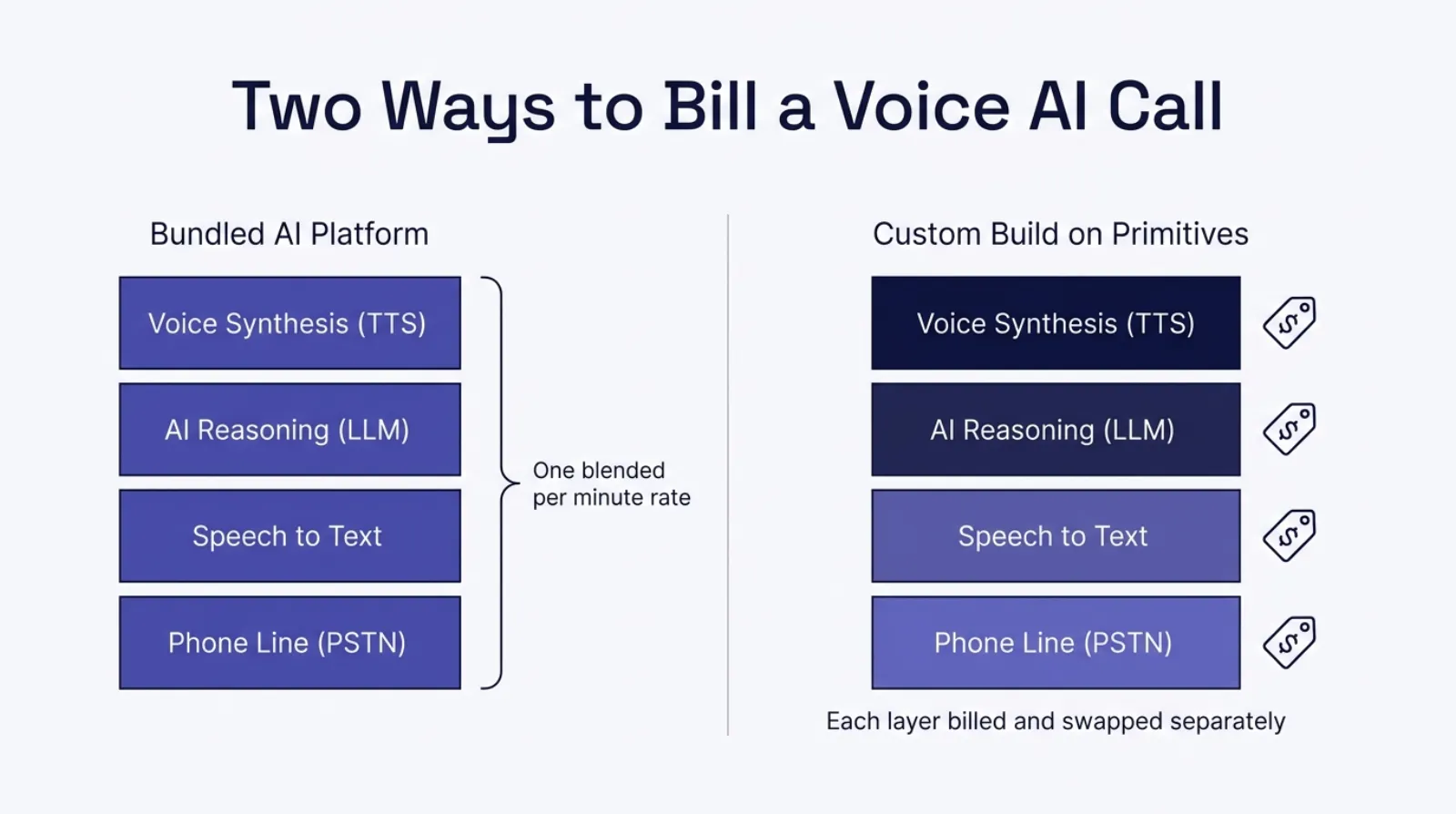
Neither approach is wrong. A bundled rate is genuinely simpler to buy, and for a lot of agencies that simplicity is worth paying for. The problem is buying it without knowing it's a bundle, then being surprised when volume makes the bundle's markup visible.
Two of the four layers are the easiest to price and the least talked about. Telnyx and Azure Communication Services both publish a flat per-minute telephony rate, and Deepgram publishes a flat per-minute transcription rate, so those two layers alone can be priced to the cent before you build anything3411. The other two, reasoning and voice synthesis, don't work that way. A language model's cost depends on how many tokens it reads and writes on a given call, which depends on how long the caller talks and how long the model's answer runs, so two calls that last the same number of minutes can cost noticeably different amounts to reason over. Voice synthesis is metered in credits rather than minutes on a provider like ElevenLabs, which is a different unit entirely and doesn't translate cleanly into a per-minute figure without knowing the specific voice and settings in use5.
What 20,000 minutes actually costs
Numbers make this concrete faster than architecture diagrams do. Twenty thousand minutes a month is a realistic AI-handled call volume for an FMO or IMO running five to eight offices with an always-on receptionist. Here's what that volume costs at each layer, using the rate each provider states on its own current pricing page.
| Product | What it includes | Rate | Monthly cost at 20,000 min |
|---|---|---|---|
| Twilio ConversationRelay | Telephony plus the AI voice loop, bundled1 | $0.07 / min | $1,400 |
| Vapi platform fee | Hosting only, before model costs pass through2 | $0.05 / min | $1,000, plus model costs |
| Azure Communication Services | Telephony leg only, no AI attached4 | $0.013 / min | $260 |
| Telnyx base voice | Telephony leg only, before a separately priced SIP trunk fee3 | $0.002 / min | $40, plus trunk fee |
| Telnyx + Deepgram, combined | Telephony plus transcription, still no reasoning or voice yet311 | $0.0068 / min | $136, plus trunk fee |
That last row is the honest starting point for a self-built stack: two of the four layers, telephony and transcription, priced at their own published rates, add up to under seven-tenths of a cent a minute combined. Even at 20,000 minutes a month, that's $136, against $1,400 for Twilio's fully bundled AI product covering all four layers. The gap doesn't mean the bundled product is a bad deal, plenty of that gap is real engineering the vendor did for you. It means the gap is worth pricing out before you decide who should be doing that engineering, you or the vendor.
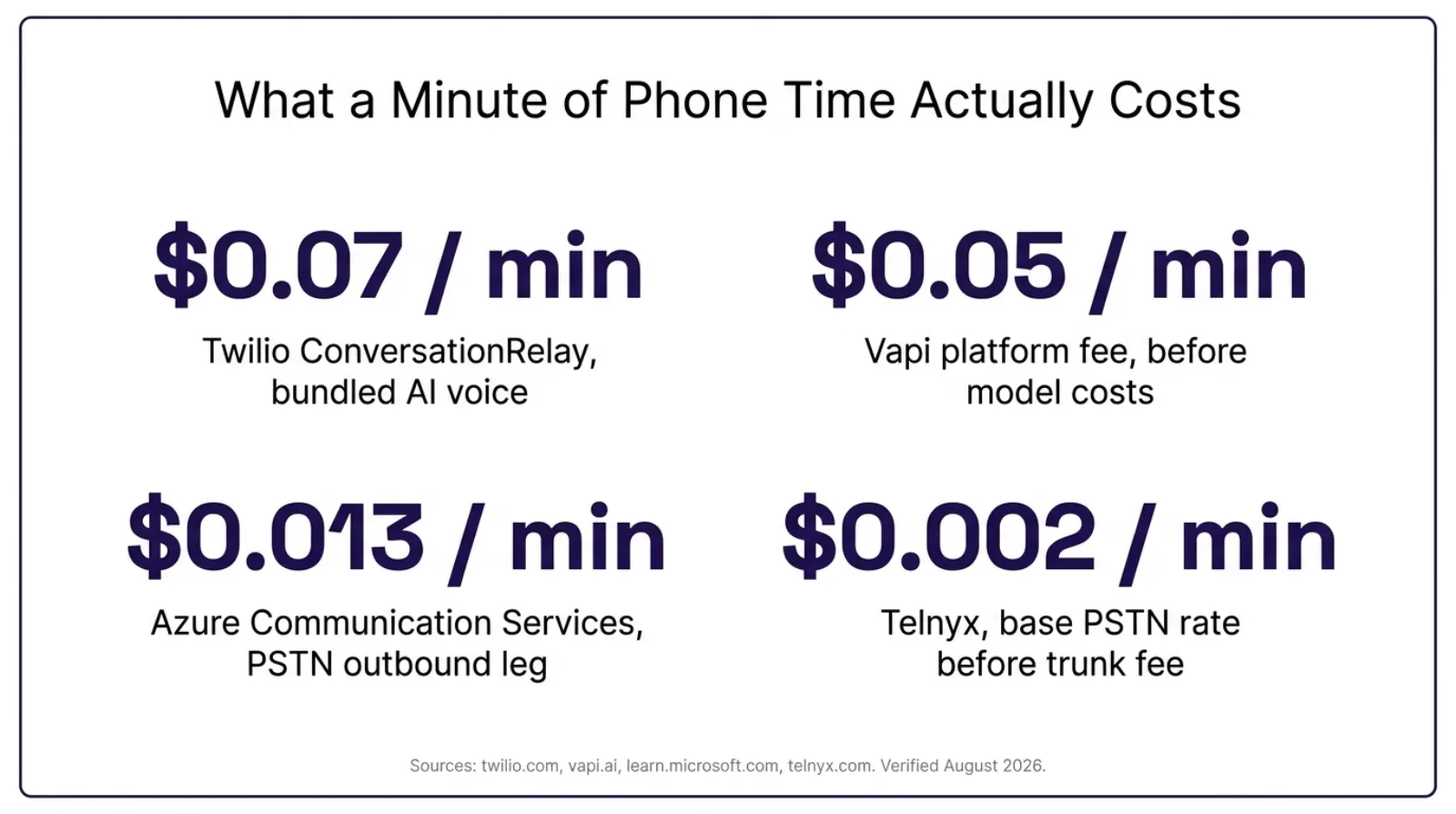
Read that table carefully, because the comparison it invites is easy to get wrong. The Azure and Telnyx rows are telephony only, the raw connection with nothing else attached. The Twilio row is a complete AI voice product, the phone line and the entire AI loop in one number. They are not the same purchase. What the table does show honestly is where each dollar of a bundled rate is actually going: a meaningful share of that $0.07 isn't the phone call at all, it's the AI wrapped around it.
The voice synthesis layer has its own separate meter too. ElevenLabs, one of the more commonly used text to speech providers for this kind of build, prices in credit tiers rather than a flat per-minute rate: its Business plan runs $990 a month for six million credits and ten seats, with lower tiers starting at $6 a month for 30,000 credits, and Enterprise pricing available for larger volume5. None of that shows up in a Twilio or Vapi quote, because in a bundled product it's already folded into the blended rate. Build it yourself, and it's a separate bill you have to plan for.
The demo quote vs. the month-three invoice
The pattern that catches agencies off guard isn't any single rate, it's the shape of how a bundled bill grows. A flat monthly package looks fixed until you cross whatever volume threshold moves you onto usage-based billing, and every layer inside the bundle scales with call volume at the same time. Double your call volume and you don't just pay more for the phone line, you pay more for transcription, more for the model, and more for the voice, all at once, because all four were always billed per minute even when the sales page showed you one number.
What you saw on the sales call
- One flat rate, or a simple monthly package
- A single line item on the quote
- No visibility into telephony vs. AI cost
- No mention of what happens above a volume threshold
Looks likeA predictable, simple monthly cost
What the invoice actually shows
- Four separate usage-based line items, all scaling with volume
- A "premium voice" or model surcharge you didn't see quoted
- Per-call fees for features like answering machine detection1
- A bill that grew faster than your call volume did
Actually isFour meters running independently on every call
The mistake we see most
An agency negotiates hard on the platform's per-minute rate and stops there, assuming that's the whole cost. It isn't. The platform fee is one of four meters. Negotiating the platform rate down by 20% while the other three layers keep scaling with volume barely moves the total bill once call volume climbs.
Why FMOs and IMOs feel it first
A single agent fielding fifty calls a month never notices any of this. The math doesn't become real money until volume does, which is exactly the position an FMO or IMO running a downline of offices is in. Multiply a per-minute gap by enough call volume across enough offices, and a decision that looked like a rounding error at the pilot stage becomes a real budget line at scale.
It compounds a second way too. Multi-office operations don't run one call flow, they run several: new business quoting, existing-client service calls, after-hours triage, renewal outreach. Each flow can end up on a different vendor or a different pricing tier if nobody's tracking the total, which means the four-layer stacking problem isn't happening once, it's happening in parallel across every flow you've stood up.
4
Separate billable layers in one AI-handled phone call
$1,400
Monthly cost of Twilio's bundled AI voice product at 20,000 minutes1
$260
Monthly cost of the raw Azure telephony leg alone at the same volume4
$2,000
Minimum project cost for a custom-built voice AI platform on your own cloud tenant7
Why call volume doesn't stay flat
A per-minute rate looks manageable when you price it against an average month. Medicare agencies don't run average months. CMS states plainly that "every year, Medicare's open enrollment period is October 15 to December 7"12, and that seven week window is when the overwhelming majority of a Medicare-focused agency's annual call volume lands, as current members shop new plans and prospects call in off a year's worth of marketing. A receptionist flow built to handle a comfortable average month gets tested hardest during the exact seven weeks it can least afford to fall over.
Run the math on a stacked bundled rate through that lens and the seasonal spike gets expensive fast. An agency that budgets for 20,000 AI-handled minutes a month year-round, then sees volume triple during AEP, isn't looking at a one-time bump on a bundled platform, it's looking at the full per-minute rate applied to three times the minutes, on all four layers at once, for seven straight weeks. A telephony-only rate at $0.002 to $0.013 a minute absorbs that spike far more comfortably than a $0.07 blended rate does, purely because the multiplier is landing on a smaller starting number.
This is also where the engineering ownership question in the next section actually matters, not just in theory. A bundled platform's support queue doesn't get shorter during AEP because every other agency using that platform is also seeing volume spike at the same seven weeks. If your own team owns the stack, you decide how much headroom to provision ahead of the season, instead of competing with every other agency on the same platform for the same support attention in December.
What changes when you own the stack
Building on primitives instead of buying a bundle means picking each of the four layers yourself: a telephony provider for the raw phone line, a speech to text engine, a reasoning model, and a voice synthesis provider, then wiring them together into one call flow. Ambrose's own documentation describes exactly this kind of assembly, listing integrations with Twilio, Vapi, and Retell as connection points rather than a single locked-in voice stack6, which is the same underlying idea: pick the components, don't rent someone else's fixed bundle.
The upside is real. You choose the cheapest reliable carrier for the telephony leg instead of accepting whatever's bundled into a platform fee. You swap voice synthesis providers if a cheaper or better one shows up, without renegotiating your entire contract. You see each layer's actual cost, which means you can actually forecast a bill instead of getting surprised by one.
The honest tradeoff is engineering ownership. Nobody is patching, monitoring, or on-call for a bundled platform's uptime but the vendor. Own the stack, and someone has to own keeping four separately-sourced components talking to each other reliably, including the night one of them has an outage during business hours.
That ownership is real work, not a one-time setup task. Each of the four layers can fail or degrade on its own: a transcription provider has a bad day and word error rates creep up, a model provider ships an update that changes response latency, a voice synthesis provider has an outage during a call spike. A bundled platform absorbs that risk for you, silently, as part of what the per-minute rate buys. Own the stack, and someone on your team, or a partner you've hired, needs monitoring in place to catch each of those failures separately, plus a fallback plan for what happens to a live call if one layer goes down mid-conversation. None of that shows up in a per-minute rate comparison, and all of it is part of the real cost of owning infrastructure instead of renting it.
| Question | Bundled platform | Own the stack |
|---|---|---|
| Who sets the per-minute rate | The platform, as one blended number | You, per layer, shopping each component |
| Who owns the infrastructure | The vendor, on their cloud account | You, on your own AWS or Azure tenant7 |
| Who's on call if it breaks | The vendor's support queue | Whoever you've assigned to own it |
| Where call recordings and transcripts live | The vendor's systems, under their terms | Your own cloud tenant7 |
What HIPAA compliant voice AI actually requires
Almost every call a Medicare or ACA agency's AI receptionist handles touches something health-adjacent: a plan question tied to a condition, a prescription lookup, a callback request from someone who mentioned a diagnosis to explain why they're calling. That data doesn't stop being protected health information because an AI system, rather than a person, is the one hearing it. Picking a cheaper carrier or a faster model doesn't change any of that.
What actually matters is where the recording and the transcript end up, and under what agreement. A Business Associate Agreement has to exist with whoever's infrastructure touches that call data before the call happens, not after. Ambrose's own documentation describes a "PHI Rail" that aliases identifiers before any destination outside a signed BAA relationship ever sees them, which is the general shape of the fix: the raw identifying data gets coded before it crosses into a system that isn't covered6. On our own Enterprise builds, that plays out as call recordings and transcripts stored inside your own AWS or Azure tenant under a signed BAA, rather than a vendor's shared, general-purpose infrastructure7.
Say this plainly, because it's easy to conflate with the cost question this guide is mostly about: a cheap telephony rate and a HIPAA-compliant setup are two separate questions. You can build on the least expensive carrier in this guide's tables and still fail a compliance review if recordings land on infrastructure with no BAA behind it. And you can pay a premium bundled rate and still not know where your call data actually lives unless you ask. Price and compliance both need a direct answer, not an assumption.
How to check your own exposure before you sign
You don't need a vendor call to get a first real answer. Most of this is checkable from your own current bill or a prospective vendor's own pricing page.
Ask for the per-minute rate broken into layers, not one blended number
A vendor who can't or won't separate telephony, speech to text, reasoning, and voice synthesis into their own line items is asking you to trust a bundle you can't actually audit.
Find the usage threshold where pricing changes
Flat monthly packages usually cap at a call volume. Ask exactly where that cap sits and what the per-minute rate becomes above it, in writing.
Multiply your real monthly minutes against the quoted rate
Pull your actual call volume for the last three months, across every office, and do the multiplication yourself before you sign anything.
Ask where recordings and transcripts are stored
If any call touches a health condition, a Medicare plan question, or anything HIPAA-adjacent, ask specifically whether that data lives on a covered environment under a signed Business Associate Agreement, not just "securely."
Model the same volume across a second and third office
If you're an FMO or IMO, price the bundled rate at your current volume, then again at what a second and third office would add. That's the number that actually matters for a downline, not the pilot-office number.
If you'd rather see where your own site and tech stack stand first
The free Audit checks a site's technical readiness in under a minute. It won't price out a voice AI vendor for you, but it's the same no-pressure starting point we'd point you to before any bigger conversation. strategicaiarchitects.com/audit10.
How we build this instead
This section sticks to what's on our own live pages, verified this session. For agencies that want a voice AI system built on components they own rather than rented from a bundled platform, Enterprise builds run on your own AWS or Azure tenant, with projects starting at a $2,000 minimum and ongoing cloud infrastructure typically under $200 a month, paid directly to the cloud provider rather than as a recurring software subscription to us7. HIPAA-compliant voice agents handle both inbound and outbound calls, with recordings and transcripts stored inside your own cloud tenant instead of a vendor's general-purpose infrastructure, and a Business Associate Agreement signed before any protected health information is handled7.
Not every agency needs that. If you're running a single office and want the AI receptionist question solved without pricing out four separate layers yourself, Digital Foundation's Pro tier bundles a 24/7 AI receptionist into a flat $497 a month alongside the rest of the site, with no separate per-minute bill to track8. You describe what you need, and either the flat package or the owned build gets scoped to your actual call volume, not a one-size quote9.
Neither claim here is a promise about what your specific invoice will look like. What we can say plainly is that we don't hand a client a blended per-minute number and call it done. You see what each layer costs, because that's the only way to actually forecast a bill instead of discovering it in month three.
What you actually get
Concretely, moving off a stacked bundled rate onto an owned or flat-rate build gets you three things. A bill you can forecast before volume grows, because you know what each layer costs instead of trusting a blended number. Infrastructure that's actually yours, so a vendor's pricing change or a platform shutdown doesn't take your call flow down with it. And, for anything touching health data, a documented HIPAA posture instead of a vendor's general assurance that things are "secure."
None of that is a guarantee about call volume, lead conversion, or revenue. It's an infrastructure decision, not a marketing promise, and it's worth treating it like one.
There's a fourth thing worth naming too, because it's easy to undervalue until you're two years into a bundled contract: portability. When you own the four components, no single vendor's pricing change, feature deprecation, or acquisition can force a migration on their timeline. Bundled platforms get bought, get repriced, and get deprecated. An FMO that's built its entire multi-office call flow on one platform's proprietary bundle is exposed to that platform's roadmap in a way an owned stack, built on interchangeable primitives, simply isn't.
When off-the-shelf is still the right call
Say this plainly: a lot of agencies are genuinely better off with the bundled platform. If you're a single office with modest call volume, the engineering overhead of owning four separate components isn't worth it, full stop. A flat monthly package that includes the AI receptionist, with someone else on call for uptime, is the right tradeoff at that scale, and you should feel fine paying the bundled rate for the simplicity it buys.
The math in this guide starts mattering once you're running enough call volume, across enough offices, that the gap between $0.07 a minute and $0.013 a minute stops being rounding error and starts being a real monthly number. Run your own volume through the table above before deciding which side of that line you're on.
A rough rule of thumb, based on nothing more than the arithmetic in this guide: if the monthly gap between the bundled rate and the raw telephony rate at your actual call volume is smaller than what it would cost to hire even a fraction of someone's time to own the infrastructure, the bundle is the better deal. If that gap is large enough to fund real ownership, meaning enough call volume, enough offices, or both, it's worth pricing out the alternative before renewing on autopilot.
Questions agencies ask
What does an AI receptionist actually cost per month for an insurance agency?
It depends entirely on whether you buy a bundled platform or build on raw components. Twilio's own bundled AI voice product, ConversationRelay, bills at $0.07 a minute. A raw phone line alone, with no AI attached yet, runs $0.002 to $0.022 a minute depending on the carrier. At 20,000 minutes a month, that's the difference between a $1,400 telephony line item and one closer to $40 to $260, before you've added speech to text, reasoning, or voice synthesis on top of the raw line.
Why is Twilio's ConversationRelay so much more expensive per minute than a regular Twilio call?
Because it isn't a phone call. ConversationRelay bundles the phone line, the speech to text pass, the connection to your reasoning model, and the text to speech voice into one metered product, and Twilio charges one blended rate for the whole bundle rather than passing each layer's cost through separately.
Is Azure Communication Services cheaper than Twilio for a custom voice AI build?
For the raw telephony leg alone, yes on the numbers we pulled this session: Microsoft's own pricing documentation shows a US PSTN outbound leg around $0.013 a minute, versus Twilio's $0.0140 outbound and $0.0085 to $0.0220 inbound. But that's telephony only. Azure Communication Services doesn't include speech to text, an LLM, or voice synthesis, so you're comparing a bare phone line to a bundled AI product, not two versions of the same thing.
What's the real difference between a platform like Vapi or Retell and building on Azure or Telnyx directly?
A platform like Vapi charges its own flat fee, $0.05 a minute by its own pricing page, on top of which the speech to text, LLM, and voice synthesis costs pass through at whatever rate the underlying providers charge. Building directly on Azure Communication Services or Telnyx removes that platform fee layer, but you take on the engineering work of wiring the pieces together and keeping them running yourself.
Does a single-office agency need a custom voice AI build?
Usually not. If you're running one office and a reasonable call volume, a flat monthly product where the AI receptionist is already built in, like the one bundled into Digital Foundation's Pro tier, removes the per-minute metering question entirely. Custom builds start making financial sense once volume and office count grow enough that the platform's per-minute markup compounds into real money.
What does HIPAA-compliant voice AI require beyond picking a cheaper carrier?
A signed Business Associate Agreement with whoever touches the call data, infrastructure that keeps recordings and transcripts inside a covered environment rather than a vendor's general-purpose cloud, and a documented chain for who can access protected health information and when. Picking a cheaper per-minute rate doesn't satisfy any of that on its own.
How much does a custom voice AI build actually cost to have built?
On our own live pricing page, Enterprise projects start at a $2,000 minimum, with ongoing cloud infrastructure costs typically under $200 a month, paid directly to your own AWS or Azure account rather than as a recurring software subscription to us.
Does call volume actually spike enough during AEP to matter for pricing?
For a Medicare-focused agency, yes. CMS states the Medicare Open Enrollment Period runs October 15 through December 7 every year, and that seven week window is when the bulk of a Medicare agency's annual call volume typically lands. A stacked per-minute rate applied to three times the normal volume, on all four billed layers at once, is a materially different number than the same rate applied to an average month.
Sources
- Twilio. "Voice Pricing, United States," current rate card including ConversationRelay, inbound and outbound per-minute rates, verified live 2026-08-15. twilio.com.
- Vapi. "Pricing," platform fee and model cost pass-through structure, verified live 2026-08-15. vapi.ai.
- Telnyx. "Voice API Pricing," base per-minute rate and SIP trunking fee structure, verified live 2026-08-15. telnyx.com.
- Microsoft. "Pricing scenarios for Calling (Voice/Video) and Chat," Azure Communication Services documentation, PSTN and VoIP worked pricing examples, content updated 2026-03-25, verified live 2026-08-15. learn.microsoft.com.
- ElevenLabs. "Pricing," subscription tiers and credit allotments, verified live 2026-08-15. elevenlabs.io.
- Ambrose. "What Is Ambrose?" platform documentation, integrations including Twilio, Vapi, and Retell, verified live 2026-08-15. app.hiambrose.com.
- Strategic AI Architects. "Enterprise," minimum project pricing, cloud infrastructure cost, HIPAA-compliant voice agent and Business Associate Agreement terms, verified live 2026-08-15. strategicaiarchitects.com.
- Strategic AI Architects. "Digital Foundation," Pro tier pricing and included AI receptionist, verified live 2026-08-15. strategicaiarchitects.com.
- Strategic AI Architects. "AI Expert," custom build capabilities and scoped pricing, verified live 2026-08-15. strategicaiarchitects.com.
- Strategic AI Architects. "Free Audit," verified live 2026-08-15. strategicaiarchitects.com.
- Deepgram. "Pricing," pay-as-you-go real-time transcription rates including Nova-3 monolingual, verified live 2026-08-15. deepgram.com.
- Centers for Medicare & Medicaid Services. "Medicare Open Enrollment," annual open enrollment dates of October 15 through December 7, verified live 2026-08-15. cms.gov.
Talk it through
Want a second pair of eyes on it?
Free 30 minutes. Bring what you found, or bring nothing and we will look together at how AI engines read your site and which fixes move first.
Price out your own call volume before you sign anything
Run the free Audit, a live AEO Audit plus a HIPAA tracking scan of your site, in under a minute.
Related reading: what an after-hours call costs an insurance agency · what a virtual assistant costs your insurance agency