Playbook
What a Virtual Assistant Costs Your Insurance Agency
Less than what you are already paying yourself to do the work, once you run the actual math.

19 min read

Your own hour has a price, whether you write it down or not. The median U.S. insurance sales agent's time is worth $60,370 a year, or $28.40 an hour, per the Bureau of Labor Statistics (May 2023 wage data). A trained virtual assistant paired with automation exists to take the CRM entry, renewals, and recordkeeping off that hour, so it goes back to selling.
The hour you're not selling
Nine o'clock on a Tuesday, and you're still at the desk. Not calling the two leads that came in that afternoon, not following up on the quote you sent last week. You're updating five renewal dates in the CRM, because nobody else is going to do it and the carrier portal only lets you export one client file at a time. That's real work. It also doesn't require a license, and it isn't the hour that pays you like a producer.
This is the hour an insurance agency virtual assistant exists to take off your desk, and most agency owners never actually price it out. They know, in a general way, that hiring help costs money. What they don't do is put a number next to the hour they're already spending, the one that disappears into the CRM instead of the phone.
That's the gap this guide closes. Not "you should get help," which every agent has heard a hundred times, but the actual arithmetic: what your own hour is worth by federal wage data, what a week of admin work costs at that rate, which tasks legally have to stay with a licensed agent, and which ones don't. Then what a virtual assistant paired with automation actually changes, and where the honest limits are.
Before you read further
If you want to see where your own site and back office stand today, the free Audit scores AEO readiness and HIPAA tracking exposure in about a minute. Run a free Audit.
Why agents keep doing this themselves
Ask an agency owner why they still do their own data entry, and you'll hear some version of three answers. First, "I'll hire when I'm bigger," which treats the cost of doing it yourself as free in the meantime, when it isn't. Second, "nobody else knows my book well enough," which is true on day one and stops being true the moment a process exists to hand off. Third, and the one agents say less often out loud: the CRM is messy enough that handing it to anyone feels riskier than just doing it yourself one more week.
All three are understandable. None of them make the hour free. The math in this guide doesn't ask you to believe hiring help is a good idea in the abstract. It asks you to look at what your own hour is already priced at, by the same government wage data that prices every other occupation in the country, and decide from there.
There's also a real, separate reason agents hesitate: client data. An insurance CRM holds health information, income details, and beneficiary data. Handing that to an outside person without a real access and compliance setup is a legitimate worry, not an excuse. We'll come back to that directly, because it's the part most VA services skip.
A messy CRM makes all three excuses worse. If your pipeline stages don't mean anything, if half your contacts have no notes attached, and if the same lead shows up three times under three spellings, handing that off to anyone feels like handing off a mess rather than a process. That's a real problem, but it's a different problem than the one this guide solves, and it's usually the reason a VA engagement stalls in the first month. A CRM that actually holds context on every contact, the way we cover in our guide to AI context in the CRM, is what makes delegation work instead of just relocating the mess.
What your own hour is actually worth
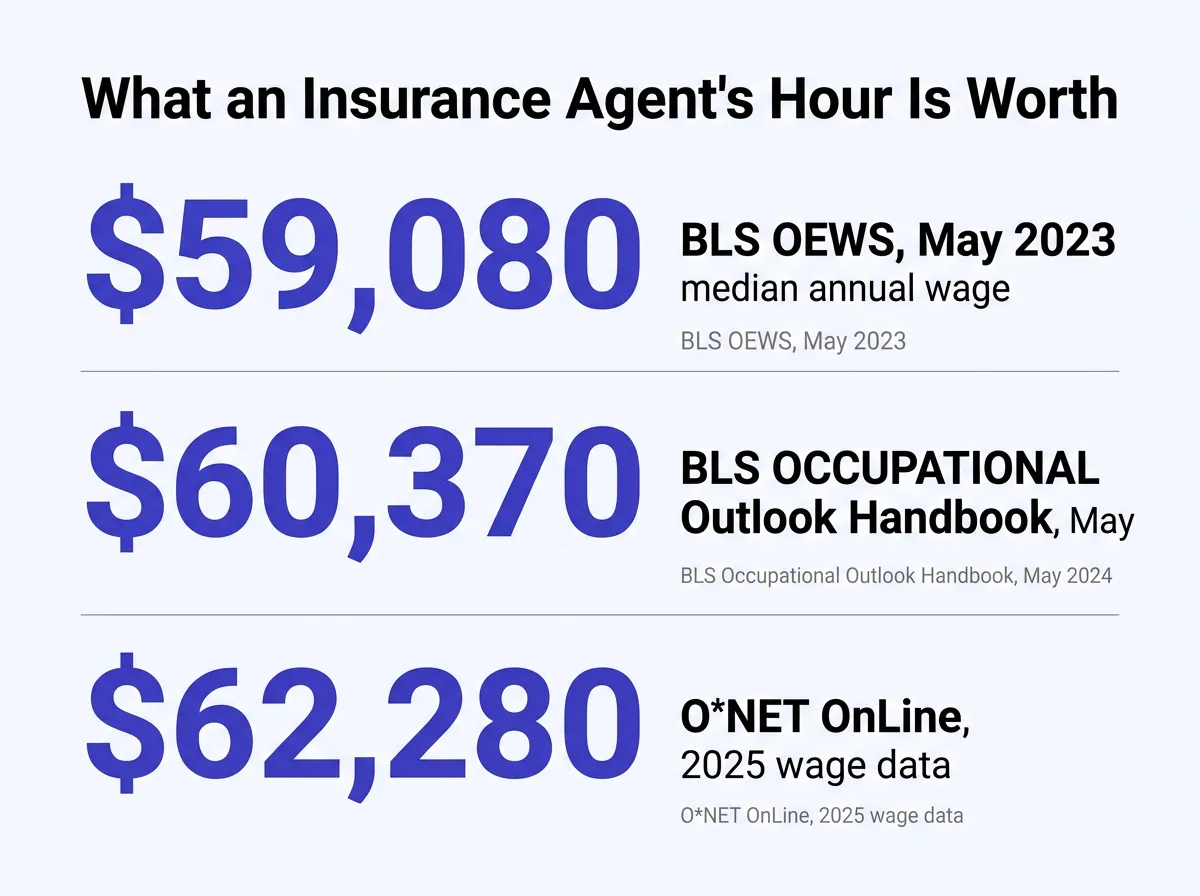
The Bureau of Labor Statistics tracks wages for insurance sales agents (SOC 41-3021) two ways: the Occupational Outlook Handbook, updated with May 2024 figures, and the more granular Occupational Employment and Wage Statistics survey, whose most recent published percentile breakdown is dated May 20231. Both agree on the order of magnitude, and both are worth knowing, because the spread between a new agent and an established one is wide.
The Occupational Outlook Handbook puts the current median at $60,370 a year2. The more detailed OEWS survey, one plan year prior, reported a median of $59,080 a year, or $28.40 an hour, with a mean of $79,700 a year across the full range of agents, from brand new producers to top earners1. The Department of Labor's O*NET database, which draws on the same underlying wage series, lists a 2025 figure of $62,280 a year3. Three separate government pages, three points in time, and the number moves in a narrow, consistent band. That's what a well sourced wage figure looks like.
The two BLS releases measure slightly different things, and it's worth knowing why they don't match exactly. The Occupational Outlook Handbook is the plain-language summary BLS updates most often, meant for someone deciding whether to enter an occupation. The Occupational Employment and Wage Statistics survey behind it is the underlying data collection, built from actual employer payroll reports across hundreds of thousands of establishments, and it's the source with the percentile breakdown. When a number matters to a business decision, checking both is the right habit, not a shortcut around either one.
| Percentile | Hourly wage | Annual wage |
|---|---|---|
| 10th | $16.80 | $34,940 |
| 25th | $20.89 | $43,440 |
| Median (50th) | $28.40 | $59,080 |
| 75th | $40.11 | $83,420 |
| 90th | $64.62 | $134,420 |
Read that table by finding yourself in it, not by using the median as a universal stand in. A newer agent nearer the 25th percentile is still pricing their own hour at close to $21. An established agent nearer the 75th or 90th is pricing it at $40 to $65. The gap between what an hour of your time is worth and what a VA or automation costs only gets wider as you move up that table, which is the opposite of the intuition most owners have.
The math on a week of admin work
Here's the part most owners never sit down and do. Take the OEWS median, $28.40 an hour, and multiply it by whatever block of non-selling admin time you actually spend in a normal week. Eight hours is a reasonable middle estimate for an agent handling their own renewals, data entry, and recordkeeping, though your own number could be higher or lower. At eight hours, that's $227.20 a week spent on work priced at a producer's rate. Over a 50-week year, that's $11,360, not in cash you write a check for, but in selling time you never get back.
Now compare that hour to what it should cost. The Bureau of Labor Statistics separately tracks bookkeeping, accounting, and auditing clerks, the occupation whose entire job is "compute, classify, and record data to help organizations keep complete and accurate financial records"4, which is a near exact description of CRM entry and renewal processing. The median wage for that occupation was $49,210 in May 20244, against $60,370 for an insurance sales agent in the same release2. On a standard 2,080 hour work year, that's roughly $23.66 an hour for clerk-level work, against $29.02 an hour for a producer's time, both figures derived from the same BLS pay period.
| Occupation | Median annual wage | Derived hourly* | 2024 to 2034 outlook |
|---|---|---|---|
| Insurance sales agent | $60,370 | $29.02 | +4%, about 47,000 openings a year |
| Bookkeeping, accounting & auditing clerk | $49,210 | $23.66 | Projected to decline 6% |
That last row is worth sitting with. The BLS projects clerk-level recordkeeping roles to shrink over the next decade, not because the work disappears, but because software and automation absorb more of it every year4. Insurance sales agent roles, meanwhile, are still projected to grow2. The work isn't going away. The question is only whether it stays priced at your rate, or moves to the rate it actually costs.
Run the same math at a few different weekly loads, using the OEWS median of $28.40 an hour, and the number moves fast. Five hours a week of admin work costs $142 a week, or $7,100 across a 50-week year. Eight hours costs $227.20 a week, or $11,360 a year, the scenario above. Twelve hours, which is not unusual during a renewal push or an enrollment period, costs $340.80 a week, or $17,040 a year. None of those totals include the leads that went uncalled while the hour was spent, which is the part that doesn't show up in any wage table at all.
What has to stay with you, and what doesn't
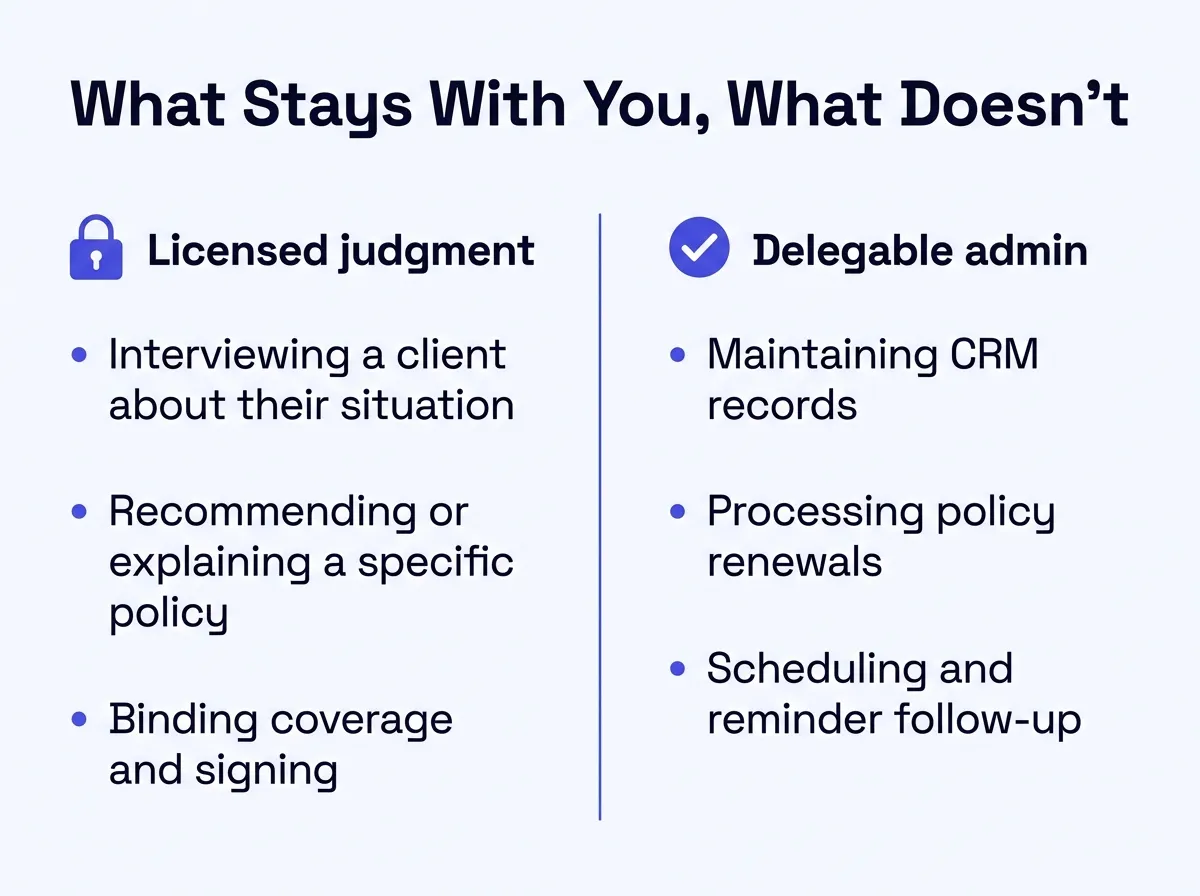
The Department of Labor's O*NET database lists the actual task set for insurance sales agents, and it splits cleanly into two categories3. The first needs a license and your judgment. The second is administrative, and it's exactly the category a trained VA or an automation can take over without touching anything that requires you personally.
Stays with you
Interviewing a prospect about their situation, recommending or explaining a specific policy, and any conversation that amounts to advice.
Stays with you
Binding coverage, changing beneficiaries, and anything that requires your license number and your signature.
Delegable
"Perform administrative tasks, such as maintaining records and handling policy renewals," in O*NET's own wording for this occupation3.
Delegable
"Maintain records of sales or other business transactions," the exact CRM upkeep that eats the evening hour3.
Delegable
Data entry into named industry CRM platforms O*NET lists for this role, including Applied Systems Vision and Insurance Technologies ForeSight Enterprise3.
Delegable
Scheduling, reminder sequences, and the first draft of a follow-up message, reviewed and sent by you or approved in bulk.
Notice what isn't on the delegable list: talking a client into a decision, or making one for them. That line doesn't move. What moves is everything downstream of the decision, which is most of the paperwork that actually eats an evening.
Finding your own split doesn't require guessing. For two weeks, keep a running note, on paper or in a phone, of every task you touch and how long it takes. At the end of each day, mark each entry with an L for licensed judgment or a D for delegable admin. Most agents who actually do this, rather than estimate from memory, are surprised by how much of the D column there is, and by how much of it repeats in nearly the same form week to week. That repetition is exactly what a trained VA, backed by automation, is built to absorb.
Virtual assistant, AI automation, or a hire
Three different fixes get pitched for the same problem, and they aren't interchangeable. A human virtual assistant is good at judgment calls inside a defined process, like reading a renewal file and flagging what actually changed before it goes into the CRM. Automation is good at repeatable, rules-based work: sending a reminder on a fixed schedule, syncing a field between two systems, generating a first-draft follow-up. A full-time in-house hire makes sense once the volume is high and steady enough to fill a real job, which for most independent agencies is further down the road than owners assume.
Every task on your desk
- CRM entry happens whenever you find an hour, often at night
- Renewals get processed in a batch, close to the deadline
- No one reviews whether a task still needs to exist
- The cost is real but never appears on a line item
Priced atYour own hourly rate, every time
Delegable work off your desk
- A trained person handles recordkeeping and renewal prep on a schedule
- Automation handles the reminders and syncing in the background
- You still make every decision that requires your license
- The cost is a known number you can compare to your own hour
Priced atScoped to the actual work, not a flat retainer
Most agencies that get real hours back use a VA and automation together, not one instead of the other. Automation alone can't read a messy renewal file. A VA alone, without automation handling the repetitive parts, ends up doing manual work that software should have absorbed years ago. The combination is the point.
Say the honest part too: if your book is small and your admin load really is under an hour a week, none of this pencils out yet. The math in this guide is for the agent who already knows the answer is more than an hour, and just hasn't priced it.
The math changes again once you're running more than one book, which is the normal case for an FMO or IMO managing agents across several offices rather than the exception. A single agent weighing eight admin hours a week is one calculation. An organization with twenty producers each carrying a similar load is the same calculation twenty times over, and it's usually where the case for a shared VA and automation layer, instead of each agent solving this alone, becomes obvious. The same reactivation and follow-up automation that keeps a single agent's dead leads working, covered in our guide to database reactivation, scales the same way across a multi-office book.
This is a conversation, not a form
If you want a scoped, no obligation walkthrough of what a VA and automation setup would actually look like against your book, that's easier on a call than in an email. Book an appointment.
The risk of handing this off carelessly
The reason agents hesitate on delegation isn't laziness, and it deserves a straight answer. An insurance CRM holds health information, income data, and beneficiary details. Handing a login to an outside contractor with no access controls and no signed Business Associate Agreement is a real exposure, not a paperwork formality, on anything touching Medicare, ACA, or general health coverage.
The fix isn't avoiding delegation. It's setting it up so the VA and any connected automation never touch raw protected health information in the first place. Ambrose, the platform Strategic AI Architects builds on, does this through a PHI gating function that passes coded, safe data between connected systems, so a CRM, a VA's task queue, or an automation gets what it needs to function without ever holding the raw record. Say this plainly: HIPAA compliant, never HIPAA certified, because no vendor can certify a practice as a whole.
If you're evaluating any VA service, insurance-specific or general, ask directly whether they'll sign a BAA and what data actually crosses to a human versus staying masked. A service that can't answer that clearly isn't ready for an insurance CRM, whatever else it offers. The same scrutiny applies to any tracking or analytics tool already running on your site; for enterprise level clients we will do a Business Associate Agreement covering exactly that, detailed in our BAA and NDA.
How we build the handoff
Strategic AI Architects builds VA + AI as a paired system, not a headcount you hire and hope integrates. A trained virtual assistant handles the judgment-level admin work, CRM hygiene, pipeline and task management, and routine tech support. Automation runs underneath it for the repeatable parts: reminders, data syncing, and appointment workflows, so the VA isn't doing by hand what software should already be doing5.
Pricing is scoped and priced on a call to the actual work required, not a bloated retainer for capacity you don't use, which is the same model the site states for custom builds generally: freelancer or agency alternatives for comparable custom work often run $5,000 to $25,000 or more upfront, delivered over weeks, against a scoped build delivered in days5. Everything runs on your own accounts, your own domain, and your own CRM. You own it, and it keeps working whether or not the relationship continues5.
None of this replaces you making the calls that require your license. It replaces the hours around those calls that don't.
The build itself runs through Ambrose, the AI platform behind the automation layer, and Claude Code on the engineering side. The strategy call is where the actual scope gets set: which tasks the VA takes, which run through automation, and which stay untouched because they belong to your license. Nothing ships until that scope is agreed, which is also why the price is a number you hear before work starts, not an estimate that grows once you're committed.
What the first month actually looks like
Handing off admin work fails when it starts with "here's my login, figure it out." It works when it starts with the two-week task log described above, turned into an actual plan before anyone touches your CRM. The order matters more than the speed.
Week one is the audit. You (or a VA working alongside you) run the two-week log, or a compressed version of it, to get a real list of what repeats: renewal reminders, data entry after a call, quote follow-ups, policy document filing. This is also when access gets scoped, meaning a VA or an automation tool gets exactly the permissions a task needs and nothing more, with PHI masked at the connection point rather than handed over whole.
Weeks two and three are a shadow period. The VA or the automation runs the delegable tasks with you reviewing the output before anything goes final, the same way you'd check a new hire's work before trusting it unsupervised. This is the part agencies skip when they're in a hurry, and it's the part that determines whether month two feels like relief or like cleanup.
By week four, the review step should be shrinking to spot checks rather than a full review of everything, and the tasks that were eating your evenings should be landing in the CRM before you ever see them, correct and on time. If they're not, that's a sign the task list from week one needs revisiting, not that delegation itself failed. Most of the friction in a bad handoff traces back to skipping the audit, not to the VA or the automation doing the work.
What you get back
The honest outcome isn't a promised income number, a lead count, or a ranking, because none of those are something any vendor can guarantee. What changes is concrete and measurable in your own week.
$29
Roughly what your own hour is worth, BLS median, 2024
2
Task categories: what stays licensed, what doesn't
1
PHI gate between your CRM and any connected VA or AI tool
Days
Typical scoped build time, not weeks
A clean CRM that's actually ready for automation to work on top of it. Selling hours back on the calendar, spent talking to the leads that already came in instead of catching up on the ones from last week. And a straight answer on what any of this costs, priced to your agency instead of guessed at.
Picture the same Tuesday from the top of this guide, six months later. The renewal dates synced into the CRM automatically when the carrier file came in. A VA flagged the two files that actually needed your eyes, with notes attached, before you sat down. The two leads from that afternoon got called at four o'clock instead of getting an apology text at nine. Nothing about your license changed. What changed is which hour got which task.
Questions agents ask
How much does a virtual assistant cost for an insurance agency?
There is no single flat number, because the fair price depends on hours and how much of the work automation can absorb. What is measurable is the cost of not doing it: the median U.S. insurance sales agent's own time is worth $60,370 a year, or roughly $29 an hour on a standard work year, per the Bureau of Labor Statistics (May 2024). Every hour spent on CRM entry instead of a sales call is billed at that rate whether you track it or not.
Is it HIPAA compliant to let a virtual assistant touch client data?
It can be, but only with the right setup. A VA who can see raw protected health information needs a signed Business Associate Agreement and access controls, the same as any vendor. Strategic AI Architects builds this through Ambrose's PHI masking, which passes coded, safe data between connected systems so a VA or an automation gets what it needs without ever holding raw PHI. Say plainly: HIPAA compliant, never HIPAA certified.
What insurance agency tasks actually require a licensed agent?
Anything that gives advice, recommends a specific policy, or binds coverage has to stay with a licensed producer. The Department of Labor's O*NET database lists an agent's core duties as interviewing clients, explaining policy terms, and analyzing coverage needs, alongside separate administrative duties like maintaining records and processing renewals. The second category is exactly what a trained VA or automation can take over.
Is AI automation enough, or do I still need a human virtual assistant?
It depends on the task. Automation is strong at repeatable, rules-based work: reminders, data syncing, follow-up sequences. A human VA is better at judgment calls inside a process, like reading a renewal file for what actually changed. Most agencies that get real hours back use both together, which is the model Strategic AI Architects builds: a trained VA paired with automation, not one instead of the other.
How much time do insurance agents actually spend on admin work?
Neither the Bureau of Labor Statistics nor O*NET publishes a time-share breakdown for this occupation, so any specific percentage you read elsewhere is not sourced. What both do confirm is that recordkeeping, policy renewals, and CRM maintenance are named parts of the job. The reliable way to get your own number is a two-week log of every non-selling task, timed honestly.
Why would I pay a producer's hourly rate to enter data a clerk could do?
Because that is exactly what happens when a licensed agent does clerk-level work personally. The median bookkeeping, accounting, and auditing clerk earns $49,210 a year, against $60,370 for an insurance sales agent, both per BLS figures for May 2024. An agent doing that work themselves is paying producer-level cost for clerk-level output, every single time.
How fast can Strategic AI Architects set up a VA + AI system?
Builds are scoped and priced on a call, then typically delivered in days rather than the weeks a freelancer or agency alternative usually takes, which the same alternative path often runs $5,000 to $25,000 or more upfront for. Everything is built on your own accounts, your domain, and your CRM, so you own it whether or not the relationship continues.
What if my agency is too small for this yet?
Then it probably is, and that is a fine answer. If a two-week honest log of your own week shows an hour or less of true non-selling admin work, the math in this guide has not caught up to your book yet. The point is not to push every agency toward a VA. It is to make sure the decision gets made with a real number in front of it, not a guess.
Sources
- U.S. Bureau of Labor Statistics. "Occupational Employment and Wage Statistics, Insurance Sales Agents (41-3021), May 2023." bls.gov.
- U.S. Bureau of Labor Statistics. "Occupational Outlook Handbook: Insurance Sales Agents," May 2024 wage data. bls.gov.
- O*NET OnLine, sponsored by the U.S. Department of Labor. "Summary Report for Insurance Sales Agents (41-3021.00)." onetonline.org.
- U.S. Bureau of Labor Statistics. "Occupational Outlook Handbook: Bookkeeping, Accounting, and Auditing Clerks," May 2024 wage data. bls.gov.
- Strategic AI Architects. "Your Ambrose and AI Expert," service page. strategicaiarchitects.com.
Talk it through
Want a second pair of eyes on it?
Free 30 minutes. Bring what you found, or bring nothing and we will look together at how AI engines read your site and which fixes move first.
See what's actually delegable in your agency
Run the free Audit, then talk through a scoped VA + AI setup priced to your own book.