Playbook
Why Your Insurance Agency's Virtual Assistant Isn't Working
It's rarely the person. It's the role, the access, and the training nobody set up first.

20 min read

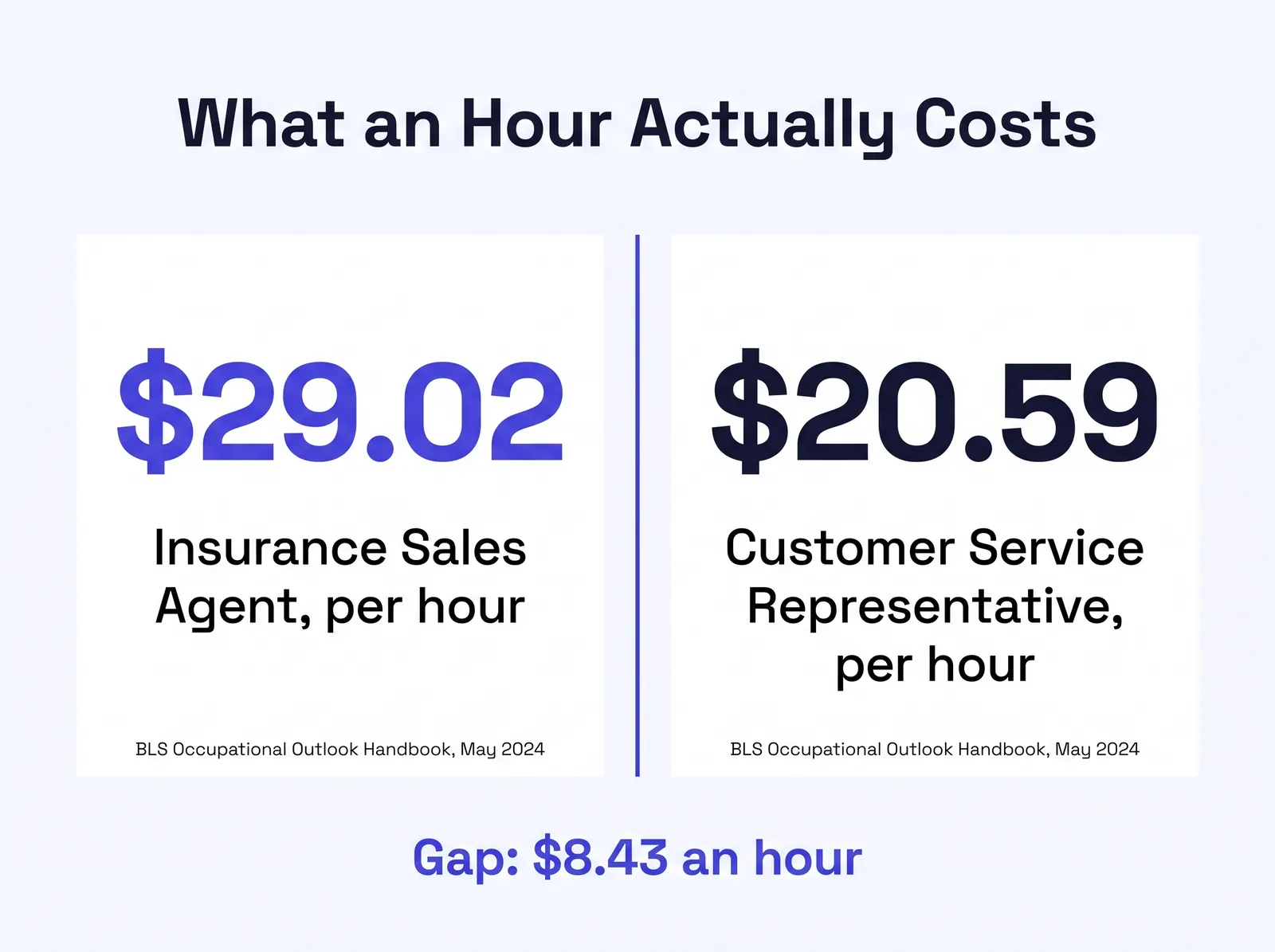
A virtual assistant that "isn't working out" is almost always a setup problem, not a people problem. Three things get skipped in order: the role is never actually scoped, CRM access is handed over all at once instead of staged, and nobody separates what state producer licensing law allows an unlicensed person to do from what it doesn't. Fix those three and pair the VA with automation, and the math works: BLS puts an insurance agent's own hour at $29.02, more than a customer service representative's $20.59, both May 2024 data.
What "not working out" actually looks like
You hired someone to take work off your plate. Three months in, you're spending more time checking their work, re-explaining the same task, and worrying about what they have access to than you spent doing the work yourself. So you conclude the obvious thing: virtual assistants don't work for an insurance agency, or you got unlucky with the person.
That conclusion is usually wrong, and it's an expensive one, because it stops you from trying again with a setup that would have worked the first time. In agency after agency we look at, the person isn't the variable that broke. The role was never written down past "help with marketing and whatever else comes up." Access to the CRM went from zero to everything on day one. And nobody spent an hour explaining which parts of your job are licensed work a VA legally can't touch, so the VA guessed, and guessed wrong at least once.
None of that is a hiring platform problem, an offshore-versus-domestic problem, or a "good VAs are hard to find" problem, though all three get blamed. It's a setup problem, and setup problems are fixable before you hire, not after you're three months into being frustrated with someone who was set up to fail from the first day.
Before you read further
If you want to know where your own site and back office stand today, the free Audit scores AEO readiness and HIPAA tracking exposure in about a minute. Run a free Audit.
Why this happens to careful owners too
It's tempting to assume this only happens to agencies that rush. It doesn't. Careful, detail-oriented owners run into the same wall, because the failure isn't carelessness, it's a wrong assumption carried over from how hiring works in other industries. A general business VA, the kind most hiring platforms are built around, really can start on generic admin work with minimal onboarding, because the tasks (managing an inbox, scheduling meetings, formatting a spreadsheet) don't touch licensed activity or protected health information. An owner who has hired that kind of help before, or read about it, reasonably expects an insurance VA to work the same way.
It doesn't, for two reasons that compound each other. First, insurance work carries a licensing boundary that generic admin work doesn't, so "figure it out as you go" isn't a safe onboarding method here the way it is for a general assistant. Second, most VA hiring platforms and staffing agencies are built for volume placement across every industry at once. They're set up to source and vet for general skills quickly, not to hand you an insurance-specific onboarding packet, a licensing briefing, and a staged access plan. That part is left to the agency, and it's the part that quietly determines whether the hire works.
There's a second, subtler reason it happens to careful owners specifically: they're often the ones busiest running the agency, which is exactly why they're looking for help in the first place. Writing a detailed role scope and a staged access plan takes the kind of uninterrupted hour that's hardest to find when you're already underwater. So the setup work gets deferred "until things calm down," the VA starts anyway because the need is real today, and the agency ends up running the experiment backward: hire first, figure out the job second.
The three setup failures behind it
Talk to enough agency owners about a VA who "didn't work out" and the same three failures show up, almost always stacked together rather than alone. None of them require a bad hire. All three are things the agency controls before anyone starts.
The undefined role
"Help with marketing and whatever else comes up" isn't a job. It's a request for someone to read your mind, and every VA guesses differently.
The all-at-once access
Full CRM access on day one, before trust or process exists, turns one mistake into a mistake touching your whole book instead of one lead.
The missing insurance context
A VA trained on general admin work doesn't know a SEP from an OEP, or that "just tell them the premium is lower" is a licensing problem, not a helpful answer.
Put a face on each one, because they look different in practice than they sound on a slide. The undefined role shows up as a VA who spends their first week reorganizing your email folders, because that's what "help with whatever comes up" looked like to them, while the CRM entry backlog you actually needed cleared sits untouched. The all-at-once access shows up as a VA who, trying to be helpful, updates twelve contact records based on a guess about what a confusing field meant, and now you're not sure which of your existing notes are accurate anymore. The missing insurance context shows up as a VA who tells a caller "yes, that plan covers it" because the note in the file said so, without knowing that plan details change by county and by year, and that answering the question at all was a licensing problem before it was an accuracy problem.
Each failure alone is survivable. A vague role with staged access and good training still eventually gets clarified through trial and error. Full access with a clear, scoped role rarely causes real damage, because the VA knows exactly what they're supposed to touch. It's the combination, an undefined role, full access, and no insurance-specific grounding, all at once, that turns a hire into a liability instead of an asset. That combination is also, not coincidentally, the fastest way to onboard someone, which is exactly why so many agencies default to it.
The licensing line most agencies cross by accident
Every state licenses insurance producers, and every state's producer licensing framework draws the same basic line: an unlicensed employee can provide technical and administrative support to a licensed agent, but selling, soliciting, or negotiating insurance stays with the license holder. That line sounds clean in the abstract. It gets blurry fast in an actual CRM workflow.
"Can you follow up with the lead from Tuesday and let them know their options?" is an instruction an owner gives without thinking twice. Depending on what the VA says next, it's either a scheduling task or an unlicensed person discussing plan benefits, which is the exact activity the licensing line exists to keep inside a license. The agency rarely notices the line got crossed, because nothing visibly goes wrong. The exposure sits there anyway, attached to the agent of record, not the VA who made the call.
For Medicare-specific work, this gets a second, more explicit layer on top of general state licensing. CMS requires that anyone marketing a Medicare Advantage or Part D plan, meaning anyone discussing specific plan benefits with the intent to enroll someone, be licensed, certified, or registered under state law and trained and tested annually on the rules for the plans they represent4. A VA who has never taken that training and isn't licensed cannot be the one explaining what a plan covers, full stop, regardless of how helpful the answer sounds.
What this doesn't mean
It doesn't mean a VA can't touch your book at all. Scheduling a call, updating a renewal date, sending a message you drafted and approved, confirming a mailing address, flagging a lead that needs your attention: none of that is selling, soliciting, or negotiating insurance. The line is about who's doing the persuading and advising, not who's allowed near the CRM.
Advising and persuading
- "That plan covers what you're asking about"
- "I'd go with the second option if I were you"
- Comparing two plans' benefits over the phone
- Enrolling someone or confirming they're enrolled
- Answering "does Medicare cover this" unprompted
Licensed workStays with the agent, no exceptions
Informing and organizing
- "I've got you scheduled for 2pm Thursday with Mike"
- "I'll have him call you back about that today"
- Updating a renewal date or a mailing address
- Sending a message the agent already drafted and approved
- Flagging a file for the agent's review, with no opinion attached
Administrative workFine for an unlicensed VA
A quick test that holds up in almost every real conversation: if the VA's answer requires knowing anything about what a specific plan covers, costs, or excludes, it's licensed territory. If the answer is purely about scheduling, status, or a fact that doesn't require insurance knowledge to state, it's administrative. When a VA isn't sure which side of that line a question falls on, the correct move is to say "let me have the agent call you back on that," every time, not to guess toward being helpful.
This same discipline extends to how follow-up gets sent, not just what gets said on a call. A VA drafting messages that go out under your name and license carries its own consent and compliance considerations, which we cover separately in our guide to AI follow-up and TCPA risk. The short version: who's allowed to say what is one boundary, and how and when a message can legally be sent is a second, related one. A well-scoped VA role accounts for both.
What a mis-set-up VA actually costs
A VA who spends their week on tasks that don't need a producer's judgment is a good trade on paper. The Bureau of Labor Statistics puts the median U.S. insurance sales agent's time at $60,370 a year, or $29.02 an hour, in its most recent Occupational Outlook Handbook wage release, dated May 20241. Customer service representatives, the occupation closest to the CRM and admin work a well-set-up VA actually does, carry a separate median of $42,830 a year, or $20.59 an hour, same source, same period2.
That $8.43-an-hour gap is the whole argument for delegating admin work in the first place. Every hour a producer personally spends on CRM entry instead of a sales call is billed, in effect, at producer rates for CSR-level output. Over an eight-hour week of admin work, that gap alone is $67.44. Across a fifty-week year, it's $3,372, and that's before counting the selling time that never happened because the hour went to data entry instead of the phone.
There's a second cost that doesn't show up in a wage table: the cost of a VA engagement that stalls or ends because the setup failed, not the person. A Clutch survey of 517 U.S. small-business leaders, fielded in December 2022, found 83% planned to maintain or increase their spending on outsourced business services the following year3. Small businesses broadly are betting on delegation working. An agency that tries it once, under a bad setup, concludes it doesn't, and stops, is opting out of something that's working for most of its peers, over a fixable mistake.
The wage gap and the churn risk aren't the only costs, they're just the two you can put a number on. There's a third cost that's harder to price but easy to recognize once you've lived it: the hours an owner spends re-explaining the same task three different ways, double-checking work they no longer trust, and eventually redoing it themselves anyway. That time comes out of the same producer hour priced at $29.02, and it's spent on top of, not instead of, the admin work the VA was hired to absorb. A VA who needs constant correction isn't neutral. They're a net drain on the exact hour you were trying to protect.
| Hours per week | At producer rate ($29.02/hr) | At CSR rate ($20.59/hr) | Weekly gap |
|---|---|---|---|
| 5 hours | $145.10 | $102.95 | $42.15 |
| 8 hours | $232.16 | $164.72 | $67.44 |
| 15 hours | $435.30 | $308.85 | $126.45 |
Run your own admin hours through that table and the case makes itself. At fifteen hours a week, the producer-rate-versus-CSR-rate gap alone is $126.45 a week, or $6,322.50 across a fifty-week year, before counting the selling time that never happened because those fifteen hours went to the CRM instead of the phone. That's the number a properly scoped VA and automation pairing exists to close.
A self-check for your current setup
If you already have a VA in the seat and things feel off, run through this before deciding whether to fix it or end it. Most agencies that think they need a new VA actually need a new setup around the same person.
Six questions worth answering honestly
- Could you hand a new hire a written list of your VA's actual responsibilities today, or would you have to think about it first?
- Does your VA have access to CRM records they've never actually needed for a task you've assigned them?
- Has your VA ever answered a question about what a plan covers, costs, or excludes, even once, even informally?
- Could you point to the specific training that told your VA where the licensing line sits?
- Is your VA doing any task, like manual renewal-date entry, that a synced automation could do without a person touching it?
- If your VA left tomorrow, do you know exactly what access to revoke, or would you have to guess?
Two or more "no" answers means the setup, not the person, is the thing to fix first. Zero or one "no" answer, and a VA who's still struggling is a separate, more ordinary management problem, the same one you'd troubleshoot with any employee.
Fix one: scope the role before you hire
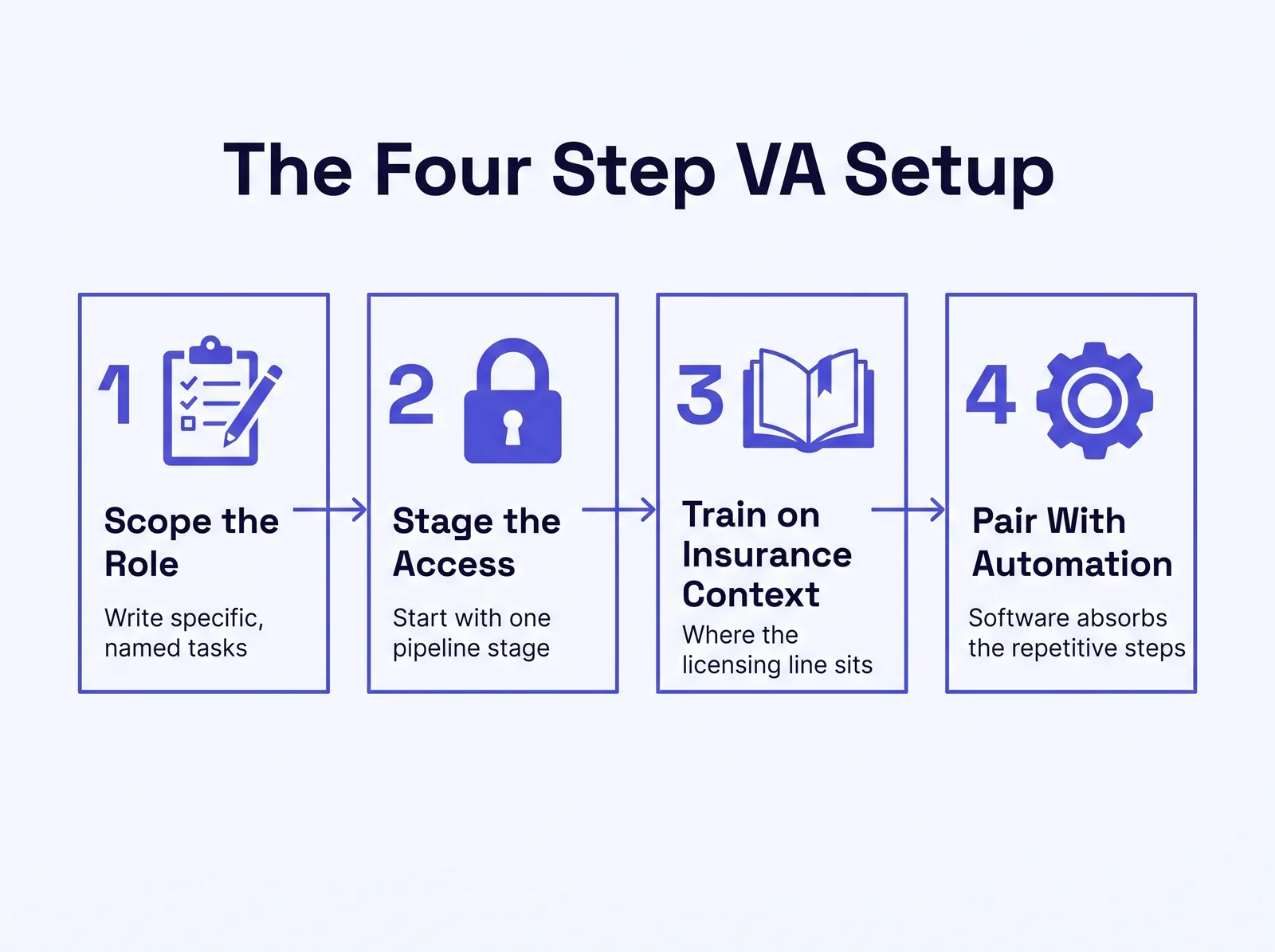
"Help with marketing and whatever else comes up" fails because it hands a stranger the job of deciding what your business needs, before they know your business. Write the role down as a list of named, specific tasks instead. Not "handle the CRM," but "update renewal dates within 24 hours of a carrier file landing," "tag every new lead with source and product line within one business day," and "flag any contact with no activity in 60 days for my review."
This takes an hour, maybe two, and most agency owners skip it because it feels like overhead before you've even hired anyone. It isn't overhead. It's the difference between a VA who can start producing in week one and a VA who spends six weeks trying to figure out what "whatever else comes up" means, then guessing, then getting corrected, then guessing again.
A useful test: if you can't write the task as a sentence with a clear start and a clear finished state, it isn't ready to hand off yet. "Help with follow-up" isn't ready. "Send the three-day follow-up template to every new lead who hasn't responded, then mark the task complete" is.
A first-thirty-days scope for a typical agency VA role looks something like this, and it's deliberately narrow. Week one: CRM data audit, flag duplicate contacts, tag every lead with source and product line for the last ninety days. Week two: take over renewal-date entry for a single carrier's files, with the owner reviewing every entry before it's finalized. Weeks three and four: expand renewal entry to the remaining carriers once week two's error rate is at or near zero, and begin drafting, not sending, follow-up messages for the owner's review. Nothing in that thirty-day scope requires a license, and nothing in it requires guessing.
Fix two: stage the access, don't hand over the keys
Full CRM access on day one is the single most common mistake, and it's understandable, because staging access feels slower and more annoying to set up than just sharing a login. It's also the difference between a mistake that touches one lead and a mistake that touches your whole book.
Start narrow. Give a new VA access to one pipeline stage, or one task queue, not the full contact database. Watch how the first two weeks of work go against the scoped role you wrote in fix one. Expand access in deliberate steps as specific workflows prove out, not all at once because it's Tuesday and you're busy. A CRM that actually holds context on every contact, the way we cover in our guide to AI context in the CRM, makes staged access easier, because permissions can follow the same structure the workflows already use instead of being bolted on afterward.
Staged access also protects the VA, not just you. Someone handed the entire CRM on day one and told to "get familiar with things" has no way to know which parts of that access they're actually expected to touch. A narrow, explicit scope removes the guesswork on both sides of the relationship.
| Stage | Access granted | Gate to move forward |
|---|---|---|
| Week 1 | Read access to one pipeline stage | Task list completed, no unresolved questions |
| Weeks 2 to 3 | Edit access to renewal dates, one carrier | Owner-reviewed error rate near zero |
| Month 2 | Full pipeline visibility, drafting privileges | No licensing-line incidents in stages one and two |
| Ongoing | Task-specific access, reviewed monthly | Access still matches the current, documented role |
You can do this yourself
Everything in fixes one through three is something you can set up without hiring anyone to help you set it up. Most agents read this and decide they'd rather have someone build the automation piece for them. Either outcome is fine, but the role and access work is yours to do regardless of who ends up in the VA seat.
Fix three: pair the VA with automation
A VA who spends their week manually re-typing renewal dates from carrier portals into a CRM is doing work software should be doing. That's not a knock on the VA. It's a sign the role was scoped around what a human has to do by hand instead of what actually needs a human's judgment.
The useful split: automation handles the repetitive, rule-based steps, syncing renewal dates, creating a task when a lead goes quiet for a set number of days, sending the templated first-touch message the moment a new lead lands. The VA handles the judgment calls automation can't make: reading a note and deciding whether a contact actually needs the owner's attention, catching the lead that looks like a duplicate but isn't, deciding which of three flagged files to escalate first. Database reactivation is a clean example of this pairing at work; we walk through the actual multi-channel version of it in our reactivation playbook.
Skip the automation half and a VA caps out at whatever one person can manually process in a week, which is exactly the ceiling most "it didn't scale" complaints run into. Add the automation half and the VA's time goes almost entirely to the parts of the job that actually need a person paying attention.
The same pairing shows up in other places agencies already feel the strain. A lead who calls after hours and gets voicemail is a task for automation, not a VA working a normal shift, which is the exact gap we cover in our guide to after-hours call cost. And a CRM automation that quietly breaks the moment two contact records merge is a maintenance problem no VA can fix by working harder, which we walk through in our guide to why CRM automation keeps breaking. A VA who understands which category a problem falls into, a broken workflow versus a task that needs a human, is worth more than one who just works through the queue in front of them.
| Task | Owner | Why |
|---|---|---|
| Renewal date sync from carrier files | Automation | Rule-based, high-volume, no judgment required |
| Flagging a stalled lead for review | Automation, VA reviews | Trigger is rule-based; the response needs a human read |
| CRM data cleanup and deduping | VA | Judgment calls on which record is correct |
| Explaining plan benefits to a client | Licensed agent only | Selling, soliciting, or negotiating insurance stays licensed |
| Website and content updates | VA | Administrative task, no licensing exposure |
How we build VA + AI
This is the exact gap our VA support closes. We provide trained virtual assistants who handle the insurance-specific admin work your agency actually needs done: CRM hygiene and data entry, pipeline and task management, website updates, tech support, and the routine back-office work that eats a producer's selling hours. The VA is paired with automation from day one, so they aren't doing by hand what software should already be doing, and the role is scoped to your actual workflows before anyone starts, not figured out by trial and error over the first two months.
Anything that touches real client data runs through Ambrose, which masks protected health information before any non-BAA AI model ever sees it, the same PHI-safe path every custom build uses5. Builds are scoped on a strategy call and priced to the actual work, typically delivered in days rather than the weeks a freelance or agency alternative usually takes, and everything runs on your own accounts, your domain, and your CRM, so you own it whether or not the relationship continues5.
The role-and-access work described in fixes one and two isn't something we skip past either. Because the VA is paired with the same automation layer that runs your renewal syncing and follow-up sequencing, staged access maps naturally onto the workflows automation already touches, instead of being a separate policy someone has to remember to enforce. The licensing line gets built into the role scope from the first call, not discovered the hard way three months in.
Worth a conversation if this is you
This is the kind of setup work we handle for agencies who've tried a VA before and had it stall. If that's you, it's worth a conversation. Book a call.
What actually changes
Not a promised income number, a lead count, or a headcount reduction, because none of those are something any vendor can guarantee. What changes is concrete and specific to your own week.
$8.43
Hourly gap between producer and CSR-level wage, BLS May 2024
3
Setup failures that cause most "it didn't work" outcomes
1
PHI-safe gate between your CRM and any connected VA or AI tool
Days
Typical scoped build time, not weeks
A CRM that's actually clean enough for automation to work on top of it. A defined, documented role that a VA can succeed at from week one instead of guessing at for two months. And selling hours back on the calendar, spent on the leads that came in today instead of catching up on the ones from last week.
The same agency, six months after fixing the setup instead of firing the VA: renewal dates sync automatically when the carrier file lands. A flagged file has a note attached before the owner sits down to look at it. The lead who called at nine in the morning gets a same-day call back instead of a next-week apology. Nothing about the license changed. What changed is which task went to which person, and which task never needed a person at all.
Questions agents ask
Can a virtual assistant legally discuss insurance plan benefits with a client?
Not if they aren't a licensed producer. State producer licensing law lets unlicensed staff give technical and administrative support, but selling, soliciting, or negotiating insurance, which includes explaining plan benefits to steer a decision, stays with a licensed agent. If your VA crosses that line, the agent of record answers for it, not the VA.
What tasks are safe to hand an unlicensed VA?
CRM data entry and cleanup, calendar and pipeline management, drafting (not sending as final advice) follow-up messages for your review, website and content updates, renewal date tracking, and call scheduling. The dividing line is simple: informing and organizing is fine, advising and persuading toward a specific plan is not.
How much CRM access should a new VA get on day one?
Less than you're tempted to give. Start with read access to a single pipeline stage or a specific task queue, not the full contact database. Expand access as the VA proves out specific workflows. A staged rollout catches a bad hire before they've touched your whole book, not after.
Is an offshore VA riskier for an agency than a domestic one?
Location isn't the risk variable. Access design is. A domestic VA with unrestricted CRM access and no audit trail is riskier than an offshore VA working inside scoped, logged permissions. The question to ask a VA service isn't where they're based, it's what happens to your data if the relationship ends tomorrow.
What's the actual difference between a VA and a VA paired with AI?
A VA alone still does repetitive CRM and pipeline work by hand, at whatever pace one person can sustain. Pairing the VA with automation means the VA reviews and handles the judgment calls, while software absorbs the repetitive steps, renewal reminders, data sync, task creation, so the VA's time goes to the work a human still needs to do.
How long before a properly set up VA actually saves time?
Most of the delay agencies blame on "the VA" is actually the setup: writing down the role, staging access, and documenting insurance-specific steps. Skip that and a VA takes months to become useful, if ever. Do it first and a VA is handling defined, scoped work inside the first two weeks.
What does Strategic AI Architects' VA support actually include?
Trained virtual assistants who handle the insurance-specific admin work: CRM hygiene, pipeline and task management, website updates, and routine back-office work, paired with automation so the VA isn't doing by hand what software should already be doing. Builds are scoped on a call and priced to the actual work.
Should I fire the VA or fix the setup?
Check the role definition and access design first. If a VA was handed a vague mandate and full CRM access with no training on insurance workflows, that setup would fail with almost anyone in the seat. Fix the setup once, and it's often the same person succeeding at a job that was never actually defined.
Sources
- U.S. Bureau of Labor Statistics. "Occupational Outlook Handbook: Insurance Sales Agents," May 2024 wage data. bls.gov.
- U.S. Bureau of Labor Statistics. "Occupational Outlook Handbook: Customer Service Representatives," May 2024 wage data. bls.gov.
- Clutch. "Clutch Report Uncovers the Surge of Small Business Outsourcing," survey of 517 U.S. small-business leaders, fielded December 2022. clutch.co.
- Centers for Medicare & Medicaid Services. "Medicare Communications and Marketing Guidelines," agent/broker licensing, training, and testing requirements. cms.gov.
- Strategic AI Architects. "Your Ambrose and AI Expert," service page. strategicaiarchitects.com.
Talk it through
Want a second pair of eyes on it?
Free 30 minutes. Bring what you found, or bring nothing and we will look together at how AI engines read your site and which fixes move first.
See what's actually delegable in your agency
Run the free Audit, then talk through a scoped VA + AI setup priced to your own book.