Playbook
Is Your Insurance Agency's Vibe Coded Website Leaking Data?
Veracode tested over 100 AI models this year and found 44% of coding tasks shipped a security flaw. GitGuardian counted 28.65 million leaked secrets on public GitHub in 2025. Before you chat your agency's next tool into existence, here's what that app is actually running on.

20 min read
Tools like Lovable, Bolt.new, and Replit can generate a full working app, frontend, backend, live database, and authentication, from a chat prompt in minutes.1 Veracode's 2026 GenAI Code Security Report tested more than 100 models and found an average security pass rate of 56%, meaning 44% of coding tasks produced a detectable vulnerability.2 GitGuardian logged 28,649,024 new hardcoded secrets on public GitHub in 2025 alone, up 34% year over year, with AI assisted commits leaking secrets at roughly twice the ordinary rate.3 Escape's scan of 5,600 publicly reachable vibe coded apps found 175 exposed instances of personal information, including medical records, and more than 400 exposed secrets, a figure the researchers call a conservative floor.4 None of that makes vibe coding useless. It makes it the wrong tool for anything that touches a client's name, health information, or payment detail, which is most of what an insurance agency's website actually does.
The shortcut that's tempting right now
AEP is three weeks out, your marketing budget already went to ads, and someone on your team just watched a video of a stranger building a working app in four minutes by typing into a chat box. It's a real capability, not a trick. You can describe a quote form, a client portal, or a referral tracker, and watch it get built in front of you, for free or for a handful of dollars a month. Compared to a multi week build with a developer, or a monthly retainer, the chat box looks like the obvious move.
That instinct isn't wrong about the technology. It's wrong about what the technology is actually handing you when it finishes. A finished looking app and a safe app are not the same claim, and the gap between them is exactly where the research below sits.
Before you keep reading
If you or someone on your team has already shipped a chat built tool that collects a client's name, phone number, date of birth, or anything health related, skip ahead to how to check your own site. It takes about ten minutes and needs nothing but a browser.
What's actually running behind the screen
"Vibe coding" is the practical term for building software by describing what you want in plain language and letting an AI assistant write and run the code. Lovable, one of the larger tools in this category, describes its own output plainly in its documentation: it creates "a working application that includes frontend, backend, database, authentication, and integrations," all backed by editable code.1 That's not a static page. It's a full application stack, generated in one pass, usually by someone who isn't reading the code it produces.
That matters because of what each of those four pieces means in practice. The frontend is what a visitor sees. The backend and database are where the actual data lives, every name, phone number, and answer a form collects. Authentication decides who's allowed to see it. When a human developer builds this stack by hand, each piece gets reviewed before it ships, and the database's access rules get set on purpose. When a chat prompt generates all four at once, the access rules are whatever the tool's default happened to be, and the only check on that default is whoever was chatting, usually once, usually under deadline, usually not a security engineer.
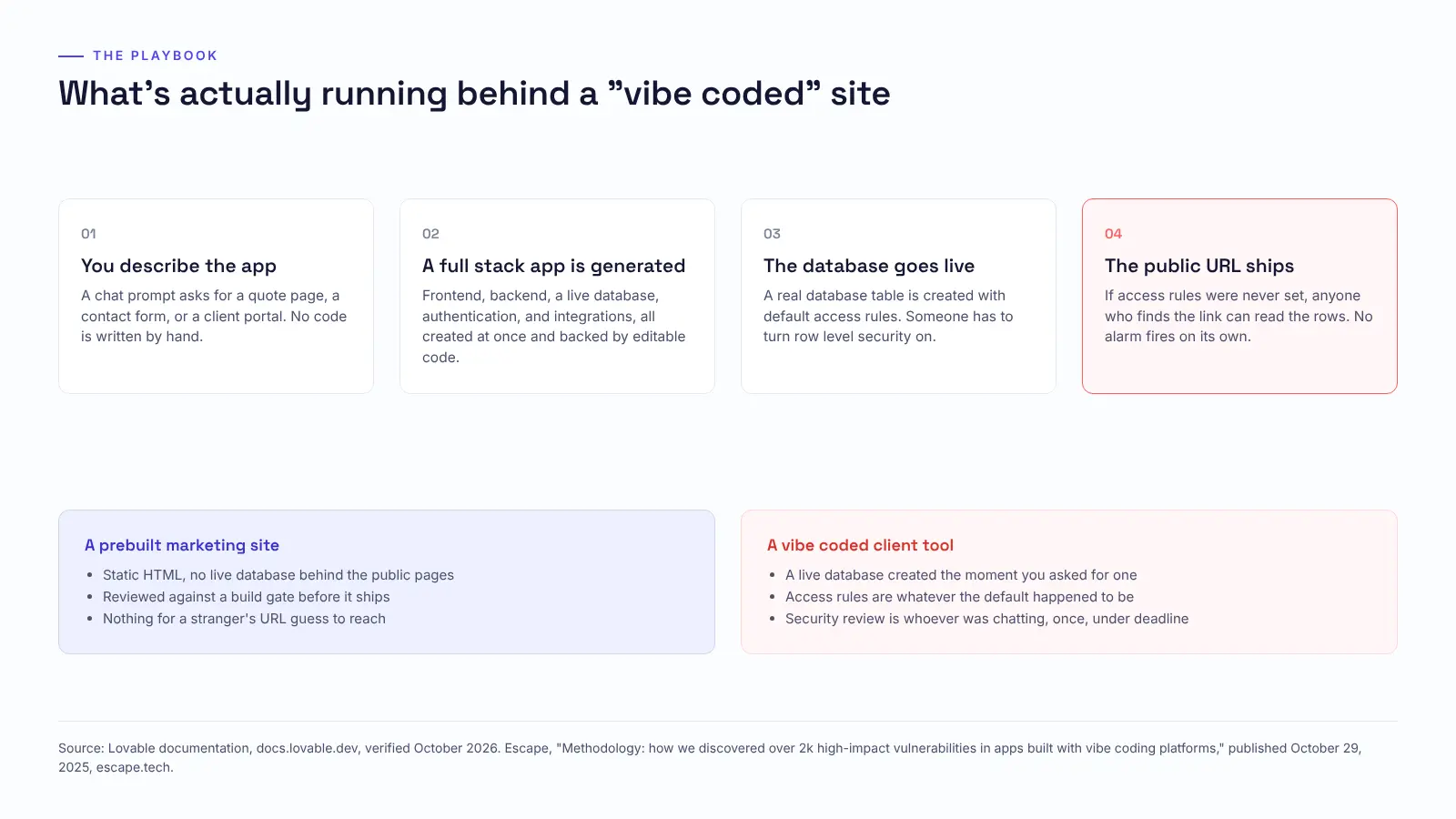
The database layer is the part worth sitting with. Modern app builders typically wire the generated backend to a managed database service, the kind that ships with "row level security," a setting that controls which rows of a table a given visitor is allowed to read or write. Row level security has to be configured. It isn't automatically locked down the moment a table exists, and a tool optimized to get you to a working demo as fast as possible has every incentive to leave that step for later, because a demo that works feels like success even when the data behind it is sitting wide open.
Why the code is usually insecure by default
This isn't a knock on any one platform. It's measured, repeatedly, across the entire category. Veracode's 2026 GenAI Code Security Report, published July 28, 2026, is the clearest single data point: testing code generation tasks across more than 100 large language models, the company found an average security pass rate of 56%, "barely changed from 55% in the first report."2 Put plainly, 44% of the code these models generated contained a detectable, exploitable vulnerability, and that rate hasn't moved in a year of model improvements. The pass rate wasn't even across vulnerability types. Cryptographic implementations passed 87% of the time and SQL injection defenses passed 83% of the time, both reasonably strong. Cross site scripting passed only 15% of the time, and log injection only 12%, meaning those two categories failed in the large majority of tasks tested.2
GitGuardian's research looks at a different layer of the same problem: not whether the logic is secure, but whether the credentials the code needs to run, API keys, database passwords, tokens, end up exposed in plain text. The company's fifth annual State of Secrets Sprawl report found 28,649,024 new hardcoded secrets added to public GitHub commits in 2025 alone, a 34% increase over 2024 and the largest single year jump the company has recorded.3 The AI specific finding is the sharper one: commits made with AI coding assistants leak secrets at roughly twice the rate of the GitHub wide baseline, and credentials tied specifically to AI services were exposed 1,275,105 times, up 81% year over year.3 An assistant that writes fast, working code has no built in reason to also remember that a key belongs in an environment variable instead of directly in the file it just generated.
| Study | Sample | Headline finding |
|---|---|---|
| Veracode, 2026 GenAI Code Security Report | Code generation tasks across 100+ LLMs | 56% avg. pass rate; 44% of tasks introduced a vulnerability |
| GitGuardian, State of Secrets Sprawl 2026 | Public GitHub commits, full year 2025 | 28.65M new secrets leaked, +34% year over year |
| Escape, vibe coding methodology study | 5,600 apps / 14,600 assets, 5 platforms | 175 PII instances, 400+ secrets, 2,000+ vulnerabilities exposed |
| IBM / Ponemon, Cost of a Data Breach Report 2026 | Global breach cost study | $4.99M average cost, a record high, +12% year over year |
This isn't a model quality problem that improves next year
Veracode's report is explicit that the pass rate is "virtually unchanged" from the prior year despite a full cycle of model upgrades.2 The vulnerability categories that fail most, cross site scripting and log injection, are also the ones that require understanding how an attacker would actually use a web form against the app, not just whether the code compiles and runs. That's a harder problem than writing working code, and nothing about faster or cheaper model inference fixes it on its own.
It helps to know why those two categories specifically fail so often. A model generating a contact form or a quote request page is optimizing for one thing: does the form submit and does the data show up where it's supposed to. Cross site scripting happens when user submitted text gets displayed back on a page without being neutralized first, so a malicious script typed into a name field runs in another visitor's browser instead of showing up as plain text. Log injection is the same idea applied to a server's internal logs. Neither failure stops the form from working in a quick test. The page still submits, the email still arrives, the demo still looks finished. The flaw only shows up when someone deliberately tries to break it, which is exactly the step a chat prompt has no reason to take on its own and a rushed human reviewer, if there even is one, is the most likely step to get skipped.
What's already happened to other builders
None of this is theoretical. Escape, an application security research firm, published a methodology study on October 29, 2025, describing a scan of 5,600 publicly available apps built on five vibe coding platforms, Lovable, Base44, Create.xyz, Vibe Studio, and Bolt.new.4 Across 14,600 total assets, the scan found more than 2,000 vulnerabilities, more than 400 exposed secrets, and 175 separate instances of exposed personally identifiable information, including medical records, IBANs, phone numbers, and email addresses.4 The researchers describe these numbers as a conservative lower bound, since the scan ran in passive mode rather than actively probing every endpoint it found.
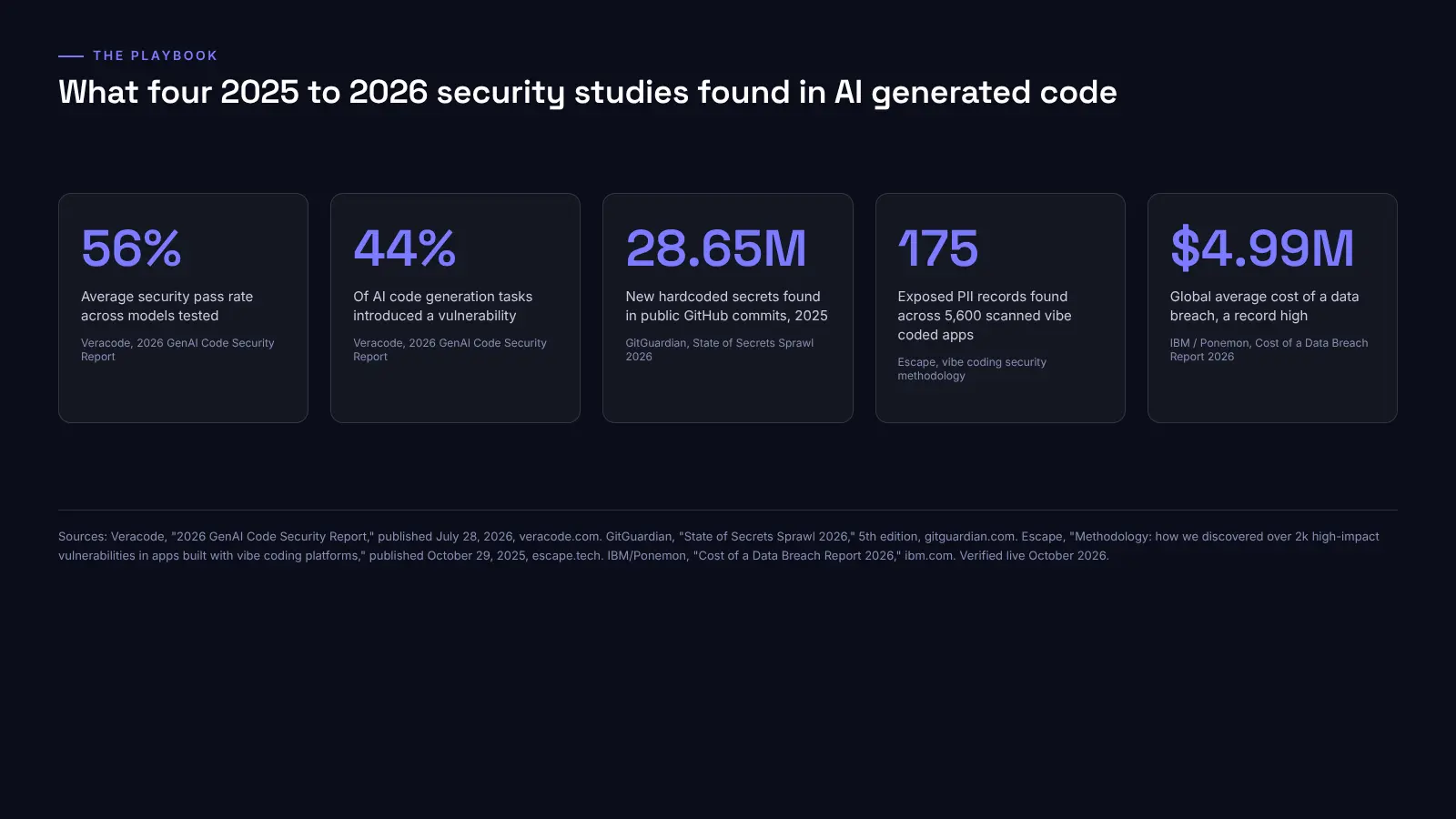
What ties these numbers together isn't that any one of them is catastrophic by itself. It's that they describe the same mechanism from four different angles: the code that gets generated commonly has a flaw (Veracode), the credentials it needs commonly leak (GitGuardian), the databases it creates commonly ship open (Escape), and when any of that turns into an actual breach, the average cost is higher than it's ever been measured.5 IBM and the Ponemon Institute's 2026 Cost of a Data Breach Report puts the global average cost of a breach at $4.99 million, a 12% increase over the prior year and a record high, driven in part by higher detection, escalation, and lost business costs.5 That figure covers breaches of every kind, not only ones that started with a vibe coded app, but it's the number that gives the other three their stakes.
If you're an FMO or IMO running several agencies under one umbrella, this risk doesn't stay contained to whoever built the tool. A single downline agent chat prompting a lead capture page for their own book, without telling anyone above them, is exactly the pattern security researchers call "shadow AI," software built and deployed outside any formal review, often by someone with no reason to think they've done anything risky. The tool works, it collects leads, and it keeps running quietly until someone finds it the hard way. An agency's own website being built correctly doesn't protect against a downline office doing this independently, which is one more reason a quick, periodic check across every site in a network is worth the hour it takes.
The specific risk when client data is involved
For most small businesses, an exposed database is a privacy and reputation problem. For an insurance agency, it can also be a HIPAA problem, and that changes the legal footing entirely. Under 45 CFR 164.502(e), a covered entity, which includes an agency handling health related client information, may disclose protected health information to a business associate and allow it to handle that information only after obtaining "satisfactory assurance that the business associate will appropriately safeguard the information."6 That assurance has to be "documented through a written contract or other written agreement," what the industry shorthand calls a Business Associate Agreement.6
Here's the practical question that rule creates: does the chat based app builder your assistant used last week publish a Business Associate Agreement that covers a live, client facing application collecting health or coverage information? If you don't know the answer, you don't have a BAA, and if you don't have a BAA, that tool has no business ever touching a real client's health information, regardless of how well its database rules are configured. A locked down database solves the security problem. It does not solve the contractual requirement, and an agency that skips this question isn't taking on vague risk, it's operating outside a specific, named federal rule.
A locked database and a signed BAA are two separate checks
Fixing the access rules on a vibe coded app's database makes it harder for a stranger to read the rows. It does not retroactively put a Business Associate Agreement in place with the platform that generated the app. Both have to be true before any client health information touches the tool, not one or the other.
If you want a second opinion on this before you decide anything
The free Audit scans your live site in about 30 seconds, including whether trackers fire before consent on health and Medicare pages, which it flags as a compliance exposure.10 Run the free Audit.
How to check your own site in ten minutes
You don't need to hire anyone to find out whether a tool your agency is using, or considering, has an open database. Here's the actual method, the same kind of check a security researcher runs first.
1. Open developer tools and watch the network traffic
In Chrome or Edge, right click the page and choose Inspect, then open the Network tab. Reload the page. Look through the requests for a domain you don't recognize, especially one ending in a managed backend service's domain, such as supabase.co or firebaseio.com. That request is the app talking to its database.
2. Open that request's URL directly
Copy the full request URL into a new browser tab. If the access rules are configured correctly, you should get an authorization error or an empty, permission denied response. If you instead see actual rows of data, names, emails, form submissions, the table is open to anyone who finds that URL, no login required.
3. Check whether a BAA exists, in writing, before any client health data goes in
Email or chat with the platform's support and ask directly whether they offer a Business Associate Agreement for your plan. If the answer is no, or it's unclear, treat that as a firm no for any tool that will touch protected health information, regardless of how the database check above comes out.
4. Run your page through PageSpeed Insights
Page speed isn't a security check, but it's a five minute way to see how much of the page's load is the generated app's own runtime versus actual content, and it tells you whether the tool is costing you visitors before the security question even matters.
You can do all four of these yourself
None of this requires a developer. Most agents who run through this checklist on a tool they already shipped find the ten minutes worthwhile, and some decide the fix is simple enough to leave as is. If you'd rather have someone else run this check and tell you plainly what it found, book a short call.
How we build it differently
We build insurance agency websites on Astro, which ships zero JavaScript to the browser by default and renders server first, letting a page opt into client side code only where it's actually needed.7 That's the opposite architecture from a vibe coded app. There's no live database sitting behind your public marketing pages for a stranger's URL guess to reach, because the pages are prebuilt HTML, not a running application waiting for a request. Where a site genuinely needs a database, a real quoting tool pulling live federal rate data, a lead form, a client portal, that piece is built and reviewed on purpose, with access rules set before anything goes live, not left on whatever default a chat prompt happened to produce.
Our builds score 90+ on Lighthouse performance on both mobile and desktop, and a number of
pages score 100, built to clear Google's own Core Web Vitals thresholds of 2.5 seconds for
Largest Contentful Paint, 200 milliseconds for Interaction to Next Paint, and 0.1 for
Cumulative Layout Shift, measured at the 75th percentile of page loads.8
That's achievable because the page that ships is the finished page, not a framework booting
up in the visitor's browser. Every build also ships a schema stack built to match what's on
the page, and llms.txt, sitemap.xml, and robots.txt
that regenerate themselves with the full URL the moment a new page publishes.
On the compliance side specifically, anything we build that touches real client data runs through infrastructure covered by a signed Business Associate Agreement, on your own AWS or Azure account rather than a shared backend with access rules we didn't choose. That's not a feature we bolted on. It's the baseline requirement for building anything an insurance agency can legally put a client's information into. Per the live pricing page, verified today, Digital Foundation starts at $84 a month, billed annually, for the website itself, with Starter, Pro and Scale adding a monthly, weekly or daily publishing cadence on top; anything beyond the standard build that touches client data gets scoped under a signed BAA as part of that project.9
What changes for your agency
The point of fixing this isn't a vague sense of being more secure. It's specific things that stop being true about your site.
No live database behind your marketing pages
Prebuilt static HTML means nothing for a stranger's URL guess to reach.
Access rules reviewed before launch, not defaulted
Anywhere a database is genuinely needed, the rules are set on purpose and checked.
A BAA in place before client data goes anywhere
Infrastructure covered by a signed Business Associate Agreement, on your own cloud account.
A fast page on a phone
90+ Lighthouse on mobile and desktop, built to pass Core Web Vitals, not assumed.
Crawl files that maintain themselves
llms.txt, sitemap.xml, and robots.txt regenerate with full URLs on every publish.
When vibe coding is actually fine
None of this means the tools are bad or that you should never touch one. For a genuinely low stakes job, a quick internal calculator only you use, a mockup to show a designer what you mean, a one off script that never sees a client's name, vibe coding is often the fastest, most reasonable way to get it done, and the security research above doesn't really apply, because there's no sensitive data in the loop for a default access rule to expose.
The line is simple to draw even if it's easy to cross by accident: the moment a tool collects a client's name, phone number, date of birth, or anything health or payment related, or represents your agency to the public, it has moved into the exact profile Escape, GitGuardian, and Veracode's research describes. At that point, the ten minute check above isn't optional caution, it's the minimum before that tool goes live.
Questions agencies ask
What does 'vibe coding' actually mean?
It's building software by describing what you want in plain language to an AI assistant, like Lovable, Bolt.new, Replit, or a general chat tool, and letting it write and run the code for you. Lovable's own documentation describes the output as a working application that includes frontend, backend, database, authentication, and integrations, backed by editable code. Nobody on the project has to read or approve that code before it ships, which is exactly what's different from a reviewed build.
Is it true that almost half of AI generated code has a security problem?
Close. Veracode's 2026 GenAI Code Security Report, published July 28, 2026, tested code generation across more than 100 large language models and found an average security pass rate of 56%, meaning 44% of tasks produced code with a detectable security vulnerability. The pass rate for cross site scripting was just 15%, and for log injection, 12%. Those numbers describe the code's quality at the moment of generation, not what happens after someone reviews and hardens it, which is the step a chat based builder skips by design.
Does a tool like Lovable or Bolt.new sign a HIPAA Business Associate Agreement?
Check before you assume one exists, and check again before any client health or financial data touches the tool. Under 45 CFR 164.502(e), a covered entity may only let a business associate create, receive, maintain, or transmit protected health information after obtaining a documented written contract providing satisfactory assurance the business associate will safeguard it. If the mainstream page and app builders you're evaluating don't publish a BAA covering a live, client facing application, that's not a paperwork gap, it's a reason the tool can't touch real client data at all.
What's the single most common mistake in a vibe coded app?
A database or API created with its default access rules left open. Escape's scan of 5,600 publicly available vibe coded apps across five platforms found more than 400 exposed secrets and 175 instances of exposed personal information, including medical records, bank account numbers, phone numbers, and emails, and the researchers describe those figures as a conservative lower bound because the scan ran passively. The pattern isn't bad code in the sense of a typo. It's a live database nobody told to lock itself down.
What's the fastest way to check if a site has an exposed database?
Open your browser's developer tools, go to the Network tab, reload the page, and look for requests to a backend service domain, such as one ending in supabase.co or firebaseio.com. Open that request's URL directly in a new tab. If it returns rows of data instead of an authorization error, the access rules are open to the public. This takes about two minutes and needs no coding knowledge, just a browser.
Is it ever fine to vibe code something for an insurance agency?
Yes, for a genuinely low stakes, internal, no client data tool: a quick calculator for your own use, a mockup to show a designer, an internal checklist. The moment a tool collects a client's name, contact information, health information, or financial detail, or represents your agency publicly, the calculus changes, because that's exactly the profile Escape, GitGuardian, and Veracode's research describes as commonly exposed.
Does switching off a vibe coded platform mean starting over?
Not necessarily. Lovable and similar tools generate editable code, so in principle it can be exported and rebuilt on. In practice, the database schema, the access rules, and the integrations usually need a full security review before anything built that way should go live for clients, which is close to the same amount of work as building it correctly the first time.
Sources
- Lovable. Documentation, "Working in Lovable": describes generated output as "a working application that includes frontend, backend, database, authentication, and integrations," backed by editable code. Verified live October 9, 2026. docs.lovable.dev.
- Veracode. "2026 GenAI Code Security Report: AI Is Writing More of Your Code but Security Hasn't Caught Up," published July 28, 2026: average security pass rate of 56% across models tested, "barely changed from 55% in the first report"; roughly 44% of code generation tasks introduced a detectable security vulnerability; category pass rates of 87% for cryptographic algorithms, 83% for SQL injection, 15% for cross site scripting, and 12% for log injection. Verified live October 9, 2026. veracode.com/blog.
- GitGuardian. "State of Secrets Sprawl 2026," 5th edition: 28,649,024 new hardcoded secrets detected in public GitHub commits during 2025, a 34% year over year increase; AI assisted commits, including Claude Code co-authored commits, leak secrets at roughly 2x the GitHub wide baseline; AI service credentials exposed 1,275,105 times, up 81% year over year; 5.6% of public repositories and 32.2% of internal repositories contain at least one secret. Verified live October 9, 2026. gitguardian.com.
- Escape. "Methodology: How we discovered over 2k high-impact vulnerabilities in apps built with vibe coding platforms," published October 29, 2025: scan of 5,600 publicly available apps across Lovable, Base44, Create.xyz, Vibe Studio, and Bolt.new, totaling 14,600 assets (5,600 web apps, 1,280 API services, 6,500 hosts, 1,103 schemas); found more than 2,000 vulnerabilities, more than 400 exposed secrets, and 175 instances of exposed personal information including medical records, IBANs, phone numbers, and emails; figures described as a conservative lower bound from passive scanning. Verified live October 9, 2026. escape.tech/blog.
- IBM and the Ponemon Institute. "Cost of a Data Breach Report 2026": global average cost of a data breach of $4.99 million, a 12% increase over the prior year, described as a record high, attributed in part to higher detection, escalation, and lost business costs. Verified live October 9, 2026. ibm.com/reports/data-breach.
- Legal Information Institute, Cornell Law School, 45 CFR 164.502(e): a covered entity may disclose protected health information to a business associate and allow the business associate to create, receive, maintain, or transmit it on the covered entity's behalf, conditioned on obtaining "satisfactory assurance that the business associate will appropriately safeguard the information," with that assurance "documented through a written contract or other written agreement or arrangement" meeting the requirements of 45 CFR 164.504(e). Verified live October 9, 2026. law.cornell.edu/cfr/text/45/164.502.
- Astro. "Why Astro," official documentation: lists "Zero JS, by default" as a core feature, described as less client side JavaScript to slow a site down, and states Astro "leverages server rendering over client-side rendering in the browser as much as possible," allowing a developer to "opt in to client-side rendering only if, and exactly as, necessary." Verified live October 9, 2026. docs.astro.build.
- web.dev (Google). "Web Vitals": Largest Contentful Paint should occur within 2.5 seconds; Interaction to Next Paint should be 200 milliseconds or less; Cumulative Layout Shift should be 0.1 or less; recommended measurement is the 75th percentile of page loads, segmented across mobile and desktop. Verified live October 9, 2026. web.dev/articles/vitals.
- Strategic AI Architects. Digital Foundation pricing page: Website $84/mo billed annually (complete site with 30 pages live on Launch Day, calculators and widgets, AI CLI access, monthly report); Starter $247/mo (adds 2 blog posts, 2 location pages and 2 answer pages a month, Google Business Profile management, AI chat widget); Pro $497/mo (adds 1 blog post, 1 location page and 1 answer page every week, up to 4 languages, review harvesting, 24/7 AI receptionist); Scale $997/mo (adds 1 of each every business day, up to 10 custom pages, monthly newsletter); Full Clone, Update and Handoff $1,000 one time; 14-day free look period. Verified live 2026-10-12. strategicaiarchitects.com/digital-foundation.
- Strategic AI Architects. Free Audit page: scans a live site across five categories (content depth and answers, question and answer structure, E-E-A-T and trust signals, schema and structured data, technical and agentic readiness); on screen score in about 30 seconds, full crawl in 6 to 15 minutes; flags trackers that fire before consent on health and Medicare pages as a compliance exposure. Verified live October 9, 2026. strategicaiarchitects.com/audit.
Talk it through
Want a second pair of eyes on it?
Free 30 minutes. Bring what you found, or bring nothing and we will look together at how AI engines read your site and which fixes move first.
See how your own site scores before you add another tool to it
Run a free Audit and see how your site scores for speed, AI citations, and HIPAA safe tracking, in about a minute.
Related reading: Is your insurance agency's WordPress site a security risk? · Your agency's new AI agent never signed a HIPAA BAA · What your insurance agency's website really costs