Playbook
Why Your Insurance Agency's Calls Show Up as Spam Likely
Nobody blocked your number. A carrier's own scoring model decided it looks like everybody else's number on the same shared platform, and started routing your calls to voicemail before the phone even finishes its first ring.


19 min read
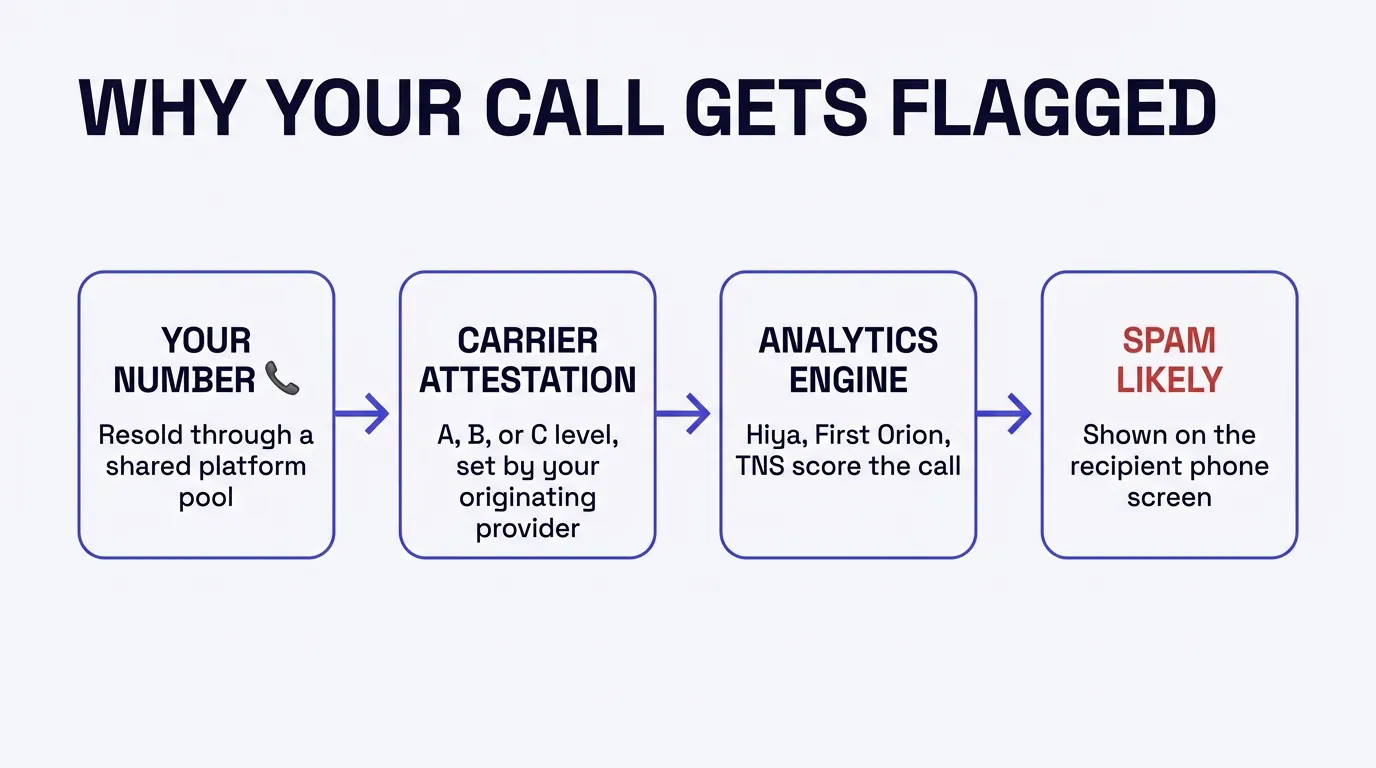
A Spam Likely tag isn't a government blacklist entry, it's a score. AT&T, T-Mobile, and Verizon each license call-scoring from a partner, Hiya, First Orion, and TNS6, and that score weighs call volume, complaint reports, and your number's STIR/SHAKEN attestation level4. Insurance agencies get flagged more than most small businesses because they place high call volume through resold numbers on shared platforms, exactly the pattern the scoring model is built to catch. Hiya's own 2026 survey found 86% of calls from unknown numbers go unanswered1. This guide breaks down the mechanism, how to check and fix your own number today, and why the fix only holds when the number itself is provisioned differently.
The tag nobody explains
You call a lead back within the hour, the way every speed-to-lead guide tells you to. They don't pick up. You check your CRM later and the call log shows a two-second duration, declined. A colleague mentions her phone flashed "Spam Likely" the last time your office called her personal cell to confirm an appointment. Your AI receptionist places a scheduled callback to a Medicare prospect who requested one, and it goes straight to voicemail every time.
None of these are your imagination, and none of them mean your agency did anything wrong in the way that word usually implies. What happened is quieter and more mechanical: a scoring system run by a company you've never spoken to decided your number looks statistically similar to numbers that place unwanted calls, and started telling the person on the other end so, before they ever hear your voice.
This is not the same problem as the AI voice billing question or the TCPA follow-up question this site has covered before. Those are about what a call costs and what it's legally allowed to say. This one is about whether the call connects at all, and the mechanism behind it is almost never explained to the agency it's happening to.
What this guide is and isn't
This is about legitimate, invited business calling: following up with a lead who requested a quote, confirming an appointment, checking in on a renewal. Every figure and mechanism here is pulled from a primary source fetched this session.
What Spam Likely actually is
"Spam Likely" is not a designation the FCC assigns, and it's not a blacklist a business gets added to by a regulator. It's a label a wireless carrier's app displays on the recipient's screen, generated by an analytics engine the carrier licenses from a third-party partner. GoHighLevel's own support documentation puts it plainly: "Carriers like AT&T, T-Mobile and Verizon use analytics engines to generate and maintain spam scores for caller IDs"6. Three specific partners run those engines: Hiya for AT&T, First Orion for T-Mobile, and Transaction Network Services (TNS) for Verizon7.
Each engine builds its own model, and none of them publish the full formula, but the inputs they draw from are consistent across the industry: how many calls a number places in a short window, what share of those calls go unanswered or get reported by recipients, whether the number's caller ID has been verified through the industry's authentication framework, and patterns that match known robocall or scam behavior. GoHighLevel's own troubleshooting article lists the same core drivers agencies run into in practice: "making too many calls in a short time can trigger spam filters," a high share of "calls go unanswered or are rejected," and a caller ID that "isn't verified"6.
The label itself sits on a spectrum most people never notice until it's their own number. A call can arrive with no label at all, with "Spam Likely," or in some carrier apps with a more specific category like "Telemarketer" or "Scam Likely." The label a recipient sees is generated in real time as the call rings through, using whatever reputation data the engine has accumulated on that number up to that moment. That's also why the label can appear inconsistently: one recipient's carrier app may show it while another's doesn't, because AT&T's Hiya-powered score and Verizon's TNS-powered score are two separate calculations running on the same call.
If you want a fast read on your own site and stack first
The free Audit checks a site's technical and AI-citation readiness in under a minute. It won't check your phone number's spam score, but it's the same no-pressure starting point we'd point you to before any bigger conversation. strategicaiarchitects.com/audit10.
Why agency numbers get flagged more than most
Two ordinary facts about how insurance agencies run their phones stack together into exactly the pattern a spam-scoring model is designed to catch, and neither one is a mistake on the agency's part.
The first is volume concentrated in short windows. A Medicare-focused agency's call volume during AEP, or an ACA agency's volume during Open Enrollment, isn't spread evenly across the year. It's a burst: confirming appointments, returning quote requests, checking in on renewals, all compressed into a matter of weeks. A number that suddenly places far more calls than its historical baseline is one of the plainest signals a scoring model watches for, because that same pattern describes a robocall campaign spinning up just as easily as it describes a legitimate seasonal surge.
The second is how the number itself is provisioned. Most agencies don't own a direct relationship with a telephone carrier. They run their calling through a CRM or marketing platform, GoHighLevel among the most common in this industry, that resells numbers through an underlying telephony provider like Twilio. That's a completely normal and reasonable way to run a small business phone system. It also means the platform, not the agency, is the entity the originating carrier actually has a relationship with, and thousands of other agencies and businesses are placing calls through that same shared pool of infrastructure at the same time. One bad actor sharing that pool can drag down the reputation signal the analytics engines see on numbers that had nothing to do with it.
Seasonal volume spikes
Call volume that jumps well above baseline in a short window reads the same to a scoring model whether it's AEP or a robocall campaign.
Resold, shared numbers
A number provisioned through a CRM's underlying telephony provider shares reputation exposure with every other tenant on that same pool.
Low answer rates
Outbound follow-up to cold leads naturally has a lower pickup rate, which the analytics engines read as another risk signal.
Unverified caller ID
A number that hasn't been through STIR/SHAKEN authentication, or carries a low attestation level, is missing the strongest trust signal an engine can weigh.
What STIR/SHAKEN actually checks
STIR/SHAKEN is the FCC's caller ID authentication framework, and it's been a live requirement for voice service providers since 2021, not a proposal. Every call placed over an IP network gets signed with a digital "attestation" that states how confident the provider originating the call is that the caller is who the caller ID claims to be. There are three levels, and the FCC's own rulemaking record defines them precisely: a provider "may assert A-level (or 'full') attestation when it (1) is responsible for the origination of the call onto the IP network, (2) has a direct authenticated relationship with its customer and can identify the customer, and (3) has established a verified association between its customer and the telephone number used for the call"4.
B-level, or "partial," attestation applies when a provider can confirm the first two conditions but can't verify the third: it knows who its customer is, but it can't confirm that customer actually has the right to use the specific number showing up on the caller ID. C-level, or "gateway," attestation is the lowest tier, applied when the provider authenticating the call has no direct relationship with whoever actually placed it4.
Here's the part that connects directly to the spam label: providers "also use attestations to inform call analytics engines" that generate blocking and labeling decisions4. A-level, B-level, and C-level attestation aren't just a background compliance detail. They're one of the direct inputs Hiya, First Orion, and TNS feed into the same scoring models that decide whether your call rings through clean or arrives with a red flag already on the screen.
| Level | What the provider must confirm | What it signals to a spam-scoring engine |
|---|---|---|
| A (full) | Originates the call, knows the customer directly, and has verified that customer's right to use the specific number4 | Highest trust. The number is tied to a known, verified entity. |
| B (partial) | Originates the call and knows the customer, but can't verify the customer's right to that specific number4 | Middle trust. Common for a legitimate business on a resold or pooled number. |
| C (gateway) | No direct relationship with whoever actually placed the call4 | Lowest trust. The strongest single risk factor an engine can weigh. |
The gap a shared platform can't close
Walk through what B-level attestation actually requires, and the reason a resold CRM number tends to land there instead of A-level becomes obvious. The FCC's own rulemaking describes exactly this scenario as an industry-wide "knowledge gap": it occurs "when the originating provider does not have a direct relationship with the end user because the end user obtained voice service from an intermediary provider, such as a reseller"4.
That's precisely the structure of an agency running its calling through a CRM's built-in telephony. The underlying carrier's actual customer is the platform, not your agency. The platform is the reseller sitting between you and the carrier. The carrier can confirm it has a relationship with the platform, but it cannot independently confirm that your agency, specifically, has the right to use the specific number your account was assigned. That's not a flaw in the platform. It's the structural reality of how reselling telephone numbers works, and it's exactly what caps the attestation at B instead of A.
None of this means B-level attestation is illegitimate or that every agency on a resold number gets flagged. Plenty don't. What it means is that a resold, shared number starts the spam-scoring calculation from a weaker trust position than a number with a verified, direct relationship to the business placing the calls, and every other risk signal, a seasonal volume spike, a lower answer rate during a cold follow-up push, gets weighed on top of that already-weaker starting point.
What the FCC is proposing to change
The attestation framework above isn't new; it's been live since 2021. What is new is a rulemaking the FCC released on April 29, 2026, proposing to tighten it further. The Further Notice of Proposed Rulemaking, filed under WC Docket No. 17-97, sets out to "improve know-your-upstream-provider (KYUP) requirements," "raise the standards to make attestations more trustworthy," and "close STIR/SHAKEN loopholes"4. As a proposal, not yet a final rule, none of this is binding today. It's worth reading closely anyway, because it's aimed directly at the exact structure this guide has been describing.
Two pieces of the proposal matter most for a resold-number agency. First, the FCC proposes requiring every voice service provider that serves end users directly, which includes the platforms agencies buy their numbers through, to make its own attestation-level decision for every call rather than leaning on whatever attestation the underlying carrier happens to assign4. Second, it proposes tightening what counts as a "verified association" between a customer and a number, explicitly ruling out "a business agreement or certification that includes only a general statement that the customer will only use numbers with which it has a verified association"4, which is close to how a lot of reseller onboarding works today.
Read plainly, the direction of travel is toward more scrutiny of exactly the reseller-pool structure this guide describes, not less. That doesn't mean every resold number is about to get worse treatment overnight. It means the compliance posture of the platform your number sits on is about to matter more, not less, and that posture is something an agency renting a number has no control over and often no visibility into. Owning the relationship with your own carrier, rather than depending on a reseller's future compliance decisions, is exactly the kind of exposure this proposal makes worth thinking about now instead of after a rule takes effect.
Why multi-office agencies feel it hardest
A single producer fielding a modest monthly call volume rarely notices any of this until a flag actually shows up. An FMO or IMO running a downline of offices is in a different position entirely, for two reasons that compound rather than simply add.
The first is scale. Multiply a modest per-agent call volume by a dozen or more offices under one downline, and the aggregate volume moving through whatever shared platform the FMO standardized on starts looking, to an analytics engine watching for patterns, less like a collection of small independent businesses and more like a single high-volume calling operation. That's not a judgment on the FMO's practices. It's simply what the traffic pattern looks like from the outside.
The second is shared exposure. If every office in a downline is provisioned through the same reseller pool, one office running an aggressive follow-up campaign, or one bad actor anywhere in that shared pool of numbers, can degrade the reputation signal attached to numbers that had nothing to do with it. A flag doesn't respect org charts. It attaches to the specific number and, over time, to patterns the analytics engine associates with the infrastructure that number rides on.
What a flagged number costs
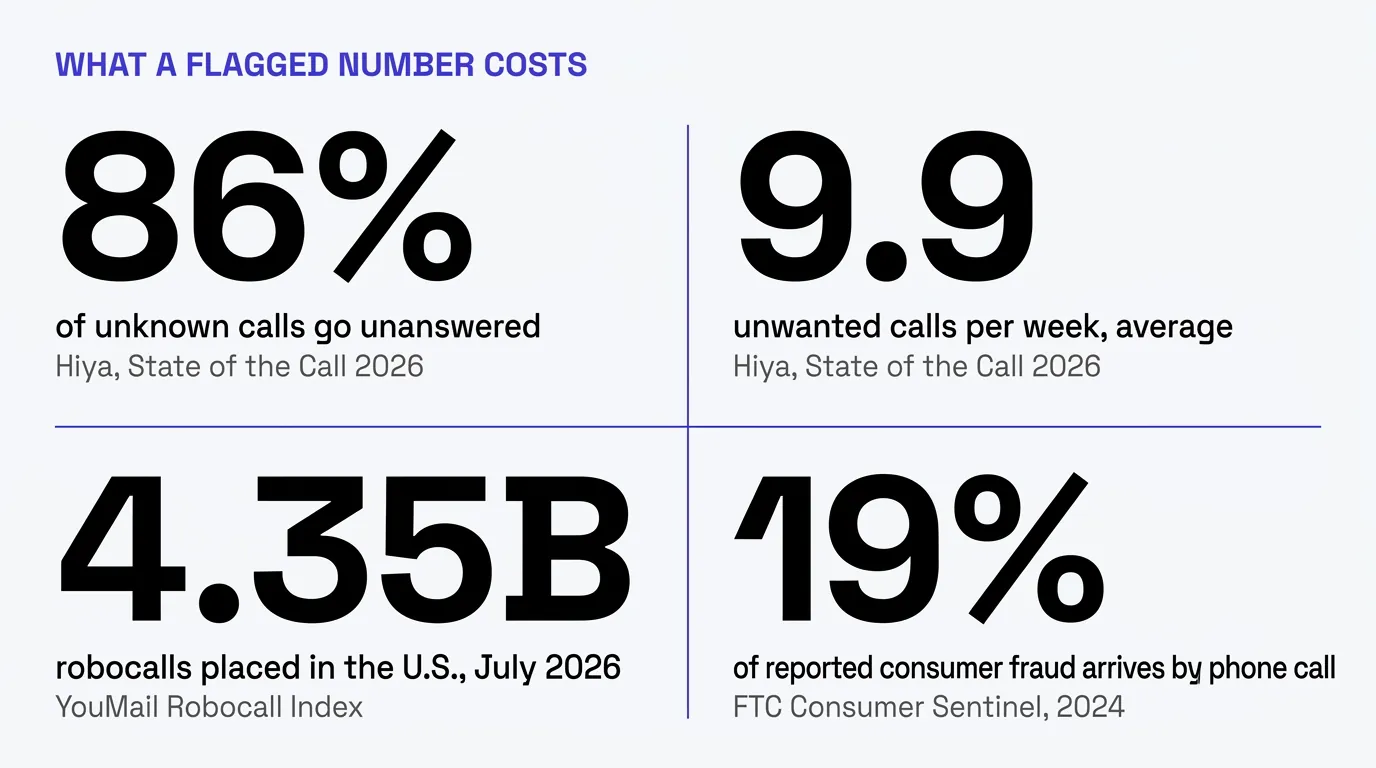
The cost here isn't a fee. It's silence. Hiya's 2026 State of the Call report, drawn from a survey of more than 12,000 consumers across the U.S., U.K., Canada, France, Germany, and Spain, found that 86% of calls from unknown numbers go unanswered1. A Spam Likely tag doesn't just make a number "unknown," it actively tells the recipient not to trust it, which pushes that already-high non-answer rate even higher for the calls that carry the label.
The volume this problem operates inside of is large and growing. YouMail's Robocall Index, drawing on its network of call-blocking customers, put U.S. robocall volume at 4.35 billion calls in July 2026 alone, with telemarketing and scam calls together accounting for 49% of that total3. Consumers and the carriers protecting them are tuned to be suspicious by default, because the volume of genuinely unwanted calls hitting their phones every single month is measured in the billions.
That suspicion has a real financial backdrop behind it too. The FCC's own April 2026 rulemaking cites the FTC's Consumer Sentinel Network Data Book, noting that 19% of reported consumer fraud in 2024 arrived by phone call, with a median individual loss of $1,500 and a total of $948 million lost to phone-based fraud that year alone45. Recipients aren't being paranoid when they let an unfamiliar number ring through to voicemail. The base rate of harm behind unfamiliar calls is real, and carriers built spam scoring precisely because that base rate justified it.
Put a number on your own agency's exposure. Say your team, including any AI-driven follow-up, places 2,000 outbound calls a month, a modest volume for a multi-line agency during a normal season. If even a third of those calls carry a number with a soft spam reputation, and the label pushes the non-answer rate on those specific calls from a typical cold-outreach rate up toward Hiya's 86% figure for flagged or unknown numbers, you're looking at several hundred calls a month that never get a chance to become a conversation, regardless of how good the offer or the script is on the other end.
86%
Of calls from unknown numbers go unanswered1
9.9
Average unwanted calls received per person, per week2
4.35B
Robocalls placed in the U.S. in July 2026 alone3
3
Attestation levels a carrier can assign to your outbound calls4
How to check your own number
Before fixing anything, confirm the problem is real and specific to your number rather than a one-off. Ask two or three people outside your office, a spouse, a friend on a different carrier, someone who wouldn't recognize the number, to call it from their own phone and tell you what label, if any, shows up. Cross-carrier matters here: AT&T, T-Mobile, and Verizon each run a different analytics partner, so a number can show clean on one network and flagged on another at the same time6.
If you have access to your CRM or telephony platform's dashboard, check whether it surfaces delivery or answer-rate data by number. A number whose connect rate has quietly dropped over recent weeks, with no change in your script or list quality, is showing the same signal from the inside that a recipient's phone is showing from the outside.
The DIY fix, step by step
You can do this yourself, today, without buying anything. Here's the actual process, straight from how GoHighLevel documents it for its own users, since the underlying remediation path is the same regardless of which platform's number you're fixing.
Submit through the Free Caller Registry
A single free submission at freecallerregistry.com reaches AT&T, T-Mobile, and Verizon's analytics partners at once, so you don't have to file three separate requests7.
Fill the form out accurately
List the correct underlying service provider (Twilio, if that's what your platform runs on), select the right call type, and leave fields blank exactly where your platform's own documentation tells you to7. An inaccurate submission is the most common reason a delisting request gets rejected.
Give it about four business days
That's the processing window GoHighLevel's own support article states for a Free Caller Registry submission to clear7. It's not instant, and resubmitting the same day won't speed it up.
Go direct to a single carrier if needed
If the registry submission doesn't clear a specific carrier's tag, you can submit directly to that carrier's own analytics partner: Hiya for AT&T, First Orion for T-Mobile, TNS for Verizon7.
| Carrier | Analytics partner | Where to submit |
|---|---|---|
| AT&T | Hiya | Free Caller Registry, or direct to Hiya7 |
| T-Mobile | First Orion | Free Caller Registry, or direct to First Orion7 |
| Verizon | Transaction Network Services (TNS) | Free Caller Registry, or direct to TNS7 |
Register for STIR/SHAKEN authentication where your platform allows it
If your U.S.-based number has an EIN behind it, enabling caller ID authentication through your platform strengthens the signal an analytics engine sees, even though it can't push a resold number all the way to A-level attestation on its own6.
The mistake we see most
An agency clears a Spam Likely tag through Free Caller Registry, sees the label disappear, and assumes the problem is solved. Nothing about the number's underlying attestation level or the shared pool it's provisioned through changed. The tag cleared because the specific complaint that triggered it aged out or was corrected, not because the mechanism that produces the tag went away.
Why the DIY fix doesn't hold
Free Caller Registry and direct carrier submissions genuinely work, in the narrow sense that they clear a specific flag on a specific number at a specific carrier. What they don't do is change any of the three underlying inputs that produced the flag in the first place: your call volume pattern, your number's attestation level, and the shared reputation pool your number sits inside on a resold platform.
That's why agencies commonly report the tag returning weeks or months later, often right as the next seasonal volume spike hits. The scoring models re-evaluate continuously. Clearing today's complaint doesn't immunize the number against tomorrow's volume spike landing on the same weak attestation foundation. Rotating to a brand-new number resets the specific complaint history, but a new number on the same shared platform, making the same call pattern, with the same B-level attestation ceiling, tends to accumulate similar reputation on a similar timeline. You've bought a few weeks, not fixed the mechanism.
Clears the symptom
- Free Caller Registry submission removes today's specific flag
- Number stays on the same shared, resold platform
- Attestation level stays capped at B, structurally
- Call volume pattern during peak season doesn't change
TimelineTag often returns within weeks or months
Changes the mechanism
- Number provisioned on your agency's own accounts, not a shared pool
- Direct, verifiable relationship between agency and number
- Built once, on infrastructure you own going forward8
- AI-driven follow-up and receptionist calls share the same standing
TimelineThe underlying reputation risk doesn't reset every season
How we build this instead
This section sticks to what's stated on our own live pages, verified this session. When we scope a custom AI voice build, whether that's an AI receptionist, conversational follow-up, or an outbound calling flow for renewals, the build runs on your agency's own accounts, your own domain, and your own CRM8. That's not a marketing phrase. It's the specific structural difference that matters here: a number tied to your agency's own identity, rather than pooled across hundreds of other tenants on a shared reseller platform, is exactly the kind of direct, verifiable relationship a carrier's attestation criteria is built to check for4.
We're not going to promise a specific attestation level or a guaranteed spam score, because the carriers and their analytics partners make that determination, not us or any vendor. What we can say plainly, and what's on the live page, is "you own it," and "it keeps working whether or not you keep working with us"8. That ownership is the lever. A number your agency directly controls, on infrastructure built for your call patterns specifically rather than shared across a generic reseller pool, starts every reputation calculation from stronger footing than a number nobody at the carrier level can actually vouch for.
Not every agency needs a custom build to make progress here. If you're running a single office and want a receptionist question solved without redesigning your telephony from scratch, Digital Foundation's Pro tier bundles a 24/7 AI receptionist that "answers your phone, qualifies callers, and books appointments" into a flat $497 a month alongside the rest of the site9. It won't rebuild your number's carrier relationship on its own, but it's a real starting point for agencies not ready to scope a full custom voice build.
What you actually get
Concretely, moving your voice AI and outbound follow-up onto infrastructure your agency actually owns gets you three things. A number whose reputation reflects your agency's own calling pattern, not the combined pattern of every other business sharing the same resold pool. Standing to fix a spam flag permanently rather than clearing it and waiting for it to return. And AI-driven follow-up, whether that's a receptionist confirming an appointment or a renewal check-in call, that carries the same trust footing as a call your own staff dials by hand.
None of that is a promise about a specific answer rate, a lead count, or revenue. It's an infrastructure decision about who your agency's number actually belongs to, and it's worth treating it like one.
When the DIY path is genuinely fine
Say this plainly: if you're a single-office agency placing a modest, steady call volume and you haven't actually seen a spam flag on your own number yet, none of this is urgent. Run the Free Caller Registry submission if a flag ever shows up, keep an eye on your answer rates during seasonal spikes, and don't rebuild infrastructure you don't have a symptom for.
The math in this guide starts mattering once you're running enough call volume, across enough offices or enough seasonal spikes, that a Spam Likely tag on your AI receptionist or follow-up number is costing you real connections during the exact weeks those connections matter most. If you've already chased the same flag off the same number more than once, that's the signal the DIY fix has run its course.
Questions agencies ask
What does it actually mean when a call shows up as Spam Likely?
It means a carrier's own analytics engine, not a government blacklist, scored your number as likely unwanted based on call patterns, complaint reports, and how the call was authenticated. AT&T, T-Mobile, and Verizon each license this scoring from a partner: Hiya, First Orion, and Transaction Network Services (TNS), respectively.
Why do insurance agency numbers get flagged more than other small businesses?
Two reasons stack together. Agencies place a genuinely high volume of outbound calls in short windows, especially around AEP and open enrollment, and most run that volume through a resold VoIP number on a shared platform where the originating carrier can't verify a direct relationship between the agency and the number. Both are exactly what a spam-scoring model is built to catch.
What is STIR/SHAKEN, and does it stop the spam label?
STIR/SHAKEN is the FCC's caller ID authentication framework, in force since 2021, that has every call signed with an A, B, or C attestation stating how confident the originating provider is that you're really you. It doesn't stop spam labeling by itself. Carriers feed the attestation level into the same analytics engines that generate the Spam Likely tag, so a lower attestation raises your risk of being flagged, it doesn't remove you from consideration.
Can I fix a Spam Likely label myself?
Yes, for a specific flag. Free Caller Registry lets you submit one request that reaches the major analytics engines at once, and GoHighLevel's own support documentation says processing runs about four business days. It's free, and you can resubmit if the tag comes back.
Does registering with the Free Caller Registry actually work?
It clears the specific label you're fighting when the submission is accurate, but it doesn't change the underlying signal that got you flagged in the first place: shared number reputation and a low attestation level. Agencies commonly see the tag return within weeks because nothing about how the number is provisioned changed.
Will just switching to a new phone number fix the problem?
Temporarily, and only if nothing else about your call pattern changes. A new number on the same shared platform, making the same volume of calls with the same attestation level, tends to accumulate the same reputation on roughly the same timeline. It buys time, it doesn't fix the mechanism.
Does this affect inbound calls too, like an AI receptionist calling a lead back?
Yes. Spam scoring applies to any outbound call from your number, including a callback your AI receptionist places to confirm an appointment or follow up on a quote request. If the number carries a low attestation, that legitimate follow-up call faces the same risk of being silently sent to voicemail as any other outbound call from it.
How does Strategic AI Architects handle this differently on a custom voice AI build?
Everything is built on your agency's own accounts, your own domain, and your own CRM, and you own it, so the number your AI receptionist and follow-up system use is tied to your agency's identity rather than pooled across hundreds of other tenants on a shared reseller platform. That's the standing a carrier's attestation criteria actually asks for.
Sources
- Hiya, Inc. "State of the Call 2026," 86% of calls from unknown numbers go unanswered, survey of 12,000+ consumers, verified live 2026-08-18. hiya.com.
- Hiya, Inc. "State of the Call 2026: AI Deepfake Voice Calls Hit 1 in 4 Americans as Consumers Say Scammers Are Beating Mobile Network Operators 2-to-1," press release, 9.9 average unwanted calls per week, published 2026-03-01, verified live 2026-08-18. businesswire.com.
- YouMail, Inc. "U.S. Robocalls Continue Upward Trend as Consumers Received More Than 4.3 Billion in July, According to YouMail Robocall Index," 4.35 billion robocalls in July 2026, published 2026-08-06, verified live 2026-08-18. prnewswire.com.
- Federal Communications Commission. "Enhancing STIR-SHAKEN to Combat Illegal Robocalls," Further Notice of Proposed Rulemaking, WC Docket No. 17-97, CG Docket No. 17-59, attestation level definitions and FTC fraud data citation, released 2026-04-29, verified live 2026-08-18. docs.fcc.gov.
- Federal Trade Commission. "Consumer Sentinel Network Data Book 2024," 19% of reported fraud by phone call, $948 million total loss, 2024 reference period, verified live 2026-08-18 (as cited in source 4). ftc.gov.
- HighLevel, Inc. "Why are my Calls marked as Spam, and How can I avoid it?" support article, carrier analytics engines and spam-scoring drivers, verified live 2026-08-18. help.gohighlevel.com.
- HighLevel, Inc. "Remediate 'Spam Likely' on your Caller ID using Free Caller Registry," support article, remediation process and named carrier analytics partners, verified live 2026-08-18. help.gohighlevel.com.
- Strategic AI Architects. "AI Expert," custom build ownership terms and scoping language, verified live 2026-08-18. strategicaiarchitects.com.
- Strategic AI Architects. "Digital Foundation," Pro tier pricing and included AI receptionist, verified live 2026-08-18. strategicaiarchitects.com.
- Strategic AI Architects. "Free Audit," verified live 2026-08-18. strategicaiarchitects.com.
Talk it through
Want a second pair of eyes on it?
Free 30 minutes. Bring what you found, or bring nothing and we will look together at how AI engines read your site and which fixes move first.
Find out where your own site and stack stand
Run the free Audit, a live AEO Audit plus a HIPAA tracking scan of your site, in under a minute.
Related reading: why your insurance agency's voice AI bill keeps climbing · what an after-hours call costs an insurance agency · can your AI follow-up get your agency sued