Playbook

Why Your Insurance Agency's AI Employee Doesn't Remember Your Clients
Five AI products under one price tag do not add up to one memory.

21 min read
GoHighLevel's AI Employee bundles Voice AI, Conversation AI, Reviews AI, Content AI, Ask AI, and AI Studio for $50 to $97 a month per location, and HighLevel's own documentation prices and limits each one separately with no documented shared memory between them1. Twenty six states and D.C. had adopted the NAIC's AI accountability bulletin by August 31, 20262, which means the gap is not just annoying, it is something your agency is on the hook for.
The bot that makes clients repeat themselves
A client calls your office line at 6:40 in the evening. Your new AI receptionist picks up, sounds reasonably human, and books them for a callback about their Part D drug coverage. Two days earlier, that same client had messaged your website's chat widget asking a completely different question about switching from a PPO to an HMO. The voice bot on the phone has no idea the chat happened. It asks the client to explain their situation from the beginning, again, and the client sighs audibly before answering.
That sigh is the whole story. You did not buy one AI receptionist. You bought a bundle of AI products that happen to share a checkout page. GoHighLevel's AI Employee packages Voice AI, Conversation AI, Reviews AI, Content AI, Ask AI, and AI Studio into a single add-on, billed at $50 a month per location for the Growth tier or $97 a month per location for the Unlimited tier, according to HighLevel's own support documentation1. That documentation lists usage caps for each product on its own line: 100 Voice AI minutes and 1,000 Conversation AI responses a month on Growth, unlimited minutes and responses under fair use on Unlimited, with phone system charges billed separately even at the top tier1. Separate line items for separate meters is a strong hint about what is actually happening under the hood: these are five distinct products, not one brain wearing five hats.
Quick gut check
Text your own agency's number with a specific plan question, wait a day, then call the same number and ask a related follow-up without repeating the earlier context. If the person or bot who answers the phone has no idea the text ever happened, you have the exact problem this guide is about. If you want a second pair of eyes on the rest of your stack while you are at it, the free Audit checks this along with your site's AI citation readiness in about a minute. strategicaiarchitects.com/audit
One client's week, four separate memories
- Monday: texts the website chat widget about a Part D question. Conversation AI answers, and logs nothing anyone else reads.
- Wednesday: calls the office about a dependent's coverage. Voice AI has no record Monday happened and asks her to explain from scratch.
- Friday: leaves a Google review mentioning she had to repeat herself twice in one week. Reviews AI drafts a generic thank you, unaware why the review says what it says.
Four systemsZero shared history
The same week, one record
- Monday: texts about the Part D question. The exchange writes to one contact history, not a chat-only log.
- Wednesday: calls the office. The call opens already aware of Monday's question, so she never repeats it.
- Friday: leaves a good review instead, because nobody asked her the same question twice in the same week.
One recordEvery channel reads it
This is not a complaint about GoHighLevel specifically. It is a complaint about how AI add-ons get sold across the entire category right now. A single price tag and a single dashboard tab create the impression of one system. Underneath, most of these bundles are still separately metered products stitched together by a shared login screen, and insurance is exactly the kind of business where that gap shows up fastest, because your clients call, text, and email about the same policy in the same week.
Why AI Employee doesn't share one memory
HighLevel's own AI Employee overview describes six distinct products under one umbrella brand, each with its own pricing line and its own usage cap1. Nowhere in that documentation is there a described shared memory object, a unified contact timeline, or a cross-product context layer that automatically feeds what Conversation AI learned into what Voice AI says next. That absence is the mechanism. Each product was built to do one job inside one channel, and bundling them under a single monthly charge changed the billing, not the architecture.
| Product | What it handles | Growth, $50/location/mo | Unlimited, $97/location/mo |
|---|---|---|---|
| Voice AI | Answers and places phone calls | 100 minutes / month | Unlimited, fair use |
| Conversation AI | SMS, web chat, social DMs | 1,000 responses / month | Unlimited, fair use |
| Reviews AI | Drafts review requests and replies | Bundled | Bundled |
| Content AI | Drafts marketing copy | Bundled | Bundled |
| Ask AI / AI Studio | Internal assistant and configuration | Bundled | Bundled |
| Phone system | The line itself | Billed separately | Billed separately |
Look at the last row. If the phone line itself is metered and billed apart from the AI that answers it, on the plan called "Unlimited," that tells you the whole bundle is a pricing wrapper around separately built products, not one system with a single meter. Nothing about that makes GoHighLevel a bad CRM. It is a genuinely capable platform for pipelines, funnels, and calendars, and we build on top of it for clients. It just means the word "Employee" in the product name is doing more work than the architecture underneath it currently supports.
Separately priced
Voice AI minutes and Conversation AI responses are two different meters on two different lines.
Separately documented
HighLevel's own support articles describe each product's limits on its own, never as one memory.
Channel bound
A bot built for chat answers chat. A bot built for calls answers calls. Neither reads the other's log by default.
Bridgeable, not bridged
The contact record can hold notes from every channel, but nothing wires that history into a bot's prompt automatically.
None of this is a secret HighLevel is hiding. It is simply what "bundle" means in most of this category right now: one invoice, several products. The mistake is buying the invoice and assuming it describes the architecture.
How a shared memory system is actually built
Strip away the marketing and a system that genuinely remembers a contact across channels needs three specific pieces, none of which are automatic side effects of billing several AI products on one invoice. First, a stable identity resolution step, so the same phone number, email address, or contact ID reliably points at one record no matter which channel it arrived through. Second, a timeline store keyed to that identity, holding every call, text, email, note, and appointment with a timestamp and a channel tag, not scattered across five separate logs. Third, a retrieval step that runs before every reply is generated, pulling the relevant slice of that timeline into whatever is about to answer, whether that is a voice model about to speak or a text model about to type.
HighLevel's AI Employee documentation does not describe steps two or three as shared across its six products1. Each product is documented as answering within its own channel. That is not a flaw so much as a scope decision: a phone bot and a chat bot are genuinely different engineering problems, and building each one well is real work on its own. The missing piece is the middle layer, the timeline and the retrieval step, that would let the work already done in one channel inform the next. Building that layer is exactly what turns a bundle of AI products into one system with a memory, and it is additive work on top of what ships in the box.
The multi-location, multi-producer edge case
HighLevel bills AI Employee per location, and that detail matters here. Three offices on the Unlimited tier would run $291 a month before any phone system charges, and each location's sub-account holds its own contact records by default1. That is fine if every client only ever talks to one location, which is not how most independent agencies actually operate. A producer who covers both the main office and a satellite branch, or a client who calls whichever office is closest to home but later emails a producer they met through a referral, crosses the same sub-account boundary that already separates each AI product's memory from the others. The fix is another layer of custom work: a cross-location contact match sitting on top of the cross-product context problem, which roughly doubles the integration work for a multi-location agency compared with a single office running one sub-account.
What a bot with no memory actually costs
Zendesk's 2026 Customer Experience Trends research, based on its global survey of consumers and business buyers, found that 74% of consumers are frustrated when they have to repeat information across channels, 81% want a support conversation continued rather than restarted, and 67% expect a brand to tailor support based on what happened in a prior interaction3. Those numbers describe exactly the sigh on the phone call at the top of this guide, and they are not insurance specific. They describe what any consumer now expects from any company that answers a phone with AI.
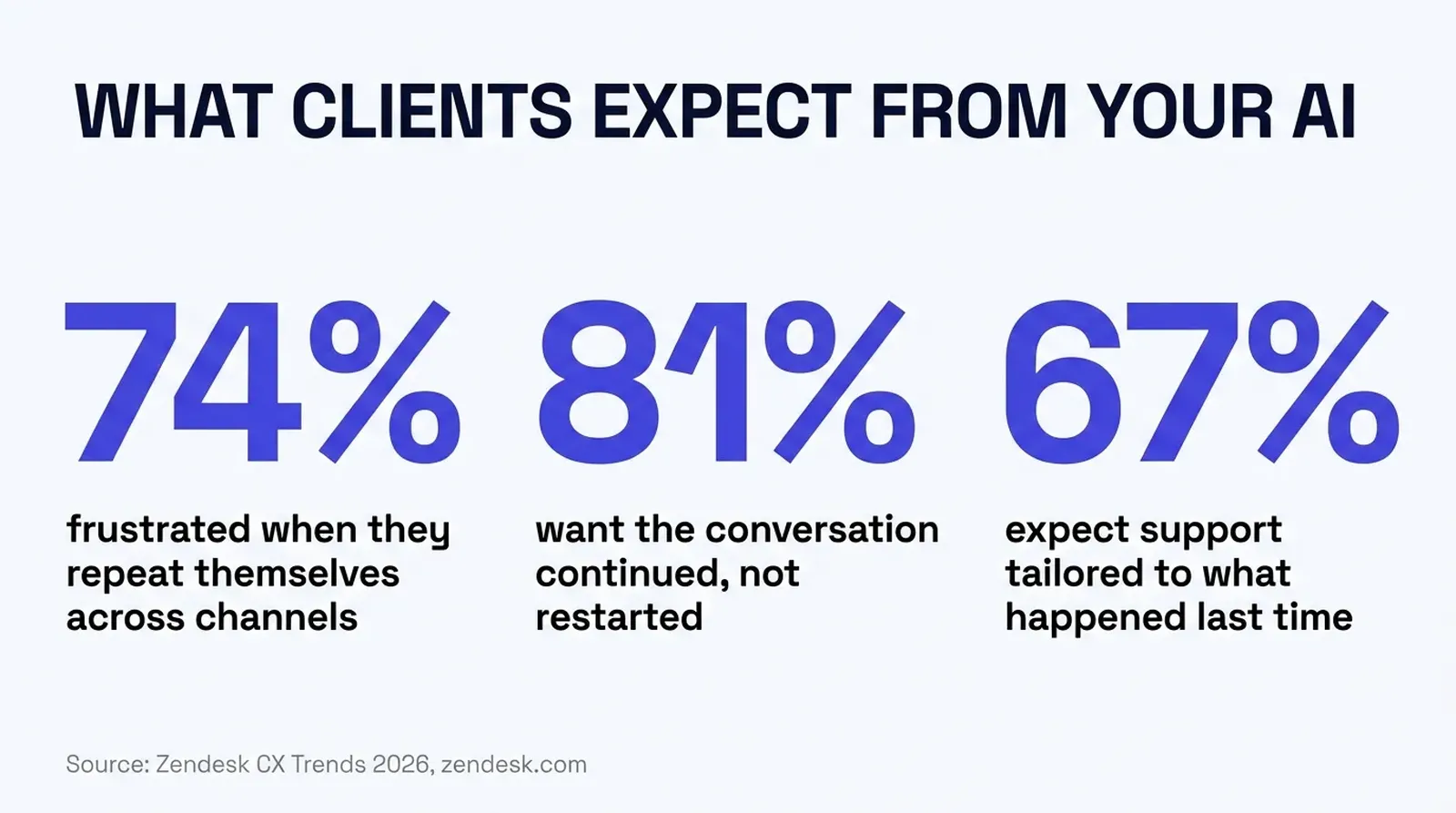
Consumer frustration is the softer half of this. The harder half is regulatory, and it is not hypothetical. The National Association of Insurance Commissioners adopted its Model Bulletin on the Use of Artificial Intelligence Systems by Insurers on December 4, 2023, and by August 31, 2026, 26 states and the District of Columbia had adopted it in some form, according to NAIC's own state adoption tracker2. The bulletin's core position, per NAIC's own insurance topics page, is that decisions made or supported by AI must comply with all applicable insurance laws and regulations, that insurers remain responsible for fairness and accuracy regardless of which tool produced the answer, and that regulators can require an insurer to explain how an AI tool is used in underwriting, marketing, or claims4. None of that carves out an exception for a $97 add-on that happens to answer your phone.
| Jurisdiction | Rule | Adopted |
|---|---|---|
| Illinois | Company Bulletin 2024-08 | March 13, 2024 |
| Nevada | Bulletin 24-001 | February 23, 2024 |
| Washington | Technical Assistance Advisory 2024-02 | April 22, 2024 |
| District of Columbia | Bulletin 24-IB-002-05/21 | May 21, 2024 |
| Michigan | Bulletin 2024-20-INS | August 7, 2024 |
| Mississippi | Bulletin 2026-9 | July 22, 2026 |
Mississippi's adoption in July 2026 is the newest entry on the list, which tells you this is not a rule that landed once in 2023 and went quiet. States are still signing on. If your agency operates in more than one of them, and most independent agencies do, you are very likely already inside the bulletin's scope in at least one state, whether anyone at your office has read it or not.
26
States plus D.C. under the NAIC AI bulletin, Aug. 31, 2026
74%
Consumers frustrated repeating themselves across channels, Zendesk 2026
$50 to $97
Monthly price per location for the bundle that doesn't share memory
6
Separate AI products inside one add-on, per HighLevel's own docs
Put the two halves together and the cost is not abstract. A client who has to repeat themselves is measurably more likely to be annoyed, per Zendesk's own numbers, and an agency that cannot explain how its AI tools handle a client's health information consistently is operating inside a regulatory framework that 26 jurisdictions have now put in writing. Neither of those costs shows up on the GoHighLevel invoice. Both of them show up eventually, one in a lost renewal conversation, the other in a market conduct exam.
Can you wire the context together yourself?
Yes, and it is worth walking through exactly what that takes, because some agencies genuinely should do it themselves and some genuinely should not. The honest version of the DIY path looks like this.
| Step | What you build | Why it's needed |
|---|---|---|
| 1 | A custom field set on the contact record for a running conversation summary | There is nowhere to store cross-channel context unless you build the container first |
| 2 | A workflow that fires after every Conversation AI reply, summarizing the exchange into that field | Chat history has to be written down, not just left sitting in the conversation log |
| 3 | A webhook that injects the current summary into Voice AI's prompt before a call connects | Voice AI has no native step that reads a custom field before it starts talking |
| 4 | The same webhook running in reverse after every call, to update the field again | Context has to flow both directions or the chat bot goes stale after the next call |
| 5 | A review pass on the summaries themselves, since AI-written summaries drift and compound errors | A wrong summary fed into every future prompt is worse than no summary at all |
The part most agencies underestimate
This is not a one time setup. Every time HighLevel changes a field name, a workflow trigger, or a webhook payload format in an update, the bridge between your bots can quietly break, and nothing in either product's dashboard will tell you it happened. You find out when a client says "I already told you this" again.
Two more things worth weighing before you commit staff time to this. First, the engineering hours are not free just because no new software gets purchased. Someone has to build the workflows, test the webhook, and fix it when it breaks, and those hours come out of the same producer or ops capacity you were trying to free up by adding AI in the first place. Second, a partial bridge is worse than no bridge if you mistake it for a complete one. Wiring Voice AI to read Conversation AI's summaries but never building the return path back into Reviews AI leaves a system that looks connected in the one place you tested it and is still fragmented everywhere else. Test the full loop, every channel you actually offer, before you trust it in front of a client.
If you have someone on staff who already builds GoHighLevel automations and has the time to maintain this ongoing, it is a legitimate path. Plenty of agencies should stop reading here and go build it. What it is not, is a checkbox in a settings panel. It is a small piece of software your agency now owns and has to keep working every time the platform underneath it changes, indefinitely.
What one memory per contact looks like
This is the exact problem Ambrose, the AI operating system we build for insurance agencies, was built to close. Ambrose's architecture keeps one dossier per contact, a single retrievable history spanning every call, text, email, note, and appointment, rather than one log per product5. A voice conversation and a chat conversation both write to, and read from, the same underlying record, so the follow-up after a call can reference the plan question asked over text three days earlier without anyone building a custom webhook to make that happen.
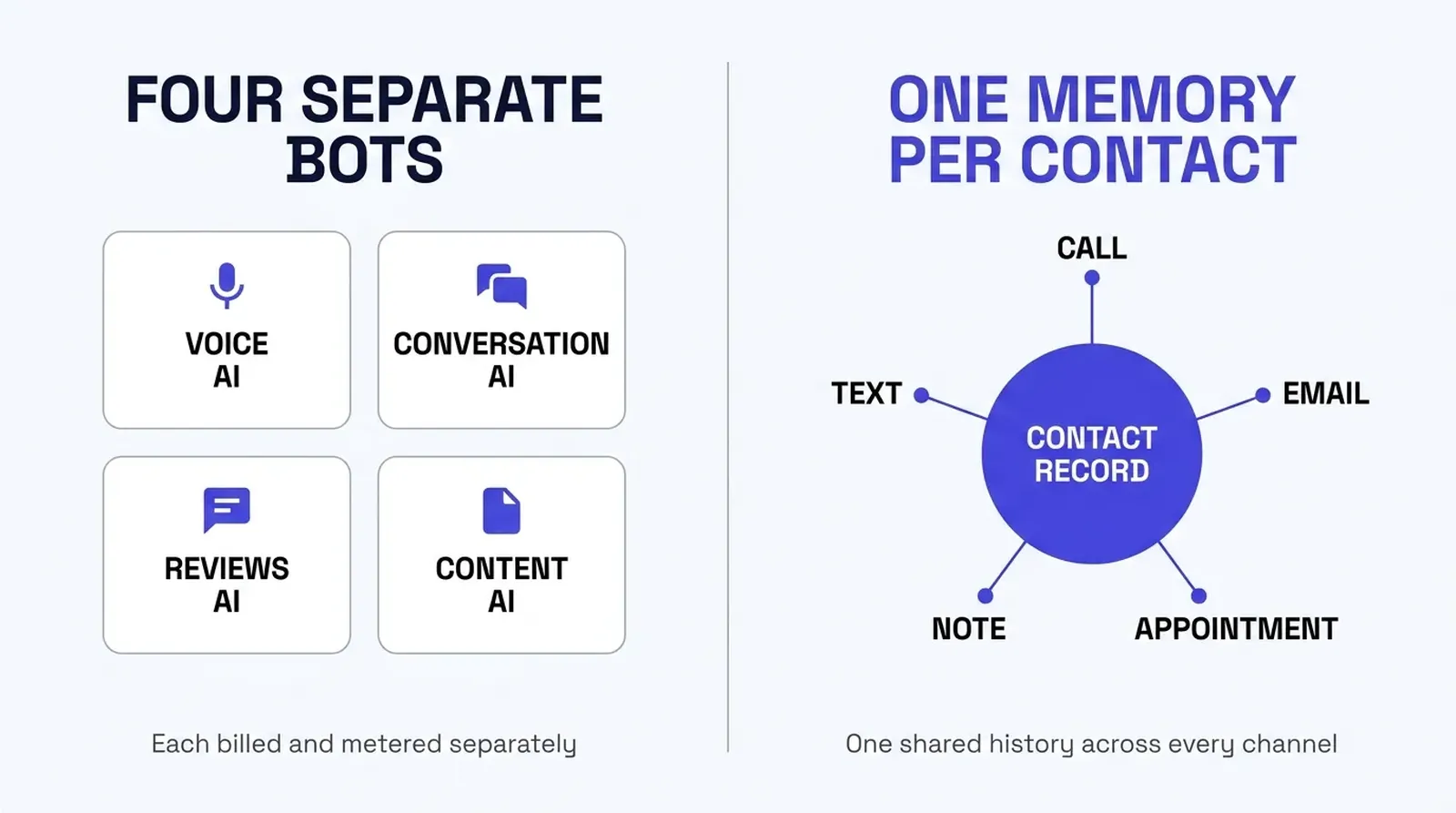
Ambrose's documented architecture also matters for the compliance half of this problem, not just the annoyance half. Its PHI Rail aliases identifiers before any non-BAA-covered destination ever sees them, and re-hydrates the real values only on the way back, which is a specific engineering answer to the question raised earlier about a health detail moving between AI products with no documented rail between them5. That is a structural answer, not a policy promise. We say "HIPAA compliant," never "HIPAA certified," because certification is not a status that exists for this kind of system, and we hold to that distinction here too.
The rest of Ambrose's documented architecture is built around that same single contact record rather than duplicating it per channel. The War Room is the interaction layer where a producer adds a plain-language note after a call, and that note becomes part of the same history a follow-up text or a voice reply reads from next, not a separate note field nobody downstream ever opens5. Spokes are Ambrose's term for its integration layer, connecting into GoHighLevel, marketplace and plan search, and other systems, so the context shaping an automated reply is the same context a producer sees when they open the contact record themselves. Routines and skills, Ambrose's configurable automations and knowledge packs, attach to that one history rather than each getting their own copy of it. For a multi-location agency, tenant isolation through application filters and row-level security keeps each office's data separated at the database level, which is the direct answer to the multi-location edge case raised earlier: separation where you want it, between offices, without recreating the separation you are trying to remove, between channels5.
Because this is a custom build question rather than a plan you pick off a pricing page, we scope it on a call. Strategic AI Architects' custom builds cover exactly this kind of unified context work, along with agent-ready websites, HIPAA-conscious automations, and voice AI, and the page is direct about the alternative: comparable custom development elsewhere typically runs $5,000 to $25,000 or more6. If your agency is already paying a monthly bundle price per location and still hearing "I already told you this" from clients, that comparison is worth having with real numbers on the table.
If you would rather see it than read about it
Book a strategy call and bring your current stack. We will look at what you already pay for, what actually talks to what, and whether the fix is a smaller integration than you expect or a genuinely custom build. Book a call
What changes once your AI has real memory
The outcome is not a fancier chatbot. It is a follow-up sequence that reads like it was written by someone paying attention. A renewal reminder that references the specific plan question from last season. A missed-call text that already knows the caller asked about a dependent's coverage last week. A review request that does not go out to someone who just filed a complaint on a different channel an hour earlier, because the system actually knows about the complaint.
None of that requires more AI. It requires the AI you already pay for to read from one place instead of five. Agencies that close this gap are not spending more per month, in most cases they are spending less, because they stop paying separately for tools that quietly work against each other and start paying once for a system that shares what it knows.
Picture a three-producer ACA and Medicare agency running two locations, which is a common enough shape for an independent agency in a mid-size metro. Today, a client who called about a subsidy change in March and texted a provider question in July looks like two different people to whatever answers the phone in October, because the March call lives in one product's log and the July text lives in another's. Multiply that by every client who has touched more than one channel this year, which on a Medicare or ACA book is most of them, and the agency is running an AI system that forgets a meaningful share of its own conversation history by design, not by accident. Closing that gap does not require replacing GoHighLevel or hiring anyone new. It requires the timeline and retrieval layer described earlier actually existing, once, instead of being assumed because six products share a login screen.
For a deeper look at what "AI context" means as a data architecture problem, independent of any one vendor's product bundle, see our earlier guide, Your CRM Remembers Nothing. If HIPAA and the BAA question specifically are what's on your mind, see Your GoHighLevel BAA Doesn't Make Your Funnel HIPAA Safe and Why Your Agency's Virtual Assistant Never Signed a HIPAA BAA.
Questions agencies ask
What is GoHighLevel's AI Employee, exactly?
AI Employee is HighLevel's bundled AI add-on covering Voice AI, Conversation AI, Reviews AI, Content AI, Ask AI, and AI Studio. HighLevel's own support documentation prices it at $50 a month per location on the Growth tier or $97 a month per location on the Unlimited tier, on top of any GoHighLevel plan.
Do Voice AI and Conversation AI share the same memory inside GoHighLevel?
HighLevel's own AI Employee documentation lists each product's usage limits and pricing separately and does not document a shared memory layer between them. A caller who messaged the website chat widget yesterday should not be assumed known to today's phone bot unless an agency built that connection itself.
Is my agency legally responsible for what an AI bot tells a client?
Yes. Existing insurance law already applies to decisions made or supported by AI. By August 31, 2026, 26 states and the District of Columbia had adopted the NAIC's Model Bulletin on the Use of Artificial Intelligence Systems by Insurers, which says exactly that in writing.
Can I build shared context myself inside GoHighLevel?
Yes, with custom fields, workflows, and webhooks that write each channel's conversation summary back to the contact record and feed it into the next bot's prompt. It is ongoing engineering work, not a settings toggle, and each product's separate pricing and usage limits still apply while you build it.
What is Ambrose, and how is its context different from AI Employee?
Ambrose is Strategic AI Architects' AI operating system for insurance agencies, built around one memory per contact across every call, text, email, note, and appointment. A follow-up references what actually happened last time instead of restarting the conversation from zero on whatever channel it lands on.
Does turning on a bundled AI product like this change my HIPAA exposure?
It can. The moment a Medicare or ACA detail gets typed into a chat bot or spoken to a voice bot, that detail is protected health information. How it moves between separate AI products with no documented compliance rail between them is a question your agency, not the software vendor, has to answer.
How much does fixing this actually cost?
It depends on whether you patch it yourself with engineering time or have it built. Strategic AI Architects scopes custom AI builds, including unified context across channels, on a call rather than off a fixed menu, and says plainly that comparable custom development elsewhere typically runs $5,000 to $25,000 or more.
- HighLevel Support Portal, "AI Employee Overview," help.gohighlevel.com, fetched September 17, 2026.
- National Association of Insurance Commissioners, "Implementation of NAIC Model Bulletin: Use of Artificial Intelligence Systems by Insurers" (state adoption map), content.naic.org, status as of August 31, 2026.
- Zendesk, Inc., "Contextual Intelligence Becomes the New Standard for Exceptional Customer Experience in 2026," zendesk.com, 2026.
- National Association of Insurance Commissioners, "Artificial Intelligence" insurance topics page, content.naic.org, accessed September 17, 2026.
- Ambrose documentation, "What is Ambrose," app.hiambrose.com/docs, accessed September 17, 2026.
- Strategic AI Architects, custom build page, strategicaiarchitects.com/ai-expert, fetched September 17, 2026.
Talk it through
Want a second pair of eyes on it?
Free 30 minutes. Bring what you found, or bring nothing and we will look together at how AI engines read your site and which fixes move first.
Find out what's actually talking to what in your stack
Run the free Audit, a live AEO Audit plus a HIPAA tracking scan of your site, in under a minute.