Playbook
One Robots.txt Line Could Soon Speak for Every AI Company
One line, read the same way by more than one AI company at once. Here is what actually changed, and what to check on your own site.


19 min read
On October 30, 2026, Google said it plans to support a shared AI training control in robots.txt,
built on an IETF draft that defines one policy token, __usage_ai-training, which
multiple AI companies can read the same way12.
Today it changes nothing. Google's own target for actually supporting it is 2027, and the draft
itself is an early, individual proposal with no formal standing yet23.
What is worth doing now is understanding the file this will eventually live in, because most
agency robots.txt files already mix at least two different kinds of AI directives, and the most
common mistake is blocking AI training and accidentally blocking AI citation at the same time,
when they have never been the same setting.
You already decided whether to block AI. Google just changed what that decision does.
Somewhere in your site's files sits a robots.txt, and odds are decent that at some point in the last two years, you, a developer, or a WordPress plugin added a line or two about AI. Maybe it was a blog post that told you to disallow GPTBot. Maybe it was a security plugin that shipped an "AI blocking" toggle you flipped once and never thought about again. Either way, that file has been sitting there quietly doing exactly what it was told, and until recently, each line in it spoke to exactly one company.
That is the part that just changed. On October 30, 2026, Google published a post saying it plans to support a new, shared signal in robots.txt, one line that multiple AI companies agree to read the same way, instead of each company requiring its own separate rule1. The underlying mechanism comes from a draft filed the same day with the Internet Engineering Task Force, the body that writes the technical standards the internet runs on, titled the Machine Readable Training Preference Signal2.
Nothing about this is a crisis. The draft is early, the rollout target is 2027, and nothing in your current file stops working today. But it is worth fifteen minutes, because the whole point of a shared signal is that one line now has more reach than it used to. A mistake in a single user agent group used to affect one crawler. The design intent of this new token is that a mistake, or an unread default, could someday speak for several companies at once. That is worth understanding before it matters, not after.
A two minute check before you read further
Open yoursite.com/robots.txt in a browser tab right now. Scroll past the search
engine lines near the top. If you see any line that says GPTBot,
Google-Extended, ClaudeBot, or Content-Signal, you already
have an opinion about AI set somewhere in that file, whether you remember setting it or not.
Why one file now has three different ways to say the same thing
Robots.txt is a plain text file, specified by an actual internet standard, RFC 9309, and for most
of its history it did one job: tell a given crawler, identified by its own name, which paths it
may fetch. A line reading User-agent: Googlebot followed by Disallow: /admin/
speaks only to Googlebot. A different crawler reads its own group, or falls back to the wildcard
group if it has none. Simple, and for twenty five years, that was the entire vocabulary.
AI changed what people wanted to say with that file, and the vocabulary has been playing catch up ever since, in three separate layers that now all sit in the same document on most agency sites without most owners realizing there are three.
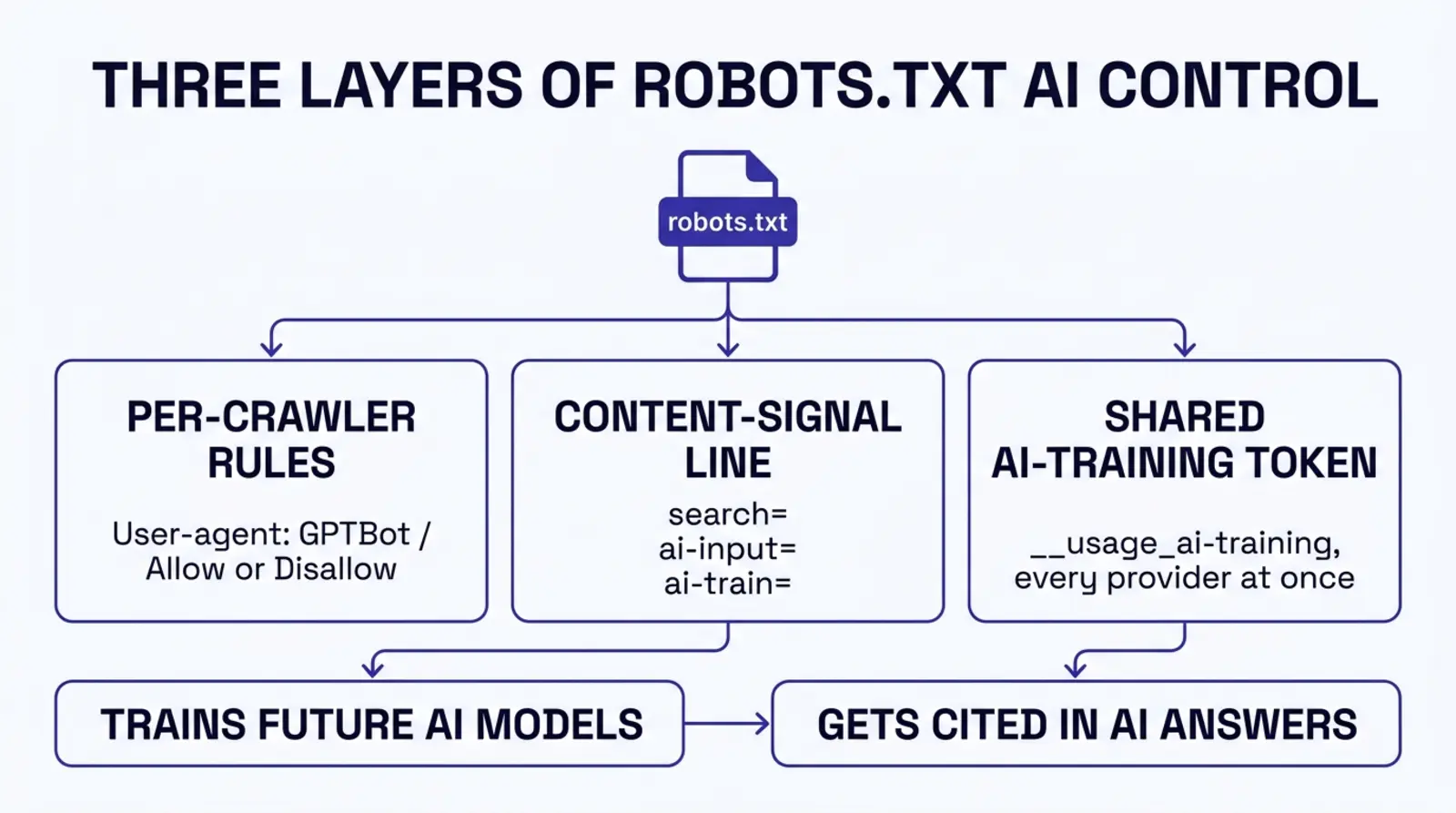
The first layer is the one everyone already knows: per crawler rules. A group named for one exact user agent token, with an Allow or Disallow for that crawler only. This is how a site tells OpenAI's GPTBot, used to train the company's generative AI foundation models5, apart from OpenAI's entirely separate OAI-SearchBot, which exists to surface a site in ChatGPT's search features, and from ChatGPT-User, which handles a live, user-initiated fetch inside a chat and is not automated crawling at all5. Three different jobs, three different tokens, and disallowing one says nothing about the other two. The same split exists on Anthropic's side with ClaudeBot, Claude-SearchBot, and Claude-User, and on Perplexity's side with PerplexityBot and Perplexity-User.
The second layer is the Content-Signal line, a robots.txt extension Cloudflare
published on September 24, 2025, built as the Content Signals Policy6.
Instead of naming a crawler, it names a use, in one line: Content-Signal: search=yes,
ai-train=no for example. Cloudflare defines three fields exactly: search
covers building a search index and providing search results, and explicitly does not include
AI-generated search summaries; ai-input covers feeding content into an AI model
for a real-time answer, the retrieval-augmented-generation and grounding use case; and
ai-train covers training or fine-tuning a model6. Any
crawler that chooses to read this line gets all three preferences in one place, rather than
needing a separate rule per company. Cloudflare's own managed robots.txt feature is active on
over 3.8 million domains, and the company sets new customers by default to
search=yes, ai-train=no, leaving ai-input unset entirely because, in Cloudflare's own
words, it does not want to guess a site owner's preference on that one6.
The third layer is the one that is new as of this proposal: a dedicated token meant to be read identically by every participating AI company, covered in full in the next section.
None of these three layers replaces either of the others. A site can, and increasingly will, carry all three at once: per crawler rules for fine control, a Content-Signal line for a three-way preference in one spot, and the new shared training token once it exists. The practical risk is not that any one of them is dangerous on its own. It is that an owner sets one, assumes it covers everything, and never checks whether a different layer is quietly saying something else.
What Google and the IETF actually proposed on October 30
Here is the mechanism in exact terms, because the vague version of this story is more confusing
than the precise one. The draft, authored by Kevin Kelley at Anthropic and filed with the IETF's
AI Preferences working group, defines a policy token: __usage_ai-training, following
the same product token syntax every robots.txt user agent name already uses2.
It goes on a User-Agent line, the same way a crawler's name does, and the example the draft itself
gives is this:
The draft's own example block
User-Agent: __usage_ai-training
Disallow: /
Allow: /press-kit/
Read as: "for AI training purposes specifically, disallow everything except the press kit folder." Any company that recognizes this token is meant to apply that same rule, without the site needing a separate group for each one2.
A few details matter more than they first look like they should. The draft states consumers
"MUST match policy tokens exactly, apart from case, as for any product token," and that wildcard
groups, a plain User-Agent: *, "MUST NOT be interpreted as matching the policy
token"2. In other words, a generic catch-all allow rule does not
accidentally opt a site into or out of anything here, the token has to be addressed directly. The
draft is also explicit that this is "not a directive for crawling behavior"2,
meaning it does not control whether a bot may fetch a page at all, only what the fetched content
may be used for. Crawling itself is still governed by the ordinary per-crawler rules in layer one.
On status: this is an individual Internet Draft, version 00, published October 30, 2026, and set to expire May 3, 2027 under the IETF's standard six-month draft lifecycle unless it is renewed or formally adopted23. The IETF's own datatracker lists it as an individual submission, not a working group document, meaning the IETF has not endorsed it and it currently carries no formal standing in the standards process3. Discussion is happening in public, on the AI Preferences working group's mailing list, which is the normal, deliberately slow way an internet standard gets built. Google's own post states its aim to support the resulting signal alongside other AI providers in 2027, and says it will post updates as that work progresses1.
| Date | What happened |
|---|---|
| 2023 | Google introduces Google-Extended, its first dedicated AI training control1 |
| 2025-09-24 | Cloudflare publishes the Content Signals Policy and the Content-Signal line6 |
| 2026-10-30 | Google announces plans to support a shared signal; the IETF draft is filed the same day12 |
| 2027-05-03 | The current draft, version 00, expires unless renewed or advanced2 |
| 2027 (target) | Google's stated aim to support the shared control alongside other providers1 |
If you want a second opinion on where your own site stands
The free Audit checks a live site's crawler and AI citation setup in about a minute, no signup required. Run a free Audit.
What Google-Extended already does, and what it has never touched
Because Google is the company that made this announcement, and because Google already has the oldest AI training control of the three layers, it is worth being precise about what that existing control covers before adding a new one on top. Google's documentation names two uses Google-Extended governs: training future generations of Gemini models, in both Gemini Apps and the Vertex AI API, and grounding, which is supplying Google Search index content to a model at the moment someone asks it a question, again in both Gemini Apps and Grounding with Google Search on Vertex AI4.
On Search specifically, Google's own documentation is direct: "Google-Extended does not impact a site's inclusion in Google Search nor is it used as a ranking signal in Google Search"4. That sentence is doing real work. It means an agency that disallowed Google-Extended at some point, perhaps along with a blanket "block all AI" pass across its robots.txt, did not change its Search rankings even slightly by doing so. It changed two narrower things: whether that content can train a future Gemini model, and whether Google's own grounding feature can pull it into a live Gemini answer at the moment someone asks.
Google's October 30 announcement adds one more wrinkle worth knowing. If a site sets the new shared training token to opt out, and never separately addresses Google-Extended by name, Google has said it will treat that as equivalent to having disallowed Google-Extended too1. Company specific controls keep working alongside the shared one. A site can set a broad preference with the new token and still carve out an exception for one provider with that provider's own rule, the same layering the per crawler groups in layer one already allow today.
Google counts eleven distinct crawler and control tokens on its own documentation page as of this writing: Googlebot, Googlebot-Image, Googlebot-Video, Googlebot-News, Storebot-Google, Google-InspectionTool, GoogleOther, GoogleOther-Image, GoogleOther-Video, Google-CloudVertexBot, and Google-Extended4. That is one company. Add OpenAI's three, Anthropic's several, Perplexity's two, and the rest of the named AI crawlers, and the realistic count of tokens an agency site might need an opinion about runs well past twenty, which is exactly the complexity the new shared signal is trying to collapse back down to one line for the training question specifically.
What the growing pile of robots.txt rules already costs an agency that never checks
It is tempting to treat all of this as too technical to matter for a two or three person agency. The honest cost is not a dollar figure, because this is a configuration problem, not a billing problem. The cost is a silent mismatch between what an owner thinks their site is doing and what it is actually doing, and the mismatch gets wider every time a new layer gets added to the same file.
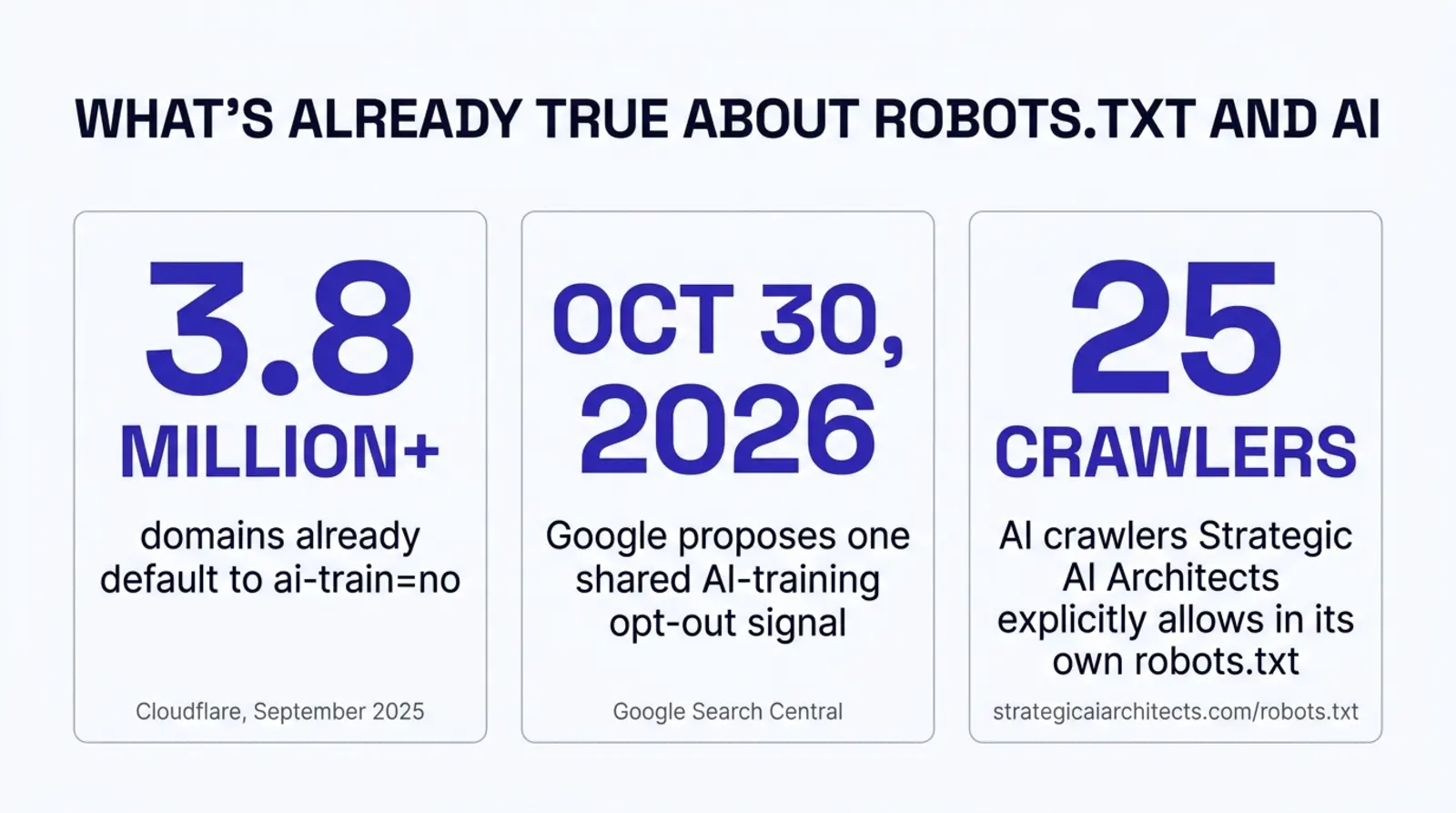
Consider the scale of just one default. Cloudflare's managed robots.txt feature, active on over
3.8 million domains as of the policy's September 2025 launch, sets ai-train=no as the
out of the box default for every one of them6. Some meaningful share of
those domain owners chose that deliberately. A meaningful share almost certainly never looked at
the setting at all, because it shipped as a default inside a security feature they turned on for
an unrelated reason, DDoS protection or bot management, and never revisited. Multiply that pattern
across every agency that installed a WordPress security plugin's "block AI bots" toggle, every
site on a hosting platform that quietly ships its own AI-blocking default, and every robots.txt
copied from a blog post written for a different kind of business entirely, and the honest picture
is a large share of small business websites carrying an AI preference nobody at the business
actually chose.
That matters specifically for an insurance agency because of what the preference actually governs. Training is the uncontroversial one to opt out of, your blog posts and plan pages improving a model you get no say in, if that is genuinely a concern for your agency. The problem is when the same blunt instrument that blocked training also blocked a citation-relevant crawler by mistake, because the person who added the rule, or the plugin that shipped the default, did not separate the tokens the way the companies that built them do. A site can end up invisible to the exact moment a prospect asks ChatGPT or Perplexity who handles Medicare enrollment in their county, not because a competitor out-marketed it, but because a setting nobody at the agency discussed quietly removed it from consideration.
Put a rough shape on it without inventing a number that was not fetched this session. Say a mid-sized agency's site answers, across a typical month, somewhere between a handful and a few dozen AI-driven questions about who handles Medicare or ACA enrollment in its county, a plausible range given how much of that research has moved off a traditional search box and into a chat window. If one crawler among the several that could have surfaced that answer is blocked by accident, the agency does not lose a fraction of those chances. It loses all of them, for the whole month, for that one assistant, because an AI crawler either sees the page or it does not, there is no partial credit. That is the actual shape of the risk: not a gradual decline, a binary switch flipped by a line nobody remembers writing.
Here is the self-audit we built as a companion to this post, written for exactly this blind spot, and it goes deeper into the per crawler layer specifically, with a sample file and a five minute check7: Can ChatGPT and Claude Even See Your Website? What follows here is the shorter version, focused on the two newer layers this post is actually about.
Read your own robots.txt in five minutes
You do not need a developer for this. Open yoursite.com/robots.txt in any browser.
It is a plain text file, and every line in it is readable English once you know what the three
layers above are looking for.
What to look for, layer by layer
- Per crawler rules: search for
GPTBot,Google-Extended,ClaudeBot,PerplexityBot, and similar names. Each one needs its own line,Allow: /orDisallow: /, to mean anything. No line for a given crawler usually falls back to whatever the wildcardUser-agent: *group says. - The Content-Signal line: search for the literal text
Content-Signal. If present, read the three values,search=,ai-input=,ai-train=, and confirm each one matches what you actually want, not just what a default assigned. - The new shared token: search for
__usage_ai-training. Almost no site has this yet, since the draft was only filed October 30, 20262, so finding nothing here today is the expected result, not a problem to fix. - The wildcard group: find
User-agent: *and read what it allows or disallows. This is the fallback every crawler without its own named group reads, including future ones you have never heard of yet.
If what you find matches what you actually want, you are done, and that is a genuinely common outcome, not a trick answer. If you find a Disallow rule for a crawler you do not remember adding, or a Content-Signal line set to values nobody at your agency chose, that is worth fifteen more minutes figuring out where it came from, a plugin, a host default, a template copied from another site, before deciding whether to change it.
Three places those unexplained lines tend to come from, in rough order of how often we see them on an agency site we are auditing for the first time. A WordPress SEO or security plugin that shipped an "AI bot blocking" feature as a selling point, turned on by default or toggled once during setup and never revisited. A hosting platform or CDN that ships its own managed robots.txt, the way Cloudflare's does for over 3.8 million domains, with its own default baked in before the site owner ever opens the file6. And a template or starter theme, copied from a different kind of business entirely, carrying rules that made sense for whoever wrote them originally and mean nothing in particular for an insurance agency. None of the three is malicious. All three are the same root problem: a default chosen by someone who was never thinking about your agency specifically, sitting in a file almost nobody ever reads.
Should an insurance agency actually opt out of AI training?
It is a fair question with a real answer, not an obvious one either direction, and it is worth saying plainly where the honest tradeoff sits rather than pretending there is only one right choice.
The case for leaving training open: an agency chasing visibility in AI answers is, by definition, trying to be the thing a model recognizes and names. A large share of AI training still comes from the open web, and a site that disallows training broadly is choosing to not be part of that corpus going forward, on the same logic that caused the agency to want AEO in the first place. If the whole strategy is "be findable and citable," training is upstream of that goal, not opposed to it, for most agencies most of the time.
The case for opting out is real too, and it deserves to be said without hedging: some site owners simply do not want a company building a commercial model off content they wrote, full stop, as a matter of principle rather than strategy, and that is a legitimate business decision a site owner is entitled to make regardless of what it does to AI visibility. If that is your position, the Content-Signal line and the per crawler rules both support it cleanly today, and the new shared token will add a third, simpler way to say the same thing once it exists.
There is a version of this specific to insurance worth naming directly. An agency's own county level research, a plan comparison it wrote up, or a local market note built from its own carrier relationships is proprietary work in a way a generic "five tips for choosing insurance" post is not. Wanting that narrower category of original work excluded from training, while still wanting the same page fully visible to the crawlers that drive AI citation and grounding, is a coherent, defensible position, and it is exactly the kind of split the three-layer system above is built to support: a training preference set one way, a citation and search preference set another, on the same page, without the two ever needing to match.
Our own default, stated plainly: we want to be read, indexed, and cited, so every site we build
ships open across all three layers by default, Allow on every named search and AI crawler,
Content-Signal: search=yes, ai-input=yes, ai-train=yes, verified live on our own
robots.txt this session7. That is our call for our own content, not a
claim that it is the only defensible one for yours.
What we ship instead
This section stays narrow, describing only what is actually live, because that is the whole point of writing about compliance and configuration honestly. Every Digital Foundation build ships a robots.txt that names search engines and AI crawlers by their exact token rather than relying on a bare wildcard allow, since a wildcard can be silently overridden by a CDN or security plugin's own defaults in a way a named rule cannot. It carries a Content-Signal line stating all three preferences in one place from day one, and it is built on Astro, which renders pages to finished HTML at build time rather than shipping a JavaScript runtime the browser, or a crawler, has to execute before the content exists8.
The part that matters most for this specific topic: it updates. Sitemap, llms.txt, and robots.txt are generated by the site itself, not maintained by hand, and they update with the full absolute URL the moment a new page or post publishes. When the shared training signal moves from an individual draft to something crawlers actually read in practice, that is one change we make once, across every site we operate, rather than an email every client has to act on individually or forget to.
| Tier | Price | What it adds |
|---|---|---|
| Starter | $247/mo | Complete site, 7 new pages a month, 95+ mobile PageSpeed, a 60-point SEO and AEO checklist9 |
| Pro | $497/mo | Everything in Starter, plus 14 to 17 new pages a month and a 24/7 AI voice receptionist9 |
| Scale | $997/mo | Everything in Pro, plus up to 71 new pages a month and up to 4 languages9 |
All three tiers are month to month with a 14-day free look period, verified live on the Digital Foundation page this session9. If what you actually need is narrower, just a correct, future-proofed crawler and citation setup on a site you are keeping as is, that is exactly the kind of scoped check the free Audit runs.
What changes once the file says what you actually mean
Strip the standards talk away and the outcome is small and concrete. Your robots.txt stops being an inherited artifact nobody at the agency understands and starts being a short, deliberate statement of two separate preferences: what may crawl and index your site, and what may train a model on it. Those two questions get answered on purpose instead of by whatever a plugin or a host defaulted to, and the gap between what you think your site allows and what it actually allows closes.
There is a second benefit that compounds quietly. A site built to welcome the citation-relevant crawlers by name, with the training question answered separately and on purpose, is positioned correctly for every future layer this standard adds, not just the one that exists today. The companies building these controls are explicit that they plan to keep crawler specific rules working alongside any shared signal12, so a site that gets the fundamentals right now does not have to redo this work when the shared token moves from draft to something crawlers actually check.
What changes if you run more than one agency site
Everything above holds for one site run by one owner who can spend fifteen minutes reading a text file. It compounds for an FMO or IMO running several branded sites, or for downline agents each running their own, because the same inherited default, a plugin's AI-blocking toggle, a template copied from one site to the next, is not a problem that is five times smaller across five sites. It is five times larger, quietly repeated, usually without any one person responsible for noticing it across all five.
A shared training signal arriving sometime in 2027 raises the stakes on exactly this pattern, because a mistake in one line will eventually speak for more AI companies at once than it does today. Standardizing a correct robots.txt, Content-Signal line, and crawler welcome list across every site a multi-office operation runs, while each office keeps its own brand and its own content, is exactly the kind of work worth a real conversation rather than five separate, inconsistent fixes.
Worth a real conversation at this scale
Getting crawler and AI citation settings right across more than one agency site, and keeping them right as the standards keep changing, is exactly the kind of work we handle for agencies running more than one site. Book a call.
Questions agents ask
What is the new shared AI training signal Google proposed for robots.txt?
On October 30, 2026, Google published a post saying it plans to support a shared AI training control in robots.txt, based on an Internet Engineering Task Force draft called the Machine Readable Training Preference Signal. The draft defines one policy token, written as __usage_ai-training, that a site adds to a User-Agent line in robots.txt. Instead of writing a separate Disallow rule for every AI company's crawler, a site owner states one preference against AI training, and any participating company that recognizes the token is supposed to read it the same way. Google says it aims to support the signal alongside other AI providers in 2027.
Does blocking AI training also block my site from being cited in AI answers like ChatGPT or Google AI Overviews?
Not by itself, and this is the distinction most site owners miss. The IETF draft states plainly that the training preference token is not a directive for crawling behavior, and it does not touch whether your content can be read for a live answer or shown in a search result. Google's own Google-Extended token, the company's existing training control, carries the identical separation: its documentation states that Google-Extended does not impact a site's inclusion in Google Search and is not used as a ranking signal in Google Search. Training and citation run on separate controls today, and the new shared signal is designed to extend the training control specifically, not the citation one. The risk is a copied snippet that blocks more than the owner meant to, not the new signal itself.
What is the difference between Google-Extended and Googlebot?
Googlebot is the crawler that indexes your pages for Google Search, and the rules you write for it control whether your pages can rank at all. Google-Extended is not a separate crawler with its own requests hitting your server. It is a control token layered onto the crawling Google already does, letting you opt out of two specific downstream uses: training future Gemini models, and grounding, which is handing your already-indexed content to a model at the moment someone asks it a question. Google states directly that blocking Google-Extended changes neither your Search ranking nor your Search inclusion. The two tokens answer two different questions: Googlebot controls whether you show up in Search at all, and Google-Extended controls what happens to your content after Google already has it.
Do I need to do anything to my robots.txt file right now because of this announcement?
No. Google's own post frames this as a plan, and the underlying draft is an individual Internet Draft with no formal standing in the IETF standards process yet, version 00, published October 30, 2026, and set to expire May 3, 2027 unless it is renewed or advances. Google's stated target for actually supporting the signal is 2027. Nothing changes today for how any crawler reads your current robots.txt. What is worth doing now, with no deadline attached, is reading your own file once and knowing exactly what each line in it already does, because that is the file this new signal will eventually sit inside.
What is the Content-Signal line, and is it different from the new AIPREF token?
They are two separate efforts that solve a similar problem in different ways. The Content Signals Policy is a robots.txt extension Cloudflare published on September 24, 2025, built around a single Content-Signal line with three named fields: search, ai-input, and ai-train, each set to yes or no. Cloudflare's own managed robots.txt feature, active on over 3.8 million domains, defaults new customers to search=yes and ai-train=no. The IETF's Machine Readable Training Preference Signal is a different mechanism, a dedicated User-Agent group carrying the token __usage_ai-training, drafted specifically so multiple AI companies can agree on how to read one training preference. Both exist in the same robots.txt file without conflicting, but they are not interchangeable, and a site that sets one and assumes it covers the other is leaving a gap.
Who controls whether this new standard becomes official?
No single company. The draft is being discussed on the IETF's AI Preferences working group mailing list, a public, multi-stakeholder process, not a single company's product decision. The current text was authored by Kevin Kelley at Anthropic, and the IETF's own datatracker lists it as an individual Internet Draft rather than an adopted working group document, which is an early stage with no guarantee it ships in its current form. Google's announcement describes its own intent to support the resulting signal once the vocabulary settles, which is a company stating a plan, not the standard itself being finalized.
Should an insurance agency block AI crawlers from training on its website?
Think about what you are actually trying to accomplish before touching the file. If the goal is getting named when a prospect asks ChatGPT, Perplexity, or Google's AI tools who handles Medicare or ACA enrollment near them, blocking training does not help with that and blocking the wrong crawler can quietly hurt it, because grounding and citation run through crawlers and signals separate from the training-only ones. If the concern is strictly that a company might use your blog posts and plan pages to improve a model you get no say in, that is a legitimate, separate preference, and the tools above exist for exactly that. Most agencies chasing visibility in AI answers are better served leaving training open the same way they leave Search open, but it is a real choice, not a default everyone has to accept.
What does Digital Foundation do differently with robots.txt and AI crawlers?
Every Digital Foundation build ships a robots.txt file that explicitly welcomes named search engines and AI crawlers by exact user agent token, rather than relying on a bare wildcard allow rule that some CDN or security plugin can silently override. It already carries a Content-Signal line stating search, ai-input, and ai-train preferences in one place, and it updates automatically, alongside the sitemap and llms.txt, the moment a new page or post goes live, so nothing about crawler access depends on an agency owner remembering to edit a file by hand. When the shared AI training signal moves from draft to something crawlers actually read, that is a file we update once, for every site we run, not a fire drill for each agency to handle alone.
Sources
- Google Search Central Blog. "Supporting a shared AI training control in robots.txt," published 2026-10-30, verified live 2026-11-04. developers.google.com.
- IETF. "Machine Readable Training Preference Signal" (draft-kelley-aipref-training-preference-signal-00), published 2026-10-30, expires 2027-05-03, verified live 2026-11-04. ietf.org.
- IETF Datatracker. Status page for draft-kelley-aipref-training-preference-signal, individual Internet-Draft status, verified live 2026-11-04. datatracker.ietf.org.
- Google Search Central. "Google's common crawlers," Google-Extended section, verified live 2026-11-04. developers.google.com.
- OpenAI Developers. GPTBot, OAI-SearchBot, and ChatGPT-User documentation, verified live 2026-11-04. developers.openai.com.
- Cloudflare Blog. "Giving users choice with Cloudflare's new Content Signals Policy," published 2025-09-24, verified live 2026-11-04. blog.cloudflare.com.
- Strategic AI Architects. Live robots.txt, verified 2026-11-04. strategicaiarchitects.com.
- Astro. "Why Astro," zero JavaScript by default, verified live 2026-11-04. docs.astro.build.
- Strategic AI Architects. "Digital Foundation," pricing and tier features, verified live 2026-11-04. strategicaiarchitects.com.
Talk it through
Want a second pair of eyes on it?
Free 30 minutes. Bring what you found, or bring nothing and we will look together at how AI engines read your site and which fixes move first.
See what your own robots.txt is actually telling AI companies
Run the free Audit, a live AEO Audit plus a HIPAA tracking scan of your site, in under a minute.
Related reading: can ChatGPT and Claude even see your website · does an llms.txt file get your agency cited by AI