Playbook
Why Your Insurance Agency's Facebook Ads Get Rejected
Meta and the FTC are both tightening around the same category, at the same time, and your compliant ad is caught in the crossfire.

19 min read

Insurance ads get more scrutiny than almost any other category on Meta, by design. Meta requires insurance advertisers to self identify as a Special Ad Category, which strips certain targeting options, and a separate policy bans ad copy that implies the reader has a specific health condition123. At the same time, the FTC announced on August 7, 2025 that Assurance IQ and MediaAlpha would pay a combined 145 million dollars for deceptive health insurance lead generation, including selling roughly 119 million consumer leads to telemarketers4. Both forces land on the same category at once, which is why a compliant agency ad can get caught in the same net as a bad actor's.
What "ad disapproved" actually looks like
You write the ad the same way you did last month. Same offer, same photo, same landing page. This time it comes back disapproved within an hour, with a policy reference number and no human to call. You edit a word, resubmit, and it gets approved. You never find out which word it was.
Multiply that by every campaign an agency runs during AEP or open enrollment and it stops being an annoyance and starts being a scheduling problem. A disapproved ad sits at zero delivery while you wait on a review queue you can't see into, and every hour it sits there is an hour your competitor's ad, whichever one Meta's automated system happened to like better, is the one a prospect in your county actually sees.
There's a second layer to the frustration that makes it worse than a one-off delay. A disapproved ad doesn't just sit at zero delivery, it also attaches a mark to the account's review history, and Meta's automated systems weigh that history when deciding how fast to clear the next submission. An account with a clean record gets faster automated approval. An account with several recent disapprovals, even ones you fixed the same day, tends to get routed for slower, sometimes manual, review on the next campaign too, which is why the same agency can feel stuck in a review loop that never fully clears even after every individual ad eventually gets approved.
Ask around and most agents assume it's something they did. It usually isn't. Insurance ads get reviewed differently than almost any other category Meta runs, by policy, and the policy has gotten stricter, not looser, over the last two years. Layered on top of that, federal regulators just spent 2025 building a very public case against the exact channel a lot of agencies lean on when their own ads aren't converting: buying leads from an aggregator instead of generating them.
Both problems have the same root cause. Insurance sits in a category the platform and the government both watch closely, because a real share of the ads and offers in that category over the years have been scams. Your compliant ad gets caught in the same net as the ones that weren't, because neither an algorithm nor a regulator scanning at scale can always tell the difference from the outside.
Why Meta puts insurance in a Special Ad Category
Meta's advertising standards require any US advertiser running ads for financial products and services, housing, or employment to self identify as a Special Ad Category before the campaign can launch1. Insurance sits inside that financial products and services bucket, and once an ad account declares it, Meta's own restricted goods and services policy for financial and insurance products kicks in on top of the general Special Ad Category rules2.
That policy, current as of the version live on transparency.meta.com as of April 30, 2026, states plainly that ads promoting credit cards, loans, or insurance services must be targeted to people eighteen or older, and it separately requires that insurance advertisers be able to demonstrate appropriate authorization from the relevant regulatory authorities on request2. The same policy blocks any ad from directly requesting personally identifiable information or certain categories of financial information in the ad unit itself, which rules out a class of "quick quote" creative that used to be normal in the category2.
None of that is unique to a bad actor. It applies to your agency exactly as much as it applies to a lead-buying operation running the same category. The difference is that a Special Ad Category declaration also strips out targeting options the rest of Meta's advertisers still get: detailed age brackets outside the 18-and-older floor, gender, and options built on top of zip-code-level geography and lookalike audiences modeled from those narrower signals. An agent used to targeting a specific age band or gender for a Medicare campaign, because that's who actually buys the product, loses that lever the moment the account is correctly flagged as a financial services advertiser. Losing it isn't a bug. It's the entire point of the category: Meta decided, after years of financial and housing discrimination complaints across the industry generally, that letting advertisers slice financial offers by protected characteristics was a bigger risk than losing some ad relevance, and applied that decision uniformly rather than case by case.
One exception worth knowing
Meta's own policy carves out brand ads for banks or insurance companies, meaning ads that build awareness without letting someone actually obtain or connect with the product inside the ad flow, from the stricter authorization requirements that apply to lead-generating financial ads2. A "who we are" brand campaign and a "get your quote" campaign are reviewed differently, even from the same page.
What you can't say, or ask for, in the ad itself
The Special Ad Category rules govern who you can target. A separate Meta policy, the personal attributes and privacy violations standard under objectionable content, governs what the ad copy itself is allowed to say, and this is the one that trips up health and Medicare advertisers specifically. As of the version last updated June 26, 2024 on transparency.meta.com, the policy prohibits ads that assert or imply a person's personal attributes, and it names medical information explicitly: an ad cannot imply knowledge of a user's or a user's family's medical information3.
Meta's own published examples make the line concrete. "Do you have diabetes?" and "Depression getting you down? Get help now." are both listed as prohibited, because both assert something about the reader's health before the reader has said anything about themselves. "Bulimia counseling available" is listed as allowed, because it describes a service rather than asserting a condition onto the specific person looking at the ad3.
That distinction matters enormously for Medicare and health insurance creative, because so much of the category's default copywriting leans on exactly the pattern Meta bans. "Diabetic? See if you qualify for a $0 premium plan" reads like a normal insurance headline and is a near-verbatim match for the prohibited pattern in Meta's own documentation. It gets flagged automatically, at scale, before a human ever looks at it, and the account that keeps submitting variations of it accumulates a disapproval history that makes every future ad, including the compliant ones, take longer to clear review.
The same logic extends past headlines into the parts of a campaign agents don't usually think of as "the ad": a testimonial that quotes a client naming their own diagnosis, a before-and-after framing that implies a health outcome changed because of the plan, or stock photography paired with copy that lets the reader infer a condition even without stating one outright. None of those are exotic edge cases. They're common patterns in insurance creative because they work on a human reader, which is exactly why an automated system trained to catch health-condition implications flags them too. And this scrutiny isn't limited to paid delivery. Organic posts from a Page promoting insurance products can be reviewed under the same content standards if they're boosted or if they violate the platform's broader content policies, so "it's not a paid ad" isn't a reliable way around any of this.
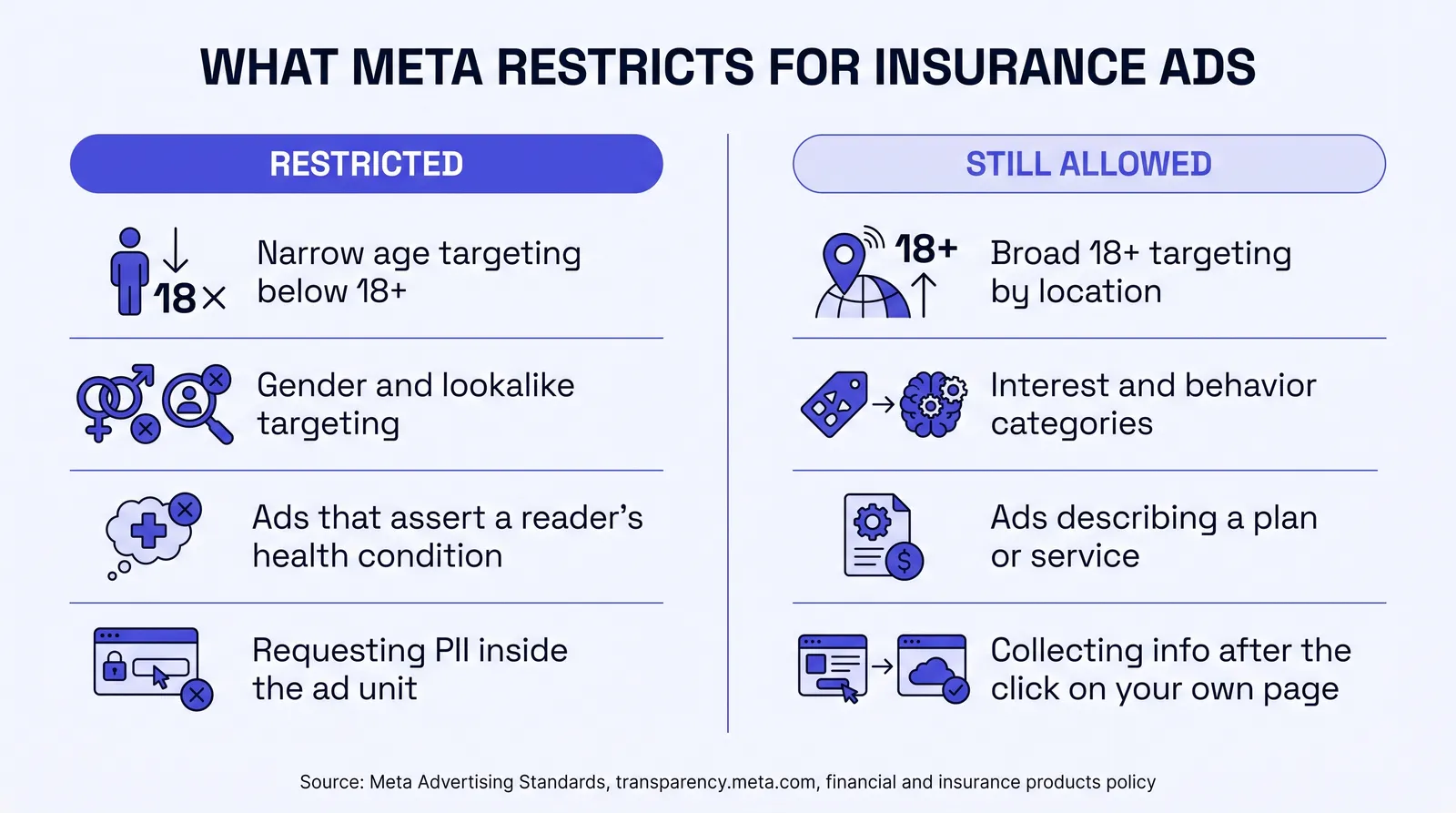
| Element | Restricted or removed | Still allowed |
|---|---|---|
| Targeting: age | Narrow age brackets outside the 18+ floor | Broad 18+ targeting by location and interest |
| Targeting: audience type | Gender, and lookalikes built on those narrower signals | Interest and behavior categories that survive Special Ad Category rules |
| Ad copy: health | "Do you have diabetes?" style assertions about the reader's condition | "Diabetes plan options available" style service descriptions |
| Ad copy: data requests | Directly requesting PII or financial details inside the ad unit | A link to a landing page that collects information after a click |
| Authorization | Running lead-generating insurance ads with no verifiable regulatory authorization on file | Brand awareness ads that don't connect the viewer to the product directly |
The bigger reason your lead pipeline isn't stable
Meta's review policy is only half of what's tightening around this category. The other half is regulatory, and it landed hard in the middle of 2025.
On August 7, 2025, the Federal Trade Commission announced that Assurance IQ, LLC and MediaAlpha, Inc. agreed to pay a combined 145 million dollars, 100 million from Assurance IQ and 45 million from MediaAlpha, to settle FTC charges that the two companies misled consumers shopping for health insurance4. The FTC's own press release lays out the mechanics in detail: MediaAlpha operated websites with names like ObamacarePlans.com that falsely implied a government affiliation, ran ads promoting a nonexistent "Health Insurance Give Back Program" using paid actors including someone presented as a doctor, and sold approximately 119 million consumer leads to telemarketers who then used those leads to make robocalls and place live sales calls promising coverage the underlying plans didn't actually provide4. Assurance IQ, the FTC alleged separately, made false claims that plans covered preexisting conditions and had no benefit caps, then charged consumers for bundled supplemental products without proper consent4.
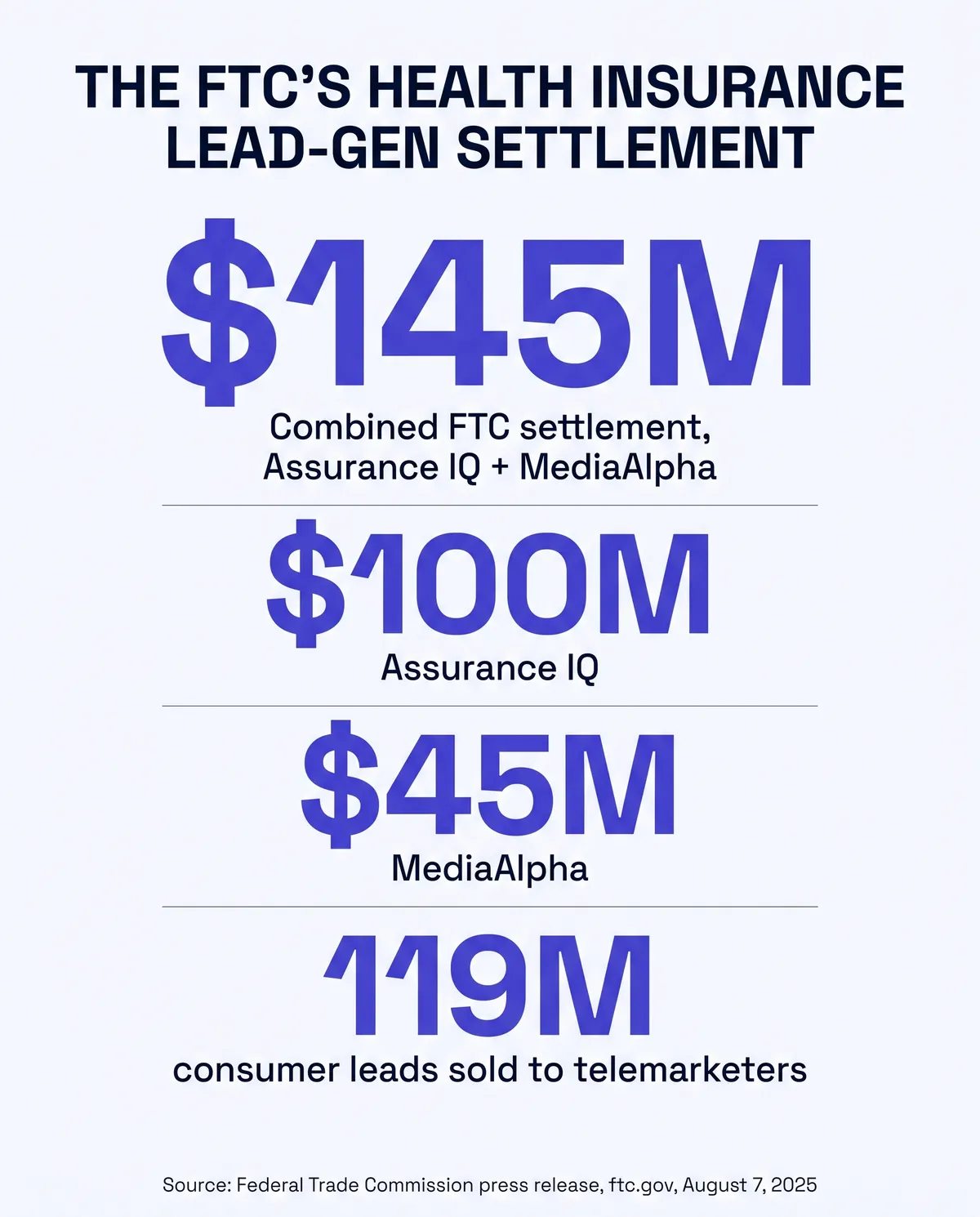
Read that case next to Meta's own creative policy and the pattern lines up almost exactly. The tactics the FTC punished, false government affiliation, coverage promises the plan didn't back up, and personal-information harvesting dressed up as a quote request, are close cousins of the exact ad patterns Meta's personal attributes and financial services policies exist to catch before they ever reach a feed. Two enforcement systems, one built into the ad platform and one built into federal law, are converging on the same category from different directions at the same time.
This matters to your agency even if you have never run a single deceptive ad, for two concrete reasons. First, if any share of your leads comes from an aggregator or a network reseller rather than your own website or your own compliant campaigns, you now have a real, active regulatory precedent showing that channel can be shut down, fined, and restructured with no notice to the agencies downstream who were buying from it. A pipeline built on rented leads from a network you don't control is a pipeline the FTC can interrupt on a day you didn't pick. Second, Meta's automated review has no reliable way to distinguish, at the speed and scale it operates, between your compliant local campaign and a bad actor's campaign that happens to use similar-sounding language, similar targeting settings, or a similar-looking landing page pattern. Guilt by category resemblance is a real cost of doing business in a space regulators just proved was full of exactly the abuse they were watching for.
A question worth asking your own pipeline
If a meaningful share of your current leads comes from a source you don't own, a network, an aggregator, a "co-op" lead program, ask what happens to that flow if the source gets an FTC letter tomorrow. If the honest answer is "I don't know" or "it stops," that's a dependency worth pricing out now, not after it happens. The free Audit looks at where your own site stands on this. Run a free Audit.
What a flagged account or a dried-up lead source actually costs
Put a number on the ad-account side first, because it's the one you can estimate from your own spend today. Say your agency runs 50 dollars a day across active Meta campaigns during a normal week, a modest but realistic budget for a single-office agency. Neither Meta nor the FTC publishes an average review-hold length, so use three days here purely as a round example: an account restriction that pauses delivery for that long doesn't just cost the 150 dollars in unspent budget. It costs the leads that budget would have produced during the exact days your competitors' unrestricted campaigns kept running, in a market where the buyer researching a plan today may have made a decision before your account clears review. That's the part a paused-spend number alone doesn't capture: lost timing, not just lost dollars. Swap in whatever hold length your own account has actually experienced and the table below still works the same way.
Run the same arithmetic at a higher spend level and the exposure scales with it. An agency spending 300 dollars a day loses 900 dollars of budget to a three-day hold, on top of whatever share of that period's normal lead flow doesn't get recovered later. None of these are numbers Meta publishes, they're your own math against your own budget, which is exactly why it's worth running against your actual spend rather than treating "my account got restricted" as a one-time inconvenience instead of a recurring cost with a real dollar figure attached.
| Daily Meta ad spend | Budget lost over a 3-day hold | Lost over a 50-week year, one hold a month |
|---|---|---|
| $50/day | $150 | $1,800 |
| $150/day | $450 | $5,400 |
| $300/day | $900 | $10,800 |
The rented-lead side of the cost is harder to price and more dangerous, because it's binary instead of gradual. A paused ad account is a delay. A shut-down lead network is a stop. If an aggregator you buy from is the next MediaAlpha, meaning the next company an FTC investigation determines was harvesting and reselling leads under a false premise, your pipeline doesn't slow down, it goes to zero on whatever day that network's operations get frozen, and you find out the way every agency that bought from Assurance IQ or MediaAlpha's downstream partners found out: after the fact, with no transition plan, because the transition plan was never yours to make.
How to structure a Meta ad account that doesn't trip review
None of this means you should stop running your own Meta ads. It means running them with the category's actual rules built in from the first campaign, instead of discovered one disapproval at a time.
Declare the Special Ad Category honestly and up front, for every insurance campaign, not just the ones that feel obviously financial. Meta's system checks this, and an account caught running financial services ads without the declaration accumulates a compliance flag that makes every future review slower, not just the one ad that got caught.
Write creative that describes the plan or the service, not the reader's condition. "See if you qualify for extra Medicare benefits" describes an outcome. "Struggling with diabetes costs?" asserts something about the person reading it. The first pattern survives review consistently. The second is a near match for Meta's own published example of a banned ad, and it will get flagged whether or not you meant anything deceptive by it.
Move data collection off the ad unit and onto your landing page. An ad that says "click to see your options" and collects information after the click, on a page you control, is reviewed differently than an ad that asks for a phone number or a health status directly inside the ad itself. This isn't just a policy workaround, it's also the point where a real quoting tool, one that pulls actual eligibility and pricing from live data instead of asking generic intake questions, does more selling work than the ad ever could.
Keep a documented authorization trail. Meta's financial products policy allows the platform to request proof of regulatory authorization for insurance advertisers on demand2. An agency with its NPN, state licensing information, and E&O documentation ready to attach the moment a review requests it clears that step in hours. An agency scrambling to find the right document clears it in days, if at all, while the campaign sits paused.
Separate brand awareness campaigns from lead-generation campaigns, deliberately, because Meta's own policy treats them differently. A campaign that never lets someone submit information or connect with the product inside the ad flow qualifies for the brand-ad exception to the stricter authorization requirements2. Running every campaign as a lead-gen campaign, even the ones that are really just building name recognition in a county, needlessly exposes work that didn't need the stricter review to the stricter review.
You can do all of this yourself
Every fix above is something you can implement in your own Meta Business Manager this week without hiring anyone. Most agents read this and decide the account-hygiene half is worth doing themselves. The part that's harder to DIY is what the ad points to once someone clicks, and that's the half most agencies actually get stuck on.
The deeper fix: stop renting your pipeline
Account hygiene reduces disapprovals. It doesn't fix the second, bigger problem, which is a pipeline that depends on a channel you don't own and can't audit. The agencies least exposed to both the Meta review tightening and the regulatory tightening are the ones whose leads originate on their own domain, from their own compliant tools, rather than from a purchased list or a co-branded lead network with practices you've never actually seen.
That's a website problem before it's an ads problem. A quoting tool that pulls real premiums and subsidy figures from live federal data, instead of a generic form promising "options" with no numbers attached, gives Meta's reviewers, and any regulator who ever looks, a landing page with nothing to hide, because there's nothing invented on it. A site built on Astro and served statically from the edge loads fast enough that the ad spend you do run isn't wasted on visitors who bounce before the page finishes painting, which is a separate, compounding cost we cover in our guide to why cost per lead keeps climbing. And a site with real organization schema, a named licensed author, and verifiable business information gives an automated reviewer, human or otherwise, a faster path to confirming you're not the thing the policy was written to catch.
None of this replaces owning your own advertising decisions. It changes what happens downstream of the click, and downstream of the click is where an aggregator's leads and your own compliant funnel stop looking anything alike, to Meta, to a regulator, and to the person deciding whether to trust you with their health information.
There's also a tracking dimension to this that agencies running health-related campaigns tend to overlook until it's a problem: what analytics and ad-pixel setup sits on the landing page itself. A Meta Pixel firing directly on a health insurance quote page, with no server-side gate and no consent flow, is a separate HIPAA-adjacent exposure from the ad-approval question, one we cover in detail in our guide to pixel lawsuit risk. The two issues compound each other in practice: an agency worried enough about ad compliance to fix its Meta account, but still running client-side pixels on the same landing page, has closed the visible half of the exposure and left the less visible half running.
How we build agencies out of this
This is the exact gap our website build closes. Every site we ship is a compliant, AEO-optimized build on Astro, served statically from the edge on Cloudflare, with real quoters wired to live federal data instead of decorative forms with example numbers5. Digital Foundation Starter, verified live on the pricing page at 247 dollars a month, includes the complete compliant website plus all educational and offer pages, AI citation optimization, Google Business Profile management with review harvesting, and an AI chat widget, with setup free on a limited basis and a 14-day free trial5.
Because the site is the landing surface for your own ads, not a third party's, the organization identity, the licensing information, and the schema markup a reviewer or a regulator would look for are already built in rather than assembled under deadline when a review flags something. And because the quoting tools pull real numbers from live sources, there's no gap between what the ad promises and what the landing page delivers, which is the exact gap the FTC's case against MediaAlpha and Assurance IQ was built around4.
We don't run your Meta ad account for you as part of this build. What we build is the part your ads point to: a site that survives scrutiny because there's nothing on it that needs to survive scrutiny, and a pipeline that's yours regardless of what happens to any lead network or ad platform's policy next quarter.
Worth a conversation if you're buying leads today
If a meaningful share of your book still runs through a purchased lead source, that's a specific, fixable dependency, and it's worth a conversation about what owning the pipeline instead would actually take. Book a call.
What actually changes
Not a promised approval rate, a guaranteed lead count, or a specific ranking, because none of those are something any vendor can honestly promise you. What changes is concrete.
$145M
FTC settlement against two health insurance lead brokers, Aug. 2025
119M
Consumer leads sold to telemarketers in that case
18+
Meta's targeting floor for every financial and insurance ad
1
Compliant landing page that survives both kinds of scrutiny
Your landing page stops being the reason a compliant ad gets extra scrutiny, because there's nothing on it that resembles what the FTC's case was built around. Your account's disapproval history stops compounding, because the creative and targeting choices behind it were built around the actual policy instead of last year's habits. And the leads reaching your CRM stop depending on whether a network you've never audited stays in business through the next enforcement cycle.
Questions agents ask
Why do insurance ads get flagged more than other industries on Meta?
Insurance falls inside Meta's Special Ad Category for financial products and services, which strips certain targeting options and applies stricter review to every ad in the category, plus a separate personal attributes policy that specifically bans ad copy implying a reader's health condition. The scrutiny is built into the category, not triggered by anything unusual your account did.
Is it illegal to target insurance ads by age or gender on Meta?
It isn't illegal, it's against Meta's own advertising policy once an account is correctly declared as a financial services advertiser. Special Ad Category rules remove narrow age brackets below the 18-and-older floor, gender targeting, and lookalike audiences built from those signals, for every advertiser in the category, uniformly.
Can I still mention a health condition in a Medicare or health insurance ad?
You can describe a service related to a condition. You can't assert or imply that the reader personally has that condition. "Diabetes plan options available" is allowed under Meta's own published examples. "Do you have diabetes?" is the exact pattern its policy names as prohibited.
What actually happened with the FTC and MediaAlpha?
The FTC announced on August 7, 2025 that Assurance IQ and MediaAlpha agreed to pay a combined 145 million dollars to settle charges that they misled health insurance shoppers, including running ads that falsely implied government affiliation and selling approximately 119 million consumer leads to telemarketers. Neither company is a household name to most agents, which is exactly why it's worth knowing if a lead source you buy from resembles their model.
How do I know if my leads are coming from a risky aggregator?
Ask the source directly where the lead originated, whether it was sold to more than one buyer, and whether the consumer opted in to be contacted by your agency specifically or by "partners" generally. A source that can't answer those three questions plainly, or that resells the same lead to competing agencies, carries the same structural risk the FTC's case was built around.
Does Strategic AI Architects manage Meta ad accounts?
No. What we build is the website and the quoting tools the ads point to: a compliant, fast, AEO-optimized site with real quoters wired to live federal data, so the landing experience holds up to the same scrutiny the ad account does. Digital Foundation Starter, verified live on the pricing page, is 247 dollars a month with a 14-day free trial.
Should I stop buying leads entirely?
Not necessarily, but treat it as a dependency to manage rather than a default. Know exactly where a purchased lead originated and whether the source could survive the kind of scrutiny that just cost Assurance IQ and MediaAlpha a combined 145 million dollars. If you can't answer that, weight your pipeline more toward leads your own compliant site generates, where you control the whole chain.
Sources
- Meta. "Advertising Standards," Special Ad Category requirement for financial products and services, housing, and employment ads. transparency.meta.com.
- Meta. "Restricted Goods and Services: Financial and Insurance Products and Services," age targeting, authorization, and prohibited-information rules, version live as of April 30, 2026. transparency.meta.com.
- Meta. "Objectionable Content: Privacy Violations, Personal Attributes," last updated June 26, 2024. transparency.meta.com.
- Federal Trade Commission. "Assurance IQ and MediaAlpha to Pay a Total of $145 Million to Settle FTC Charges That They Misled Consumers Seeking Health Insurance," press release, August 7, 2025. ftc.gov.
- Strategic AI Architects. "Digital Foundation," service pricing page. strategicaiarchitects.com.
Talk it through
Want a second pair of eyes on it?
Free 30 minutes. Bring what you found, or bring nothing and we will look together at how AI engines read your site and which fixes move first.
See if your own site could carry the weight of your ads
Run the free Audit, a live AEO Audit plus a HIPAA tracking scan of your site, in under a minute.