Playbook
Florida's Medicare Advantage Plans Can Now Close Mid-AEP for 2027
Humana's non-renewal letters for up to 600,000 Medicare Advantage members are landing now, right as new CMS rules let the replacement plans close to new enrollees without any public warning. Florida carries the second largest Medicare Advantage population in the country and one of the highest penetration rates of any state, so more of your clients are about to feel this than in almost any other market.


20 min read
Two Medicare Advantage rules are colliding right as AEP opens. Humana told investors its 2027 plan exits will affect roughly 600,000 members nationally, with federal rules pushing the non-renewal notice deadline into the first days of October 2026.79 Separately, CMS's new CY2027 bid rules let any insurer cap enrollment on a plan once it hits a floor set by its membership on June 1, 2026, and a capped plan closes to every new enrollee, with no public indicator, the moment it's full.45 Florida is the second largest Medicare Advantage state in the country by enrollment and has one of the highest penetration rates of any state, 57.36% as of September 2026, so more of your book sits inside this than almost anywhere else.3 Nationally, average MA premiums are actually falling for 2027. In Florida, they're rising while plan choice shrinks.12
The letter about to land in your clients' mailboxes
If you write Medicare Advantage business in Florida, some of your Humana clients are getting, or have just gotten, a letter telling them their plan won't exist in 2027. Humana disclosed on its July 29, 2026 second quarter earnings call that its planned 2027 plan exits will affect approximately 600,000 members nationally, as the company narrows its Medicare Advantage lineup toward higher performing plans and works back toward a stated pre-tax margin target of at least 3% by 2028.710 Newsweek independently reported the same figure, tied to the same earnings call, on September 9, 2026.8
The timing isn't a coincidence, and it isn't optional for Humana either. Federal rule 42 CFR 422.506(a)(2)(ii) requires a Medicare Advantage organization that won't renew a plan to notify every enrollee by mail at least 90 calendar days before the non-renewal takes effect.6 Count 90 calendar days back from the start of a new plan year and you land in the first days of October, which is exactly what trade coverage of Humana's 2027 exits has reported, naming October 2, 2026 as the date the notices had to be in the mail.9
Here's the part that makes this AEP different from the last several. In past years, a non-renewal meant your client shops among whatever plans remain, on the same terms as anyone else. For 2027, some of those replacement plans can legally refuse to take them, not because they're ineligible, but because the plan already has enough members.
Before you keep reading
Pull your own book and flag every Humana Medicare Advantage client in Florida. You'll want that list for the fix section. If you want an outside read on how your own site would perform if this exact search spike hit it this week, the free Audit scores speed, AI citations, and HIPAA safe tracking in about a minute.
Why a Medicare Advantage plan can legally close to new members
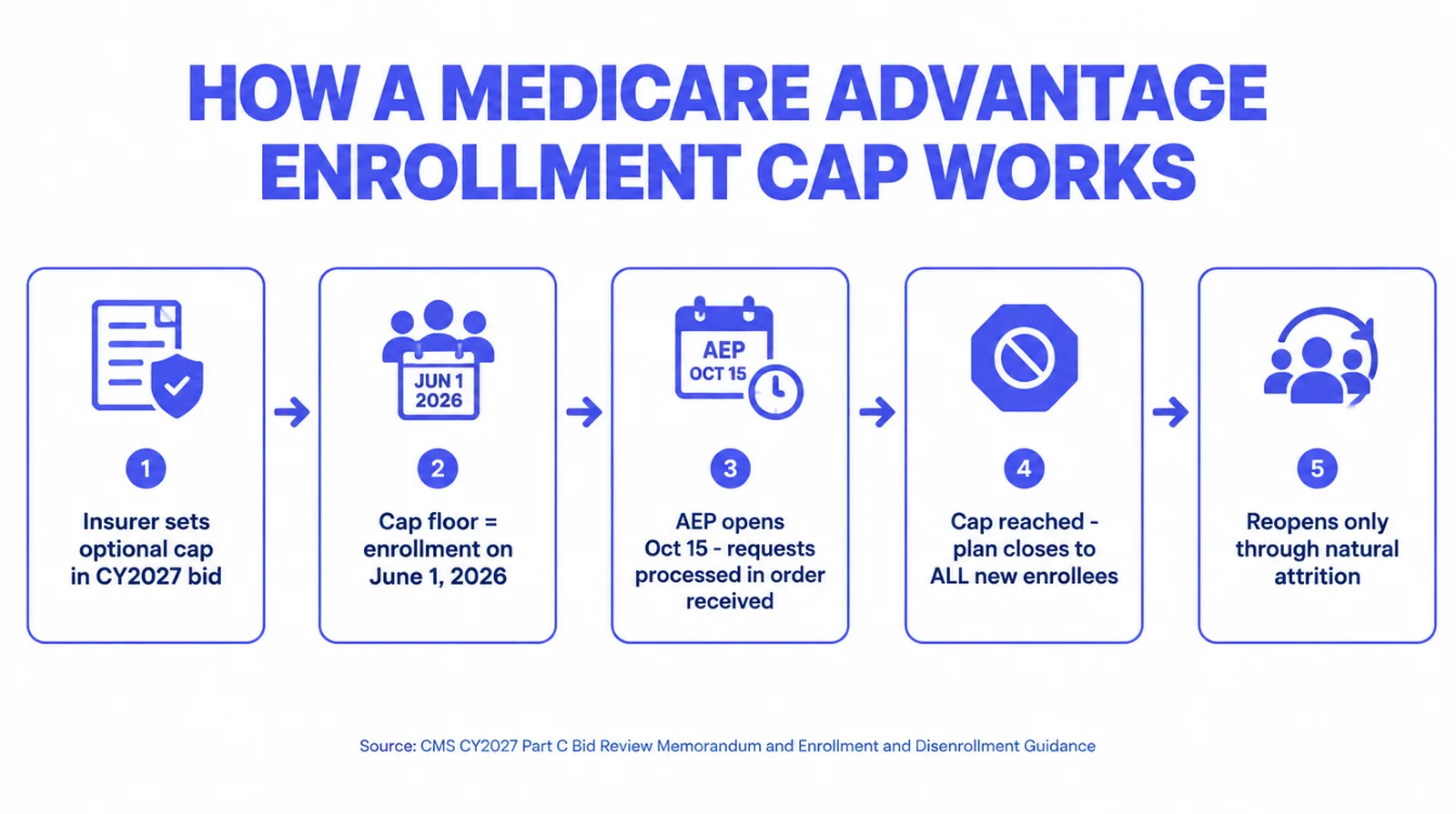
A Medicare Advantage plan can close to new enrollees in 2027 because CMS's own contract year 2027 bid rules let an insurer request an enrollment capacity limit as part of its annual bid submission. The relevant regulation is 42 CFR 422.254(c)(4) and (e)(1), and CMS's Final Contract Year 2027 Standards for Part C Benefits, Bid Review and Evaluation memorandum spells out how it works: "MA organizations may submit an enrollment capacity limit (if any) as part of their bid submission for a specific plan... Requesting an enrollment capacity limit as part of the bid is optional."4
That's new leverage for insurers, and CMS built in a real guardrail. The same memo states that "CMS will only accept enrollment capacity limits at or above current enrollment as of June 1, 2026, for plans' CY 2027 planned service area," and that "MA organizations may not disenroll existing members to reach a capacity limit."4 In plain terms, an insurer can't use this to shrink a plan it already has. What it can do is draw a line above today's membership and refuse to let the plan grow past it, which is a very different business decision than exiting the plan altogether, and one your clients have no reason to expect.
An insurer can't use this to shrink a plan it already has. What it can do is draw a line above today's membership and refuse to let it grow past that line.
The path that already existed, and the one that's new
A plan restricting its own enrollment isn't a brand new idea. Before CY2027, the only way an insurer could cap a plan was to request special CMS approval under 42 CFR 422.60(b), and CMS's own bid review memo says it "will consider such requests only if the health and safety of beneficiaries is at risk."4 That's a narrow, exceptional path, the kind used when a plan's provider network genuinely can't absorb more patients safely.
The bid based option for CY2027 is a different animal. It doesn't require a health or safety showing at all. An insurer can request a cap simply because it wants one, as a normal part of filing its bid, for any business reason it chooses. That's the actual change worth understanding: CMS didn't just tighten an existing safety valve, it opened a second, much wider door that has nothing to do with network capacity and everything to do with how an insurer wants to manage its own growth.
How an enrollment cap actually works, in CMS's own words
Once CMS approves a plan's cap, the mechanics are strict and impersonal. CMS's Medicare Advantage and Part D Enrollment and Disenrollment Guidance for contract year 2027 states plainly, in section 50.10.1: "An MA plan with an established enrollment capacity limit must accept all valid enrollments in the order they are received until the capacity limit is reached. An MA plan that has reached a CMS approved capacity limit must remain closed to all applicants until space becomes available."5
Read that twice. It doesn't say the plan closes to enrollees from agents who didn't sell it. It says closed to all applicants, first come, first served, until someone already on the plan moves, dies, or otherwise leaves, opening one seat. If a plan's enrollment already exceeds its accepted cap before AEP even starts on October 15, the guidance is explicit that it can't accept new AEP applications for a January 1, 2027 start, though it must still honor other election periods tied to a 2026 effective date through December 1, 2026.5
| Step | What CMS's guidance requires | Source |
|---|---|---|
| 1. The cap is optional | An insurer may request an enrollment capacity limit as part of its CY2027 bid. Nothing requires it. | 42 CFR 422.254(c)(4), (e)(1)4 |
| 2. The floor is fixed | CMS accepts a limit only at or above the plan's enrollment as of June 1, 2026. Existing members can't be disenrolled to reach it. | CY2027 Part C Bid Review Memorandum4 |
| 3. First come, first served | Valid applications are accepted in the order received until the limit is reached. | CY2027 Enrollment and Disenrollment Guidance, section 50.10.15 |
| 4. Closed to everyone | Once the cap is reached, the plan is closed to all applicants, not just some, until space opens. | Same guidance, section 50.10.15 |
| 5. No advance public notice | Neither document describes a Plan Finder flag or other public indicator of how close a plan is to its cap. | Absence confirmed across both documents45 |
The only individual facing document either guidance references is an updated Model Notice of Denial of Enrollment, the letter a beneficiary gets after applying to a capped plan and being turned away.5 There's no waiting list display, no "plan is full" badge, nothing an agent can check before submitting an application on a client's behalf. You find out the same way the client would: after the attempt fails.
A worked example: what this looks like for one client
Say a Humana client in Broward County gets a non-renewal letter in early October. Her agent identifies what looks like the obvious replacement, a similar HMO from a different carrier in the same network, and plans to submit it once AEP opens on October 15. If that replacement plan requested and received a CY2027 enrollment cap set at its June 1, 2026 membership, and enough of AEP's first two weeks of applications already filled that gap, the application submitted on October 15 can be denied for no reason related to the client at all.5 Nothing published anywhere would have told the agent that risk existed before submitting it.
The fix isn't a tool that doesn't exist yet. It's sequencing: submit the highest priority replacement application as early in AEP as possible, have a second and third option already identified before the first one is denied, and don't tell the client "you're all set" until the confirmation actually comes back from the carrier.
Florida's Medicare Advantage market, by the numbers
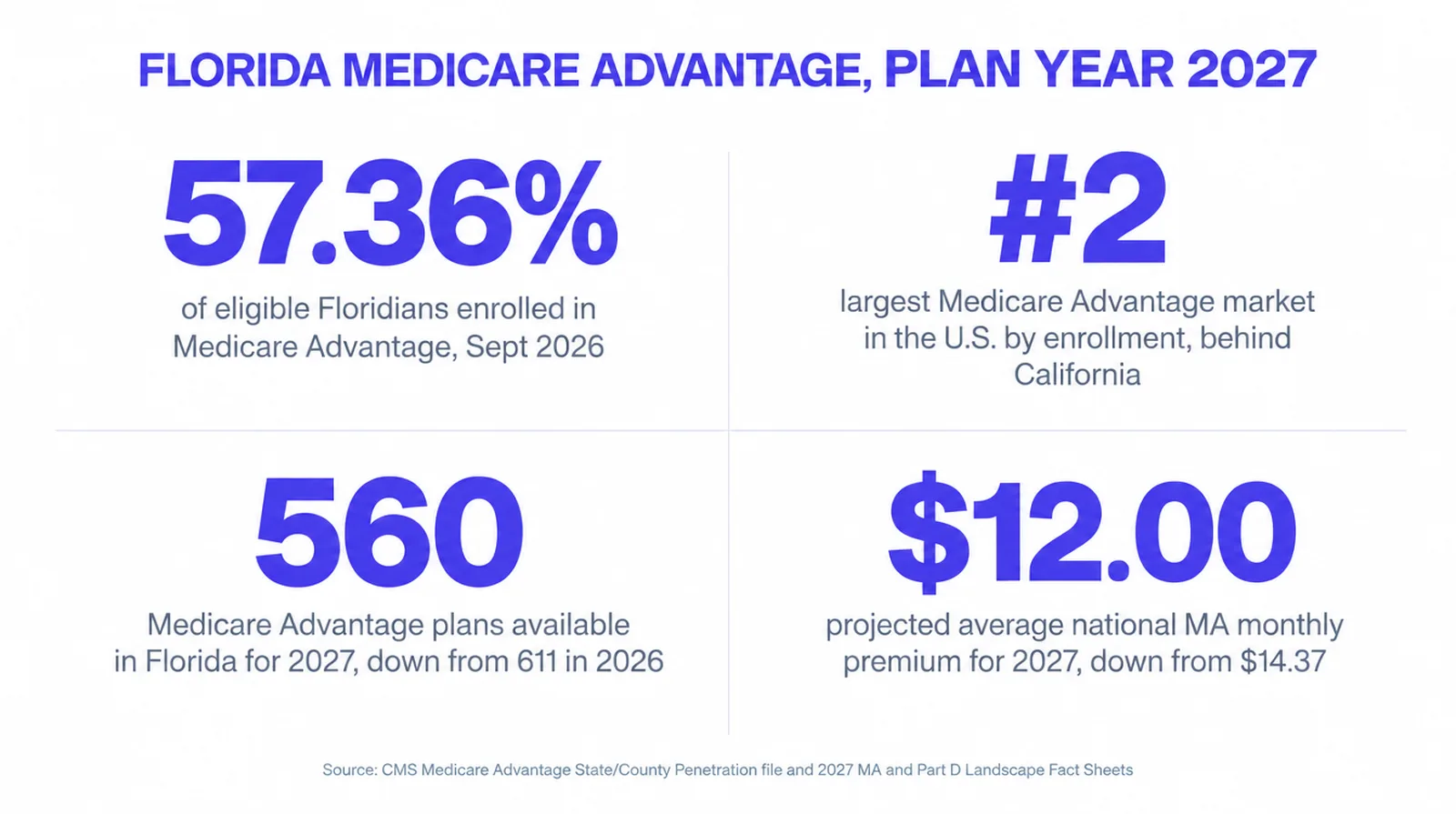
Florida carries more exposure to this than almost any other state, just not for the reason some agents assume. CMS's own September 2026 state and county enrollment file shows California with more total Medicare Advantage enrollees than Florida, 3,751,199 against 3,076,234, which makes California the largest MA market in the country by raw enrollment.3 Florida is second, and it beats California on the measure that matters more for an agency: penetration. 3,076,234 of Florida's 5,362,591 Medicare eligible residents are enrolled in a Medicare Advantage plan, a 57.36% penetration rate, against 51.49% in California.3 More of the Medicare population in Florida is already on an MA plan than in almost any other state, which means more of it sits inside whatever a carrier decides to do with its book.
CMS's state by state landscape fact sheet for plan year 2027 shows Florida's own market tightening at the same time national numbers loosen. Florida will have 560 Medicare Advantage plans available in 2027, down from 611 in 2026, and the average MA premium in the state is projected to rise from $1.83 a month to $2.13.2 Every Florida Medicare beneficiary still has access to at least one $0 premium MA plan, per the same fact sheet,2 so this isn't a story about beneficiaries being priced out entirely. It's a story about fewer doors to choose from, at the same time one of the largest carriers in the state is pulling plans out of the mix.
Zoom out and the national picture looks calm. CMS projects the weighted average MA premium nationally will fall from $14.37 a month in 2026 to $12.00 in 2027, a 16.5% decline, with the total number of available plans holding roughly steady at about 5,532, down only slightly from 5,553.1 CMS also projects 2027 MA enrollment at 34 million people, around 47.4% of everyone on Medicare, with more than 99% of beneficiaries having access to at least one MA plan and 97% having access to 10 or more.1 Nothing in that headline suggests a market under stress. The stress is concentrated, in specific states, specific carriers, and specific plans, which is exactly why a national news cycle about Medicare Advantage in general does your Florida clients no good at all.
600,000
Members nationally affected by Humana's 2027 plan exits7
57.36%
Of eligible Floridians already enrolled in Medicare Advantage, Sept 20263
560
Medicare Advantage plans available in Florida for 2027, down from 6112
$12.00
Projected national average MA premium for 2027, down from $14.371
Why Humana is the one sending the letters
Humana is doing this for a stated financial reason, not a secret one. In its Q2 2026 prepared management remarks, filed with the SEC on July 29, 2026, Humana said it expects "our approach to 2027 individual MA bids will drive meaningful progress against our commitment of returning to a sustainable pre-tax margin of at least 3% in 2028."10 On the earnings call the same day, CFO Celeste Mellet told analysts the company expects its 2027 plan exits to affect approximately 600,000 members, and that Humana expects to recapture "just over 40%" of those members onto a different Humana plan, the same share it recaptured after similar exits in 2025.7
Run that math yourself, using only Humana's own two numbers, and something like 360,000 people nationally are the ones Humana itself doesn't expect to keep. That's the group actually shopping the open market this AEP, comparing carriers for the first time in years, searching for answers about a letter they didn't ask for. Some meaningful share of them live in Florida, given how much of the country's Medicare Advantage population already does.
This is a margin decision, not a network collapse
Humana isn't withdrawing from Medicare Advantage. It's trimming specific plans to protect a stated profitability target, while other MA carriers are holding or even lowering premiums for 2027.110 Frame this to clients as what it is: a company being selective, not an industry in retreat. Overstating it erodes trust the moment a client finds a single other Humana plan still available nearby.
What waiting costs an agency this AEP
The cost of sitting this one out isn't abstract. It's a compressed calendar, a client base that's about to start Googling, and a market where the plan they land on could refuse them for a reason no directory will show you in advance.
Start with the calendar. Non-renewal notices are landing in the first days of October, per the 90 day federal notice rule,69 and AEP opens October 15 and closes December 7. That's a window of a few weeks where a large share of your displaced Humana book, plus whoever they tell, is actively deciding who to call. Nothing about the enrollment cap rule changes when AEP starts or ends. It only changes whether the plan someone picks is still accepting anyone by the time they pick it.
Then add the search behavior. A client who gets a letter saying their plan won't exist in 2027 doesn't call their agent first anymore, not reliably. A large and growing share asks a search engine or an AI assistant why this happened and what to do, in almost the exact wording of the letter. If your site doesn't have a clear, sourced, dated answer to that question sitting on it before the letters go out, you're not in the running for that search, however good your relationship with the client already is. Someone else's page answers it instead, and some of those readers never call you at all.
What to do about it this week
You can handle the client side of this yourself, today, without any of it costing you a subscription. Here's the order that actually matters.
1. Pull every Florida client on a Humana Medicare Advantage plan
Run the list from your CRM or AMS, not from memory. Note which plan they're on, since Humana hasn't exited every plan, only specific ones, and your client may not be affected at all.
2. Reach out before the letter creates the panic
A call or text that says "I saw Humana is adjusting some 2027 plans, let's check yours before you get a letter you don't need to worry about" beats a reactive callback every time. It also keeps you, not a search result, as the first source of truth for that client.
3. Re-quote early, and don't assume the obvious replacement is still open
Because caps are enforced without public notice, the "closest alternative" plan you'd normally suggest first could already be near its limit. Submit real applications early in AEP rather than waiting, since the guidance processes requests in the order received, and a plan that's still open in week one of AEP may not be in week four.5
4. Publish what you know, sourced, before you're asked
Write a plain page explaining the non-renewal, cite the actual CMS rule rather than a vague reassurance, and date it. This is the step most agencies skip, and it's the one an AI answer engine or a search result actually rewards.
Don't promise something the data doesn't support
Don't tell a client "there's plenty of room" on a replacement plan. Neither you nor CMS's own public tools can confirm that before the application goes in.45 Say what you can verify, and submit the application promptly instead of promising an outcome.
All four of those steps are things you can do with a spreadsheet and a phone. Whether you want to build and maintain the content piece yourself, on a deadline, every time a rule like this changes, is a separate question.
You can do all of this yourself
Most agents read a list like that and decide the content part is where they'd rather not spend the afternoon. Either outcome is fine. If you want to talk through what a page like this should say for your specific book, book a short call and we'll look at it with you.
How we build a site that's ready before the letters land
We build insurance agency websites on Astro, which ships zero JavaScript by default, so pages arrive as finished HTML, served from the edge on Cloudflare. Our builds score 90+ on Lighthouse performance on mobile and desktop, and some score 100, which matters here specifically because a confused client searching on a phone the week their plan letter arrives won't wait six seconds for your page to load. This page is built the same way. We measured its production build with Lighthouse on September 30, 2026, before publishing: a median of 98 on mobile across five runs, individual runs between 96 and 99, and 97 on desktop.
Every page we ship carries the schema stack that lets an AI answer engine actually read and
quote it: Article, FAQ, breadcrumb, and organization markup that matches what's on the page,
not boilerplate. The crawler files, llms.txt, sitemap.xml, and
robots.txt, regenerate themselves the moment a new page publishes, with the full
absolute URL, and robots.txt is written to welcome every major crawler including
the named AI crawlers, so a page like this one is actually reachable by the systems
summarizing it for your clients.
That's also where publishing speed stops being a nice to have. Per the live pricing page, verified today, Digital Foundation's Pro tier adds a new blog post, location page and answer page every week, and Scale adds one of each every business day.11 When a rule like the CY2027 enrollment cap starts producing specific, named plan closures county by county over the next few weeks, that's exactly the cadence that gets a sourced, updated answer live the same week it's news, instead of next quarter.
We also build real quote and comparison tools wired to live federal data, not a static form with example numbers from last year's rates. That's the difference between a page that reassures a client in the abstract and one that actually shows them a current option.
What changes for your agency
The practical result of being first with a sourced, fast, AI-citable answer is that you stop competing for a client's attention only on the phone, and start competing for it on the page they land on before they ever pick up the phone.
You're the source, not a footnote
Schema that actually matches the page content is what gets an answer engine to name you.
A page live the week it's news
Weekly or daily publishing cadence means a new rule gets answered while it's still being searched.
A fast page on the phone
90+ Lighthouse on mobile and desktop, measured, not assumed.
Real tools, not brochure forms
Quote and comparison widgets built on live federal data instead of static examples.
Crawl files that maintain themselves
llms.txt, sitemap.xml, and robots.txt regenerate with full URLs on every publish.
None of this replaces the phone call, the re-quote, or the relationship you already have with a client on a non-renewed plan. It's what happens for everyone who searches before they call, and for the prospects who were never your client to begin with but are shopping the market this AEP anyway.
When this doesn't change much for you
If your book is mostly life, final expense, or annuities, or you write Medicare Advantage outside Florida with only a handful of Humana clients, this AEP probably looks close to ordinary. A single sourced page on the topic is still worth having, since a prospect researching the news will find it regardless of your book's makeup, but you don't need a publishing cadence built around it. Save the urgency for the agencies actually sitting on a concentrated Humana book in a high penetration state, because that's where the calendar and the cap rule actually collide.
Questions agents ask about the 2027 enrollment caps
Why did my client's Medicare Advantage plan get cancelled for 2027?
Most likely a non-renewal, not a cancellation. Humana told investors on its July 29, 2026 earnings call that its 2027 plan exits will affect roughly 600,000 members nationally, as it narrows its Medicare Advantage lineup toward better performing plans. Federal rules require a 90 calendar day mailed notice before a non-renewal takes effect, which is why the letters are landing now, right as enrollees choose a new plan for 2027.
Can a Medicare Advantage plan really close to new enrollees during AEP?
Yes, starting with plan year 2027. CMS's Contract Year 2027 bid review guidance lets an insurer request an enrollment capacity limit as part of its bid. Once CMS approves one, the plan must accept every valid application in the order received until the cap is reached, then it closes to every new enrollee, not just new business from one agent, until natural attrition opens space again.
How will I know if a specific plan is near its enrollment cap?
You generally won't, until an application is denied. Neither the CY2027 bid review memorandum nor the enrollment and disenrollment guidance describes a public indicator on Medicare Plan Finder or anywhere else that shows how close a capped plan is to closing. The only individual facing document is the Model Notice of Denial of Enrollment, sent after someone applies and is turned away.
Is Florida really the state with the most Medicare Advantage members?
No, and it's worth getting right. CMS's own September 2026 state and county enrollment file shows California with more total Medicare Advantage enrollees than Florida, 3,751,199 against 3,076,234. Florida is the second largest Medicare Advantage market in the country by enrollment, and it has a higher penetration rate than California, 57.36% of eligible Floridians against 51.49% in California.
What's the deadline for Humana's non-renewal notices?
Federal rule 42 CFR 422.506 requires a mailed notice at least 90 calendar days before a non-renewal takes effect. For plans ending as the calendar flips to a new contract year, that arithmetic lands the deadline at the start of October, and trade press covering Humana's 2027 exits has named October 2, 2026 specifically as the date the letters had to be in the mail.
Will Medicare Advantage premiums be higher or lower nationally in 2027?
Lower, on average. CMS projects the weighted average MA premium will fall from $14.37 a month in 2026 to $12.00 in 2027, a 16.5% decline, with the total number of plans available nationally holding roughly steady. Florida moves the other direction: CMS's state fact sheet shows the average Florida MA premium rising from $1.83 to $2.13 while the number of plans offered in the state drops from 611 to 560.
What should an agency do about this on its website right now?
Publish a plain, sourced explanation of what's happening before your clients start searching for one, not after. The people getting these letters are going to ask Google or an AI assistant why their plan is gone and what to do next. A page with the actual CMS rule, properly dated, structured with FAQ and article schema, is what gets read out loud as the answer instead of a competitor's.
Sources
- Centers for Medicare & Medicaid Services. "Medicare Advantage and Medicare Prescription Drug Programs Expected To Remain Stable for 2027," newsroom press release: weighted average MA premium projected to fall from $14.37 in 2026 to $12.00 in 2027 (16.5% decline); total available MA plans nationally changing from 5,553 to approximately 5,532; 2027 MA enrollment estimated at 34 million, about 47.4% of Medicare beneficiaries; more than 99% of beneficiaries have access to at least one MA plan and 97% to 10 or more. Published and verified live September 28, 2026. cms.gov/newsroom.
- Centers for Medicare & Medicaid Services. "2027 Medicare Advantage and Part D Landscape State-by-State Fact Sheets," Florida section: 560 MA plans available in 2027 versus 611 in 2026; average MA premium changing from $1.83 in 2026 to $2.13 in 2027; 100% of Florida Medicare beneficiaries have access to a $0 premium MA plan. Published and verified live September 28, 2026. cms.gov/files/document/2027-medicare-advantage-part-d-landscape-state-state-fact-sheets.pdf.
- Centers for Medicare & Medicaid Services. Medicare Advantage/Part D State/County Penetration data file, September 2026: Florida 3,076,234 MA enrollees of 5,362,591 Medicare eligible residents (57.36% penetration); California 3,751,199 MA enrollees (51.49% penetration), the largest state by absolute MA enrollment; figures computed directly from the raw CMS county level file for this guide. Verified live September 2026. cms.gov, MA State/County Penetration, 2026-09.
- Centers for Medicare & Medicaid Services. "Final Contract Year 2027 Standards for Part C Benefits, Bid Review and Evaluation" memorandum, dated April 22, 2026: enrollment capacity limits are optional and submitted as part of a plan's bid under 42 CFR 422.254(c)(4) and (e)(1); CMS accepts a limit only at or above the plan's enrollment as of June 1, 2026 for its CY2027 planned service area; MA organizations may not disenroll existing members to reach a capacity limit. Distributed via CMS's HPMS memo channel. Verified live September 30, 2026. CMS CY2027 Part C Bid Review Memorandum.
- Centers for Medicare & Medicaid Services. "Medicare Advantage and Part D Enrollment and Disenrollment Guidance," contract year 2027, section 50.10.1: a plan with an established enrollment capacity limit must accept all valid enrollments in the order received until the limit is reached, then remain closed to all applicants until space becomes available through natural attrition; a plan already over its accepted cap before AEP starts may not accept AEP enrollments for a January 1, 2027 effective date; the Model Notice of Denial of Enrollment (Exhibit 7) was updated to add capacity related denial reasons. Released per an August 25, 2026 HPMS transmittal. Verified live September 30, 2026. cms.gov/files/document/cy-2027-c-d-enrollment-disenrollment-guidance.pdf.
- 42 CFR 422.506(a)(2)(ii), via Cornell Law School Legal Information Institute: a Medicare Advantage organization must notify each Medicare enrollee by mail at least 90 calendar days before the date a non-renewal is effective. Verified live September 30, 2026. law.cornell.edu/cfr/text/42/422.506.
- The Motley Fool. Humana Inc. (HUM) Q2 2026 earnings call transcript, call held July 29, 2026, transcript posted August 7, 2026: CFO Celeste Mellet stated, "For 2027, we anticipate these plan exits will impact approximately 600,000 members," and that Humana expects to recapture "just over 40%" of those members, the same share recaptured after 2025 exits. Verified live September 30, 2026. fool.com/earnings/call-transcripts.
- Newsweek. Suzanne Blake, "Hundreds of Thousands of Medicare Advantage Members Dropped From Humana," published September 9, 2026: independently reports Humana's targeted 2027 MA plan exits will affect roughly 600,000 members, attributed to the same July 29, 2026 earnings call. Verified live September 30, 2026. newsweek.com.
- Yahoo Finance. Gerelyn Terzo, "Humana Is Cutting Medicare Advantage Plans for 2027. The Non-Renewal Letters Arrive in Early October," published August 30, 2026: names October 2, 2026 as the federally required non-renewal notice deadline for affected members. Verified live September 30, 2026. finance.yahoo.com.
- Humana Inc. Q2 2026 Prepared Management Remarks, Exhibit 99.3 to Form 8-K, filed with the U.S. Securities and Exchange Commission July 29, 2026: "Expect that our approach to 2027 individual MA bids will drive meaningful progress against our commitment of returning to a sustainable pre-tax margin of at least 3% in 2028." Verified live September 30, 2026. sec.gov/Archives/edgar.
- Strategic AI Architects. Digital Foundation pricing page: Website $84/mo billed annually (complete site with 30 pages live on Launch Day, calculators and widgets, AI CLI access, monthly report); Starter $247/mo (adds 2 blog posts, 2 location pages and 2 answer pages a month, Google Business Profile management, AI chat widget); Pro $497/mo (adds 1 blog post, 1 location page and 1 answer page every week, up to 4 languages, review harvesting, 24/7 AI receptionist); Scale $997/mo (adds 1 of each every business day, up to 10 custom pages, monthly newsletter); Full Clone, Update and Handoff $1,000 one time; 14-day free look period. Verified live 2026-10-12. strategicaiarchitects.com/digital-foundation.
Talk it through
Want a second pair of eyes on it?
Free 30 minutes. Bring what you found, or bring nothing and we will look together at how AI engines read your site and which fixes move first.
See where your own site stands before the letters go out
Run a free Audit and see how your site scores for speed, AI citations, and HIPAA safe tracking, in about a minute.
Related reading: Texas ACA premiums jump again for 2027, insurers exit · Publish a carrier network change the same day it breaks · The 2026 Medicare choice overload and the rise of AI search