Playbook
Why Your Agency's GoHighLevel Texts Stopped Sending
A carrier registration step buried in Settings, not the campaign builder, decides whether your follow-up ever reaches a phone.

18 min read

Your CRM can say "sent" and still be wrong. GoHighLevel's own documentation states that "customers can only send compliant messages on the A2P route once the Campaign is fully approved"2, and Twilio's compliance docs confirm unregistered numbers face extra carrier fees and heavier filtering5. The fix, A2P 10DLC brand and campaign registration, costs about $25 to $72 one time plus $1.50 to $10 a month3, and most agencies have never heard of it because it lives in a compliance settings tab, not the message composer.
The follow-up nobody answers
You built the sequence the way every GoHighLevel tutorial tells you to. A new lead comes in from a Facebook form or a quote widget, a workflow fires, and three texts go out over the next two days: a thank-you, a reminder to book a call, a nudge if they've gone quiet. The contact record shows all three as sent. Green checkmarks, timestamps, everything looking exactly like it's supposed to.
Except the phone never buzzed. Not for this lead, not for the last dozen who went quiet right after opting in, not for the ones your gut said were warm. You start second-guessing the copy, the timing, the offer, when none of that was ever the problem. The message left your CRM. It just never finished the trip.
This isn't a GoHighLevel bug, and it isn't specific to any one CRM. It's a carrier-level registration requirement that sits one layer below the platform you're actually looking at, and because it's invisible from inside the campaign builder, most agencies discover it the same way: weeks of dead follow-up, a shrinking show rate, and no error message anywhere that says why.
Why this is easy to miss
A2P 10DLC registration is a one-time setup task buried under Settings, not something the message composer or the workflow builder ever surfaces. An agency can build, launch, and run dozens of automations without ever being prompted to complete it, because nothing in the day-to-day interface depends on it existing.
Picture the agent this actually happens to. You migrated to GoHighLevel eight months ago, imported your book, and set up the standard nurture flow the onboarding call walked you through: a text on day one, a text on day three, a text on day seven if nobody's booked yet. You never touched the messaging compliance tab because nobody told you it existed, and the platform never blocked you from building the workflow without it. For the first few weeks you didn't notice anything, because a slow trickle of leads with a slow trickle of no-shows just looks like normal insurance sales. It's only months later, staring at a pipeline full of contacts marked "texted, no response," that the pattern becomes impossible to explain any other way. The problem was never your script. It was a form in a settings menu you never had a reason to open.
What A2P 10DLC actually is
A2P stands for application-to-person: a business system, not a human with a keyboard, sending the text. 10DLC is the standard 10-digit local number your agency texts from, the same kind of number you'd give a client over the phone. GoHighLevel's own help center defines A2P 10DLC plainly as "the carrier registration framework used for business SMS and MMS messages sent to U.S. recipients from standard 10-digit local phone numbers"1, and states that "registration is required when a business sends SMS or MMS messages to U.S. recipients using standard 10-digit local phone numbers"1.
The system exists because a plain 10-digit number used to look identical whether a person was texting their neighbor or a call center was blasting ten thousand people a minute. Carriers had no way to tell the difference, so spam and legitimate business texting rode the same rails. The Campaign Registry, the organization carriers built to administer this, describes its own role as verifying "Brands and Campaign Service Providers (CSPs)... prior to being allowed to send messages," so that "both the 'Who' and the 'What' of a campaign are traceable"7. Registration is what tells a carrier your agency's number is a real business sending a stated, legitimate kind of message, not an unknown sender running an unknown script.
None of that is theoretical for an insurance agency specifically. Every lead-nurture sequence, every appointment reminder, every reactivation text to a lapsed client runs over exactly this rail. If your CRM sends SMS on your behalf, and essentially every modern insurance CRM does, this requirement already applies to you whether or not anyone ever told you about it.
It's worth naming the alternative to understand why carriers built this instead of leaving things as they were. Before this kind of registration existed, a standard 10-digit number sending one text a day to a friend and a standard 10-digit number blasting thousands of texts a minute to strangers looked identical to a carrier's network, because both were just numbers moving SMS traffic. There was no field anywhere that said "this sender is a business" or "this sender agreed to only send appointment reminders." Registration is that missing field. It converts an anonymous number into an accountable one, tied to a real EIN and a stated purpose, which is the only way a carrier can tell your agency's appointment reminder apart from an unrelated spam operation running the exact same kind of number.
Brand and Campaign are two separate approvals
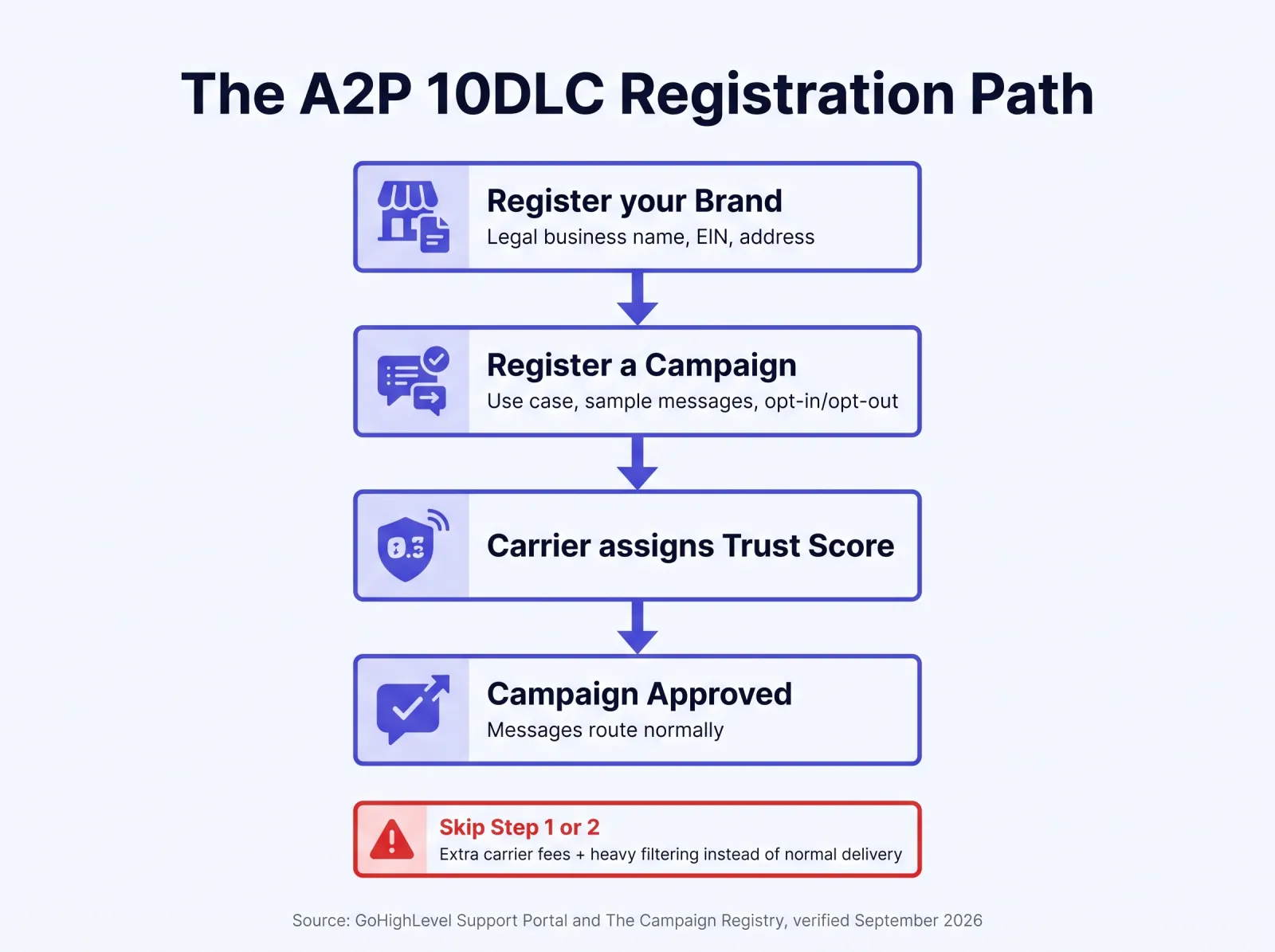
The part that trips up agencies who do know registration exists is that it isn't one approval, it's two, and both have to clear before messages route normally.
The Brand is your agency's verified business identity: legal business name, EIN, address, and website, checked against public business records. The Campaign is a separate, per-use-case registration under that brand, and it's where most of the actual paperwork lives. GoHighLevel's campaign registration guide requires real sample messages, a stated use case (customer care, marketing, appointment reminders, and so on), and documentation of exactly how each recipient opted in and how they can opt out2. An agency running separate sequences for lead follow-up, appointment reminders, and renewal outreach may need more than one campaign registered under the same brand, because each one is a distinct declared use case, not a single blanket approval that covers every kind of text you might ever send.
Legal business name
Has to match your EIN filing exactly, DBA included, on the Brand registration.
EIN and address
Checked against public business records to confirm you're a real, findable entity.
Website
Has to reflect the same business identity and name shown on the Brand application.
Declared use case
Each Campaign states one purpose: lead follow-up, reminders, renewal outreach, and so on.
Sample messages
Real examples of the actual texts you plan to send under that Campaign, reviewed as written.
Opt-in and opt-out proof
How a recipient consented, and the exact stop language they can use to opt out.
The 2026 update to GoHighLevel's own approval guidance adds a layer of consent formatting most agencies get wrong on the first pass: "consent checkboxes must be distinct for Marketing messages vs. Non-Marketing messages," those checkboxes "cannot be pre-selected by default," and the business name shown in the opt-in form has to match the legal name on file exactly, down to any DBA the agency operates under4. An agency that quietly rebranded, or that operates client-facing under a DBA different from the LLC on its business license, can fail campaign review on a name mismatch alone, with no indication anywhere in the CRM that a mismatch is the reason.
The mistake we see most
An agency registers the Brand, sees a "verified" badge somewhere in settings, and assumes every text can now send normally. The Campaign, the piece that actually declares what you're sending and gets sample messages reviewed, was never submitted. Brand approval without Campaign approval is half the job, and it's the half that doesn't move the needle on delivery.
What GoHighLevel handles, and what it doesn't
GoHighLevel gives you the form to register both pieces inside the platform. It does not register them for you, and it does not stop you from building and running SMS workflows before either approval clears. That gap, a fully functional workflow builder sitting on top of an unregistered number, is the entire mechanism behind the symptom at the top of this guide. Nothing in the interface tells you the pipes underneath aren't connected yet.
The platform's own registration guide is direct about the dependency once you look for it: "customers can only send compliant messages on the A2P route once the Campaign is fully approved"2. Twilio, whose infrastructure carries much of this traffic under the hood for CRMs built on top of it, states the same mechanism from the carrier side: "customers who send messages from a Twilio 10DLC number but do not register will receive additional carrier fees for sending unregistered traffic"5. Two different companies, two different vantage points on the same rail, describing the same outcome: unregistered traffic doesn't route the way registered traffic does, and nobody upstream is required to tell you that in plain language while you're building the campaign.
Why this hits multi-office and FMO agencies hardest
A single-office agency has one Brand and, typically, a handful of Campaigns to track. An FMO running a downline of sub-agents, or a multi-office agency with several branded sites, has a combinatorial version of the same problem, and it's the version that's easiest to assume is already handled somewhere upstream.
Registration status lives at the account and number level, not at the parent brand level. If a downline agent spins up their own GoHighLevel sub-account, or an office runs its own phone numbers under a locally managed workflow, that account needs its own Brand or its own Campaign under a shared Brand, with its own opt-in language and its own sample messages reviewed. An FMO that completed registration once for its flagship site can discover, well into a busy enrollment season, that half its downline never went through the process at all, because nobody at the corporate level had visibility into what each office's local GoHighLevel sub-account was actually configured to send.
This is the same centralization problem that shows up everywhere else in multi-site agency compliance: one office does the paperwork correctly, and the assumption spreads that the rest followed the same pattern, when nothing in the platform actually enforces that. Agencies already managing this kind of coordination across a downline of sites tend to run into the same pattern covered in our guide on why a downline's websites can get penalized together, and the fix is structurally identical: someone has to own a single checklist tracked per account, not an assumption made at the brand level.
The typical multi-office setup
- Flagship brand registered once, years ago, by whoever set up the CRM originally
- Each office or downline agent runs its own numbers and workflows independently
- No single person tracks Campaign status across every active account
- A new reactivation or renewal sequence launches without its own Campaign
ResultSome offices silently unregistered, discovered by accident
A checklist run per account
- One person confirms Brand and Campaign status for every active number, every quarter
- New use cases get their own Campaign before launch, not after a dead sequence
- Name and DBA consistency checked across every office's opt-in forms
- Downline additions get a registration step added to onboarding, not left to chance
ResultEvery office's follow-up actually has a chance to land
What this actually costs
The registration fees themselves are small. GoHighLevel's published fee schedule, last updated July 29, 2026, lists a one-time Brand and Campaign fee of $24.49875 for a Sole Proprietor or Low Volume Standard brand, rising to $71.90625 for a High Volume Standard brand, plus a recurring monthly campaign fee that ranges from $1.50 for Low Volume Mixed Use up to $10 for a Standard campaign use case, plus a small per-message carrier surcharge that varies by carrier3.
| Fee | Amount | Frequency |
|---|---|---|
| Brand + Campaign, Sole Proprietor / Low Volume Standard | $24.49875 | One time |
| Brand + Campaign, High Volume Standard | $71.90625 | One time |
| Additional campaign under the same brand | $15.00 | One time, per campaign |
| Monthly fee, Low Volume Mixed Use | $1.50 | Monthly |
| Monthly fee, Sole Proprietor / Starter | $2.00 | Monthly |
| Monthly fee, Standard use case | $10.00 | Monthly |
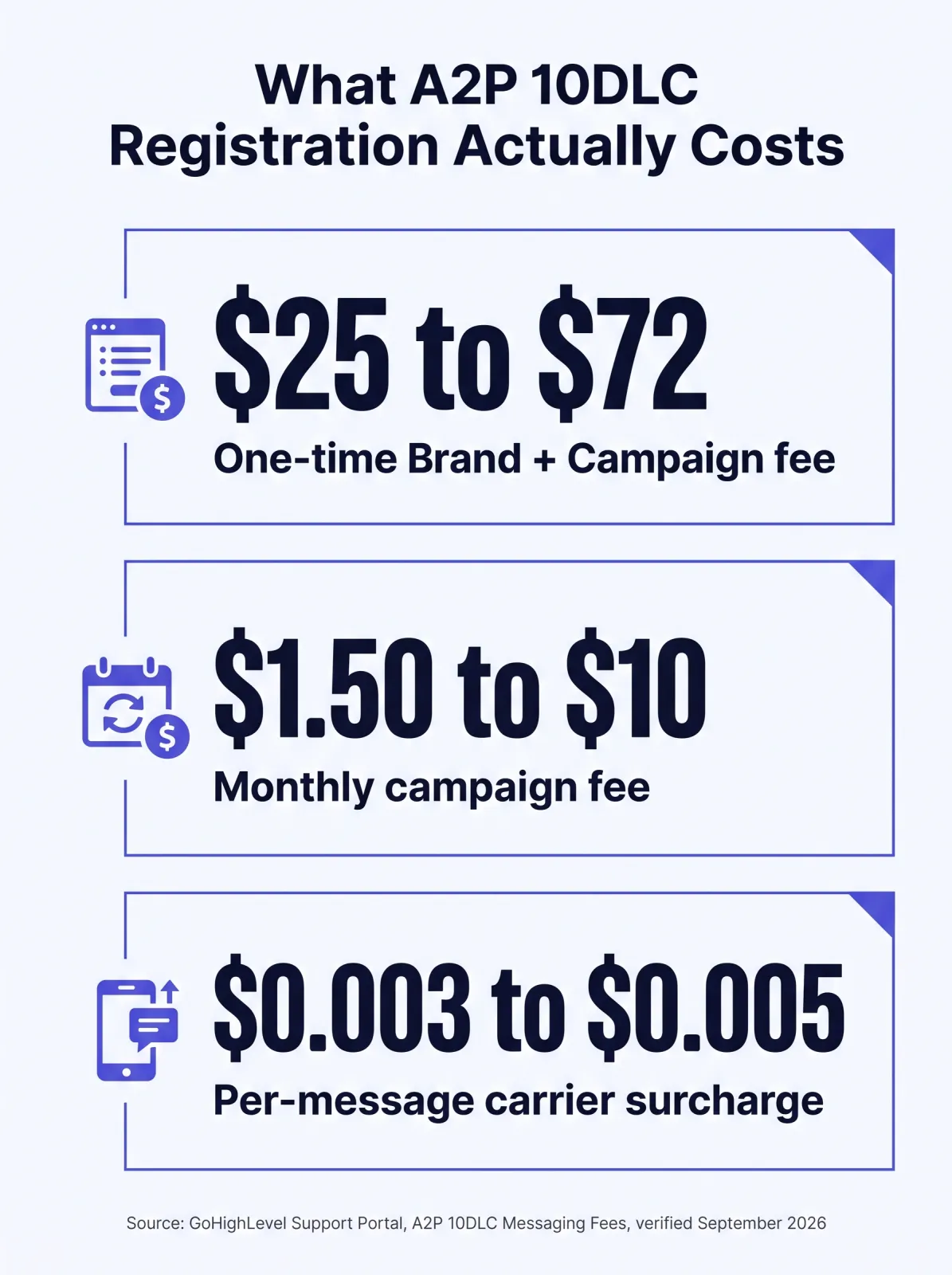
Run that against a real sequence. A single-office agency on a Standard campaign, sending roughly 800 follow-up texts a month mostly to AT&T and Verizon numbers, pays the $10 monthly campaign fee plus about $2.40 in carrier surcharges, call it $12.40 a month, plus the one-time $24.50 to $71.91 setup fee the first month. That's the entire ongoing cost of doing this correctly.
The real cost was never the fee. It's the appointments that never got booked because a reminder text silently failed, the lapsed client who never saw the reactivation message because the campaign was never approved, and the weeks an agency spends blaming its copy or its timing for a problem that was never about either one. A $12 monthly line item is a rounding error next to a single missed enrollment.
Scale that same math to an FMO with five downline offices, each running its own reactivation and appointment-reminder Campaigns under a shared Brand. That's up to ten Campaigns at $15 each for additional-campaign vetting, roughly $150 in one-time fees, plus five separate monthly campaign charges instead of one, easily $50 to $100 a month combined depending on use case mix. Still a modest number next to a downline's total ad and lead spend. What isn't modest is the outcome if even one of those five offices never completed its half of the paperwork: that office's entire reactivation program runs invisibly broken while the other four look, from a distance, like the program is working fine.
Worth checking this week
If your agency has ever wondered why a text-heavy campaign underperformed a call-heavy one with no clear reason, this is worth ruling out before you touch the copy again. It's a two-minute look in Settings, and if you want a broader read on how the rest of your site and stack hold up, the free Audit checks compliance and speed signals in about a minute. Run a free Audit.
Why "registered" doesn't mean "delivered"
Registration clears the gate. It doesn't equalize what happens after. Twilio's own onboarding documentation explains that during Brand registration, a Trust Score is assigned, and that score, not just the fact of being registered, determines how much throughput and how many daily messages a number gets: "the higher the Trust Score, the higher the daily limits and throughput" toward carriers6.
That means two fully registered insurance agencies, both compliant, both paying the same fees, can still see different real-world delivery performance depending on how their specific brand was vetted. A brand registered with a verified EIN, a matching business name across every field, and a consistent website tends to score higher than one with a mismatched name or a newly formed entity with a thin public record. Registration is necessary. It was never sufficient on its own to guarantee equal treatment on the wire.
For most single-office agencies this distinction rarely bites in practice, since default throughput at any trust tier is well above what a normal follow-up sequence sends. It matters more for FMOs and multi-office agencies running higher message volume across a shared brand, where a low Trust Score can genuinely throttle a legitimate campaign during a peak period like AEP, the same weeks the volume is highest and the margin for a slow rollout is thinnest.
The practical takeaway is to treat vetting quality as part of the registration job, not a detail to skip past. A Brand application filed with a name that matches your EIN filing exactly, an address that matches your public business records, and a website that reflects the same identity gives a carrier fewer reasons to score you conservatively. A rushed application filed the same week as a rebrand, with a mismatched name or a domain that doesn't yet reflect the new entity, is the kind of gap that shows up later as unexplained throttling rather than an outright rejection, which makes it even harder to trace back to its cause.
2
Separate approvals required: Brand, then Campaign
$25 to $72
One-time Brand + Campaign fee3
$1.50 to $10
Recurring monthly campaign fee3
0
In-app warnings before an unregistered send fails
The consent layer sitting on top of this
A2P 10DLC and TCPA consent solve two different problems, and treating them as the same checkbox is how agencies end up compliant on one and exposed on the other. A2P 10DLC asks "is this number and this use case verified with the carrier." TCPA asks "did this specific person agree to be texted." An agency can be fully registered and still send an unlawful text to someone who never opted in, and an agency can have airtight consent records and still see every message filtered because the registration step never happened.
We've written separately about the TCPA side of automated follow-up, including how the FCC's 2024 ruling on AI-generated voices applies to automated outreach and where the real legal exposure sits8. That guide and this one are meant to be read together, not as substitutes for each other: one covers whether you're allowed to send the message, this one covers whether the message can physically arrive once you're allowed to send it.
Two separate gates, both required
Consent tells you whether you're allowed to text someone. Registration tells the carrier whether your text is allowed through at all. Clearing one does nothing for the other.
How to check your own setup this week
None of this requires a developer. It requires knowing where to look, and looking before your next high-stakes send, not after a quiet month makes you suspicious.
- Check your Brand status first. In GoHighLevel, go to Settings, then Phone Numbers, then the messaging or A2P compliance section, and look for a Brand approval status. If it says nothing, unregistered, or pending, nothing downstream of it will route normally, regardless of how many workflows you've built on top of it. This is the two-minute check that rules out the biggest single cause first.
- Check Campaign status separately. A verified Brand with no approved Campaign is the single most common half-finished setup, because the Brand badge is the visible one and the Campaign approval is buried a click deeper. Confirm each distinct use case you run, lead follow-up, appointment reminders, renewal outreach, has its own approved Campaign if you're running them as separate sequences rather than one blended workflow.
- Match your legal name everywhere. The business name in your Brand registration, your opt-in forms, and your website footer all have to match exactly, DBA included, per GoHighLevel's own 2026 approval guidance4. Pull up your actual EIN filing and compare it character for character against what's typed into the Brand form. A mismatch here is a common, invisible rejection reason that shows up nowhere in the campaign builder.
- Separate your marketing and non-marketing consent checkboxes. The 2026 guidance requires these as distinct, non-pre-selected checkboxes4. Go through every lead form and landing page currently live and confirm the SMS consent language isn't a single blended checkbox left over from an older form. This is worth fixing regardless of A2P status, since a blended or pre-checked box also raises your TCPA exposure directly.
- Register every use case you actually run, not just the first one. If you added a reactivation campaign or a renewal sequence after your initial setup, confirm it has its own Campaign registration rather than assuming it inherits approval from an earlier one. Agencies that grow their automation over time, adding a new sequence every few months, are the ones most likely to have one or two orphaned workflows nobody remembered to register.
- Budget the real timeline, not the CRM's optimistic one. Campaign review takes real time and can bounce back for missing samples or a name mismatch, restarting the clock each time it does. Treat this as a task to finish weeks before AEP or open enrollment volume ramps up, not a same-day fix squeezed in alongside everything else that season demands.
- Put someone's name on it going forward. The single biggest reason this drifts out of compliance again after you fix it once is that nobody owns it as an ongoing task. Assign one person, even if that's you, to re-check registration status whenever a new number, a new office, or a new campaign gets added, rather than treating this as a one-time project you finish and forget.
How we build follow-up that doesn't break this way
Your Brand registration has to be filed under your own EIN and legal business name, since that's exactly what a carrier is verifying, so that part is never something an outside vendor can do for you. What we build is everything layered on top of a correctly registered number: conversational AI follow-up that keeps context across the whole pipeline, not a one-off text blast. Our own service page describes it plainly, an AI that "texts and calls back with real context, powered through GHL or a custom setup"9, and that context is the differentiator, the reactivation message that references the plan a lead asked about months ago instead of reading like a stranger's template.
Part of standing that up correctly the first time is confirming the compliance layer underneath it is actually in place before we wire up the conversation logic on top, rather than discovering a registration gap after a client's campaign has already been running silent for a month. It's a small, boring step next to the AI itself, and it's exactly the kind of small, boring step that determines whether the rest of the build ever gets a chance to prove itself.
You can do this yourself
Registering your own Brand and Campaign in GoHighLevel is entirely something an agency can handle without outside help. This guide walks through exactly what to check and why. This section exists for agencies who'd rather the whole conversational follow-up layer, registration included, already be built correctly instead of managed as a side project.
What you get
Fix both gates, the carrier registration and the consent language sitting on top of it, and the outcome is specific: the follow-up sequence you already built starts doing the job it was always supposed to do. Reminder texts land. Reactivation campaigns reach lapsed clients instead of disappearing into a filter. The show rate problem you'd been blaming on your script or your send times turns out, in a meaningful share of cases, to have never been about either one.
What this doesn't do is make carrier policy permanent. Trust Score thresholds, fee amounts, and consent formatting requirements can all change as carriers and The Campaign Registry adjust their rules, the way the 2026 update to GoHighLevel's own approval guidance already did4. The mechanism described here is current and sourced as of this week. Check your own Brand and Campaign status directly before you assume last year's setup still holds.
Questions agents ask
What is A2P 10DLC, in plain terms?
It's the carrier registration system that ties every business text sent from a standard 10-digit phone number to a verified business identity and a stated use case. GoHighLevel's own help center defines it as "the carrier registration framework used for business SMS and MMS messages sent to U.S. recipients from standard 10-digit local phone numbers." Without it, carriers have no record of who you are or what you're texting about, and that missing record is what breaks delivery.
I only use GoHighLevel for follow-up. Do I still need to register?
Yes. GoHighLevel's platform sits on top of the same carrier rails every texting platform uses, and its own documentation states plainly that A2P 10DLC "registration is required when a business sends SMS or MMS messages to U.S. recipients using standard 10-digit local phone numbers." The CRM you use doesn't change the carrier requirement underneath it.
What actually happens if I never register my campaign?
GoHighLevel's own registration guide states that "customers can only send compliant messages on the A2P route once the Campaign is fully approved," and Twilio's compliance documentation confirms that a number sending unregistered traffic "will receive additional carrier fees for sending unregistered traffic." In practice that means some mix of higher per-message surcharges, aggressive carrier-side filtering, and messages that never complete, with no error message pointing you to the cause.
How much does A2P 10DLC registration actually cost?
Based on GoHighLevel's own published fee schedule, the one-time brand and campaign fee runs from about $24.50 for a Sole Proprietor or Low Volume Standard brand up to about $71.91 for a High Volume Standard brand, plus a recurring monthly campaign fee of $1.50 to $10 depending on use case, plus a small per-message carrier surcharge (roughly $0.003 to $0.005 per SMS depending on carrier). For most single-office agencies that's under $15 a month once it's set up.
Does registering guarantee every text gets delivered?
No, and this is the part most agencies get wrong. Registration is the entry ticket, not a delivery guarantee. Twilio's own documentation ties post-registration deliverability and throughput to a Trust Score assigned during brand vetting, meaning two fully registered agencies can still see different delivery performance depending on how their brand was vetted.
Is A2P 10DLC registration the same thing as TCPA consent?
No, and conflating them is a common and costly mistake. A2P 10DLC is a carrier-side registration that determines whether a message can be delivered at all. TCPA is a federal consumer-protection law governing whether you had legal permission to text someone in the first place. An agency can be fully registered with a carrier and still violate TCPA by texting someone who never consented, and it can have perfect consent records and still see messages blocked for never registering. Our guide on AI follow-up and TCPA risk covers the consent side in depth.
Can Strategic AI Architects register my A2P campaign for me?
The Brand registration has to be filed under your agency's own EIN and legal business name, since that's what carriers are verifying, so that part stays with you or your GoHighLevel account admin. What we build is the conversational AI layer on top of a correctly registered number: follow-up that texts and calls back with real context, wired through GHL or a custom setup, so the registration step is done right the first time instead of discovered as a mystery three weeks into a dead campaign.
How do I check whether my agency is already registered?
In GoHighLevel, go to Settings, then Phone Numbers, then Messaging Compliance or A2P Registration, and look for a Brand status and a Campaign status. Both need to show approved, not just submitted, before messages route compliantly. If either shows pending, unregistered, or nothing at all, that's your answer.
Sources
- GoHighLevel Support Portal. "What is A2P 10 DLC: Brand and Campaign Registration," definition and registration requirement, checked September 2026. help.gohighlevel.com.
- GoHighLevel Support Portal. "A2P Campaign Registration Guide: Step-by-Step and FAQs," Campaign approval requirement and use-case documentation. help.gohighlevel.com.
- GoHighLevel Support Portal. "A2P 10DLC Messaging Fees: Registration, Monthly, and Carrier Costs," fee tables, last modified July 29, 2026. help.gohighlevel.com.
- GoHighLevel Support Portal. "HighLevel A2P Opt-In Compliance," 2026 consent checkbox and DBA name-matching requirements. help.gohighlevel.com.
- Twilio. "A2P 10DLC Compliance" documentation, unregistered traffic carrier fees. twilio.com.
- Twilio. "The new A2P 10DLC onboarding experience," Trust Score and throughput mechanism. twilio.com.
- The Campaign Registry. Homepage, role verifying Brands and Campaign Service Providers prior to sending. campaignregistry.com.
- Strategic AI Architects. "Can Your AI Follow-Up Get Your Agency Sued?" TCPA and AI-generated voice ruling. strategicaiarchitects.com.
- Strategic AI Architects. "Your Ambrose and AI Expert," conversational follow-up description, verified this week. strategicaiarchitects.com.
Talk it through
Want a second pair of eyes on it?
Free 30 minutes. Bring what you found, or bring nothing and we will look together at how AI engines read your site and which fixes move first.
See if your follow-up is actually registered to send
Run the free Audit, a live AEO Audit plus a HIPAA tracking scan of your site, in under a minute.