Playbook
The Disaster SEP Most Insurance Agents Never Check For
A storm, flood, or wildfire three counties over can quietly reopen enrollment for a client you already wrote off this year.

18 min read

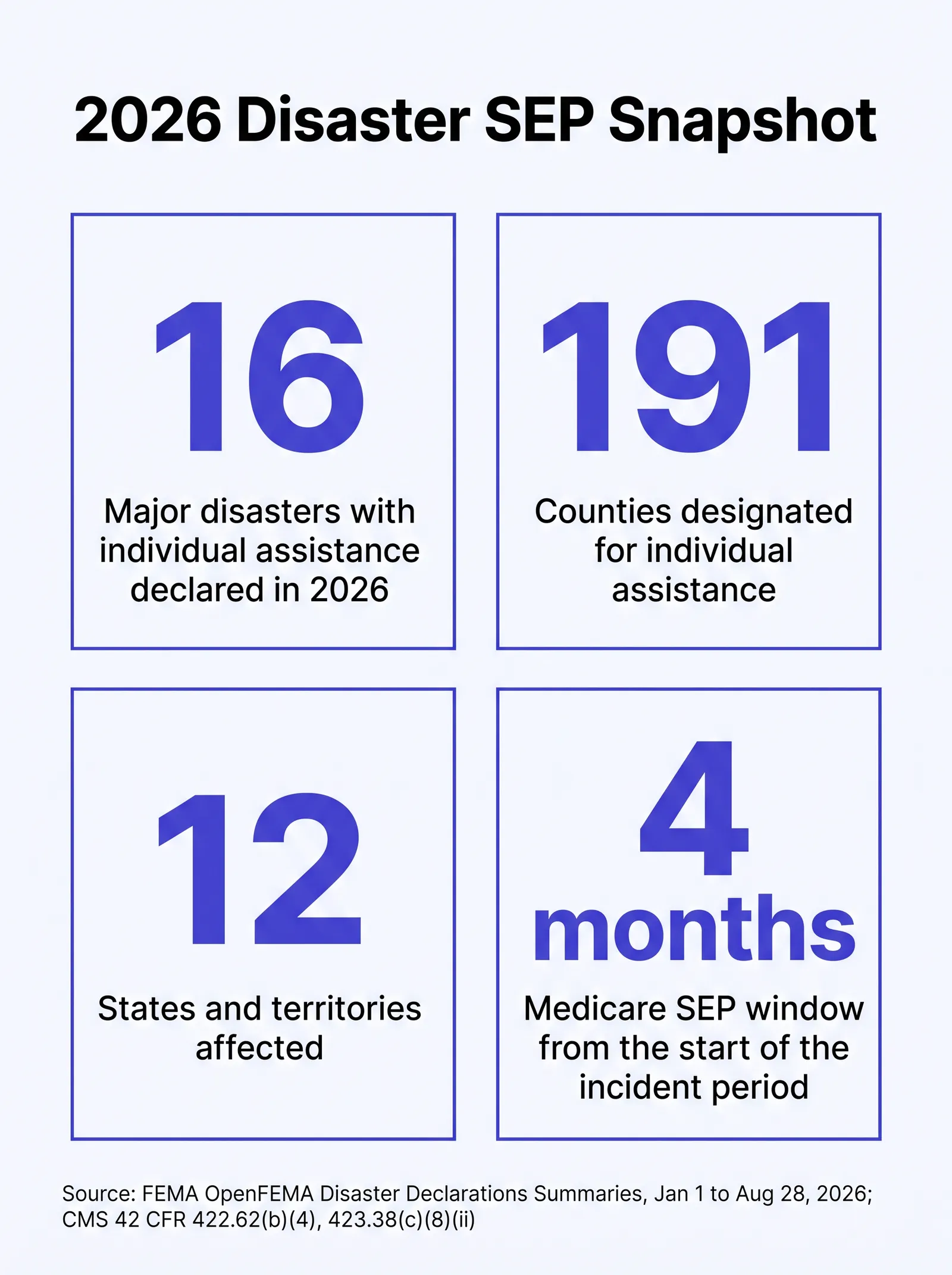
FEMA declared 16 major disasters with individual assistance in 2026 through August 28, across 191 counties in 12 states4. Each one can trigger a standing CMS rule that reopens Medicare and ACA enrollment for anyone who lives there and missed a window because of it12. Nothing notifies you. You have to check.
The client you don't know to call
On August 25, 2026, FEMA declared a major disaster for Indiana, DR-4933-IN, covering severe storms, straight-line winds, tornadoes, and flooding across 21 counties, with individual assistance designated for residents4. If you have even one client in those counties who missed a Medicare enrollment window this year, or who never finished an ACA application because the power was out and the internet was down, that client almost certainly qualifies for a Special Enrollment Period right now. Nobody sent you a list. Nothing in your CRM flagged it. The only way you'd know is if you happened to check FEMA's declarations page against your own book, county by county, this week.
Most agents don't do that, not because they don't care, but because nobody told them the rule exists in the first place, or because checking means opening a federal disaster feed and cross-referencing it against a spreadsheet by hand. So the SEP sits there, real and usable, until the four-month Medicare window or the 60-day ACA window closes, and the client either goes without coverage they were entitled to fix, or a competitor's agent, working the same disaster feed you weren't, calls first.
This isn't a rare edge case you'll hit once a career. FEMA declared 16 of these disasters with individual assistance in the first eight months of 2026 alone, an average of exactly one every 16 days4. If your book has clients in more than one state, the odds that at least one of them lives in a county that gets declared this year are not small. The gap isn't whether the SEP exists. It's whether anyone on your side is watching for it.
Part of why this stays invisible is structural. FEMA's job is disaster response, not insurance enrollment, so its declarations page is written for emergency managers and doesn't mention Medicare or the ACA anywhere on it. CMS's job is administering the SEP, not tracking which of your specific clients live in a newly declared county, so its guidance describes the rule in general terms and stops there. Neither agency owes you a personalized alert, and no third party sits in the middle connecting the two feeds for a working agent by default. The connection has to be made on your side, or it doesn't get made at all.
Why this SEP exists in the first place
CMS built this rule because enrollment deadlines don't pause for a hurricane. A Medicare beneficiary whose Aging and Disability Resource Center closed for two weeks, or an ACA applicant whose only internet access was the library that flooded, has a legitimate reason for missing a window that has nothing to do with indifference. The exceptional-circumstances SEP under 42 CFR 422.62(b)(4) and 423.38(c)(8)(ii) exists specifically for people who "were unable to and did not make an election during another valid election period as a result of the emergency or major disaster"1.
The trigger is narrow and specific on purpose. To qualify, a person has to reside, or have resided at the start of the incident period, in an area FEMA has declared an emergency or major disaster for, with affected counties designated as eligible for individual or public level assistance. They also need to have had another valid election period open at the time, and to not have used it1. The rule even extends to people who don't live in the affected area themselves but rely on a friend or family member there to help make healthcare decisions, which is a detail most agents have never heard, let alone used.
On the ACA side, CMS's current Special Enrollment Periods job aid for Navigators and Certified Application Counselors, version 3.0, dated March 2026, lists this under "Other Qualifying Changes": consumers who experience an exceptional circumstance, including a FEMA-declared national emergency or major disaster, that kept them from enrolling during OE or another SEP2. CMS clarified this policy back in 2018, and its 2026 guidance names wildfires, hurricanes, and flooding specifically as the kind of events that trigger it, alongside the COVID-19 public health emergency as a past example2.
Neither agency built this as a favor to insurance agents. CMS built it because the underlying enrollment deadlines are federal law and don't bend on their own, and a disaster SEP is the release valve that keeps a legitimate emergency from turning into a permanent coverage gap. The fact that it also happens to be an opportunity for an agent to reach a client who genuinely needs the call is incidental to why the rule exists, but it's exactly why it's worth knowing.
The detail most agents miss
The SEP isn't triggered by the weather event itself. It's triggered by FEMA's formal declaration and, specifically, by which counties get designated eligible for individual assistance within that declaration. A bad storm that never gets an IA designation doesn't open this SEP. A comparatively smaller event that does get one, does. You have to check the actual declaration, not just the news coverage of the storm.
How often this actually happens
FEMA's OpenFEMA Disaster Declarations Summaries data shows 16 major disaster declarations with individual assistance in 2026 through August 28, spread across February, April, May, June, and August4. Those 16 declarations designated 191 counties and parishes across 12 states and territories, including Indiana, West Virginia, the Northern Mariana Islands, Mississippi, Louisiana, Michigan, Wisconsin, Montana, Arizona, Hawaii, Washington, and Tennessee4.
Some months carried no new declarations of this type at all, and some carried four. That unevenness is exactly why a manual, once-in-a-while check misses events: the pattern isn't a steady drip you can check quarterly, it's a cluster during storm season and a gap in between, and the gap is precisely when an agent stops looking.
Every one of the 16 disasters counted here carries a full major disaster (DR) designation. It's worth checking the other declaration type too: FEMA can also issue a lighter emergency (EM) declaration, and CMS's own rule covers "an emergency or a major disaster" equally, not major disasters alone1. Querying the same OpenFEMA dataset for emergency declarations with individual assistance turns up zero for 2026 through August 28, so this year the full count and the major-disaster count happen to be the same number. That won't necessarily hold in a year with a different mix of events, which is one more reason to check the actual declaration type rather than assume.
| Declaration | State | Declared | Incident type | Counties (IA) |
|---|---|---|---|---|
| DR-4933 | Indiana | Aug. 25, 2026 | Flood, tornadoes, straight-line winds | 21 |
| DR-4932 | West Virginia | Aug. 3, 2026 | Flood, landslides, mudslides | 4 |
| DR-4931 | N. Mariana Islands | Aug. 3, 2026 | Typhoon (Super Typhoon Bavi) | 1 |
| DR-4930 | Mississippi | Aug. 3, 2026 | Tropical Storm Arthur | 4 |
| DR-4927 | Louisiana | Jun. 30, 2026 | Tropical Storm Arthur | 6 |
| DR-4925 | Michigan | Jun. 30, 2026 | Severe storms, tornadoes, flooding | 27 |
| DR-4923 | Wisconsin | Jun. 30, 2026 | Severe storms, tornadoes, flooding | 20 |
| DR-4922 | Mississippi | Jun. 30, 2026 | Severe storms, tornadoes, flooding | 5 |
| DR-4915 | Montana | May 29, 2026 | Severe winter storm, straight-line winds | 1 |
| DR-4914 | Montana | May 29, 2026 | Severe winter storm | 1 |
Medicare vs. ACA: two different clocks
Whichever book you write, don't assume the Medicare version and the ACA version of this SEP run the same way. They share a trigger, a FEMA declaration with individual or public assistance designated, but the clock, the access point, and what counts as proof differ enough that using the wrong one costs a client their window.
| Detail | Medicare Advantage / Part D | ACA Marketplace |
|---|---|---|
| Governing rule | 42 CFR 422.62(b)(4) and 423.38(c)(8)(ii) | "Other Qualifying Changes," exceptional circumstances SEP |
| Window length | From the start of the incident period through 4 full calendar months | From the end of the original enrollment window to up to 60 days after the disaster ends |
| Coverage start | First of the month after the request is submitted | First of the month after plan selection, or retroactive to when it would have started |
| Accessed through | 1-800-MEDICARE, the agent/broker, or the plan directly | Marketplace Call Center, 1-800-318-2596 |
| Related follow-on window | 2 months to also join an MA or Part D plan after using this SEP to enroll in Part A/B | Standard SEPV documentation rules apply for PY2026 |
| Source | CMS memo1; medicare.gov3 | CMS SEP Job Aid, March 20262 |
What a missed window actually costs
Put a number on the Medicare side first, because it's the most concrete. A client who missed the Annual Enrollment Period because their county flooded in October and who never finds out about the disaster SEP stays on whatever plan they had, or has no Part D coverage at all, until the next AEP rolls around, up to a full year later. If that plan doesn't cover a medication they actually need, or carries a higher premium than a plan they would have picked with a clear head, that gap isn't abstract. It's a real coverage cost that a two-minute phone call, made in time, would have fixed.
On the ACA side the cost is often sharper because it's binary: a household that missed Open Enrollment because of a disaster and doesn't use this SEP simply goes uninsured for the plan year, absent another qualifying event. That's a heavier miss in 2026 than in a normal year: KFF found that letting the enhanced premium tax credits expire at the end of 2025 raises average annual premium payments for subsidized marketplace enrollees by 114 percent, from $888 in 2025 to $1,904 in 20266, which makes a missed enrollment window a much more expensive gap to leave open than it would have been a year earlier.
There's a competitive cost too, and it's the one that should actually motivate you to build a habit around this. You are not the only agent who can see a FEMA declaration. If a competitor in your market runs even a rough manual check against a disaster feed and you don't, they get the call, not you, on a client who might have been in your book for years. The SEP doesn't belong to whichever agent originally wrote the policy. It belongs to whoever reaches the client first with the right information.
Put a rough range around the exposure at the agency level, not just the household level, and the reason to build a habit gets clearer. A single-office agency with a few hundred active households, spread across two or three counties, might have zero disaster-SEP-eligible clients in a quiet year and a double-digit number in a year like 2026, when 12 states and territories saw a qualifying declaration before September. An FMO or IMO with downline agents working a dozen states carries that same exposure multiplied by every county its book touches, which is exactly the kind of arithmetic that turns "check it sometimes" into "someone has to own this every week."
| Book profile | States in book | Rough odds of a 2026 match |
|---|---|---|
| Single-office, local book | 1 to 2 | Depends entirely on whether your state had a declaration; check directly rather than guess |
| Regional book | 3 to 5 | Meaningfully higher; several of 2026's declarations landed in adjoining states |
| FMO or IMO downline | 6+ | Near-certain that some part of the downline's book sits in a declared county |
None of that is a precise forecast, and it shouldn't be treated as one. It's the honest shape of the problem: the wider your book's geography, the less realistic it becomes to trust a memory of "did anything happen near my clients" instead of an actual check against FEMA's list.
A quick gut check
Pull up your book right now and count how many clients live in a county that's had a FEMA major disaster declaration with individual assistance this year. If you don't know off the top of your head, that's the actual problem this article is about, not a hypothetical one. The free Audit looks at what your site does with data like this. Run a free Audit.
When this SEP doesn't apply
It's worth being precise about the edges of this rule, because misusing it wastes a client's time and yours. The disaster SEP doesn't apply if the client already used a valid election period on time. It's only for someone who had a window open and, because of the emergency or major disaster, didn't use it. A client who calmly re-shopped during a normal AEP and picked a plan has nothing to reopen.
It also doesn't apply outside the declared area. CMS's rule is tied specifically to residence in a county FEMA designated as eligible for individual or public level assistance during the incident period1. A client one county over from a declared area, in a county that never got the individual assistance designation, doesn't qualify no matter how bad the weather looked on the news. This is the exact reason the county-level match matters more than a general sense that "there was a storm nearby."
And it isn't a plan-category loophole. On the ACA side, most disaster SEP enrollees who are already covered stay inside their existing plan's metal category the same way they would under most other SEP types, per CMS's plan category limitation rules, unless a separate qualifying change applies2. The SEP reopens the window to enroll or change, it doesn't hand someone an unrelated upgrade.
How to check your own book
You don't need software to start. You need a habit and a source. Here's the method, run by hand, that works for a single-office agency with no automation at all.
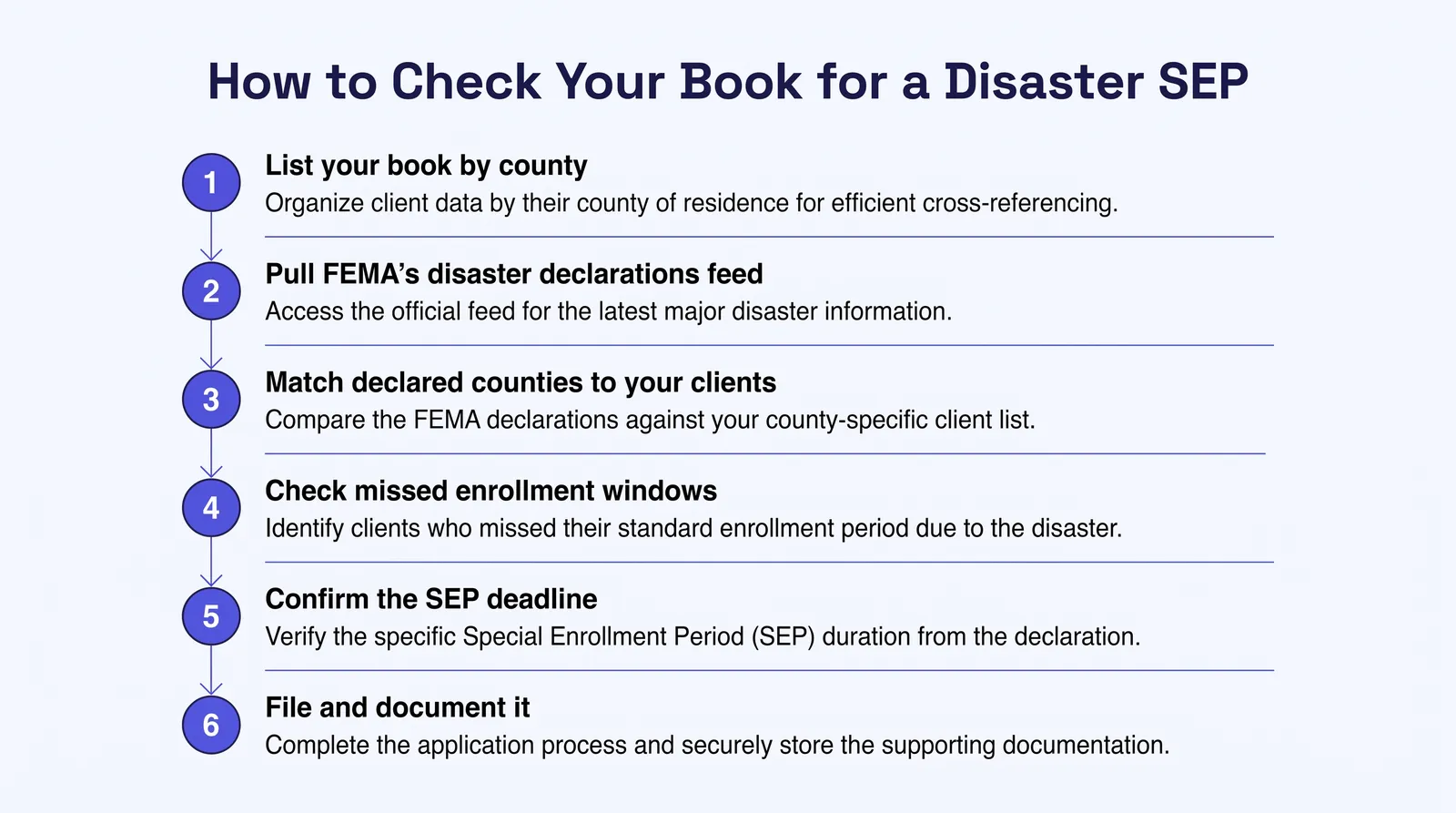
List your book by county, not just by zip code. FEMA declarations are issued and designated at the county level, so a client record that only has a zip code makes matching slower and more error-prone than one that has the county name attached.
Pull FEMA's disaster declarations feed weekly. The public page at fema.gov/disaster lists every current declaration, and FEMA also publishes the same data through its OpenFEMA API, which you can query for free without an account4. Filter for declaration type "DR" (major disaster) and check whether individual assistance was designated. Weekly is frequent enough to catch a new declaration inside the same month it happens, which matters more on the ACA side where the window is shorter.
Match the declared counties against your client list. This is the manual step that actually takes time without a tool, and it's also the step most agents skip once the initial excitement of "I should check this" wears off after a month or two.
For every match, check whether the client actually missed a valid election period. The SEP only applies if there was a window open that the disaster kept them from using. A client who already enrolled or made their change on time doesn't need it, and telling them they do wastes both your time and theirs.
Confirm which deadline applies before you call. Four full calendar months from the incident start for Medicare, up to 60 days after the disaster ends for ACA. Know which one you're working with before you're on the phone, not during the call.
File it, and keep your documentation. The next section covers exactly what to have ready.
The honest tradeoff
This entire method works with nothing but a spreadsheet, a weekly calendar reminder, and the free FEMA feed. Plenty of agents will read this and decide that's exactly what they'll do, and that's a completely reasonable choice for a small book. The place it breaks down is scale: once you're managing more than a couple hundred households across multiple counties, a manual weekly cross-reference starts eating hours you'd rather spend selling.
What CMS will actually ask for
Don't assume a disaster SEP is a rubber stamp. CMS's 2026 rules tightened verification generally: for plan year 2026 only, Exchanges on the federal platform must conduct pre-enrollment SEP verification for at least 75 percent of new enrollments across all SEP categories for consumers not already enrolled, a policy that CMS's own SEP Job Aid documents alongside an active piece of litigation, City of Columbus v. Kennedy, that has stayed some of the broader verification requirements while leaving loss-of-coverage verification in place2.
Practically, that means you should have three things ready before you help a client file a disaster SEP: proof they lived in the declared county at the start of the incident period, evidence of the enrollment window they missed and why (a plan renewal notice, a documented AEP deadline, a Marketplace application started but not finished), and the specific FEMA declaration number and incident period dates. CMS gives consumers 30 days after plan selection to resolve any SEP verification issue that gets generated, so having the documentation ready up front avoids a pended enrollment sitting unresolved while the client thinks they're covered2.
On the Medicare side, the process runs through 1-800-MEDICARE, the client's agent or broker, or the plan sponsor directly, and the beneficiary generally isn't required to prove they were personally affected beyond meeting the residency and missed-election criteria1. Document it anyway. A missed premium payment or a lapsed enrollment that gets questioned later is much easier to sort out with a dated note in the file than without one.
If a client's ACA application does generate an SEP verification issue, CMS's SVI resolution process runs on a fixed sequence: the client submits the application with an SEP attestation, picks a plan, and gets a 30-day timer; the Marketplace sends a pended plan selection notice, then a warning notice at the 20-day mark if documents are still outstanding2. Coach the client to upload documents rather than mail them, since CMS notes uploading is faster, and don't let the client assume they're covered just because they picked a plan. Until the SVI resolves, the enrollment sits pended and the client can't use the coverage yet.
Multi-county and multi-office agencies
Everything above assumes one person checking one book. That breaks down fast once an agency runs more than one office, or an FMO oversees a downline of agents who each carry their own book across different counties and, sometimes, different states. Nobody at the top of that structure has a single view of which counties the whole downline actually covers, so a FEMA declaration in a state where the FMO itself has no office can still be sitting on top of a dozen downline agents' clients without anyone at the FMO level ever seeing it.
The fix at that scale isn't "everyone checks their own book harder." It's a single county list, built once from wherever the downline's client data actually lives, checked against the FEMA feed in one place, with matches routed back down to whichever agent owns that client. That's a data and workflow problem before it's a compliance problem, and it's the same shape of problem as reactivating a dormant database or automating appointment reminders: real records, matched against a real external trigger, routed to the person who should act on it.
It also compounds the AEP timing pressure most agencies already feel. CMS's federal call recording rule change cut Medicare call retention from 10 years to 6, effective October 1, 2026, right before AEP opens, which is a separate compliance shift covered in our guide to that rule. A downline managing that change and a disaster-SEP check by hand, in the same six weeks, is exactly the kind of season where a manual process quietly stops happening.
How we automate the check instead
The manual method above works. It just doesn't scale, and scaling it by hand is exactly the kind of repetitive, data-matching work that shouldn't eat a producer's selling hours. That's the gap our custom builds close.
What we build for an agency that wants this automated is specific to that agency's actual book and CRM, not a generic add-on5. You describe the workflow, we build it on your accounts and your domain, and you own it when it's done5. For this particular problem, that typically means a workflow that pulls FEMA's disaster declarations on a schedule, matches the declared counties against your client list by county, and flags the matches for you to review and call, so the FEMA-checking step stops depending on someone remembering to do it every week.
It's the same underlying idea behind the database reactivation and appointment automation work we build for agencies generally: real data, matched against your real book, surfaced as a specific action instead of a general reminder to "check your list." Ambrose, our AI platform, keeps context per contact across calls, texts, and notes, which is what lets an automation like this attach the right client history to a flagged match instead of just handing you a bare name and county.
Concretely, that means the workflow pulls the FEMA declarations feed on a schedule you set, cross-checks the newly designated counties against your book's county field, and produces a short, specific list: this client, this county, this declaration, this deadline. It doesn't file anything or contact the client on its own. It hands you exactly what you need to make the call yourself, which keeps the actual enrollment decision, and the relationship, where it belongs.
This is a custom build, scoped on a call
We don't sell this as an off-the-shelf product with a fixed price, because the shape of it depends on your CRM, your book size, and how you already track county-level client data. If a manual weekly FEMA check isn't realistic for your book anymore, that's worth a conversation. Book a call.
What actually changes
Not a promised enrollment count or a guaranteed number of saved clients, because nobody can honestly promise you that. What changes is concrete and specific to this one problem.
16
Major disasters with individual assistance declared in 2026 YTD
4 mo.
Medicare SEP window from the start of the incident period
60 days
ACA SEP window after the emergency or disaster ends
1
Weekly habit that closes the whole gap
You stop finding out about a disaster SEP by accident, or not at all. Clients in a declared county who missed a window get a call from you before the window closes, not a letter from Medicare.gov they never read. And you're the agent in your market who actually knew the rule existed, which is a smaller advantage than a lower premium but a real one, in a business where most competitive edges come down to who called first.
Questions agents ask
What is a disaster Special Enrollment Period?
It's a standing CMS and Marketplace rule that gives people extra time to enroll in or change Medicare or ACA coverage if a FEMA-declared emergency or major disaster kept them from doing it during their normal window. For Medicare it runs from the start of the incident period through four full calendar months. For the ACA Marketplace it runs from the end of the missed enrollment window to up to 60 days after the disaster ends.
How long does a Medicare disaster SEP last?
The SEP itself is available from the start of the FEMA-designated incident period through four full calendar months after that start date, under 42 CFR 422.62(b)(4) and 423.38(c)(8)(ii). Separately, medicare.gov notes that once someone uses an exceptional-situation SEP to sign up for Part A or Part B, they then get two months to also join a Medicare Advantage or Part D plan.
How long does an ACA Marketplace disaster SEP last?
CMS's Special Enrollment Periods job aid, current as of March 2026, says eligible consumers may apply for this SEP from the end of their original enrollment window up to 60 days after the emergency or disaster ends, and coverage can be made retroactive to when it would have started if the disaster hadn't interfered.
Does the disaster SEP apply automatically, or does the client have to request it?
It's not automatic. A consumer or their agent has to recognize the FEMA declaration applies, contact the Marketplace Call Center or the plan directly, and make the election within the window. CMS's own guidance is explicit that eligibility depends on residing in a county FEMA designated for individual or public assistance during the incident period, and on having missed another valid election period because of it.
What counts as a FEMA-declared disaster for SEP purposes?
A federal emergency or major disaster declaration where FEMA designates affected counties as eligible to apply for individual or public level assistance. FEMA published 16 such major disaster declarations with individual assistance in 2026 through August 28, covering 191 counties and parishes across 12 states and territories, per FEMA's OpenFEMA Disaster Declarations Summaries data.
Can an agent enroll someone using a disaster SEP without extra paperwork?
Sometimes, but plan for verification. CMS's 2026 Marketplace rules require Exchanges on the federal platform to verify eligibility for at least 75 percent of new SEP enrollments this plan year, so bring documentation of the client's address in the declared county and evidence of the missed election, even when the SEP category itself doesn't always require it up front.
Does Strategic AI Architects file the SEP on our behalf?
No. We don't touch enrollment, and we're not a broker. What we build is the automation that checks your book against FEMA's live data and flags who to call, so the filing itself stays exactly where it belongs, with you and the carrier or Marketplace.
Sources
- Centers for Medicare & Medicaid Services, Medicare Enrollment & Appeals Group. "Special Enrollment Period (SEP) for Individuals Affected by a FEMA-Declared Weather Related Emergency or Other Major Disaster," citing 42 CFR 422.62(b)(4) and 423.38(c)(8)(ii). cms.gov.
- Centers for Medicare & Medicaid Services. "Special Enrollment Periods," SEP Job Aid for Navigators and Certified Application Counselors, Version 3.0, March 2026. cms.gov.
- Medicare.gov. "Special Enrollment Periods," current page, exceptional-situation SEP and the 2-month follow-on window to join a Medicare Advantage or Part D plan. medicare.gov.
- Federal Emergency Management Agency. OpenFEMA Disaster Declarations Summaries v2 API, major disaster (DR) declarations with individual assistance designated, queried August 28, 2026. fema.gov.
- Strategic AI Architects. "Your Ambrose and AI Expert," custom build service page. strategicaiarchitects.com.
- KFF. "ACA Marketplace Premium Payments Would More than Double on Average Next Year if Enhanced Premium Tax Credits Expire," September 30, 2025. kff.org.
Talk it through
Want a second pair of eyes on it?
Free 30 minutes. Bring what you found, or bring nothing and we will look together at how AI engines read your site and which fixes move first.
See where your own site stands before AEP
Run the free Audit, a live AEO Audit plus a HIPAA tracking scan of your site, in under a minute.