Playbook
Why ChatGPT Never Names Your Agency for Annuities
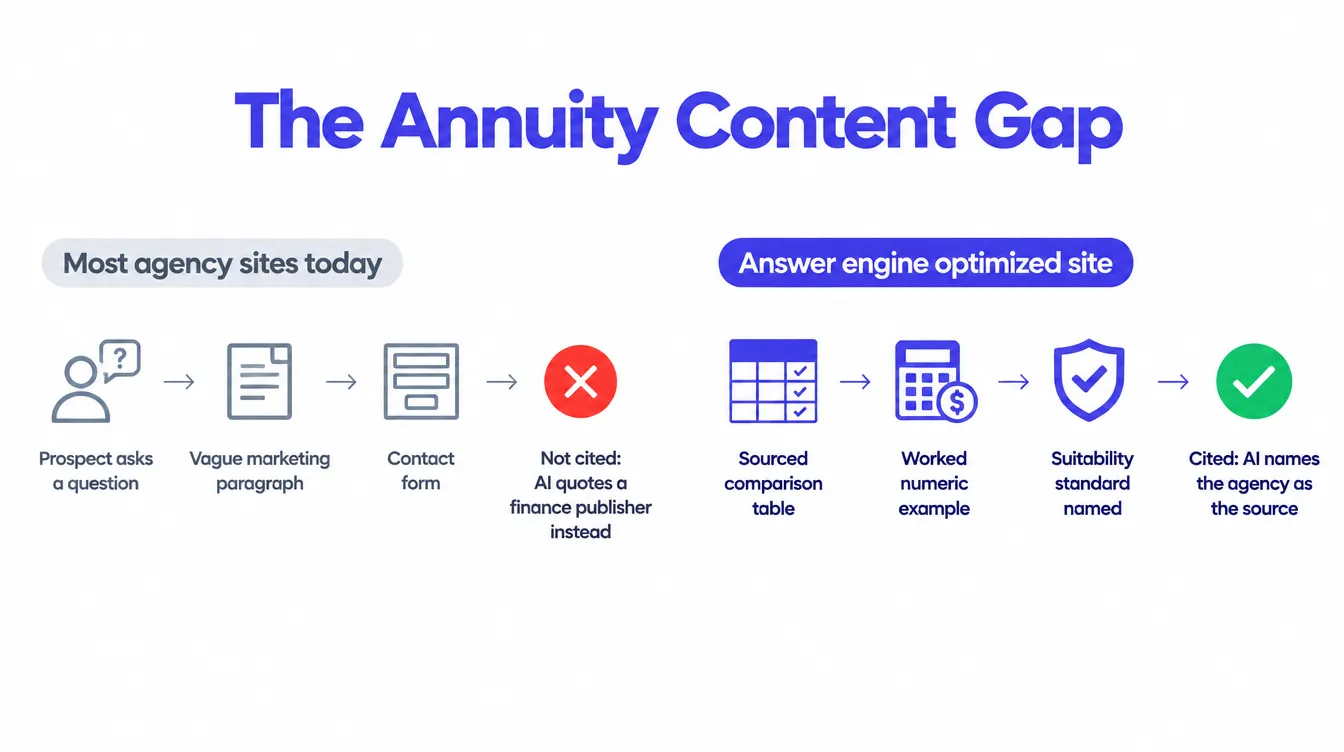
The annuity market just posted a record year. Most Americans still can't define the product they'd be buying, and a growing share of them are asking an AI assistant instead of a person. This is what answer engine optimization for an annuity practice looks like, and almost no independent agency site has built it yet.


18 min read
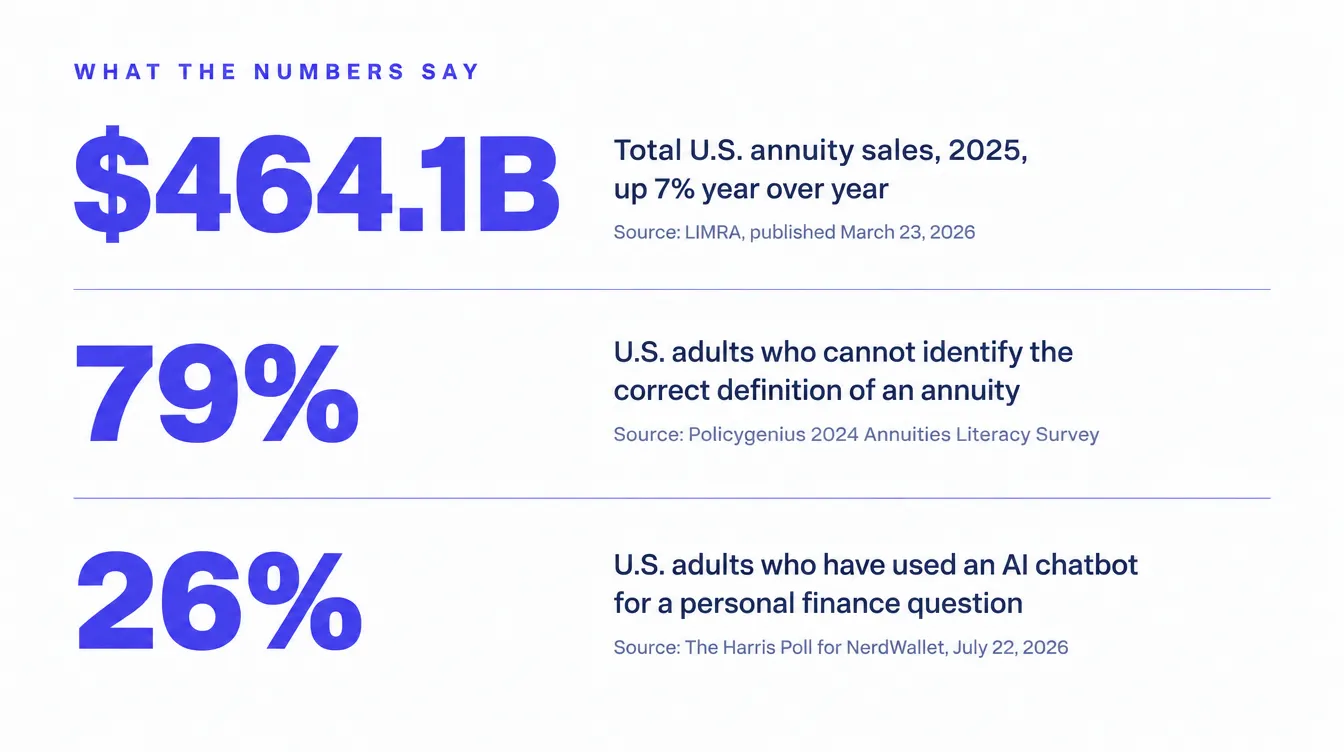
U.S. annuity sales hit a record $464.1 billion in 2025, up 7% year over year, per LIMRA's final industry survey1, and the second quarter of 2026 alone brought in $123.9 billion, the eleventh straight quarter above $100 billion2. At the same time, a 2024 Policygenius survey of 2,353 American adults found 79% could not identify the correct definition of an annuity, and among adults 55 and older, the group actually buying them, only one in four could3. Those buyers are starting to ask AI assistants instead of agents: a Harris Poll for NerdWallet found 26% of U.S. adults have used an AI chatbot for a personal finance question4. Search the term on any independent agency site and you'll mostly find a paragraph of adjectives and a contact form. That's the gap this guide is about closing.
What answer engine optimization means for an annuity practice
Answer engine optimization, AEO, is the work of structuring a website so an AI assistant can find a direct answer inside it and quote your agency as the source, instead of quoting a finance publisher, a carrier's own marketing page, or nothing specific at all. It is not a separate discipline from search engine optimization so much as the next layer on top of it. Google's own documentation is explicit that AI Overviews and AI Mode require no special markup beyond ordinary Search fundamentals: a page has to be indexed and eligible to show a snippet, and the rest is the same crawlability, speed, and content quality work that has always mattered5. What changes is what happens after the page qualifies. A ranked page gets a click. A cited page gets quoted, by name, inside an answer the reader never has to click through to see.
Annuities are a specific, useful test case for this, because the vertical has almost no independent-agent content competing for the citation. Type a Medicare or ACA question into an AI assistant and you'll usually get an answer drawn from a mix of agency sites, carrier pages, and CMS.gov. Type an annuity question in and the sources skew almost entirely toward large finance publishers, comparison marketplaces, and a handful of insurer marketing pages. The independent agent, the person actually licensed to sell the product and answer for it, is largely absent from the answer. That absence is the opening.
Before you keep reading
If you want to know whether your own site currently has anything an AI assistant could quote on annuities, the free Audit reads it for AI-citation readiness in about thirty seconds. strategicaiarchitects.com/audit
A record market with almost no independent content
The scale of the opportunity is not a guess. LIMRA's U.S. Individual Annuity Sales Survey, representing 93% of the total U.S. annuity market, put final 2025 total sales at $464.1 billion, a 7% increase over 20241. That pace carried into 2026: total sales reached a record $123.9 billion in the second quarter alone, up 4% year over year and marking the eleventh consecutive quarter above the $100 billion mark, with first-half 2026 sales of $231.3 billion running 2% ahead of the first half of 20252. This is not a niche corner of the insurance business. It is one of the largest, fastest-growing product categories an independent agent can sell, and it is compounding while most agency websites treat it as an afterthought page under a life insurance tab.
Compare that to the content. Run a search for almost any specific annuity question, "how does a guaranteed lifetime withdrawal benefit work," "what's a reasonable surrender charge schedule," "fixed indexed annuity versus RILA," and the pages that show up belong to Annuity.org, Kiplinger, AARP, Policygenius, or an insurer's own product brochure rewritten as an article. Those are not bad sources, several are careful and well sourced, but none of them is a licensed agent in your state who can actually sell and service the policy the reader is asking about. When an AI assistant answers that question, it has nowhere else to point, because the independent agent side of the internet mostly didn't show up to the question in the first place.
Buyers are already confused, and already looking elsewhere
The absence of agent content would matter less if annuity buyers already understood the product and just needed a quote. They don't, and the surveys on this are unusually direct about it. Policygenius fielded its Annuities Literacy Survey online from April 25 through April 29, 2024, with 2,353 American adults, and found that roughly four out of five, 79%, could not correctly identify what an annuity is3. Narrow that to adults 55 and older, the age band where most annuity buying actually happens, and only about one in four identified the correct definition3. Beyond the definition itself, 35% of respondents said they don't know when buying an annuity could benefit them, and only 5% could both name the correct definition and identify a sensible age to consider one3.
A separate survey, Nationwide's Current Annuity Buyer Survey of 300 respondents published June 12, 2024, asked people who had actually bought or were considering an annuity how the online research process felt. More than two-thirds, 69%, said the annuity information available online tends to be very basic and lacking detail, and 65% said annuities are harder to research online than other investment topics6. The same survey found 84% still rely on a financial professional as their primary source, but 48% also turn to websites, blogs, and online articles6. Read those two numbers together and the picture is plain: nearly half of buyers are already reading the open web for annuity answers, and two-thirds of them find what's there unsatisfying. That is close to a textbook description of the gap an AI assistant is built to fill, by synthesizing whatever thin content exists into one answer, and naming whichever source it trusts most.
The three question families annuity shoppers bring to an AI
Annuity questions cluster into three families, and each wants a different kind of page. None of them require recommending a specific product to a specific person, which matters for the compliance question later in this guide.
| Family | Typical question | What makes the page quotable |
|---|---|---|
| Cost and mechanics (what does it actually do) | "What's a surrender charge?" / "How does a guaranteed lifetime withdrawal benefit work?" | A named definition, a worked example with real numbers on a hypothetical contract, and the tradeoff stated plainly, what the guarantee actually promises and what triggers a penalty. Vague reassurance is unquotable; a worked example with numbers is citable indefinitely. |
| Comparison (which type fits) | "Fixed indexed annuity vs. variable annuity" / "Is a RILA the same as a fixed indexed annuity?" | A direct comparison table naming all six major product types by their actual mechanics, not marketing language, current sales figures for context, and the honest tradeoff each one carries. Assistants lift structured comparisons far more readily than prose paragraphs. |
| Suitability and process (is this for me, and is it safe) | "Is my agent required to act in my best interest?" / "What's the free look period on an annuity?" | A direct answer naming the actual regulation, the NAIC's Suitability in Annuity Transactions Model Regulation and its best interest standard, plus your state's specific free look period. Citing the regulation by name, rather than describing it vaguely, is exactly the citation profile assistants reward. |
The pattern across all three families is the same one that decides citability in every vertical: the answer has to be inside the answer. A page that raises the question and then asks the reader to call for the real information gives an assistant nothing to lift. A page that states the mechanic, the number, and the source gets quoted, and the reader still calls, because a worked example on a page is rarely the same as a personalized recommendation for their actual situation.
Why annuity content is harder to publish than a Medicare page
If the opportunity is this visible, it's worth asking why agency sites haven't already filled it. Two structural reasons, and both are fixable once you see them clearly.
The first is genuine product complexity. Medicare marketing, for all its regulatory weight, revolves around a fairly small number of plan mechanics that repeat every plan year: star ratings, enrollment periods, formularies, out-of-pocket caps. Annuities span six meaningfully different product structures, fixed rate deferred, fixed indexed, registered index-linked, traditional variable, single premium immediate, and deferred income, each with its own payout mechanics, its own risk profile, and its own vocabulary. Writing one honest, accurate page about "annuities" in general is close to writing one honest page about "cars" that's supposed to cover a sedan, a pickup, and a motorcycle equally well. Most agencies look at that complexity and either skip the content or write something vague enough to avoid the work of getting each product type right.
The complexity is real even within a single product type, not just across the six. Take the cap rate on a fixed indexed annuity, one of the single most-asked questions in the category. A cap rate limits how much index gain a contract credits in a given period even when the index itself rises further, and carriers can reset that cap annually, quarterly, or even monthly depending on the contract. A prospect who read "10% cap" on a brochure two years ago and assumes that number still applies is one of the most common and most fixable misunderstandings in the whole product line, and it's exactly the kind of specific, answerable question an AI assistant gets asked constantly and almost no agency site addresses directly, with a stated review date, rather than leaving the old number sitting on an unreviewed page.
The second reason is compliance caution, and it's the more interesting one, because it's mostly a misreading of the actual rule. The NAIC's Suitability in Annuity Transactions Model Regulation, revised in February 2020 to add a best interest standard and adopted in some form by 48 states7, requires that a recommendation of a specific annuity to a specific consumer be made with care, full disclosure, no conflicting financial interest ahead of the consumer's, and documentation of the reasoning7. That's a real and important rule, and it's scoped to the moment of recommendation. It does not say an agency can't publish a plain-language explainer of how a surrender charge schedule works, or a comparison table of product types, on a public web page that isn't recommending anything to any specific person. Agencies that treat the whole topic as too hot to write about are applying a rule written for a specific transaction to content that never triggers it.
What a citable annuity page actually looks like
Take the guaranteed lifetime withdrawal benefit as a worked example, because it's one of the most-searched and most-misunderstood annuity features. A non-citable version of this page reads like marketing copy: "our income riders provide peace of mind and guaranteed income for life." There's no fact in that sentence an assistant could lift, because there's no fact in it, period.
A citable version states the mechanic directly. A guaranteed lifetime withdrawal benefit, or GLWB, guarantees a stream of withdrawals for as long as the annuitant lives, calculated as a percentage of a separate "benefit base" that grows on a schedule set by the contract, even if the actual account value underlying the contract runs to zero from market performance or prior withdrawals. The benefit base is not the same as the cash value you could withdraw in a lump sum, and withdrawing more than the guaranteed percentage in a given year can reduce or void the guarantee going forward. State that mechanic once, in one place, with a simple worked number ("a $6 withdrawal in this hypothetical example is guaranteed against a benefit base, regardless of the account's actual market value"), and you've written something an assistant can quote verbatim to answer the exact question a confused buyer typed in.
The structural rules that make a page like this work are consistent across every vertical this site covers: one question, one URL, the direct answer inside the first two sentences of the section, a named source for every regulatory or numeric claim, and a visible review date so a reader and a machine can both tell whether "this year's rate cap" is still this year's.
Surrender charges follow the same pattern and reward the same treatment. A non-citable version says "surrender charges may apply during the early years of the contract." A citable version runs a hypothetical: on a hypothetical contract with a seven-year surrender schedule starting at 7% and stepping down one point a year, a $100,000 withdrawal beyond the contract's penalty-free amount in year two would carry roughly a $6,000 charge, falling to about $1,000 by year six and to zero once the schedule ends in year eight. None of those numbers describe a real product on offer, and the page should say so plainly, but the shape of the example, a declining percentage against a stated term, is exactly what a reader is trying to picture when they ask an assistant what a surrender charge actually costs. A hypothetical worked correctly is more useful, and more quotable, than a true statement with no numbers in it at all.
The six annuity types agency sites rarely explain
Most of the content gap traces back to one missing page: a plain comparison of the six major annuity product types, with real sales data instead of adjectives. Here is that comparison, built from LIMRA's second quarter 2026 U.S. Individual Annuity Sales Survey, which represents 84% of the total U.S. annuity market2.
| Product type | Q2 2026 sales | YoY change | What it actually does |
|---|---|---|---|
| Fixed rate deferred (FRD) | $44.7B | -2% | Pays a fixed, stated interest rate for a set term, closest in mechanics to a bank CD |
| Fixed indexed (FIA) | $30.7B | -7% | Credits interest based on an index's performance, subject to a cap or participation rate, with principal protected from market loss |
| Registered index-linked (RILA) | $23.3B | +22% | Tracks an index with more upside than a FIA but real downside exposure within a stated buffer or floor |
| Traditional variable (VA) | $17.9B | +25% | Invests in sub-accounts similar to mutual funds; value moves directly with market performance, full downside included |
| Single premium immediate (SPIA) | $4.0B | +12% | Converts a lump sum into income payments that start almost immediately and continue for life or a set period |
| Deferred income (DIA) | $1.3B | +5% | Same as a SPIA, but income payments start at a future date the buyer selects, often at retirement |
Publish something close to this table, with your own state's specifics and your own carriers' actual product names layered on top, and you've built the single page most likely to answer the comparison question an assistant sees most often in this vertical. It also happens to be the page most agency sites are missing entirely, which is exactly why it's worth building first.
$464.1B
Total U.S. annuity sales, 2025, up 7% year over year1
79%
U.S. adults who can't identify the correct definition of an annuity3
69%
Annuity buyers who say online info is too basic and lacks detail6
48
States that adopted the NAIC's annuity best interest standard7
Turning the suitability rule into a trust signal instead of a reason to say nothing
Most agencies treat the NAIC's best interest standard as a reason to write less. Flip it, and it becomes one of the strongest trust signals a page can carry, precisely the kind of signal answer engines are built to reward. The three obligations the model regulation actually imposes on a recommendation, care, disclosure, and avoiding a conflicting financial interest, read almost like a checklist for what an honest, quotable page already does7.
Naming the standard explicitly on your site, in plain language, does two things at once. It tells a human reader that your agency operates under a documented legal duty to put their interest first, not just a marketing promise to that effect. And it gives an AI assistant a named, verifiable regulatory anchor to attach to your page when it answers a question about whether an annuity recommendation can be trusted, which is a different and stronger citation than a page that just asserts trustworthiness with no authority behind it. Compliance language most agencies bury in a disclosure footer is, written differently, some of the most citable material on the whole site.
Where the line actually sits
Explaining the best interest standard, in general, to every reader, is publishing. Telling one specific prospect which annuity to buy, in writing, without documenting the basis, is a recommendation, and that's the moment the NAIC rule's disclosure and documentation requirements attach. Keep public content in the first category and the second category is a conversation you have with a licensed professional in the room, the same as it always was.
What skipping this actually costs
Two figures, from two different places, describe the size of what's being left on the table. The first is the market itself: a $464.1 billion category growing 7% a year, with the first half of 2026 already running ahead of the first half of 20251,2. Every dollar of that flows through some distribution channel, and independent agents are a real part of it, not a rounding error. A category this size does not stay uncontested by AI-search content forever. The agencies publishing real annuity content now are building a lead that gets harder to close the longer it's ignored.
The second figure is about where the questions are already going. The Harris Poll survey for NerdWallet, published July 22, 2026, found 26% of the more than 2,000 U.S. adults surveyed have used an AI chatbot for a personal finance question, and 49% of that group had asked one in just the past week4. That's a general personal-finance number, not an annuity-specific one, and it's worth stating that limitation plainly rather than stretching it. What it establishes honestly is direction: a real and growing share of the exact audience asking "should I consider an annuity" is asking a chatbot first, and every month that passes without your agency's content in the answer is a month a competitor's content, or no independent agent's content at all, gets the citation instead.
There's a compounding piece to this too, separate from the raw dollar figures. Because so few independent agency sites currently publish real annuity content, an assistant answering an annuity question today has a genuinely thin field to choose from among licensed-agent sources. A handful of well-built pages published now are competing against near silence, not against a decade of entrenched competitor content the way a Medicare or a mortgage page would be. That window closes as more agencies catch up to what this guide describes. Publishing first in a near-empty field is a materially different position than publishing tenth in a crowded one, and right now this vertical is closer to the first case than almost any other line an agency sells.
Who this fits, and who it doesn't
This build makes the most sense for an agency that already writes real annuity business, or wants to, as part of a diversified Medicare, ACA, or life book, not as a side mention on a homepage. If annuities are a meaningful line for you, the content gap described in this guide is close to the largest single opportunity available on your site right now, precisely because so little independent-agent content exists to compete with.
It fits less well, or not at all, for an agency that doesn't hold an appointment to sell annuities and has no intention of adding one. Publishing detailed annuity content you can't service creates a page that answers a question and then has nowhere useful to send the reader, which is a worse outcome than not publishing it. And for every agency, regardless of how deep the annuity book runs, none of this content substitutes for the actual suitability review a licensed producer performs before a specific recommendation. The pages described here answer the question a prospect asks before that conversation happens. They are not the conversation itself, and they shouldn't be written as if they were.
What to publish in the next 30 days
Start with the three pages that carry the most volume and the least compliance risk, since none of them recommend a product to a specific person.
The six-type comparison page first. Use the table above as a starting structure, replace it with your own state specifics and the actual products your carriers offer, and keep the numbers current with a visible review date. This is the single page most likely to be missing from your site entirely.
A guaranteed lifetime withdrawal benefit explainer second. Use the worked-example format from earlier in this guide: state the mechanic, run one hypothetical number, and name what the guarantee does and doesn't cover.
A surrender charge and free look period page third. State your state's actual free look period length, a hypothetical surrender charge schedule with real percentages declining over a real number of years, and what triggers a charge versus what doesn't.
For each one: one question per URL, the direct answer inside the first two sentences, a named source for every number, and the suitability standard named plainly rather than buried in a footer. Then check that AI crawlers aren't blocked on your robots.txt, and run the pages through the free Audit to see how they score for AI-citation readiness.
How we build this
Every site we build ships the same answer-page specification described in this guide as the default, not an upsell: one question per URL, sourced figures with the date attached, the schema stack that matches what's on the page, and a sitemap and llms.txt that update themselves the moment a new page publishes. Digital Foundation runs $247 a month for a complete, AEO-optimized site with Google Business Profile management and an AI chat widget, $497 a month for that plus a new blog post and location page every week and a 24/7 AI receptionist, and $997 a month for a blog post nearly every business day8. All three tiers include a 14-day free trial and month-to-month billing8.
For an agency running a large annuity book alongside Medicare, ACA, or life business, a custom build scoped on a call can also wire a real premium and payout calculator into the site, something visitors and AI agents alike can query directly instead of reading a static example9. What matters most, regardless of which tier fits, is that the content described in this guide gets built at all. Almost none of your competitors have done it yet.
Questions agents ask about annuity AEO
What is answer engine optimization for an annuity agency, in plain terms?
It's structuring the annuity pages on your own website so ChatGPT, Perplexity, and Google's AI Overviews can lift a direct answer from them and name your agency as the source. The mechanism is the same as classic SEO in one way, the content has to exist and be indexed, and different in another: the target isn't a ranking position, it's being the passage an assistant quotes when someone asks about surrender charges, guaranteed income, or which annuity fits their situation.
Are annuity buyers really asking AI chatbots about this, or is that overstated?
A Harris Poll survey for NerdWallet, published July 22, 2026, found 26% of more than 2,000 U.S. adults surveyed have used an AI chatbot for a personal finance question, and of those, 49% had asked one within the past week. That's a general personal-finance figure, not an annuity-specific one, and we say so. But it puts a real number on a behavior that didn't have one two years ago, and annuities, a product most people already find confusing, are a natural category for that kind of question.
Doesn't the suitability rule make it risky to publish annuity content?
It makes it risky to publish a recommendation for a specific person. It doesn't make it risky to publish process content: what a surrender charge schedule is, how a guaranteed lifetime withdrawal benefit works, what free look period means in your state, how the six major product types differ. None of that is a recommendation. The NAIC's Suitability in Annuity Transactions Model Regulation, adopted in some form by 48 states, governs the point where an agent recommends a specific product to a specific consumer. A page explaining mechanics to everyone who reads it isn't that moment.
What's the fastest annuity content to publish first?
Three pages, in this order: a plain comparison of the six product types with real numbers instead of adjectives, a surrender-charge explainer with a worked example, and a guaranteed lifetime withdrawal benefit page that states what it actually guarantees and what it doesn't. None of the three requires recommending anything to anyone. All three answer a question we can confirm real buyers are confused about.
Do I need a separate page for fixed, indexed, and variable annuities?
Yes, eventually, and not on day one. Assistants quote pages, not sections of a long page, so a single URL trying to cover fixed rate deferred, fixed indexed, registered index-linked, variable, and both immediate and deferred income annuities in one scroll is quotable for none of them specifically. Start with one comparison page that names all six and links out, then split the two or three your book actually sells into their own pages once the comparison page is live.
Does HIPAA apply to annuity content the way it does to Medicare or ACA content?
No, and that's one of the few genuine advantages of this vertical. An annuity application collects financial and identity information, not protected health information, so the HIPAA business associate analysis that dominates Medicare and ACA marketing mostly doesn't apply here. State financial-privacy and data-security rules, including the NAIC's own Insurance Data Security Model Law, still govern how you handle what a prospect submits, so this isn't a compliance-free zone. It's a different compliance zone, and a narrower one.
How is this different from the other answer engine optimization guides on this site?
The mechanics are the same ones covered in the Medicare and health, life, and commercial guides: answer-first pages, named sources, structured data, a real author. What's different is the gap. Life and Medicare content is common enough that competing well requires real depth. Annuity content is close to absent on independent agency sites specifically, which means the bar to become the page an assistant quotes is lower right now than in almost any other line this site covers.
Sources
- LIMRA. "LIMRA: Final U.S. Retail Annuity Sales Set New Sales High, Totaling $464.1 Billion in 2025," published March 23, 2026: total U.S. annuity sales increased 7% to $464.1 billion in 2025, per LIMRA's U.S. Individual Annuity Sales Survey, representing 93% of the total U.S. annuity market. Verified live 2026-09-25. limra.com.
- LIMRA. "LIMRA: U.S. Annuity Sales Set New Quarterly Record, Totaling $123.9 Billion in the Second Quarter of 2026," published July 27, 2026: total sales up 4% year over year to $123.9 billion, the 11th consecutive $100 billion-plus quarter; first-half 2026 sales of $231.3 billion, up 2% versus first-half 2025; product-level Q2 2026 breakdown (RILA $23.3B, +22%; fixed rate deferred $44.7B, -2%; fixed indexed $30.7B, -7%; traditional variable $17.9B, +25%; single premium immediate $4.0B, +12%; deferred income $1.3B, +5%); survey represents 84% of the total U.S. annuity market. Verified live 2026-09-25. limra.com.
- Policygenius. "2024 Annuities Literacy Survey," fielded online April 25 to April 29, 2024, 2,353 U.S. adults, published July 16, 2024: 79% of respondents could not identify the correct definition of an annuity; among adults 55 and older, roughly one in four (25%) identified it correctly; 35% didn't know when buying an annuity could benefit them; only 5% both identified the correct definition and a sensible age to consider one. Verified live 2026-09-25. policygenius.com.
- The Harris Poll for NerdWallet. Personal finance and AI chatbot survey, more than 2,000 U.S. adults, published July 22, 2026: 26% of respondents have used an AI chatbot for a personal finance question; of that group, 49% had asked a money question within the past week. Verified live 2026-09-25. nerdwallet.com.
- Google Search Central. "AI features and your website": no additional or special requirements exist to appear in AI Overviews or AI Mode beyond a page being indexed and eligible to display with a snippet under standard Search fundamentals. Verified live 2026-09-25. developers.google.com.
- Nationwide. "Survey: Financial professionals key to positive annuity purchase experience," Current Annuity Buyer Survey, 300 respondents, published June 12, 2024: 69% of investors said annuity information available online tends to be very basic and lacking detail; 65% said annuities are harder to research online than other investment topics; 84% rely primarily on financial professionals; 48% also use websites, blogs, and online articles. Verified live 2026-09-25. news.nationwide.com.
- National Association of Insurance Commissioners (NAIC). "Annuity Suitability and Best Interest Standard": Suitability in Annuity Transactions Model Regulation (#275), revised February 2020 to incorporate a best interest standard requiring care, disclosure, and avoidance of a conflicting financial interest in annuity recommendations; adopted in some form by 48 states. Verified live 2026-09-25. content.naic.org.
- Strategic AI Architects. Digital Foundation service page: Starter $247/month (complete AEO-optimized website, Google Business Profile management, AI chat widget); Pro $497/month (adds one blog post and one location page weekly, 24/7 AI receptionist); Scale $997/month (adds a blog post nearly every business day and two location pages weekly); all tiers include a 14-day free trial and month-to-month billing. Verified live 2026-09-25. strategicaiarchitects.com/digital-foundation.
- Strategic AI Architects. AI Expert / custom build service page: custom AI agents and calculators wired to live data, scoped and priced on a call, built on the agency's own accounts and domain. Verified live 2026-09-25. strategicaiarchitects.com/ai-expert.
Talk it through
Want a second pair of eyes on it?
Free 30 minutes. Bring what you found, or bring nothing and we will look together at how AI engines read your site and which fixes move first.
See if your annuity content gives AI anything to quote
Run the free Audit, a live AEO Audit plus a HIPAA tracking scan of your site, in under a minute.
Related reading: AEO for Medicare and health agencies · AEO for life insurance agencies · AEO for commercial insurance agencies